Buy Research Peptides Online: A Guide to Quality, COAs, Testing and Laboratory Research
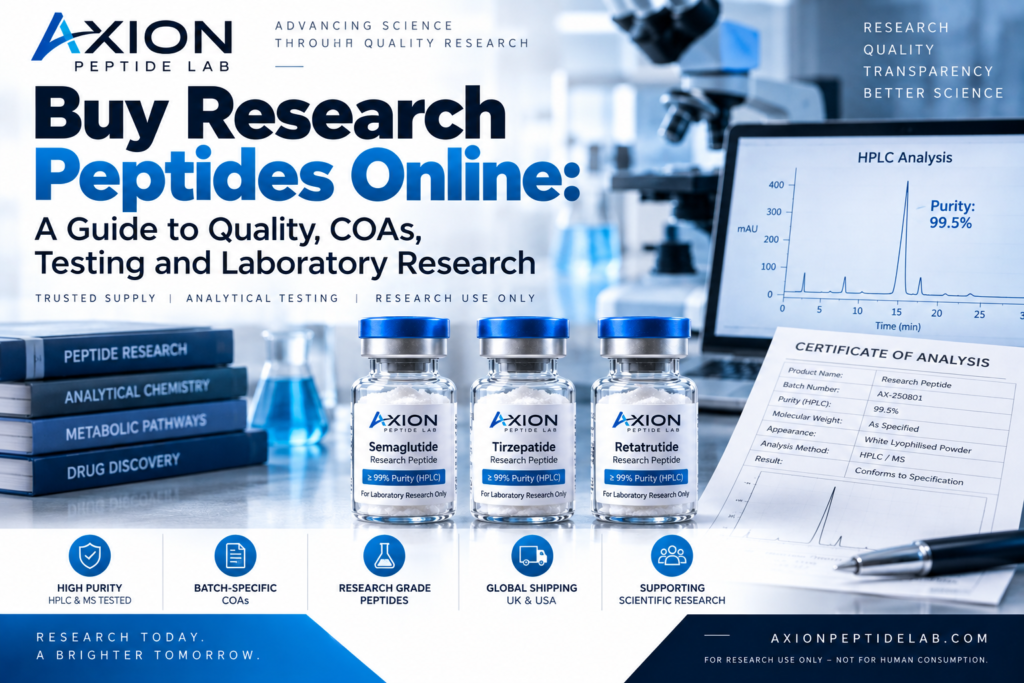
Researchers searching for where to buy research peptides online face an increasingly complicated marketplace.
Peptides are used across many areas of laboratory research, including molecular biology, receptor signalling, metabolic research, analytical chemistry, pharmaceutical development and biochemical investigation. At the same time, the growing public interest in compounds associated with GLP-1, GIP and weight-regulation research has created a large online market in which legitimate laboratory materials can easily become confused with prescription medicines and unapproved products marketed for human use.
For legitimate researchers, the most important question should therefore not simply be:
Where can I buy research peptides online?
Best Places to Buy Research Peptides Online
A better question is:
How can I evaluate research peptides, suppliers, Certificates of Analysis, batch testing and analytical documentation before purchasing materials for laboratory research?
That distinction matters.
Research-use peptides should be evaluated as laboratory materials. They should not be presented as substitutes for licensed medicines, and a label stating “Research Use Only” does not automatically make therapeutic marketing compliant.
This guide explains what researchers should examine when sourcing research peptides online, including:
- peptide identity
- HPLC purity
- mass spectrometry
- Certificates of Analysis
- batch traceability
- third-party testing
- peptide content
- storage information
- supplier transparency
- regulatory considerations
- GLP-1 and GIP research
- semaglutide
- tirzepatide
- investigational retatrutide
Researchers looking for laboratory-use materials can explore the research catalogue at AxionPeptideLab.com, while maintaining the distinction between research materials and medicines intended for patients.
For Research Use Only – Not for human consumption.
What Are Research Peptides?
Peptides are molecules composed of amino acids connected through peptide bonds.
The sequence and arrangement of amino acids influence the chemical and biological properties of a peptide.
Naturally occurring peptides participate in numerous biological processes, including:
cell signalling,
hormone signalling,
immune activity,
metabolic regulation,
growth,
appetite signalling,
and communication between tissues.
Researchers can also produce peptides synthetically.
Synthetic peptides are widely used as laboratory tools for investigating molecular pathways, receptor interactions, structural chemistry and biological mechanisms.
A research peptide is therefore best understood as a laboratory material supplied for experimental or analytical purposes.
It should not automatically be interpreted as a pharmaceutical medicine simply because the same or a related molecule is studied clinically.
Why Do Researchers Buy Peptides Online?
Online peptide suppliers can provide researchers with access to specialised compounds without requiring every laboratory to synthesise each peptide independently.
Researchers may purchase peptide materials for work involving:
analytical method development,
chromatography,
mass spectrometry,
molecular interaction studies,
receptor research,
biochemical assays,
reference-material comparison,
stability research,
or other legitimate laboratory applications.
However, availability alone does not establish quality. buy research peptides online
When researchers buy research peptides online, the supplier’s documentation is often as important as the product name printed on the vial.
What Should You Look for When Buying Research Peptides Online?
A professional research supplier should make it reasonably easy to understand what is being offered.
Researchers should evaluate several factors together rather than choosing materials based only on price or a headline purity percentage.
Clear Product Identification
The product should clearly identify the peptide or research compound.
Useful information can include:
compound name,
quantity,
molecular formula,
molecular weight,
CAS number where applicable,
storage information,
batch number,
and research-use designation.
The exact fields required depend on the compound and research application.
Batch Traceability
Batch or lot identification helps connect a physical research material with its analytical documentation.
If a vial is marked with one batch number while the Certificate of Analysis shows another, the certificate may not describe the material being supplied.
Batch-specific documentation is therefore more useful than a generic COA repeatedly displayed for multiple production lots.
Analytical Documentation
A research peptide supplier may provide analytical data such as:
HPLC,
mass spectrometry,
peptide content,
water content,
residual-solvent testing,
counterion information,
or other tests relevant to the research material.
Different tests answer different questions.
No single test establishes every aspect of quality.
Certificates of Analysis: One of the Most Important Things to Check
Before researchers buy research peptides online, understanding the Certificate of Analysis can help them make a more informed procurement decision.
A Certificate of Analysis, usually called a COA, is a document summarising analytical results associated with a sample or batch.
Depending on the laboratory and product, it may show:
product identity,
batch number,
analysis date,
HPLC purity,
mass-spectrometry results,
molecular weight,
appearance,
peptide content,
and additional quality measurements.
A COA should not simply be viewed as a marketing badge.
Researchers should examine what was actually tested. buy research peptides online
Why the Batch Number Matters
Suppose a product has:
Batch: AX-260901
but the COA states:
Batch: AX-251104
Those numbers do not match.
The analytical result may therefore relate to a previous batch.
Manufacturing consistency cannot simply be assumed.
For meaningful traceability, researchers should determine whether the documentation corresponds to the material being purchased.
Understanding HPLC Purity
One of the most common measurements on peptide COAs is HPLC purity.
HPLC stands for high-performance liquid chromatography.
The technique separates components in a sample based on how they interact with a chromatographic system.
As the components pass through the system, a detector records them as peaks.
The result is called a chromatogram.
A target peptide will commonly produce the dominant chromatographic peak, while smaller detectable components may appear as additional peaks. buy research peptides online
What Does 99% Peptide Purity Mean?
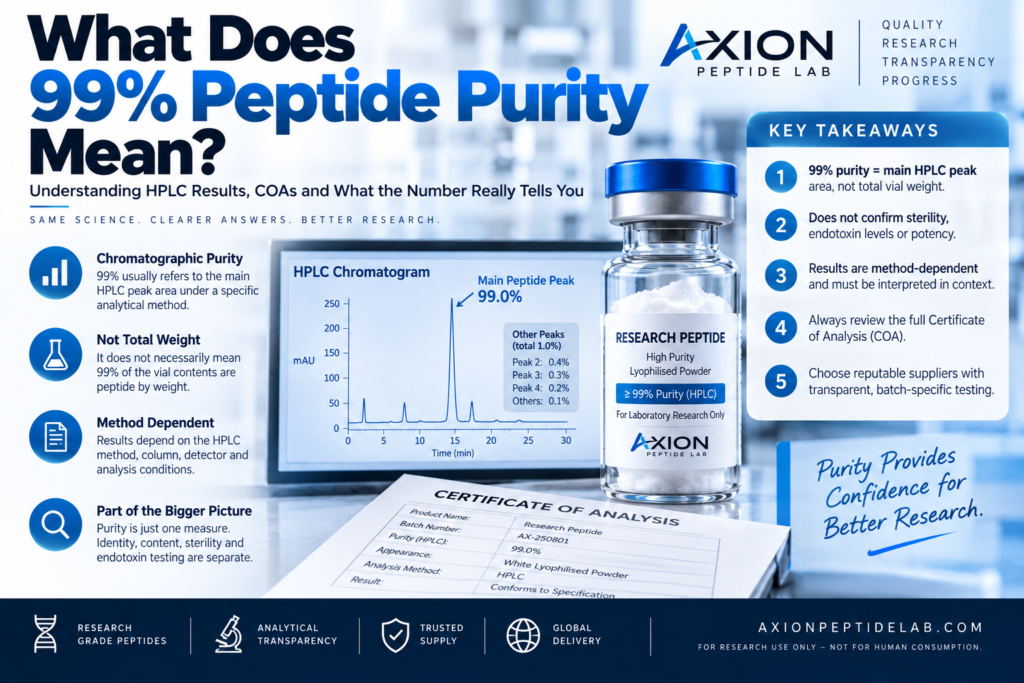
A COA may report:
Purity by HPLC: 99.2%
This generally means that approximately 99.2% of the relevant integrated chromatographic detector response was assigned to the principal peak under the analytical method used.
It does not automatically mean that 99.2% of the total physical contents of a vial are peptide by weight.
That distinction is important when comparing research products.
A sample can contain components such as water, counterions or other non-peptide material that may not be represented in the same way as peptide-related impurities in an HPLC area-percentage calculation.
Therefore:
HPLC purity and peptide content are not necessarily the same measurement.
Researchers should examine both when the distinction matters to their experiment. buy research peptides online
Why HPLC Methodology Matters
An HPLC result depends on factors including:
column chemistry,
mobile phases,
flow rate,
gradient,
detector settings,
temperature,
sample preparation,
and data processing.
This means a purity number should not be interpreted entirely independently of the method used to generate it.
Some structurally similar peptide impurities can also be difficult to separate chromatographically.
Research into pharmaceutical peptide analysis has specifically examined challenges involving co-eluting peptide impurities, demonstrating why chromatographic method quality matters when interpreting apparent peak purity.
A high percentage can be useful information, but researchers should still consider the broader analytical record.
Mass Spectrometry and Peptide Identity
HPLC primarily helps researchers assess chromatographic purity.
Mass spectrometry addresses another important question:
Is the detected molecular mass consistent with the peptide expected?
Mass spectrometry measures ions according to their mass-to-charge characteristics.
A COA might show:
Calculated molecular mass: 4,812.4 Da
and
Observed molecular mass: 4,812.6 Da
A closely corresponding result can provide evidence supporting molecular identity. buy research peptides online
However, mass spectrometry does not automatically establish:
sterility,
endotoxin level,
exact vial content,
biological activity,
or clinical safety.
This is why HPLC and mass spectrometry are commonly viewed as complementary analytical tools rather than interchangeable tests.
Third-Party Testing vs In-House Testing
Researchers may also encounter terms such as:
third-party tested
and
independently tested.
Third-party testing generally means the sample was analysed by a laboratory separate from the company selling the material.
This can provide greater analytical independence. buy research peptides online
However, researchers should still verify the documentation.
Questions worth asking include:
Who performed the test?
Is the laboratory identified?
Is there a report number?
Does the tested batch match the supplied batch?
Can the report be independently verified?
What analytical methods were performed?
When was the sample tested?
A logo saying “third-party tested” is less informative than an actual batch-linked laboratory report.
Peptide Purity Is Not the Same as Sterility
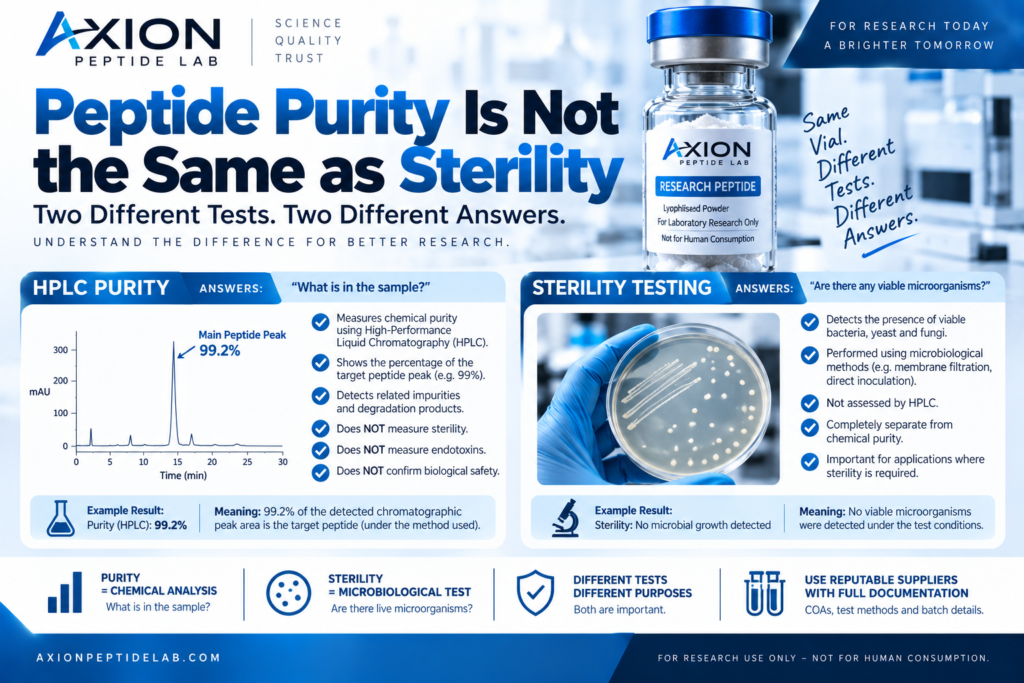
When buying research peptides online, researchers should not assume that high chemical purity means a material is sterile.
These are different analytical characteristics.
HPLC evaluates chemical components under chromatographic conditions.
Sterility testing evaluates viable microbial contamination using dedicated microbiological procedures.
Therefore:
99.5% HPLC purity does not mean 99.5% sterile.
If sterility is relevant to a particular laboratory protocol, a separate appropriate test is required.
Endotoxin Testing Is Also Separate
Endotoxins are substances associated with certain bacteria.
An HPLC chromatogram does not establish endotoxin status. buy research peptides online
Neither does standard mass-spectrometry identity testing.
If endotoxin information is important for an experimental protocol, researchers should look for dedicated endotoxin testing.
This illustrates a fundamental principle when comparing online research peptide suppliers:
Different laboratory tests answer different questions.
Why Storage and Shipping Matter
Analytical quality at the time of manufacture is only one part of research material handling.
Peptide stability can be influenced by environmental factors including:
temperature,
moisture,
light,
oxidation,
pH,
and storage duration.
Researchers should therefore review supplier storage recommendations and plan receiving procedures appropriate to the material involved.
A strong COA cannot compensate for improper storage after manufacturing. buy research peptides online
Likewise, laboratory personnel should follow their own institutional protocols when receiving and storing research materials.
What Are Lyophilised Research Peptides?
Many research peptides are supplied in a lyophilised, or freeze-dried, form.
Lyophilisation removes water from a frozen material under controlled conditions.
This can improve stability for certain peptides during storage and transportation.
A lyophilised peptide may appear as:
a powder,
a compact cake,
or a thin residue within a research vial.
Appearance alone does not establish purity.
Analytical documentation remains necessary.
Researchers should also avoid assuming that a laboratory powder is intended for administration simply because a pharmaceutical formulation of a related molecule exists.
Research Peptides vs Prescription Medicines
This is one of the most important distinctions for anyone searching buy research peptides online.
A research-use material is not automatically equivalent to a prescription medicine.
A licensed medicine undergoes regulatory assessment covering factors such as:
manufacturing controls,
formulation,
quality,
safety,
efficacy,
labelling,
and defined clinical indications.
Research peptide materials are supplied for laboratory investigation.
Their analytical documentation may provide information about:
purity,
identity,
molecular mass,
and composition.
That does not transform them into an authorised medicine.
A Research-Use Label Does Not Override Human-Use Marketing
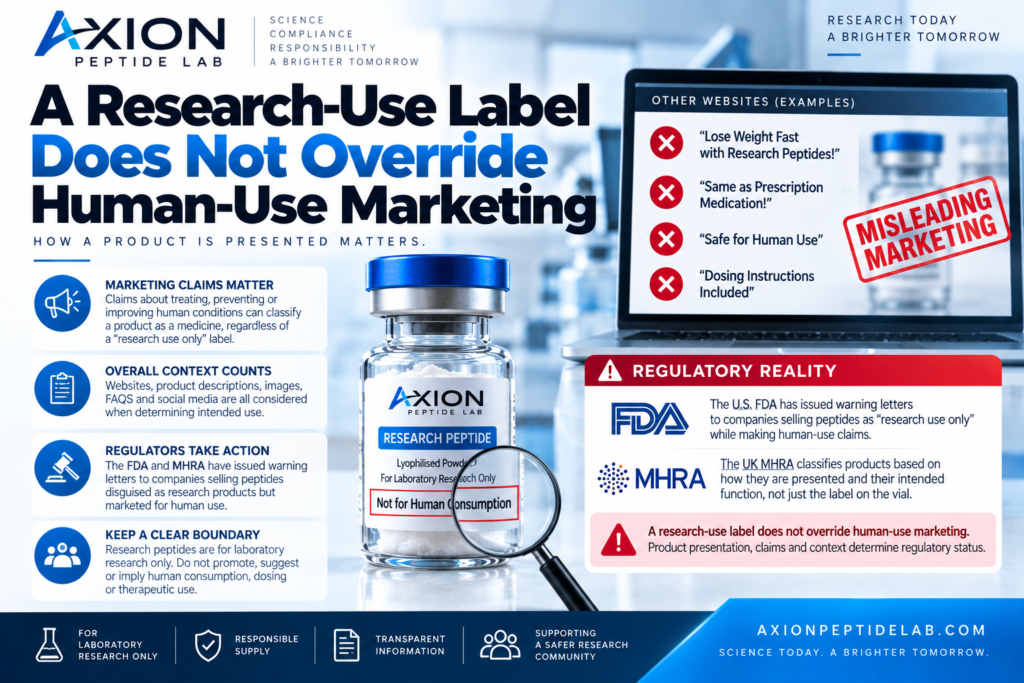
This point is particularly important for US suppliers.
During 2026, the FDA issued warning letters to several peptide websites selling compounds including semaglutide, tirzepatide and retatrutide.
The agency found that despite statements such as “Research Use Only” or “Not for Human Consumption,” surrounding claims on the websites demonstrated an intended human drug use. FDA treated those products as unapproved new drugs.
FDA’s broader guidance on unapproved GLP-1 products similarly warns about products falsely labelled for research purposes when they are actually marketed directly to consumers for human use.
For genuine laboratory suppliers, this means research positioning should be reflected consistently throughout:
product descriptions,
blog content,
images,
FAQs,
social posts,
instructions,
and marketing claims.
A disclaimer should not contradict the rest of the page.
Why Peptides Are Connected to Weight-Regulation Research
One reason online peptide searches have increased is growing scientific interest in metabolic peptide pathways.
The body uses peptide hormones as signalling molecules.
Several of these signals help regulate:
appetite,
satiety,
glucose metabolism,
insulin secretion,
glucagon signalling,
gastric emptying,
and energy balance.
GLP-1 and GIP are particularly important examples.
Research into these pathways has contributed to the development of pharmaceutical compounds targeting one or more metabolic receptors.
What Is GLP-1?
GLP-1 stands for glucagon-like peptide-1.
It is a naturally occurring incretin hormone released in response to nutrient intake.
GLP-1 receptor signalling participates in processes involving:
glucose-dependent insulin secretion,
glucagon regulation,
gastric emptying,
and appetite.
Pharmaceutical researchers have developed longer-acting GLP-1 receptor agonists.
Semaglutide is one prominent example.
What Is GIP?
GIP stands for glucose-dependent insulinotropic polypeptide.
It is another incretin hormone involved in metabolic signalling following nutrient intake.
Research has increasingly investigated compounds capable of targeting more than one receptor system.
This led to dual GIP/GLP-1 receptor agonists such as tirzepatide and investigational triple-receptor compounds such as retatrutide.
Semaglutide: Research Compound and Licensed Medicine Must Be Distinguished
Semaglutide is a GLP-1 receptor agonist.
It has been extensively studied in metabolic research and forms the active ingredient in regulated pharmaceutical products.
In the United States, specific Wegovy semaglutide products are FDA-approved for defined weight-management indications. The FDA also approved a higher-dose Wegovy formulation in March 2026.
In the UK, semaglutide-containing products are prescription medicines authorised for particular indications and formulations.
This does not mean that an online vial labelled “semaglutide research peptide” is equivalent to Wegovy or another licensed pharmaceutical product.
The regulatory status belongs to the authorised pharmaceutical product and its approved formulation—not automatically to every material containing a similarly named substance.
Tirzepatide: Dual GIP and GLP-1 Research
Tirzepatide interacts with both GIP and GLP-1 receptor systems.
The FDA approved Zepbound containing tirzepatide for chronic weight management in eligible adults in November 2023.
Tirzepatide-containing prescription products are also licensed in the UK for defined medical uses.
Again, licensed Zepbound or Mounjaro products should not be confused with laboratory materials marketed as research tirzepatide.
Researchers sourcing peptide compounds should maintain that distinction clearly.
Retatrutide: An Investigational Triple-Receptor Compound
Retatrutide is often discussed alongside semaglutide and tirzepatide, but its status is different.
Retatrutide activates receptors for:
GIP,
GLP-1,
and glucagon.
It is therefore described as a triple hormone receptor agonist.
A Phase 2 randomised trial published in the New England Journal of Medicine evaluated retatrutide in adults with obesity and demonstrated substantial weight reductions within the controlled clinical study while also documenting adverse events, particularly gastrointestinal events.
However, clinical research is not the same as regulatory approval.
As of September 2026, Lilly describes retatrutide as investigational and states that it is not yet available for public use.
FDA likewise states that retatrutide is not a component of an FDA-approved drug and has not been found safe and effective by FDA for any condition.
Therefore, retatrutide should not be marketed as an approved weight-loss medicine.
Semaglutide vs Tirzepatide vs Retatrutide
These compounds are related through metabolic research but differ in their receptor profiles.
Semaglutide
Primarily acts as a GLP-1 receptor agonist.
Tirzepatide
Acts at GIP and GLP-1 receptors.
Retatrutide
Acts at GIP, GLP-1 and glucagon receptors.
Their regulatory status also differs.
Specific semaglutide and tirzepatide pharmaceutical products have regulatory approvals for defined indications.
Retatrutide remains investigational as of September 2026.
Researchers should therefore avoid treating all three as equivalent products simply because they appear together in discussions of metabolic peptide research.
What Clinical Research Actually Shows
Clinical studies evaluate pharmaceutical or investigational preparations under controlled protocols.
Researchers should examine factors such as:
study population,
trial design,
control group,
dose,
duration,
primary endpoints,
adverse events,
discontinuation,
and statistical analysis.
Clinical research associated with a pharmaceutical compound does not automatically prove anything about an unrelated research-use vial purchased online.
The composition, manufacturing controls, formulation and intended use may be entirely different.
This is particularly important when online research suppliers discuss published trials.
Scientific literature can provide educational context.
It should not be used to imply that an independently sold research material has the same clinical evidence as an authorised medicine or a clinical-trial product.
Safety and Reported Adverse Effects
Chemical purity does not equal clinical safety.
A peptide can have extremely high analytical purity and still produce significant pharmacological effects or adverse reactions.
Licensed GLP-1 and GIP/GLP-1 medicines carry product-specific prescribing information and safety warnings.
UK MHRA guidance states that licensed GLP-1 medicines should be used according to their authorised indications and obtained through appropriate healthcare channels.
For people seeking medication for weight management rather than laboratory materials, the appropriate route is a qualified healthcare professional and legitimate regulated pharmacy—not a research peptide supplier.
UK Regulatory Considerations When Buying Research Peptides Online
UK businesses need to be particularly careful when discussing research compounds alongside weight-management claims.
The MHRA determines whether a product falls within the definition of a medicinal product based on factors including how it is presented and its intended function. Its borderline-product guidance was updated in July 2026.
The regulator has also taken repeated action during 2026 over public advertising of prescription-only weight-management medicines.
MHRA states that advertising rules prohibit advertisements to the public that are likely to lead to the use of a prescription-only medicine, including certain direct or indirect references to GLP-1 weight-management medicines.
Businesses operating across both research and educational content should therefore maintain a clear separation between:
laboratory procurement,
scientific discussion,
and human medical treatment.
USA Regulatory Considerations
The United States has also increased enforcement involving online peptide sellers.
In August 2026 alone, FDA warning letters identified online companies selling products described as research peptides that the agency considered unapproved drugs based on their surrounding marketing and intended-use claims.
This is especially relevant to pages targeting phrases such as:
“buy research peptides online,”
“semaglutide research peptide,”
“tirzepatide research,”
or
“retatrutide research.”
The safest approach for legitimate laboratory businesses is to keep commercial descriptions focused on scientific identity, analytical documentation, storage and laboratory research—not consumer dosing or therapeutic instructions.
How to Compare Research Peptide Suppliers
Researchers choosing where to buy research peptides online should compare suppliers using evidence rather than promotional language.
A useful assessment can include:
Product transparency
Can researchers clearly determine what compound and quantity are being supplied?
Batch-specific COAs
Does the COA correspond to the actual lot being offered?
HPLC documentation
Is chromatographic purity shown rather than simply claimed?
Identity testing
Is mass spectrometry or another appropriate identity method included?
Independent testing
Can third-party laboratory results be traced or verified?
Storage information
Does the supplier provide appropriate research-material storage information?
Research-use positioning
Is laboratory use consistently presented without contradictory human-use marketing?
Customer support
Can legitimate researchers obtain documentation or clarification regarding their laboratory materials?
No single factor establishes overall quality.
The entire supplier and analytical record should be considered.
Common Red Flags When Buying Research Peptides Online
Researchers should be cautious when encountering websites that provide little information beyond claims such as:
“best peptide,”
“highest quality,”
“guaranteed results,”
or
“99.9% pure.”
Particular attention may be warranted when:
the batch cannot be identified,
the COA does not match the lot,
the testing laboratory is not named,
analytical documentation cannot be verified,
the same certificate appears across multiple batches,
clinical claims are attached directly to research-only products,
dosing or administration instructions appear on research-product pages,
or research disclaimers contradict the rest of the website’s marketing.
A professional-looking website does not substitute for analytical transparency.
Why Price Should Not Be the Only Factor
Researchers naturally consider cost when purchasing laboratory materials.
However, a low price means little if the product lacks:
batch traceability,
reliable analytical documentation,
clear identity testing,
or appropriate storage information.
Likewise, a high price does not guarantee better analytical quality.
Instead of asking only:
Which research peptide is cheapest?
consider asking:
What evidence accompanies this batch?
That question is much more relevant to scientific reproducibility.
Research Peptides and Laboratory Reproducibility
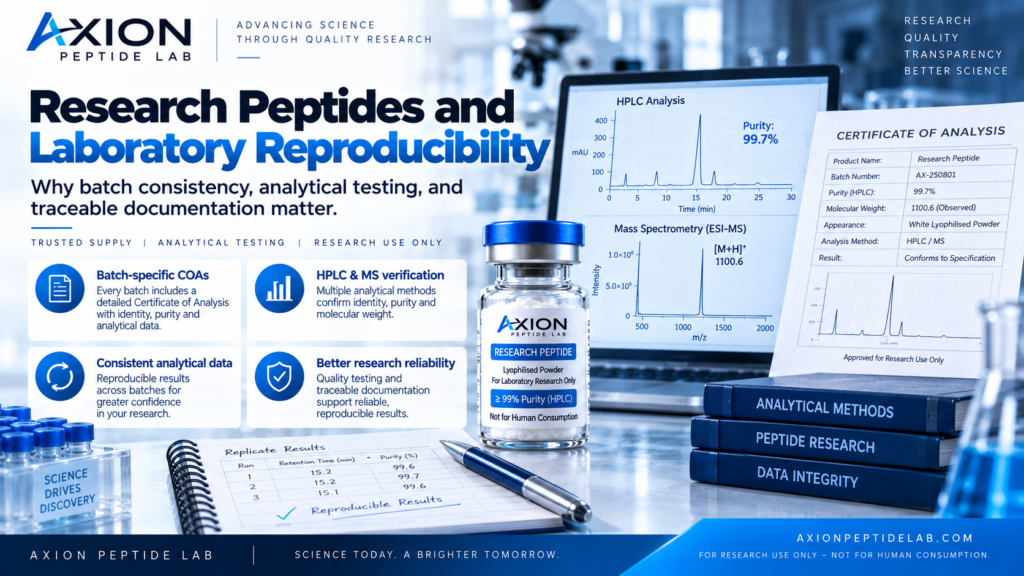
Reproducibility is fundamental to scientific research.
If different laboratories—or the same laboratory at different times—use materials with poorly characterised composition, experimental results may become more difficult to interpret.
Documented identity and purity can improve researchers’ understanding of what material entered an experiment.
This does not guarantee that every result will be reproducible.
However, analytical traceability is an important part of good laboratory practice.
Current and Future Peptide Research
Peptide research continues to develop rapidly.
Current scientific interest extends beyond single-receptor systems to increasingly complex molecular strategies involving:
dual receptor agonists,
triple receptor agonists,
longer-acting peptides,
novel delivery systems,
metabolic signalling pathways,
amylin biology,
glucagon pathways,
and improved analytical characterisation.
At the same time, analytical science is becoming increasingly sophisticated.
Advanced chromatography and mass spectrometry can help researchers distinguish closely related peptide species and investigate impurities that simpler analytical methods may not resolve.
The future of peptide research will therefore depend not only on discovering new molecules but also on improving how researchers characterise, manufacture and evaluate those molecules.
Frequently Asked Questions About Buying Research Peptides Online
Can you buy research peptides online?
Research materials are sold online by laboratory suppliers, but researchers are responsible for ensuring that their procurement and intended use comply with applicable laws, institutional requirements and local regulations.
What should I look for when buying research peptides online?
Look for clear product identification, batch numbers, Certificates of Analysis, analytical purity data, identity testing, storage information and supplier transparency.
What is a peptide COA?
A Certificate of Analysis is a document containing analytical information associated with a particular sample or batch. It may include HPLC purity, mass spectrometry, molecular weight, appearance and other test results.
What does 99% peptide purity mean?
A 99% HPLC purity result usually means approximately 99% of the relevant integrated chromatographic detector response was attributed to the principal peptide peak under the specified analytical method. It does not necessarily mean that 99% of the total vial mass is peptide.
Is HPLC enough to confirm peptide quality?
HPLC provides important chromatographic information but does not answer every quality question. Identity, content, sterility, endotoxin and other characteristics may require separate tests.
Why is mass spectrometry used for peptides?
Mass spectrometry helps researchers evaluate whether an observed molecular mass is consistent with the expected peptide and can support molecular identity.
Are third-party tested research peptides better?
Independent testing can provide additional confidence because the analysis is performed by a laboratory separate from the seller. Researchers should still verify the batch, report and analytical methods.
Are research peptides the same as prescription medicines?
No. Research-use materials are laboratory products. Licensed prescription medicines have undergone regulatory assessment for defined formulations and clinical indications.
Can research semaglutide be treated as Wegovy?
No. An online research material labelled semaglutide should not be assumed to be equivalent to the authorised pharmaceutical product Wegovy.
Is tirzepatide approved?
Specific pharmaceutical tirzepatide products such as Zepbound and Mounjaro have regulatory approvals for defined uses. That does not make every research-use material labelled tirzepatide an approved medicine.
Is retatrutide approved?
No. As of September 2026, retatrutide remains investigational and has not been approved for public use.
Can high peptide purity prove a product is safe?
No. Chemical purity is not the same as clinical safety. Safety requires separate pharmacological, toxicological and clinical evidence.
Should every research peptide batch have a COA?
Batch-specific analytical documentation is valuable because it allows researchers to connect test results with the particular material being supplied.
How should research peptides be stored?
Storage requirements depend on the particular compound and formulation. Researchers should follow supplier documentation and appropriate laboratory protocols.
Where can legitimate researchers explore research peptides?
Researchers looking for laboratory-use materials can explore the research catalogue at AxionPeptideLab.com and review available product information and batch documentation before ordering.
For Research Use Only – Not for human consumption.
Final Thoughts: Buying Research Peptides Online Responsibly
The internet makes specialised laboratory compounds easier to source than ever before.
But convenience should not replace scientific evaluation.
Before researchers buy research peptides online, they should look beyond product names, prices and headline purity claims.
Review the Certificate of Analysis.
Check the lot number.
Understand what HPLC purity actually means.
Look for molecular identity information.
Evaluate whether testing is batch-specific.
Consider storage and handling requirements.
And distinguish scientific research materials from pharmaceutical medicines.
This distinction is especially important in metabolic peptide research.
Semaglutide, tirzepatide and retatrutide are frequently discussed together because of their relationships with GLP-1, GIP and metabolic signalling.
Yet their pharmaceutical and regulatory status differs.
Specific semaglutide and tirzepatide medicines are authorised for defined medical indications.
Retatrutide remains investigational as of September 2026.
A research supplier should not blur those categories.
The goal of laboratory procurement should be to obtain well-characterised research materials supported by transparent analytical information—not to bypass legitimate medical or pharmaceutical channels.
Researchers can explore laboratory-use products and supporting research information through AxionPeptideLab.com.
For Research Use Only – Not for human consumption.
References and Further Reading
U.S. Food and Drug Administration — FDA’s Concerns with Unapproved GLP-1 Drugs Used for Weight Loss. Current FDA guidance concerning unapproved semaglutide, tirzepatide, retatrutide and products falsely marketed as research materials.
FDA — Warning Letters to Online Peptide Sellers, 2026. Recent FDA enforcement demonstrates how research-use disclaimers may be insufficient where surrounding marketing indicates human drug use.
FDA — Zepbound Approval. Regulatory information concerning tirzepatide for chronic weight management.
FDA — Higher-Dose Wegovy Approval, March 2026. Current US information concerning authorised semaglutide for weight management.
New England Journal of Medicine — Triple-Hormone-Receptor Agonist Retatrutide for Obesity: A Phase 2 Trial. Peer-reviewed clinical research on investigational retatrutide.
Eli Lilly — What to Know About Retatrutide. Current developer information confirming investigational status as of 2026.
MHRA — GLP-1 Medicines for Weight Loss and Diabetes: What You Need to Know. UK regulatory guidance concerning licensed GLP-1 and GIP/GLP-1 medicines.
MHRA — Borderline Products: How to Tell if Your Product Is a Medicine. Guidance relevant to how intended purpose and product presentation can influence regulatory classification.
MHRA — Warning on Promoting Licensed and Unlicensed Weight-Management Medicines. Current UK advertising guidance relevant to online marketing.
MHRA — Advertising Investigations, August 2026. Recent enforcement concerning public promotion of prescription-only weight-management medicines.