Peptide Research 2026: GLP-1 Science, Metabolic Peptides, AI and the Future of Peptide Therapeutics
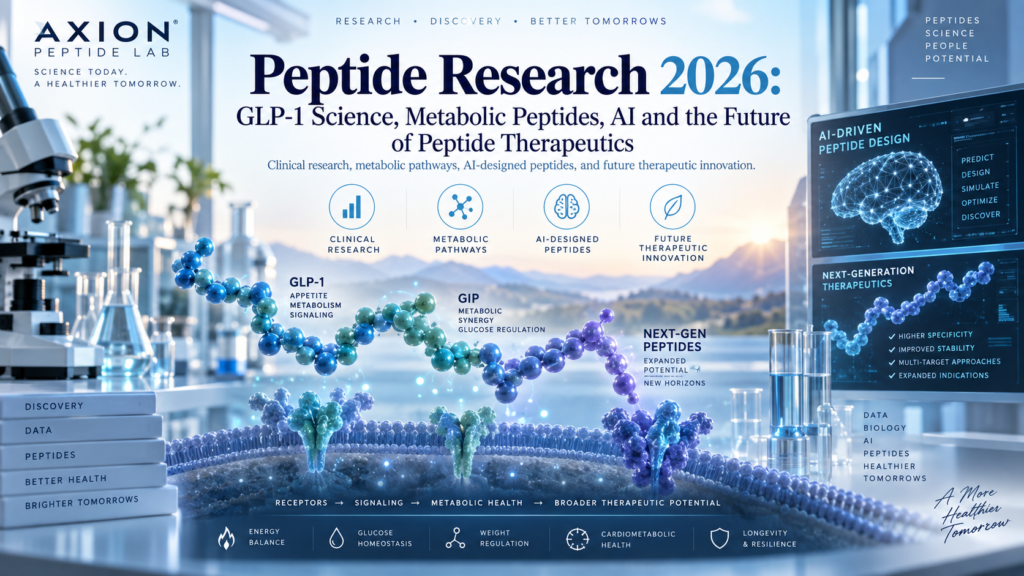
Peptide research in 2026 is moving far beyond the idea of peptides as simply short chains of amino acids.
Today, scientists are engineering peptides to target specific receptors, developing multi-receptor metabolic compounds, using artificial intelligence to design new peptide sequences, investigating peptide-drug conjugates for cancer, developing cell-penetrating peptides for intracellular delivery and trying to overcome one of the field’s oldest challenges: delivering peptide medicines effectively without relying exclusively on injections.
Metabolic research remains one of the most visible parts of this scientific expansion.
GLP-1 receptor agonists have transformed diabetes and obesity medicine. Dual GIP/GLP-1 receptor agonism has expanded the field further. Triple-receptor agonists such as investigational retatrutide are now testing whether simultaneously targeting GIP, GLP-1 and glucagon pathways can produce additional metabolic effects.
At the same time, peptide research 2026 extends far beyond weight management.
Research published during 2026 is exploring artificial-intelligence-assisted peptide design, peptide-drug conjugates, antimicrobial peptides, cyclic peptides for precision oncology, cell-penetrating peptides and new approaches to oral peptide delivery. Recent scientific reviews describe therapeutic peptides as an increasingly important class positioned between traditional small molecules and large biologic medicines, while noting continuing challenges involving stability, membrane permeability, manufacturing and delivery.
This article examines the major areas shaping peptide science in 2026, including what peptides are, how metabolic peptide pathways work, GLP-1 and GIP research, semaglutide, tirzepatide, retatrutide, current clinical evidence, safety considerations, research peptides versus licensed medicines and the technologies likely to shape the next generation of peptide research.
Products identified as research materials by Axion Peptide Lab are intended for laboratory research only. Research-use products should not be interpreted as prescription medicines or products intended for human consumption.
What Are Peptides?
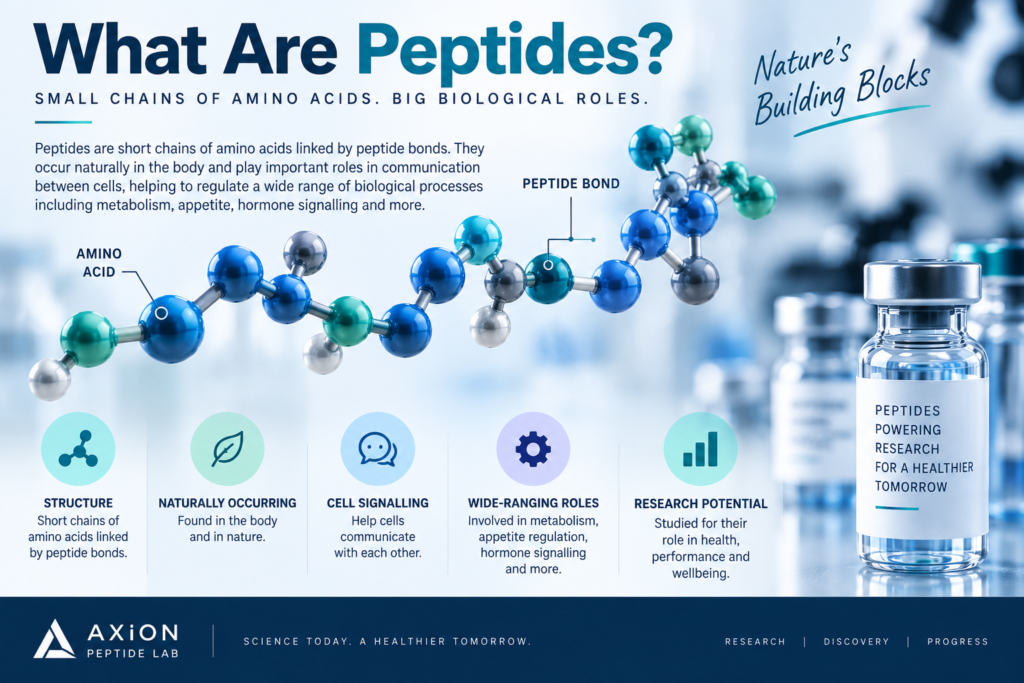
Peptides are molecules constructed from amino acids connected by peptide bonds.
Amino acids are also the building blocks of proteins, but peptides are generally shorter and often function as highly specific biological signalling molecules.
The distinction between peptides and proteins is not based on one universally accepted amino-acid cutoff. Instead, the terms often reflect differences in molecular size, structure and biological behaviour.
Naturally occurring peptides participate in a remarkable range of physiological systems.
They can influence hormone signalling, appetite, glucose regulation, immune responses, digestion, reproduction, growth, nervous-system function and communication between cells.
Scientists can also manufacture peptides synthetically.
Synthetic and engineered peptides allow researchers to change characteristics such as receptor affinity, stability, duration of action and resistance to enzymatic degradation.
This ability to modify peptide structure is one reason peptide therapeutics occupy such an interesting position in drug discovery.
They can offer some of the molecular specificity associated with biological medicines while remaining chemically programmable in ways that are useful for medicinal chemistry and laboratory research. Current 2026 reviews describe high target specificity and structural programmability among the major attractions of therapeutic peptides.
Why Is Peptide Research Growing So Quickly in 2026?
Several scientific developments are converging.
Researchers now have better methods for peptide synthesis, purification, structural analysis, computational modelling and drug delivery.
At the same time, clinical success in metabolic medicine has increased interest in the wider potential of peptide-based compounds.
Peptide research also benefits from advances in artificial intelligence.
Machine-learning and generative models can increasingly help scientists predict peptide structure, receptor binding, stability and potential sequence modifications before large numbers of candidate molecules are synthesized experimentally.
A 2026 review of generative AI in peptide drug design describes graph neural networks, transformers, diffusion models and other deep-learning approaches being applied to novel sequence generation and property optimisation. The authors also note that experimental validation remains essential because characteristics such as solubility, immunogenicity and toxicity remain difficult to predict perfectly.
This means AI is not replacing laboratory peptide science.
Instead, it is increasingly helping researchers narrow enormous sequence spaces to more promising candidates.
How Peptides Are Connected to Weight Regulation
Weight regulation involves far more than calories alone.
The body uses complex interactions between the digestive tract, pancreas, brain, liver, adipose tissue, muscle and nervous system to regulate hunger, satiety, blood glucose and energy balance.
Peptide hormones are central to many of these processes.
After food intake, the gastrointestinal system releases hormonal signals that communicate information about nutrient availability.
Some of these hormones affect insulin secretion.
Others influence appetite or the rate at which the stomach empties.
Still others influence energy use and glucose production.
The success of GLP-1 receptor agonists has demonstrated how important these pathways can be when translated into pharmaceutical research.
Researchers have subsequently moved from targeting one receptor toward molecules capable of influencing two or even three metabolic signalling pathways at once.
How Metabolic Peptide Pathways Work
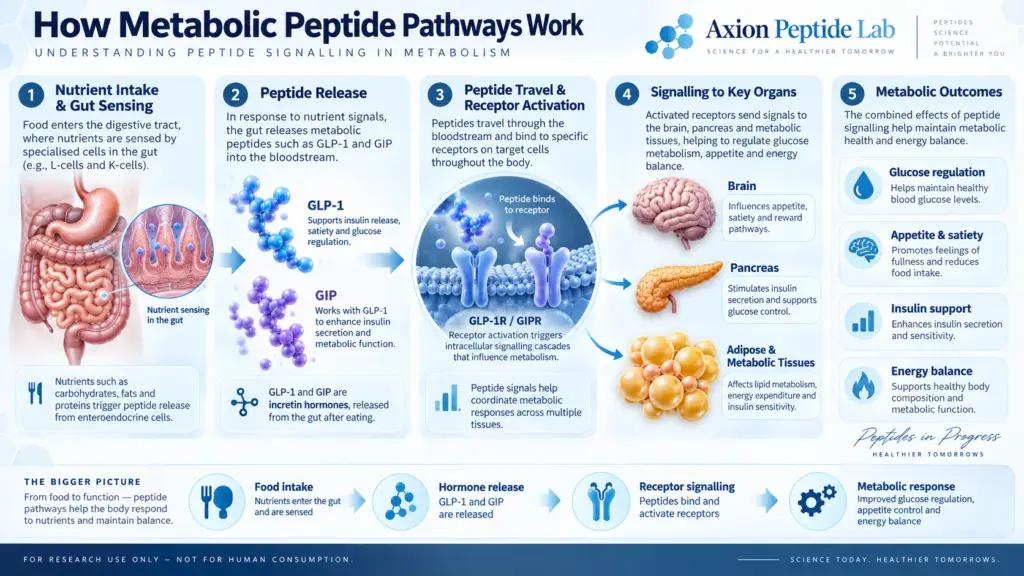
Metabolic peptide signalling can be understood as a communication network.
A peptide hormone binds to a receptor.
That receptor then triggers intracellular signals.
Those signals may alter processes such as insulin secretion, appetite, gastrointestinal movement or energy metabolism.
The biological response depends on which receptor is activated and in which tissues that receptor is expressed.
Modern metabolic drug development has increasingly focused on combining receptor pathways.
A single-receptor agonist targets one pathway.
A dual agonist targets two.
A triple agonist targets three receptor systems through one engineered molecule.
This progression can be seen clearly when comparing semaglutide, tirzepatide and retatrutide.
GLP-1 Research in 2026
GLP-1 stands for glucagon-like peptide-1.
It is a naturally occurring incretin hormone involved in nutrient-responsive metabolic signalling.
GLP-1 receptor activation can influence glucose-dependent insulin secretion, appetite, glucagon activity and gastric emptying.
Natural GLP-1 is broken down rapidly.
Researchers therefore developed longer-lasting GLP-1 receptor agonists capable of maintaining receptor activity much longer.
Semaglutide is one of the best-known examples.
In 2026, GLP-1 research continues to expand beyond simple questions about weight loss.
Researchers are increasingly examining cardiovascular outcomes, long-term metabolic effects, different formulations, higher-dose regimens and how GLP-1 signalling can be combined with other pathways.
What Is GIP?
GIP stands for glucose-dependent insulinotropic polypeptide.
Like GLP-1, it is an incretin hormone released in connection with nutrient intake.
GIP participates in insulin and metabolic signalling.
The development of tirzepatide demonstrated that simultaneously targeting GIP and GLP-1 could produce clinically important effects.
This dual-receptor concept has become one of the foundations for the next generation of metabolic peptide research.
Researchers are now investigating whether adding additional pathways can further alter metabolic outcomes.
Peptide-Based Compounds Commonly Discussed in Weight-Loss Research
Three molecules dominate many current discussions about metabolic peptides:
semaglutide, tirzepatide and retatrutide.
However, their similarities should not obscure their differences.
Semaglutide and tirzepatide are active ingredients in licensed prescription medicines.
Retatrutide remains an investigational compound.
Their receptor profiles are also different.
Understanding these distinctions is critical for interpreting peptide research in 2026 accurately.
Semaglutide Research in 2026
Semaglutide primarily acts as a GLP-1 receptor agonist.
Prescription semaglutide products have established regulatory approvals for defined indications.
Wegovy is authorised for chronic weight management in appropriate populations, and the FDA previously expanded its indication to reduce the risk of cardiovascular death, heart attack and stroke in adults with cardiovascular disease and obesity or overweight.
A notable development in 2026 peptide research was the expansion of higher-dose semaglutide.
On March 19, 2026, the FDA approved a 7.2 mg Wegovy dose for weight loss and long-term weight maintenance in defined adults with obesity or overweight and an associated weight-related condition.
The UK MHRA also approved a maximum weekly Wegovy dose of 7.2 mg for adults with obesity in January 2026 and subsequently approved a single-dose 7.2 mg pen in April.
These developments illustrate an important trend.
Peptide research is not always about discovering a completely new molecule.
Researchers also investigate how established molecules may be optimised through dose, delivery and formulation.
Tirzepatide Research in 2026
Tirzepatide represents another stage of metabolic peptide development.
Rather than targeting only GLP-1 receptors, tirzepatide activates both:
GIP receptors
and
GLP-1 receptors.
This makes it a dual GIP/GLP-1 receptor agonist.
Specific pharmaceutical products containing tirzepatide are already authorised.
In the United States, Zepbound is approved for chronic weight management in eligible adults and, since December 2024, for moderate-to-severe obstructive sleep apnoea in adults with obesity.
In the UK, NICE guidance updated in January 2026 recommends tirzepatide as a weight-management option for people who meet defined eligibility criteria.
Research involving tirzepatide demonstrates how metabolic peptide science is expanding from weight and glucose outcomes toward obesity-related conditions such as sleep apnoea. Peptide Research 2026
Retatrutide Research in 2026
Retatrutide represents a further expansion of multi-receptor peptide research.
It is a single investigational molecule designed to activate:
GIP receptors,
GLP-1 receptors,
and
glucagon receptors.
This makes retatrutide a triple hormone receptor agonist.
Unlike semaglutide and tirzepatide, retatrutide remains investigational as of September 2026.
Lilly states that retatrutide is still being studied in Phase 3 clinical trials and is not available for public use.
The 2026 Phase 3 programme has nevertheless produced major findings.
In TRIUMPH-1, Lilly reported that participants receiving the highest studied dose had an average body-weight reduction of 28.3% at 80 weeks under the study’s efficacy estimand.
In the Phase 3 TRANSCEND-T2D-1 trial, published in The Lancet in June 2026, researchers investigated retatrutide in adults with type 2 diabetes inadequately controlled by diet and exercise.
Additional Phase 3 results announced in July 2026 included TRIUMPH-2 and TRIUMPH-3. Lilly reported average body-weight reductions of up to 20.8% in adults with type 2 diabetes and obesity or overweight and up to 22.6% in adults with severe obesity and established cardiovascular disease. The company stated that it plans to submit a Biologics License Application to the FDA in the first quarter of 2027.
Positive clinical-trial results do not equal regulatory approval.
Retatrutide remains investigational until regulators complete formal review and grant any future marketing authorisation. Peptide Research 2026
Semaglutide vs Tirzepatide vs Retatrutide
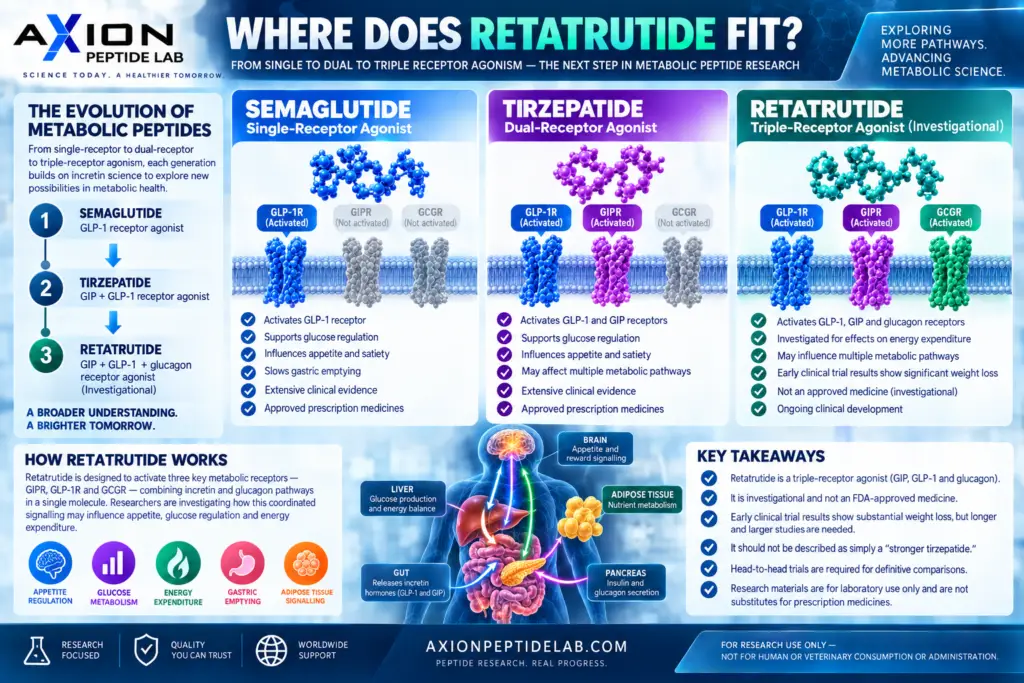
The simplest scientific comparison is their receptor activity.
Semaglutide primarily targets the GLP-1 receptor.
Tirzepatide targets GIP and GLP-1 receptors.
Retatrutide targets GIP, GLP-1 and glucagon receptors.
Their regulatory status also differs.
Semaglutide and tirzepatide are active ingredients in authorised prescription medicines for defined uses.
Retatrutide remains in clinical development.
It is also important not to rank these compounds simply by comparing weight-loss percentages from separate trials.
Clinical trials differ in participant populations, duration, baseline weight, statistical analysis, dose escalation, adherence and other variables.
Proper comparisons require head-to-head randomized studies.
A Phase 3 study called TRIUMPH-5 is directly comparing retatrutide with tirzepatide, but its final results were not yet available as of September 2026.
What Does Clinical Research Actually Show?
One of the biggest mistakes in online peptide discussions is turning clinical-trial results into simple marketing claims.
A clinical trial is much more specific.
Researchers define:
who can participate,
how treatments are assigned,
which dose is studied,
how long participants are followed,
what outcomes are measured,
and how adverse events are recorded.
A result applies to that research context.
For example, a percentage reported in a retatrutide Phase 3 trial should not automatically be applied to every person or to unrelated laboratory material claiming to contain the same molecule.
The pharmaceutical product used in a regulated clinical trial is manufactured and controlled within a specific development programme.
A separately manufactured laboratory research material is not automatically equivalent.
This distinction is critical whenever scientific studies are discussed commercially.
Safety and Reported Adverse Effects
Peptides can be biologically powerful molecules.
Being made from amino acids does not make a compound automatically safe.
Safety depends on the specific molecule, dose, route of administration, formulation, biological target and patient characteristics.
For GLP-1 and GIP/GLP-1 medicines, gastrointestinal events such as nausea, vomiting, diarrhoea and constipation are well-recognised adverse effects.
The UK MHRA continues to publish safety guidance for authorised GLP-1-related medicines and stresses that these medicines should be used according to their licensed indications and prescribed through legitimate healthcare channels.
For investigational molecules, the evidence is less mature.
Retatrutide Phase 3 programmes have reported gastrointestinal events among the most common adverse effects, and its overall safety profile remains under investigation.
Longer follow-up and larger populations are important because uncommon safety signals may not become clear until more participants have been studied.
Peptide Research in 2026 Goes Far Beyond Weight Loss
Metabolic research attracts enormous public attention, but the broader peptide field is considerably larger.
Several research directions are particularly important in 2026.
AI-Designed Peptides
Artificial intelligence is becoming an increasingly important tool in peptide discovery.
Instead of experimentally synthesizing every conceivable amino-acid sequence, computational systems can help predict which sequences may interact with a desired molecular target.
Generative models can propose novel peptide structures.
Machine-learning models can assist with predicting properties such as binding activity, stability and biological behaviour.
Research published in 2026 describes AI-guided peptide development using protein language models, machine learning, generative architectures and data-driven structural optimisation.
The potential advantage is speed.
Researchers may be able to identify promising candidates more efficiently.
The limitation is that computational predictions still require experimental confirmation.
Biology remains more complicated than a software model.
Cell-Penetrating Peptides
Another major area involves cell-penetrating peptides, commonly called CPPs.
Many therapeutic compounds struggle to enter cells.
Cell membranes create a powerful biological barrier.
CPPs are short peptide sequences capable of crossing cellular membranes or helping transport other molecular cargo into cells.
A 2026 review describes emerging design strategies for using cell-penetrating peptides to deliver therapeutic cargos while addressing challenges such as systemic clearance, non-specific distribution and enzymatic instability.
Future applications may include delivering nucleic acids, proteins, gene-editing components and other therapeutic agents into cells.
Peptide-Drug Conjugates
Peptide-drug conjugates are another rapidly developing research field.
The concept is to combine a targeting peptide with another therapeutic payload.
The peptide can potentially help direct the attached molecule toward cells expressing a particular receptor.
This strategy is especially interesting in oncology.
A 2026 review of peptide-drug conjugates highlights continued development of peptide targeting, linker chemistry and therapeutic payloads for cancer research.
Researchers hope such approaches can increase delivery to the intended target while reducing unnecessary exposure elsewhere.
This remains a technically demanding field because peptide stability, linker behaviour and tumour uptake all need to be optimised.
Cyclic Peptides and Precision Oncology
Cyclic peptides have structural features that can increase resistance to enzymatic breakdown and improve receptor-binding properties.
These characteristics are particularly interesting for molecular imaging and targeted radiopharmaceuticals.
A 2026 review of radiolabelled cyclic peptides describes their growing role as targeting vectors in precision oncology and nuclear medicine, including research involving receptors expressed by tumours.
This illustrates how peptide science can bridge diagnostics and therapy.
The same targeting molecule may potentially help researchers identify tumour tissue and deliver a therapeutic radionuclide.
Antimicrobial Peptide Research
Antibiotic resistance is another major challenge driving peptide research.
Antimicrobial peptides are naturally occurring components of innate immune systems in many organisms.
Researchers are investigating their ability to disrupt microbial membranes, interact with intracellular targets and potentially combat drug-resistant organisms.
Research published in 2026 continues to explore antimicrobial peptide discovery, structure-activity relationships and AI-assisted prediction.
However, promising antimicrobial activity in laboratory experiments does not automatically translate into a successful medicine.
Researchers still need to address toxicity, stability, delivery and manufacturing.
The Challenge of Oral Peptide Delivery
One of the oldest limitations of peptide medicines remains highly relevant in 2026.
Many peptides are difficult to administer orally.
The gastrointestinal system is designed to digest proteins and peptides.
Enzymes can rapidly break peptide molecules apart.
Peptides may also have difficulty crossing the intestinal barrier because of their molecular size, polarity and charge.
A 2026 review of oral peptide delivery describes enzymatic instability and poor epithelial permeability as major remaining barriers, while noting that advances in formulation, structural modification and computational modelling are gradually improving the field.
Researchers are investigating:
protective formulations,
permeation enhancers,
chemical modifications,
nanoparticle delivery,
and other approaches designed to improve peptide absorption.
The future of peptide medicine could therefore involve not only new molecules, but better ways of delivering existing molecules. Peptide Research 2026
Why Peptide Stability Matters
Peptides can be sensitive molecules.
Their structure can potentially change through processes such as:
oxidation,
hydrolysis,
deamidation,
aggregation,
or enzymatic degradation.
Researchers therefore study pharmacokinetics and stability carefully.
A 2026 review of systemic peptide pharmacokinetics discusses the factors governing distribution, clearance and biological half-life of therapeutic peptides.
Modern peptide engineering attempts to overcome short half-life through strategies such as molecular modification, albumin binding, lipidation and changes to amino-acid composition.
These modifications help explain why engineered pharmaceutical analogues can behave very differently from naturally occurring peptides.
Research Peptides vs Prescription Medicines
This distinction is essential for peptide research in 2026.
A licensed prescription medicine has gone through a formal regulatory process.
Regulators evaluate areas including:
clinical efficacy,
safety,
manufacturing quality,
stability,
formulation,
labelling,
and intended medical use.
A research peptide is different.
Research-use products are intended for laboratory investigation.
A research material may have analytical documentation describing identity or purity, but that does not make it an approved pharmaceutical medicine.
A compound can also exist in both scientific and pharmaceutical contexts.
For example, semaglutide is an active pharmaceutical ingredient in licensed medicines.
A separate material labelled “semaglutide research peptide” does not automatically acquire the regulatory status, formulation or quality controls of Wegovy.
Likewise, clinical evidence involving regulated tirzepatide or investigational retatrutide material cannot automatically be transferred to unrelated laboratory material. Peptide Research 2026
Peptide Certificates of Analysis and Research Quality
Analytical documentation is an important component of legitimate laboratory peptide research.
A peptide Certificate of Analysis may include information such as:
batch identification,
HPLC purity,
mass spectrometry,
molecular weight,
analysis date,
and other quality characteristics.
HPLC can help assess chromatographic purity.
Mass spectrometry can provide evidence supporting molecular identity.
These tests answer different questions.
A high HPLC purity percentage does not automatically prove sterility, endotoxin status, peptide content, potency or human safety.
Researchers should therefore consider a COA as one piece of the analytical record rather than a universal guarantee.
Legitimate researchers exploring laboratory materials through AxionPeptideLab.com can use batch documentation, COAs and analytical information when evaluating materials for appropriate laboratory applications.
For Research Use Only – Not for human consumption.
UK Regulatory Considerations in 2026
UK research and commercial websites need to distinguish scientific information from medicinal product promotion carefully. Peptide Research 2026
The MHRA’s updated July 2026 borderline-product guidance explains that whether something is considered a medicine can depend on its pharmacological properties, intended purpose and how it is presented through websites, advertising, packaging, social media and other promotional material.
This means a research-use disclaimer does not automatically override contradictory medical marketing.
If a product is presented as treating obesity, diabetes or another disease, regulators can consider the overall presentation rather than relying only on the words printed on the vial.
The MHRA has also remained active throughout 2026 in enforcement involving public promotion of prescription-only weight-management medicines.
Its August 2026 adve rtising decisions again required businesses to amend advertising that could lead members of the public toward prescription-only weight-management medicines. Peptide Research 2026
For research-focused businesses, the practical distinction should remain clear:
scientific discussion is educational,
laboratory products are for laboratory research,
and medical treatment belongs within licensed healthcare and pharmacy channels.
US Regulatory Considerations
The same general distinction matters in the United States.
Approved pharmaceutical products are regulated differently from materials supplied solely for laboratory research.
Researchers and suppliers should not assume that calling a compound “research use only” overrides evidence that it is actually being marketed for treatment or human administration.
This is particularly important in the GLP-1 and metabolic peptide space, where consumer demand has increased dramatically.
Scientific research information should therefore remain clearly separated from therapeutic sales claims.
What Will Shape Peptide Research After 2026?
Several trends are likely to remain particularly important.
One is multi-receptor biology.
Retatrutide demonstrates the scientific interest in combining multiple metabolic pathways in one molecule.
Other researchers are investigating additional hormone combinations and signalling networks.
A second trend is AI-assisted design.
Generative models may help produce peptides with more precise receptor targeting, improved stability and better physical properties.
A third is targeted delivery.
Peptide-drug conjugates and cell-penetrating peptides could make peptides useful not only as medicines themselves but as vehicles carrying other therapeutic agents.
A fourth trend is delivery technology.
Improving oral, inhaled, transdermal and other non-injectable peptide delivery remains an important research challenge. Peptide Research 2026
A fifth is precision oncology.
Cyclic peptides, peptide-drug conjugates and peptide-based radiopharmaceutical targeting systems could play increasingly important roles in detecting and treating specific tumour types.
Finally, antimicrobial resistance is likely to keep antimicrobial peptide research active.
The future of peptide science will therefore not be defined by one molecule or one therapeutic area.
It will involve a broader convergence of chemistry, biology, computation, manufacturing and precision medicine.
Frequently Asked Questions About Peptide Research 2026
What is peptide research?
Peptide research involves studying short chains of amino acids and their chemical, biological and potential therapeutic properties. Researchers investigate natural peptides, synthetic peptides, receptor interactions, delivery systems, manufacturing and potential clinical applications. Peptide Research 2026
Why is peptide research important in 2026?
The field is expanding because of advances in metabolic medicines, AI-assisted molecular design, peptide delivery, oncology, antimicrobial research and multi-receptor drug development.
What are the biggest developments in peptide research in 2026?
Major developments include higher-dose semaglutide authorisations, continued tirzepatide research, Phase 3 retatrutide results, AI-guided peptide design, improved delivery systems, cell-penetrating peptides, peptide-drug conjugates and targeted oncology research. Peptide Research 2026
What is GLP-1?
GLP-1 is glucagon-like peptide-1, a naturally occurring incretin hormone involved in glucose regulation, insulin secretion and appetite-related signalling. Peptide Research 2026
What is GIP?
GIP is glucose-dependent insulinotropic polypeptide, another incretin hormone involved in nutrient-responsive metabolic signalling. Peptide Research 2026
Is semaglutide a peptide medicine?
Semaglutide is a peptide-based GLP-1 receptor agonist and is the active ingredient in licensed prescription pharmaceutical products.
What changed with semaglutide in 2026?
Both US and UK regulators authorised higher-dose 7.2 mg Wegovy options for specified adult obesity populations during 2026. Peptide Research 2026
What is tirzepatide?
Tirzepatide is a dual GIP/GLP-1 receptor agonist used in authorised prescription products for defined metabolic indications.
What is retatrutide?
Retatrutide is an investigational triple receptor agonist targeting GIP, GLP-1 and glucagon receptors.
Is retatrutide approved in 2026?
No. As of September 2026, retatrutide remains investigational. Lilly plans a US regulatory submission in 2027.
What did retatrutide Phase 3 research show?
TRIUMPH-1 reported average body-weight reductions of up to 28.3% at 80 weeks in the highest studied dose group under the efficacy analysis. Additional Phase 3 studies have reported results in populations with type 2 diabetes and cardiovascular disease. Peptide Research 2026
Is AI being used to design peptides?
Yes. Researchers are increasingly using machine learning, protein language models and generative AI to predict peptide sequences and optimise molecular characteristics, although experimental laboratory validation remains necessary.
Why are peptide medicines difficult to take orally?
Peptides can be degraded by digestive enzymes and often cross the intestinal lining poorly. Researchers are developing chemical modifications and specialised formulations to improve oral delivery.
Are research peptides the same as prescription medicines?
No. Research peptides are laboratory materials. Prescription medicines have undergone regulatory assessment for defined formulations, indications and populations.
What areas of peptide research could grow after 2026?
AI-designed peptides, multi-receptor metabolic compounds, peptide-drug conjugates, cell-penetrating peptides, antimicrobial peptides, precision oncology and advanced peptide-delivery technologies are among the major areas to watch. Peptide Research 2026
Final Thoughts: Where Peptide Research Is Heading in 2026 and Beyond
Peptide research 2026 is increasingly defined by convergence.
Biologists are discovering more about receptor signalling.
Chemists are making peptide molecules more stable.
Data scientists are applying artificial intelligence to sequence design.
Pharmaceutical scientists are improving delivery.
Clinical researchers are testing multi-receptor molecules across increasingly large populations.
Metabolic peptide research provides one of the clearest examples.
Semaglutide demonstrates how a single-receptor strategy can become an established pharmaceutical platform.
Tirzepatide shows how combining GIP and GLP-1 signalling can expand the approach.
Retatrutide is testing whether adding glucagon receptor activity can push multi-pathway metabolic research further.
But the larger peptide field is even broader.
Peptide-drug conjugates are being investigated in oncology.
Cell-penetrating peptides are being designed to transport molecules into cells.
Antimicrobial peptides are being explored as potential tools against drug-resistant pathogens.
Cyclic peptides are being investigated as precision targeting molecules. peptide research 2026
AI is increasingly helping researchers design new sequences.
And new formulation technologies are gradually addressing peptide medicine’s long-standing stability and delivery limitations.
The result is a field that looks increasingly different from peptide science even a decade ago.
At the same time, careful scientific distinctions remain essential.
Clinical research does not equal regulatory approval. Peptide Research 2026
A laboratory research peptide is not automatically a prescription medicine.
A high purity result does not prove safety.
And promising experimental evidence does not guarantee clinical success.
The most useful approach to peptide research is therefore evidence-based.
Look at the molecule.
Look at the receptor.
Look at the trial.
Look at the analytical method.
Look at the regulatory status.
And distinguish clearly between established evidence and emerging research. Peptide Research 2026
Researchers exploring laboratory peptide materials can review available research information and catalogue materials through AxionPeptideLab.com while maintaining the appropriate separation between laboratory research and human medical treatment.
For Research Use Only – Not for human consumption.
References and Further Reading
Hornsby BD et al. Therapeutic Peptides and Proteins: Status and Developments in Drug Delivery. Journal of Controlled Release, 2026. Current review covering peptide delivery challenges and technological development.
Jang YE et al. Integrative Peptide Drug Development: Chemical Engineering, AI-Driven Design, and Cell-Penetrating Peptides. Pharmaceutics, 2026. Review of AI, peptide engineering and intracellular delivery.
Ekambaram S, Dokholyan NV. Peptide-Based Drug Design Using Generative AI. Chemical Communications, 2026. Review of generative AI approaches to peptide discovery.
FDA — Higher-Dose Semaglutide Approval, March 2026. Official US regulatory information on Wegovy 7.2 mg.
MHRA — Semaglutide 7.2 mg Approval, 2026. UK regulatory information concerning higher-dose Wegovy.
FDA — Zepbound for Obstructive Sleep Apnoea. Official tirzepatide regulatory information.
NICE — Tirzepatide for Managing Overweight and Obesity. Updated UK prescribing and implementation guidance.
Bajaj HS et al. TRANSCEND-T2D-1. The Lancet, 2026. Published Phase 3 retatrutide research in type 2 diabetes.
Eli Lilly — TRIUMPH-1 Phase 3 Retatrutide Results, May 2026. Sponsor-reported Phase 3 obesity findings.
Eli Lilly — TRIUMPH-2 and TRIUMPH-3 Results, July 2026. Current Phase 3 results and planned 2027 regulatory submission.
Kim EJ et al. Cell-Penetrating Peptides for Therapeutic Applications. Organic & Biomolecular Chemistry, 2026. Review of CPP design and therapeutic delivery.
Feng Y et al. Recent Advances in Peptide-Drug Conjugates as Anticancer Agents. European Journal of Medicinal Chemistry, 2026. Review of peptide-drug conjugate research.
Ai D et al. Radiolabeled Cyclic Peptides in Precision Oncology. Journal of Controlled Release, 2026. Review of cyclic peptide applications in targeted nuclear medicine.
MHRA — Borderline Products: How to Tell if Your Product Is a Medicine. Updated UK regulatory guidance on product presentation and classification.
MHRA — Advertising Investigations, August 2026. Current UK enforcement concerning public promotion of prescription-only weight-management medicines.