Peptide Stability Testing: 7 Essential Methods for Evaluating Degradation and Shelf Life
Peptide stability testing helps laboratories understand how synthetic peptides change over time and how environmental conditions influence their chemical and physical characteristics. It is an important part of research material characterisation because a peptide that meets its analytical specifications at one point may not retain the same properties indefinitely.
Peptides can be affected by temperature, moisture, light, oxygen, solution composition and interactions with surrounding materials. Depending on their molecular structure, these factors may contribute to oxidation, deamidation, hydrolysis, aggregation or other changes.
A well-designed peptide stability testing programme examines these possibilities using analytical methods appropriate to the material and the intended research purpose.
High-performance liquid chromatography (HPLC) can help monitor chromatographic changes, while liquid chromatography–mass spectrometry (LC-MS) may provide molecular-mass evidence about certain degradation products. Other methods can assess moisture, physical changes and additional characteristics.
However, stability cannot be established by a single purity result or an unsupported storage recommendation.
This guide explains peptide stability testing, seven analytical approaches, common degradation pathways, lyophilised versus solution stability, accelerated studies, real-time testing and the evidence needed to support storage and shelf-life claims.
What Is Peptide Stability Testing?
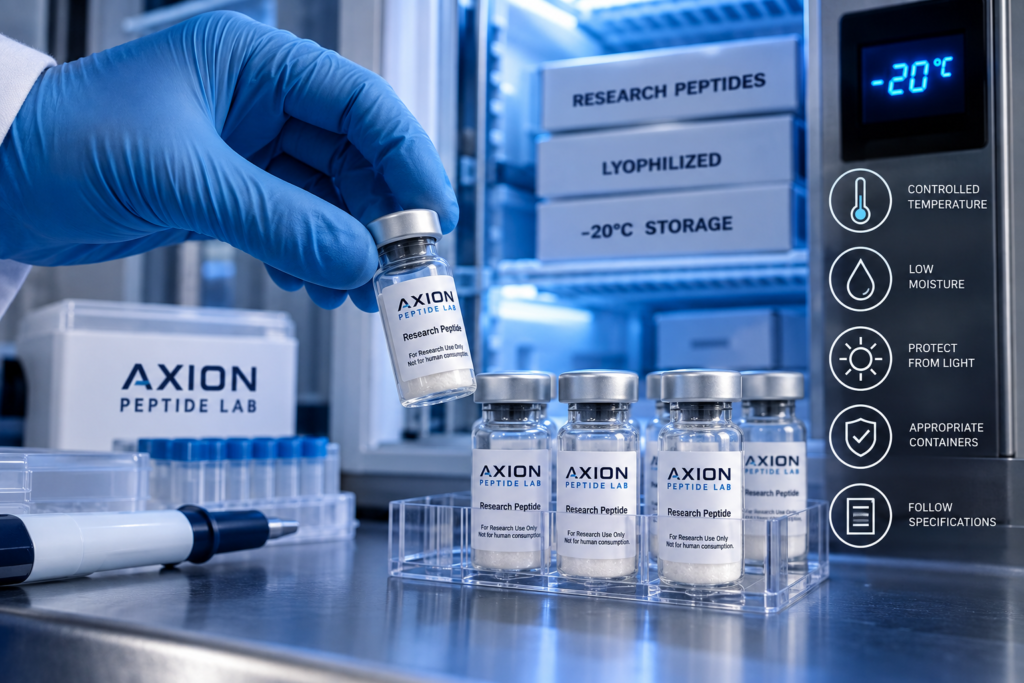
Peptide stability testing is the systematic assessment of changes in peptide materials over time under defined conditions.
The purpose is to determine whether relevant characteristics remain within appropriate limits throughout the period being studied.
Those characteristics may include chemical identity, chromatographic purity, quantitative content, physical appearance, moisture content and other properties relevant to the material.
The scope of peptide stability testing depends on the peptide, its physical form, the analytical objective and the intended application.
Why Stability Matters in Peptide Research
Synthetic peptides are chemically diverse.
Their behaviour depends on factors such as amino acid sequence, terminal modifications, molecular structure and surrounding environment.
Some peptides may be susceptible to oxidation, while others may undergo deamidation, hydrolysis or aggregation under particular conditions.
Peptide stability testing helps identify these changes and evaluate their significance.
Without suitable stability information, researchers may be unable to distinguish changes in experimental results from changes in the material itself.
Stability Is Not the Same as Initial Purity
A peptide may have high chromatographic purity when initially analysed.
That result describes the material under the analytical conditions and at the time of testing.
It does not establish how the material will behave during subsequent storage.
Peptide stability testing addresses this separate question by examining material characteristics over time.
Chemical Stability vs Physical Stability
Chemical stability concerns changes in molecular composition or structure.
Physical stability concerns characteristics such as aggregation, precipitation, appearance or other physical changes.
A peptide can undergo physical changes without a readily detectable change in intact molecular mass.
Conversely, chemical degradation may occur without an obvious visual change.
A suitable peptide stability testing programme considers whichever characteristics are relevant to the material.
Why Do Peptides Degrade During Storage?
Peptide degradation can occur through several chemical and physical pathways.
The susceptibility of a particular peptide depends on its structure and environment.
Oxidation
Oxidation involves chemical changes associated with electron transfer or the incorporation of oxygen.
Certain amino acid residues, including methionine and cysteine, can be susceptible to oxidative reactions.
Oxidation may change the peptide’s molecular mass, chromatographic behaviour or other properties.
Peptide stability testing may use HPLC and LC-MS to investigate these changes.
However, not every oxidation event can be identified from molecular mass alone.
Deamidation
Deamidation can affect susceptible asparagine and glutamine residues.
The process may alter the peptide’s chemical structure and charge-related characteristics.
Under relevant conditions, deamidation can produce a mass increase of approximately 0.984 Da.
Peptide stability testing may detect deamidated components using appropriate chromatography and mass spectrometry.
Hydrolysis
Hydrolysis involves chemical bond cleavage through reaction with water.
Some peptide bonds or other susceptible functional groups may undergo hydrolytic changes.
The resulting products can differ in molecular mass and chromatographic retention.
Peptide stability testing helps researchers investigate whether hydrolytic degradation occurs under the conditions being evaluated.
Aggregation
Aggregation occurs when molecules associate to form larger assemblies.
It can be influenced by peptide concentration, solution composition, temperature and molecular interactions.
Aggregation is not necessarily equivalent to chemical degradation.
A peptide may form aggregates without a change in the molecular mass of the individual intact molecules.
For this reason, peptide stability testing may require physical characterisation methods in addition to conventional HPLC or LC-MS.
Isomerisation and Other Structural Changes
Some peptides can undergo structural rearrangements or isomerisation under certain conditions.
These changes may be difficult to distinguish using intact molecular-mass measurements alone.
Additional chromatographic or structural methods may be necessary.
Moisture-Related Changes
Water can influence chemical reactions and physical characteristics.
For lyophilised materials, moisture content may affect stability under particular storage conditions.
The relationship is not universal: stability depends on the peptide, formulation, residual moisture and other factors.
Peptide stability testing should therefore evaluate moisture effects rather than assume that every dry preparation behaves identically.
7 Essential Methods Used in Peptide Stability Testing
Different analytical methods provide different information about peptide stability.
No single method necessarily detects every relevant chemical or physical change.
The following seven approaches are useful components of peptide stability testing when appropriately selected and validated.
1. High-Performance Liquid Chromatography (HPLC)
HPLC is commonly used to monitor chromatographic changes in peptide samples.
A stability study may compare chromatograms collected at different time points.
Changes in the principal peak or the appearance of additional peaks may indicate alterations in the sample.
What HPLC Can Reveal
A suitable HPLC method can help detect:
- Changes in the principal chromatographic peak.
- New or increasing peptide-related components.
- Changes in relative peak areas.
- Certain degradation products.
- Differences between samples stored under different conditions.
Peptide stability testing using HPLC requires a method capable of resolving degradation products relevant to the material.
What HPLC Cannot Automatically Establish
A dominant chromatographic peak does not prove the absence of every degradation product.
Some components may co-elute or produce weak detector responses.
HPLC area percentage also does not automatically measure absolute peptide content.
For additional background, see How HPLC Is Used to Measure Peptide Purity.
2. Liquid Chromatography–Mass Spectrometry (LC-MS)
LC-MS combines chromatographic separation with mass-spectral detection.
It can provide molecular-mass information about components observed during stability studies.
Peptide stability testing using LC-MS may help investigate whether new analytical signals are consistent with oxidation, hydrolysis or other chemical changes.
Molecular-Mass Changes
Certain degradation pathways produce characteristic mass differences.
For example, the addition of one oxygen atom may produce a mass increase of approximately 15.995 Da.
Such observations can help generate hypotheses about chemical changes.
However, mass differences alone do not always establish a unique degradation pathway.
Identifying Related Components
LC-MS may help associate molecular-mass information with individual chromatographic features.
This can improve the interpretation of complex degradation profiles.
Limitations
Ionisation efficiency and matrix effects influence mass-spectral response.
Raw signal intensity is not automatically proportional to the amount of each component.
Peptide stability testing should therefore distinguish qualitative mass-spectral evidence from validated quantitative measurements.
See LC-MS Peptide Analysis for a detailed explanation.
3. Size-Exclusion Chromatography (SEC)
Size-exclusion chromatography separates components according to their effective size in solution.
It can be useful when investigating aggregation or the presence of larger molecular assemblies.
Detecting Aggregates
Some peptide materials can form aggregates under certain conditions.
SEC may help distinguish larger species from smaller components when the method is suitable.
Method Limitations
Separation depends on the characteristics of the analytes and the chromatographic system.
Some aggregates may dissociate or interact with the column.
SEC results should therefore be interpreted according to the method’s demonstrated suitability.
Peptide stability testing may combine SEC with other techniques when aggregation is an important concern.
4. Dynamic Light Scattering (DLS)
Dynamic light scattering examines fluctuations in scattered light to estimate the hydrodynamic size of particles or molecular assemblies in solution.
It may be useful for investigating aggregation or changes in particle-size distribution.
Physical Stability Assessment
DLS can provide information about changes in the size distribution of species in solution.
This may help researchers investigate whether larger assemblies develop during storage.
Important Limitations
DLS is strongly influenced by larger scattering particles.
It does not independently establish the chemical identity of the material being measured.
Peptide stability testing using DLS should therefore be complemented by appropriate chemical analysis where necessary.
5. Karl Fischer Water Determination
Karl Fischer titration is an analytical method used to determine water content.
It can be relevant when examining lyophilised peptide preparations.
Why Water Content Matters
Residual or absorbed moisture can influence chemical and physical behaviour.
A stability study may assess whether moisture changes during storage.
Interpretation
Water content is one material characteristic.
A particular moisture result does not automatically predict the stability of every peptide.
Peptide stability testing should interpret moisture measurements alongside other analytical findings.
6. Quantitative Peptide Assay
A quantitative assay measures the amount of intended peptide in a defined sample.
This is different from reporting the principal peak’s relative chromatographic area.
Monitoring Peptide Content
A suitable assay can help determine whether the amount of target peptide changes over time.
The analytical method may use calibration against an appropriate reference standard.
Why Quantification Matters
A sample may show changes in content that are not adequately described by relative chromatographic purity alone.
Peptide stability testing can therefore benefit from quantitative measurement when content is a relevant stability attribute.
For more information, read Peptide Purity vs Peptide Content.
7. Complementary Spectroscopic and Physical Methods
Additional methods may include Fourier-transform infrared spectroscopy, circular dichroism, nuclear magnetic resonance or other techniques suited to the material.
These approaches can provide information about molecular structure, conformation or physical characteristics.
Selecting the Right Technique
Not every peptide requires every method.
The analytical strategy should address plausible degradation pathways and relevant material attributes.
A reliable peptide stability testing programme uses methods selected for the scientific question rather than simply accumulating instrument results.
Comparison of Peptide Stability Testing Methods
| Method | Primary information | Main limitation |
|---|---|---|
| HPLC | Chromatographic changes and related components | May miss co-eluting or poorly detected substances |
| LC-MS | Molecular-mass evidence for chemical changes | Variable ionisation response |
| SEC | Size-based separation of certain aggregates | Method-dependent recovery and interactions |
| DLS | Hydrodynamic particle-size information | Sensitive to larger scattering particles |
| Karl Fischer | Water content | Does not independently establish chemical stability |
| Quantitative assay | Amount of intended peptide | Requires suitable calibration and validation |
| Complementary spectroscopy | Selected structural or physical characteristics | Technique-specific sensitivity and applicability |
The most appropriate peptide stability testing methods depend on the material and the changes that need to be detected.
Lyophilised Peptide Stability vs Peptide Solution Stability
Peptides may be supplied or studied in different physical forms.
Lyophilised materials and solutions can behave differently because the surrounding environment influences chemical reactions and physical interactions.
Understanding these differences is an important part of peptide stability testing.
What Is a Lyophilised Peptide?
Lyophilisation, also called freeze-drying, is a process used to remove water from a frozen material under controlled conditions.
The resulting preparation may contain a porous solid cake or powder.
The actual structure and residual moisture depend on the formulation and process.
Lyophilisation can improve the stability of some materials, but it does not guarantee indefinite stability.
Why Lyophilised Peptides May Behave Differently
Removing much of the water can reduce the rate of certain reactions.
However, residual moisture, oxygen exposure, temperature and formulation characteristics can still influence degradation.
Peptide stability testing is necessary to determine how a particular lyophilised preparation behaves.
What Changes When a Peptide Is in Solution?
In solution, peptide molecules interact with the solvent and dissolved components.
Solution conditions can influence reaction rates, aggregation and other changes.
Relevant factors may include pH, ionic strength, concentration and temperature.
Peptide stability testing of a solution should consider its actual composition rather than assuming that findings for a dry preparation apply.
Can Lyophilised and Solution Stability Be Compared Directly?
Not without appropriate evidence.
The physical forms and environmental conditions differ.
A peptide that is stable in one form may behave differently in another.
A scientifically meaningful comparison requires suitable analytical measurements under clearly defined conditions.
How Temperature Affects Peptide Stability
Temperature influences many chemical reaction rates and physical processes.
However, the relationship between temperature and peptide stability depends on the peptide and the degradation pathway.
Elevated Temperatures
Higher temperatures may accelerate certain chemical degradation reactions.
They can also influence aggregation or other physical changes.
Accelerated peptide stability testing may use elevated temperatures to investigate degradation behaviour over shorter periods.
Lower Temperatures
Lower temperatures may slow some reactions, but they do not necessarily prevent all changes.
Certain physical processes can behave differently during cooling or freezing.
Temperature Fluctuations
Repeated changes in temperature may influence some materials.
The significance depends on the formulation, container and relevant physical or chemical mechanisms.
Peptide stability testing should evaluate temperature effects according to the actual storage conditions being studied.
Why Universal Storage Claims Are Unreliable
No single storage temperature or duration can be assumed appropriate for every peptide.
Recommendations should be supported by material-specific evidence.
An analytical result obtained at one temperature does not automatically establish performance at another.
The Role of pH in Peptide Stability Testing
For peptides in solution, pH can influence chemical reaction pathways and molecular interactions.
Some degradation reactions are sensitive to acidic or alkaline conditions.
pH-Dependent Hydrolysis
Hydrolytic reactions may be influenced by solution pH.
The susceptibility of a particular peptide depends on its chemical structure.
Deamidation and pH
Deamidation rates can vary with solution conditions.
The relationship is sequence-dependent and may involve competing reaction pathways.
Solubility and Aggregation
pH can influence peptide charge, solubility and intermolecular interactions.
These effects may contribute to physical stability changes.
Peptide stability testing should examine pH only in relation to the specific formulation and analytical objective.
How Light and Oxygen Can Influence Peptide Stability
Some peptides contain chemical groups that may undergo light-associated or oxidative changes.
The extent of these changes depends on the material and environmental conditions.
Light Exposure
Light may contribute to chemical changes in susceptible compounds.
Photostability testing can help determine whether exposure produces relevant degradation products.
Oxygen Exposure
Oxygen may contribute to oxidation pathways in susceptible peptides.
However, the presence of oxygen does not mean that every peptide will degrade at the same rate.
Container Considerations
Container materials and closure systems can influence the environment surrounding a sample.
Interactions with container surfaces, permeability and other properties may be relevant to certain materials.
A complete peptide stability testing programme considers these factors when they could materially affect the results.
Real-Time vs Accelerated Peptide Stability Testing
Two important approaches to stability assessment are real-time and accelerated studies.
They provide different types of evidence.
What Is Real-Time Stability Testing?
Real-time peptide stability testing examines a material under defined conditions over the period of interest.
Samples are analysed at selected time points.
The objective is to observe actual changes under those conditions.
What Is Accelerated Stability Testing?
Accelerated peptide stability testing uses conditions intended to increase the rate of certain changes.
For example, elevated temperatures may help reveal susceptibility to specific degradation pathways.
Accelerated studies can provide useful information about potential instability.
However, accelerated results do not automatically establish long-term behaviour under different conditions.
Why Accelerated Results Have Limitations
Different degradation pathways may become important under different conditions.
A reaction observed at an elevated temperature may not occur in the same way under ordinary storage conditions.
Physical changes may also complicate extrapolation.
Therefore, accelerated peptide stability testing should not be treated as a universal substitute for real-time evidence.
When Both Approaches Are Useful
Accelerated studies can support method development and understanding of degradation mechanisms.
Real-time studies provide direct evidence under the conditions examined.
The combination can be informative when appropriately designed.
What Is a Stability-Indicating Analytical Method?
A stability-indicating analytical method is intended to measure relevant characteristics while distinguishing the target substance from degradation products or other interference.
For peptide stability testing, a stability-indicating method should be capable of detecting changes important to the analytical objective.
Chromatographic Selectivity
The method should provide adequate separation of relevant components.
If a degradation product co-elutes with the intended peptide, the method may fail to reveal a meaningful change.
Detection Capability
The method must be capable of detecting relevant degradation products at levels appropriate for the intended purpose.
Quantitative Performance
When quantitative conclusions are required, the procedure should have suitable accuracy, precision and calibration characteristics.
Supporting Mass-Spectral Evidence
LC-MS can help investigate whether chromatographic changes correspond to chemical modifications.
However, mass-spectral evidence should be interpreted within the method’s limitations.
Forced Degradation Studies
Forced degradation studies expose a material to selected stress conditions to explore possible degradation pathways and assess analytical method suitability.
The objective is to generate useful analytical information, not necessarily to reproduce ordinary storage conditions.
Peptide stability testing may use forced degradation data to help establish whether a method can distinguish the intended peptide from relevant degradation products.
How Laboratories Design a Peptide Stability Study
A scientifically useful stability study begins with a defined objective.
The design should reflect the material, its physical form and the characteristics being evaluated.
Define the Study Objective
The laboratory should identify what it needs to establish.
Examples include understanding chemical degradation, monitoring quantitative content or evaluating physical changes.
Characterise the Starting Material
Initial analytical measurements provide a reference point.
These may include identity, chromatographic purity, content or other relevant characteristics.
Select the Study Conditions
Conditions should be chosen according to the study purpose.
The selected environment must be documented so that the results can be interpreted correctly.
Establish Sampling Time Points
Measurements should be collected at time points appropriate to the study.
The schedule depends on the anticipated changes and study duration.
Select Analytical Methods
Methods should detect the characteristics relevant to the stability question.
Peptide stability testing may require more than one analytical technique.
Evaluate the Results
The laboratory compares results across time points and conditions.
Interpretation should consider analytical variability, method limitations and the significance of observed changes.
Document the Conclusions
Conclusions should describe what the study actually established.
A stability claim should not extend beyond the conditions, material and period supported by the evidence.
Example of Peptide Stability Testing Results

Consider a hypothetical research peptide studied under one defined condition.
The laboratory uses an HPLC method to monitor the relative area of the principal chromatographic peak.
| Study time | Principal HPLC peak area | Observation |
|---|---|---|
| Initial | 99.1% | Starting analytical profile |
| Month 1 | 98.9% | Small measured change |
| Month 2 | 98.5% | Additional minor components |
| Month 3 | 97.8% | Further chromatographic change |
These values are illustrative and do not represent an actual peptide or verified stability study.
The results suggest a change in the chromatographic profile over the period examined.
However, the table alone does not establish the identity of the additional components, the precise degradation mechanism or the peptide content by weight.
Analytical variability must also be considered before drawing conclusions about small differences.
This example demonstrates why peptide stability testing requires careful interpretation rather than reliance on a single percentage.
How Peptide Stability Testing Relates to Impurity Profiling
Stability testing and impurity profiling are closely connected.
Impurity profiling examines unwanted or unexpected components.
Stability testing examines how material characteristics change over time.
A degradation product may appear as a new impurity during storage.
Peptide stability testing can therefore use impurity profiling methods to monitor chemical changes.
Identifying Degradation Products
HPLC may detect additional components.
LC-MS may provide molecular-mass evidence relevant to their possible identities.
Tracking Changes Over Time
Repeated analysis can help determine whether certain components increase or decrease during the study.
Understanding Degradation Pathways
Structural evidence may support hypotheses about oxidation, deamidation, hydrolysis or other reactions.
Distinguishing Initial Impurities From New Products
An impurity present in the starting material is not necessarily a degradation product formed during storage.
Peptide stability testing should distinguish initial sample composition from subsequent changes.
For a detailed explanation, read Peptide Impurity Profiling.
Peptide Stability Testing and Certificates of Analysis
A certificate of analysis reports specified analytical findings associated with a sample or batch.
It may include chromatographic purity, molecular-mass results or other characteristics.
However, an ordinary batch COA is not necessarily a stability report.
What a COA Can Establish
A COA can document results obtained from specified tests on an identified material.
The report should indicate the methods and measurements involved.
What a COA Cannot Automatically Establish
A single testing date does not demonstrate how the material behaves over time.
A high initial purity result does not independently establish a shelf life.
Stability Data vs Batch Release Data
Batch release data describe material characteristics at a particular stage.
Stability data examine changes under defined conditions across time.
These forms of documentation serve different purposes.
Peptide stability testing provides the longitudinal evidence needed to evaluate stability-related claims.
For additional guidance, read Peptide Certificate of Analysis: How to Read a COA.
Can Peptide Stability Testing Establish Shelf Life?
A shelf-life claim concerns the period during which a material is expected to retain specified characteristics under defined conditions.
Supporting such a claim requires suitable evidence.
Peptide stability testing can contribute to shelf-life assessment when the study design, analytical methods and available data are appropriate.
Stability Specifications
The relevant characteristics and acceptable limits should be defined.
These may include chemical purity, quantitative content or other attributes depending on the material.
Study Duration
The available data must support the period being claimed.
Short-term testing does not automatically establish long-term stability.
Storage Conditions
A shelf-life statement must be linked to the conditions under which it is supported.
Results obtained under one condition should not be assumed to apply universally.
Packaging and Material Form
Container systems and physical form can affect stability.
A result obtained for one preparation or package may not apply to another.
Limitations of Shelf-Life Predictions
Mathematical extrapolation may be appropriate in some validated stability frameworks.
However, predictions require suitable models and supporting evidence.
Peptide stability testing should not be used to make unsupported guarantees about indefinite storage.
Common Mistakes in Peptide Stability Testing
Several misconceptions can lead to unreliable conclusions.
Assuming Lyophilised Peptides Never Degrade
Freeze-drying may improve stability for some materials, but it does not eliminate every degradation pathway.
Assuming Refrigeration Guarantees Stability
Lower temperatures may reduce certain reaction rates, but the outcome is material-specific.
Treating One HPLC Result as a Stability Study
A single chromatographic result describes the sample at the time of analysis.
Stability assessment requires an appropriate study across time or conditions.
Assuming Visual Appearance Proves Chemical Stability
A material may undergo chemical changes without obvious visible differences.
Conversely, physical changes do not always indicate the same type of chemical degradation.
Using Mass Spectrometry Alone for Every Stability Attribute
LC-MS is valuable for certain chemical changes but does not automatically quantify moisture, aggregation or all other relevant characteristics.
Ignoring Analytical Variability
Small changes between measurements may reflect analytical variability rather than meaningful material degradation.
Applying One Peptide’s Stability Data to Another
Different sequences and formulations may have different stability characteristics.
Peptide stability testing results should not be generalised without supporting evidence.
What Makes Peptide Stability Testing Reliable?
Reliable stability findings depend on appropriate study design and analytical performance.
Suitable Methods
The selected methods should measure relevant characteristics and distinguish important changes.
Defined Conditions
The study conditions should be documented.
Appropriate Time Points
Sampling should support the intended interpretation.
Repeatability and Precision
Analytical variability should be understood.
Sample Traceability
The tested material should be clearly identified.
Appropriate Data Interpretation
Conclusions should reflect the evidence and its limitations.
Transparent Reporting
Reports should distinguish measured findings from assumptions or predictions.
A reliable peptide stability testing programme does not merely produce numbers. It explains what those numbers establish.
International Guidance Relevant to Peptide Stability Testing
International scientific and regulatory guidance provides useful principles for analytical testing and stability study design.
ICH Q1A(R2)
ICH Q1A(R2) addresses stability testing of new drug substances and products within its defined regulatory scope.
It describes principles relevant to stability study design and evaluation.
These requirements should not automatically be applied to every laboratory research material.
ICH Q1B
ICH Q1B addresses photostability testing within its applicable scope.
It provides context for evaluating light-related stability characteristics.
ICH Q2(R2)
ICH Q2(R2) concerns validation of analytical procedures.
It is relevant to understanding whether analytical methods are suitable for their intended purpose.
ICH Q14
ICH Q14 addresses analytical procedure development.
It provides a scientific framework for method development and performance considerations.
Peptide stability testing can draw on these principles without implying that a particular research product has regulatory approval or verified compliance.
Frequently Asked Questions About Peptide Stability Testing
1. What is peptide stability testing?
Peptide stability testing examines changes in peptide materials over time under defined conditions. It may assess chemical degradation, chromatographic purity, quantitative content, moisture or physical characteristics.
2. What causes peptides to degrade?
Possible degradation pathways include oxidation, deamidation, hydrolysis and other chemical changes. Physical processes such as aggregation may also occur. Susceptibility depends on the peptide and its environment.
3. Are lyophilised peptides more stable than peptide solutions?
Lyophilisation can improve stability for some materials by reducing water-related processes. However, stability depends on the specific peptide, formulation and storage conditions. A universal comparison cannot be made without suitable data.
4. Can HPLC measure peptide stability?
HPLC can help monitor chromatographic changes during a stability study. A suitable stability-indicating method may detect certain degradation products, but it does not necessarily measure every relevant characteristic.
5. What is accelerated peptide stability testing?
Accelerated peptide stability testing examines materials under conditions intended to increase the rate of certain changes. It can help investigate degradation behaviour but does not automatically establish long-term stability under other conditions.
6. How does LC-MS help identify peptide degradation?
LC-MS provides molecular-mass information that may help investigate chemical modifications and degradation products. Structural assignments should be supported by appropriate evidence.
7. Does a peptide COA establish shelf life?
Not necessarily. A COA commonly reports analytical findings at a particular time. Shelf-life claims require suitable stability evidence under defined conditions.
8. How long do research peptides remain stable?
There is no universally valid duration. Stability depends on the peptide structure, physical form, formulation, packaging and environmental conditions. Reliable duration claims require material-specific supporting data.
Conclusion: Why Peptide Stability Testing Matters
Peptide stability testing provides evidence about how synthetic peptide materials behave over time and under defined environmental conditions.
It helps laboratories investigate chemical degradation, physical changes and variation in analytical characteristics.
HPLC and LC-MS can provide complementary information about chromatographic profiles and molecular-mass changes. Additional methods may be needed to assess aggregation, water content and quantitative peptide content.
Real-time studies provide evidence under the conditions examined, while accelerated studies can help investigate possible degradation pathways.
Neither approach should be used to make claims beyond the available data.
Reliable peptide stability testing depends on appropriate methods, documented study conditions, meaningful time points and careful interpretation.
For researchers evaluating synthetic peptide materials, the central question is whether stability claims are supported by evidence relevant to the actual material and conditions being considered.
Scientific References and Further Reading
- International Council for Harmonisation (ICH). Q1A(R2): Stability Testing of New Drug Substances and Products. Official stability guidance within its regulatory scope.
https://www.ich.org/page/quality-guidelines - International Council for Harmonisation (ICH). Q1B: Photostability Testing of New Drug Substances and Products. Guidance on evaluating photostability.
https://www.ich.org/page/quality-guidelines - International Council for Harmonisation (ICH). Q2(R2): Validation of Analytical Procedures. Guidance on analytical validation.
https://www.ich.org/page/quality-guidelines - International Council for Harmonisation (ICH). Q14: Analytical Procedure Development. Guidance on method development.
https://www.ich.org/page/quality-guidelines - Manning, M. C., Chou, D. K., Murphy, B. M., Payne, R. W., Katayama, D. S. (2010). Stability of Protein Pharmaceuticals: An Update. Pharmaceutical Research, 27, 544–575. Background on stability mechanisms in protein pharmaceuticals; not a universal stability guide for all synthetic peptides.
https://doi.org/10.1007/s11095-009-0045-6 - Wang, W. (1999). Instability, Stabilization, and Formulation of Liquid Protein Pharmaceuticals. International Journal of Pharmaceutics, 185(2), 129–188. Background on protein formulation stability and degradation mechanisms.
https://doi.org/10.1016/S0378-5173(99)00152-0 - Waters Corporation. Synthetic Peptide Analysis. Technical resources concerning peptide chromatography and mass spectrometry.
https://www.waters.com/nextgen/sg/en/applications/biopharma-and-pharma/protein-therapies/synthetic-peptide-analysis.html
Scientific information notice: This article is intended for laboratory education and research material characterisation. It does not establish the stability, shelf life, purity or safety of any particular commercial peptide batch. Storage conditions and stability claims should be supported by material-specific evidence. Research peptide testing does not establish suitability for human or veterinary administration.
3 Responses