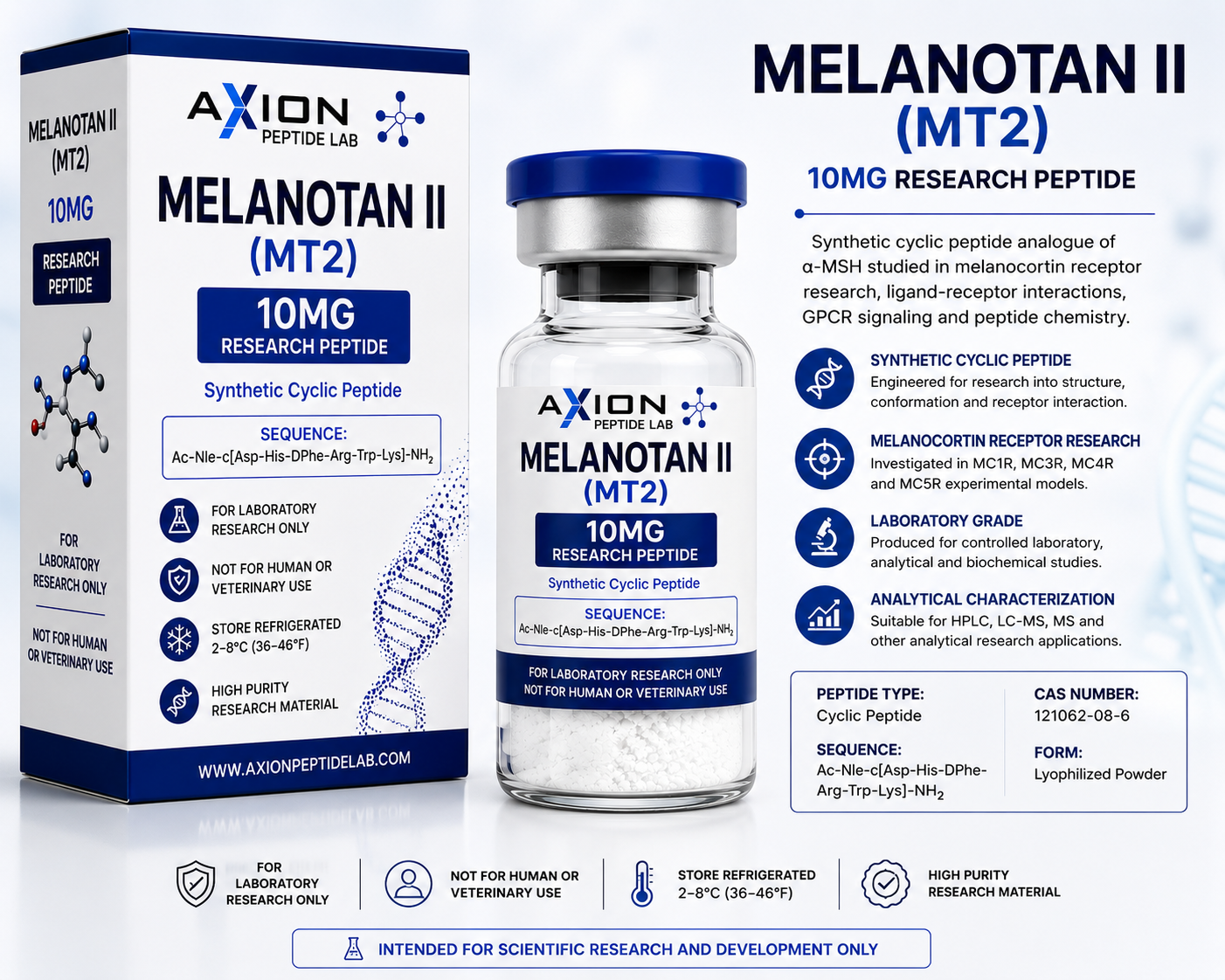
Melanotan II (MT2) 10mg Research Peptide is a synthetic cyclic melanocortin analogue intended for controlled laboratory and analytical investigation.
MT2 is relevant to experimental research involving melanocortin receptors, GPCR signalling, ligand-receptor interactions, cyclic peptide chemistry, structure-function relationships and analytical characterisation.
10mg represents the stated research quantity and is not a dosage recommendation.
For Research Use Only – Not for human or veterinary consumption or administration.
Melanotan II (MT2) 10mg Research Peptide from Axion Peptide Lab is a synthetic cyclic peptide research material intended exclusively for controlled laboratory, biochemical, receptor, peptide-chemistry and analytical investigation.
Melanotan II, frequently abbreviated MT2, is a synthetic analogue related to the naturally occurring melanocortin peptide alpha-melanocyte-stimulating hormone (α-MSH). Its modified cyclic structure has made MT2 a subject of experimental research involving melanocortin receptors, ligand-receptor interactions, peptide conformation and structure-function relationships.
The 10mg designation identifies the stated quantity of research material. It is not a dosage or administration recommendation.
Melanotan II is not being presented here as a medicine, cosmetic treatment or product for personal administration.
For Research Use Only – Not for human or veterinary consumption or administration.
Melanotan II is a synthetic cyclic peptide developed as part of scientific research into melanocortin peptide analogues.
The melanocortin system contains several receptors and endogenous peptide ligands involved in diverse biological processes. This provides researchers with a useful molecular framework for investigating receptor selectivity, ligand binding, signalling and peptide structure.
MT2 differs structurally from naturally occurring α-MSH. Researchers can use this distinction to explore how modifications to a peptide’s sequence and conformation influence experimentally measurable molecular characteristics. Melanotan II 10mg Research Peptide
Alpha-melanocyte-stimulating hormone is an endogenous melanocortin peptide derived from the proopiomelanocortin system.
Research into α-MSH helped scientists investigate how particular amino-acid regions contribute to melanocortin receptor interactions.
Melanotan II was developed as a modified analogue within this broader field of peptide research.
Comparative laboratory studies can examine differences between endogenous melanocortin peptides and synthetic analogues under carefully controlled experimental conditions.
Such research should not be interpreted as evidence supporting unsupervised personal use of MT2.
One of the defining characteristics of Melanotan II is its cyclic structure.
Cyclisation is an important strategy in peptide chemistry because constraining a peptide’s conformation can substantially alter its molecular properties.
Researchers may compare cyclic peptides with linear analogues to investigate conformational flexibility, receptor interactions, analytical behaviour and molecular stability.
MT2 therefore provides a useful model for controlled studies examining relationships between peptide cyclisation and experimentally observable biological or chemical characteristics. Melanotan II 10mg Research Peptide
Melanotan II has been extensively investigated within experimental melanocortin receptor systems.
The melanocortin receptor family includes several G-protein-coupled receptors, commonly designated MC1R, MC2R, MC3R, MC4R and MC5R.
Individual receptor subtypes differ in tissue distribution, endogenous ligand interactions and signalling characteristics.
Laboratory research involving MT2 may therefore investigate receptor binding, receptor activation, subtype selectivity and downstream signalling in appropriately designed experimental models.
MC1R is one of the receptor subtypes commonly investigated within melanocortin research.
Researchers can use receptor-expression systems and molecular assays to examine interactions between melanocortin ligands and MC1R. Melanotan II 10mg Research Peptide
Experimental work may investigate ligand concentration, receptor expression, signalling responses and structural characteristics.
These experiments provide information about receptor pharmacology under controlled conditions rather than instructions for human use.
MT2 has also appeared in experimental literature involving MC3R and MC4R.
Researchers may compare receptor-associated responses across different melanocortin receptor subtypes to explore ligand selectivity and structure-function relationships.
Because receptor systems can respond differently depending on experimental conditions, direct comparisons require appropriately standardised assays and suitable controls.
Findings obtained from receptor or cellular models should not automatically be extrapolated to clinical outcomes. Melanotan II 10mg Research Peptide
Melanocortin receptors belong to the G-protein-coupled receptor (GPCR) superfamily.
GPCRs represent a major area of molecular and pharmacological research.
MT2 can therefore be incorporated into controlled experiments investigating GPCR-associated signalling.
Researchers may examine ligand-receptor interactions, second-messenger responses, concentration-response relationships or receptor-specific signalling characteristics.
Experimental methodology should be selected according to the particular receptor and research objective. Melanotan II 10mg Research Peptide
Receptor-binding experiments can help researchers investigate how peptide structure influences molecular recognition.
Melanotan II may be compared with endogenous melanocortin ligands or other synthetic analogues.
Variables may include receptor subtype, peptide concentration, incubation conditions and competing ligands.
Appropriate controls are particularly important when attempting to distinguish specific receptor interactions from nonspecific effects.
MT2 is relevant to peptide structure-function research because it differs structurally from its naturally occurring peptide relatives. Melanotan II 10mg Research Peptide
Researchers can investigate how amino-acid substitution and conformational restriction influence measurable properties.
Comparative experiments may include linear peptides, cyclic analogues, sequence variants or related melanocortin compounds.
These studies contribute to broader understanding of peptide engineering and molecular recognition. Melanotan II 10mg Research Peptide
The three-dimensional conformation adopted by a peptide can influence its interactions with molecular targets.
Cyclisation can restrict the number of conformations available to a peptide compared with a more flexible linear structure.
Researchers studying MT2 can use suitable biophysical and analytical techniques to investigate conformational properties.
These experiments may contribute to broader research into rational peptide design.
Melanotan II may also be investigated using appropriately selected cultured-cell models.
Cells engineered to express particular melanocortin receptors can provide controlled systems for investigating receptor-associated responses.
Researchers can measure selected molecular endpoints after experimental exposure and compare responses across receptor subtypes or peptide variants.
Cell type, receptor density, experimental concentration and assay methodology can substantially influence observed results.
Melanocortin receptor activation can initiate intracellular signalling pathways.
Depending on the experimental system, researchers may investigate second messengers and other downstream molecular responses.
Controlled signalling studies can help establish concentration-response relationships and compare different receptor ligands.
The resulting observations should remain interpreted within the limitations of the experimental model.
Melanotan II research can incorporate several analytical methodologies.
Depending on the laboratory objective, these may include:
High-performance liquid chromatography (HPLC)
Liquid chromatography-mass spectrometry (LC-MS)
Mass spectrometry (MS)
Peptide-binding assays
Receptor-based assays
Spectroscopic techniques
Analytical methodology should be validated for the particular experimental application.
HPLC is widely used in peptide analytical research.
Appropriately developed chromatographic methods can help researchers examine peptide-related chromatographic characteristics and separate target material from detectable related species.
Column selection, mobile-phase composition, gradient conditions, temperature and detection method can influence analytical performance.
Claims regarding exact purity should be based on applicable batch-specific analytical documentation.
LC-MS combines chromatographic separation with mass analysis and can provide useful molecular information during peptide investigation. Melanotan II 10mg Research Peptide
Researchers may use mass-spectrometric techniques to examine molecular identity, selected degradation products or other experimentally relevant species.
Instrument parameters and sample preparation should be optimised according to the specific research objective. Melanotan II 10mg Research Peptide
Melanotan II may be incorporated into controlled stability experiments.
Researchers can investigate the influence of variables such as temperature, pH, light exposure, time and formulation conditions.
Samples may be collected at predefined intervals and examined using appropriate analytical techniques.
Storage requirements for a specific commercial research preparation should always be determined from applicable product or batch documentation rather than assumptions based on unrelated preparations. Melanotan II 10mg Research Peptide
The 10mg designation represents the stated amount of research material associated with this product.
It does not represent a recommended human or veterinary dose.
Axion Peptide Lab does not provide dosing, reconstitution, injection, nasal administration, tanning protocols or other personal-use instructions for Melanotan II.
Experimental quantities should be established by qualified researchers according to validated laboratory protocols.
Melanotan II may be relevant to controlled laboratory investigation involving melanocortin receptor biology, cyclic peptide chemistry, GPCR research, ligand-receptor interactions, peptide conformation, molecular signalling, structure-function relationships, comparative peptide analysis, HPLC, LC-MS, mass spectrometry and stability studies.
These represent scientific research categories and should not be interpreted as therapeutic, cosmetic or personal-use indications. Melanotan II 10mg Research Peptide
Axion Peptide Lab supplies Melanotan II (MT2) 10mg Research Peptide as a specialised material for legitimate laboratory and analytical investigation.
Its synthetic cyclic structure and relationship to the melanocortin peptide family make MT2 scientifically relevant to research involving receptor biology, peptide engineering, molecular recognition, GPCR signalling and analytical characterisation.
Researchers should review applicable specifications and batch documentation before conducting quantitative experiments.
For Research Use Only – Not for human or veterinary consumption or administration.
Melanotan II is a synthetic cyclic peptide analogue related to the melanocortin peptide α-MSH and is investigated in laboratory melanocortin-receptor and peptide-chemistry research.
MT2 is a commonly used abbreviation for Melanotan II.
Yes. MT2 is a synthetic cyclic peptide, making it relevant to research into conformational restriction and peptide structure-function relationships.
Experimental MT2 research commonly involves melanocortin receptors, including MC1R, MC3R, MC4R and MC5R, depending on the research model.
Yes. The five recognised melanocortin receptor subtypes belong to the G-protein-coupled receptor family. Melanotan II 10mg Research Peptide
Yes. Appropriately developed HPLC methods can be incorporated into analytical workflows involving peptide research.
Yes. LC-MS and other mass-spectrometric techniques can support molecular and analytical investigation of peptide materials. Melanotan II 10mg Research Peptide
10mg identifies the stated quantity of research material. It is not a recommended dose or administration instruction.
No. This product is supplied exclusively as a laboratory research material and is not intended for tanning, cosmetic use, human consumption or personal administration.
Research areas include melanocortin receptor biology, cyclic peptide chemistry, GPCR signalling, ligand-receptor interactions, structure-function studies, peptide conformation and analytical characterisation.