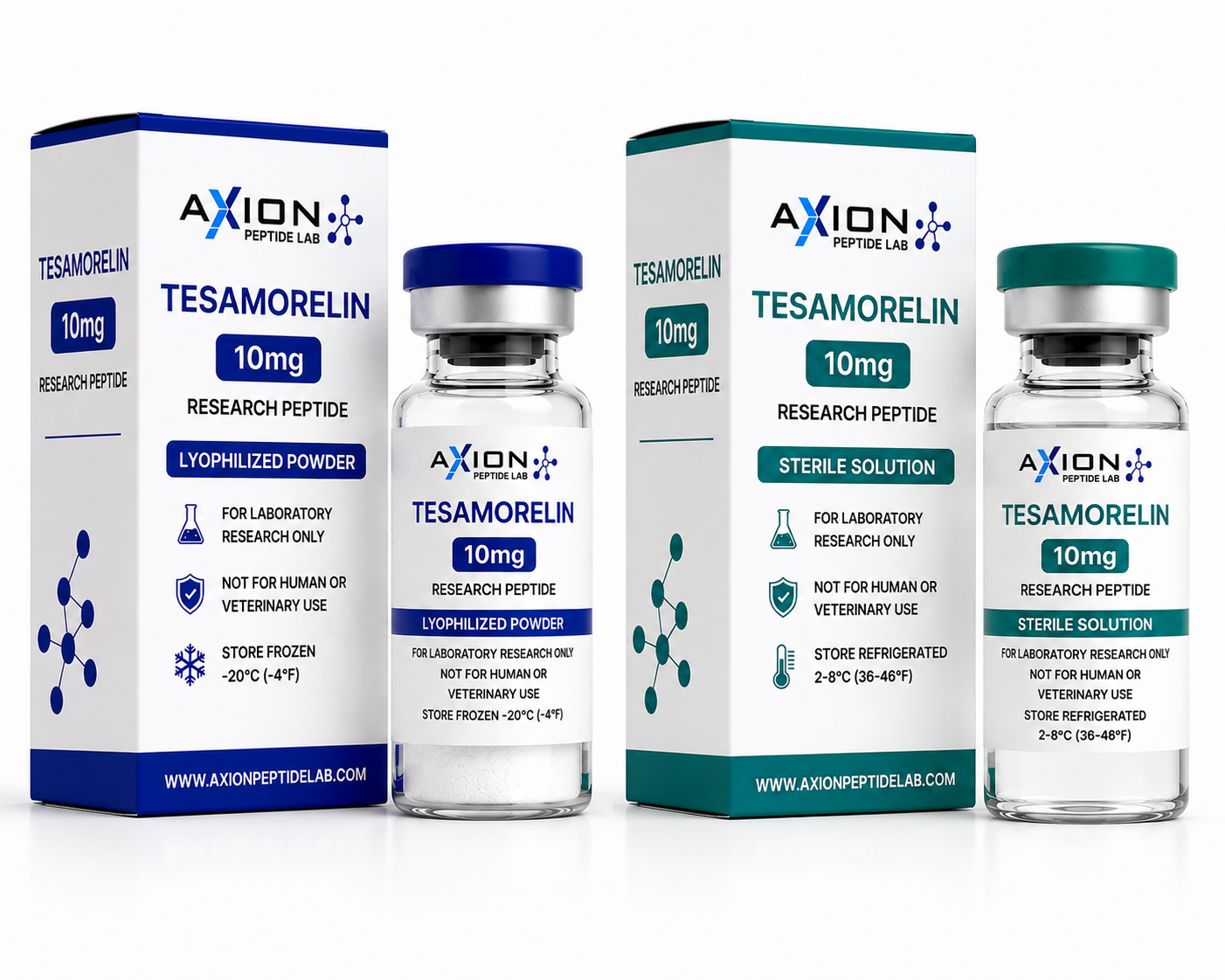
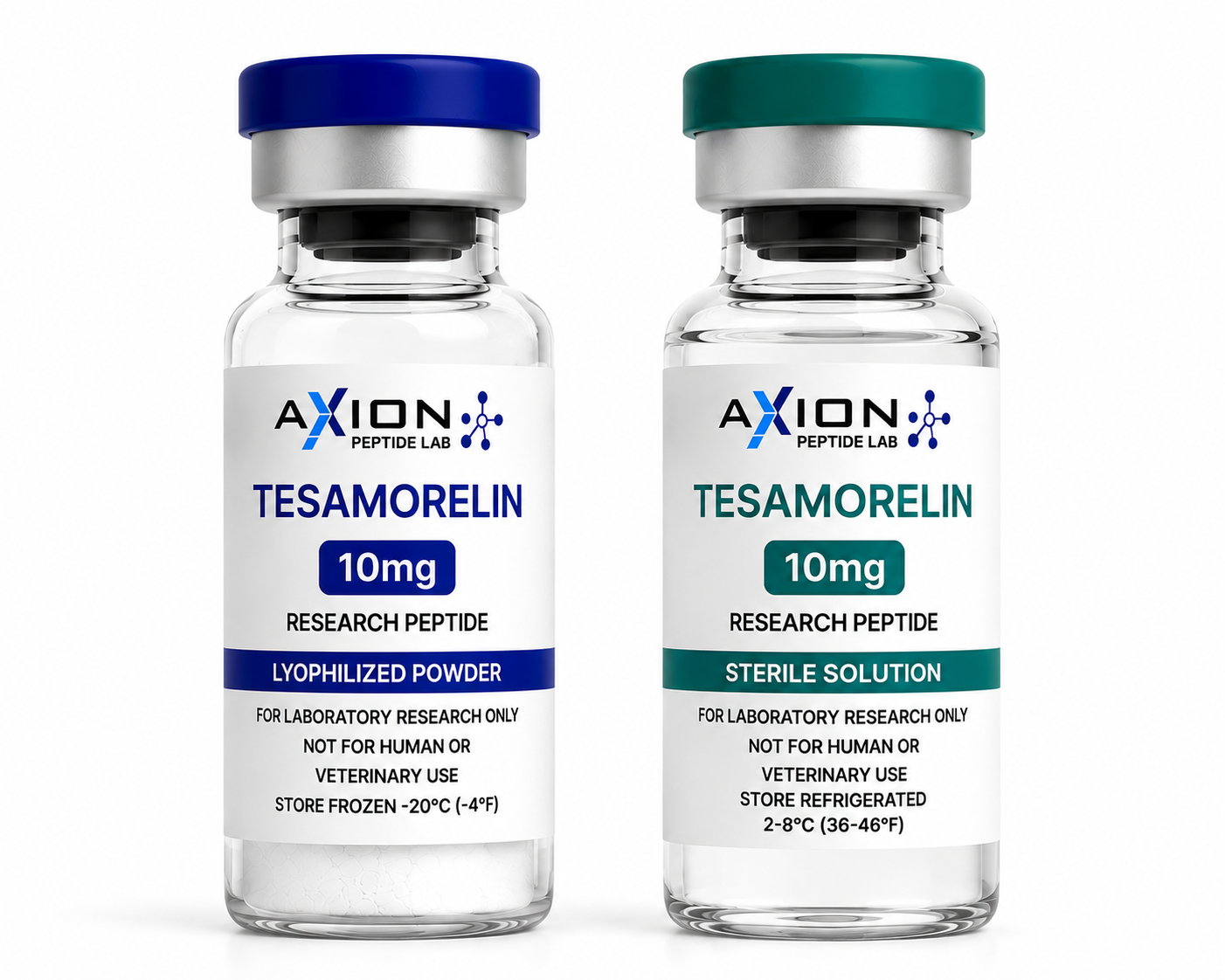
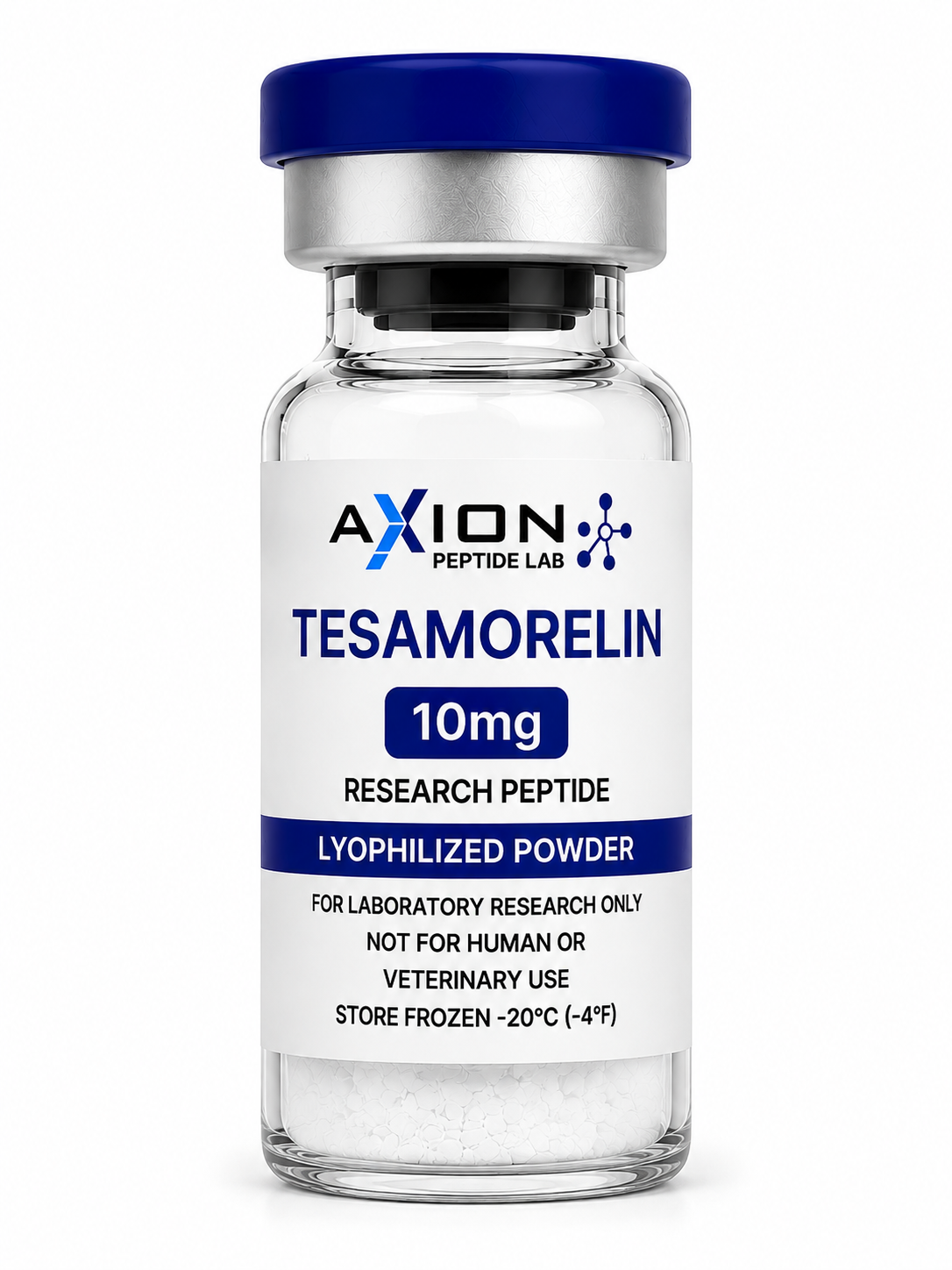
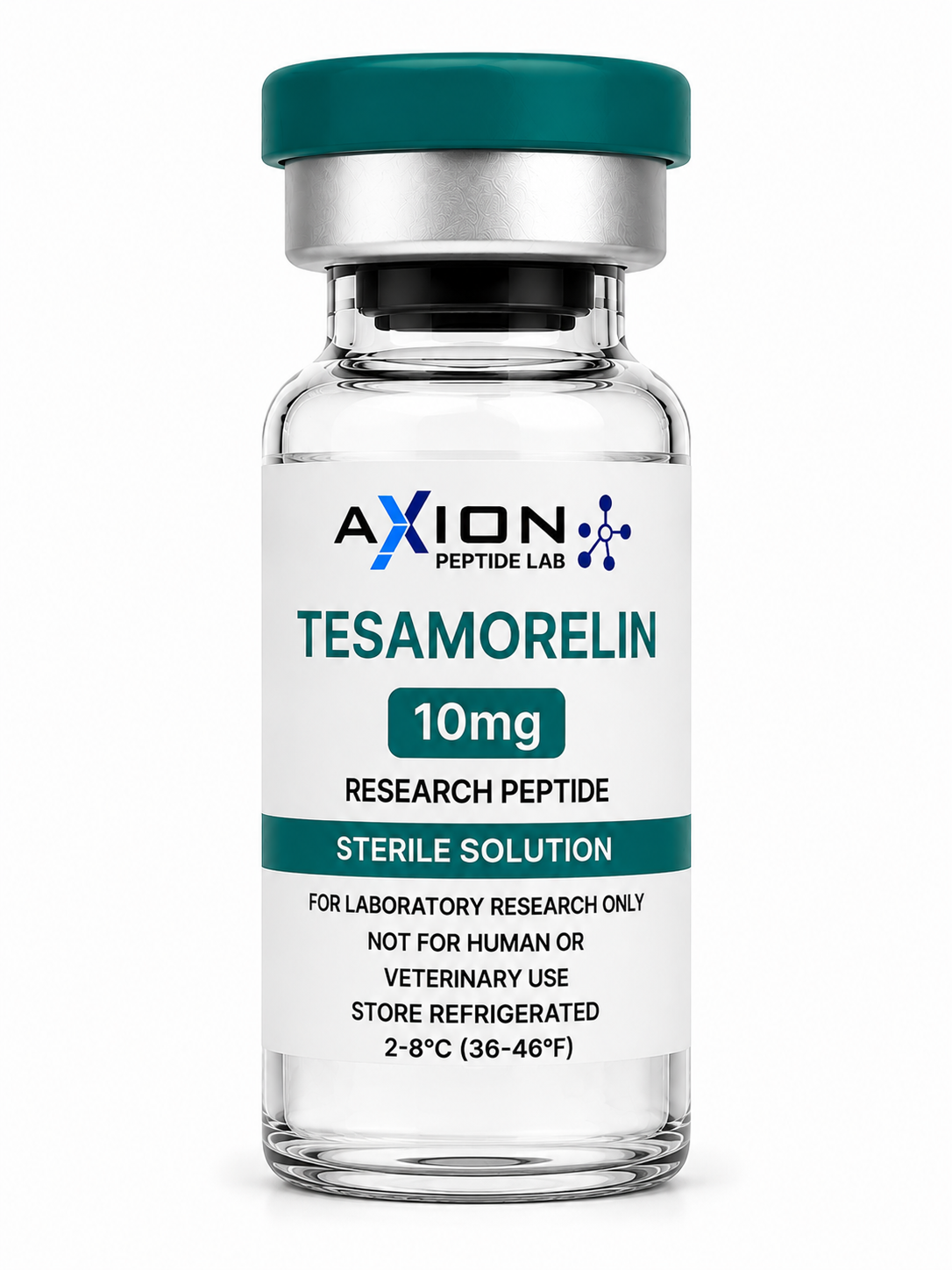
Tesamorelin 10mg Research Peptide is a synthetic 44-amino-acid GHRH analogue supplied for controlled laboratory investigation involving GHRH receptor biology, GPCR signalling, peptide-receptor interactions, molecular pharmacology, structure-function relationships, stability and analytical characterisation.
The 10mg designation represents the stated quantity of research material and is not a dosage recommendation. This independently supplied research material is not represented as an approved pharmaceutical tesamorelin product.
For Research Use Only – Not for human or veterinary consumption or administration.
$81.21 – $108.29Price range: $81.21 through $108.29
Tesamorelin 10mg Research Peptide from Axion Peptide Lab is supplied for controlled laboratory, molecular, biochemical and analytical research involving growth hormone-releasing hormone receptor biology, peptide-receptor interactions and GHRH-associated signalling.
Tesamorelin is a synthetic analogue of human growth hormone-releasing factor, also known as growth hormone-releasing hormone or GHRH. Structurally, tesamorelin consists of a 44-amino-acid peptide sequence with an N-terminal trans-3-hexenoic acid group.
Its relationship to endogenous GHRH makes tesamorelin an important molecular tool for experimental investigation of receptor signalling, peptide structure-function relationships, molecular pharmacology, stability and analytical peptide chemistry.
The 10mg designation represents the stated quantity of research material and is not a dosage or administration recommendation.
This independently supplied research product should not be confused with or represented as an FDA-approved tesamorelin pharmaceutical product.
For Research Use Only – Not for human or veterinary consumption or administration.
Tesamorelin is a synthetic peptide analogue of human GHRH.
GHRH is an endogenous hypothalamic peptide that interacts with the growth hormone-releasing hormone receptor, commonly abbreviated GHRHR.
Tesamorelin retains the 44-amino-acid framework associated with human GHRH while incorporating an N-terminal modification.
The modification differentiates tesamorelin structurally from the endogenous peptide and makes it particularly interesting for peptide structure-function research.
Laboratories can investigate tesamorelin in controlled experimental models involving receptor biology, molecular interactions and peptide characterisation.
Tesamorelin is composed of 44 amino-acid residues and incorporates a trans-3-hexenoic acid group at its N-terminus.
The peptide’s structure is important when interpreting analytical data or comparing tesamorelin with endogenous GHRH and other synthetic GHRH-related peptides.
Small modifications to peptide structure can affect properties such as stability, molecular interactions and experimentally measured receptor behaviour.
Researchers requiring exact molecular formula, molecular weight, salt form, counterion or other chemical specifications should consult documentation associated with the actual product and batch.
Product-specific analytical data should take priority over generic reference information.
One of the primary areas of tesamorelin research involves the growth hormone-releasing hormone receptor.
GHRHR belongs to the G protein-coupled receptor family.
Researchers can use appropriately characterised GHRH-related peptides to investigate ligand-receptor interactions and downstream molecular signalling.
Experimental systems may examine receptor activation, pathway responses or comparative behaviour among different GHRH analogues.
Tesamorelin’s defined structural relationship to GHRH makes it particularly relevant to this type of research.
Results should remain specific to the experimental model and should not automatically be interpreted as evidence for effects of an independently supplied research product in humans.
G protein-coupled receptors, or GPCRs, represent a major class of membrane receptors involved in cellular communication.
The GHRH receptor is part of this broad receptor family.
Researchers studying tesamorelin may investigate receptor-associated signalling under controlled laboratory conditions.
Experiments can compare ligand concentrations, receptor expression systems or modified peptide sequences.
Such research contributes to broader understanding of how peptide ligands interact with GPCRs and initiate intracellular signalling processes.
Appropriate controls and validated analytical endpoints are important when interpreting these experiments.
Peptide-receptor interactions depend on molecular shape, amino-acid sequence and chemical modifications.
Tesamorelin provides an experimental example of a modified GHRH-related peptide.
Researchers may compare tesamorelin with endogenous GHRH or other analogues to examine how structural differences influence receptor-associated behaviour.
These studies can contribute to molecular pharmacology, receptor biology and peptide design research.
Experimental conclusions should reflect the exact molecular identity of the research material used.
Batch documentation is therefore important for reproducibility.
Structure-function studies examine how molecular modifications influence the behaviour of a peptide.
Tesamorelin’s N-terminal modification makes it particularly interesting for comparative peptide research.
Scientists may investigate how modified GHRH-related peptides differ in stability, molecular interaction or analytical properties.
Experiments can also compare complete sequences with fragments or other synthetic analogues.
This type of research contributes to understanding relationships among peptide sequence, chemical modification and experimentally observed characteristics.
Peptides can undergo degradation through multiple chemical and enzymatic processes.
Stability therefore represents an important consideration in experimental design.
Researchers may investigate tesamorelin under controlled conditions to examine changes in molecular integrity over time.
Potential variables can include temperature, pH, solution composition and experimental environment.
Analytical techniques can be used to detect degradation products or changes in chromatographic behaviour.
Storage conditions should follow documentation associated with the specific Axion Peptide Lab product rather than generic recommendations for unrelated tesamorelin preparations.
Tesamorelin can be incorporated into analytical workflows involving peptide identity, molecular mass, chromatographic behaviour and degradation analysis.
Depending on laboratory capabilities, researchers may use high-performance liquid chromatography, mass spectrometry or other validated techniques.
Analytical characterisation is important for confirming that experimental material is appropriate for a particular study.
Researchers requiring a defined purity specification should review batch-specific analytical documentation.
Purity percentages should not be assumed from generic product descriptions.
Several synthetic peptides are associated with GHRH-related research.
Tesamorelin can therefore be incorporated into comparative experiments alongside other properly characterised GHRH analogues.
Researchers may investigate differences in structure, stability, receptor-associated behaviour or analytical characteristics.
Meaningful comparisons require careful documentation of the exact sequence and chemical form of every material used.
Researchers should also avoid transferring pharmacokinetic or clinical findings from one GHRH analogue directly to another without appropriate evidence.
Tesamorelin is relevant to molecular pharmacology because it provides a defined peptide ligand for investigating GHRH receptor-associated systems.
Experimental work may explore ligand-receptor interactions, signalling characteristics or molecular response patterns.
Researchers can also use tesamorelin in comparative pharmacology experiments involving structurally related peptides.
These applications are intended to investigate molecular mechanisms rather than provide clinical guidance.
Axion Peptide Lab’s research material is not represented as an approved pharmaceutical preparation.
Endogenous GHRH is produced naturally within biological systems.
Synthetic analogues are designed to retain selected structural or functional characteristics while incorporating specific molecular modifications.
Tesamorelin is one example of this approach.
Comparing endogenous peptides with synthetic analogues can help researchers understand how structural modifications influence experimental properties.
Such work is valuable in peptide chemistry and receptor biology.
However, researchers should clearly distinguish between endogenous GHRH, tesamorelin and other GHRH-related research materials when reporting results.
The 10mg designation describes the stated amount of tesamorelin research material associated with this product.
It does not represent a recommended human or veterinary dose.
Experimental quantities should be determined according to validated laboratory protocols, research objectives and institutional procedures.
Where experiments require molar calculations, researchers should use the confirmed molecular form and molecular weight provided by appropriate product documentation.
Axion Peptide Lab does not provide personal dosing, injection or administration guidance.
Controlled laboratory investigation may include:
These categories describe experimental research areas rather than medical indications.
Tesamorelin is unusual among research peptides because the molecule is also associated with an approved prescription pharmaceutical.
That does not mean every product containing or labelled tesamorelin is the approved medicine.
An independently supplied research peptide should be evaluated according to its own manufacturing, formulation, quality and analytical documentation.
The Axion Peptide Lab product described here is positioned exclusively as research material.
It should not be marketed as a generic substitute, equivalent medicine or alternative source of an approved prescription product.
Reproducible peptide research depends on accurate documentation.
Researchers should record product identity, batch information, experimental conditions and analytical methods.
Available batch documentation should be reviewed where molecular identity, purity or other specifications are important.
Certificate of Analysis and independent testing availability may vary according to product and batch.
Claims such as a particular purity percentage, sterility or pharmaceutical grade should only be made when supported by documentation for the actual supplied material.
Tesamorelin 10mg Research Peptide should be handled by appropriately trained personnel in suitable laboratory environments.
Research material should remain clearly labelled and separated from medicines, foods, supplements and consumer products.
Storage and handling should follow documentation associated with the specific research product.
Customers are responsible for ensuring that acquisition, possession, importation and experimental use comply with applicable regulations and institutional requirements.
Axion Peptide Lab supplies specialised research materials intended for controlled scientific and analytical applications.
Tesamorelin 10mg provides researchers with a GHRH-related peptide format suitable for appropriately designed experimental projects involving receptor biology, molecular signalling, peptide chemistry and analytical characterisation.
Researchers should review available product documentation to determine whether the material meets the requirements of their intended research workflow.
Qualified laboratories, researchers and scientific organisations can buy Tesamorelin 10mg Research Peptide from Axion Peptide Lab for legitimate laboratory and analytical investigation.
Its structural relationship to GHRH makes tesamorelin relevant to experimental work involving GHRH receptor biology, GPCR signalling, peptide structure-function relationships and molecular pharmacology.
This independently supplied research product should not be promoted for fat reduction, bodybuilding, anti-ageing, growth-hormone enhancement or treatment of any medical condition.
For Research Use Only – Not for human or veterinary consumption or administration.
Tesamorelin 10mg is a stated quantity of synthetic GHRH-analogue research material supplied for controlled laboratory, molecular and analytical investigation.
Yes. Tesamorelin is a synthetic peptide consisting of 44 amino-acid residues with an N-terminal modification.
Tesamorelin is structurally related to human growth hormone-releasing hormone, also known as growth hormone-releasing factor.
Tesamorelin is studied in relation to the growth hormone-releasing hormone receptor, abbreviated GHRHR.
Yes. The growth hormone-releasing hormone receptor belongs to the G protein-coupled receptor family.
Research areas include GHRH receptor biology, GPCR signalling, peptide-receptor interactions, structure-function investigation, molecular pharmacology and analytical characterisation.
The 10mg designation represents the stated quantity of research material. It is not a dosage recommendation.
No. Independently supplied research material should not be represented as equivalent to an approved pharmaceutical product without the relevant regulatory and manufacturing basis.
No. The product is intended strictly for laboratory research, and human dosing, injection or administration instructions are not provided.
Qualified research customers can purchase Tesamorelin 10mg Research Peptide from Axion Peptide Lab for legitimate laboratory and analytical applications, subject to availability and applicable requirements.