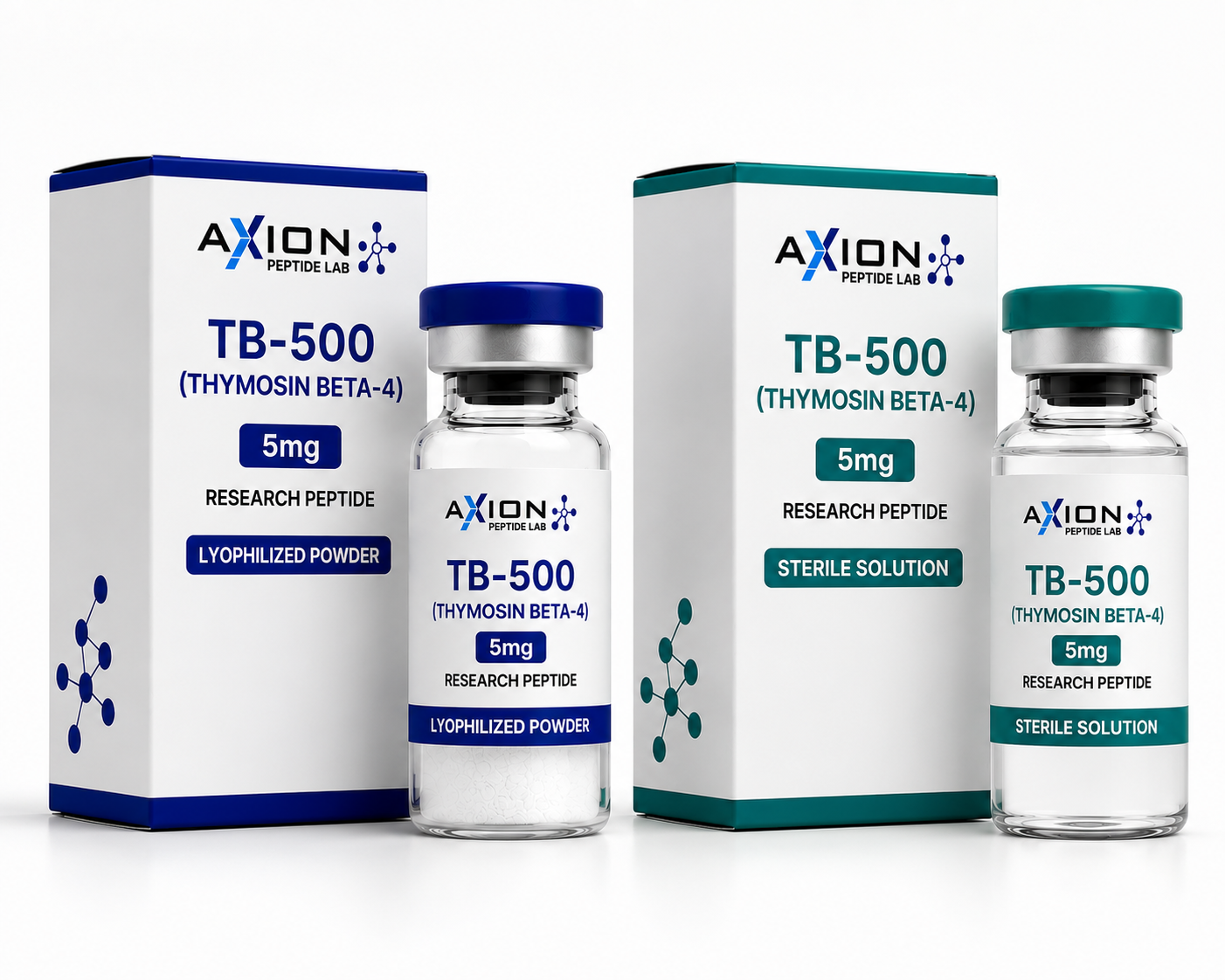
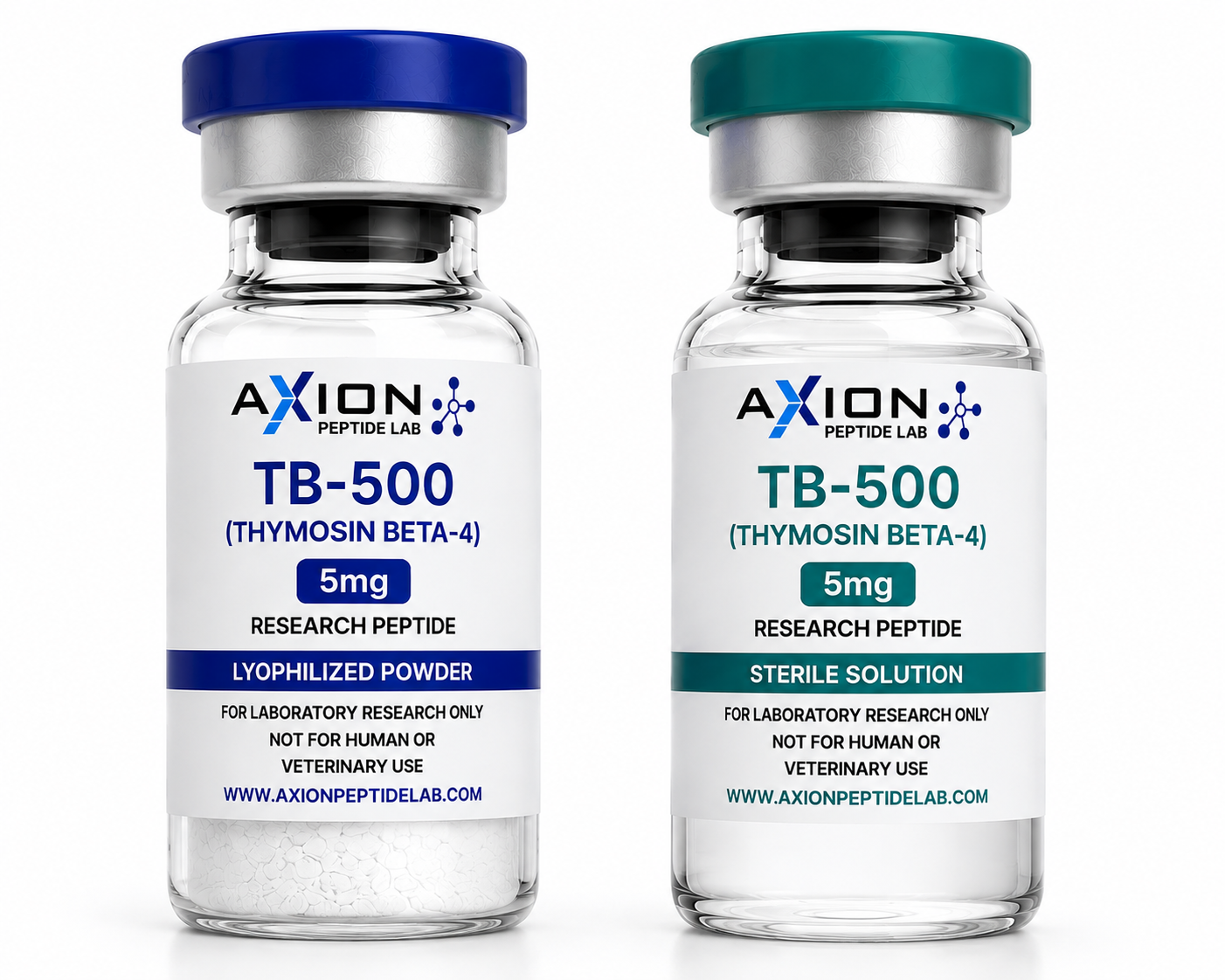
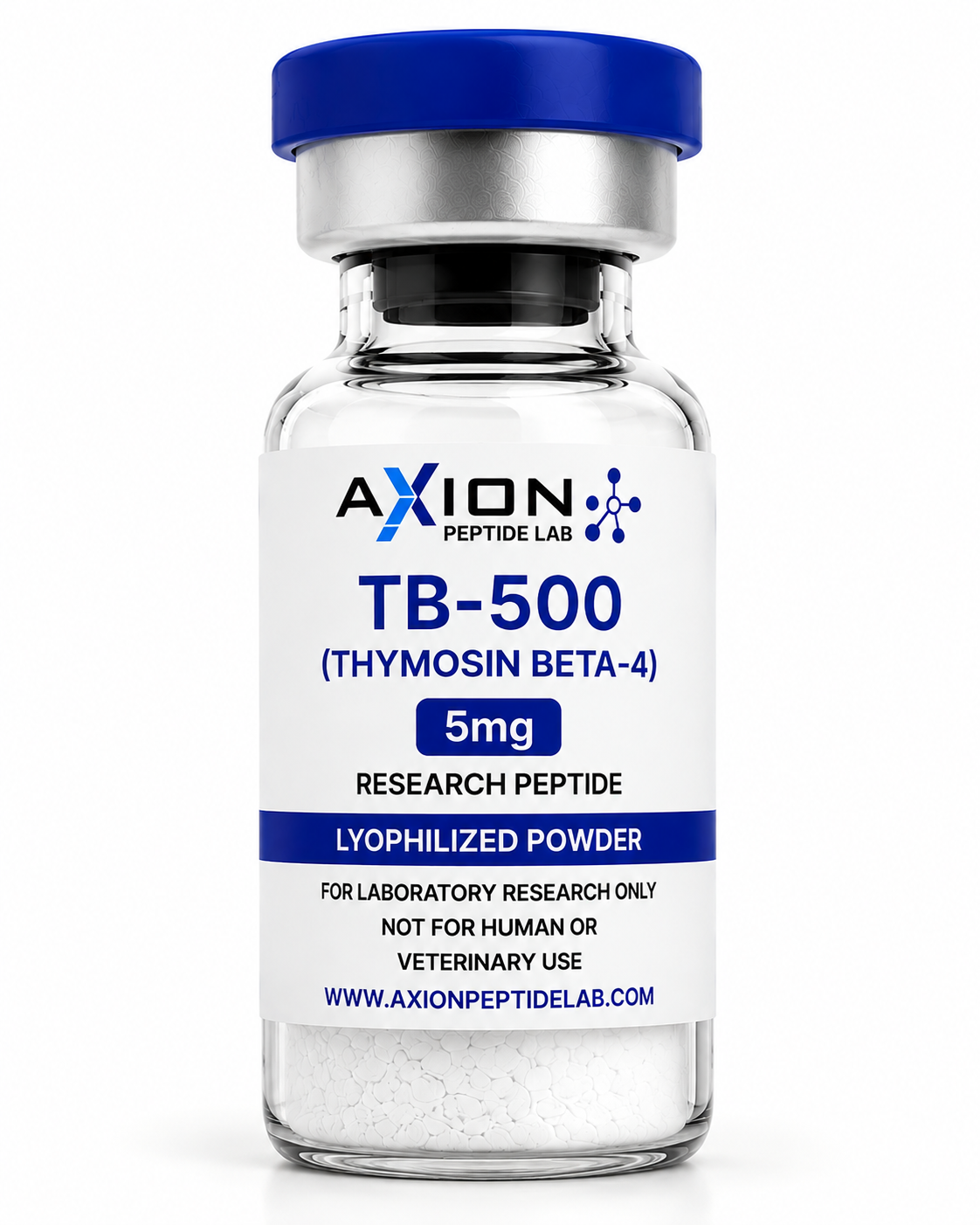
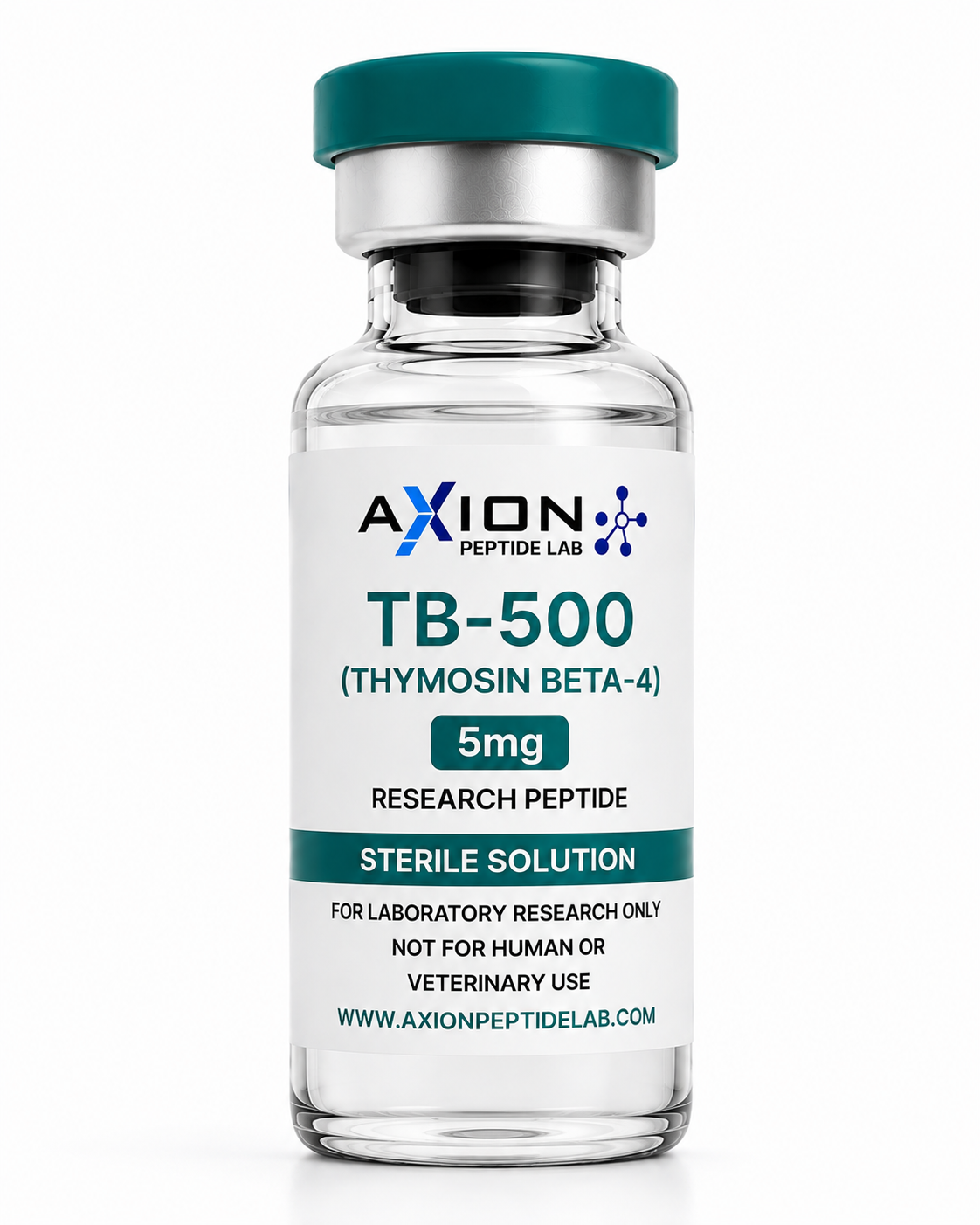
TB-500 (Thymosin Beta-4) 5mg Research Peptide is supplied for controlled laboratory investigation involving thymosin-related peptide chemistry, actin-associated molecular interactions, cytoskeletal biology, peptide structure-function relationships, stability and analytical characterisation.
Because commercial TB-500 terminology can vary, researchers requiring full-length thymosin beta-4 or another defined sequence should verify exact molecular identity from the product documentation.
The 5mg designation represents the stated research quantity and is not a dosage recommendation.
For Research Use Only – Not for human or veterinary consumption or administration.
$36.54 – $63.62Price range: $36.54 through $63.62
TB-500 (Thymosin Beta-4) 5mg Research Peptide from Axion Peptide Lab is supplied for controlled laboratory, biochemical, molecular and analytical investigation involving thymosin-beta-4-related peptide systems.
Thymosin beta-4 is a naturally occurring peptide that has attracted significant scientific attention because of its interactions with actin and its broader role in cellular biology. TB-500 terminology is commonly associated with thymosin-beta-4-related research materials, although researchers should carefully distinguish commercially labelled TB-500 from full-length thymosin beta-4 unless the exact molecular identity has been confirmed.
This 5mg research format can support appropriately designed experiments involving peptide chemistry, actin-associated mechanisms, cytoskeletal biology, molecular interactions, peptide stability and analytical characterisation.
The 5mg designation represents the stated quantity of research material and is not a dosage recommendation.
For Research Use Only – Not for human or veterinary consumption or administration.
Thymosin beta-4, commonly abbreviated Tβ4, is a naturally occurring peptide consisting of 43 amino-acid residues.
It belongs to the beta-thymosin family and is found in many mammalian tissues and cell types.
One of the best-established biochemical characteristics of thymosin beta-4 is its ability to interact with monomeric, or G-actin.
This interaction has made thymosin beta-4 an important molecule in research involving actin dynamics, cytoskeletal regulation and cellular processes influenced by actin organisation.
Researchers studying commercially supplied TB-500 material should nevertheless verify whether their product represents full-length thymosin beta-4 or another related peptide form.
The term TB-500 is widely used in the research peptide market, but its meaning is not always chemically precise.
Some suppliers use TB-500 as a commercial name associated broadly with thymosin beta-4, while other materials described under the same term may represent thymosin-beta-4-related sequences or fragments.
For rigorous scientific work, the commercial product name alone is not sufficient to establish molecular identity.
Researchers should review available documentation for information such as amino-acid sequence, molecular mass, salt form and analytical characterisation.
This distinction is especially important when comparing experimental results with peer-reviewed literature involving full-length thymosin beta-4.
One of the most established research areas involving thymosin beta-4 concerns its interaction with G-actin.
Actin is a highly conserved cellular protein that exists in monomeric and filamentous states.
Thymosin beta-4 can bind monomeric actin and is therefore frequently discussed as an actin-sequestering peptide.
Researchers have investigated this interaction to better understand actin availability, polymerisation dynamics and cytoskeletal organisation.
TB-500 or appropriately identified thymosin-beta-4-related research material may therefore be useful in experimental models examining peptide-actin interactions.
The cytoskeleton provides structural organisation within cells and contributes to numerous dynamic cellular processes.
Actin filaments represent one of its major components.
Because thymosin beta-4 interacts with actin, it has become relevant to research examining how cells regulate cytoskeletal structure.
Laboratory experiments may investigate peptide-protein interactions, actin polymerisation, cellular morphology and other measurable aspects of cytoskeletal biology.
Results depend on the precise experimental system and peptide identity.
Findings from these experiments should remain within their scientific context and should not be converted into claims that a commercial TB-500 product repairs human tissues or treats injuries.
TB-500-related materials may also be investigated as part of broader peptide-protein interaction research.
Peptides can interact with proteins through highly specific structural mechanisms.
Understanding these relationships helps researchers investigate how amino-acid sequence and molecular conformation influence biological interactions.
Thymosin beta-4’s established relationship with actin provides an experimentally relevant model.
Researchers may compare different thymosin-derived sequences or fragments to determine how structural modifications affect measured molecular interactions.
Such comparative work requires accurate identification of every peptide included in the experiment.
Structure-function research examines how the molecular structure of a peptide relates to its experimentally observed behaviour.
Full-length thymosin beta-4 contains 43 amino acids, providing numerous potential sites for molecular interaction.
Researchers can compare the complete peptide with shorter sequences or modified analogues to investigate which structural regions contribute to particular interactions.
This can provide insight into peptide-protein recognition, molecular stability and sequence-dependent behaviour.
For commercially labelled TB-500, exact sequence documentation is therefore particularly valuable.
Researchers should avoid assuming that findings from one thymosin-beta-4-derived sequence automatically apply to another. TB-500 5mg Research Peptide
Thymosin-beta-4-related materials have been investigated in a variety of experimental cellular models.
Laboratories may examine cellular responses using controlled culture conditions and validated analytical endpoints.
Depending on the study, researchers can monitor protein interactions, cytoskeletal organisation, molecular signalling or changes in cellular markers.
Appropriate controls are essential.
Experimental observations should be interpreted according to the specific cell type, peptide identity, concentration and methodology employed.
Cellular research does not establish clinical effectiveness or safety in humans.
Research surrounding thymosin beta-4 extends beyond its direct interaction with actin.
Experimental studies have investigated relationships between thymosin beta-4 and different molecular signalling processes. TB-500 5mg Research Peptide
These investigations can provide researchers with opportunities to explore how peptide-protein interactions connect with broader cellular pathways.
TB-500-related research material may therefore be incorporated into appropriately designed molecular biology studies.
However, researchers should distinguish established biochemical properties from proposed downstream mechanisms. TB-500 5mg Research Peptide
Claims should reflect the strength and limitations of available experimental evidence.
Analytical characterisation is particularly important for TB-500 because commercial terminology is variable.
Laboratories may use suitable analytical techniques to investigate peptide identity, molecular mass, chromatographic behaviour, purity profile and degradation products.
Depending on available equipment, this can include chromatography and mass-spectrometry-based approaches.
Researchers should compare analytical results with the expected characteristics of the specific sequence being investigated.
Where exact molecular identity matters, batch-specific analytical documentation should take priority over generic descriptions found online. TB-500 5mg Research Peptide
Peptide stability can significantly influence experimental reproducibility.
Environmental conditions can affect molecular integrity over time.
Researchers may investigate TB-500-related material under controlled conditions to examine degradation patterns and changes in analytical characteristics.
Variables such as temperature, solution composition, pH and time can potentially influence peptide stability.
Product-specific storage information should therefore be obtained from the documentation supplied with the actual research material.
Generic storage recommendations for another thymosin product should not automatically be applied to this SKU. TB-500 5mg Research Peptide
The beta-thymosin family provides opportunities for comparative molecular research.
Researchers can compare full-length thymosin beta-4 with related peptides, fragments or modified sequences.
Such experiments may help identify structural regions associated with actin binding or other molecular interactions.
Comparative research can also investigate differences in stability and analytical profiles.
Precise nomenclature becomes especially important in these experiments.
A study using full-length thymosin beta-4 should not be represented as studying an unspecified TB-500 material unless analytical documentation confirms equivalence.
The 5mg designation identifies the stated quantity of research material supplied with this product.
It does not represent a recommended human or veterinary dose.
Laboratories should determine experimental quantities according to validated protocols, research objectives and institutional requirements.
Where calculations depend on molecular concentration, researchers should use the confirmed molecular identity and molecular mass of the supplied material.
Axion Peptide Lab does not provide personal dosing, injection, administration or self-experimentation instructions. TB-500 5mg Research Peptide
TB-500-related research material may be relevant to controlled investigation involving:
These are scientific research categories rather than therapeutic indications. TB-500 5mg Research Peptide
Reliable peptide research depends on accurate documentation.
Researchers should record product identity, batch information, experimental conditions and analytical methodology.
For TB-500, exact sequence information is particularly important because commercial naming practices vary.
Where available, a Certificate of Analysis or other analytical documentation can provide information relevant to the specific batch.
Independent testing availability may vary according to product and batch.
Specific purity percentages, identity claims or other analytical specifications should only be published when supported by appropriate documentation.
TB-500 (Thymosin Beta-4) 5mg Research Peptide should be handled by trained personnel in appropriate research environments.
The material should remain clearly labelled and separated from medicines, foods, supplements and consumer products.
Researchers should follow product-specific storage documentation and suitable laboratory safety procedures.
Customers are responsible for ensuring that purchase, possession, importation and experimental use comply with applicable laws and institutional requirements. TB-500 5mg Research Peptide
Axion Peptide Lab supplies specialised research materials intended for controlled scientific and analytical applications.
The TB-500 5mg research format is intended for appropriately designed experiments involving thymosin-related peptide chemistry, actin-associated mechanisms, cytoskeletal biology and analytical peptide research.
Researchers should review available product specifications and documentation before purchase, particularly when their experimental design requires full-length thymosin beta-4 or another precisely defined sequence.
Qualified laboratories, scientific organisations and researchers can buy TB-500 (Thymosin Beta-4) 5mg Research Peptide from Axion Peptide Lab for legitimate laboratory and analytical investigation.
The relationship between thymosin beta-4 and actin makes this family of peptides relevant to cytoskeletal and molecular interaction research.
TB-500 should not be marketed as an injury-healing treatment, muscle-building product, athletic-recovery compound or therapeutic medicine. TB-500 5mg Research Peptide
For Research Use Only – Not for human or veterinary consumption or administration.
TB-500 is a commercial term used for thymosin-beta-4-related research material. The 5mg designation represents the stated quantity supplied for laboratory investigation.
Thymosin beta-4 is a naturally occurring 43-amino-acid beta-thymosin peptide extensively studied for its interaction with monomeric actin.
Not necessarily. TB-500 terminology is used inconsistently commercially, so the exact sequence and molecular identity of a product should be verified from its documentation.
G-actin is the monomeric form of actin. Individual G-actin molecules can participate in the formation of filamentous actin structures.
A well-established biochemical property of thymosin beta-4 is its ability to bind monomeric actin, making it relevant to experimental research involving actin dynamics.
Research can include peptide chemistry, actin interactions, cytoskeletal biology, peptide-protein interactions, structure-function investigation and analytical characterisation.
It represents the stated quantity of research material in the product and is not a human dosage recommendation.
No. Researchers should first verify whether the supplied material has the same molecular identity as the peptide used in the cited study.
No. The material is supplied strictly for laboratory research, and human dosing, injection or self-experimentation guidance is not provided. TB-500 5mg Research Peptide
Qualified research customers can purchase TB-500 5mg Research Peptide from Axion Peptide Lab for legitimate laboratory and analytical investigation, subject to availability and applicable requirements.