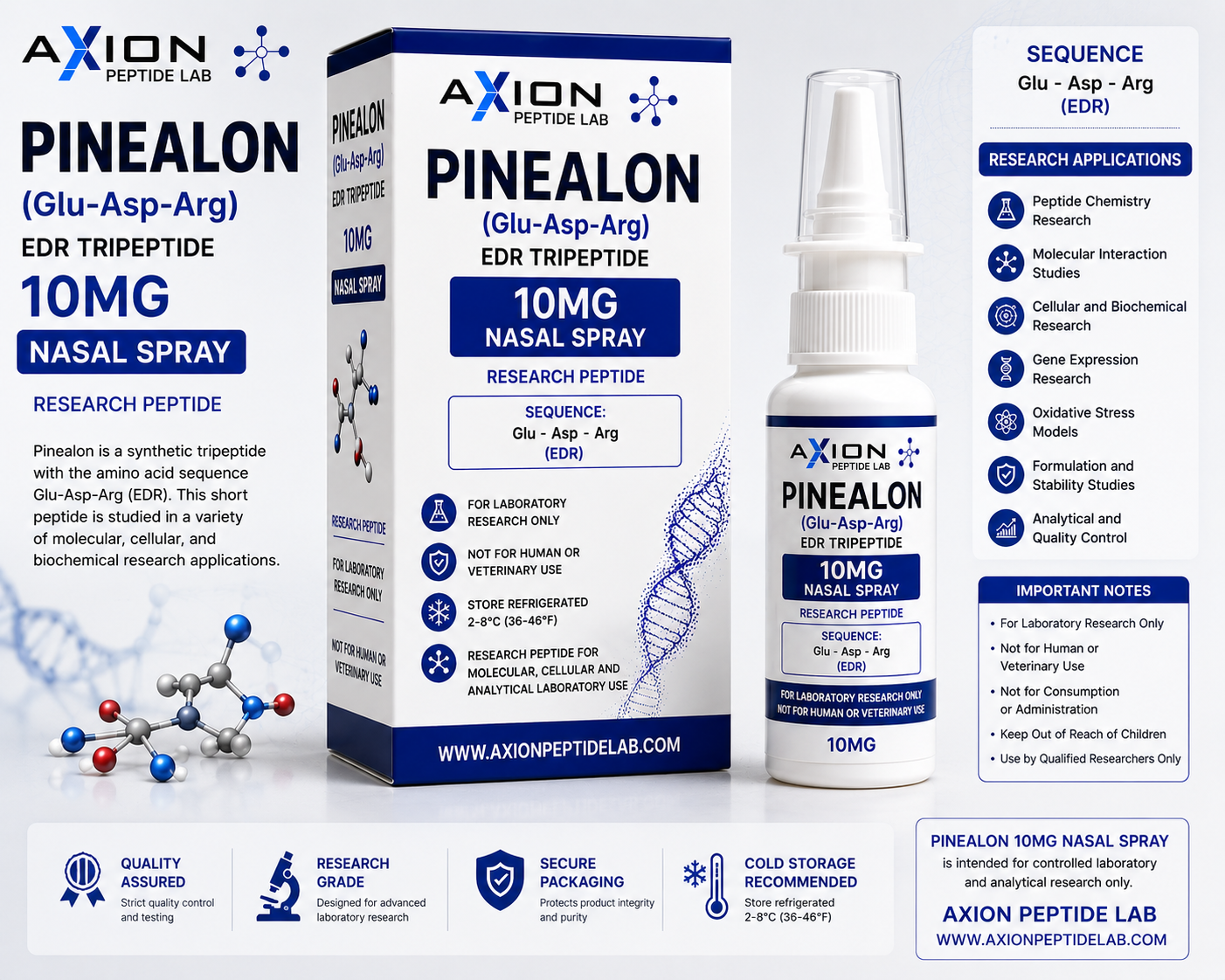
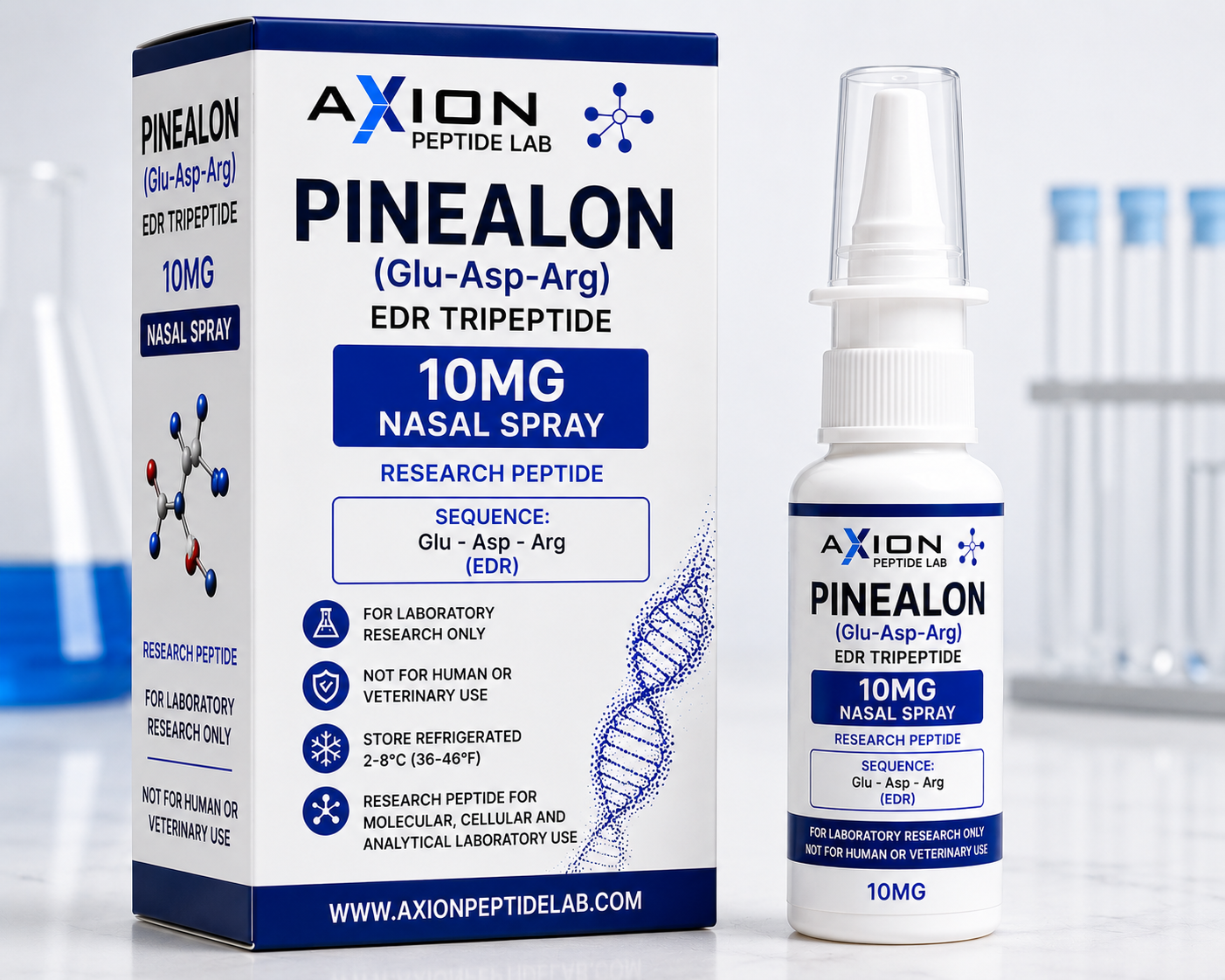
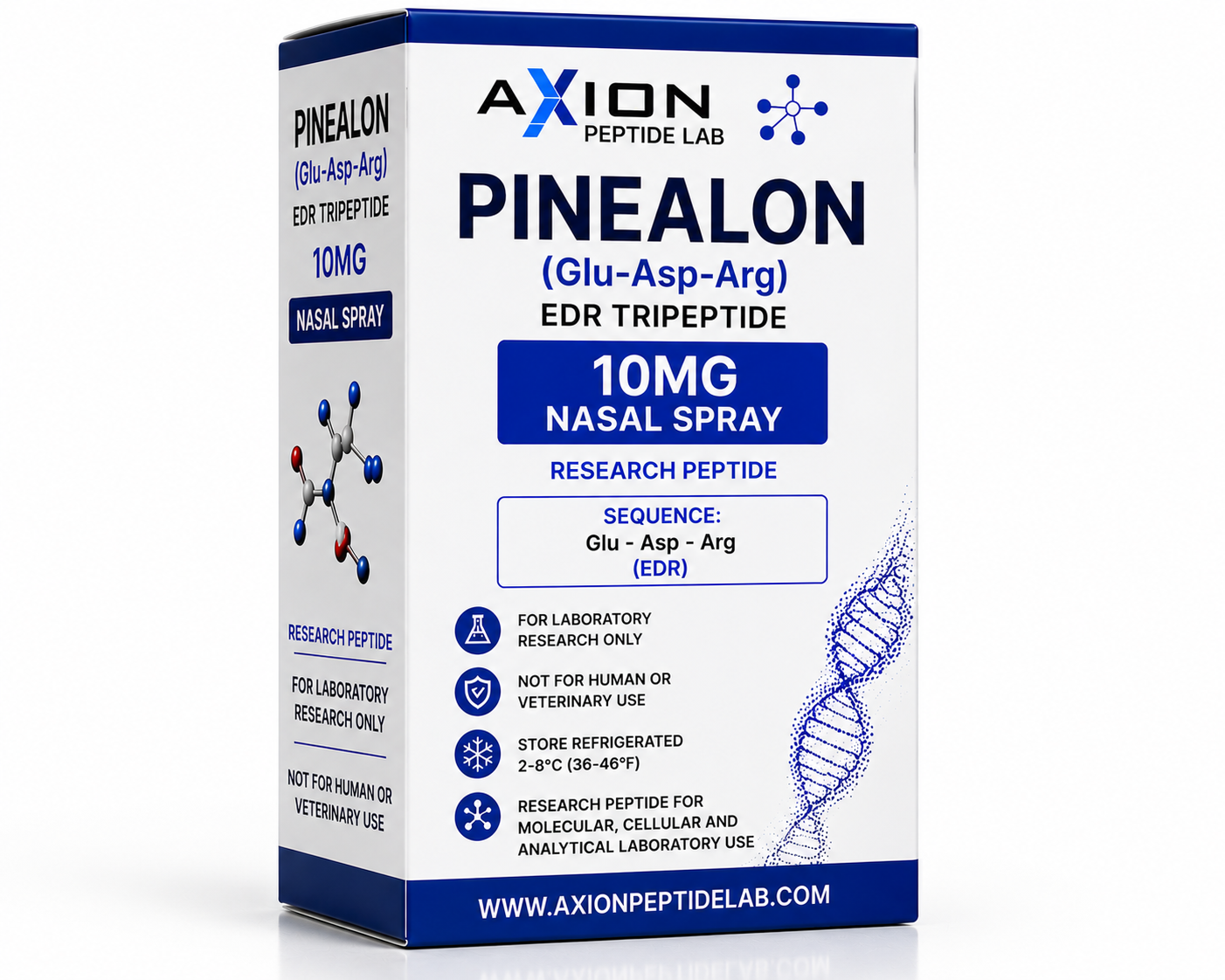
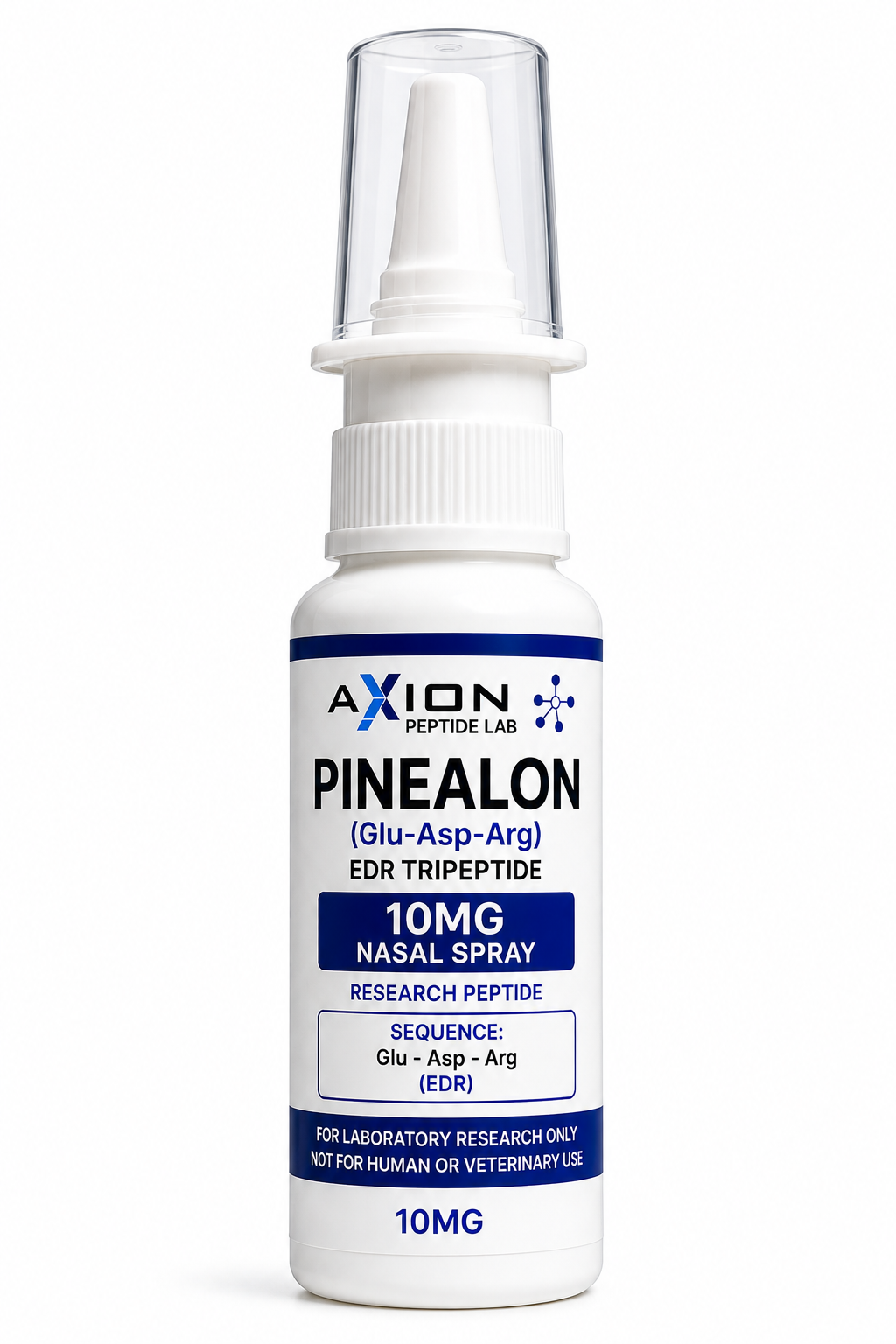
Pinealon 10mg Nasal Spray is a short synthetic tripeptide research preparation based on the amino-acid sequence Glu-Asp-Arg (EDR).
Its compact three-residue structure makes Pinealon relevant to controlled short-peptide chemistry, molecular interaction, cellular, structure-function, formulation, stability and analytical laboratory research.
10mg represents the stated research quantity and is not a dosage recommendation. Nasal Spray describes the physical research presentation only.
For Research Use Only – Not for human or veterinary consumption or administration.
$108.29 Original price was: $108.29.$94.76Current price is: $94.76.
Pinealon 10mg Nasal Spray from Axion Peptide Lab is a short synthetic tripeptide research preparation intended for controlled peptide chemistry, molecular biology, cellular, formulation, stability and analytical laboratory investigation.
Pinealon is commonly identified by the three-amino-acid sequence Glu-Asp-Arg, abbreviated EDR. Its unusually compact structure makes it an interesting material for laboratories investigating short-peptide behaviour, peptide-molecular interactions, structure-function relationships and experimental cellular systems.
Unlike considerably larger polypeptides, Pinealon contains only three amino-acid residues. This simple architecture provides researchers with a manageable model for studying how very short peptide sequences interact with biological and chemical environments under controlled experimental conditions.
The 10mg designation represents the stated quantity of research material associated with this preparation and is not a dosage recommendation. “Nasal Spray” describes the physical research presentation only and does not constitute instructions for human administration.
For Research Use Only – Not for human or veterinary consumption or administration.
Pinealon is the name commonly associated with the synthetic tripeptide Glu-Asp-Arg (EDR).
The abbreviation EDR is derived from the standard one-letter amino-acid codes:
E – Glutamic acid (Glu)
D – Aspartic acid (Asp)
R – Arginine (Arg)
This three-residue structure places Pinealon among the shortest peptide materials investigated experimentally.
Short peptides are particularly interesting because relatively small changes in sequence, charge or environmental conditions can alter their molecular interactions.
Researchers can therefore use EDR within carefully designed comparative experiments involving other short peptide sequences. Pinealon 10mg Nasal Spray
The compact architecture of Pinealon makes it relevant to fundamental peptide chemistry.
Glutamic acid and aspartic acid contribute acidic side chains, while arginine contains a basic guanidinium group.
These different chemical characteristics create opportunities to investigate electrostatic behaviour and intermolecular interactions.
Researchers may examine how variables including pH, ionic strength, temperature and buffer composition affect experimentally measurable characteristics of EDR. Pinealon 10mg Nasal Spray
Such experiments can contribute to a broader understanding of short-peptide chemistry.
Pinealon has been investigated experimentally for its interactions with molecular targets.
Published research has examined EDR interactions with DNA using analytical approaches including spectroscopy, nuclear magnetic resonance and molecular-dynamics techniques.
These studies make the tripeptide relevant to laboratory investigation of peptide-nucleic-acid relationships.
Such findings should be interpreted within the conditions of the individual experimental systems and should not be translated directly into therapeutic claims. Pinealon 10mg Nasal Spray
Short peptide interactions with DNA represent an interesting area of molecular research.
Experimental studies involving Glu-Asp-Arg have examined how the peptide behaves in the presence of DNA and how factors such as ions may influence those interactions.
Researchers can design controlled experiments to evaluate molecular binding behaviour, environmental effects and sequence-dependent interactions. Pinealon 10mg Nasal Spray
This provides a useful framework for exploring fundamental peptide-nucleic-acid chemistry.
Pinealon has also appeared in experimental cellular research.
Published studies have investigated the peptide in different cellular systems under defined laboratory conditions.
For example, EDR has been examined in oxidative-stress-related experimental models and short-peptide cellular interaction studies.
Researchers interested in reproducing or extending these observations should carefully control cell type, peptide concentration, incubation duration and analytical endpoints.
Results from cellular models should not automatically be assumed to predict effects in humans.
Some experimental Pinealon research has focused on cellular oxidative-stress systems.
Investigators have examined variables including reactive oxygen species and cellular responses under experimentally induced stress. Pinealon 10mg Nasal Spray
These studies make EDR relevant as a laboratory material for researchers investigating short-peptide behaviour within oxidative-stress models.
However, observations from isolated cells or animal experiments do not establish that a commercial Pinealon research preparation prevents or treats oxidative-stress-related conditions in people.
EDR has also been investigated in experimental models involving gene expression and molecular regulation.
Short peptides are of scientific interest because their compact structures may permit interactions with cellular components that can be studied using modern molecular techniques.
Researchers may examine predefined gene-expression endpoints under controlled conditions.
These studies can involve molecular assays, cell cultures and computational approaches.
Claims regarding specific regulatory effects should always remain tied to the experimental model and supporting evidence. Pinealon 10mg Nasal Spray
Structure-function research explores relationships between a molecule’s architecture and experimentally measurable behaviour.
Pinealon provides a particularly compact model because it contains only three residues.
Researchers may compare EDR with related dipeptides, tripeptides and longer sequences to investigate how residue composition influences molecular interactions.
Sequence substitution studies may also provide information about the contribution of individual amino acids. Pinealon 10mg Nasal Spray
This makes Pinealon useful for fundamental peptide-design and comparative chemistry research.
Laboratories may incorporate Pinealon into experiments alongside other short peptides.
Comparative studies can help researchers determine whether observed characteristics are sequence-specific or represent broader properties of short peptides.
Experiments should use equivalent conditions whenever meaningful comparisons are required.
Important variables can include concentration, temperature, buffer system, assay duration and analytical technique. Pinealon 10mg Nasal Spray
The liquid spray presentation creates opportunities for controlled formulation research.
Researchers may investigate physical and chemical properties of EDR within a defined liquid environment.
Possible experimental variables include solution composition, pH, light exposure, temperature, container compatibility and storage duration. Pinealon 10mg Nasal Spray
The term “Nasal Spray” on this product identifies its physical spray presentation. It does not represent instructions or a recommendation for intranasal administration to people or animals.
Peptide stability is an important area of laboratory research.
Researchers can investigate Pinealon under predefined environmental conditions and analyse samples at established time intervals.
Controlled stability experiments can examine how changes in variables affect measurable chemical characteristics.
Analytical methods may then be used to detect changes in the research material.
Storage conditions for the commercial preparation should follow documentation for the specific product rather than being inferred from unrelated peptide preparations. Pinealon 10mg Nasal Spray
High-performance liquid chromatography (HPLC) is widely used in peptide analytical research.
Appropriately developed HPLC methods may help laboratories examine chromatographic characteristics of EDR-containing materials. Pinealon 10mg Nasal Spray
Researchers can investigate retention behaviour, related molecular species and changes occurring during controlled stability studies.
Any numerical purity statement should be supported by documentation for the specific batch being evaluated. Pinealon 10mg Nasal Spray
Liquid chromatography-mass spectrometry (LC-MS) can provide additional information during peptide characterisation. Pinealon 10mg Nasal Spray
The combination of chromatographic separation and mass analysis can support molecular identification and investigation of related species.
Researchers conducting quantitative studies should use suitable reference materials, validated procedures and calibrated instrumentation where appropriate. Pinealon 10mg Nasal Spray
Analytical conclusions should remain within the limitations of the methodology used.
Published EDR research has incorporated spectroscopic and nuclear magnetic resonance techniques when examining molecular interactions.
These analytical approaches may provide useful information about short-peptide behaviour under controlled conditions. Pinealon 10mg Nasal Spray
Researchers can combine complementary techniques when greater structural or interaction information is required. Pinealon 10mg Nasal Spray
Method selection should reflect the hypothesis and characteristics of the experimental system.
The 10mg designation represents the stated amount of Pinealon associated with this research preparation.
It should not be interpreted as a recommended human or veterinary dose.
Axion Peptide Lab does not provide personal dosing, therapeutic or administration protocols for this research material. Pinealon 10mg Nasal Spray
Experimental concentrations should instead be selected according to properly designed laboratory protocols. Pinealon 10mg Nasal Spray
Axion Peptide Lab supplies Pinealon 10mg Nasal Spray as a specialised short-peptide preparation for legitimate laboratory and analytical investigation.
Its Glu-Asp-Arg (EDR) sequence makes Pinealon relevant to controlled short-peptide chemistry, molecular interaction, cellular, structure-function, formulation, stability and analytical research.
Researchers should review available specifications and applicable batch documentation before performing quantitative experiments. Pinealon 10mg Nasal Spray
The product should not be represented as an approved medicine or as having established therapeutic, anti-aging, neurological or cognitive benefits.
For Research Use Only – Not for human or veterinary consumption or administration.
Pinealon is the name commonly associated with the short synthetic tripeptide Glu-Asp-Arg, abbreviated EDR.
The sequence is Glu-Asp-Arg, represented by the one-letter abbreviation EDR.
Yes. Pinealon is a tripeptide composed of three amino-acid residues.
10mg represents the stated quantity of research material associated with the preparation. It is not a human or veterinary dosage recommendation.
EDR is relevant to short-peptide chemistry, molecular interactions, cellular models, peptide-nucleic-acid investigation, structure-function studies and analytical characterisation.
Yes. Published experimental studies have examined EDR in several cellular systems, including oxidative-stress-related models.
Appropriately developed HPLC methods can be used to investigate chromatographic characteristics and support analytical peptide research.
LC-MS and other mass-spectrometric approaches may support molecular characterisation when suitable analytical procedures and reference standards are used.
Nasal Spray identifies the physical research presentation. It does not constitute instructions or recommendations for human intranasal administration. Pinealon 10mg Nasal Spray
No. The preparation is intended exclusively for legitimate laboratory and analytical investigation and is not intended for human or veterinary consumption or administration.