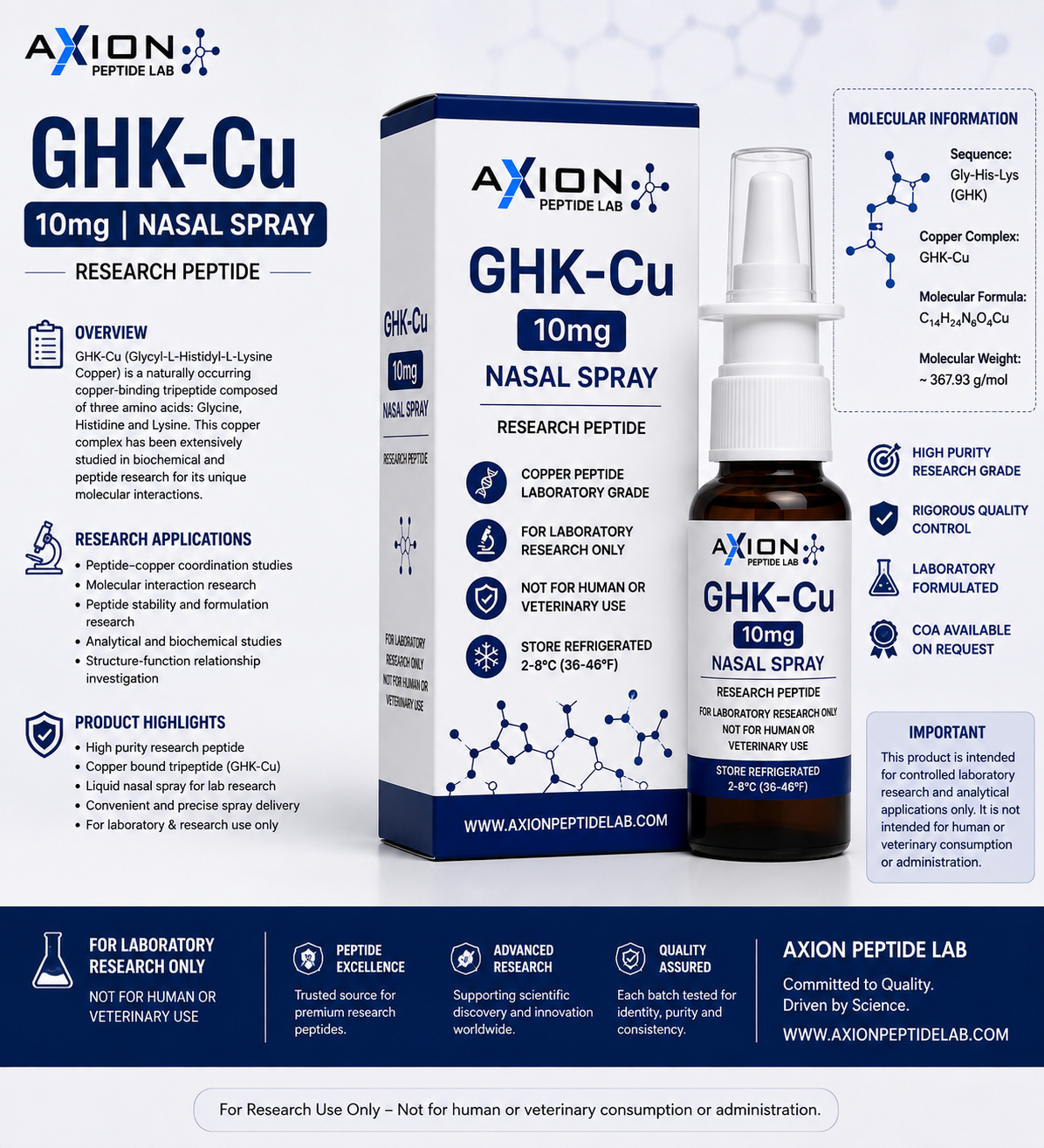
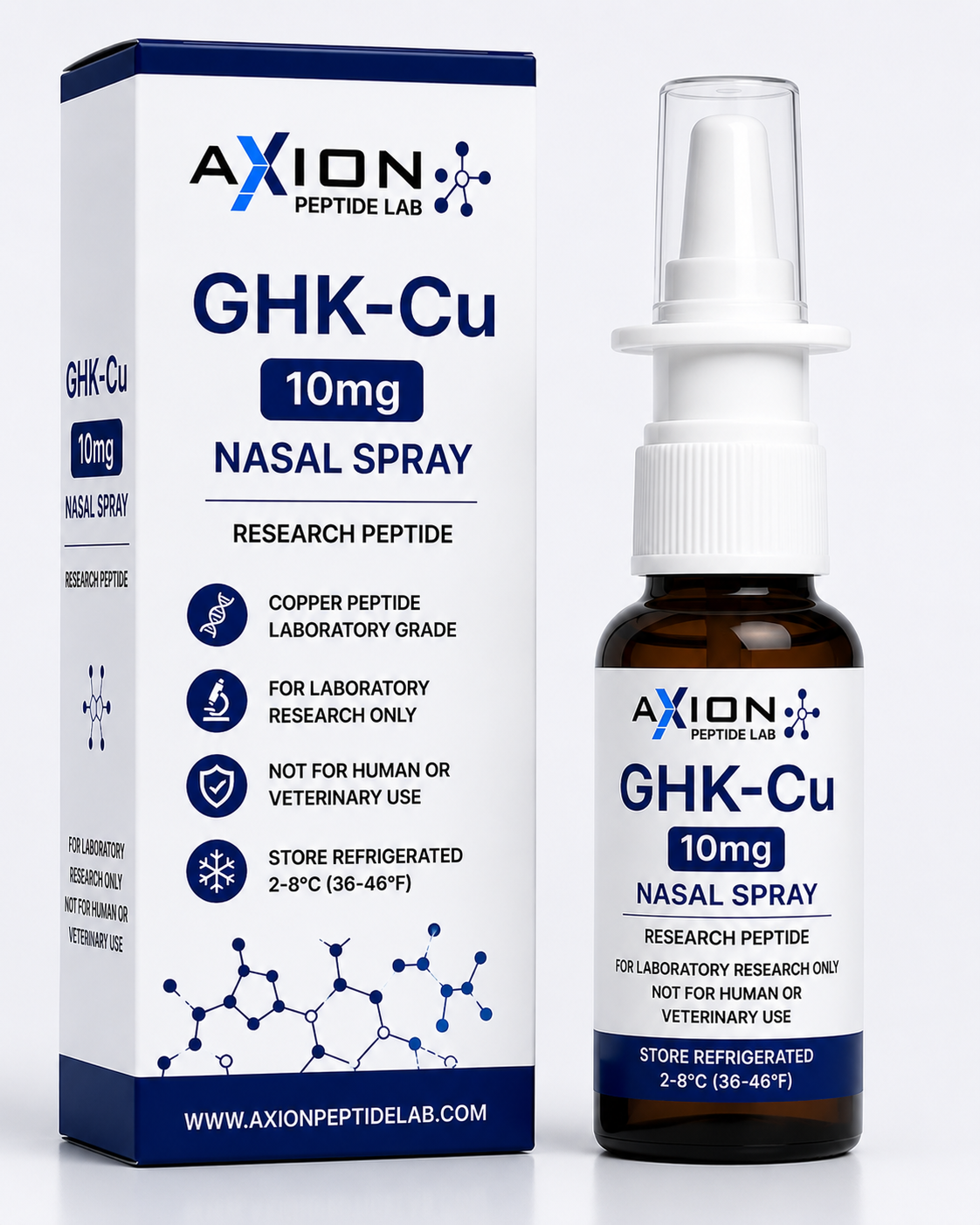
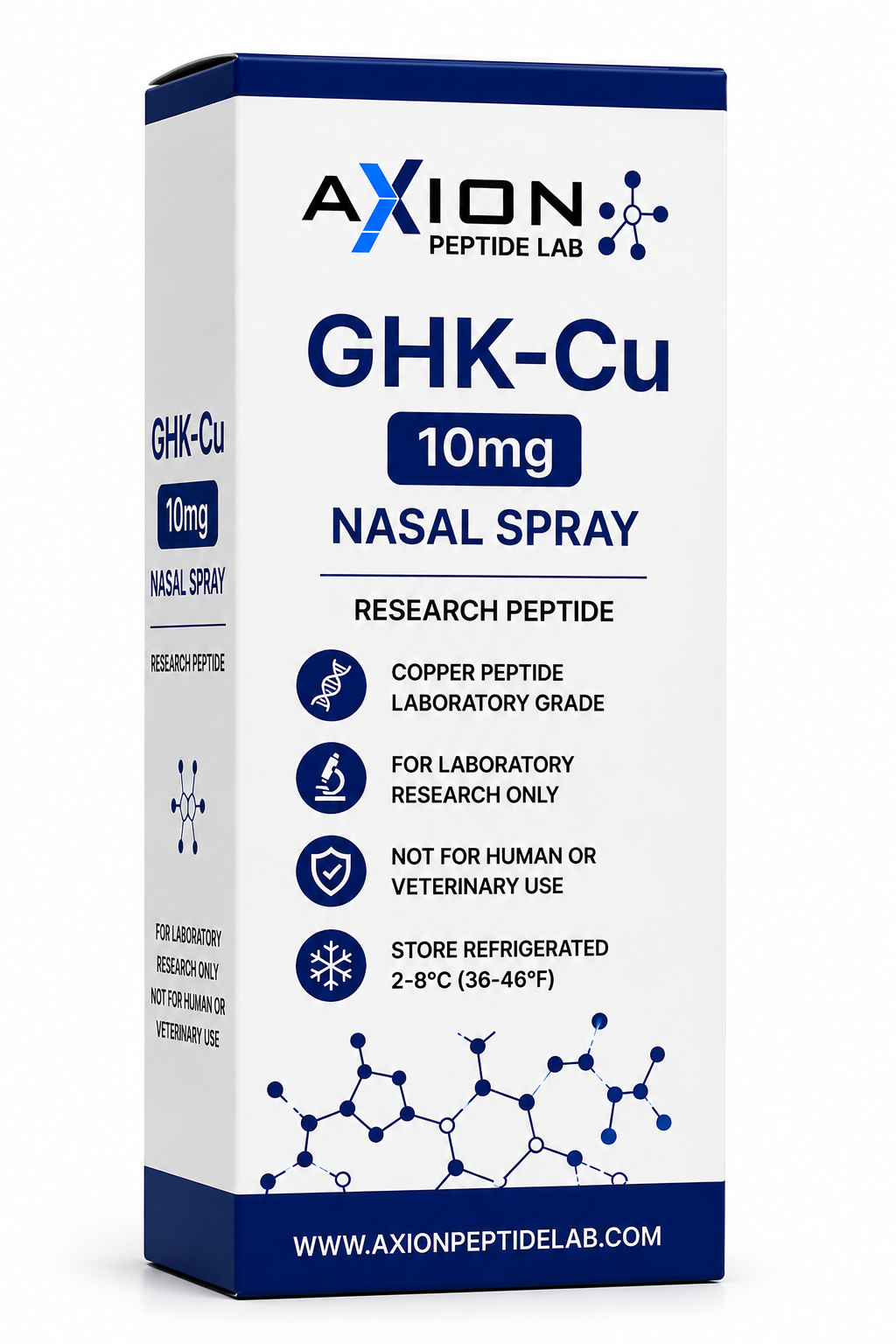
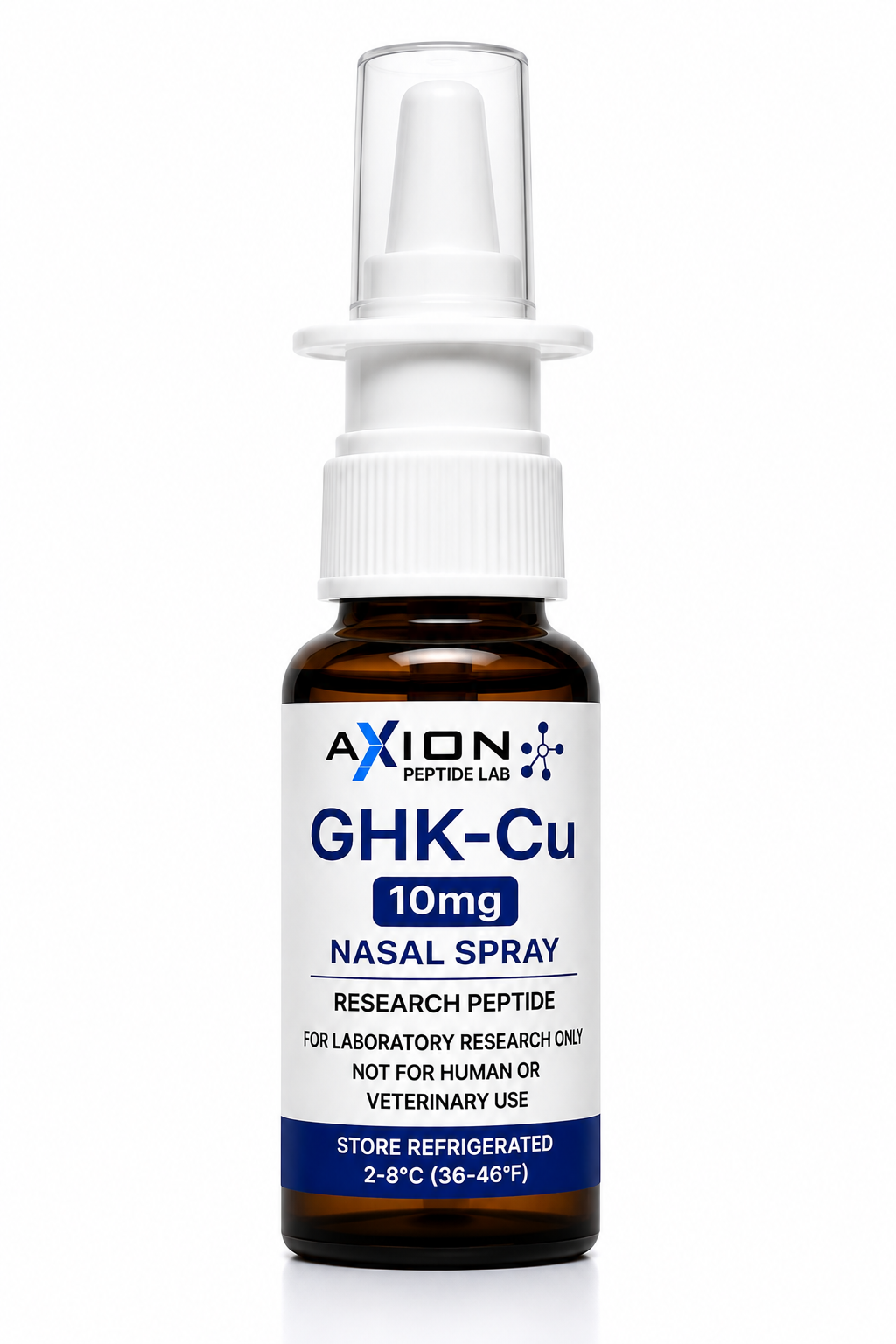
GHK-Cu 10mg Nasal Spray is a copper-peptide research preparation containing the copper complex of glycyl-L-histidyl-L-lysine (GHK). Supplied in a liquid research format, it is suitable for controlled laboratory investigation involving copper-peptide coordination, peptide-metal interactions, structure-function relationships, formulation studies, stability and analytical characterisation.
The 10mg designation represents the stated research quantity and is not a dosage recommendation. “Nasal Spray” describes the research presentation only.
For Research Use Only – Not for human or veterinary consumption or administration.
$128.62 Original price was: $128.62.$115.08Current price is: $115.08.
GHK-Cu 10mg Nasal Spray from Axion Peptide Lab is a copper-peptide research preparation supplied in a convenient liquid spray format for controlled laboratory, biochemical and analytical investigation. GHK-Cu is the copper complex of the naturally occurring tripeptide glycyl-L-histidyl-L-lysine (GHK), making it an established molecule of interest in peptide chemistry, copper-binding research and molecular interaction studies.
The 10mg designation represents the stated research quantity associated with the preparation and is not a dosage recommendation. “Nasal Spray” describes the product presentation only and should not be interpreted as instructions or a recommendation for human intranasal administration.
GHK-Cu research can involve copper-peptide coordination, peptide-metal interactions, analytical characterisation, peptide stability, comparative chemistry and controlled formulation studies.
For Research Use Only – Not for human or veterinary consumption or administration.
GHK is a naturally occurring tripeptide composed of three amino-acid residues:
Glycine – Histidine – Lysine
It is commonly abbreviated as GHK.
GHK-Cu is formed when GHK coordinates a copper ion, creating a copper-peptide complex that has been investigated extensively in biochemical and molecular research.
The histidine residue is particularly relevant to the coordination chemistry of the molecule. Researchers have studied how GHK interacts with copper and how this coordination influences measurable chemical and biological properties.
Because GHK-Cu combines a short peptide with a metal ion, it offers an interesting model for laboratories investigating both peptide chemistry and metal-binding interactions. GHK-Cu 10mg Nasal Spray
One of the most important research characteristics of GHK is its ability to coordinate copper.
Copper is an essential transition metal involved in numerous biochemical systems. Understanding how peptides interact with copper can contribute to broader investigation of metal transport, coordination chemistry and molecular interactions.
GHK-Cu can therefore be studied as part of controlled experiments involving peptide-metal binding.
Researchers may examine variables such as concentration, environmental conditions, competing ligands and formulation composition to determine how they affect the characteristics of the complex.
These applications should remain within appropriately designed laboratory models.
GHK consists of only three amino acids, making it substantially smaller than many research peptides.
This compact structure provides advantages for certain experimental approaches.
Researchers can examine individual residues and their contribution to copper coordination, molecular stability and structure-function relationships.
GHK may also be compared with modified peptides or alternative metal-binding sequences.
Comparative experiments can help researchers understand how relatively small structural modifications affect experimentally measured characteristics.
GHK-Cu therefore has relevance not only as a specific copper complex but also as a model molecule for studying peptide chemistry. GHK-Cu 10mg Nasal Spray
Analytical characterisation is an important part of laboratory peptide research.
Researchers working with GHK-Cu may employ analytical techniques suitable for evaluating peptide identity, composition and molecular behaviour.
Depending on laboratory equipment and experimental objectives, techniques can include chromatography, mass spectrometry, spectroscopy and other validated analytical methods.
Copper coordination can also introduce additional analytical considerations compared with an uncomplexed peptide.
Researchers should therefore distinguish between GHK and GHK-Cu when documenting experiments.
The exact chemical form and batch-specific specifications should be confirmed from relevant product documentation rather than inferred from generic information about the peptide.
Metal-binding peptides represent an important field of biochemical research.
The interaction between a peptide and metal ion can influence structural, chemical and functional properties.
GHK-Cu provides researchers with a compact copper-peptide system suitable for appropriately designed molecular investigations.
Experiments may evaluate copper coordination, binding behaviour or changes under controlled environmental conditions.
Researchers can also compare GHK-Cu with uncomplexed GHK or other metal-peptide systems.
Such studies may contribute to a broader understanding of peptide coordination chemistry and biochemical metal interactions.
The three-residue structure of GHK provides opportunities for structure-function research.
Scientists can investigate how glycine, histidine and lysine contribute to the overall properties of the peptide.
Modified sequences can be compared with the original structure to examine changes in copper affinity or other measurable characteristics.
This approach can help researchers identify relationships between peptide sequence and molecular behaviour.
GHK-Cu may consequently serve as a useful reference molecule in comparative peptide studies. GHK-Cu 10mg Nasal Spray
Stability is an important consideration when studying peptide and metal-peptide systems.
Researchers may examine how GHK-Cu behaves under different experimental conditions.
Variables can include temperature, light exposure, pH, solvent environment, concentration and time.
Appropriate analytical methods can then be used to detect chemical changes or degradation.
Because stability can depend strongly on formulation and experimental conditions, researchers should avoid assuming that data from one GHK-Cu preparation automatically apply to another.
Product-specific storage requirements should be taken from the applicable documentation for the supplied preparation.
The GHK-Cu 10mg Nasal Spray presentation provides a liquid research format that may be useful for controlled formulation studies.
Researchers may investigate how GHK-Cu behaves within a defined liquid environment, including its compatibility, stability and analytical recovery.
Liquid preparations may also be incorporated into method-development experiments where accurately documented formulation characteristics are important.
The exact concentration basis, excipients and formulation characteristics should be established from product-specific documentation when required by an experimental protocol.
The spray dispenser itself should not be interpreted as evidence of clinical suitability. GHK-Cu 10mg Nasal Spray
The 10mg designation identifies the stated research quantity associated with the GHK-Cu preparation.
It does not represent a recommended dose.
Experimental quantities should be determined according to validated research protocols, analytical requirements and institutional procedures.
Researchers conducting quantitative experiments should use verified batch information when calculating concentrations or preparing analytical methods.
Axion Peptide Lab does not provide human dosing, treatment or administration protocols for research materials.
GHK-Cu has been investigated in a broad range of experimental literature.
For commercial research material, however, it is important to distinguish between legitimate discussion of scientific investigation and unsupported therapeutic claims.
Researchers may use GHK-Cu in controlled biochemical studies involving peptide-metal coordination, molecular interactions, peptide chemistry and experimental pathway investigation.
Results from cell, animal or other preclinical models should not automatically be interpreted as established clinical effects.
This distinction helps maintain scientifically responsible product documentation. GHK-Cu 10mg Nasal Spray
GHK-Cu research material may be relevant to projects involving:
The suitability of a particular preparation depends on the requirements of the individual experiment.
Reliable laboratory work requires accurate documentation.
Researchers should record product identity, batch information, experimental conditions, analytical methodology and relevant formulation characteristics.
Where a Certificate of Analysis or independent analytical documentation is available for a particular batch, it can provide additional information useful for experimental planning.
Availability of such documentation may vary by product and batch.
Exact purity percentages, sterility, concentration or other specifications should not be claimed unless they are supported by documentation applicable to the supplied product. GHK-Cu 10mg Nasal Spray
GHK-Cu 10mg Nasal Spray should be treated as laboratory research material.
Researchers should follow appropriate laboratory procedures for handling, identification and storage.
Research products should remain clearly labelled and separated from consumer medicines, supplements or personal-use products.
Customers are responsible for determining whether purchase, possession, importation and intended research applications comply with applicable laws, regulations and institutional requirements.
Researchers looking to buy GHK-Cu 10mg Nasal Spray can obtain this research-format copper peptide from Axion Peptide Lab for legitimate laboratory and analytical applications.
Its compact tripeptide structure, copper-binding characteristics and established relevance to peptide coordination chemistry make GHK-Cu an interesting research material for molecular, biochemical and analytical investigation.
The liquid spray presentation provides a practical format for appropriately designed laboratory formulation and analytical studies while remaining strictly a research product.
For Research Use Only – Not for human or veterinary consumption or administration.
GHK-Cu is a copper complex of the tripeptide glycyl-L-histidyl-L-lysine, commonly abbreviated GHK.
GHK contains three amino-acid residues: glycine, histidine and lysine. It is therefore classified as a tripeptide.
“Cu” is the chemical symbol for copper and indicates that the GHK peptide is present as a copper-coordinated complex.
Laboratory applications can include peptide-metal coordination, copper-binding chemistry, structure-function relationships, molecular interactions, stability and analytical characterisation.
The 10mg designation identifies the stated research quantity associated with the preparation. It is not a recommended human dosage.
Not exactly. GHK refers to the glycyl-L-histidyl-L-lysine peptide, while GHK-Cu refers to its copper-coordinated complex.
Its compact three-residue structure and ability to coordinate copper make it useful for experiments involving peptide chemistry, metal binding and molecular structure-function relationships.
Yes. Appropriate laboratory techniques can be used to investigate identity, composition, stability and other experimentally measurable characteristics.
No. Nasal spray describes the research product presentation. It does not constitute a recommendation or instruction for human intranasal administration.
GHK-Cu 10mg Nasal Spray is available from Axion Peptide Lab for legitimate laboratory, analytical and scientific research applications, subject to availability and applicable requirements.