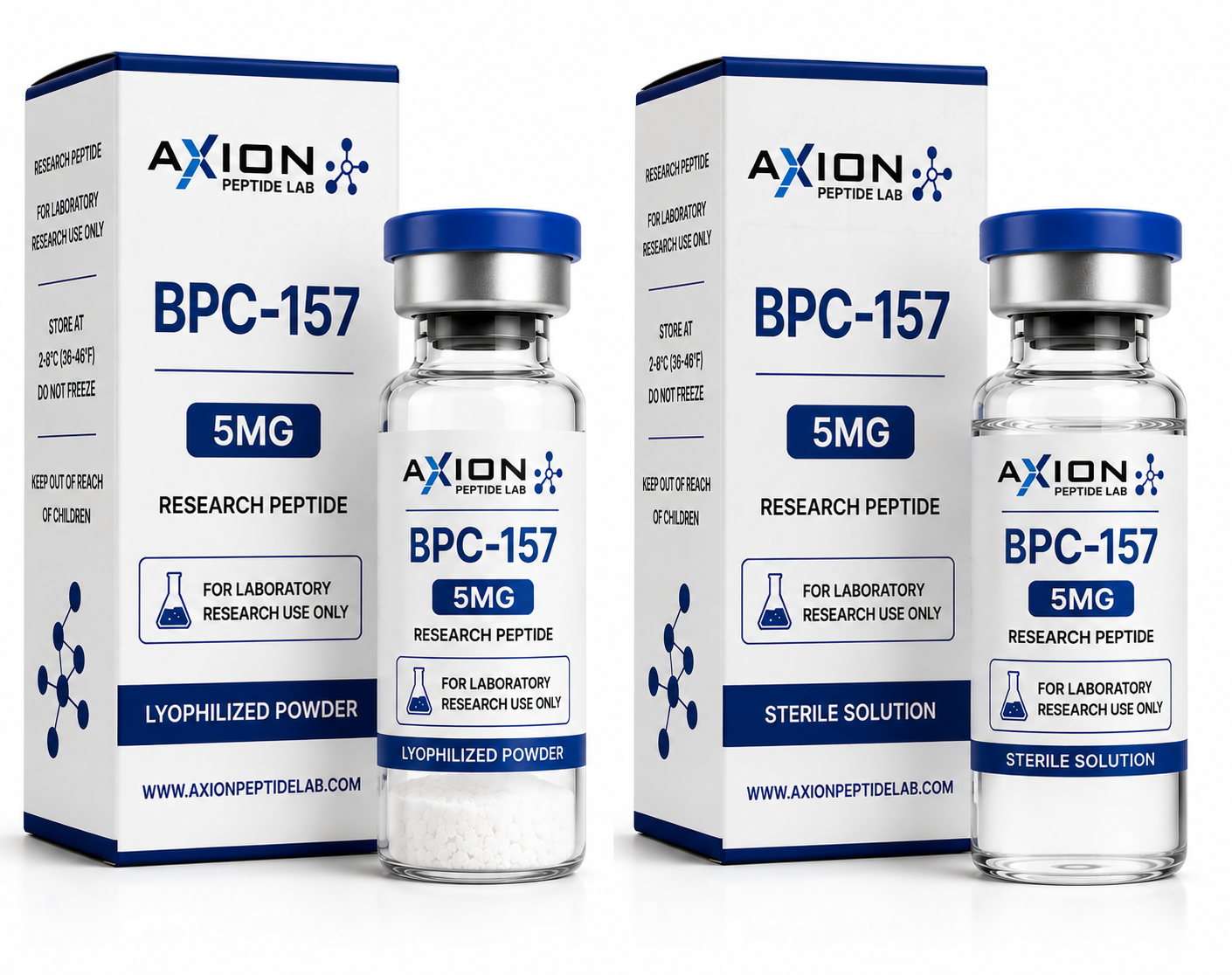
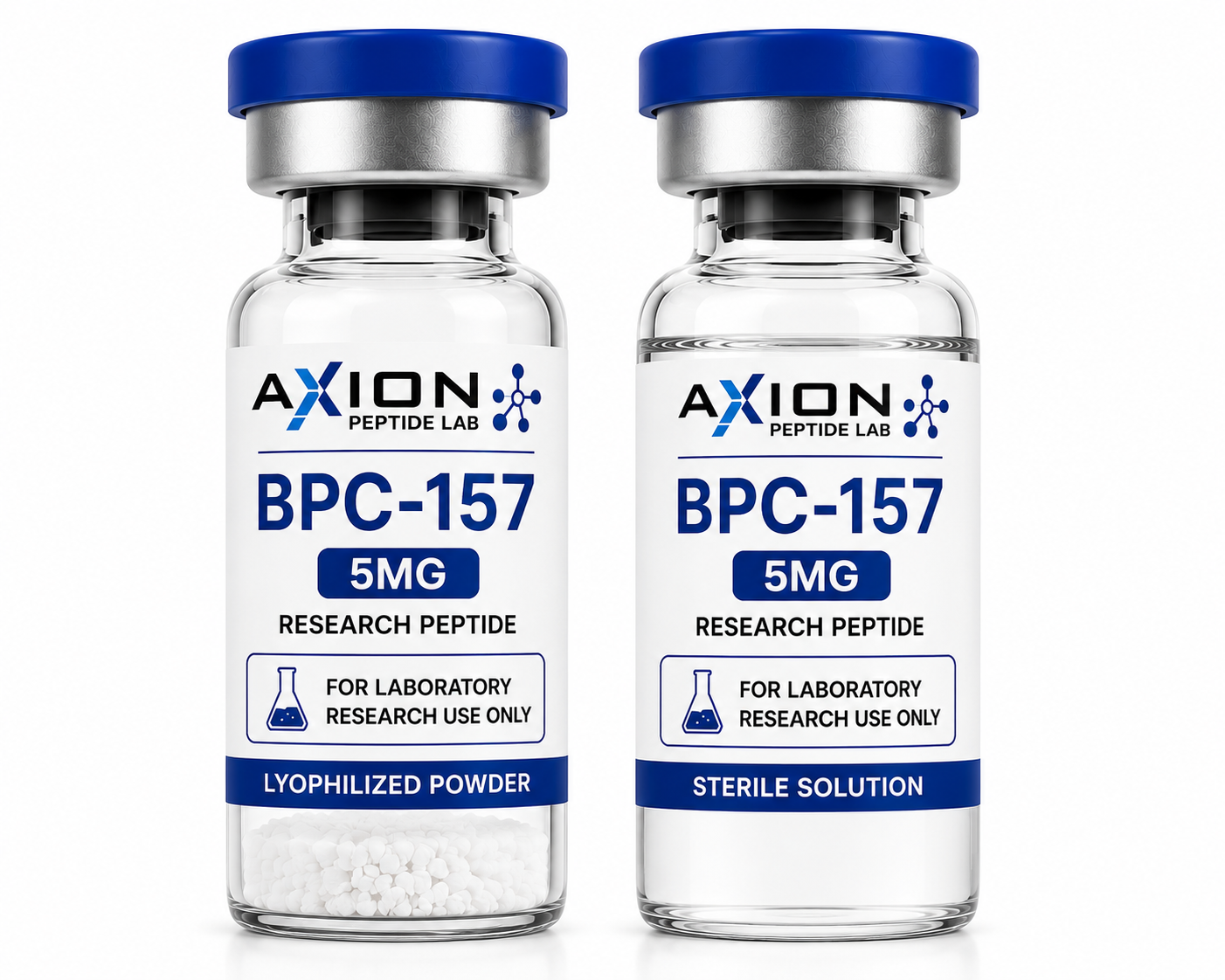
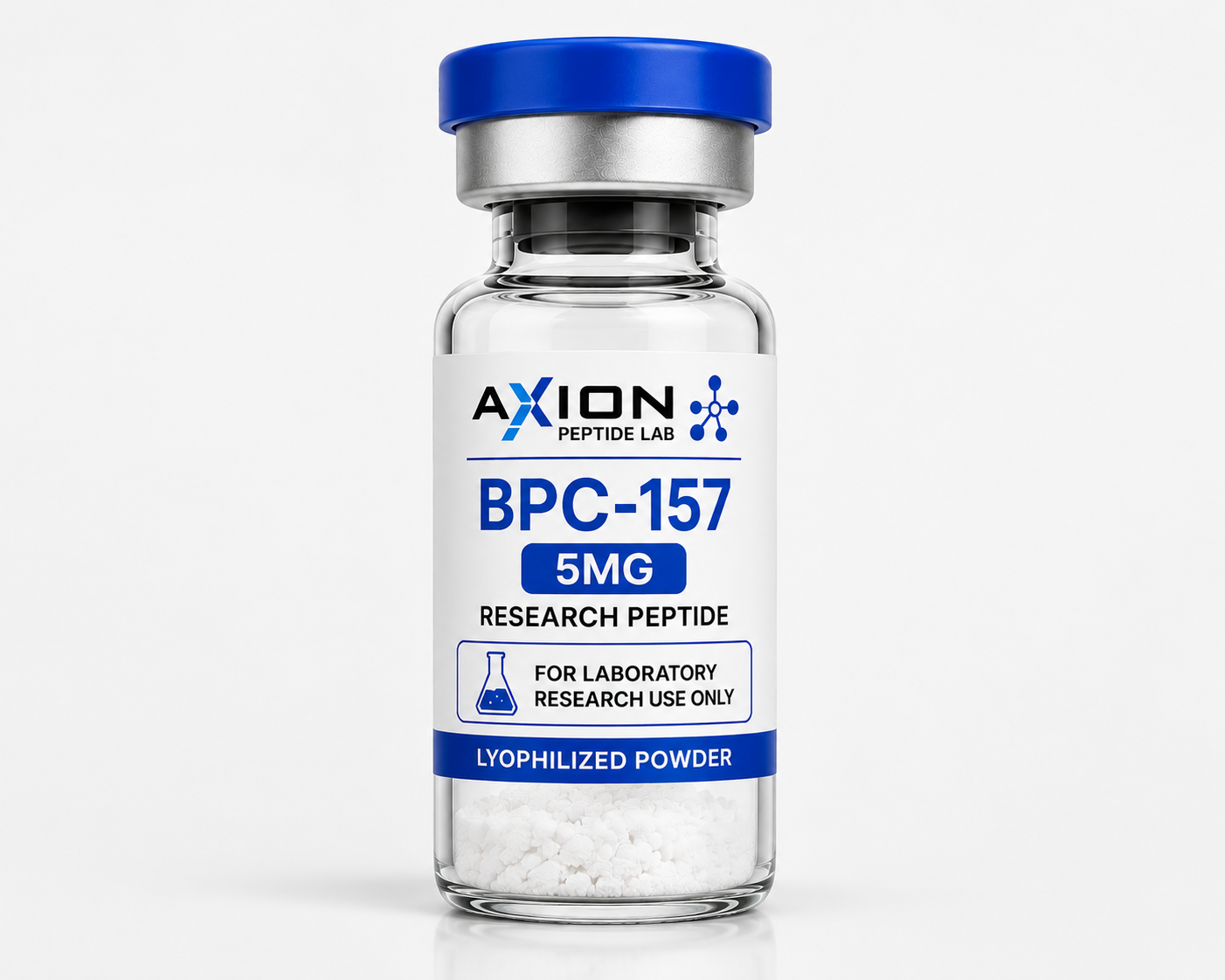
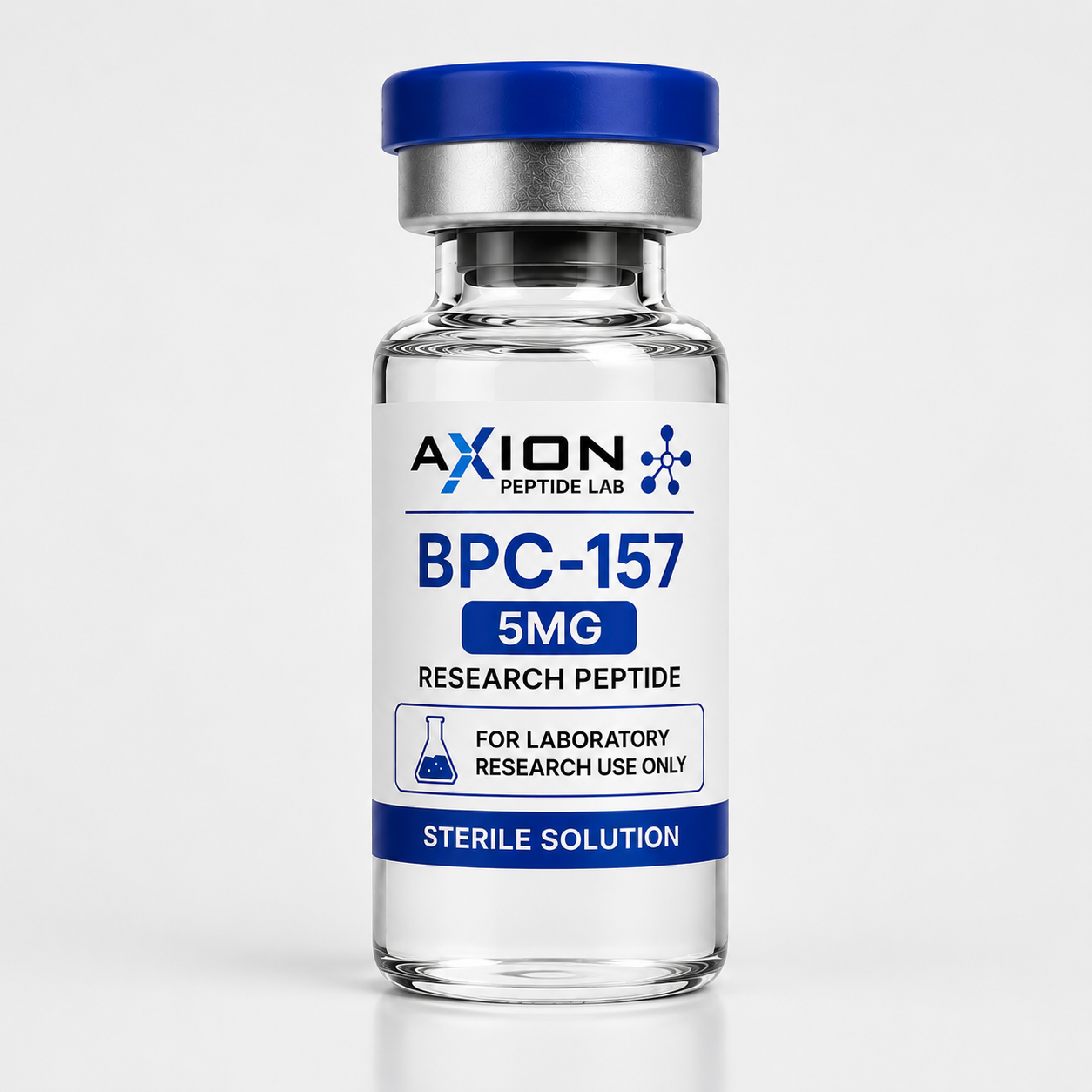
BPC-157 5mg Research Peptide is a synthetic 15-amino-acid pentadecapeptide with the sequence GEPPPGKPADDAGLV. It is supplied for controlled scientific investigation involving peptide chemistry, molecular signalling, cellular models, structure-function relationships, peptide stability and analytical characterisation.
The 5mg designation represents the stated research quantity and is not a dosage recommendation.
For Research Use Only – Not for human or veterinary consumption.
$40.61 – $67.69Price range: $40.61 through $67.69
BPC-157 5mg Research Peptide from Axion Peptide Lab is a synthetic pentadecapeptide supplied for controlled laboratory, biochemical and analytical research. Composed of 15 amino-acid residues, BPC-157 has attracted considerable scientific interest as an experimental peptide for investigations involving molecular signalling, cellular models, peptide structure, stability and preclinical biological pathways.
The commonly referenced amino-acid sequence of BPC-157 is:
Gly-Glu-Pro-Pro-Pro-Gly-Lys-Pro-Ala-Asp-Asp-Ala-Gly-Leu-Val
This can be abbreviated as:
GEPPPGKPADDAGLV
The 5mg designation represents the stated quantity of research material and should not be interpreted as a dosage or administration recommendation.
BPC-157 remains an investigational research compound. Laboratory and preclinical findings should not be interpreted as established therapeutic effects in humans.
For Research Use Only – Not for human or veterinary consumption.
BPC-157 is a synthetic peptide consisting of 15 amino-acid residues and is therefore classified as a pentadecapeptide.
It has been investigated primarily in experimental and preclinical research.
Its relatively compact structure makes it an interesting material for researchers investigating peptide chemistry, molecular interactions, biological signalling and structure-function relationships.
BPC-157 is sometimes discussed online using extensive health, recovery and performance claims. Those claims should be distinguished from established scientific evidence.
Human evidence remains limited, and BPC-157 should not be represented as an approved medicine or clinically established treatment.
Axion Peptide Lab supplies BPC-157 5mg exclusively as research material for qualified laboratory applications. BPC-157 5mg Research Peptide
The parent BPC-157 peptide is associated with the molecular formula:
C62H98N16O22
Its molecular weight is approximately:
1419.5 g/mol
The commonly referenced CAS Registry Number is:
137525-51-0
Researchers should note that different chemical forms may have different molecular specifications.
For example, BPC-157 acetate and BPC-157 TFA salt are distinct representations from the parent compound.
Therefore, researchers requiring a specific salt form, counterion, purity specification or molecular identity should consult documentation associated with the actual product and batch rather than relying solely on generic BPC-157 information.
Much of the scientific interest surrounding BPC-157 comes from preclinical research.
Experimental investigations have explored BPC-157 across different cellular and animal models and have examined several molecular and biological pathways.
This body of research makes BPC-157 interesting as an experimental compound for laboratories studying peptide-associated biological mechanisms.
However, preclinical evidence does not automatically demonstrate clinical effectiveness.
Findings observed in cell cultures or animal models should remain clearly identified as experimental observations.
This distinction is essential when presenting BPC-157 as a legitimate laboratory research material.
Cellular signalling involves networks through which cells detect and respond to molecular signals.
BPC-157 has been investigated in experimental systems involving several signalling mechanisms.
Researchers may examine changes in molecular markers, pathway-associated proteins or other predetermined endpoints after experimental exposure.
Suitable laboratory designs can also compare BPC-157 with control compounds or structurally different peptides.
These approaches may help scientists investigate whether particular experimental observations are associated with specific peptide characteristics.
Any conclusions should remain limited to the research model and conditions used.
BPC-157 has also attracted attention in preclinical investigations involving vascular biology.
Researchers have examined experimental pathways associated with vascular signalling and related cellular processes.
Such studies can contribute to broader understanding of how synthetic peptides interact with biological systems.
The existence of vascular research should not be converted into claims that BPC-157 treats cardiovascular conditions or produces established human benefits.
Instead, BPC-157 5mg should be positioned as an experimental material suitable for controlled molecular and preclinical research.
The 15-residue structure of BPC-157 provides opportunities for structure-function investigation.
Researchers may examine how its amino-acid sequence contributes to molecular behaviour under controlled conditions.
Experiments may compare the complete peptide with modified sequences, fragments or unrelated peptides.
This can help researchers understand how structural changes influence measurable experimental characteristics.
Sequence-based research is particularly useful in peptide science because even relatively small molecular modifications can influence stability, interaction profiles and analytical behaviour.
BPC-157 can therefore serve as an experimental material within broader peptide chemistry projects.
Peptides can interact with proteins, receptors, enzymes and other biological molecules.
Researchers may investigate BPC-157 within appropriately validated molecular or cellular systems to explore these interactions.
Experimental designs can evaluate predefined biochemical endpoints rather than relying on assumptions about the peptide’s effects.
Comparative studies may also help determine how BPC-157 behaves relative to other research peptides.
Careful controls, validated methodologies and accurate documentation are important for obtaining interpretable results.
Stability is an important area of peptide research because environmental and experimental conditions may affect molecular integrity.
Researchers may investigate BPC-157 stability under controlled laboratory conditions and monitor changes over time.
Potential research endpoints include peptide degradation, chromatographic changes and molecular integrity.
Experimental variables should be documented carefully to improve reproducibility.
Product-specific storage information should be obtained from documentation associated with the supplied material rather than copied from unrelated suppliers.
This is especially important when different chemical forms or formulations are being compared.
Analytical characterisation is another important research application.
Depending on available equipment and methodology, laboratories may investigate molecular identity, chromatographic behaviour, molecular mass, purity profiles or degradation products.
Analytical techniques can also help distinguish the parent peptide from different salts or related materials.
Researchers should confirm which form of BPC-157 is supplied before assigning molecular specifications to an experiment.
Exact purity percentages should only be reported when supported by analytical documentation for the specific batch.
Generic specifications from another BPC-157 supplier should not be assumed to apply to Axion Peptide Lab material.
The BPC-157 5mg Research Peptide format provides laboratories with a clearly identified quantity for controlled experimental investigation.
The 5mg figure describes the stated amount of research material associated with the product.
It does not represent a recommended human dose.
Researchers should establish experimental quantities according to validated protocols, analytical requirements and institutional procedures.
Axion Peptide Lab does not provide human dosing, administration, injection or self-experimentation instructions.
BPC-157 may be incorporated into controlled research involving:
These categories represent areas of scientific investigation and should not be interpreted as medical indications.
Researchers should distinguish between different forms of BPC-157.
The parent peptide, acetate form and TFA salt may have different formula representations and molecular weights because additional chemical components are present.
This can affect analytical calculations and interpretation.
For experiments requiring precise molecular information, laboratories should confirm the exact form supplied by reviewing product-specific documentation.
Using the molecular weight of the parent compound for a different salt form may introduce errors into analytical work.
Accurate identification is therefore essential for reproducible peptide research.
Reliable scientific investigation requires accurate documentation.
Researchers should record product identity, batch information, experimental conditions and analytical procedures.
When available, batch-specific analytical documentation can provide additional information concerning identity, composition or other measured specifications.
Certificate of Analysis and independent testing availability may differ between products and batches.
Researchers requiring particular specifications should review available documentation before incorporating the material into an experimental workflow.
Unverified claims such as exact purity percentages should not be assumed.
BPC-157 5mg should be handled by appropriately trained personnel within suitable laboratory environments.
The product should remain clearly labelled and separated from medicines, supplements, food products and consumer materials.
Laboratories should follow appropriate procedures designed to maintain research-material integrity and minimise contamination.
Handling and storage should follow product-specific documentation where available.
Researchers are responsible for determining whether acquisition, possession, importation and experimental use comply with applicable regulations and institutional requirements.
Axion Peptide Lab provides specialised research materials for controlled laboratory, biochemical and analytical applications.
BPC-157 5mg offers researchers a convenient synthetic pentadecapeptide format suitable for appropriately designed experimental projects.
Researchers may incorporate the material into molecular, analytical, cellular or comparative peptide investigations according to their validated protocols.
Product specifications and available documentation should be reviewed before purchase to ensure that the material is appropriate for the intended research application.
Qualified laboratories, researchers and scientific organisations can buy BPC-157 5mg Research Peptide from Axion Peptide Lab for legitimate laboratory and analytical investigation.
Its 15-amino-acid structure and extensive preclinical research history make BPC-157 an interesting experimental compound for peptide science.
Researchers should verify relevant product specifications and available documentation before beginning an experimental workflow.
BPC-157 should not be marketed as a medicine, injury treatment, bodybuilding product, recovery aid or human wellness product.
For Research Use Only – Not for human or veterinary consumption.
BPC-157 5mg is a stated quantity of a synthetic 15-amino-acid peptide supplied for controlled laboratory, biochemical and analytical research. BPC-157 5mg Research Peptide
The commonly referenced sequence is Gly-Glu-Pro-Pro-Pro-Gly-Lys-Pro-Ala-Asp-Asp-Ala-Gly-Leu-Val, abbreviated GEPPPGKPADDAGLV.
BPC-157 contains 15 amino-acid residues and is classified as a pentadecapeptide.
The parent peptide has the molecular formula C62H98N16O22.
The molecular weight of the parent peptide is approximately 1419.5 g/mol. Salt forms can have different molecular weights. BPC-157 5mg Research Peptide
The commonly referenced CAS Registry Number for the parent BPC-157 compound is 137525-51-0.
Research areas include peptide signalling, cellular models, molecular interactions, vascular pathways, structure-function studies, stability and analytical characterisation. BPC-157 5mg Research Peptide
No. The 5mg designation represents the stated quantity of research material associated with the product and is not a human dosage recommendation.
No. BPC-157 is supplied exclusively for laboratory research, and human administration, injection or self-experimentation guidance is not provided. BPC-157 5mg Research Peptide
Qualified research customers can purchase BPC-157 5mg Research Peptide from Axion Peptide Lab for legitimate laboratory and analytical research, subject to availability and applicable requirements.