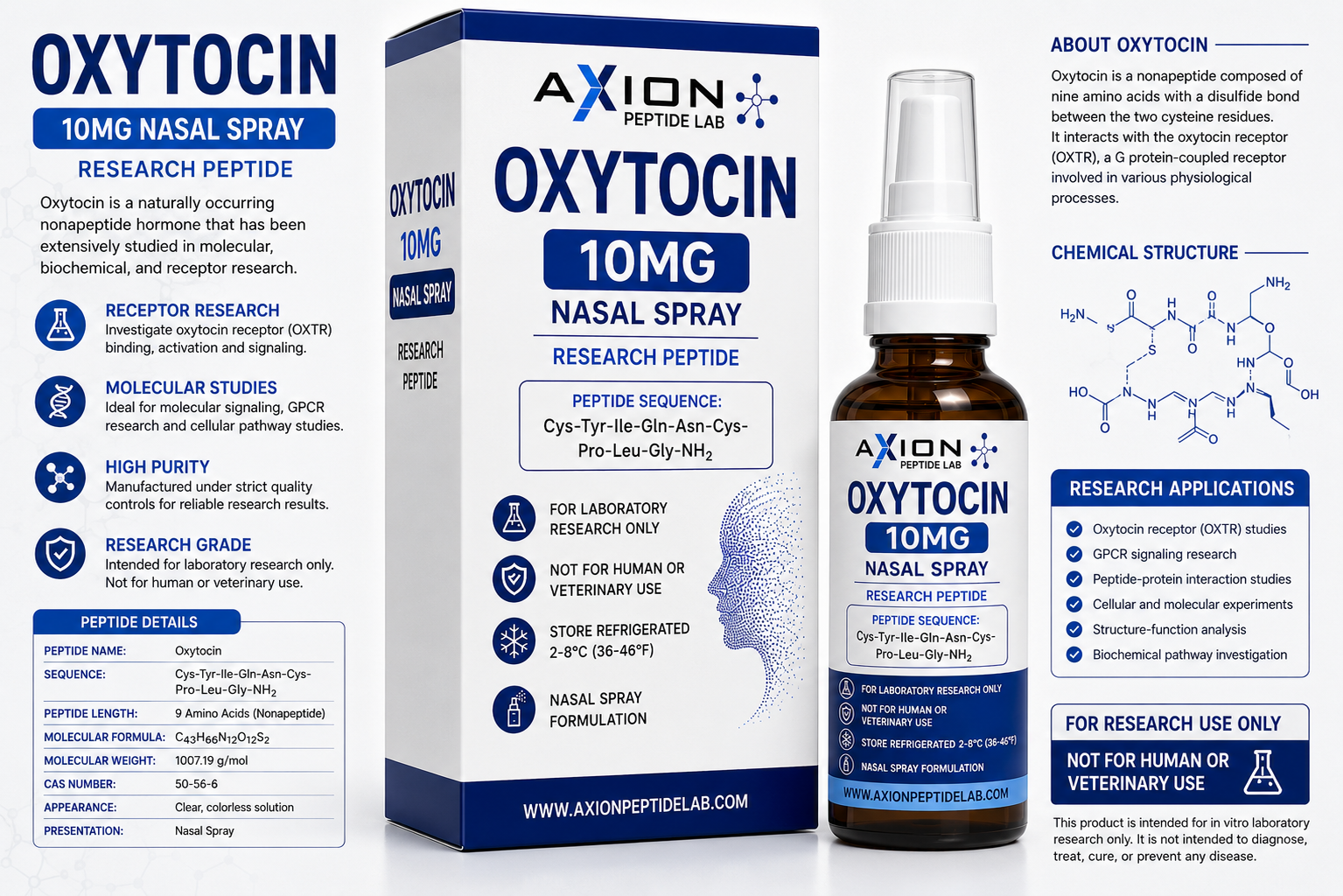
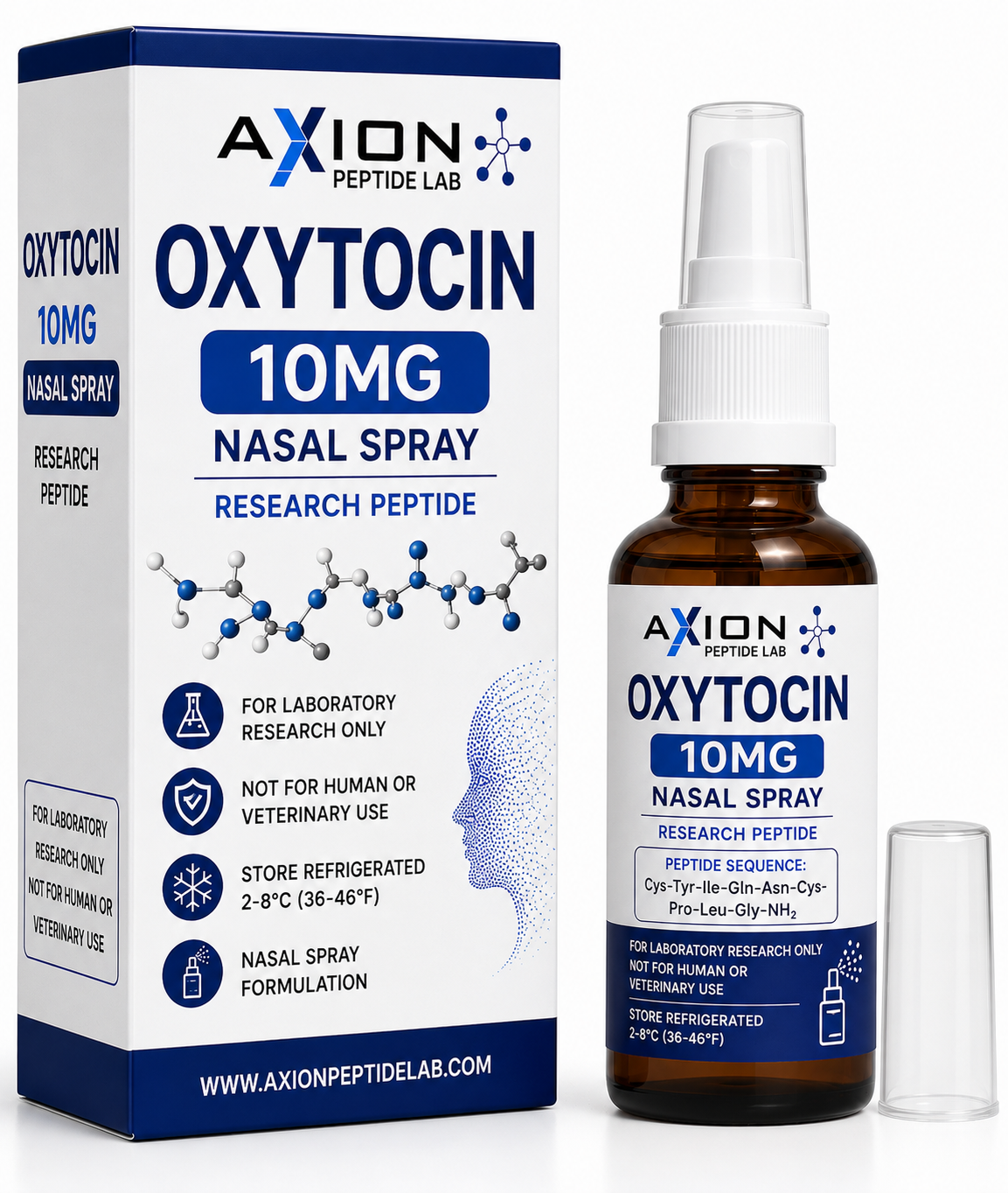
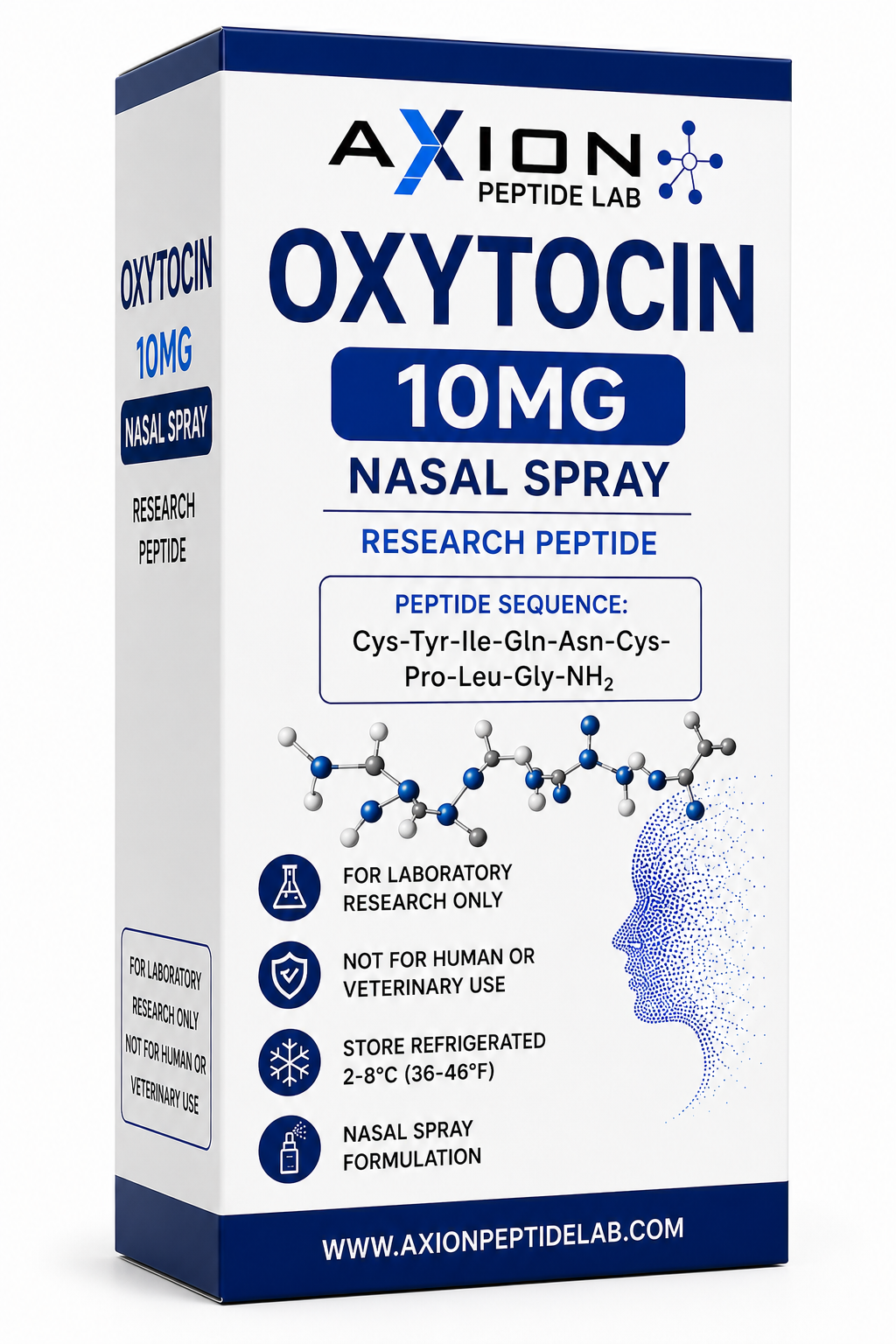
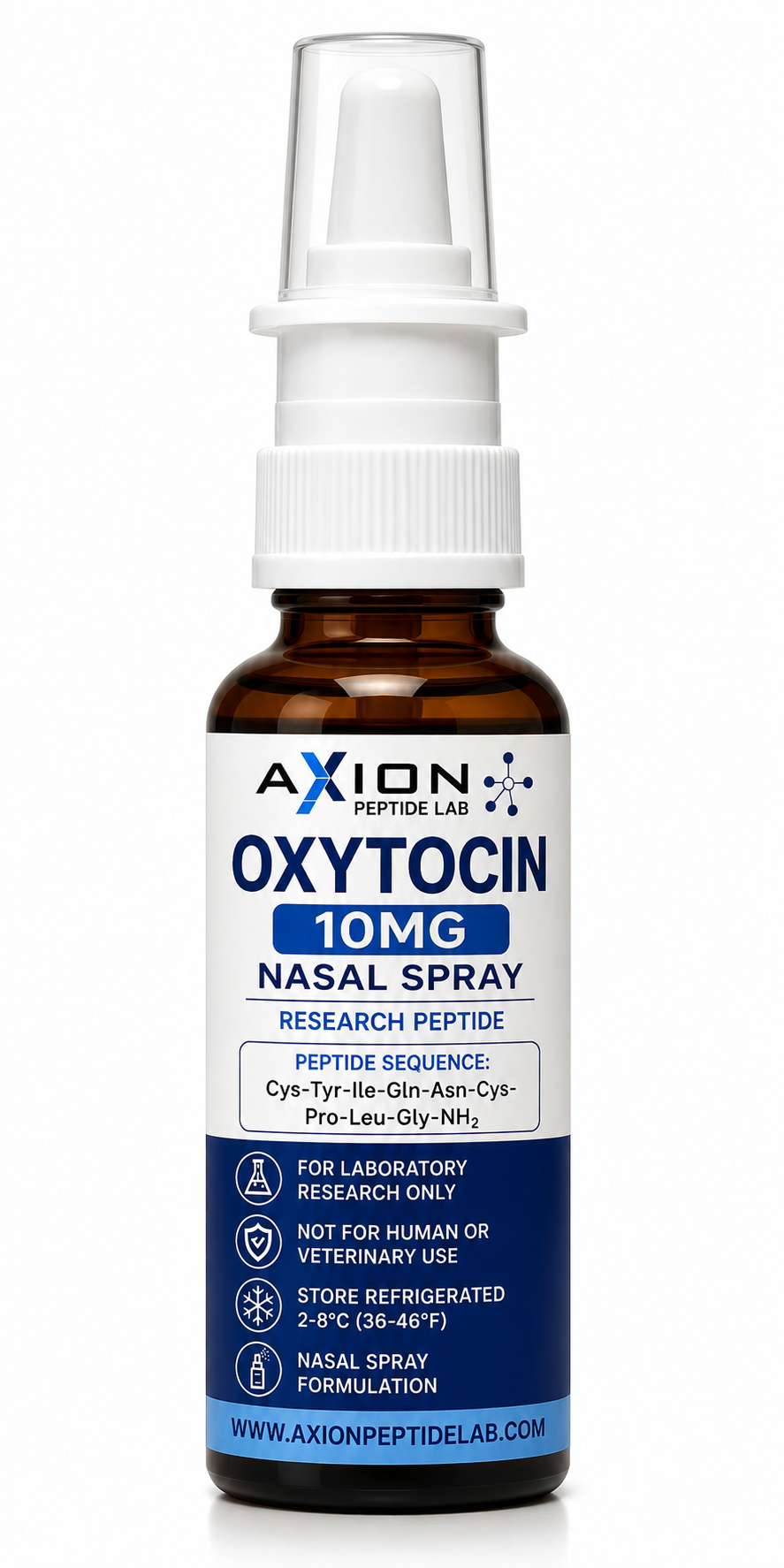
Oxytocin 10mg Nasal Spray is a nonapeptide research preparation supplied in a liquid spray format for controlled receptor, peptide, molecular, formulation and analytical laboratory investigation.
Oxytocin contains nine amino-acid residues and features a characteristic intramolecular disulfide bond. It is extensively investigated in relation to the oxytocin receptor (OXTR), GPCR signalling, ligand-receptor interactions, peptide structure-function relationships and analytical characterisation.
The 10mg designation represents the stated research quantity and is not a dosage recommendation. “Nasal Spray” describes the research presentation only.
For Research Use Only – Not for human or veterinary consumption or administration.
$87.99
Oxytocin 10mg Nasal Spray from Axion Peptide Lab is a peptide research preparation presented in a liquid spray format for controlled laboratory, receptor, molecular, biochemical, formulation and analytical investigation.
Oxytocin is a naturally occurring peptide hormone composed of nine amino-acid residues, making it a nonapeptide. Its compact cyclic structure and established interaction with the oxytocin receptor (OXTR) have made oxytocin an important research molecule in peptide chemistry, receptor pharmacology, molecular signalling and structure-function investigation.
The commonly represented oxytocin sequence is:
Cys-Tyr-Ile-Gln-Asn-Cys-Pro-Leu-Gly-NH₂
A disulfide bond between the two cysteine residues contributes to the characteristic cyclic portion of the molecule.
The 10mg designation identifies the stated research quantity associated with this preparation and is not a dosage recommendation. “Nasal Spray” describes the physical research presentation and does not constitute instructions or approval for human intranasal administration.
Axion Peptide Lab supplies this preparation specifically for legitimate scientific and analytical research.
For Research Use Only – Not for human or veterinary consumption or administration.
Oxytocin is an endogenous peptide hormone found naturally in mammalian biological systems.
Chemically, it is a short peptide consisting of nine amino-acid residues.
Its molecular architecture contains a six-residue ring formed through a disulfide linkage and a short three-residue tail.
This relatively compact but structurally distinctive configuration makes oxytocin valuable for experiments investigating how peptide conformation influences receptor interactions and molecular behaviour.
Synthetic oxytocin can consequently be studied in controlled laboratory systems using biochemical, receptor-based and analytical methodologies.
The commonly reported sequence of oxytocin is:
Cys-Tyr-Ile-Gln-Asn-Cys-Pro-Leu-Gly-NH₂
The cysteine residues located at positions one and six form an intramolecular disulfide bond.
This bond creates the cyclic portion characteristic of the oxytocin molecule.
Researchers interested in peptide chemistry can examine how this structural arrangement contributes to molecular stability, receptor interaction and other experimentally measurable characteristics.
Analogue studies can also investigate what occurs when particular amino-acid residues or structural features are modified.
A peptide containing nine amino-acid residues is classified as a nonapeptide.
Oxytocin therefore provides researchers with a compact model for studying peptide structure and molecular recognition.
Its sequence is sufficiently short for detailed structure-function investigation while still containing distinctive structural features such as the disulfide bridge and amidated C-terminal region.
Comparative experiments can evaluate oxytocin alongside structurally related peptides or synthetic analogues.
One of the most important areas of oxytocin research concerns the oxytocin receptor, commonly abbreviated OXTR.
OXTR belongs to the large family of G protein-coupled receptors (GPCRs).
GPCRs are membrane-associated receptors that translate extracellular molecular interactions into intracellular signalling events.
Oxytocin can therefore be incorporated into controlled receptor-binding and receptor-signalling experiments.
Researchers may investigate receptor affinity, activation characteristics, downstream signalling or comparative activity of related peptide molecules.
GPCR signalling represents one of the largest fields in molecular pharmacology.
When a ligand interacts with an appropriate receptor, intracellular signalling pathways can be influenced through receptor-associated molecular mechanisms.
Oxytocin provides a defined peptide ligand for studying OXTR-associated signalling.
Laboratories may use receptor-expressing cell systems, biochemical assays or other validated experimental platforms.
Appropriate controls are essential because receptor expression, cell type, experimental concentration and assay methodology can influence observed results.
Ligand-receptor binding experiments can help scientists characterise molecular recognition.
Researchers may investigate oxytocin binding using suitable receptor preparations or engineered experimental systems.
Comparative studies can evaluate oxytocin alongside related molecules to identify how structural modifications influence receptor interaction.
These experiments contribute to understanding receptor pharmacology and peptide structure-function relationships.
Results obtained from receptor assays should remain tied to the conditions under which the experiments were performed.
Oxytocin’s defined nine-residue sequence makes it particularly relevant to structure-function research.
Scientists can investigate the role of individual amino-acid residues, the disulfide bridge and terminal characteristics through comparative analogue experiments.
Structural modifications can then be evaluated using receptor assays or analytical techniques.
Such research helps clarify how molecular architecture influences experimentally measurable peptide behaviour.
It does not establish therapeutic efficacy for a commercially supplied research preparation.
Oxytocin belongs to a broader family of structurally related peptide hormones.
Comparative experiments can provide researchers with information about sequence conservation, receptor selectivity and molecular recognition.
Scientists may compare oxytocin with related peptides or deliberately modified analogues.
Small structural differences can sometimes produce substantial changes in receptor interactions, making comparative peptide research particularly useful for studying ligand-receptor relationships.
Beyond initial receptor interaction, researchers may examine downstream molecular events associated with OXTR activation.
Different experimental models can be used to measure selected signalling endpoints.
Researchers should select assays according to the particular molecular question being investigated and include appropriate negative and positive controls.
Because signalling networks are complex, changes in a downstream marker should not automatically be interpreted as evidence of a complete biological mechanism.
Cell-based experimental systems can be useful for investigating oxytocin receptor biology.
Researchers may work with cells naturally expressing OXTR or validated engineered systems.
Variables such as receptor density, cell type, exposure duration and experimental conditions can influence measured outcomes.
Accurate documentation is therefore essential when comparing findings across experiments.
Cellular findings also should not automatically be extrapolated to clinical outcomes.
Oxytocin provides several features of interest to peptide chemists.
Its amino-acid sequence, cyclic region, disulfide bridge and amidated terminus create opportunities for investigating peptide synthesis, folding, stability and structural characterisation.
Researchers may compare intact oxytocin with modified analogues or degradation products.
Analytical techniques can then help determine how structural alterations influence molecular properties.
Reliable oxytocin research depends on suitable analytical characterisation.
Laboratories may employ high-performance liquid chromatography, liquid chromatography coupled with mass spectrometry and other validated analytical methods.
Chromatographic techniques can support separation and compositional investigation.
Mass spectrometry can provide information relevant to molecular identity and peptide-related transformations.
Where exact purity, concentration or identity specifications are required, researchers should consult documentation applicable to the supplied product and batch.
HPLC and related chromatographic techniques are widely used in peptide research.
Researchers may develop analytical methods to examine oxytocin, related compounds and potential degradation products.
Experimental variables such as column chemistry, mobile phase and detection conditions can influence analytical performance.
Quantitative work should incorporate suitable reference standards, calibration procedures and quality controls.
Mass spectrometry provides another important platform for oxytocin characterisation.
Researchers can use appropriate mass-spectrometric techniques to investigate molecular identity and structural characteristics.
When combined with liquid chromatography, mass spectrometry can provide detailed analytical information in complex samples.
Method selection should reflect the experimental objective and available instrumentation.
Peptide stability can affect experimental reproducibility.
Oxytocin research may therefore include controlled stability experiments evaluating variables such as temperature, pH, light exposure, oxidation environment, formulation composition and time.
The disulfide-containing structure makes careful analytical characterisation particularly important.
Samples collected at predefined intervals can be analysed for measurable changes.
Results from one formulation should not automatically be applied to another.
Oxytocin 10mg Nasal Spray is presented in a liquid research format.
This presentation may be relevant to controlled formulation, solution compatibility, dispensing-characterisation and stability experiments.
Researchers requiring information about solvent composition, preservatives, pH or other formulation characteristics should consult verified product-specific documentation.
These properties should not be assumed from the spray format alone. Oxytocin 10mg Nasal Spray
“Nasal Spray” describes the physical presentation of this research preparation.
It does not indicate that this product is an approved intranasal medicine or provide instructions for personal administration.
The distinction is particularly important because pharmaceutical oxytocin products exist for specific medically supervised indications and should not be confused with a commercial research preparation. Oxytocin 10mg Nasal Spray
Axion Peptide Lab does not provide human dosing or administration protocols for this product.
The 10mg designation identifies the stated amount of research material associated with the preparation.
It is not a human or veterinary dosage recommendation.
Researchers conducting quantitative experiments should determine appropriate experimental concentrations according to validated protocols, study objectives and verified product specifications.
Oxytocin 10mg Nasal Spray may be relevant to controlled research involving:
These are scientific research categories and not medical indications. Oxytocin 10mg Nasal Spray
Reliable laboratory investigation requires accurate documentation.
Researchers should record product identity, batch information, experimental conditions, formulation characteristics and analytical procedures.
Where available, batch-specific analytical documentation should be reviewed before quantitative experiments.
Certificate of Analysis and independent testing availability may vary according to product and batch.
Exact claims concerning purity, concentration, sterility or formulation composition should only be made when supported by documentation applicable to the supplied material.
Oxytocin 10mg Nasal Spray should remain clearly identified as laboratory research material.
Research facilities should maintain appropriate inventory, handling and storage procedures and keep research preparations separated from medicines and products intended for personal consumption.
Purchasers and researchers are responsible for determining whether acquisition, possession, importation and intended experimental applications comply with applicable regulations and institutional requirements. Oxytocin 10mg Nasal Spray
Researchers looking to buy Oxytocin 10mg Nasal Spray can source this nonapeptide research preparation from Axion Peptide Lab for legitimate scientific and analytical investigation.
Oxytocin’s defined nine-amino-acid structure, characteristic disulfide bridge and established relationship with OXTR make it particularly relevant to research involving peptide chemistry, GPCR pharmacology, receptor interactions, molecular signalling, structure-function relationships, formulation science and analytical characterisation.
The liquid spray presentation also provides a format for controlled solution and formulation-oriented laboratory investigation.
For Research Use Only – Not for human or veterinary consumption or administration.
Oxytocin is a naturally occurring peptide hormone composed of nine amino-acid residues and is extensively investigated in peptide, receptor and molecular research.
Yes. Oxytocin contains nine amino-acid residues and is classified as a nonapeptide.
The commonly represented sequence is Cys-Tyr-Ile-Gln-Asn-Cys-Pro-Leu-Gly-NH₂.
Yes. A disulfide bond between its two cysteine residues creates the characteristic cyclic portion of the molecule.
The oxytocin receptor, abbreviated OXTR, is a G protein-coupled receptor studied in receptor pharmacology and molecular signalling research.
Potential areas include OXTR research, GPCR signalling, ligand-receptor interaction, peptide chemistry, structure-function studies, formulation research and analytical characterisation.
Yes. Appropriate validated chromatographic and mass-spectrometric methods can be used for analytical peptide investigation. Oxytocin 10mg Nasal Spray
The 10mg designation represents the stated research quantity associated with the preparation. It is not a human or veterinary dosage recommendation.
No. Nasal Spray describes the physical research presentation only. This product is supplied strictly for controlled laboratory research. Oxytocin 10mg Nasal Spray
Oxytocin 10mg Nasal Spray is available from Axion Peptide Lab for legitimate receptor, peptide, molecular, formulation and analytical laboratory investigation, subject to availability and applicable requirements.