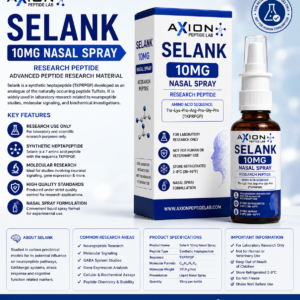
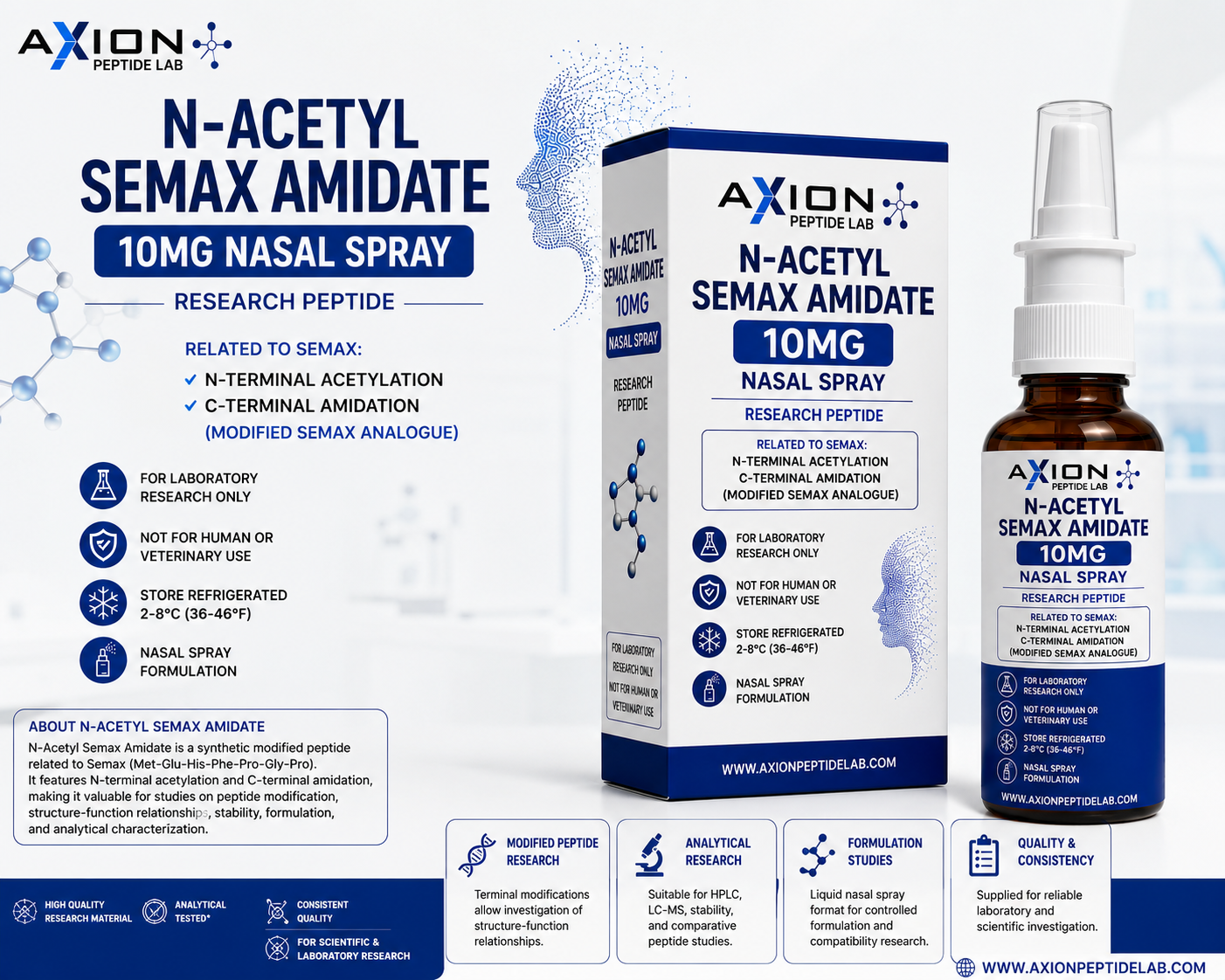
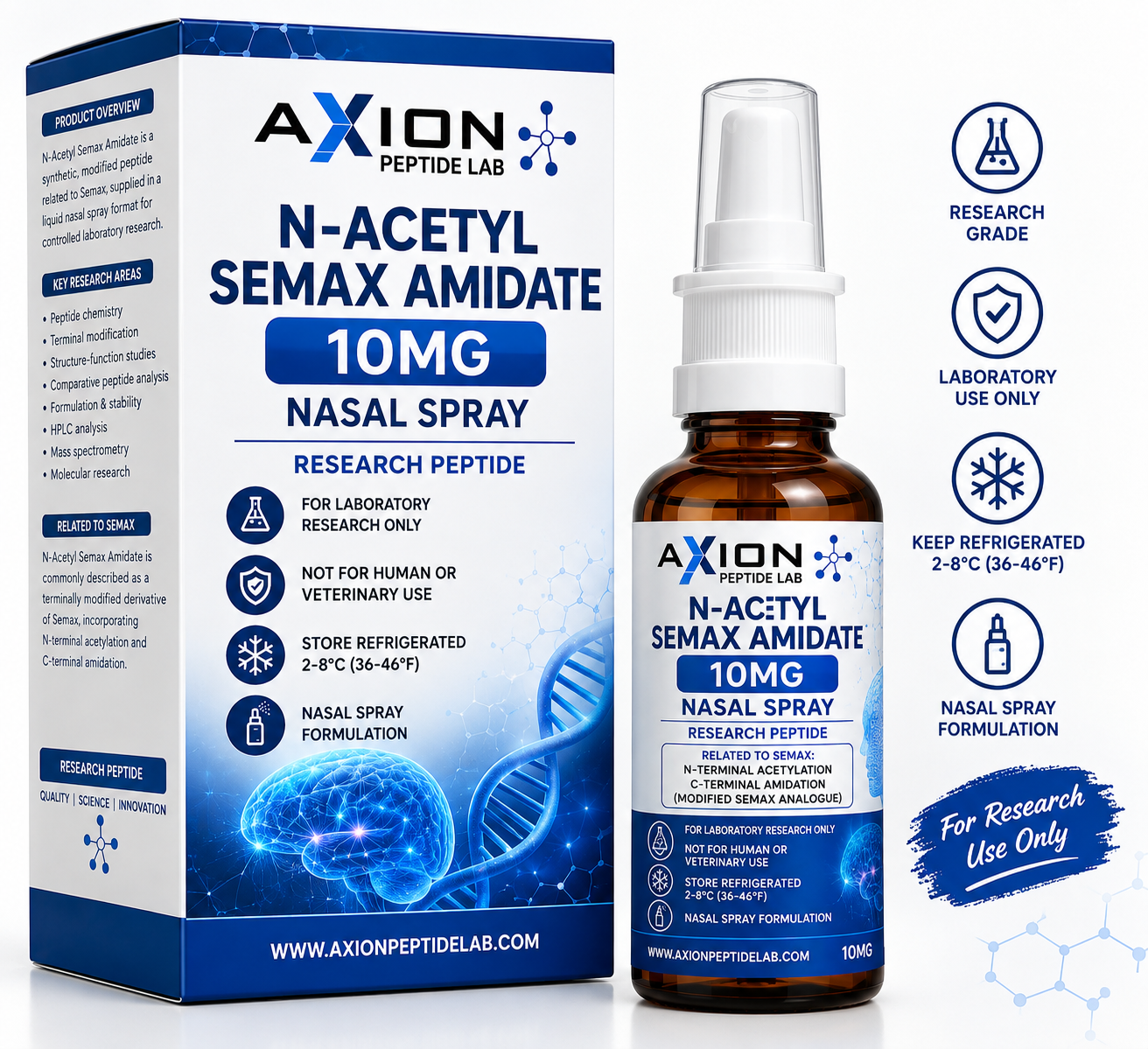
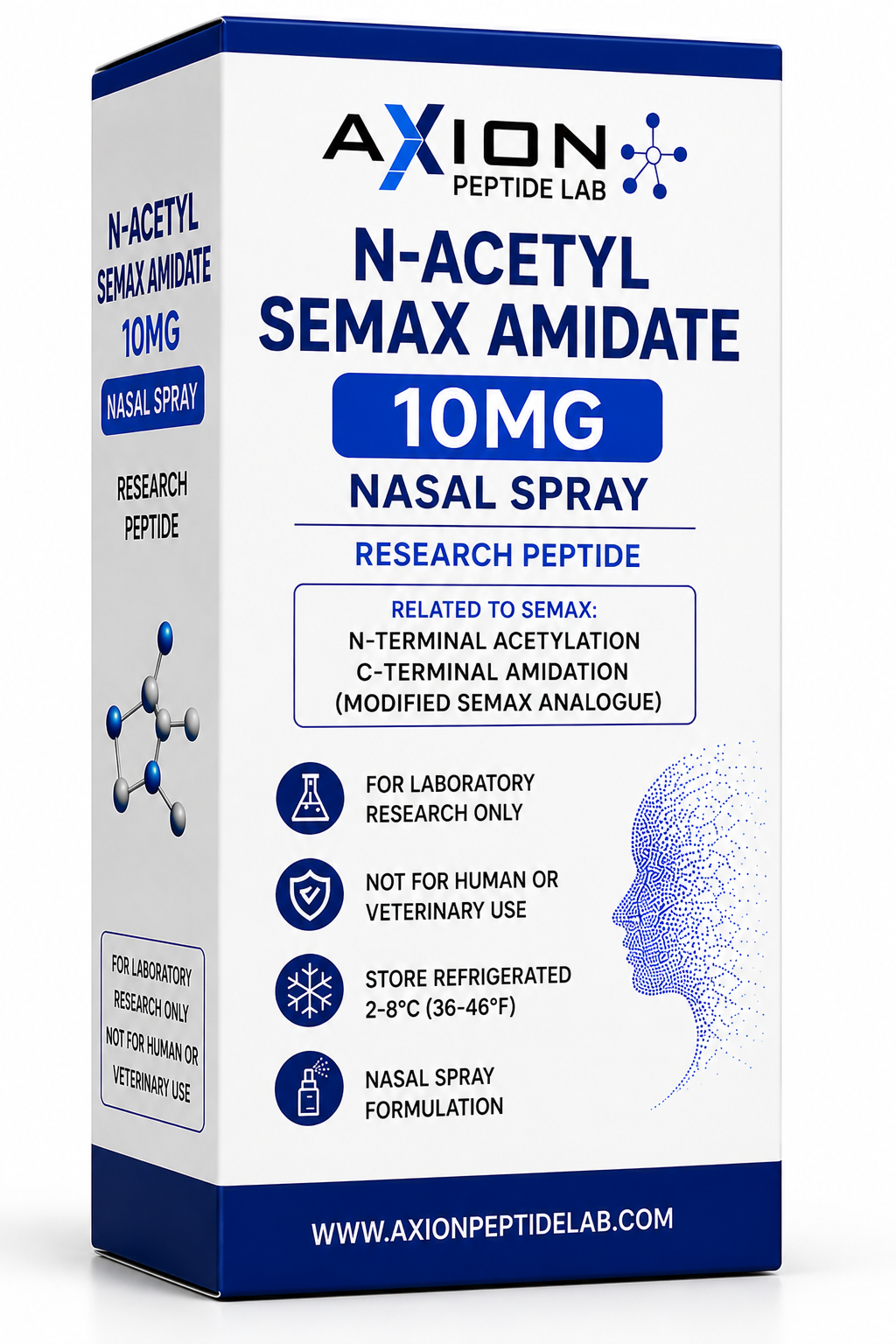
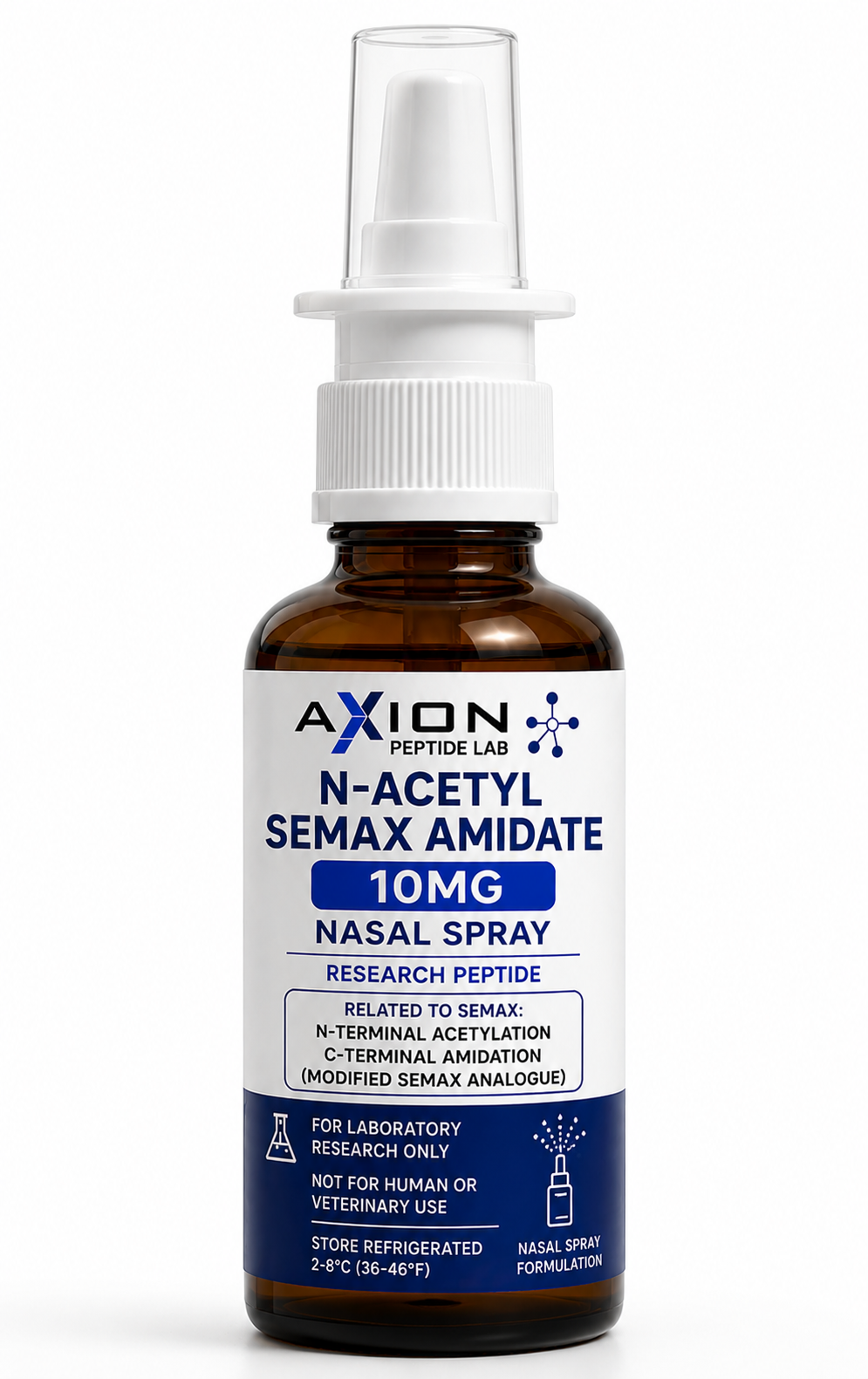
N-Acetyl Semax Amidate 10mg Nasal Spray is a modified synthetic peptide research preparation supplied by Axion Peptide Lab in a liquid spray format.
Related to the Semax peptide framework, N-Acetyl Semax Amidate is commonly described as incorporating N-terminal acetylation and C-terminal amidation, making it relevant to controlled studies involving modified-peptide chemistry, terminal modifications, structure-function relationships, comparative peptide analysis, formulation, stability, HPLC and mass spectrometry.
The 10mg designation represents the stated research quantity and is not a dosage recommendation. Nasal Spray describes the research presentation only.
For Research Use Only – Not for human or veterinary consumption or administration.
$108.29
N-Acetyl Semax Amidate 10mg Nasal Spray from Axion Peptide Lab is a synthetic peptide research preparation presented in a liquid spray format for controlled laboratory, molecular, peptide-chemistry, formulation, stability and analytical investigation.
N-Acetyl Semax Amidate is commonly described in the research-material market as a terminally modified derivative related to Semax. The name reflects modifications involving N-terminal acetylation and C-terminal amidation. These structural modifications make the compound particularly relevant to comparative peptide research examining how terminal changes may influence experimentally measurable molecular and analytical characteristics.
The 10mg designation represents the stated research quantity associated with this preparation and is not a dosage recommendation. “Nasal Spray” identifies the physical presentation of the research material only. It does not constitute instructions, recommendations or approval for human intranasal administration.
Because commercial naming and molecular specifications for modified Semax materials can vary between suppliers, researchers requiring an exact sequence, molecular formula, molecular weight, salt form or other identity specification should rely on documentation applicable to the specific product and batch.
Axion Peptide Lab supplies this preparation exclusively for legitimate scientific and analytical investigation.
For Research Use Only – Not for human or veterinary consumption or administration.
N-Acetyl Semax Amidate is a synthetic modified peptide related to Semax research.
Semax itself is commonly represented as the heptapeptide sequence Met-Glu-His-Phe-Pro-Gly-Pro, abbreviated MEHFPGP.
N-Acetyl Semax Amidate is distinguished by terminal modifications represented by its commercial name.
N-terminal acetylation involves modification at the amino terminus of a peptide, while C-terminal amidation modifies the carboxyl terminus.
Terminal modification is widely studied in peptide science because the ends of peptide molecules can contribute to physicochemical properties, enzymatic interactions and other experimentally measurable characteristics.
This makes N-Acetyl Semax Amidate relevant to laboratories studying how peptide modification influences molecular behaviour.
Semax is a synthetic heptapeptide historically developed through research involving fragments associated with adrenocorticotropic hormone-related sequences.
Its commonly represented sequence is:
Met-Glu-His-Phe-Pro-Gly-Pro
N-Acetyl Semax Amidate is related to this peptide framework but incorporates terminal modifications.
Researchers can therefore compare Semax-related materials with modified analogues to investigate differences in chromatographic behaviour, stability, molecular properties and other experimental parameters.
It is important not to assume that findings obtained with standard Semax automatically apply to N-Acetyl Semax Amidate.
Structural modifications can alter experimental characteristics, and each research material should be characterised independently.
Acetylation is a chemical modification frequently encountered in peptide and protein science.
N-terminal acetylation changes the chemical environment of a peptide’s amino terminus.
Researchers may investigate how this modification affects experimentally measurable properties such as chromatographic retention, susceptibility to selected enzymatic processes, molecular interactions or stability under defined laboratory conditions.
N-Acetyl Semax Amidate provides an interesting model for comparative experiments involving an acetylated peptide derivative and its related unmodified sequence.
C-terminal amidation is another common peptide modification.
Replacing a terminal carboxyl group with an amide changes the chemical characteristics of the peptide terminus.
This type of modification occurs naturally in numerous biologically active peptides and is also widely incorporated into synthetic peptide research.
Researchers studying N-Acetyl Semax Amidate can examine the combined presence of N-terminal acetylation and C-terminal amidation in controlled analytical systems.
Such experiments can contribute to broader research into peptide terminal chemistry and structure-function relationships.
Modified peptides are valuable research tools because even relatively small structural alterations can produce measurable changes in molecular characteristics.
Researchers can compare modified and unmodified peptide sequences using analytical and biochemical methods.
N-Acetyl Semax Amidate may therefore be incorporated into studies comparing terminal modification, peptide stability, chromatographic behaviour and molecular characteristics.
Careful experimental design is necessary when interpreting differences between peptide variants.
Structure-function research examines relationships between molecular architecture and experimentally measurable behaviour.
N-Acetyl Semax Amidate provides a useful example because its commercial identity is based on modifications to a Semax-related peptide framework.
Researchers can investigate whether terminal changes influence analytical behaviour under defined experimental conditions. N-Acetyl Semax Amidate 10mg
Comparative studies may incorporate Semax, N-Acetyl Semax Amidate and other appropriately characterised analogues.
Conclusions should remain limited to the conditions and models actually tested.
Peptide chemistry encompasses synthesis, purification, modification, structural characterisation and stability analysis. N-Acetyl Semax Amidate 10mg
N-Acetyl Semax Amidate may be relevant to laboratories examining synthetic peptide modification.
Researchers can investigate terminal chemistry, chromatographic characteristics, molecular identity and degradation behaviour.
The relatively compact Semax-related framework also makes this material relevant to analytical method development involving short synthetic peptides.
Laboratories can incorporate appropriately characterised N-Acetyl Semax Amidate into controlled molecular experiments.
Depending on the study objective, researchers may investigate peptide interactions, sequence-related properties or comparative behaviour against related synthetic materials.
Experimental systems should include appropriate controls and validated methodologies.
Observed molecular effects should not automatically be extrapolated beyond the experimental model. N-Acetyl Semax Amidate 10mg
Reliable peptide investigation depends on analytical characterisation.
Techniques such as high-performance liquid chromatography (HPLC) and liquid chromatography-mass spectrometry (LC-MS) are commonly employed in peptide science.
HPLC can support separation and compositional evaluation, while mass spectrometry can provide information relevant to molecular identity and structural characteristics.
Researchers requiring exact purity or identity specifications should review documentation applicable to the supplied batch.
Chromatographic methods are particularly valuable when comparing structurally related peptides.
Terminal modification can influence chromatographic behaviour.
Researchers may therefore compare N-Acetyl Semax Amidate with other Semax-related materials under controlled HPLC conditions. N-Acetyl Semax Amidate 10mg
Variables including stationary phase, mobile-phase composition, gradient profile, flow rate and detection methodology can influence retention and resolution.
Validated analytical methods are important when quantitative results are required.
Mass spectrometry can complement chromatographic analysis by providing mass-based molecular information.
LC-MS approaches may be useful for investigating N-Acetyl Semax Amidate, related compounds and selected transformation products.
The expected molecular characteristics should be established using verified product identity rather than assumptions based solely on the commercial product name.
This is particularly important for modified research peptides. N-Acetyl Semax Amidate 10mg
Peptide stability can influence experimental reproducibility.
N-Acetyl Semax Amidate may be investigated in controlled stability experiments examining variables such as temperature, pH, formulation environment, light exposure and time.
Samples can be collected at predetermined intervals and analysed using suitable chromatographic or mass-spectrometric methods. N-Acetyl Semax Amidate 10mg
Results obtained with one formulation should not automatically be applied to another preparation.
Terminal modifications are often investigated as variables in peptide stability research.
A laboratory could compare appropriately characterised Semax-related materials under identical experimental conditions to evaluate measurable differences over time.
Such experiments require controlled sample preparation, validated analytical methods and appropriate reference materials.
The presence of terminal modifications alone should not be treated as proof of superior stability without supporting experimental evidence.
N-Acetyl Semax Amidate 10mg Nasal Spray is presented as a liquid research preparation.
This format may be relevant to controlled formulation, solution compatibility, dispensing-characterisation and stability investigation.
Researchers requiring information regarding solvent composition, preservatives, pH or concentration basis should consult verified product-specific documentation.
These characteristics should not be assumed solely from the liquid spray format. N-Acetyl Semax Amidate 10mg
The term Nasal Spray describes the physical presentation of this research preparation.
It does not represent a recommendation or instruction for human administration.
This product should remain clearly separated from medicines or consumer nasal products.
Axion Peptide Lab does not provide human dosage, administration or therapeutic protocols for this research preparation.
The 10mg designation represents the stated research quantity associated with the preparation.
It is not a dosage recommendation.
Researchers conducting quantitative experiments should determine experimental concentrations according to their validated protocols, study objectives and applicable product documentation.
N-Acetyl Semax Amidate may be relevant to controlled laboratory investigation involving:
These categories describe scientific research applications and should not be interpreted as medical indications.
Researchers should document product identity, batch information, experimental conditions and analytical procedures when conducting reproducible studies.
Because commercially supplied modified peptides can vary in molecular specification, batch-specific documentation should be consulted when exact identity characteristics are required.
Certificate of Analysis and independent testing availability may vary by product and batch.
Claims regarding exact purity, sterility, concentration, solvent composition or other specifications should only be made when supported by applicable documentation.
Researchers looking to buy N-Acetyl Semax Amidate 10mg Nasal Spray can source this modified peptide research preparation from Axion Peptide Lab for legitimate scientific and analytical investigation.
Its relationship to the Semax peptide framework and its terminal modifications make N-Acetyl Semax Amidate particularly relevant to research involving peptide chemistry, terminal acetylation, amidation, structure-function relationships, comparative peptide investigation, formulation science, stability and analytical characterisation.
The liquid spray presentation also provides a convenient format for controlled formulation and solution-oriented laboratory research. N-Acetyl Semax Amidate 10mg
For Research Use Only – Not for human or veterinary consumption or administration.
N-Acetyl Semax Amidate is a synthetic modified peptide related to the Semax peptide framework and commonly described as incorporating terminal acetylation and amidation.
Semax is commonly represented as the seven-residue peptide Met-Glu-His-Phe-Pro-Gly-Pro. N-Acetyl Semax Amidate is commercially described as a terminally modified derivative related to this framework.
N-terminal acetylation is a chemical modification of the amino terminus of a peptide and is investigated in peptide chemistry and structure-function research.
Amidation modifies a peptide’s terminal carboxyl group to form an amide. It is a common feature of naturally occurring and synthetic research peptides.
Relevant laboratory areas include terminal peptide chemistry, modified-peptide research, comparative analysis, stability, formulation studies, HPLC and mass spectrometry.
No. The names describe related but structurally different research materials. Experimental findings involving one material should not automatically be attributed to the other. N-Acetyl Semax Amidate 10mg
Yes. Suitable validated HPLC methods may be used for chromatographic investigation and comparative peptide analysis.
Appropriate LC-MS and mass-spectrometric methods may provide information relevant to molecular identity and analytical characterisation.
10mg represents the stated research quantity associated with the preparation. Nasal Spray describes the physical research presentation. Neither term constitutes a human dosage or administration recommendation.
N-Acetyl Semax Amidate 10mg Nasal Spray is available from Axion Peptide Lab for legitimate peptide, molecular, formulation and analytical laboratory investigation, subject to availability and applicable requirements.