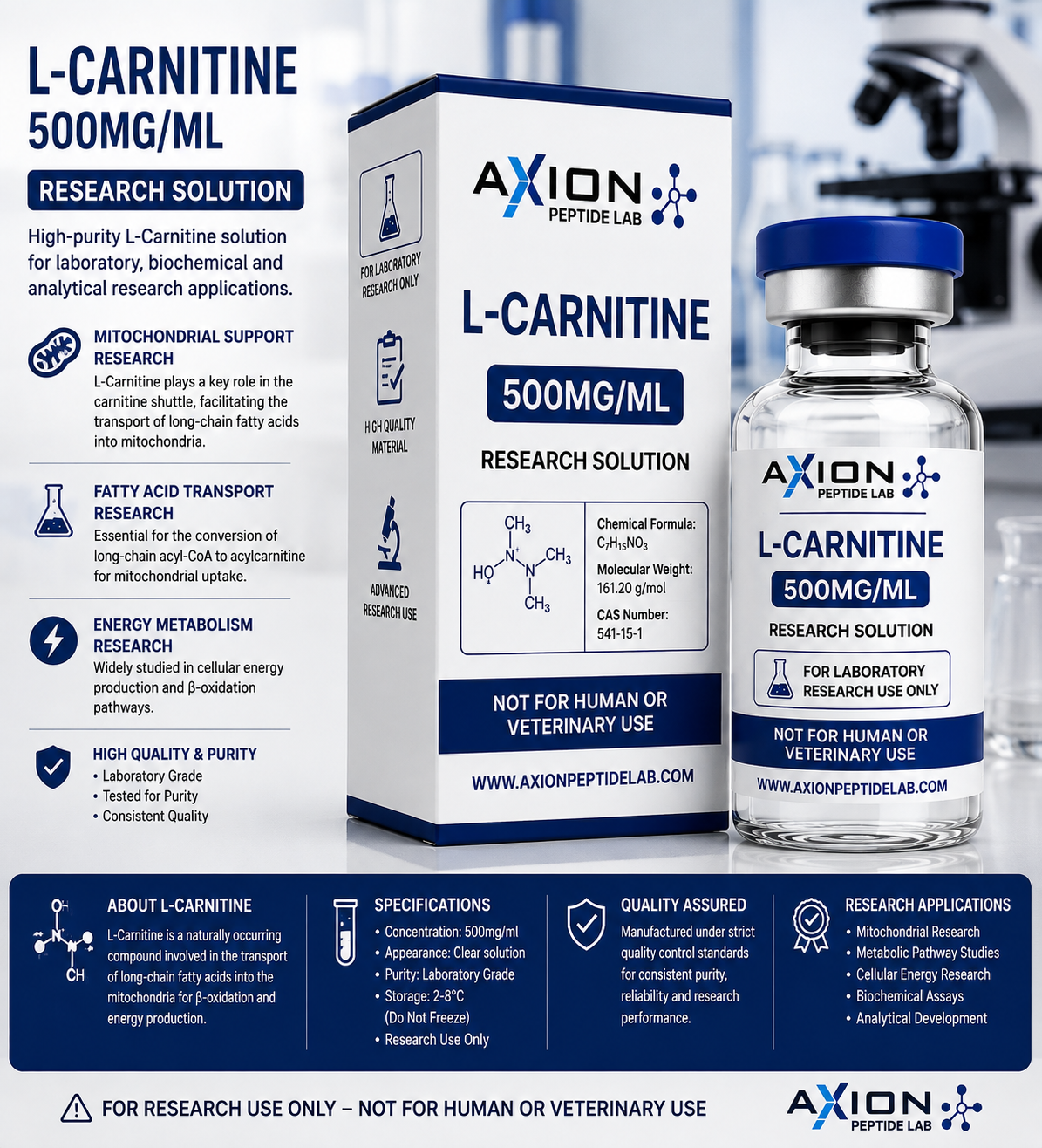
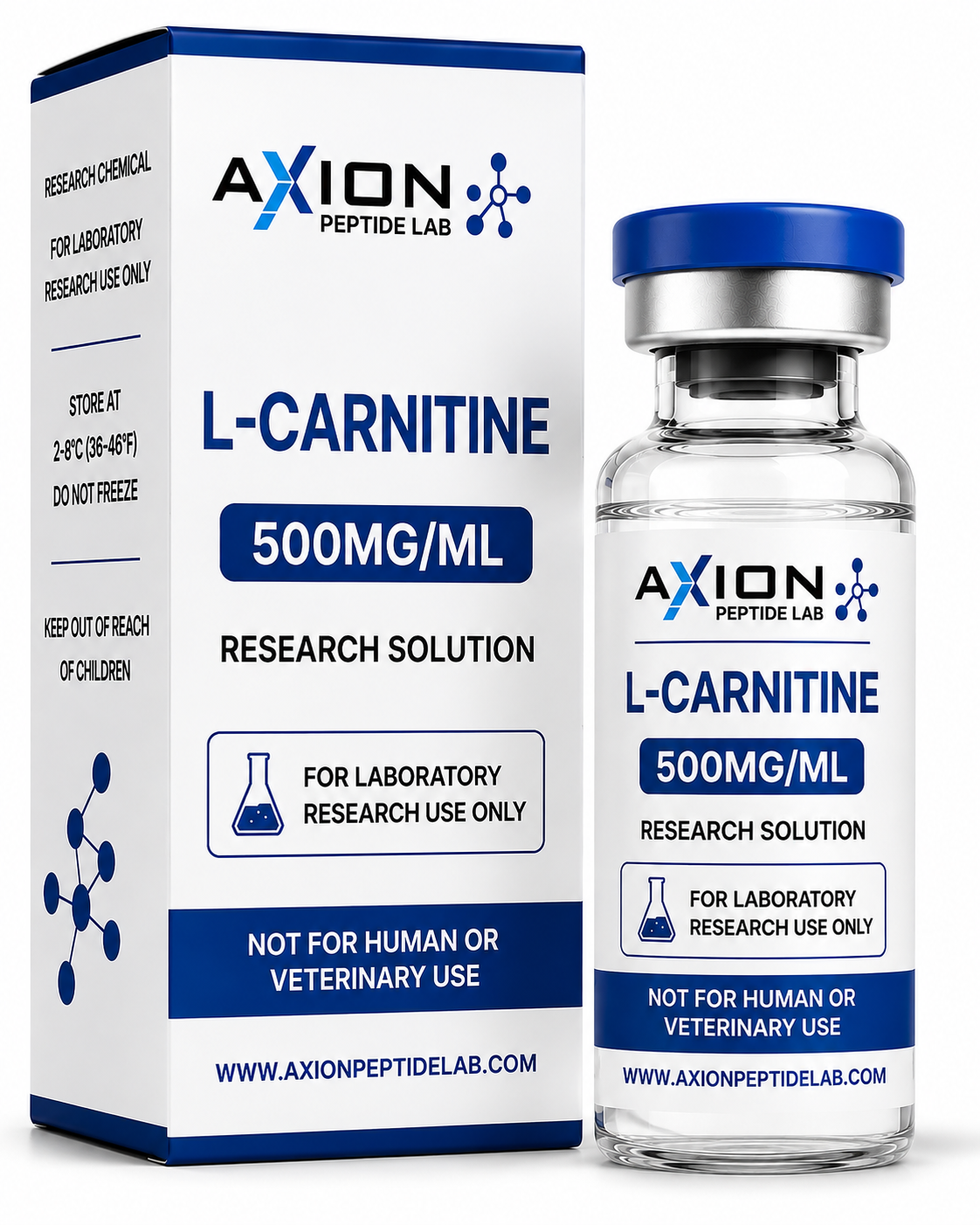
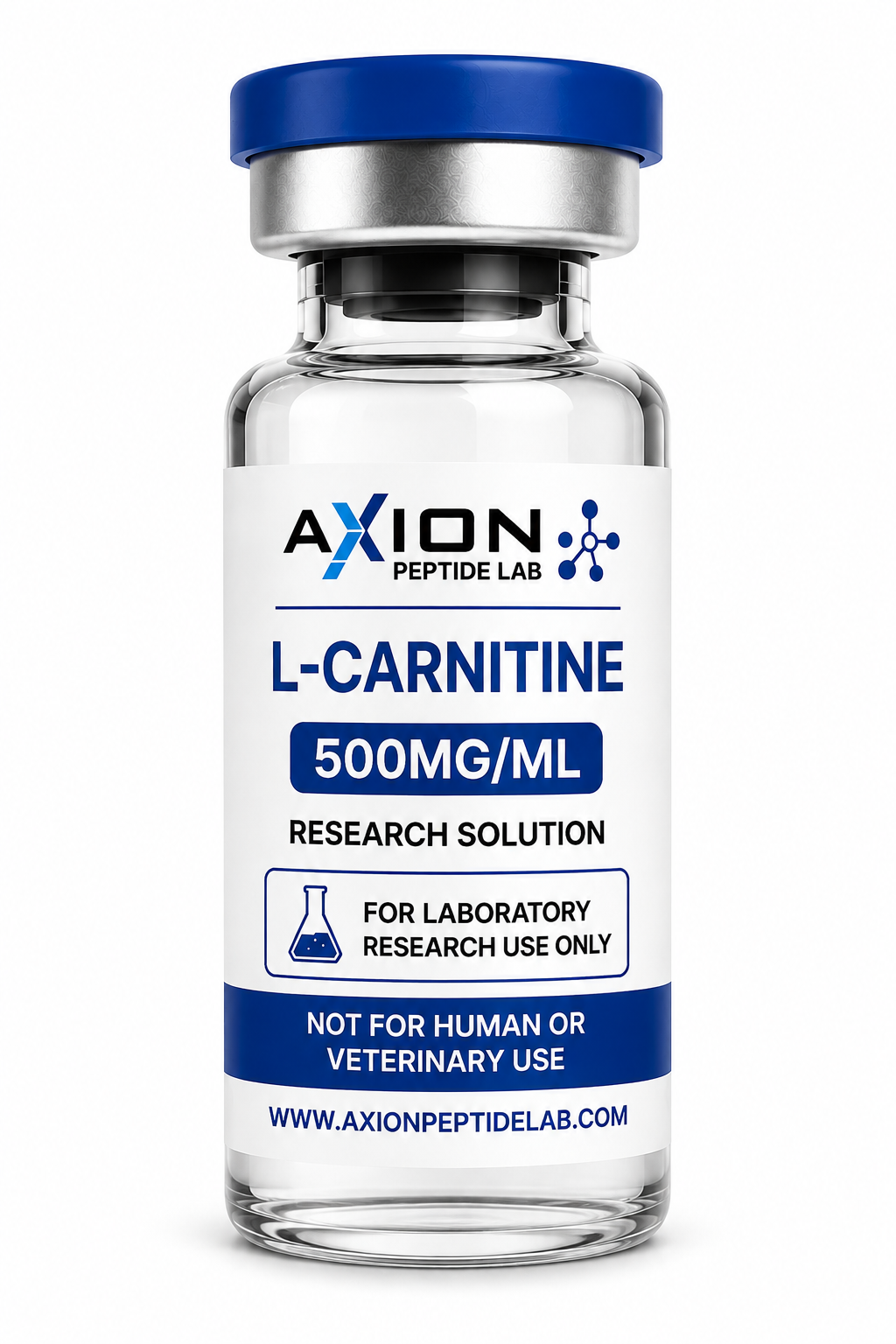
L-Carnitine 500mg/ml Research Solution is a concentrated liquid research formulation intended for controlled laboratory, biochemical and analytical investigation. L-carnitine is an amino-acid-derived molecule involved in the mitochondrial carnitine shuttle and is widely studied in research involving long-chain fatty-acid transport, β-oxidation, acylcarnitine metabolism and cellular bioenergetics.
The 500mg/ml designation represents the stated research concentration and is not a dosage recommendation.
For Research Use Only – Not for human or veterinary consumption.
$27.06
L-Carnitine 500mg/ml Research Solution from Axion Peptide Lab is a concentrated research formulation intended for controlled laboratory, biochemical and analytical investigation.
L-carnitine, also known as levocarnitine, is a naturally occurring molecule with an established biochemical role in cellular fatty-acid transport. Unlike many products available from peptide research laboratories, L-carnitine is not a peptide. It is an amino-acid-derived quaternary ammonium compound involved in the transport of long-chain fatty-acid groups into mitochondria.
The 500mg/ml designation describes the stated concentration of the research solution and should not be interpreted as a dosage or administration recommendation.
Researchers can use this material in appropriately designed studies involving carnitine chemistry, mitochondrial metabolism, fatty-acid transport, the carnitine shuttle, acylcarnitine biology and analytical characterisation.
For Research Use Only – Not for human or veterinary consumption.
L-carnitine is the biologically active R-enantiomer of carnitine and is naturally present in mammalian metabolism.
Its molecular formula is:
C₇H₁₅NO₃
Its molecular weight is approximately:
161.20 g/mol
The commonly referenced CAS Registry Number is:
541-15-1
The systematic chemical name reported for L-carnitine is (3R)-3-hydroxy-4-(trimethylazaniumyl)butanoate.
These characteristics distinguish L-carnitine from conventional peptide research materials composed of chains of amino-acid residues.
For laboratories, its defined molecular structure provides opportunities for biochemical, metabolic and analytical investigation.
One of the most established areas of L-carnitine research involves mitochondrial biology.
Mitochondria are responsible for numerous metabolic processes, including the oxidation of fatty acids for cellular energy production.
Long-chain fatty-acid groups require a specialised transport system to reach the mitochondrial matrix efficiently.
L-carnitine participates directly in this process through the carnitine shuttle.
This established biochemical relationship makes L-carnitine an important research compound for laboratories studying mitochondrial metabolism, fatty-acid handling and cellular bioenergetics.
Researchers can examine these pathways using controlled cellular, biochemical or analytical models.
The carnitine shuttle is a transport system responsible for moving long-chain fatty-acid-derived acyl groups across the inner mitochondrial membrane.
Long-chain acyl-CoA molecules cannot efficiently cross this membrane independently.
Carnitine participates in their conversion into acylcarnitines, enabling transport across the mitochondrial membrane.
The pathway involves several important components, including carnitine palmitoyltransferase 1 (CPT1), carnitine-acylcarnitine translocase (CACT) and carnitine palmitoyltransferase 2 (CPT2).
Once transported into the mitochondrial matrix, fatty-acid-derived molecules can enter β-oxidation.
This makes the L-carnitine system particularly valuable for controlled research involving mitochondrial transport mechanisms.
Fatty-acid oxidation is a fundamental metabolic process through which fatty acids are broken down within mitochondria.
Long-chain fatty-acid oxidation depends on an operational carnitine transport system.
Researchers studying this pathway may investigate L-carnitine alongside acyl-CoA compounds, acylcarnitines, mitochondrial enzymes or transport proteins.
Analytical experiments can examine changes in metabolites under carefully controlled conditions.
L-carnitine research can therefore contribute to broader investigations of mitochondrial energy pathways and cellular metabolic regulation.
Such biochemical roles should not be converted into unsupported claims that the Axion research solution produces weight-loss, athletic-performance or therapeutic effects.
Acylcarnitines are formed when carnitine carries acyl groups.
They represent an important part of mitochondrial fatty-acid transport and are frequently examined in metabolic research.
Researchers may study relationships between free carnitine and different acylcarnitine species.
Analytical methods can be used to investigate changes in these compounds across different experimental conditions.
Acylcarnitine profiling can also provide useful information when researchers are studying mitochondrial pathways or disruptions in fatty-acid metabolism.
L-Carnitine 500mg/ml Research Solution provides a concentrated format for appropriately designed laboratory investigation of these biochemical systems.
Carnitine palmitoyltransferases play central roles in the carnitine shuttle.
CPT1 contributes to the formation of long-chain acylcarnitines on the mitochondrial side of the transport pathway.
Following transport through the mitochondrial membrane system, CPT2 contributes to converting acylcarnitines back into long-chain acyl-CoA molecules.
Researchers can investigate these enzymes and associated metabolites to understand mitochondrial lipid transport.
L-carnitine may therefore be incorporated into experimental systems studying CPT-associated biochemical pathways.
Appropriate controls and validated methodologies should be used to ensure meaningful interpretation.
L-carnitine is relevant to broader research involving cellular metabolism.
Cells must continuously regulate the use, transport and storage of energy-containing molecules.
Mitochondrial fatty-acid metabolism represents one component of this complex system.
Researchers may investigate how changes in experimental conditions influence carnitine-associated pathways, mitochondrial metabolites and cellular energy-related processes.
Experiments may include cellular models, enzyme systems, biochemical preparations or analytical standards depending on the research objective.
Findings should remain specific to the experimental model and conditions used.
Stereochemistry is an important consideration when working with carnitine.
L-carnitine represents the R-enantiomer of carnitine.
Its stereochemical identity distinguishes it from D-carnitine and racemic DL-carnitine preparations.
This distinction is important for researchers because stereoisomers can interact differently with biological systems.
Laboratories conducting precise analytical or biochemical work should therefore verify that their reference information corresponds specifically to L-carnitine rather than another carnitine form.
Product-specific documentation should be consulted when exact identity or composition is essential to an experiment.
L-carnitine can be incorporated into analytical workflows involving chemical identity, concentration and molecular characterisation.
Depending on laboratory capabilities, researchers may use chromatographic, spectrometric or other validated analytical techniques.
Studies may investigate L-carnitine independently or alongside related metabolites such as acetyl-L-carnitine and long-chain acylcarnitines.
Comparative analytical research can help distinguish compounds based on molecular characteristics and chromatographic behaviour.
Researchers requiring specific purity, concentration tolerances or additional specifications should consult documentation associated with the actual Axion Peptide Lab product and batch.
The 500mg/ml designation communicates the stated concentration of L-carnitine in the research solution.
This means that each millilitre of the formulation is represented as containing 500mg of L-carnitine according to the product specification.
The concentration is provided for laboratory identification and experimental planning.
It is not a recommended human dose.
Researchers should establish experimental quantities using validated laboratory protocols, analytical objectives and institutional procedures.
The concentration should also be distinguished from total container volume, which determines the total amount of material present in an individual product.
A prepared research solution can offer practical advantages for experimental workflows requiring a liquid material.
Researchers may incorporate the solution into appropriately designed analytical, biochemical or cellular experiments.
The exact solvent, pH, sterility status, preservatives and other formulation characteristics should not be assumed from the concentration alone.
These parameters should be confirmed using documentation associated with the specific product and batch.
This distinction is particularly important where experimental outcomes could be influenced by formulation components.
Controlled laboratory investigation may include:
These categories describe scientific research applications rather than medical or consumer indications.
Reliable laboratory investigation depends on accurate documentation.
Researchers should record product identity, concentration, batch information, experimental conditions and analytical methodology.
When available, batch-specific documentation can provide additional information concerning measured product specifications.
Certificate of Analysis and independent testing availability may vary by product and batch.
Researchers requiring particular purity, concentration, solvent or other analytical parameters should verify the relevant documentation before beginning an experiment.
Specifications from unrelated L-carnitine products should not automatically be attributed to this research solution.
L-Carnitine 500mg/ml Research Solution should be handled by appropriately trained personnel within suitable research environments.
The product should remain clearly labelled and separated from medicines, supplements, foods and other consumer products.
Researchers should follow product-specific handling and storage documentation.
The words “research solution” should not be interpreted as indicating that the product is an approved pharmaceutical preparation.
Customers are responsible for ensuring that purchase, possession, importation and experimental use comply with applicable regulations and institutional requirements.
Axion Peptide Lab supplies specialised materials intended for controlled laboratory, biochemical and analytical investigation.
L-Carnitine 500mg/ml provides researchers with a concentrated liquid format for appropriately designed experimental projects.
Its established relationship with the carnitine shuttle makes L-carnitine particularly relevant to research involving mitochondrial transport, fatty-acid metabolism and acylcarnitine chemistry.
Researchers should review available product specifications and documentation to determine whether the material meets the requirements of their intended experimental workflow. L-Carnitine 500mg/ml Research Solution
Qualified laboratories, researchers and scientific organisations can buy L-Carnitine 500mg/ml Research Solution from Axion Peptide Lab for legitimate laboratory and analytical investigation.
Its defined chemical identity and established biochemical relationship with mitochondrial fatty-acid transport make L-carnitine useful across a variety of experimental research applications.
This product should not be marketed as an injectable supplement, weight-loss treatment, fat burner, athletic-performance enhancer or therapeutic medicine.
For Research Use Only – Not for human or veterinary consumption.
It is a concentrated L-carnitine formulation supplied for controlled laboratory, biochemical and analytical research.
No. L-carnitine is not a peptide. It is an amino-acid-derived quaternary ammonium compound involved naturally in cellular metabolism.
The molecular formula of L-carnitine is C₇H₁₅NO₃.
L-carnitine has a molecular weight of approximately 161.20 g/mol. L-Carnitine 500mg/ml Research Solution
The commonly referenced CAS Registry Number for L-carnitine is 541-15-1.
Laboratory research areas include the carnitine shuttle, mitochondrial metabolism, long-chain fatty-acid transport, β-oxidation, acylcarnitine biology and analytical chemistry.
It represents the stated concentration of L-carnitine in the research solution. It is not a human dosage recommendation.
It is a mitochondrial transport system involving carnitine and proteins including CPT1, CACT and CPT2 that enables long-chain fatty-acid-derived groups to enter the mitochondrial matrix for oxidation.
No. L-carnitine refers specifically to the biologically active R-enantiomer, while DL-carnitine is a racemic mixture containing both stereoisomers. L-Carnitine 500mg/ml Research Solution
No. This product is supplied exclusively for laboratory and analytical research, and human administration or self-experimentation guidance is not provided. L-Carnitine 500mg/ml Research Solution