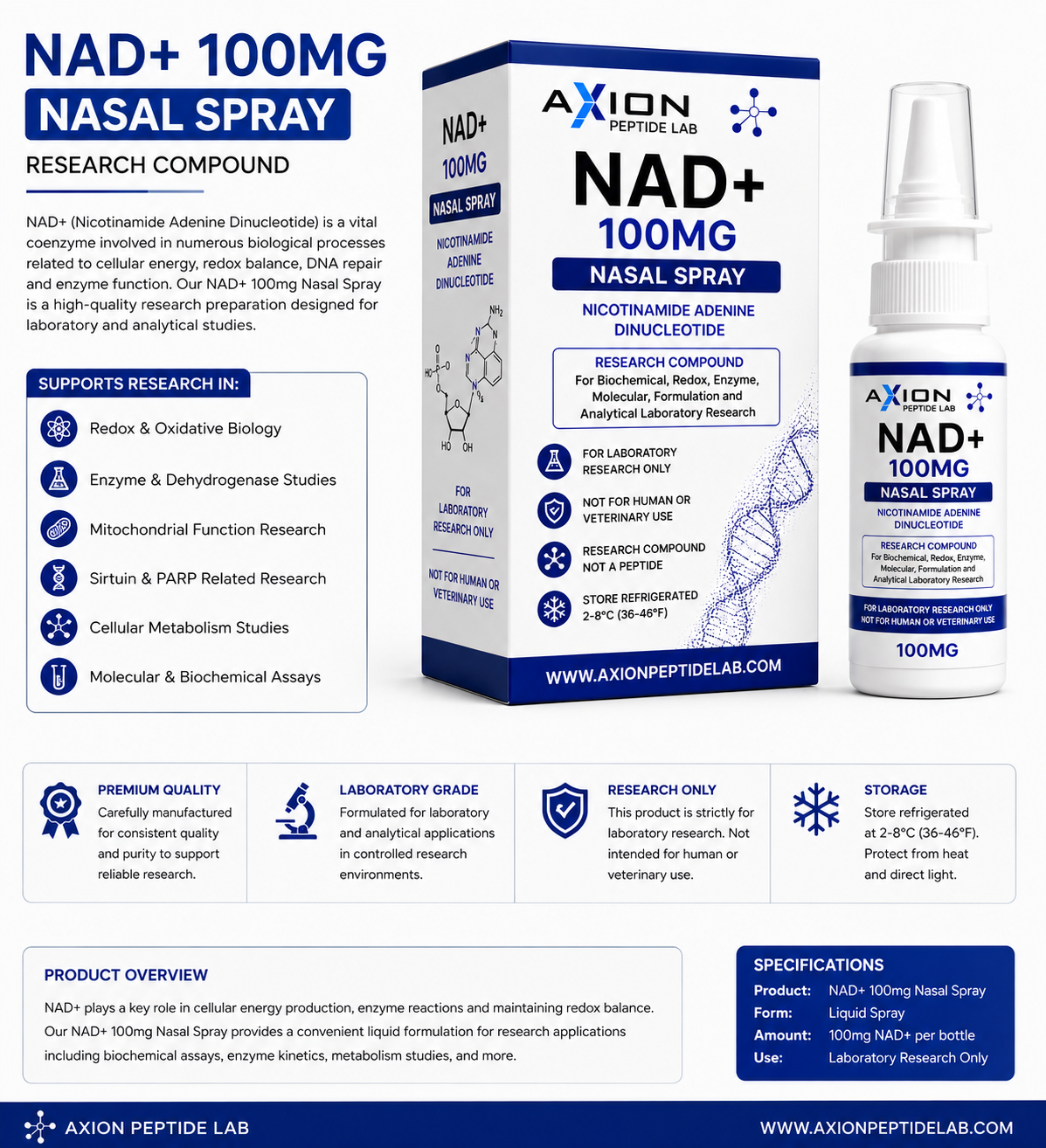
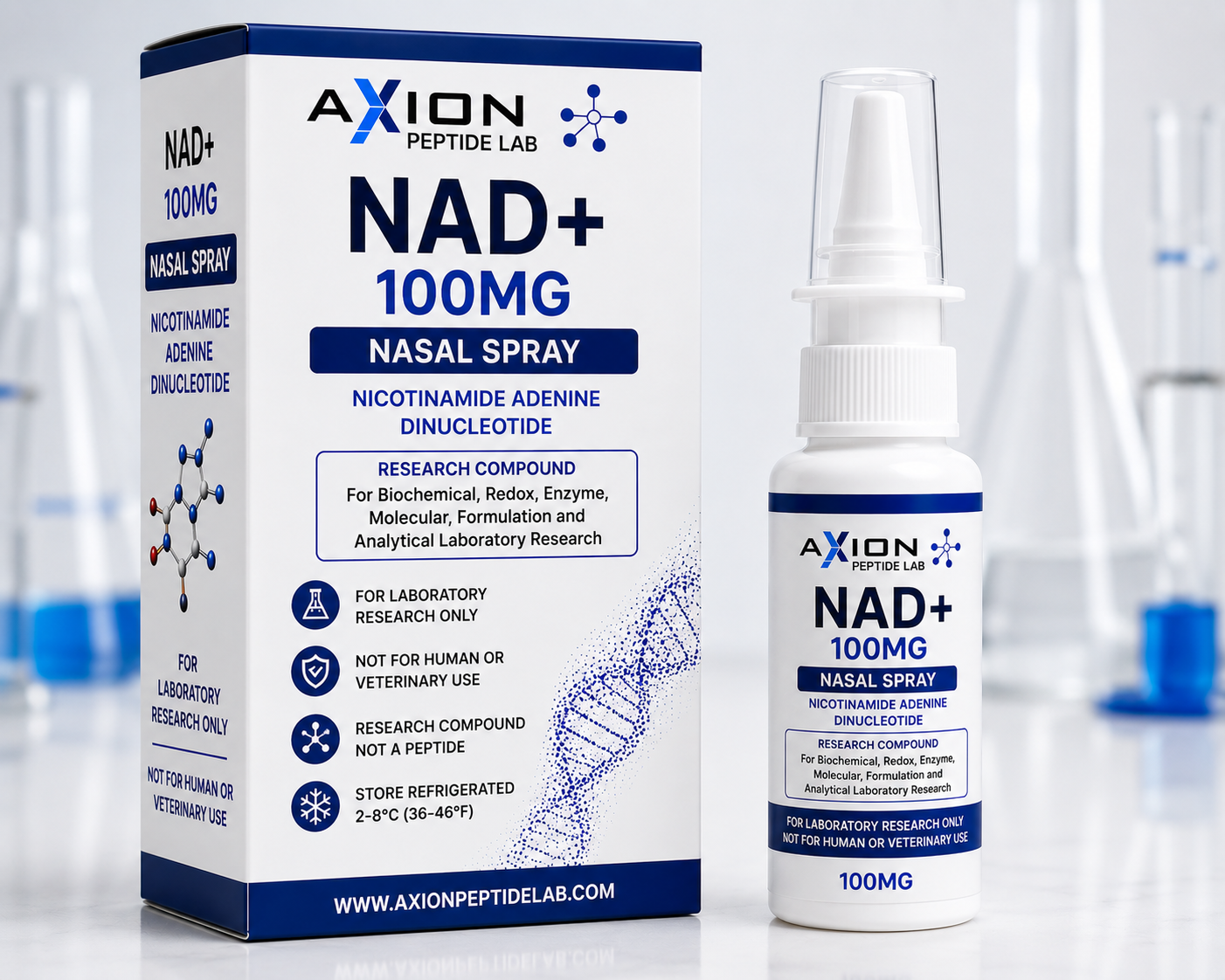
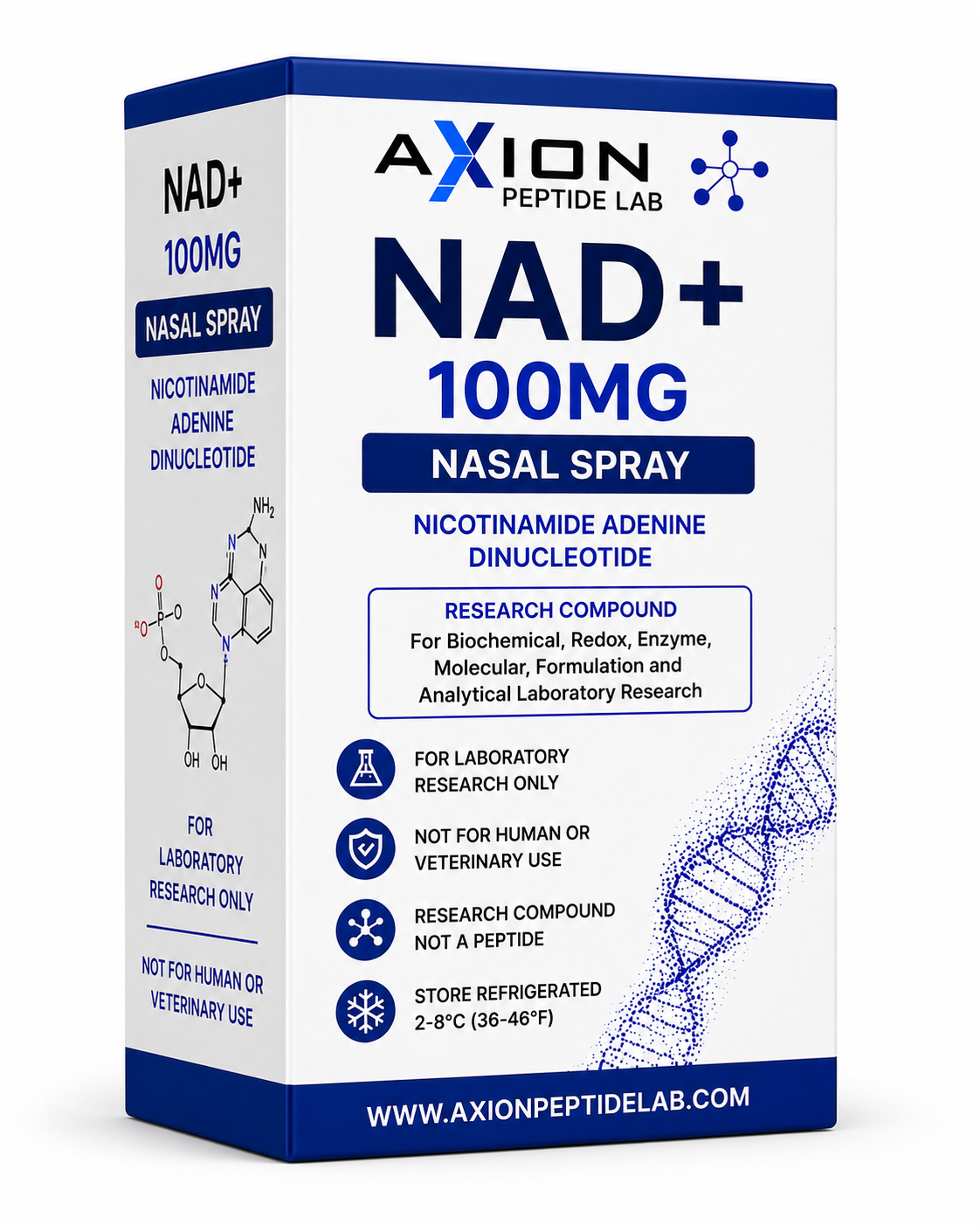
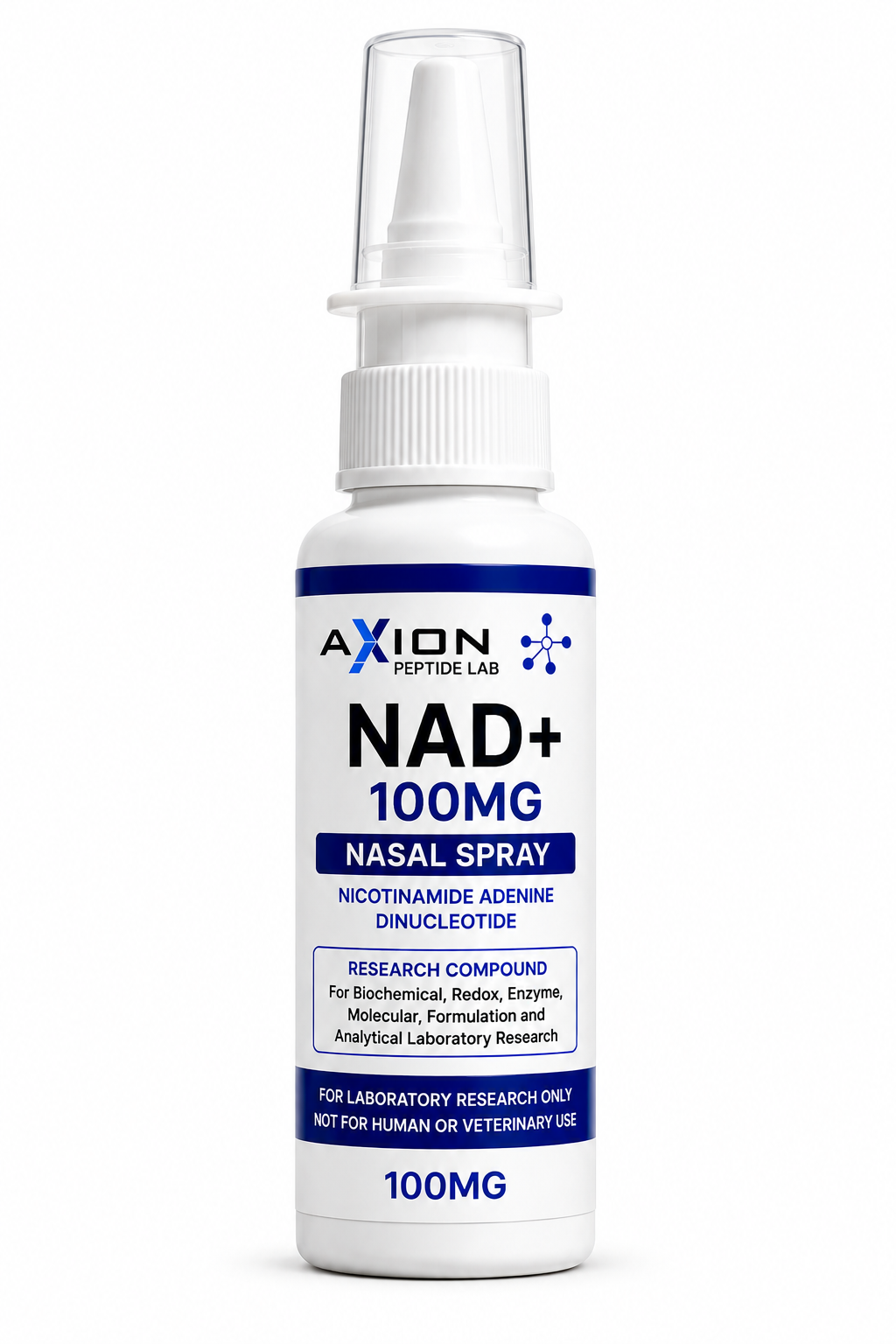
NAD+ 100mg Nasal Spray is a nicotinamide adenine dinucleotide research preparation intended for controlled biochemical, redox, enzyme, mitochondrial, formulation, stability and analytical laboratory investigation.
NAD+ is an essential dinucleotide coenzyme and forms the oxidized component of the important NAD+/NADH redox pair.
100mg represents the stated research quantity and is not a dosage recommendation. Nasal Spray describes the physical research presentation only.
For Research Use Only – Not for human or veterinary consumption or administration.
$108.29
NAD+ 100mg Nasal Spray from Axion Peptide Lab is a nicotinamide adenine dinucleotide research preparation intended exclusively for controlled biochemical, molecular, redox, formulation and analytical laboratory investigation.
Nicotinamide adenine dinucleotide, commonly abbreviated NAD+, is an essential biological coenzyme found throughout cellular systems. It participates in numerous biochemical processes and is especially important in oxidation-reduction reactions involving the transfer of electrons between molecules. NAD+ 100mg Nasal Spray
Its fundamental role in cellular biochemistry has made NAD+ an extensively investigated molecule across enzymology, metabolic biochemistry, mitochondrial science, redox biology and molecular research.
The 100mg designation identifies the stated quantity of NAD+ associated with the research preparation and is not a dosage recommendation. “Nasal Spray” describes the physical research format only and should not be interpreted as instructions for human administration. NAD+ 100mg Nasal Spray
For Research Use Only – Not for human or veterinary consumption or administration.
NAD+ stands for nicotinamide adenine dinucleotide.
Despite being frequently listed alongside peptides in research catalogues, NAD+ is not a peptide. It is a dinucleotide coenzyme assembled from two nucleotide components connected through their phosphate groups.
One nucleotide contains an adenine base, while the other contains nicotinamide.
This molecular structure allows NAD+ to participate in biochemical reactions fundamentally different from the receptor-binding mechanisms commonly associated with peptide research materials.
NAD+ is therefore more accurately categorized as a biochemical research compound. NAD+ 100mg Nasal Spray
One of the most important characteristics of NAD+ is its ability to participate in reversible redox reactions.
The oxidized form is represented as:
NAD+
Its reduced counterpart is:
NADH
During suitable biochemical reactions, NAD+ can accept electrons and a proton equivalent to form NADH. NADH can subsequently participate in reactions that regenerate NAD+.
This reversible relationship makes the NAD+/NADH redox couple a central experimental model for investigating electron-transfer processes.
Laboratories can measure changes in these molecular forms to study biochemical reaction systems under carefully controlled conditions. NAD+ 100mg Nasal Spray
Redox biology investigates oxidation and reduction reactions occurring within biological systems.
Because NAD+ and NADH form a major redox pair, these molecules are relevant to numerous biochemical experimental models. NAD+ 100mg Nasal Spray
Researchers may examine NAD+-dependent reactions under different environmental conditions, substrate concentrations or enzymatic systems. NAD+ 100mg Nasal Spray
Such experiments can provide insight into electron transfer, enzyme activity and broader biochemical relationships. NAD+ 100mg Nasal Spray
Experimental observations should always be interpreted according to the specific model rather than extrapolated automatically into therapeutic outcomes. NAD+ 100mg Nasal Spray
Numerous enzymes d NAD+ 100mg Nasal Sprayepend directly or indirectly on NAD+.
This makes nicotinamide adenine dinucleotide particularly valuable for controlled enzymology studies. NAD+ 100mg Nasal Spray
Researchers may investigate how changes in substrate availability, enzyme concentration, temperature, pH or other variables affect NAD+-associated reactions.
Spectrophotometric, chromatographic and mass-spectrometric techniques may be incorporated depending on the experimental objective.
Appropriate positive and negative controls are important when evaluating enzyme-dependent biochemical systems. NAD+ 100mg Nasal Spray
NAD+ is especially important in research involving dehydrogenase enzymes.
Dehydrogenases catalyse oxidation-reduction reactions in which electron transfer occurs between substrates and cofactors. NAD+ 100mg Nasal Spray
Depending on the enzyme and reaction, NAD+ may function as an electron acceptor and be converted into NADH.
This characteristic allows researchers to monitor biochemical reactions using analytical techniques capable of distinguishing oxidized and reduced forms.
Such models are widely useful for studying enzyme kinetics and reaction mechanisms.
NAD+/NADH biology is also relevant to controlled mitochondrial research.
Mitochondria contain interconnected biochemical pathways involving redox cofactors and electron-transfer processes.
Researchers may investigate how NAD+-related reactions interact with predefined mitochondrial experimental models. NAD+ 100mg Nasal Spray
Variables may include substrate composition, enzyme systems, environmental conditions and experimental duration.
These studies should remain appropriately framed as laboratory investigation rather than claims that a commercial NAD+ research preparation produces particular physiological outcomes.
NAD+ is widely distributed throughout cellular systems and participates in numerous biochemical pathways. NAD+ 100mg Nasal Spray
Its role extends beyond simple redox reactions.
Researchers may investigate NAD+-dependent molecular processes in cellular or cell-free models, depending on the objectives of the study. NAD+ 100mg Nasal Spray
Controlled experimental systems can help determine relationships between NAD+ availability, enzymatic activity and predefined biochemical endpoints.
Cell type, experimental conditions and assay methodology can substantially influence observed results. NAD+ 100mg Nasal Spray
Certain enzymes use NAD+ as a substrate rather than simply as a reversible redox cofactor.
This provides another major area of biochemical investigation.
Laboratories may study NAD+-dependent enzymatic systems to examine substrate utilization, reaction products, enzyme kinetics and molecular interactions.
This broader biochemical role demonstrates why NAD+ is useful across multiple areas of molecular research.
Researchers should select appropriate analytical methods according to the enzyme system being investigated.
Sirtuins are NAD+-dependent enzymes that have become important experimental targets within molecular biology.
NAD+ can therefore be incorporated into controlled biochemical models examining sirtuin-associated enzymatic reactions.
These studies may investigate enzyme kinetics, substrate relationships or changes in predefined molecular endpoints.
The existence of these research pathways should not be converted into claims that an NAD+ research product provides anti-aging or other therapeutic effects. NAD+ 100mg Nasal Spray
NAD+ is also relevant to experimental systems involving poly(ADP-ribose) polymerases, commonly abbreviated PARPs.
These enzymes use NAD+ during specific molecular reactions.
Laboratory studies can examine NAD+ utilization and associated molecular changes under carefully defined conditions.
Such research contributes to understanding NAD+-dependent biochemical pathways at a mechanistic level.
Again, mechanistic laboratory findings should remain distinct from claims about outcomes in humans.
NAD+ may be incorporated into broader molecular research involving enzyme systems, redox reactions, cellular extracts and biochemical assays.
The compound’s extensive involvement in biological chemistry makes it useful as an experimental variable in many different research designs.
Researchers should document concentration, experimental environment, assay method and other conditions carefully.
This helps ensure reproducibility and meaningful interpretation of analytical results. NAD+ 100mg Nasal Spray
The spray presentation makes this product particularly relevant to controlled liquid formulation research.
Researchers may examine physical and chemical characteristics of NAD+ within a defined liquid preparation.
Experimental variables could include pH, temperature, light exposure, solution composition, container compatibility and storage duration.
The term “Nasal Spray” identifies the product’s physical spray format.
It does not constitute a recommendation or instruction for human intranasal administration.
NAD+ stability can be an important subject of analytical investigation because biochemical compounds may respond differently to environmental conditions.
Researchers can design controlled experiments examining predefined storage or formulation variables.
Samples may be collected at established intervals and compared analytically.
Product-specific storage requirements should always follow documentation for the exact preparation rather than assumptions taken from unrelated NAD+ products.
High-performance liquid chromatography (HPLC) can support analytical investigation of NAD+-containing research preparations.
Appropriately developed chromatographic methods may allow researchers to examine retention characteristics and detect related molecular species.
HPLC can also be incorporated into controlled stability experiments.
Any numerical purity claim should be based on analytical documentation for the specific batch rather than generic information associated with NAD+.
Liquid chromatography-mass spectrometry (LC-MS) provides another analytical approach for NAD+ research.
Mass-spectrometric techniques may support molecular identification and investigation of related compounds or degradation products.
Researchers performing quantitative work should use validated analytical procedures, suitable standards and properly calibrated instrumentation where appropriate.
Method selection should reflect the objectives of the specific research project. NAD+ 100mg Nasal Spray
The NAD+/NADH system is also frequently investigated using spectrophotometric approaches.
NADH displays characteristic ultraviolet absorbance that can be useful in enzyme-based assays.
This property allows researchers to follow changes in NADH formation or consumption during appropriately designed biochemical reactions.
Spectrophotometric methods can therefore complement chromatographic and mass-spectrometric techniques in NAD+-related laboratory research.
The 100mg designation represents the stated quantity of NAD+ associated with this research preparation.
It does not represent a human or veterinary dose.
Axion Peptide Lab does not provide personal dosing, administration or therapeutic protocols for this material.
Experimental quantities and concentrations should instead be determined according to properly designed laboratory procedures.
Axion Peptide Lab supplies NAD+ 100mg Nasal Spray as a specialised biochemical research preparation for legitimate laboratory and analytical investigation.
Its central role in redox chemistry and NAD+-dependent enzymatic systems makes nicotinamide adenine dinucleotide relevant to biochemical, mitochondrial, cellular, enzyme, formulation, stability and analytical research.
Researchers should review applicable product specifications and available batch documentation before conducting quantitative experiments.
For Research Use Only – Not for human or veterinary consumption or administration.
NAD+ is nicotinamide adenine dinucleotide, a naturally occurring dinucleotide coenzyme involved in numerous cellular biochemical and oxidation-reduction reactions.
No. NAD+ is not a peptide. It is a dinucleotide coenzyme and is more accurately classified as a biochemical research compound.
NAD+ is the oxidized form of the coenzyme, while NADH is its reduced form. Together they form an important biochemical redox pair.
100mg represents the stated quantity of research compound associated with the preparation. It is not a dosage recommendation.
Many biochemical reactions involve NAD+ as a redox cofactor or substrate, making it useful in controlled enzymology and reaction-mechanism studies.
Yes. NAD+/NADH-dependent reactions are important components of mitochondrial biochemistry and can be examined using appropriate experimental models.
Appropriately developed HPLC methods can support chromatographic characterisation and controlled stability investigation of NAD+-containing research materials.
LC-MS and related mass-spectrometric techniques can support molecular characterisation and analysis when suitable methods and standards are used.
Nasal Spray describes the physical research presentation. It does not represent instructions or recommendations for human intranasal administration.
No. The product is supplied exclusively for legitimate laboratory and analytical research and is not intended for human or veterinary consumption or administration.