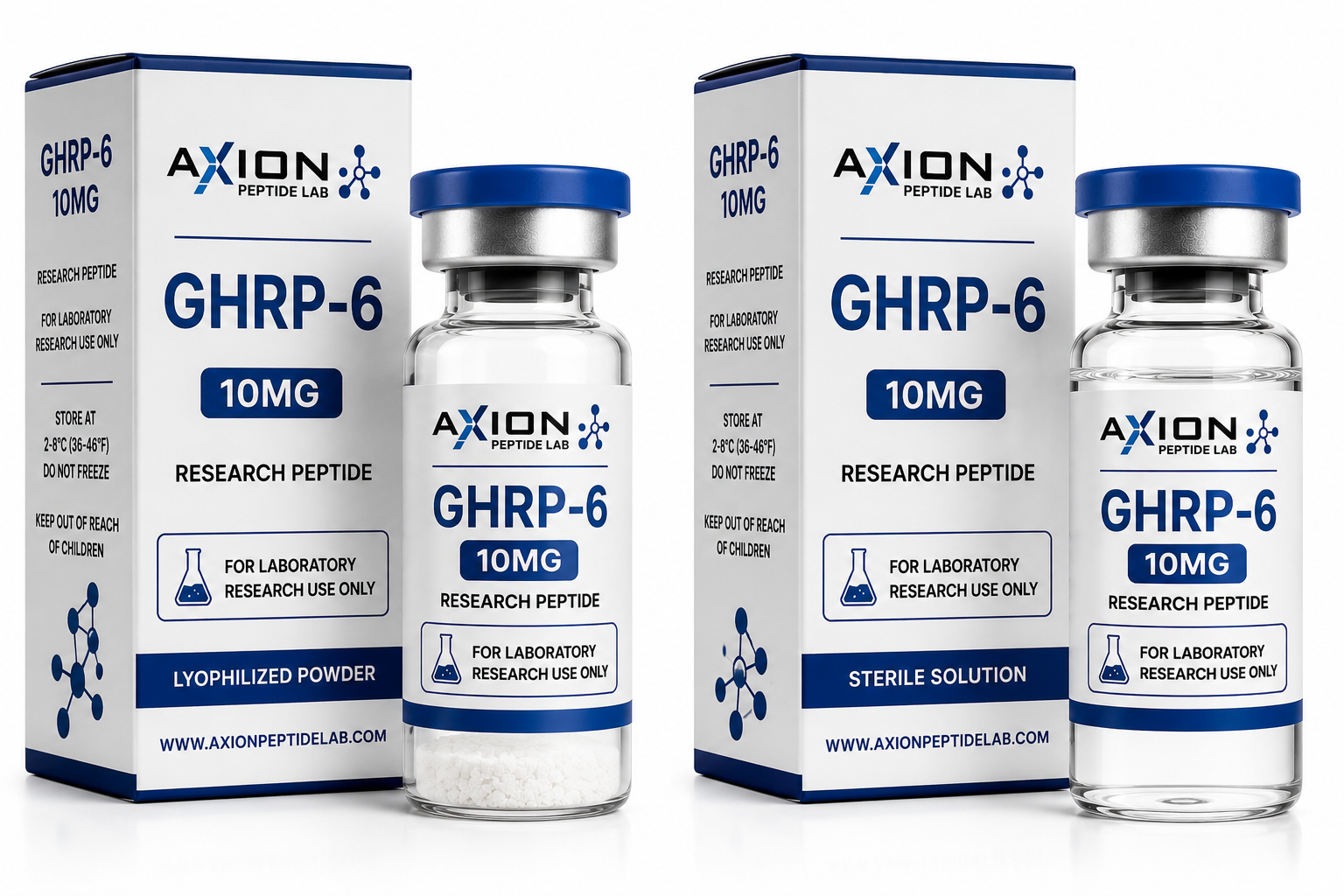
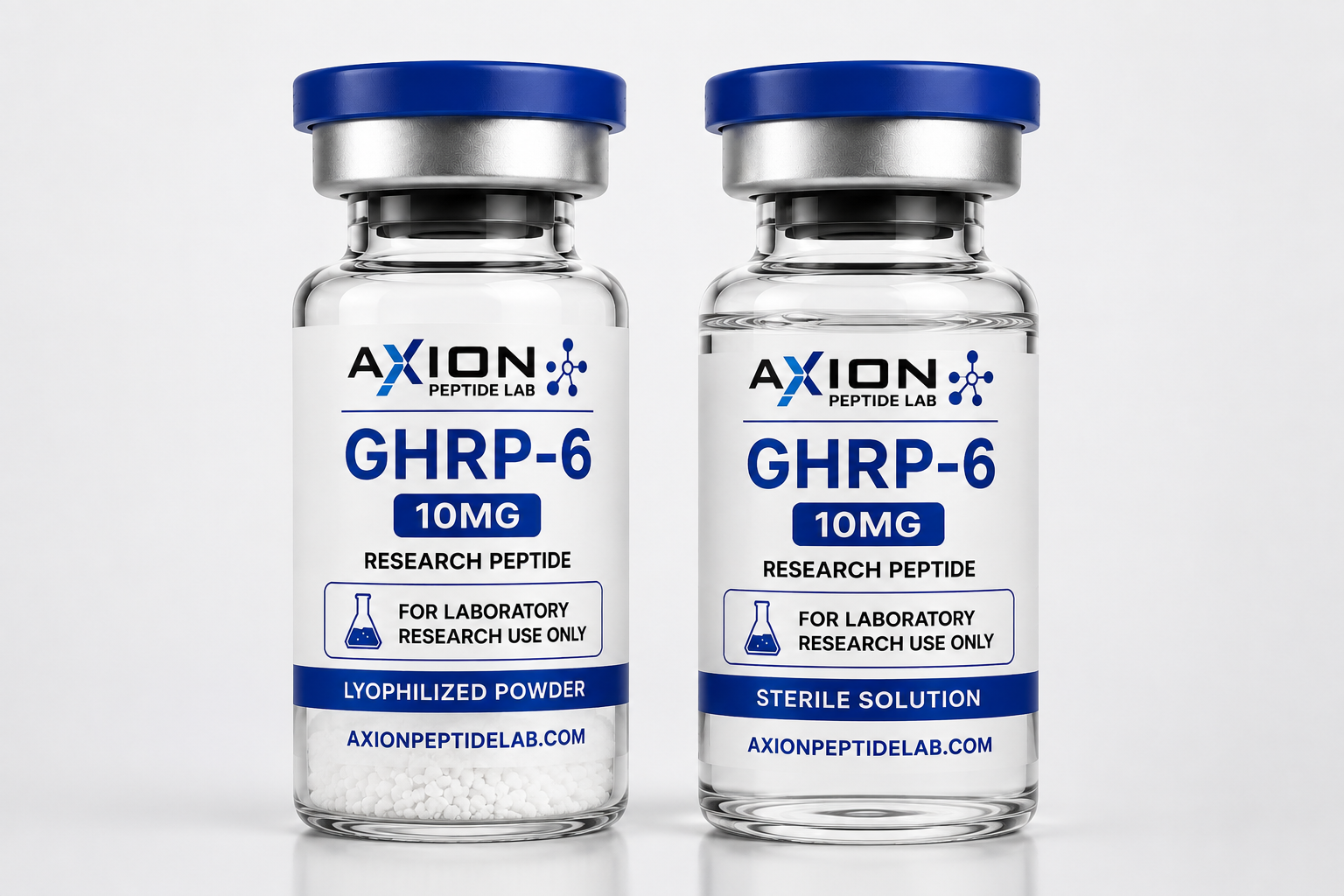
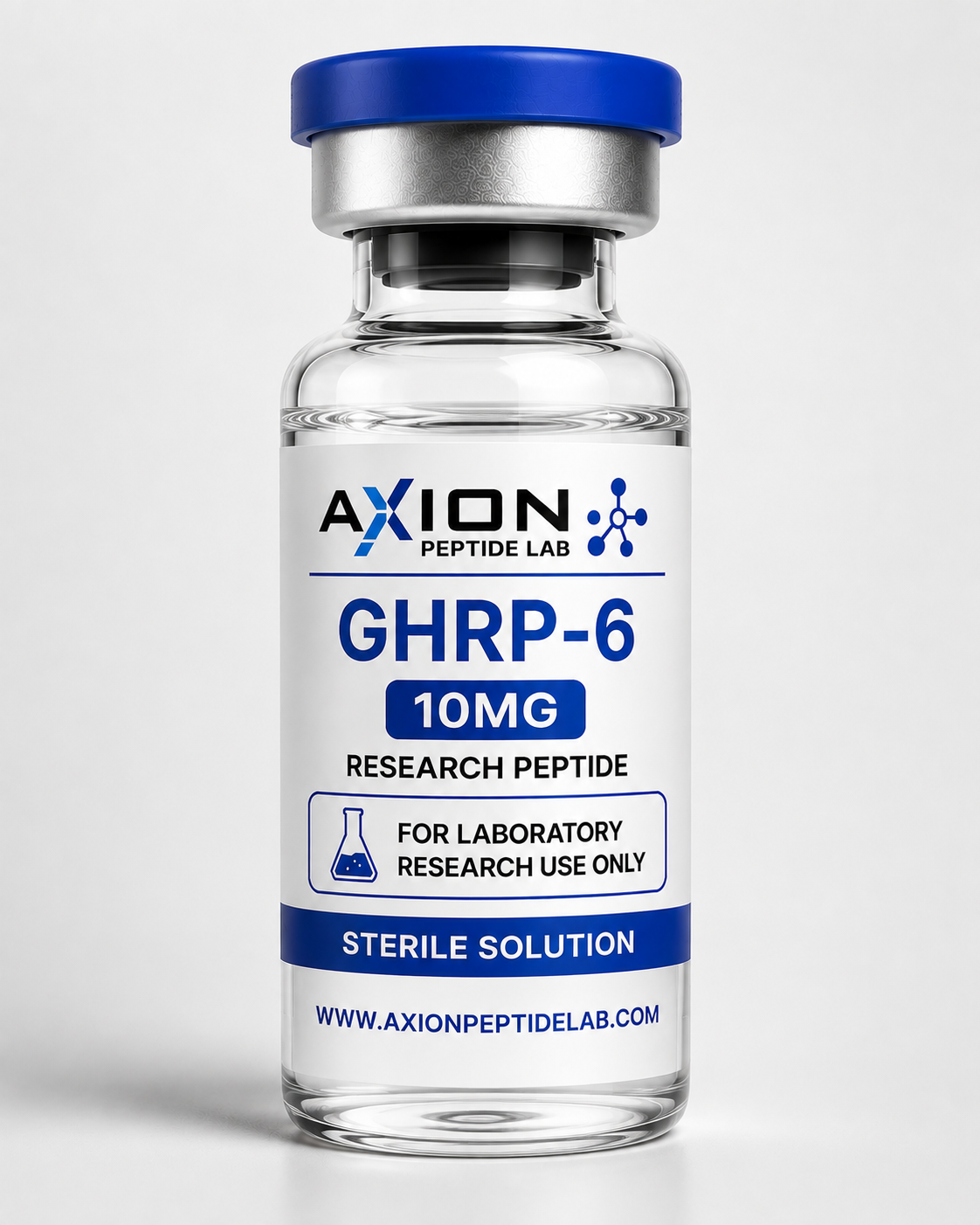
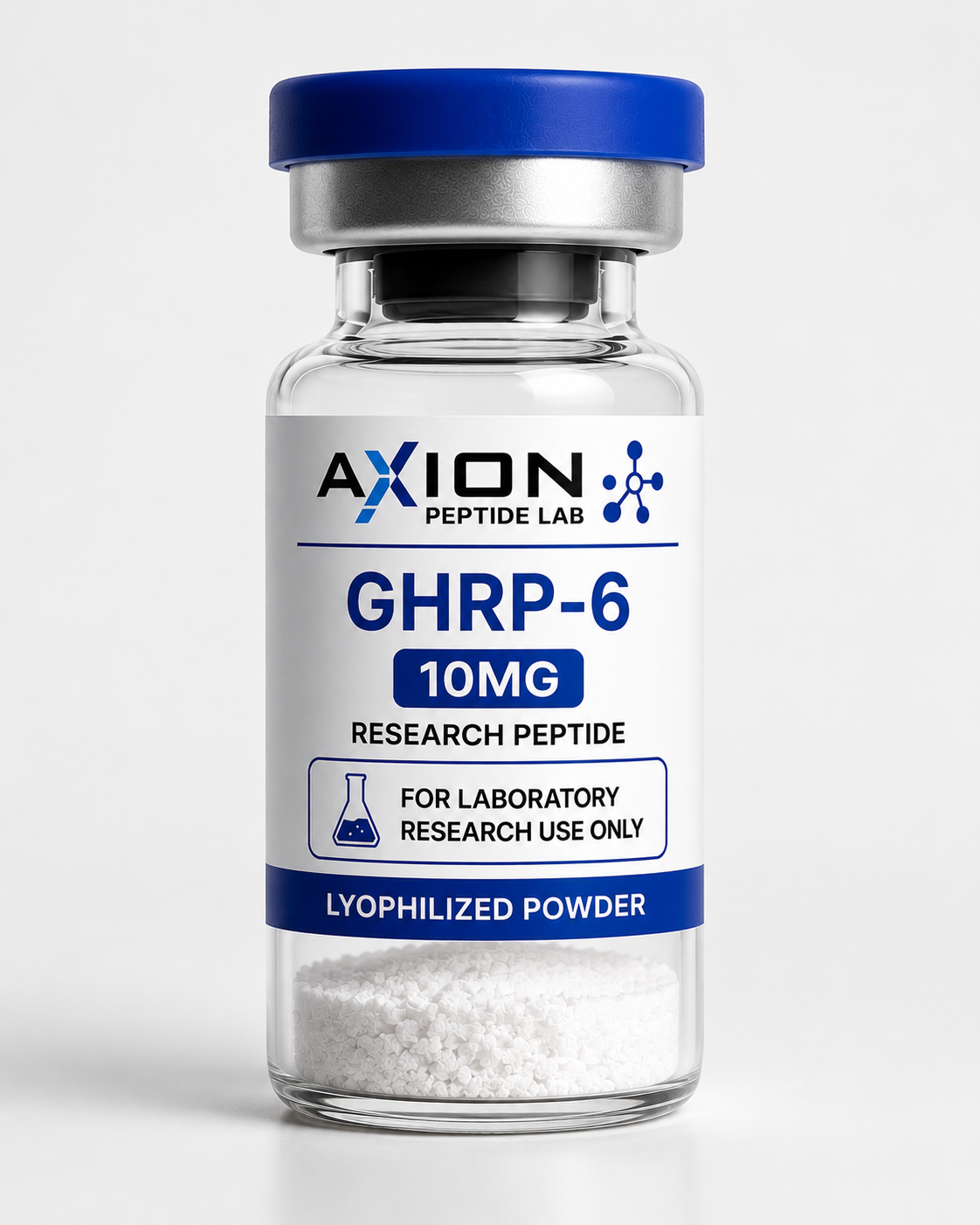
GHRP-6 10mg Research Peptide is a synthetic hexapeptide represented by the sequence H-His-D-Trp-Ala-Trp-D-Phe-Lys-NH₂. It is supplied for controlled laboratory investigation involving growth hormone secretagogue signalling, receptor interactions, GHRH-associated pathways, peptide structure-function relationships and analytical characterisation.
The 10mg designation represents the stated quantity of research material and is not a dosage recommendation.
For Research Use Only – Not for human or veterinary consumption.
$40.61 – $47.99Price range: $40.61 through $47.99
GHRP-6 10mg Research Peptide from Axion Peptide Lab is a synthetic hexapeptide supplied exclusively for controlled laboratory, biochemical and analytical research. GHRP-6, commonly known as Growth Hormone-Releasing Peptide-6 or Growth Hormone-Releasing Hexapeptide, has been investigated extensively in experimental research involving peptide signalling, growth hormone secretagogue pathways, receptor interactions and endocrine molecular biology.
GHRP-6 contains six amino-acid residues and is represented by the sequence:
H-His-D-Trp-Ala-Trp-D-Phe-Lys-NH₂
The peptide contains naturally occurring and D-configured amino-acid residues, making it an interesting material for researchers studying peptide structure, receptor recognition and structure-function relationships.
The 10mg designation represents the stated quantity of research material supplied and is not a dosage or administration recommendation.
For Research Use Only – Not for human or veterinary consumption.
GHRP-6 is a synthetic peptide belonging to the growth hormone secretagogue family of research compounds.
Its name reflects its six-residue structure: Growth Hormone-Releasing Peptide-6.
The molecule was developed during research into synthetic peptides capable of interacting with biological signalling pathways involved in growth hormone regulation.
GHRP-6 is structurally different from naturally occurring growth hormone-releasing hormone, or GHRH.
This distinction has made the peptide useful in experimental research examining how different signalling mechanisms interact within endocrine systems.
Researchers have used GHRP-6 in molecular, cellular, animal and historical human experimental studies to better understand secretagogue-associated signalling.
Axion Peptide Lab supplies GHRP-6 10mg strictly as laboratory research material.
GHRP-6 is classified as a synthetic hexapeptide, meaning its structure contains six amino-acid residues.
Its sequence is:
His-D-Trp-Ala-Trp-D-Phe-Lys-NH₂
The corresponding amino-acid sequence can be represented as HWAWFK, although this simplified notation does not display the D-configuration of specific residues.
The molecular formula associated with the parent amidated peptide is C46H56N12O6, while its molecular weight is approximately 873.0 g/mol.
GHRP-6 is commonly associated with CAS Registry Number 87616-84-0.
Researchers should confirm the exact molecular form associated with the supplied material because different salts, free-acid forms or related preparations can have different analytical characteristics.
GHRP-6 has historically been studied as a growth hormone secretagogue.
Growth hormone secretagogues represent a group of compounds investigated for their interactions with molecular systems involved in endocrine signalling.
The development of GHRP compounds helped researchers distinguish secretagogue signalling from the classical GHRH pathway.
This has made GHRP-6 useful as an experimental tool for investigating how multiple regulatory systems can participate in complex biological signalling networks.
Research involving secretagogue activity should be interpreted according to the experimental model and conditions used.
These findings do not establish GHRP-6 10mg from Axion Peptide Lab as a therapeutic product.
One particularly interesting aspect of GHRP-6 research involves interactions between secretagogue pathways and endogenous GHRH signalling.
Historical human experimental research demonstrated that blocking endogenous GHRH substantially reduced the growth-hormone response observed following experimental GHRP-6 exposure.
This finding contributed to scientific understanding that secretagogue and GHRH signalling pathways can interact rather than operating as completely isolated systems.
For laboratory researchers, these relationships provide opportunities for studying pathway interactions, receptor signalling and endocrine regulatory mechanisms.
The Axion Peptide Lab product is intended to support controlled research into such molecular questions rather than personal administration.
GHRP-6 is also relevant to receptor-signalling research.
Growth hormone secretagogues have been studied in relation to the growth hormone secretagogue receptor system, which is associated with ghrelin-related signalling biology.
Researchers may use suitable cellular or molecular models to investigate receptor activation, ligand-receptor interactions and downstream signalling events.
Experimental designs can compare GHRP-6 with other secretagogues or peptide compounds to examine differences in molecular responses.
Such comparative studies can contribute to a broader understanding of receptor selectivity, peptide structure and signalling behaviour.
GHRP-6 has a relatively compact six-amino-acid structure.
This makes it useful for experimental investigations examining relationships between peptide structure and molecular activity.
The presence of D-amino-acid residues is particularly relevant because stereochemical modifications can influence how peptides interact with enzymes, receptors and other biological molecules.
Researchers may compare GHRP-6 with structurally related peptides to investigate how individual amino-acid substitutions influence experimental behaviour.
Structure-function research can contribute to understanding fundamental principles of peptide chemistry and molecular pharmacology.
GHRP-6 belongs to a broader group of synthetic secretagogue research compounds.
This allows researchers to conduct comparative experiments involving related molecules.
Experimental studies may examine differences in receptor interaction, signalling profiles, peptide stability or other measurable characteristics.
Comparative research is particularly valuable when scientists want to determine whether observed activity is common across a peptide class or associated with a specific molecular structure.
Researchers should avoid assuming that findings involving one secretagogue automatically apply to another.
Each compound should be evaluated according to its own molecular and experimental characteristics.
Endocrine signalling involves complex interactions among hormones, peptides, receptors and regulatory pathways.
GHRP-6 has historically served as an experimental compound for investigating aspects of these systems.
Researchers may examine molecular markers, receptor pathways or biochemical responses within appropriately designed models.
Experimental studies may also explore interactions between secretagogue-associated pathways and other endocrine signalling mechanisms.
Results from laboratory or preclinical models should remain clearly distinguished from clinically established effects.
The presence of research literature does not mean that GHRP-6 is approved for therapeutic or consumer use.
Peptide stability represents an important analytical consideration when designing research involving GHRP-6.
Researchers may investigate how controlled experimental conditions influence molecular integrity over time.
Potential variables include temperature, solution composition, duration and other laboratory conditions.
Analytical methods may be used to investigate degradation patterns and changes in peptide characteristics.
Researchers should document these conditions carefully to support experimental reproducibility.
Product-specific storage requirements should be taken from documentation associated with the actual supplied batch rather than copied from unrelated suppliers.
GHRP-6 may also be incorporated into analytical workflows focused on peptide identification and characterisation.
Depending on laboratory capabilities, researchers may examine chromatographic behaviour, molecular mass, peptide integrity or degradation products.
Analytical characterisation can be particularly valuable when comparing GHRP-6 with structurally related secretagogue peptides.
Researchers requiring specific purity, salt form or analytical specifications should consult the documentation associated with the actual product and batch.
Generic chemical information about GHRP-6 does not establish the purity or analytical specifications of an individual commercial research product.
The GHRP-6 10mg Research Peptide format provides laboratories with a clearly identified quantity of synthetic peptide research material.
The 10mg designation refers exclusively to the stated amount associated with the product.
It is not a recommended dose.
Researchers should determine experimental quantities according to validated laboratory protocols, analytical requirements and institutional procedures.
Axion Peptide Lab does not provide human dosing, self-administration or therapeutic-use instructions for GHRP-6.
Appropriately designed laboratory investigation may include:
These represent scientific research categories rather than medical indications.
Reliable peptide research requires accurate documentation and traceability.
Researchers should record the product identity, relevant batch information, experimental conditions and analytical procedures used.
This helps improve reproducibility and facilitates comparisons between experiments.
Availability of Certificates of Analysis and independent testing may vary according to product and batch.
Researchers requiring specific purity, identity or analytical parameters should review the available documentation before incorporating GHRP-6 into an experiment.
Claims such as exact purity percentages should only be used when supported by documentation for the specific material supplied.
GHRP-6 10mg should be handled by appropriately trained personnel in suitable research environments.
The material should remain clearly labelled and separated from medicines, foods, supplements and other consumer products.
Laboratories should follow appropriate procedures designed to maintain material integrity and minimise contamination.
Researchers should follow product-specific storage and handling information supplied with the relevant material.
Customers are responsible for ensuring that purchase, possession, importation and experimental use comply with applicable laws and institutional policies.
Axion Peptide Lab supplies specialised peptide materials intended for controlled laboratory, biochemical and analytical research.
GHRP-6 10mg provides qualified researchers with a clearly identified synthetic hexapeptide format suitable for appropriately designed experimental projects.
Researchers can review available specifications and supporting documentation to determine whether the product meets the requirements of their intended research workflow.
Axion Peptide Lab clearly separates laboratory research materials from medicines, supplements and products intended for personal use.
Qualified researchers, laboratories and scientific organisations can buy GHRP-6 10mg Research Peptide from Axion Peptide Lab for legitimate laboratory, biochemical and analytical investigation.
GHRP-6 provides an established experimental molecule for research involving secretagogue signalling, receptor biology, peptide structure and endocrine molecular pathways.
Researchers should review the relevant specifications and available product documentation before purchase.
GHRP-6 10mg is supplied strictly as a research material and should not be represented as a bodybuilding product, performance-enhancing product, medicine or consumer health supplement.
For Research Use Only – Not for human or veterinary consumption.
GHRP-6 10mg is a stated quantity of a synthetic six-amino-acid peptide supplied for controlled laboratory, biochemical and analytical research.
GHRP-6 commonly stands for Growth Hormone-Releasing Peptide-6 and is also known as Growth Hormone-Releasing Hexapeptide.
The commonly referenced sequence is H-His-D-Trp-Ala-Trp-D-Phe-Lys-NH₂.
Yes. GHRP-6 contains six amino-acid residues and is classified as a synthetic hexapeptide.
Research areas include secretagogue signalling, receptor biology, GHRH pathway interactions, endocrine molecular signalling, structure-function relationships and peptide characterisation.
The parent amidated GHRP-6 peptide has a molecular weight of approximately 873.0 g/mol.
The commonly referenced parent peptide has the molecular formula C46H56N12O6.
GHRP-6 is commonly identified by CAS Registry Number 87616-84-0.
The 10mg designation represents the stated quantity of research material associated with the product. It is not a human dosage recommendation.
No. GHRP-6 is supplied strictly for laboratory and analytical research, and Axion Peptide Lab does not provide human dosing or self-administration guidance.