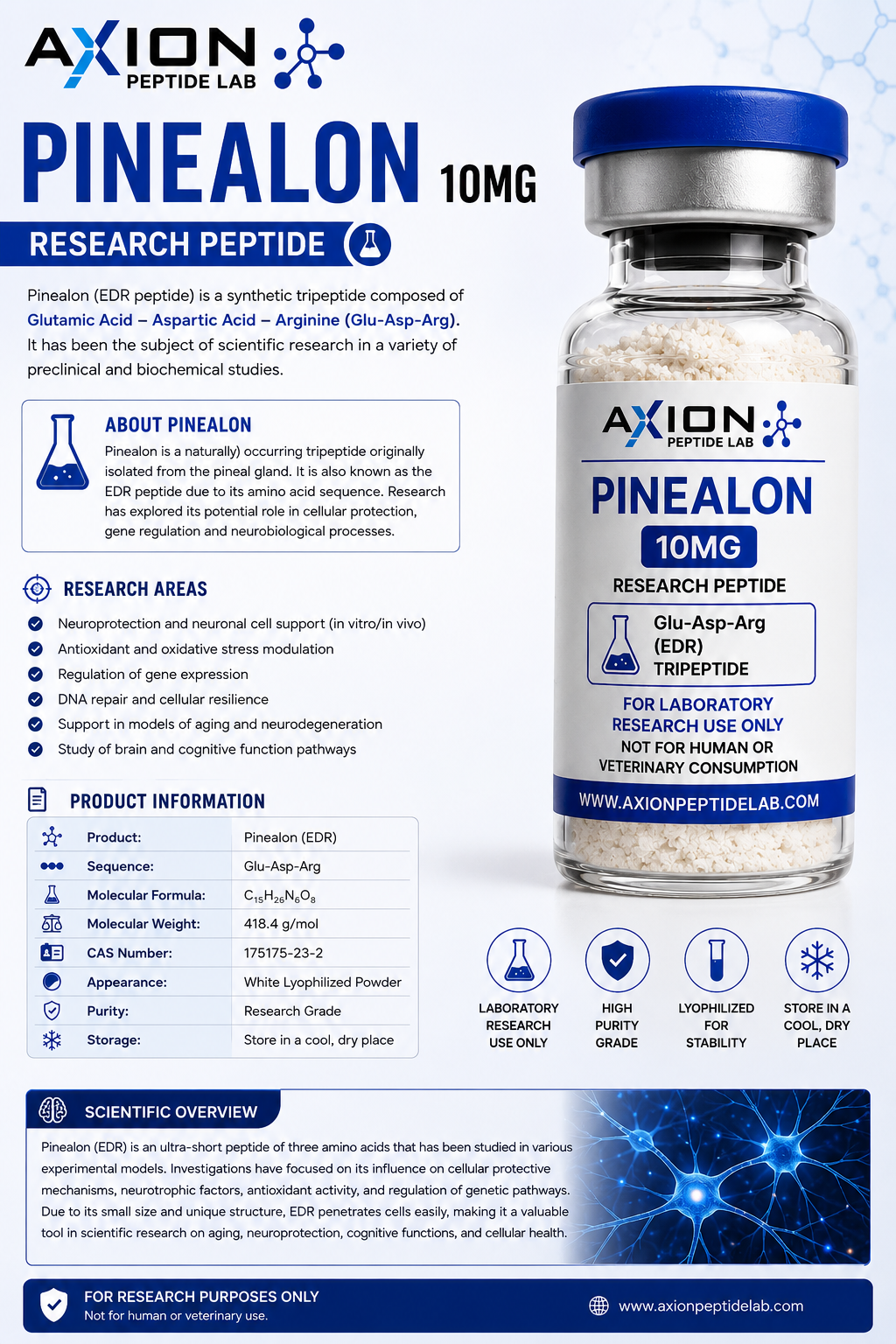
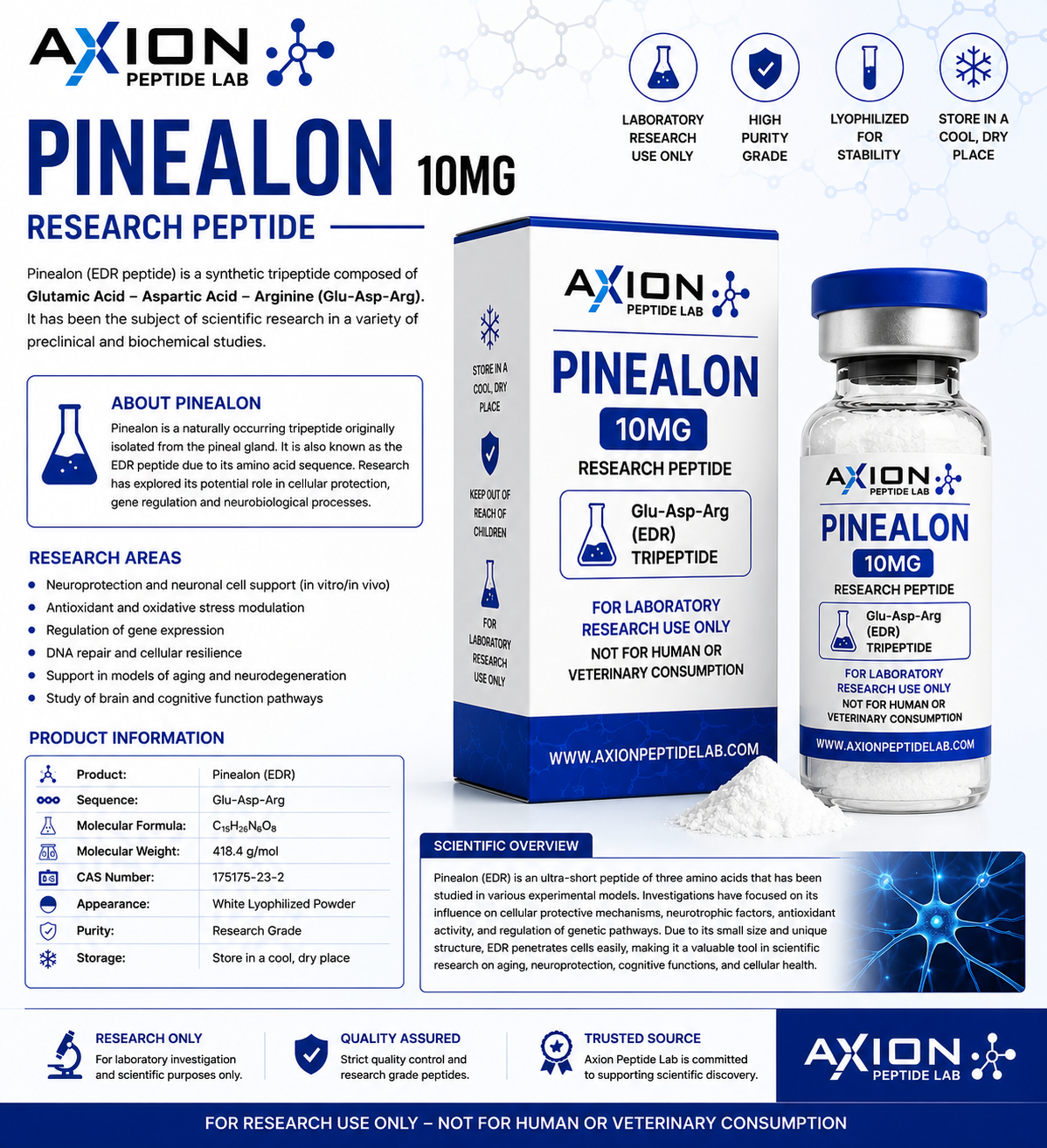
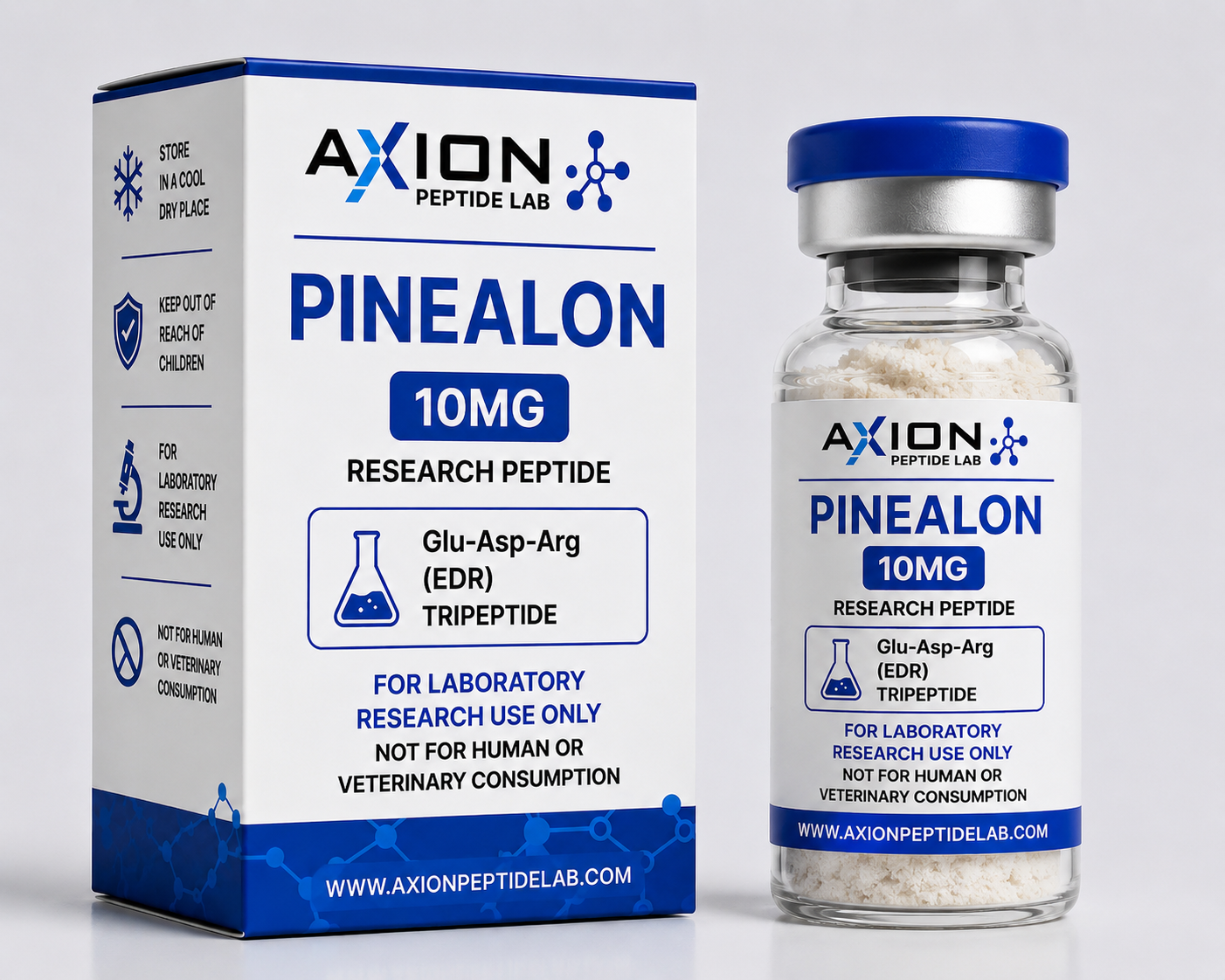
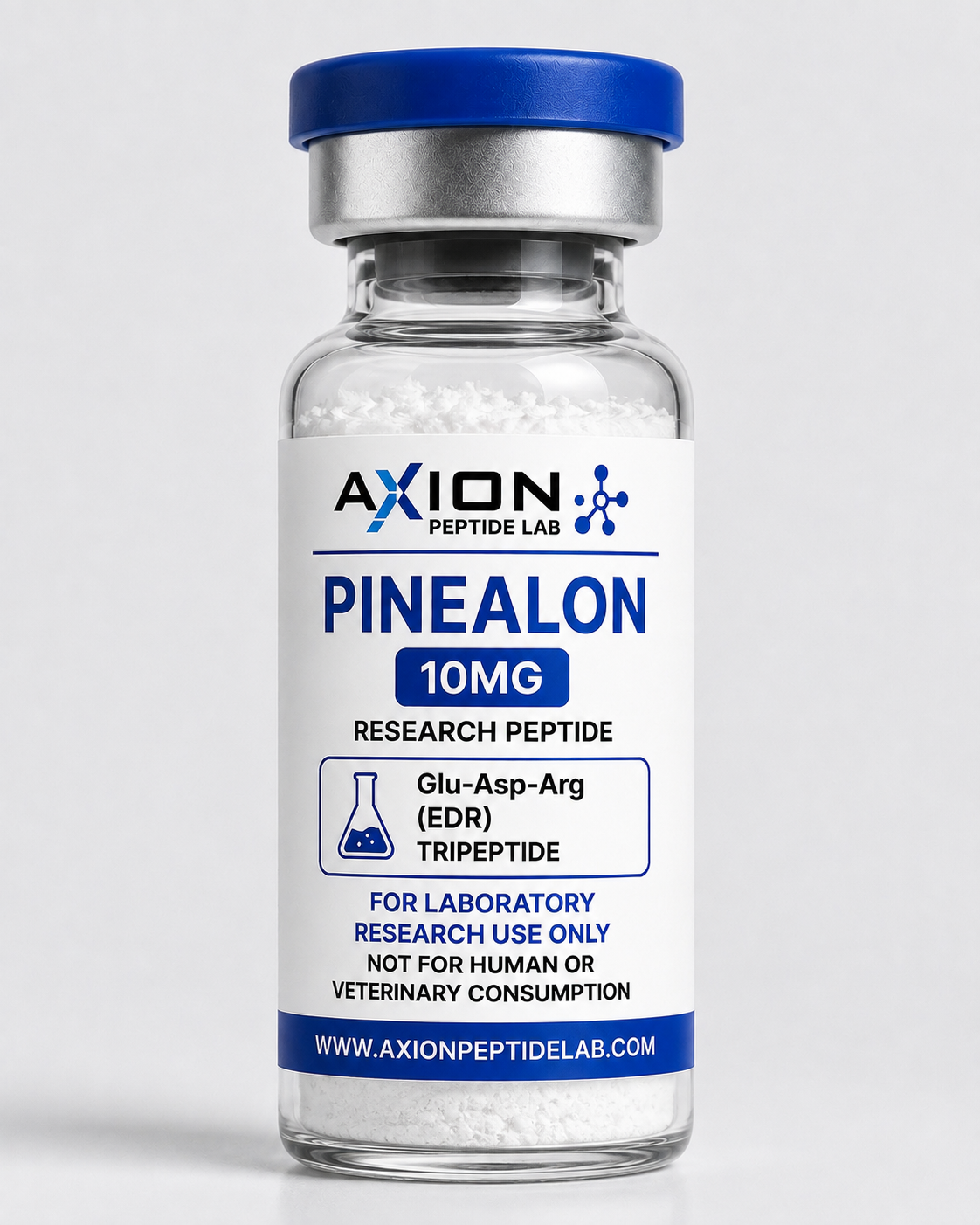
Pinealon 10mg Research Peptide is a synthetic ultrashort tripeptide composed of glutamic acid, aspartic acid and arginine (Glu-Asp-Arg/EDR). Pinealon is investigated experimentally in short-peptide chemistry, molecular interactions, gene-expression pathways, neuronal cell models and related biochemical research.
The 10mg designation represents the stated quantity of research material and is not a dosage recommendation.
For Research Use Only – Not for human or veterinary consumption.
$40.61
Pinealon 10mg Research Peptide from Axion Peptide Lab is a specialised synthetic tripeptide supplied for controlled laboratory, biochemical and analytical investigation. Also known as the EDR peptide, Pinealon consists of three amino-acid residues: glutamic acid, aspartic acid and arginine, represented by the sequence Glu-Asp-Arg.
Its exceptionally short three-residue structure has made Pinealon an interesting experimental molecule within peptide biochemistry, molecular biology and cellular research.
Published scientific investigations have examined EDR in experimental systems involving neuronal cells, oxidative-stress models, gene-expression pathways, peptide-DNA interactions and other aspects of short-peptide biology.
The 10mg designation represents the stated quantity of research material supplied and is not a human dosage or administration recommendation.
Axion Peptide Lab supplies Pinealon exclusively for legitimate laboratory and analytical research.
For Research Use Only – Not for human or veterinary consumption.
Pinealon is the commonly used name for the synthetic tripeptide Glu-Asp-Arg, abbreviated EDR using the one-letter codes of its constituent amino acids.
Because it contains only three amino-acid residues, Pinealon belongs to the category of ultrashort peptides.
Short peptides are scientifically interesting because even relatively simple amino-acid sequences may exhibit distinctive physicochemical properties and molecular interactions under experimental conditions.
Pinealon has historically been discussed within research surrounding short peptide bioregulators.
Researchers have subsequently investigated EDR using cellular, biochemical, animal and computational models.
The evidence base remains limited compared with extensively characterised pharmaceutical peptides, making careful experimental interpretation particularly important.
Pinealon’s molecular identity is based on its Glu-Asp-Arg sequence.
The three residues are L-glutamic acid, L-aspartic acid and L-arginine connected through peptide bonds.
The free peptide is commonly represented with the molecular formula C15H26N6O8 and an average molecular weight of approximately 418.4 g/mol.
Its CAS registry number is 175175-23-2, while the corresponding PubChem compound identifier is 10273502.
Researchers should recognise that salt forms or other preparations can differ from the free-peptide representation.
Product-specific analytical documentation should therefore be consulted when exact chemical specifications are important to an experiment.
Pinealon provides laboratories with an example of an unusually short peptide for molecular and biochemical investigation.
Researchers studying peptide structure-function relationships may compare EDR with longer peptides or other ultrashort sequences.
Such investigations can examine whether alterations in amino-acid identity, sequence length or molecular environment influence experimental behaviour.
The presence of acidic glutamate and aspartate residues alongside positively charged arginine also makes the sequence relevant to fundamental research concerning peptide chemistry and molecular interactions.
These properties can be investigated through appropriately designed laboratory experiments without assuming therapeutic activity.
One particularly interesting area of Pinealon research concerns proposed interactions between short peptides and DNA.
Researchers associated with the short-peptide bioregulator field have investigated whether specific peptide sequences can interact with defined DNA regions or influence processes associated with gene regulation.
EDR has appeared in experimental and computational investigations examining these hypotheses.
This remains an evolving area of research.
Proposed DNA-binding or gene-regulatory mechanisms should therefore be described as experimental hypotheses rather than universally established biological mechanisms.
Pinealon provides researchers with a material that can be incorporated into suitable biochemical, molecular and computational studies designed to explore these questions further.
Gene expression represents another area in which EDR has received experimental attention.
Researchers may investigate whether exposure to a peptide corresponds with measurable changes in transcription or other molecular markers under controlled conditions.
Modern analytical techniques provide numerous ways to evaluate these relationships.
Experimental designs may involve comparative expression profiling, pathway analysis, cellular models or other molecular methods.
Observed changes should always be interpreted within the context of the model used.
Laboratory observations cannot automatically establish clinical effects, and findings generated under one set of conditions may not reproduce in another experimental system.
A significant portion of published Pinealon literature originates from experimental neurobiology.
EDR has been investigated in neuronal cell systems and animal models examining responses to environmental or cellular stress.
This has generated scientific interest in the relationship between ultrashort peptides and neural molecular pathways.
Researchers might investigate cellular signalling, gene expression, oxidative-stress markers or other measurable laboratory endpoints.
These research areas should not be interpreted as evidence that Pinealon 10mg supplied by Axion Peptide Lab prevents, diagnoses or treats neurological disorders.
The product is supplied solely as experimental research material.
Oxidative stress is widely investigated in cellular biology because reactive oxygen species can influence numerous biochemical pathways.
Some preclinical Pinealon studies have examined EDR in experimental systems involving oxidative stress.
Researchers may use appropriate models to investigate relationships between peptide exposure and measurable markers of cellular stress.
Experimental results can depend on variables including cell type, exposure conditions, concentration, analytical method and study design.
For this reason, findings should be evaluated carefully and reproduced independently wherever possible.
The existence of preclinical observations does not establish effectiveness or safety in humans.
Pinealon may also be useful in straightforward analytical peptide research.
Depending on laboratory capabilities, researchers can investigate molecular identity, chromatographic behaviour, stability, degradation or other physicochemical characteristics.
Analytical characterisation helps researchers understand the material being incorporated into an experiment.
Laboratories requiring a particular purity specification, salt form or other technical parameter should examine documentation associated with the specific product and batch.
General chemical information about Pinealon should not be substituted for product-specific analytical evidence.
The Pinealon 10mg Research Peptide format provides a clearly identified quantity of EDR research material.
The 10mg designation refers solely to the stated amount of material associated with the product.
It does not constitute a recommended dose.
Researchers should incorporate the material into experimental workflows according to their approved laboratory protocols, analytical requirements and institutional procedures.
Axion Peptide Lab does not provide human dosing, self-administration or therapeutic-use instructions for research peptides.
Pinealon may be relevant to controlled scientific investigation involving:
These categories describe research opportunities rather than medical indications.
Accurate documentation is essential when working with specialised research materials.
Researchers should record the identity of the Pinealon product, batch information, experimental conditions and analytical methodology associated with each study.
Traceability becomes particularly important when experiments are repeated or results are compared between laboratories.
Availability of analytical documentation may vary according to product and batch.
Researchers requiring specific characteristics should verify the relevant documentation before incorporating Pinealon into a research protocol.
Claims concerning purity, sterility, salt form or other technical specifications should only be made when supported by documentation associated with the actual material supplied.
Pinealon 10mg should be handled by appropriately trained personnel within suitable scientific environments.
Researchers should follow the product- and batch-specific handling and storage information provided with the material.
Research products should remain properly labelled and separated from consumer products, medicines, foods and supplements.
Laboratories should also maintain suitable procedures to minimise contamination and preserve material integrity.
Customers are responsible for determining whether purchase, possession, importation and experimental use comply with applicable regulations and institutional requirements.
Axion Peptide Lab supplies specialised peptides and related materials for controlled scientific and analytical research.
Pinealon 10mg provides researchers with access to a clearly identified EDR tripeptide format suitable for legitimate R&D applications.
Researchers can review available product information and supporting documentation before selecting materials for their experimental workflows.
Product-specific specifications should always be verified against the current batch documentation rather than inferred from specifications published by unrelated suppliers.
Qualified laboratories, researchers and scientific organisations can buy Pinealon 10mg Research Peptide from Axion Peptide Lab for legitimate laboratory, biochemical and analytical investigation.
Researchers should review available specifications and determine whether the material is appropriate for their intended experimental design before purchasing.
Product availability and delivery eligibility may vary according to destination and applicable regulations.
Pinealon supplied by Axion Peptide Lab is not offered as a medicine, supplement or consumer wellness product.
For Research Use Only – Not for human or veterinary consumption.
Pinealon 10mg is a research preparation containing a stated quantity of the synthetic tripeptide Glu-Asp-Arg for controlled laboratory and analytical investigation.
Pinealon consists of glutamic acid, aspartic acid and arginine, represented as Glu-Asp-Arg or EDR.
Yes. Pinealon contains three amino-acid residues and is therefore classified as a tripeptide or ultrashort peptide.
EDR is the one-letter abbreviation for Glu-Asp-Arg and refers to the same tripeptide commonly known as Pinealon.
Published experimental research includes peptide-DNA interactions, gene-expression pathways, neuronal cell models, oxidative-stress models, molecular biology and short-peptide chemistry.
10mg identifies the stated quantity of research material supplied. It does not represent a recommended human dose.
The free Glu-Asp-Arg peptide has an average molecular weight of approximately 418.4 g/mol. Product salt forms or preparations may differ.
The Axion Peptide Lab product is not supplied or marketed as an approved medicine. It is intended exclusively for controlled laboratory and analytical research.
Researchers should follow the storage specifications supplied with the actual product and batch rather than assuming generic peptide storage conditions.
Qualified research customers can purchase Pinealon 10mg Research Peptide from Axion Peptide Lab for legitimate laboratory and analytical research, subject to availability and applicable requirements.