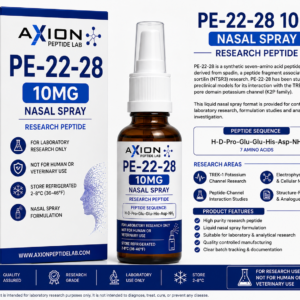
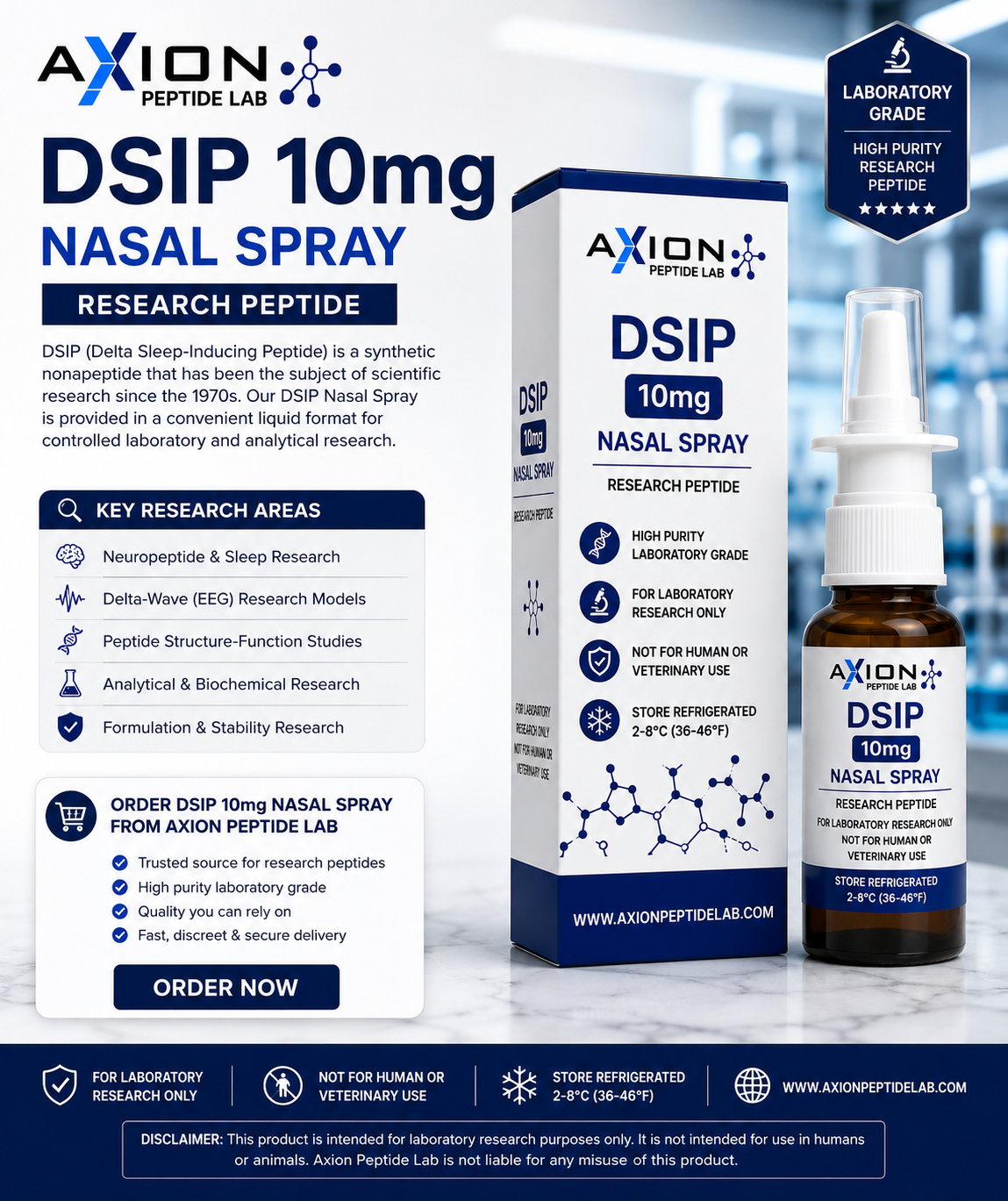
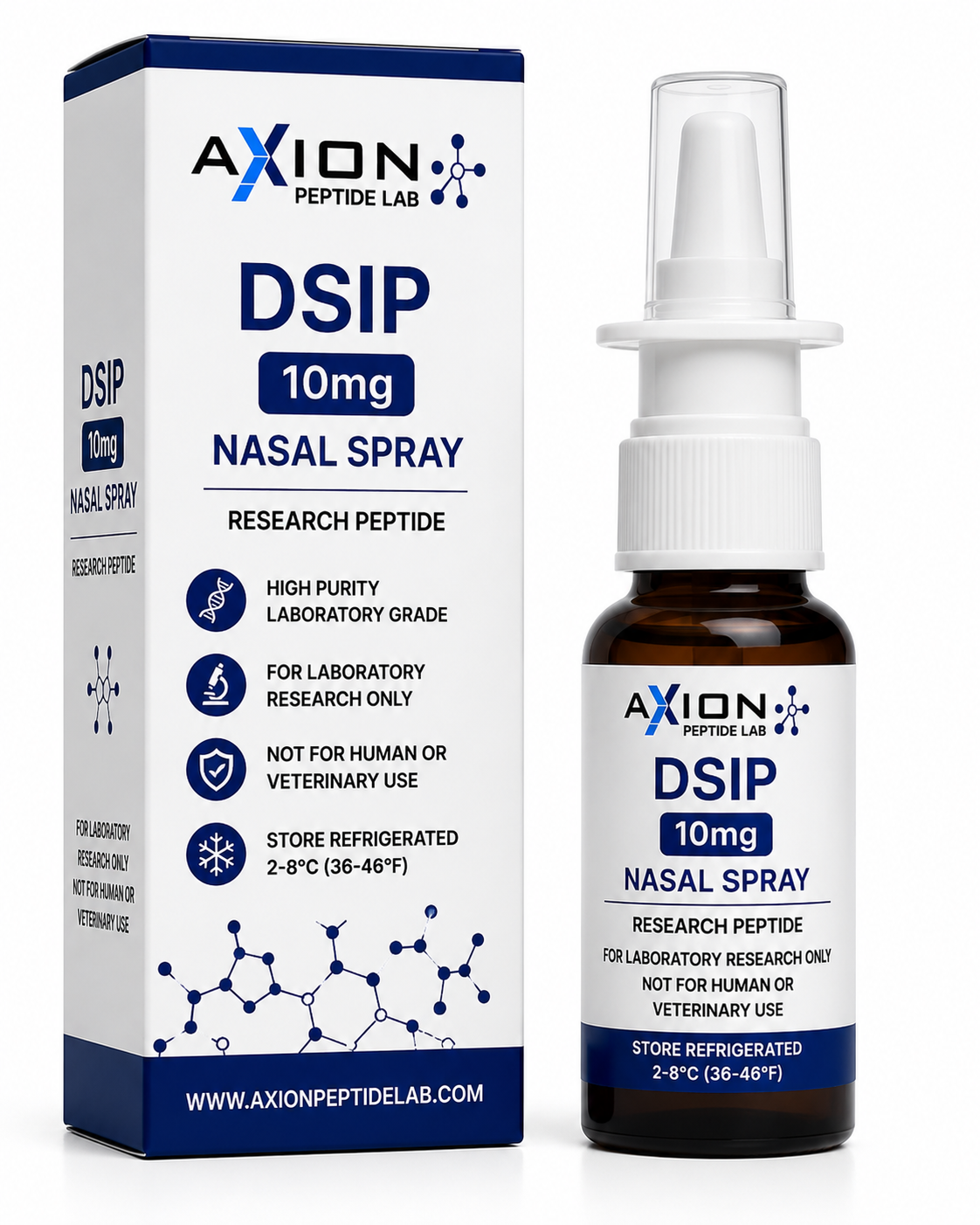
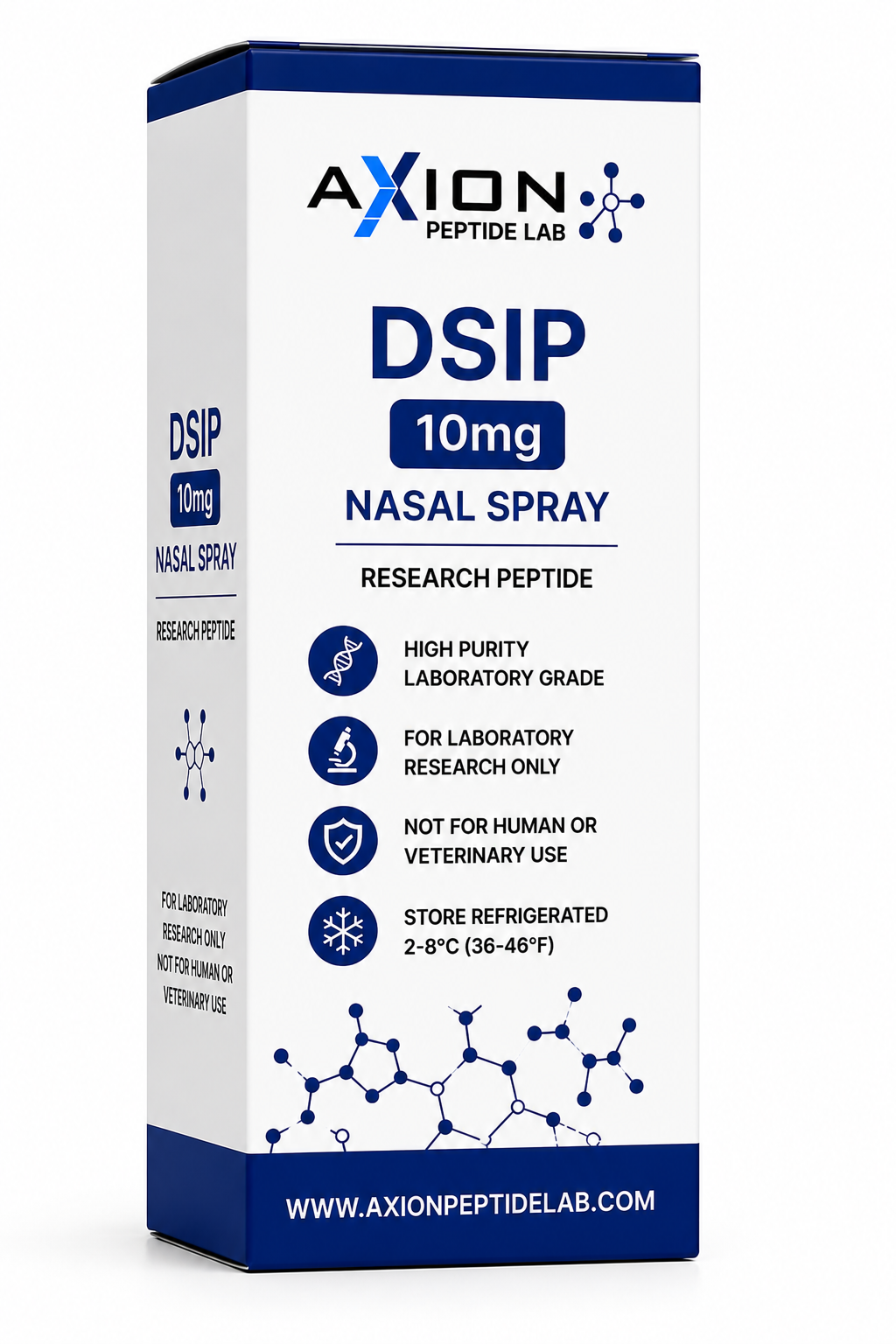
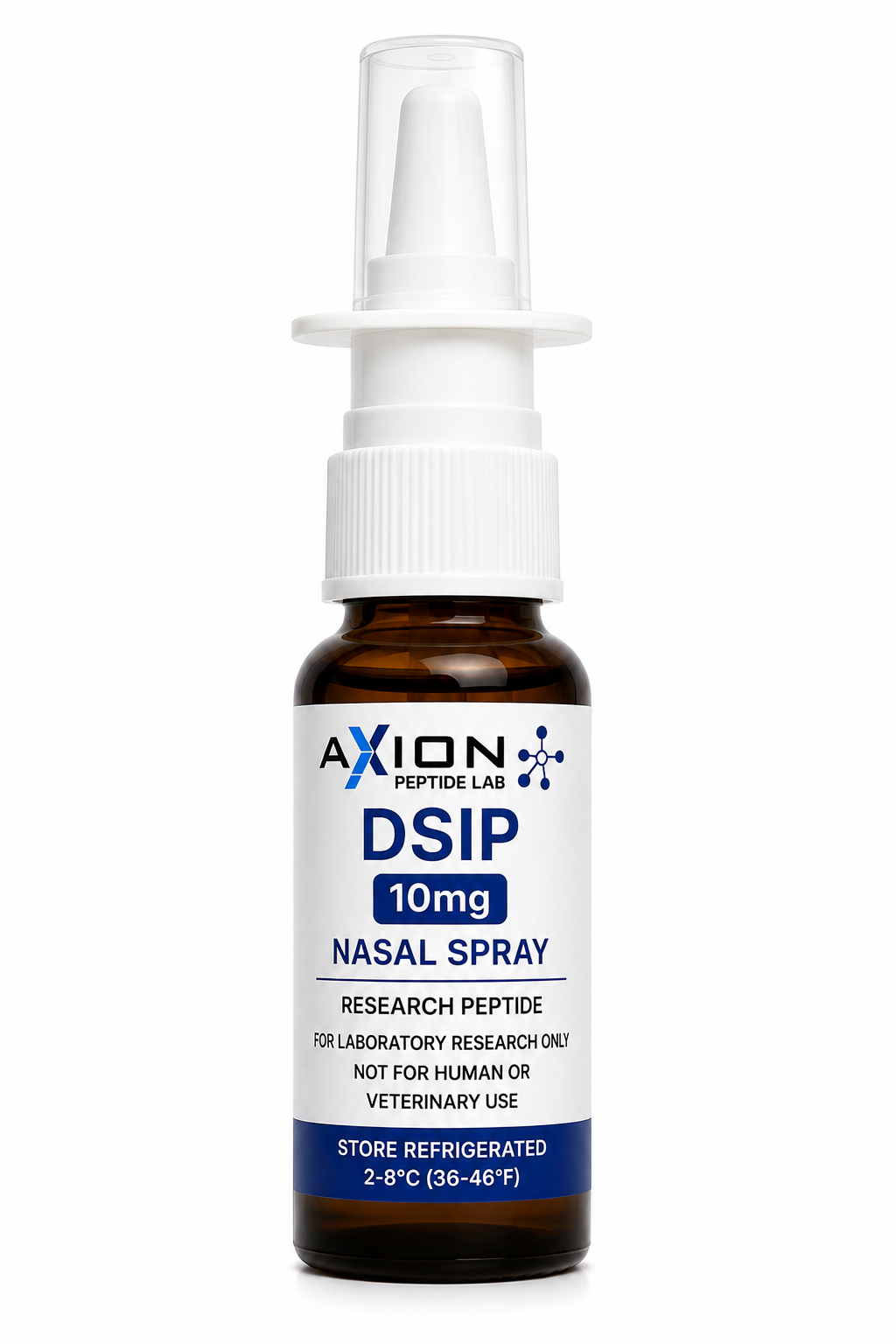
DSIP 10mg Nasal Spray contains Delta Sleep-Inducing Peptide, a synthetic nine-residue peptide supplied in a liquid research presentation for controlled laboratory and analytical investigation.
DSIP has the sequence Trp-Ala-Gly-Gly-Asp-Ala-Ser-Gly-Glu (WAGGDASGE) and is relevant to peptide chemistry, structure-function investigation, analytical characterisation, formulation studies and historical neuropeptide research.
The 10mg designation represents the stated research quantity and is not a dosage recommendation.
For Research Use Only – Not for human or veterinary consumption or administration.
$108.29 Original price was: $108.29.$94.76Current price is: $94.76.
DSIP 10mg Nasal Spray from Axion Peptide Lab is a research-format preparation containing Delta Sleep-Inducing Peptide (DSIP), a synthetic nonapeptide intended for controlled laboratory, analytical and peptide research.
DSIP has attracted scientific interest since its original characterisation in the 1970s because of historical experiments involving delta-wave EEG activity and sleep-associated biological processes. Despite its name, however, the scientific literature surrounding DSIP remains complex, and its precise endogenous role, receptor system and mechanism have not been definitively established.
The peptide consists of nine amino-acid residues with the sequence Trp-Ala-Gly-Gly-Asp-Ala-Ser-Gly-Glu.
The 10mg designation identifies the stated quantity associated with this research preparation. “Nasal Spray” describes the product presentation and should not be interpreted as a recommendation or instruction for human intranasal administration.
For Research Use Only – Not for human or veterinary consumption or administration.
DSIP stands for Delta Sleep-Inducing Peptide.
It is a small peptide originally isolated during experiments involving cerebral venous blood from rabbits subjected to conditions associated with enhanced delta-wave EEG patterns.
Researchers subsequently determined its amino-acid sequence and synthesised the peptide for additional experimental investigation.
DSIP contains nine residues, classifying it as a nonapeptide.
Its sequence is:
Trp-Ala-Gly-Gly-Asp-Ala-Ser-Gly-Glu
or in single-letter notation:
WAGGDASGE
Its relatively compact structure has made DSIP relevant to peptide chemistry, sequence analysis, structure-function studies and historical neuropeptide research.
DSIP is an unusual research peptide because its name reflects observations made during its original discovery.
Early experiments reported enhancement of delta and spindle EEG activity after the peptide was introduced into experimental rabbit models.
This resulted in the designation “Delta Sleep-Inducing Peptide.”
However, subsequent research has produced a more complicated scientific picture.
DSIP should therefore not simply be described as a proven “sleep peptide.”
Its biological significance continues to be discussed in scientific literature, and researchers have historically investigated DSIP across multiple experimental systems.
This uncertainty makes accurate research-focused language especially important when discussing the peptide.
DSIP is a nine-residue peptide with a reported molecular formula of:
C35H48N10O15
Its reported average molecular mass is approximately:
848.8 g/mol
The sequence contains tryptophan, alanine, glycine, aspartic acid, serine and glutamic acid residues.
Three of the nine positions contain glycine.
Researchers should use batch-specific documentation where exact molecular form, counterions, concentration or other analytical characteristics are important.
Generic reference values should not replace product-specific analytical documentation.
The term “delta” in DSIP originates from early EEG experiments.
Delta waves are low-frequency electrical patterns commonly associated with particular physiological states, including stages of sleep.
Original research involving DSIP reported changes in delta EEG activity in experimental rabbit models.
These findings contributed to scientific interest in the peptide.
However, historical animal experiments should not be converted directly into claims that a commercially supplied DSIP research preparation treats sleep disorders or produces a predictable effect in humans.
Modern research should evaluate the molecule according to clearly defined experimental endpoints.
DSIP has historically appeared in literature concerning neurobiology and neuropeptide research.
Researchers interested in peptide-mediated signalling may use synthetic DSIP as an experimental material when examining molecular interactions or comparing peptide sequences.
An important limitation is that the biological mechanism attributed to DSIP remains incompletely understood.
A definitive endogenous receptor has not been established.
This differentiates DSIP from research peptides with well-characterised receptor targets.
Consequently, researchers should avoid assuming a specific mechanism unless supported by their experimental model and evidence.
DSIP’s compact nine-residue sequence makes it useful for controlled peptide structure-function investigation.
Researchers may compare full-length DSIP with fragments, modified sequences or synthetic analogues.
Such experiments can examine how individual residues contribute to experimentally measured molecular properties.
Historical studies have also investigated DSIP fragments and analogues, demonstrating the usefulness of the peptide as a model for comparative sequence research.
Structure-function studies can contribute to broader understanding of how short peptide sequences interact with biological and chemical environments.
Short peptides such as DSIP are relevant to synthetic peptide chemistry.
Researchers may investigate synthesis, purification, identity confirmation and degradation characteristics.
Analytical techniques can help establish whether a synthetic preparation corresponds to the expected sequence.
Experiments may also investigate impurities, peptide fragments or degradation products.
These applications are particularly relevant where DSIP is used as an analytical reference or comparative experimental material.
Analytical characterisation represents an important component of peptide research.
DSIP can be investigated using techniques appropriate to peptide identity and purity assessment.
Depending on laboratory capabilities, these may include high-performance liquid chromatography and mass spectrometry.
Researchers may evaluate chromatographic retention, molecular mass, degradation or other measurable characteristics.
Batch-specific analytical documentation should be reviewed where a study requires a defined purity specification.
Exact purity percentages should not be assumed unless supported by documentation for the supplied batch. DSIP 10mg Nasal Spray
Peptides can undergo chemical and physical changes depending on their environment.
DSIP may therefore be incorporated into controlled stability experiments.
Researchers can investigate how variables such as temperature, pH, solvent composition, time and formulation environment influence peptide integrity.
Analytical methods can then be used to detect changes.
Storage instructions for an Axion Peptide Lab DSIP preparation should be based on the actual product documentation rather than generic recommendations for unrelated DSIP products.
The DSIP 10mg Nasal Spray presentation may also be relevant to controlled formulation research.
Scientists may investigate peptide behaviour in liquid research systems, including stability, compatibility and analytical recovery.
Researchers should document the exact formulation used in their experiments because excipients and other formulation characteristics may influence analytical results.
The presence of a spray dispenser does not establish clinical suitability or a validated human route of administration.
The 10mg designation represents the stated amount associated with the research product.
It should not be interpreted as a recommended dose.
Research quantities should be established according to validated experimental protocols, assay design and institutional procedures.
If quantitative experiments require molar concentrations, researchers should use the verified molecular identity, concentration basis and product documentation applicable to the actual preparation.
Axion Peptide Lab does not provide personal dosing or administration protocols.
DSIP may be relevant to controlled laboratory investigation involving:
These categories represent laboratory research areas and not medical indications.
Reproducibility depends on accurate documentation.
Researchers should record product identity, batch details, experimental conditions, analytical methods and relevant formulation characteristics.
Where available, batch documentation should be reviewed before beginning experiments.
Certificate of Analysis and independent testing availability may vary according to product and batch.
Claims regarding exact purity, sterility, concentration or other specifications should only be made where supported by appropriate product documentation.
DSIP 10mg Nasal Spray should be handled as research material.
It should remain clearly labelled and separated from consumer medicines, supplements and personal-use products.
Appropriate laboratory procedures should be followed throughout storage and experimentation.
Customers are responsible for ensuring that purchase, possession, importation and research use comply with applicable regulations and institutional requirements. DSIP 10mg Nasal Spray
Axion Peptide Lab supplies specialised materials intended for controlled laboratory, scientific and analytical investigation.
DSIP 10mg provides researchers with a short synthetic peptide format suitable for appropriately designed projects involving peptide chemistry, analytical characterisation, molecular investigation and historical neuropeptide research.
Researchers should review available product documentation to establish whether the material meets the requirements of their intended experimental workflow.
Qualified researchers, laboratories and scientific organisations can buy DSIP 10mg Nasal Spray from Axion Peptide Lab for legitimate laboratory and analytical investigation.
DSIP’s nine-residue sequence and unusual scientific history make it an interesting experimental peptide for research involving molecular characterisation, peptide structure-function relationships and neuropeptide-related models.
It should not be promoted as a proven treatment for insomnia, anxiety, sleep disorders or other medical conditions.
For Research Use Only – Not for human or veterinary consumption or administration.
DSIP stands for Delta Sleep-Inducing Peptide. It is a nine-residue peptide originally characterised during experimental research involving delta-wave EEG activity.
The established sequence is Trp-Ala-Gly-Gly-Asp-Ala-Ser-Gly-Glu, abbreviated WAGGDASGE.
DSIP contains nine amino-acid residues and is therefore classified as a nonapeptide.
The name originated from early experimental observations involving enhancement of delta EEG patterns in rabbit research models.
No. The historical literature is complex, and DSIP should not be represented as an established treatment for insomnia or other sleep disorders.
No. The biological role and mechanism associated with DSIP remain incompletely characterised, and a definitive endogenous receptor has not been established.
Laboratory research can involve peptide chemistry, analytical characterisation, structure-function relationships, peptide stability, formulation studies and historical neuropeptide models.
The 10mg designation identifies the stated quantity associated with the research preparation. It is not a dosage recommendation.
No. Nasal spray describes the product presentation. This product is positioned exclusively as research material and is not supplied with human administration instructions. DSIP 10mg Nasal Spray
Qualified research customers can purchase DSIP 10mg Nasal Spray from Axion Peptide Lab for legitimate laboratory and analytical applications, subject to availability and applicable requirements.