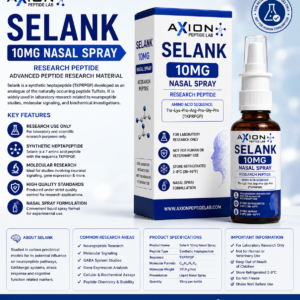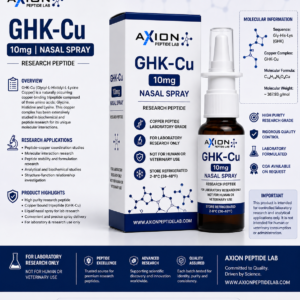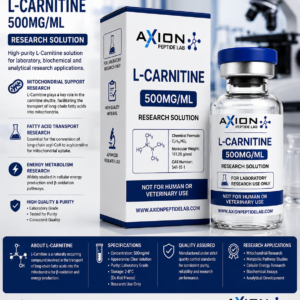
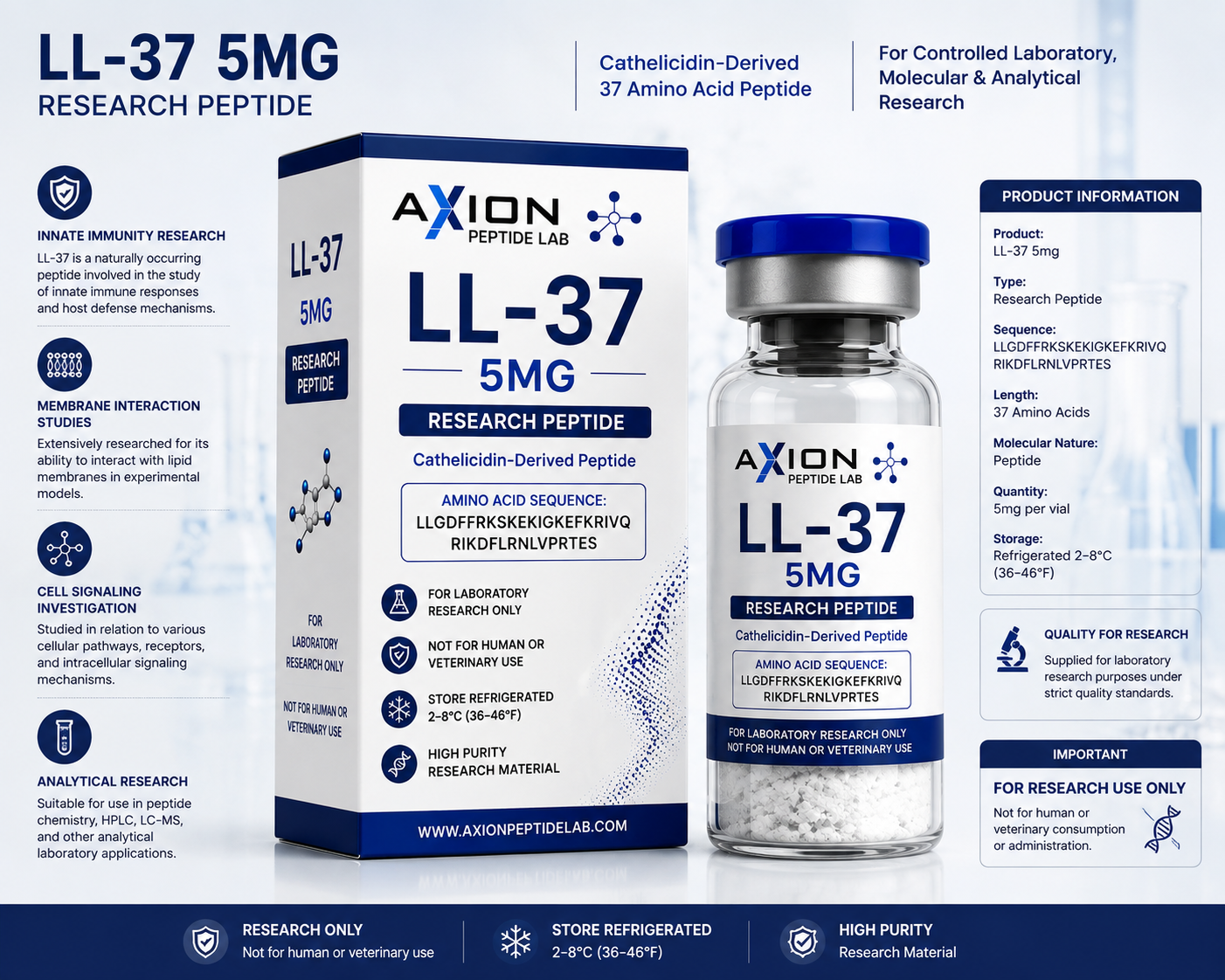
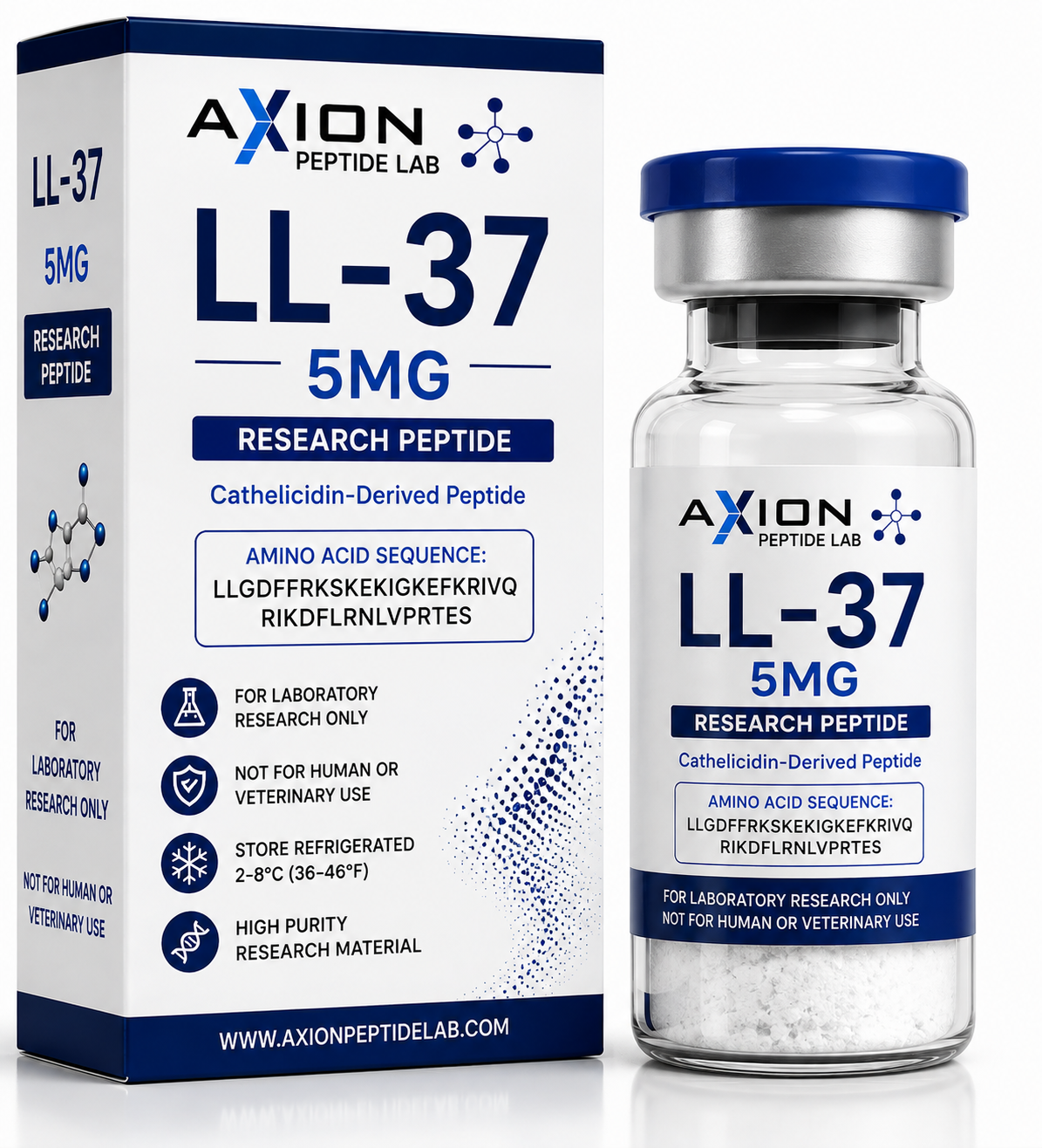
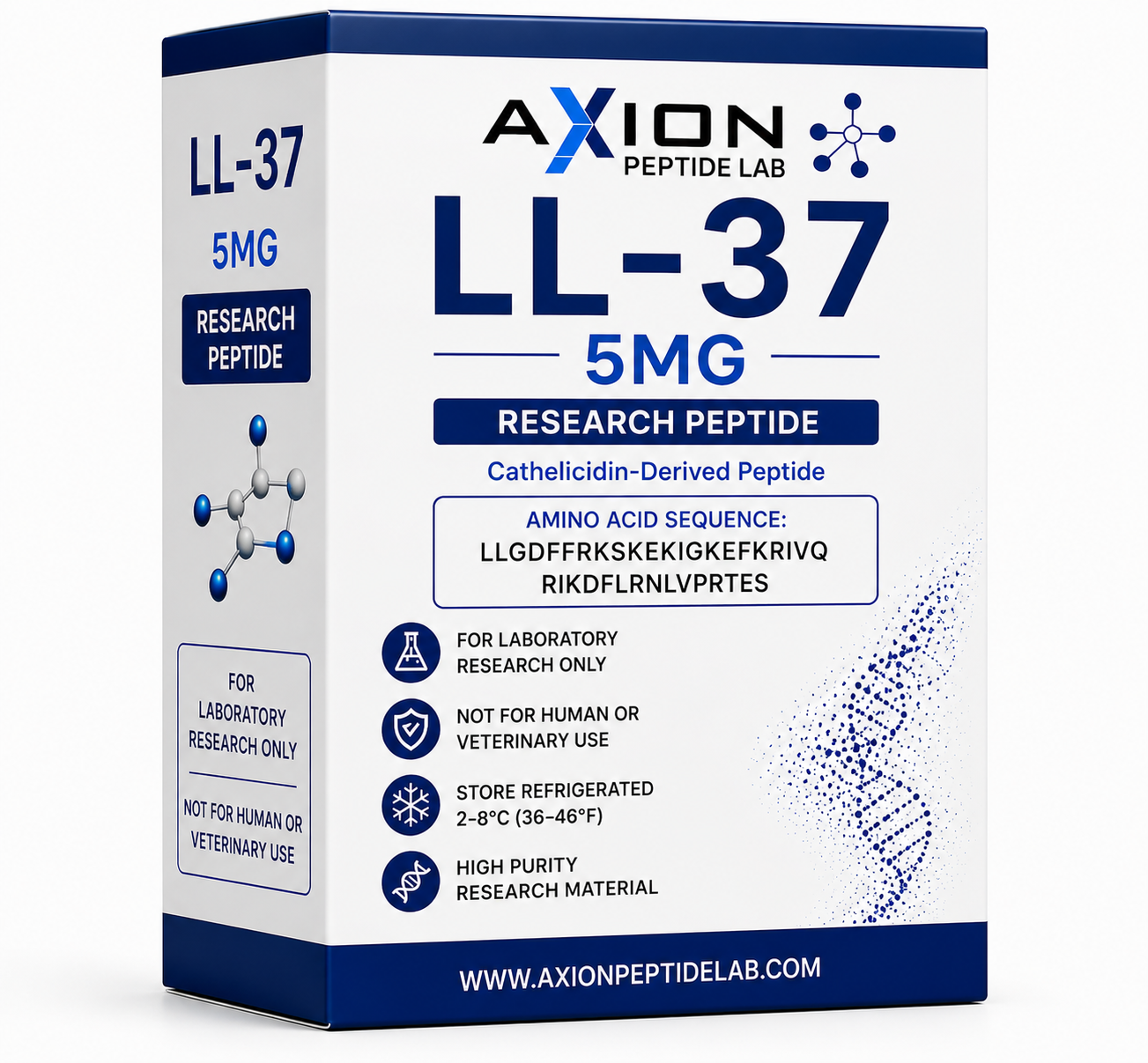
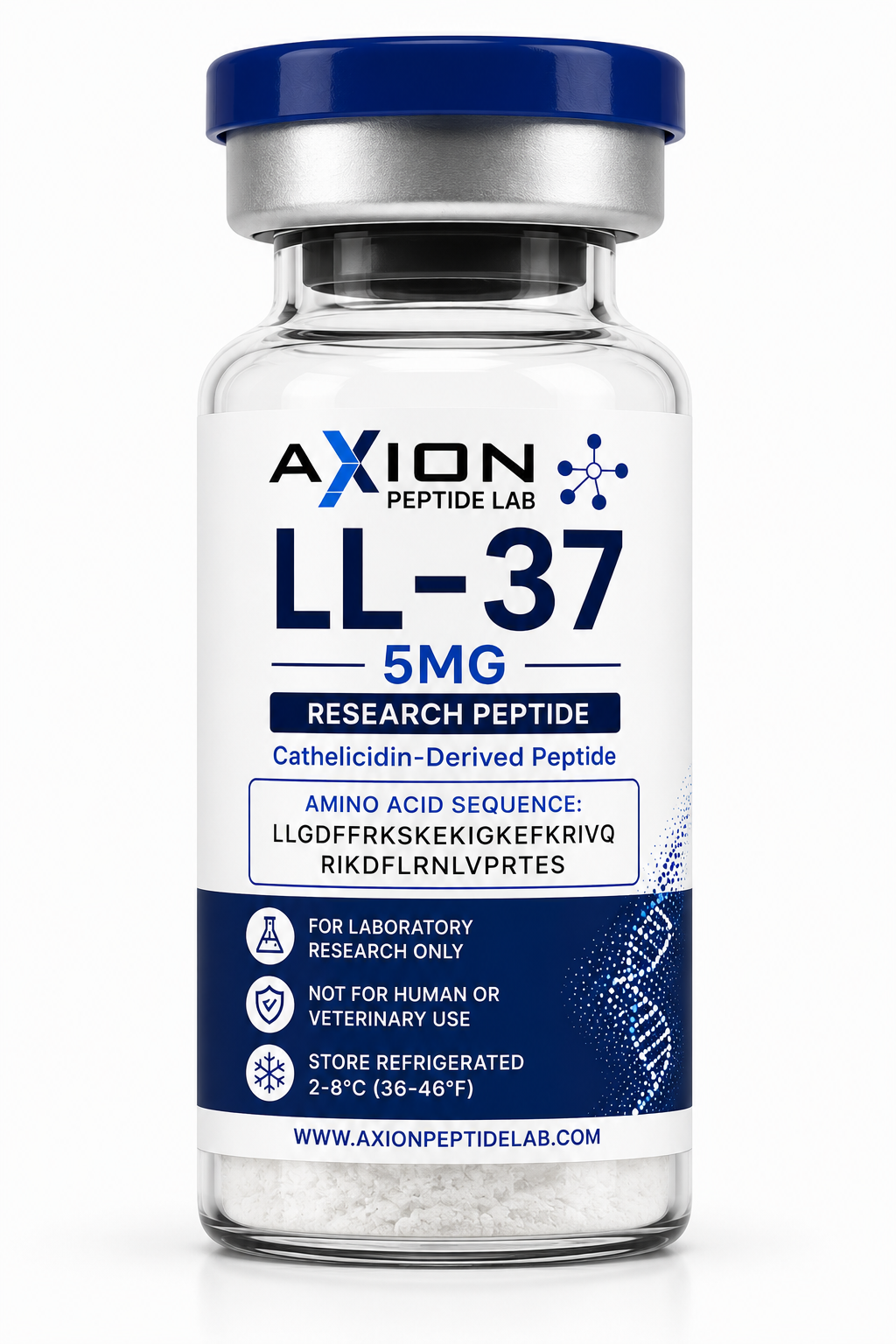
LL-37 5mg Research Peptide is a 37-amino-acid cathelicidin-derived research material for controlled peptide chemistry, membrane-interaction, molecular signalling, structure-function and analytical investigation.
LL-37 has the established sequence LLGDFFRKSKEKIGKEFKRIVQRIKDFLRNLVPRTES and is widely studied for its cationic, amphipathic and membrane-associated properties.
5mg represents the stated research quantity and is not a dosage recommendation.
For Research Use Only – Not for human or veterinary consumption or administration.
LL-37 5mg Research Peptide from Axion Peptide Lab is a laboratory research material intended for controlled peptide chemistry, molecular biology, membrane-interaction, cell-signalling, innate-immunity and analytical investigation.
LL-37 is a naturally occurring human 37-amino-acid cathelicidin-derived peptide produced through processing of the human cathelicidin antimicrobial peptide precursor, commonly associated with the CAMP gene and hCAP18 precursor system. LL-37 5mg Research Peptide
Its established amino-acid sequence is:
LLGDFFRKSKEKIGKEFKRIVQRIKDFLRNLVPRTES
LL-37 has attracted substantial scientific interest because its physicochemical properties allow researchers to investigate peptide-membrane interactions, secondary structure, lipid interactions, molecular signalling and numerous experimental aspects of innate biological systems.
The 5mg designation represents the stated quantity of research material and is not a dosage recommendation.
Axion Peptide Lab supplies LL-37 exclusively for appropriate laboratory, analytical and scientific investigation. LL-37 5mg Research Peptide
For Research Use Only – Not for human or veterinary consumption or administration.
LL-37 is a 37-residue peptide derived from the human cathelicidin precursor protein.
The name LL-37 originates from its two initial leucine residues—represented by the single-letter amino-acid code L—combined with its total length of 37 amino acids.
This relatively straightforward name identifies a structurally and biologically complex research peptide.
Human cathelicidin is initially produced as a larger precursor. Proteolytic processing generates smaller biologically active peptide products, including LL-37.
Understanding this precursor-processing relationship makes LL-37 relevant to research involving peptide maturation, protein processing and structure-function relationships. LL-37 5mg Research Peptide
Cathelicidins are a family of molecules studied as components of innate biological defence systems.
LL-37 is particularly important because it represents the major well-characterised cathelicidin-derived antimicrobial peptide in humans.
Laboratory research can examine the relationship between the larger precursor and its processed peptide products, investigate individual structural regions or compare full-length LL-37 with shortened experimental fragments.
Such studies provide useful models for investigating how peptide length and amino-acid composition influence molecular behaviour.
The sequence of LL-37 is:
LLGDFFRKSKEKIGKEFKRIVQRIKDFLRNLVPRTES
The arrangement of hydrophobic, positively charged and other amino-acid residues contributes to the peptide’s physicochemical properties.
Sequence-specific research may examine how individual amino acids influence peptide structure, molecular interactions or membrane-associated behaviour.
Researchers can also compare native LL-37 with experimentally designed truncated peptides, substituted analogues or other sequence variants. LL-37 5mg Research Peptide
LL-37 is commonly characterised as a cationic peptide.
Its positively charged characteristics are particularly relevant to laboratory studies examining interactions between peptides and negatively charged molecular environments.
Researchers may investigate electrostatic interactions under controlled conditions by modifying variables such as ionic strength, peptide concentration, membrane composition and experimental medium.
These experiments can help distinguish charge-dependent interactions from other molecular mechanisms.
Another important feature of LL-37 is its ability to display amphipathic alpha-helical structural characteristics under appropriate experimental conditions. LL-37 5mg Research Peptide
Amphipathic peptides contain regions with different affinities for aqueous and lipid environments.
This characteristic makes LL-37 particularly interesting for membrane-biophysics research.
Researchers can use techniques such as circular dichroism spectroscopy and nuclear magnetic resonance studies to investigate peptide conformation under defined laboratory conditions.
Membrane interactions represent one of the most extensively investigated characteristics of LL-37.
Laboratory models may use artificial lipid vesicles, phospholipid membranes or controlled cellular systems to investigate how LL-37 associates with membrane surfaces.
Researchers can examine variables including lipid composition, peptide-to-lipid ratio, salt concentration, temperature and pH.
These investigations are valuable for understanding fundamental relationships between peptide structure, charge, membrane composition and molecular organisation.
Controlled in-vitro research has also investigated LL-37 in membrane-permeabilisation models.
Experimental approaches may measure changes in membrane integrity, leakage from model vesicles or other measurable physical responses.
These experiments should be interpreted according to their specific model.
Activity demonstrated against isolated membranes, microorganisms or cultured cells does not automatically establish safety, effectiveness or therapeutic suitability in humans. LL-37 5mg Research Peptide
LL-37 has been studied experimentally for interactions with bacterial lipopolysaccharide, commonly abbreviated LPS.
This provides another useful research model for investigating peptide interactions with complex lipid-containing biological molecules.
Researchers may compare binding characteristics, structural changes and concentration-dependent interactions under carefully controlled conditions.
LPS-related experiments can also be combined with analytical and cell-based methods to explore downstream experimental responses.
Because LL-37 is naturally associated with human innate biological systems, it has become a widely investigated molecule in innate-immunity research.
Experimental work may examine LL-37 expression, precursor processing, peptide localisation and interactions with cellular or molecular components.
The peptide has also been investigated in experimental models involving neutrophils, epithelial cells, keratinocytes and other cellular systems.
These research categories should not be interpreted as evidence that a commercially supplied research peptide can prevent or treat disease. LL-37 5mg Research Peptide
LL-37 research extends beyond direct membrane interactions.
Laboratory studies have explored interactions involving several signalling pathways and cellular targets.
Depending on the experimental model, researchers may investigate receptor-associated responses, intracellular signalling, calcium mobilisation, kinase activation or changes in gene expression.
Because LL-37 can interact with multiple biological systems, experimental results can be highly dependent on cell type, concentration and surrounding conditions.
Appropriate controls are therefore particularly important.
Published experimental work has examined LL-37 in connection with formyl peptide receptor signalling, historically described using terminology including FPRL1 and now commonly associated with FPR2.
This provides a research framework for studying ligand-receptor interactions, chemotactic signalling and downstream cellular responses.
Researchers should carefully distinguish between direct re LL-37 5mg Research Peptideceptor interactions and indirect effects observed within complex biological systems. LL-37 5mg Research Peptide
LL-37 is particularly useful for structure-function investigation.
Researchers can compare the complete 37-residue sequence with shorter fragments or modified analogues.
Changes involving individual amino acids, terminal regions or peptide length may influence charge distribution, secondary structure and membrane interaction.
Such comparisons can help researchers identify structural regions associated with experimentally measurable molecular characteristics.
Numerous fragments derived from LL-37 have been investigated scientifically.
Truncated sequences provide useful tools for examining which portions of the complete peptide contribute to particular experimental properties.
Fragment studies can also help researchers evaluate relationships between molecular size, secondary structure and membrane association.
The identity of any supplied material should always be verified against its applicable product documentation rather than inferred from the broader LL-37 research literature.
Research involving LL-37 can incorporate several analytical technologies.
Common experimental approaches may include:
High-performance liquid chromatography (HPLC)
Liquid chromatography-mass spectrometry (LC-MS)
Mass spectrometry (MS)
Circular dichroism spectroscopy
Nuclear magnetic resonance spectroscopy
Peptide-binding assays
Cell-based analytical assays
The appropriate technique depends on the objective of the experiment. LL-37 5mg Research Peptide
Chromatographic and mass-spectrometric methods are valuable for peptide research.
HPLC may be used in appropriately developed analytical workflows to investigate peptide-related chromatographic characteristics.
LC-MS can combine chromatographic separation with mass analysis to provide additional molecular information.
Researchers should select analytical conditions according to the specific material, instrumentation and research objective.
Claims regarding exact purity or composition should be based on batch-specific analytical documentation rather than assumptions.
LL-37 may also be incorporated into controlled peptide-stability research.
Experimental variables can include temperature, pH, buffer composition, time, light exposure and other environmental conditions.
Researchers may collect samples at predetermined intervals and use suitable analytical methods to examine measurable changes.
Because peptide stability can depend heavily on formulation and experimental conditions, storage recommendations for a particular commercial preparation should come from applicable product-specific documentation.
The 5mg designation describes the stated quantity associated with this LL-37 research product.
It should not be interpreted as a recommended dose, treatment quantity or administration instruction.
Researchers are responsible for determining appropriate experimental concentrations according to their study design, analytical method and validated laboratory protocol. LL-37 5mg Research Peptide
LL-37 provides a scientifically interesting model because it combines a defined 37-residue sequence with cationic and amphipathic characteristics. LL-37 5mg Research Peptide
Its extensive research history allows laboratories to investigate peptide structure, membrane biophysics, lipid interactions, precursor processing, molecular signalling, analytical behaviour and structure-function relationships within carefully controlled experimental systems.
Researchers should always distinguish experimental findings from clinical conclusions.
Researchers looking to buy LL-37 5mg Research Peptide can source this material from Axion Peptide Lab for legitimate scientific, molecular and analytical investigation.
Its defined 37-amino-acid structure makes LL-37 suitable for controlled research involving peptide chemistry, cathelicidin biology, membrane interactions, molecular signalling, sequence analysis and analytical characterisation. LL-37 5mg Research Peptide
Product identity, specifications and batch documentation should always be reviewed when designing quantitative experiments.
LL-37 5mg is supplied exclusively as a research material.
For Research Use Only – Not for human or veterinary consumption or administration.
LL-37 is a 37-amino-acid human cathelicidin-derived peptide widely investigated in peptide chemistry, innate biological systems, membrane interactions and molecular research.
The name reflects the peptide’s first two leucine residues, represented as LL, and its total length of 37 amino acids.
The established sequence is LLGDFFRKSKEKIGKEFKRIVQRIKDFLRNLVPRTES.
Yes. LL-37 is produced through processing of the human cathelicidin antimicrobial peptide precursor associated with hCAP18.
Yes. LL-37 is commonly characterised as a cationic peptide, an important feature in experimental membrane and molecular-interaction studies.
Research areas include peptide chemistry, structure-function relationships, membrane biophysics, lipid interactions, cell signalling, sequence analysis and analytical characterisation.
Yes. Appropriately developed HPLC, LC-MS and mass-spectrometric methods can form part of analytical workflows involving LL-37.
No. 5mg identifies the stated research quantity only and is not a human or veterinary dosage recommendation.
No. This product is supplied exclusively for controlled laboratory research and is not intended for human or veterinary consumption or administration.
LL-37 5mg Research Peptide is available from Axion Peptide Lab for legitimate laboratory, molecular and analytical research, subject to availability and applicable requirements.