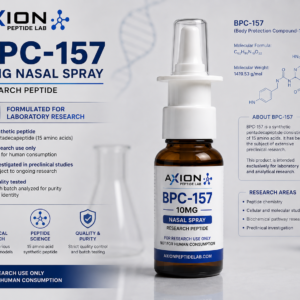
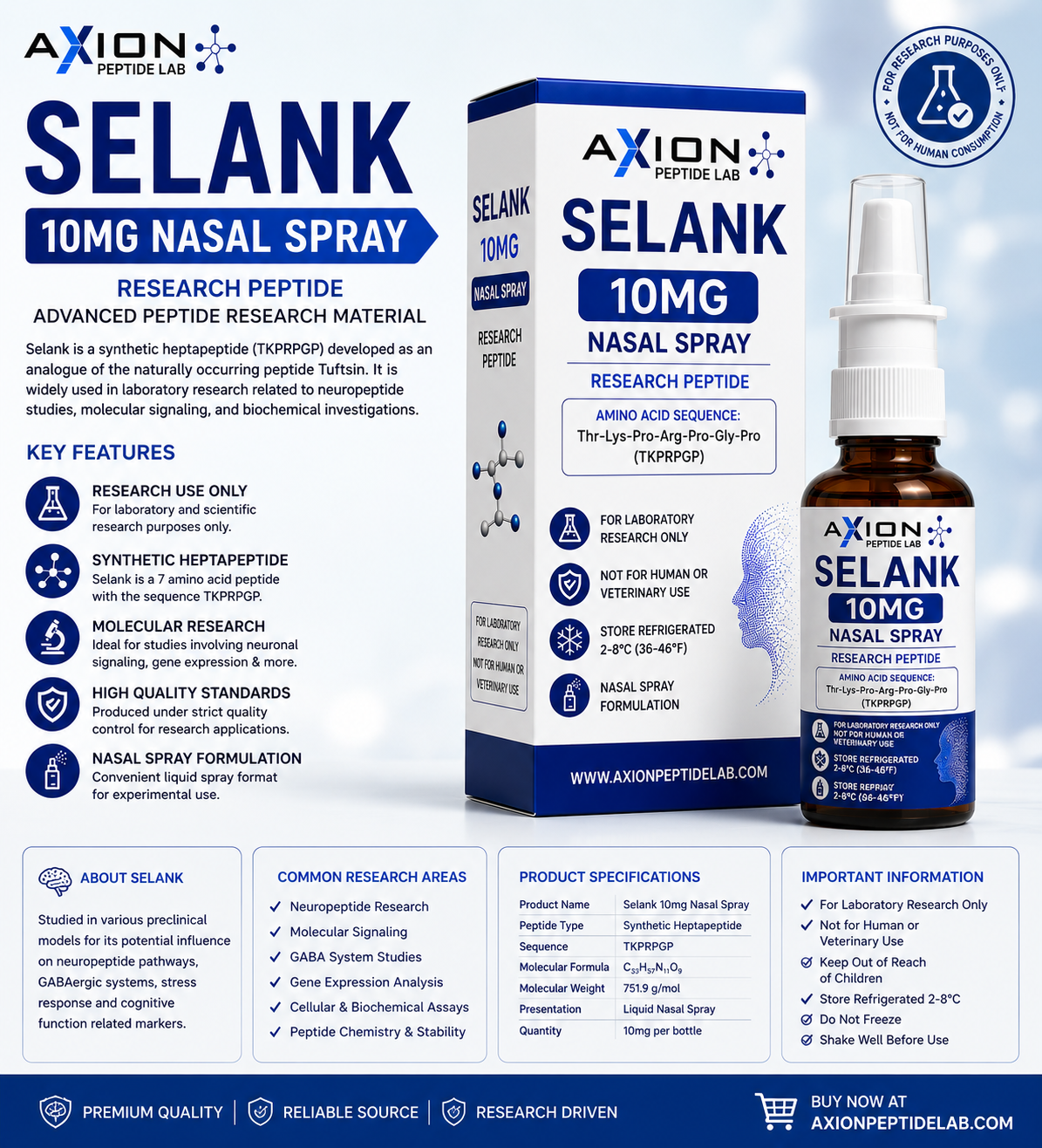
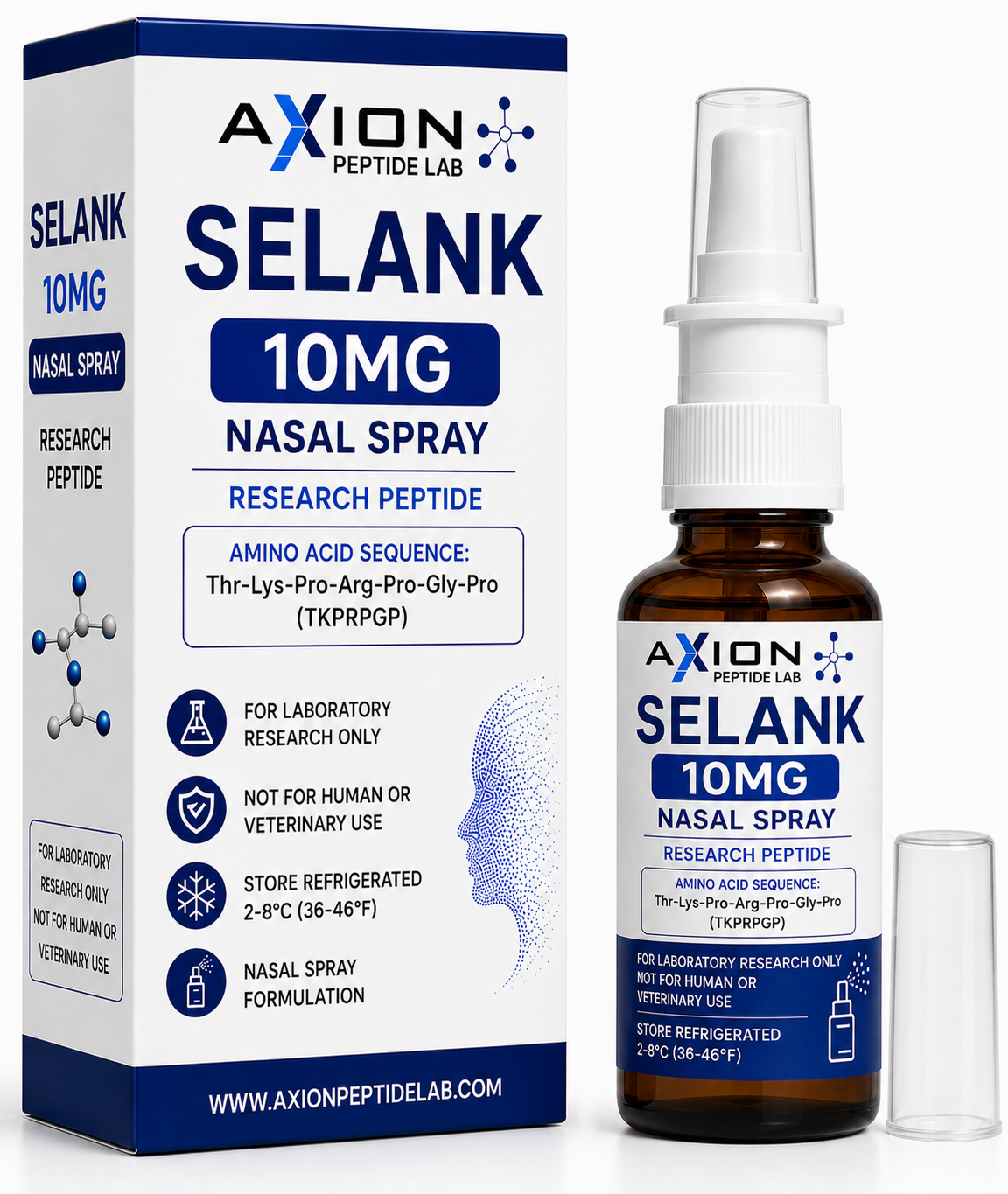
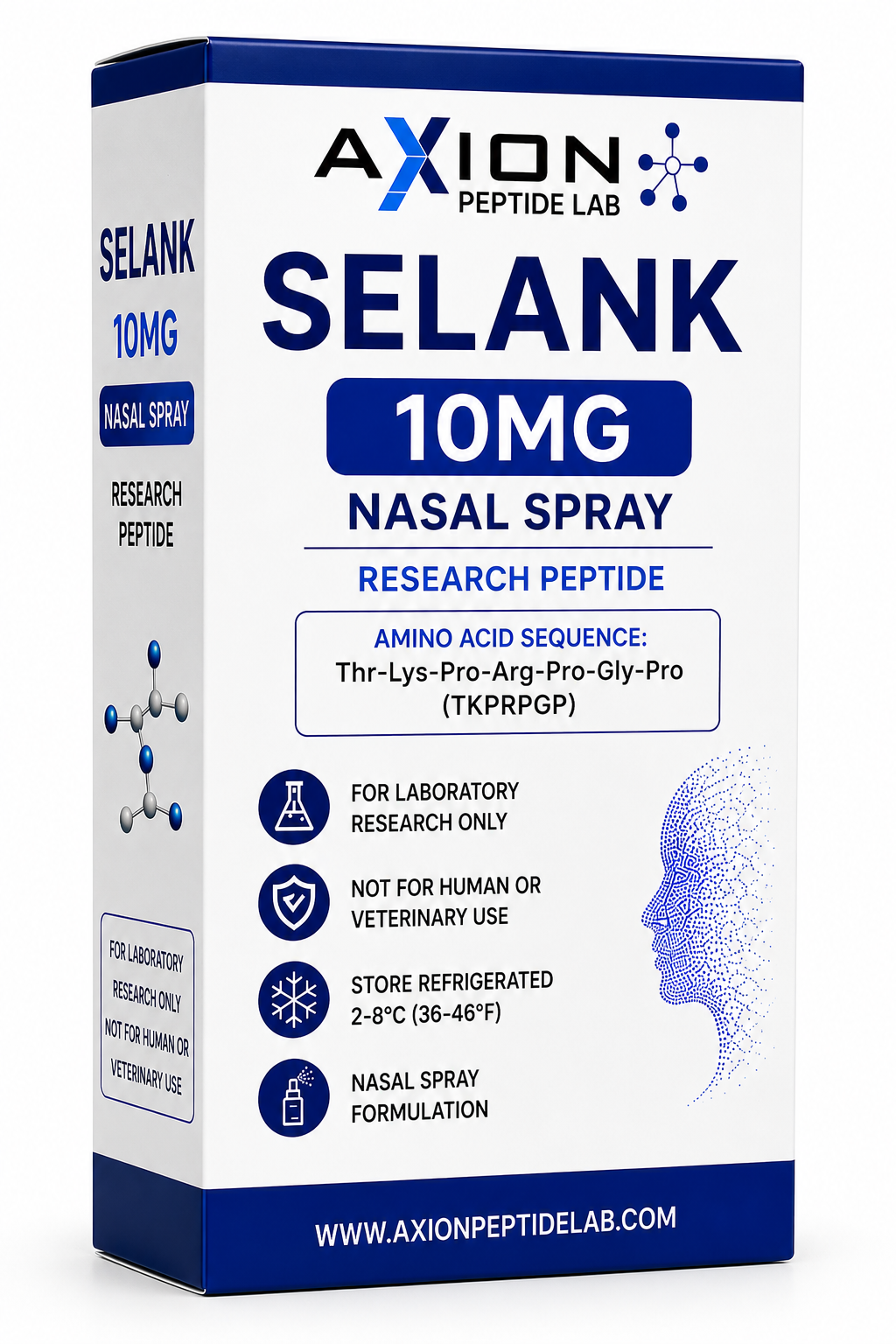
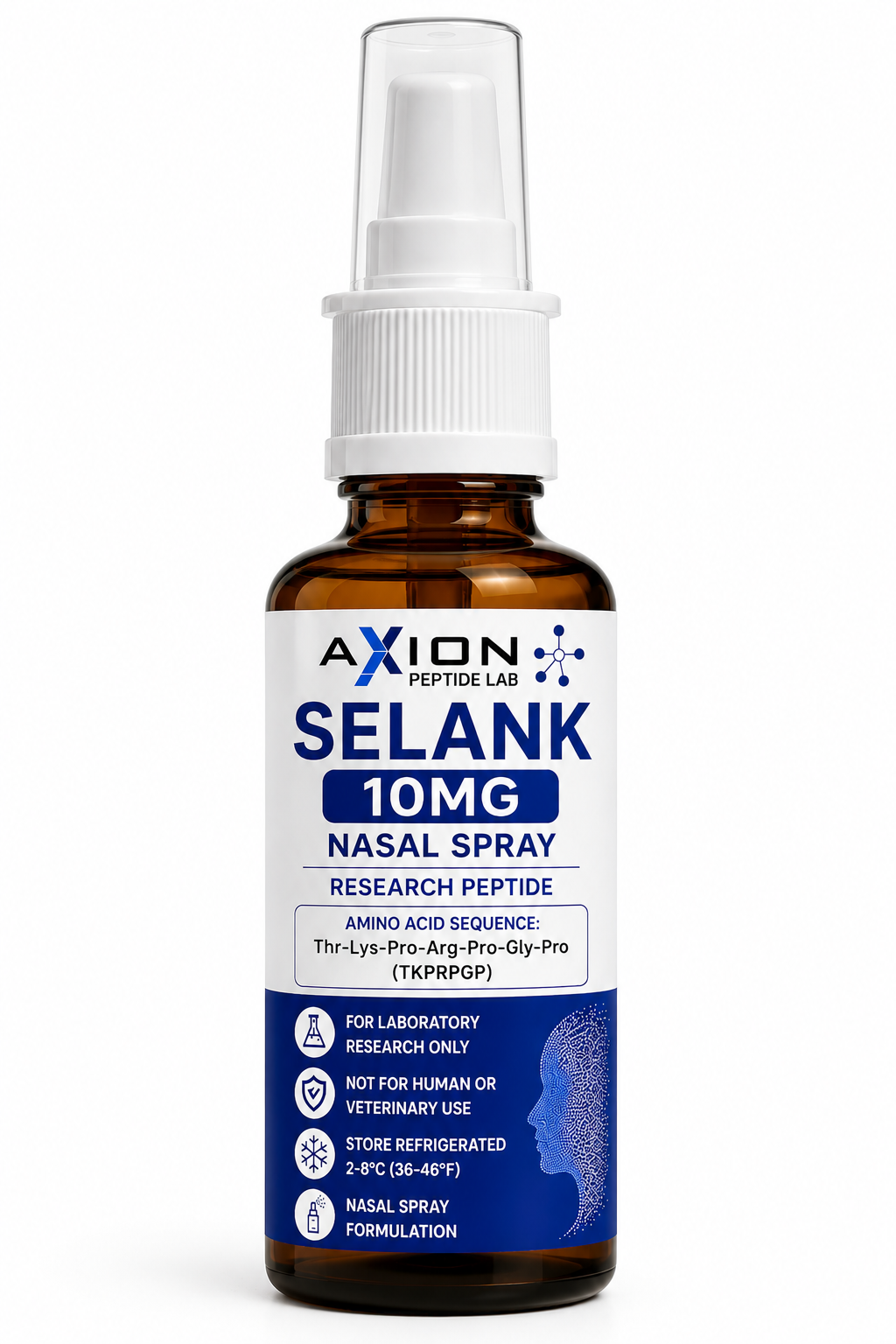
Selank 10mg Nasal Spray is a synthetic heptapeptide research preparation supplied in a liquid spray format for controlled laboratory investigation.
Selank consists of seven amino-acid residues with the sequence Thr-Lys-Pro-Arg-Pro-Gly-Pro (TKPRPGP) and is structurally related to the naturally occurring tetrapeptide tuftsin. It is relevant to controlled peptide chemistry, sequence-function, molecular signalling, comparative peptide, formulation, stability and analytical research.
The 10mg designation represents the stated research quantity and is not a dosage recommendation. Nasal Spray describes the physical research presentation only.
For Research Use Only – Not for human or veterinary consumption or administration.
$121.85 Original price was: $121.85.$108.29Current price is: $108.29.
Selank 10mg Nasal Spray from Axion Peptide Lab is a synthetic heptapeptide research preparation presented in a liquid spray format for controlled laboratory, molecular, biochemical, peptide-chemistry, formulation and analytical investigation.
Selank is composed of seven amino-acid residues and is commonly represented by the sequence:
Thr-Lys-Pro-Arg-Pro-Gly-Pro
The corresponding one-letter sequence is:
TKPRPGP
Selank was developed as a synthetic analogue related to tuftsin, a naturally occurring tetrapeptide represented by the sequence Thr-Lys-Pro-Arg. The additional Pro-Gly-Pro sequence creates the seven-residue Selank structure.
Its defined sequence and relationship to tuftsin have made Selank relevant to experimental research involving peptide chemistry, sequence-function relationships, molecular signalling, peptide stability, cellular models and analytical characterisation.
The 10mg designation identifies the stated research quantity associated with this preparation and is not a dosage recommendation. “Nasal Spray” describes its physical research presentation only and should not be interpreted as instructions or approval for human administration.
Axion Peptide Lab supplies this material specifically for legitimate scientific and analytical research.
For Research Use Only – Not for human or veterinary consumption or administration.
Selank is a synthetic seven-amino-acid peptide, making it a heptapeptide.
Its sequence is:
Thr-Lys-Pro-Arg-Pro-Gly-Pro (TKPRPGP)
The first four amino acids correspond to the sequence of tuftsin, while the remaining Pro-Gly-Pro sequence creates the extended synthetic peptide.
This relatively compact molecular structure makes Selank useful for researchers interested in short-peptide chemistry and comparative sequence analysis.
Researchers can investigate how structural differences between tuftsin, Selank and other related peptides influence experimentally measurable molecular characteristics.
Selank has a reported molecular formula of:
C33H57N11O9
Its molecular weight is approximately:
751.9 g/mol
These characteristics apply to the defined Selank molecule represented by the TKPRPGP sequence. Researchers working with particular salt forms or formulated materials should consult applicable batch documentation because counterions and formulation components can affect reported specifications.
The clearly defined molecular identity provides a useful foundation for chromatography, mass spectrometry and other analytical methods.
Tuftsin is a naturally occurring tetrapeptide represented by the sequence:
Thr-Lys-Pro-Arg
Selank incorporates this four-residue sequence and extends it with:
Pro-Gly-Pro
The resulting structure is:
Thr-Lys-Pro-Arg-Pro-Gly-Pro
This relationship has made Selank relevant to comparative peptide research.
Scientists may examine tuftsin, Selank and related synthetic analogues under controlled experimental conditions to determine how sequence extension influences molecular properties.
These experiments can contribute to broader understanding of peptide structure-function relationships.
Peptides are often classified according to the number of amino-acid residues they contain.
Because Selank consists of seven residues, it is classified as a heptapeptide.
Short peptides provide useful models for studying molecular recognition, enzymatic interactions, peptide stability and sequence-dependent behaviour.
The relatively compact TKPRPGP sequence can also simplify certain aspects of analytical characterisation compared with substantially larger proteins.
Researchers can examine intact Selank alongside related fragments or modified analogues.
Structure-function research examines how molecular architecture relates to experimentally measurable behaviour.
Selank offers a defined peptide framework for this type of investigation.
Researchers can compare the complete TKPRPGP sequence with shorter peptide fragments, tuftsin or modified synthetic analogues.
Changes in amino-acid sequence, terminal structure or formulation environment may influence analytical and experimental characteristics.
Such comparative experiments can provide information about which structural features contribute to observed molecular behaviour.
Selank has appeared in experimental literature investigating several molecular and cellular signalling systems.
Researchers may use suitable laboratory models to examine changes in selected molecular markers, gene-expression patterns or biochemical pathways under controlled experimental conditions.
Experimental observations should remain interpreted within the specific model used.
Results obtained from isolated cells, animal models or biochemical assays cannot automatically establish corresponding clinical effects in humans.
Appropriate controls, replication and validated methodology are therefore important components of Selank research.
One area represented in the Selank research literature involves GABA-associated molecular systems.
Gamma-aminobutyric acid, commonly abbreviated GABA, is an important signalling molecule studied extensively in neurobiology.
Experimental studies have investigated relationships between Selank exposure and selected components of GABA-associated signalling.
This makes Selank relevant to laboratories conducting mechanistic research involving peptide interactions with neurochemical signalling systems.
However, proposed molecular mechanisms should not be interpreted as evidence that a commercial research preparation treats anxiety or another medical condition.
Researchers have also examined Selank in experimental gene-expression studies.
Modern molecular techniques allow scientists to measure changes in expression across selected genes or broader transcriptional profiles.
These experiments can help identify pathways that may respond under particular experimental conditions.
Gene-expression findings are highly dependent on cell type, model system, experimental duration and analytical methodology.
Consequently, careful controls and independent replication remain important when interpreting these results.
Selank may be incorporated into comparative experiments involving other short synthetic peptides.
Researchers can evaluate differences in chromatographic behaviour, molecular stability, sequence composition or experimentally measurable interactions.
Comparative peptide studies are particularly useful when investigating how relatively small sequence differences alter molecular characteristics.
Each compound should nevertheless be treated as a distinct research material rather than assuming that findings involving one peptide automatically apply to another.
Cell-based experimental models provide another platform for investigating Selank.
Researchers may select cellular systems according to the molecular pathway or experimental endpoint being studied.
Important variables include cell type, culture conditions, experimental concentration, exposure duration and assay methodology.
Detailed documentation is essential for reproducibility.
Observations from cell-based research should remain separated from claims about effects in humans.
Selank is also relevant to fundamental peptide chemistry.
Researchers can investigate its sequence, terminal groups, peptide bonds, physicochemical behaviour and interactions with analytical systems.
Synthetic peptide research may include comparisons between intact Selank and chemically modified analogues.
These experiments can contribute to understanding how relatively small molecular modifications influence analytical behaviour.
Reliable peptide research requires appropriate analytical characterisation.
Techniques commonly employed in peptide laboratories include:
High-performance liquid chromatography (HPLC)
Liquid chromatography-mass spectrometry (LC-MS)
Mass spectrometry (MS)
HPLC can support separation and compositional analysis, while mass spectrometry can provide molecular-mass and identity-related information.
Researchers requiring exact purity, concentration, salt form or other specifications should consult documentation applicable to the supplied product and batch.
High-performance liquid chromatography is widely used in peptide science.
Researchers can develop HPLC methods to investigate Selank and related peptide materials.
Variables such as column chemistry, mobile-phase composition, gradient conditions, temperature, flow rate and detection method can influence chromatographic results.
Suitable reference materials and validated procedures should be used where quantitative measurements are required.
Chromatography can also support comparative stability experiments. Selank 10mg Nasal Spray
Mass spectrometry provides complementary information for peptide analysis.
Researchers may employ suitable MS or LC-MS methods to examine Selank’s molecular characteristics and investigate peptide-related transformation products.
Combining chromatographic separation with mass-based detection can provide particularly useful analytical information.
Expected molecular characteristics should be established using the specific molecular form represented by the research material.
Peptide stability is an important consideration when designing reproducible laboratory experiments.
Researchers may investigate Selank under controlled conditions involving variables such as temperature, pH, light exposure, formulation composition and time.
Samples collected at predetermined intervals can be analysed using validated analytical techniques.
Researchers should avoid assuming that stability findings obtained with one formulation automatically apply to another.
Product-specific storage instructions should similarly be based on applicable documentation.
Selank 10mg Nasal Spray is presented in a liquid research format.
This presentation may be relevant to controlled formulation, solution compatibility, stability and dispensing-characterisation experiments.
Researchers requiring exact information regarding solvent composition, preservatives, pH, concentration basis or other formulation properties should consult product-specific documentation.
These characteristics should not be inferred solely from the spray presentation.
“Nasal Spray” describes the physical format in which this Selank research preparation is supplied.
It does not represent human administration instructions.
The product should remain clearly identified and handled as laboratory research material rather than as a consumer nasal product or medicine.
Axion Peptide Lab does not provide human dosage, treatment or administration protocols for this material.
The 10mg designation identifies the stated quantity associated with the research preparation.
It does not constitute a recommended dose.
Researchers performing quantitative experiments should determine appropriate experimental concentrations according to validated laboratory protocols, study objectives and applicable product documentation. Selank 10mg Nasal Spray
Selank may be relevant to controlled investigation involving:
These represent areas of scientific investigation and not medical indications.
Researchers should document product identity, batch information, formulation characteristics, experimental conditions and analytical methodology.
Where available, batch-specific analytical documentation should be reviewed before quantitative research.
Certificate of Analysis and independent testing availability may vary by product and batch.
Exact claims regarding purity, sterility, concentration or formulation composition should only be made when supported by applicable documentation.
Researchers looking to buy Selank 10mg Nasal Spray can source this synthetic heptapeptide research preparation from Axion Peptide Lab for legitimate scientific and analytical investigation.
Its defined seven-amino-acid TKPRPGP sequence and relationship to tuftsin make Selank particularly relevant to peptide chemistry, sequence analysis, molecular signalling, comparative peptide investigation, formulation science, stability studies and analytical characterisation.
The liquid spray presentation also provides a format suitable for controlled solution and formulation-oriented laboratory research.
For Research Use Only – Not for human or veterinary consumption or administration.
Selank is a synthetic seven-amino-acid peptide developed as an analogue related to the naturally occurring tetrapeptide tuftsin.
The commonly reported Selank sequence is Thr-Lys-Pro-Arg-Pro-Gly-Pro, abbreviated TKPRPGP.
Yes. Selank contains seven amino-acid residues and is therefore classified as a heptapeptide.
The first four residues of Selank correspond to the tuftsin sequence Thr-Lys-Pro-Arg. Selank additionally contains a Pro-Gly-Pro sequence.
The defined Selank molecule is reported with the molecular formula C33H57N11O9.
The molecular weight of the defined Selank molecule is approximately 751.9 g/mol.
Relevant areas include peptide chemistry, sequence analysis, molecular signalling, comparative peptide studies, cellular investigation, formulation research, stability and analytical characterisation.
Yes. Appropriate validated HPLC, LC-MS and mass-spectrometric methods can be used for controlled analytical peptide investigation.
10mg identifies the stated research quantity. Nasal Spray describes the physical product presentation. Neither term constitutes a human dosage or administration recommendation.
Selank 10mg Nasal Spray is available from Axion Peptide Lab for legitimate peptide, molecular, formulation and analytical laboratory investigation, subject to availability and applicable requirements.