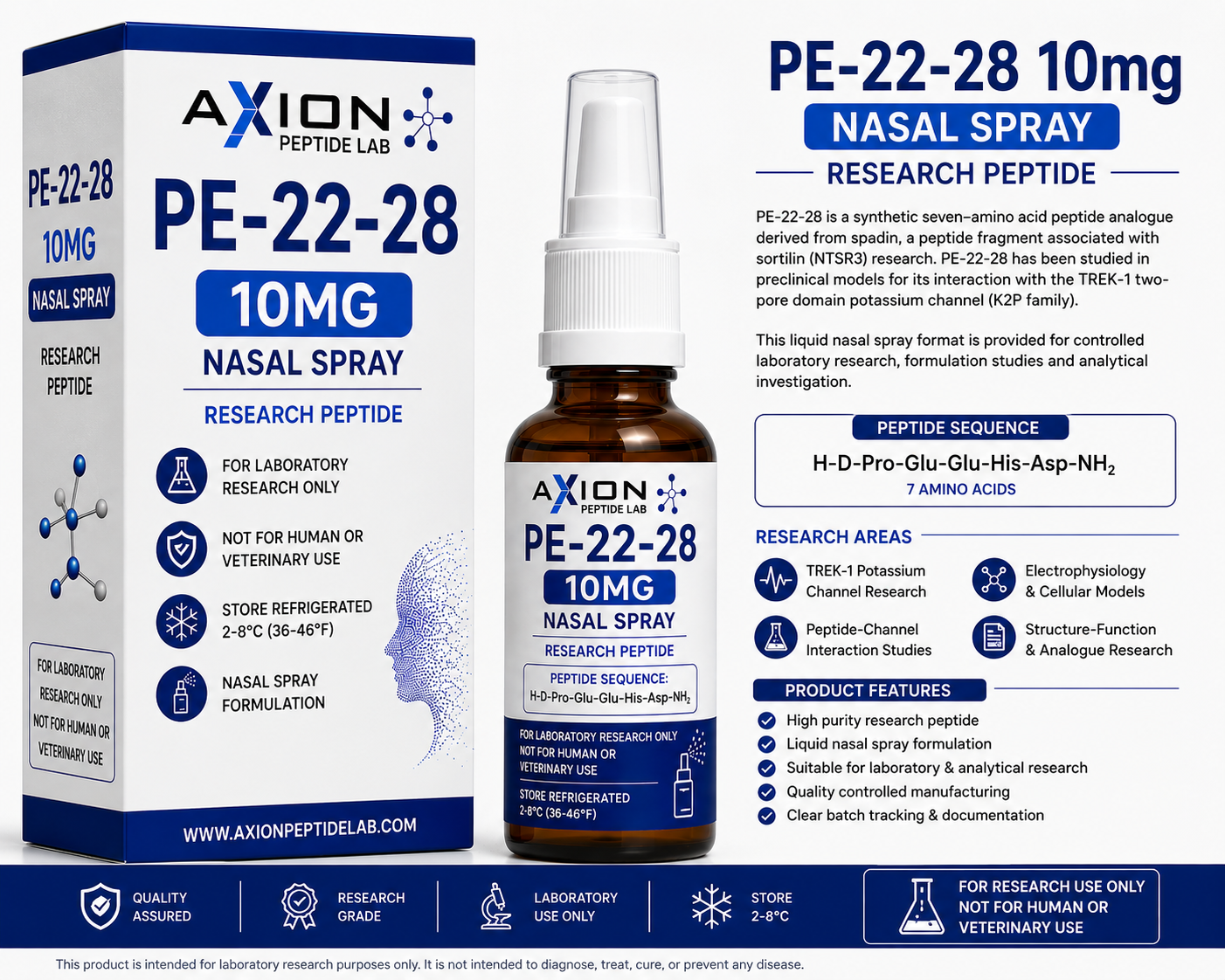
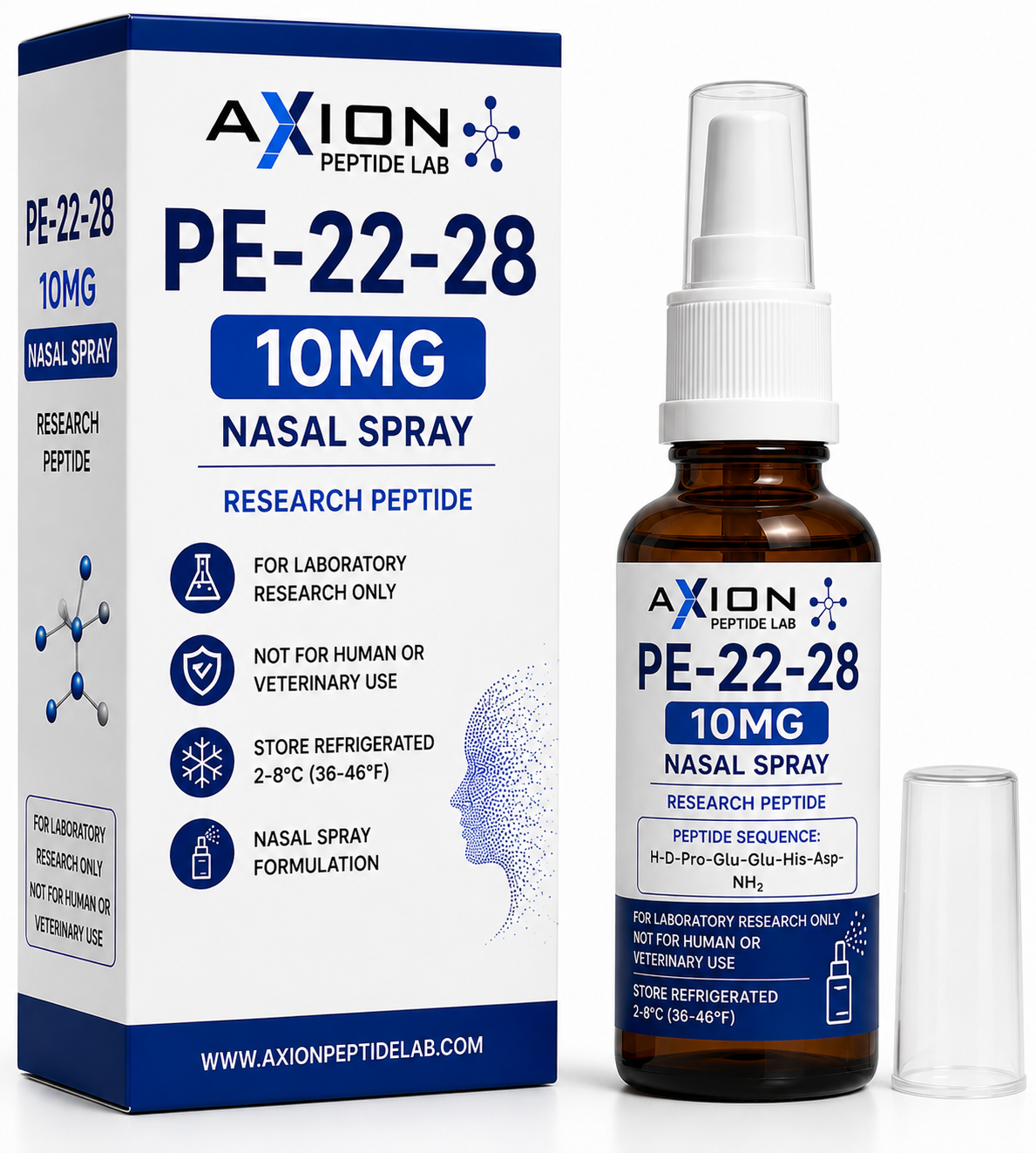
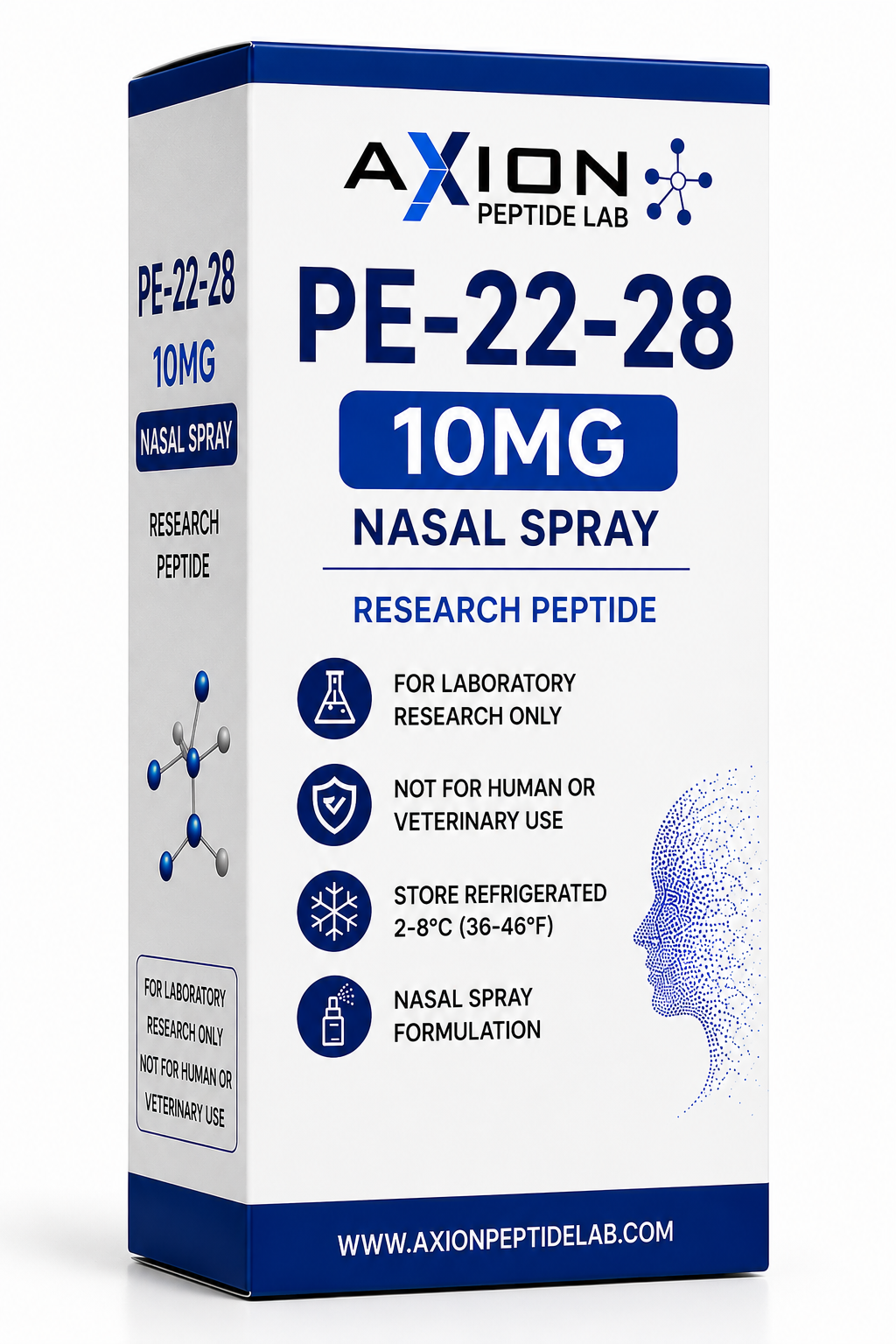
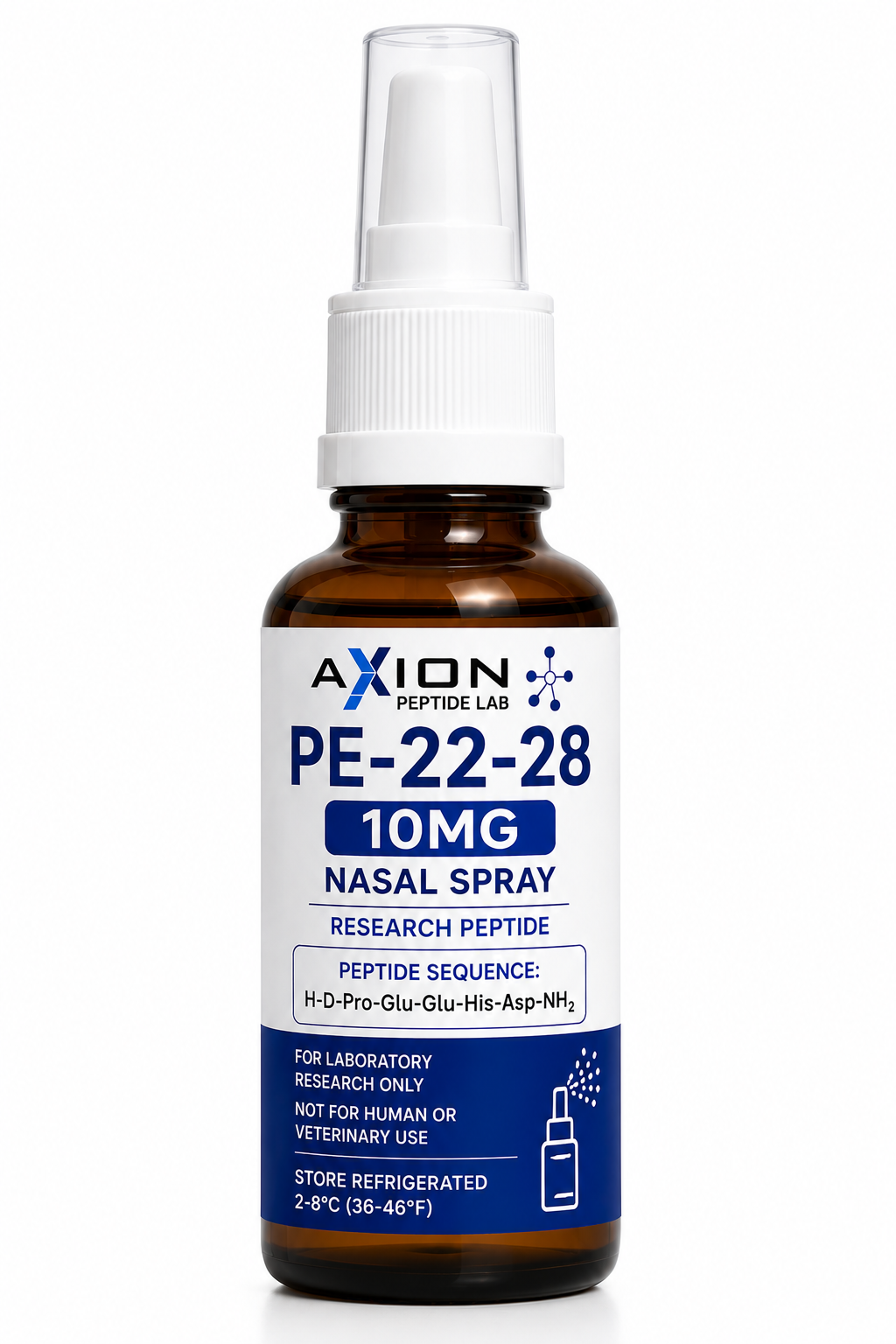
PE-22-28 10mg Nasal Spray is a seven-amino-acid research peptide presented in a liquid spray format for controlled laboratory investigation.
Developed through research involving shortened spadin-related peptides, PE-22-28 has been studied experimentally in connection with the TREK-1 two-pore-domain potassium channel. It is relevant to ion-channel research, electrophysiology, peptide-channel interaction, structure-function investigation, formulation studies and analytical characterisation.
The 10mg designation represents the stated research quantity and is not a dosage recommendation. Nasal Spray describes the physical research presentation only.
For Research Use Only – Not for human or veterinary consumption or administration.
$101.52
PE-22-28 10mg Nasal Spray from Axion Peptide Lab is a synthetic research peptide presented in a liquid spray format for controlled laboratory investigation involving peptide chemistry, TREK-1 channel research, electrophysiology, molecular interactions, formulation studies and analytical characterisation.
PE-22-28 is a shortened peptide analogue developed from research involving spadin, a sortilin-derived peptide investigated for its interaction with the TWIK-related potassium channel TREK-1. PE-22-28 contains seven amino-acid residues and has attracted scientific interest as a compact molecular tool for studying peptide-channel interactions and the structural characteristics associated with TREK-1 modulation.
The 10mg designation represents the stated research quantity associated with this preparation and is not a dosage recommendation. “Nasal Spray” describes the physical presentation of the research material only and does not constitute instructions or approval for human administration.
Axion Peptide Lab supplies PE-22-28 exclusively for legitimate scientific, analytical and laboratory research.
For Research Use Only – Not for human or veterinary consumption or administration.
PE-22-28 is a shortened synthetic peptide associated with the experimental development of spadin analogues. PE-22-28 10mg Nasal Spray
Spadin itself originated from research into a peptide sequence related to sortilin, also known as neurotensin receptor-3 or NTSR3.
Researchers subsequently investigated shorter fragments to determine whether compact sequences could retain or modify experimentally measurable interactions with TREK-1.
PE-22-28 emerged from this work as a seven-amino-acid peptide.
Its relatively short structure makes it particularly interesting for controlled structure-function experiments because researchers can investigate how a limited number of residues contribute to peptide-channel interaction.
Understanding PE-22-28 requires some background on spadin.
Spadin is a peptide associated with the processing of sortilin-related material and has been investigated experimentally as an inhibitor of TREK-1.
Researchers studying spadin subsequently examined shortened sequences and degradation products to identify smaller peptide structures capable of maintaining measurable TREK-1-related activity. PE-22-28 10mg Nasal Spray
PE-22-28 was developed through this line of investigation.
This relationship makes PE-22-28 useful for comparative experiments involving spadin, shortened peptide fragments and modified analogues.
Researchers can examine whether changes in peptide length or terminal structure alter experimentally measurable characteristics.
PE-22-28 contains seven amino-acid residues.
Short peptides can provide useful experimental models because their relatively compact structures simplify certain aspects of peptide synthesis, modification and analytical characterisation.
Scientists can compare the parent sequence with terminally modified analogues or other derivatives to investigate structure-function relationships. PE-22-28 10mg Nasal Spray
Such experiments may help identify molecular features associated with target interaction without requiring researchers to work with significantly larger peptide structures.
A major focus of published PE-22-28 research involves TREK-1.
TREK-1 is a two-pore-domain potassium channel belonging to the K2P potassium-channel family.
These channels participate in the regulation of membrane electrical properties and are investigated across several areas of cellular physiology and molecular pharmacology.
PE-22-28 has been examined experimentally for its interaction with TREK-1.
This makes the peptide relevant to laboratory projects investigating ion-channel pharmacology, peptide-channel interactions and molecular determinants of channel modulation.
Potassium channels are integral membrane proteins involved in controlling potassium-ion movement across cellular membranes.
Different potassium-channel families possess distinct structures, activation mechanisms and physiological roles. PE-22-28 10mg Nasal Spray
The TREK-1 channel represents one member of the K2P family and can respond to multiple physical and chemical factors.
Laboratories investigating PE-22-28 can incorporate suitable TREK-1-expressing systems into controlled experiments designed to characterise peptide-channel interaction.
Observed experimental effects should remain interpreted within the conditions of the specific assay.
Electrophysiology provides an important approach for studying ion channels.
Published PE-22-28 research has used patch-clamp techniques in TREK-1-expressing cellular systems to investigate channel activity.
Patch-clamp experiments allow researchers to measure electrical currents across cellular membranes and evaluate changes associated with experimental compounds.
PE-22-28 may therefore be relevant to laboratories developing or validating electrophysiological methods involving TREK-1. PE-22-28 10mg Nasal Spray
Variables such as cell model, channel expression, buffer composition and experimental conditions can influence measurements and should be carefully documented.
PE-22-28 provides an interesting model for studying interactions between short peptides and membrane-associated ion channels.
Researchers may compare PE-22-28 with spadin or structurally modified analogues to investigate how changes in peptide architecture affect experimentally measured interaction.
Such studies can contribute to broader understanding of molecular recognition.
However, an interaction demonstrated in a controlled cellular assay does not independently establish a clinical effect.
Structure-function research examines how molecular architecture relates to measurable biological or chemical behaviour.
The compact structure of PE-22-28 makes it particularly suitable for comparative peptide experiments.
Researchers can investigate modified terminal groups, residue substitutions and related analogues.
Experimental results can then be compared using electrophysiological or analytical techniques.
These comparisons may reveal which structural characteristics are important for experimentally observed TREK-1 interactions. PE-22-28 10mg Nasal Spray
Researchers may use PE-22-28 alongside spadin and related analogues.
Comparative studies allow laboratories to evaluate variables such as peptide length, sequence modifications, terminal alterations and molecular stability.
This type of research can help clarify whether particular structural features influence channel-related activity or analytical behaviour. PE-22-28 10mg Nasal Spray
Appropriate controls are essential when interpreting comparative results.
Cell-based models can provide controlled platforms for PE-22-28 investigation.
Researchers may employ engineered cells expressing human TREK-1 or other validated experimental systems.
The selected model should match the scientific question being investigated.
Factors such as receptor or channel density, cell passage, experimental exposure and assay conditions can affect measured outcomes.
Results obtained from cellular models should not automatically be extrapolated to clinical outcomes.
Reliable peptide research requires appropriate analytical characterisation.
Laboratories may use techniques such as high-performance liquid chromatography and mass spectrometry to examine PE-22-28.
Chromatographic analysis can support separation, compositional evaluation and stability studies.
Mass-spectrometric techniques may assist molecular identity and structural investigation.
Where researchers require exact purity, concentration or identity specifications, documentation applicable to the supplied batch should be reviewed.
High-performance liquid chromatography is widely employed in peptide science.
Researchers can develop HPLC methods for PE-22-28 separation and analytical evaluation.
Variables including stationary phase, mobile-phase composition, gradient conditions, flow rate and detection method can influence chromatographic performance.
Validated methods may also be used to investigate stability samples and potential peptide-related degradation products.
Mass spectrometry can complement chromatographic investigation.
Appropriate MS techniques can provide information relevant to peptide identity, molecular mass and structural characteristics.
LC-MS approaches may be particularly useful when laboratories need chromatographic separation followed by mass-based detection.
Analytical conditions should be validated according to the research objective.
Peptide stability is an important consideration in experimental reproducibility.
Researchers may investigate PE-22-28 under controlled conditions to determine how variables such as temperature, pH, light exposure, formulation environment and time influence analytical characteristics.
Samples can be evaluated at predetermined intervals using appropriate analytical techniques.
Stability findings obtained with one formulation should not automatically be applied to another formulation or batch. PE-22-28 10mg Nasal Spray
PE-22-28 10mg Nasal Spray is supplied in a liquid research presentation.
This format may support controlled formulation, solution compatibility, stability and dispensing-characterisation studies.
Researchers requiring exact details regarding solvent composition, preservatives, pH, concentration basis or other formulation properties should consult product-specific documentation where available. PE-22-28 10mg Nasal Spray
These specifications should not be inferred solely from the spray presentation.
The term Nasal Spray describes the physical presentation of the PE-22-28 research preparation.
It does not indicate an approved route of human administration.
No human dosage, treatment protocol or administration recommendation is implied by the product name.
This distinction is important because experimental peptide research should remain separate from personal or therapeutic use.
The 10mg designation identifies the stated quantity associated with this research preparation.
It should not be interpreted as a recommended dose.
Laboratories conducting quantitative experiments should establish experimental concentrations according to validated methods, research objectives and verified product specifications.
PE-22-28 may be relevant to controlled laboratory investigation involving:
These represent experimental research categories rather than medical indications.
Accurate documentation is essential for reproducible PE-22-28 research.
Researchers should record the product identifier, batch information, experimental conditions, assay platform and analytical methods.
Where available, product-specific analytical documentation should be reviewed before quantitative experiments.
Certificate of Analysis and independent testing availability may vary according to product and batch.
Claims concerning exact purity, sterility, composition or other specifications should only be made when supported by applicable documentation.
Researchers looking to buy PE-22-28 10mg Nasal Spray can source this research peptide from Axion Peptide Lab for legitimate laboratory and analytical investigation.
Its compact seven-residue structure and relationship to spadin research make PE-22-28 particularly relevant to studies involving TREK-1, K2P potassium channels, electrophysiology, peptide-channel interactions, structure-function relationships, formulation science and analytical characterisation.
The liquid spray presentation also provides a practical research format for controlled solution, stability and formulation-oriented investigation.
For Research Use Only – Not for human or veterinary consumption or administration.
PE-22-28 is a seven-amino-acid research peptide developed through experimental investigation of shortened spadin-related peptide sequences.
Yes. PE-22-28 is a short peptide consisting of seven amino-acid residues.
Spadin is a sortilin-derived peptide that has been investigated experimentally for its interaction with the TREK-1 potassium channel.
TREK-1 is a two-pore-domain potassium channel belonging to the K2P family and is studied in ion-channel physiology and molecular pharmacology.
Yes. Published preclinical research has investigated PE-22-28 using TREK-1-expressing cellular systems and electrophysiological techniques.
Relevant areas include TREK-1 investigation, ion-channel pharmacology, electrophysiology, peptide chemistry, structure-function research, formulation studies and analytical characterisation.
Appropriate HPLC, LC-MS and mass-spectrometric techniques may be used for controlled analytical peptide research.
The 10mg designation represents the stated research quantity associated with the preparation. It is not a human or veterinary dosage recommendation.
No. Nasal Spray describes the physical research presentation only. The product is supplied exclusively for laboratory investigation.
PE-22-28 10mg Nasal Spray is available from Axion Peptide Lab for legitimate laboratory, ion-channel, peptide, formulation and analytical research, subject to availability and applicable requirements.