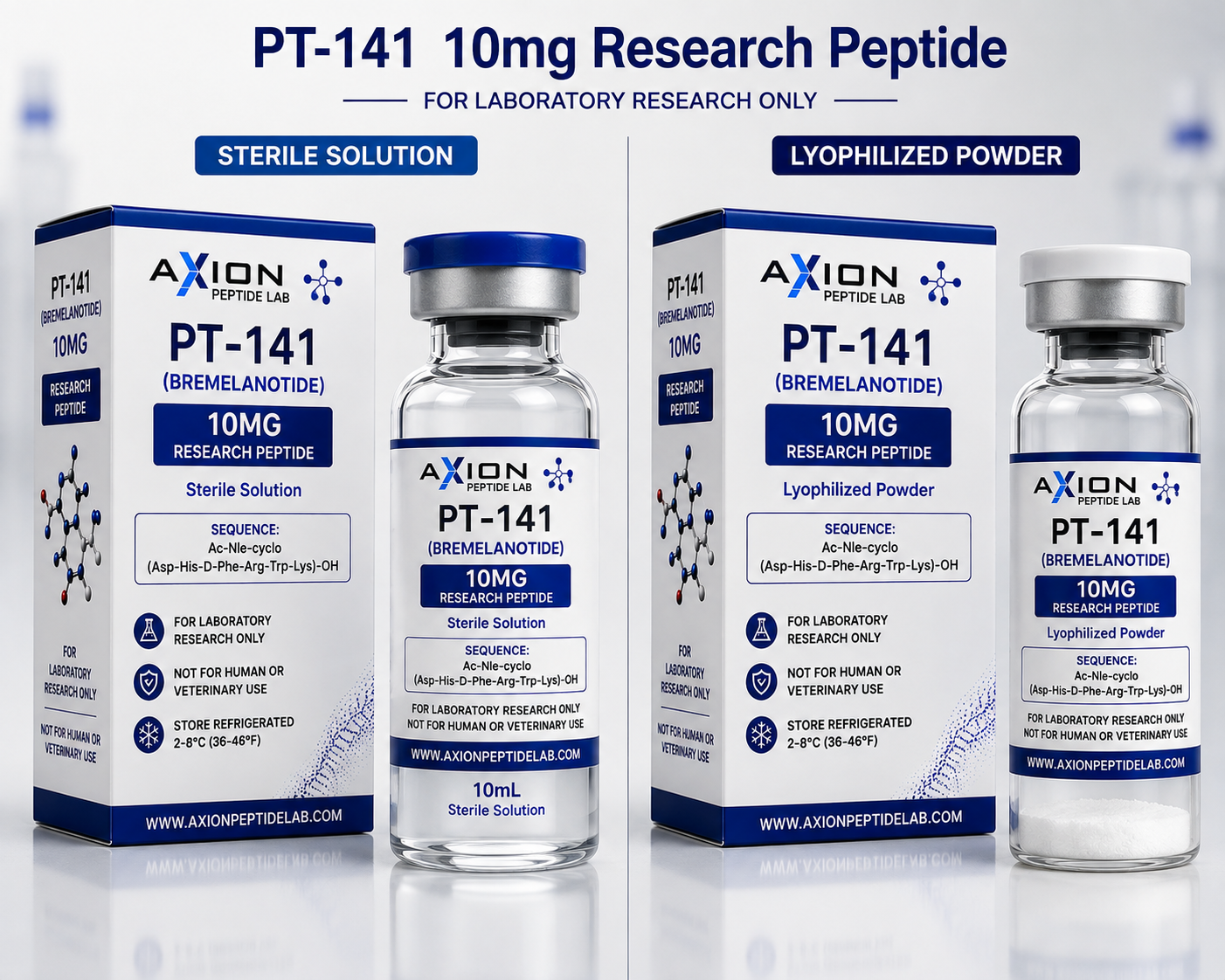
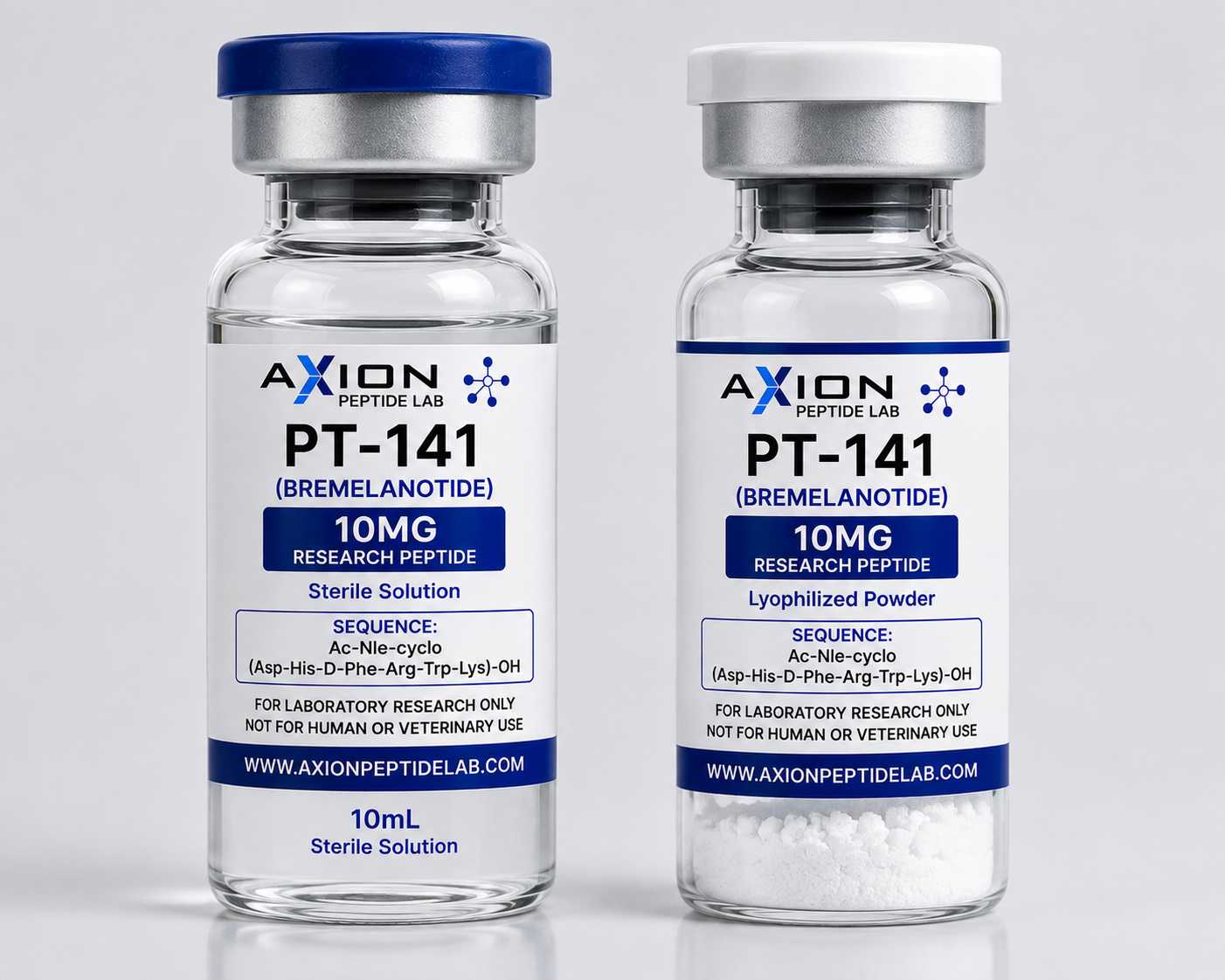
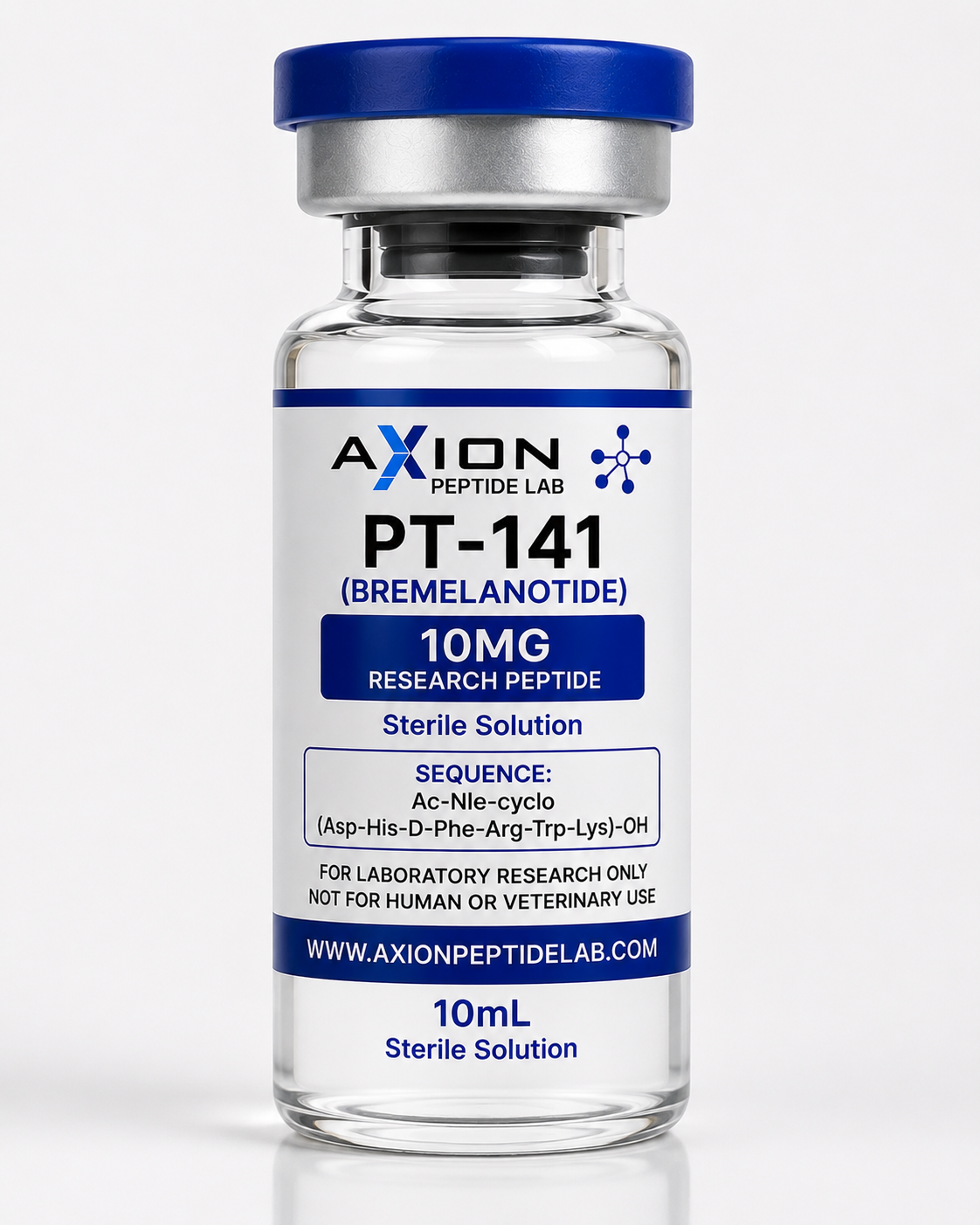
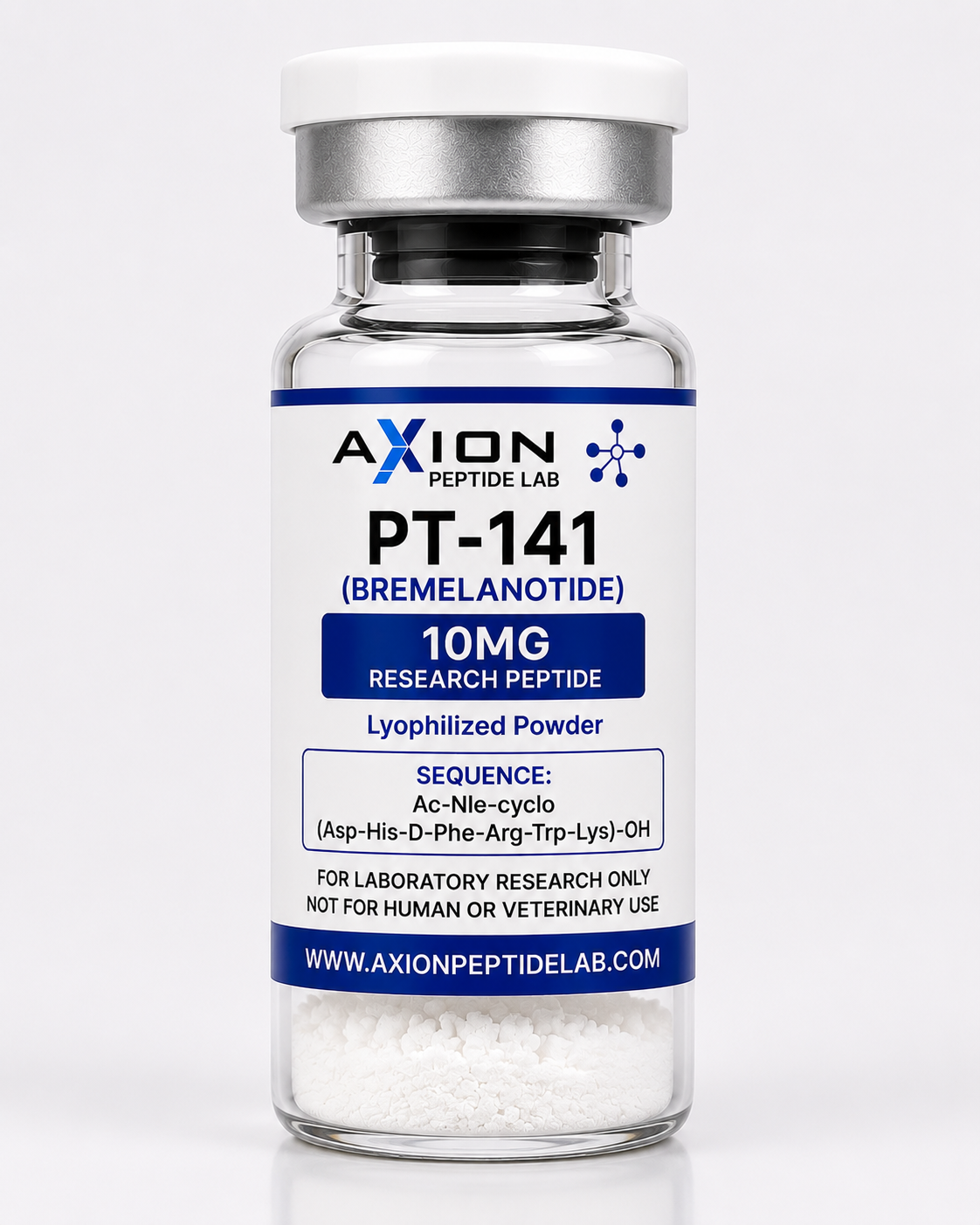
PT-141 10mg Research Peptide (Bremelanotide) is a synthetic cyclic heptapeptide research material relevant to controlled melanocortin receptor, GPCR, molecular signalling, peptide chemistry and analytical investigation.
Commonly represented as Ac-Nle-cyclo(Asp-His-D-Phe-Arg-Trp-Lys)-OH, its cyclic architecture makes PT-141 particularly relevant to structure-function and ligand-receptor research.
10mg represents the stated research quantity and is not a dosage recommendation.
For Research Use Only – Not for human or veterinary consumption or administration.
$40.61 – $67.69Price range: $40.61 through $67.69
PT-141 10mg Research Peptide, also known scientifically as bremelanotide, is a synthetic cyclic heptapeptide research material supplied by Axion Peptide Lab for controlled laboratory, receptor, molecular and analytical investigation.
PT-141 belongs to the melanocortin-related peptide research field and is structurally related to alpha-melanocyte-stimulating hormone (α-MSH) analogues. Its cyclic molecular architecture and interaction with melanocortin receptor systems make it a useful experimental material for laboratories investigating receptor pharmacology, peptide chemistry, ligand-receptor relationships, molecular signalling and structure-function characteristics.
The 10mg designation identifies the stated quantity of research material and is not a dosage recommendation.
This material is supplied exclusively for legitimate scientific investigation.
For Research Use Only – Not for human or veterinary consumption or administration.
PT-141 is the development code historically associated with bremelanotide.
It is a synthetic cyclic peptide containing seven amino-acid residues and belongs to a class of molecules investigated for their interactions with melanocortin receptors.
Unlike linear peptides, PT-141 contains a cyclic structural component. Cyclisation can significantly influence peptide conformation and molecular behaviour, making cyclic compounds valuable models for structure-function research.
Its molecular architecture allows researchers to examine relationships between peptide structure and receptor activity under carefully controlled experimental conditions.
Bremelanotide is commonly represented using the condensed peptide structure:
Ac-Nle-cyclo(Asp-His-D-Phe-Arg-Trp-Lys)-OH
The molecule contains modified amino-acid components including norleucine (Nle) and D-phenylalanine (D-Phe).
The presence of these residues, together with peptide cyclisation, makes PT-141 relevant to laboratories studying synthetic peptide design and molecular modification.
Researchers may investigate how these structural characteristics affect experimentally measurable properties such as receptor interaction, conformation, chromatographic behaviour and molecular stability.
PT-141 is classified as a cyclic heptapeptide, meaning its peptide structure contains seven amino-acid residues and incorporates a cyclic configuration.
Cyclic peptides are widely investigated because restricting molecular conformation can create properties that differ from corresponding linear sequences.
Laboratories can use PT-141 as a model when examining relationships between peptide cyclisation, molecular geometry and receptor interaction.
Comparative studies may also evaluate PT-141 alongside related melanocortin peptides under standardised experimental conditions. PT-141 10mg Research Peptide
One of the most significant scientific characteristics of PT-141 is its activity within the melanocortin receptor system.
Melanocortin receptors belong to the G-protein-coupled receptor family.
Bremelanotide demonstrates nonselective activity across several melanocortin receptor subtypes, making the molecule relevant to controlled receptor-pharmacology experiments.
Researchers may use receptor-expression models to investigate ligand binding, receptor activation, downstream signalling and comparative receptor activity.
Experimental observations should remain interpreted according to the specific model and assay conditions used.
MC1R is one member of the melanocortin receptor family.
Laboratory systems expressing this receptor can be used to investigate interactions between receptor-active ligands and downstream molecular responses.
PT-141 may therefore be incorporated into comparative experiments involving different melanocortin receptor subtypes.
Such studies can help researchers characterise receptor-specific versus broader melanocortin activity. PT-141 10mg Research Peptide
PT-141 is also relevant to experimental research involving MC3R and MC4R.
These melanocortin receptors are widely studied within receptor biology and molecular signalling research.
Controlled cell-based experiments can investigate receptor activation and downstream signalling using predefined analytical endpoints.
PT-141 can also be compared with related synthetic melanocortin analogues to examine how structural modifications influence receptor activity. PT-141 10mg Research Peptide
The compound also demonstrates activity involving MC5R, providing another experimental target for comparative receptor research.
Using multiple receptor-expression systems under equivalent conditions can allow laboratories to characterise differences in molecular response.
This type of investigation is useful for understanding broader principles of ligand-receptor selectivity and peptide pharmacology. PT-141 10mg Research Peptide
Melanocortin receptors are members of the G-protein-coupled receptor (GPCR) superfamily.
GPCRs represent an important field of molecular research because receptor activation can initiate measurable intracellular signalling pathways.
PT-141 can therefore serve as an experimental ligand in appropriately designed melanocortin GPCR studies.
Researchers may examine receptor activation, signalling characteristics and interactions with other experimental variables.
Structure-function investigation attempts to understand how molecular architecture influences experimentally measurable behaviour.
PT-141 is particularly interesting because it incorporates cyclisation, N-terminal acetylation, norleucine and D-phenylalanine. PT-141 10mg Research Peptide
Researchers may compare these structural characteristics with related peptide analogues.
Such studies can investigate whether modifications influence molecular conformation, receptor interactions, chromatographic behaviour or other measurable characteristics.
PT-141 was developed within the broader field of synthetic melanocortin peptide research.
Its structural relationship to melanocortin analogues makes it useful for comparative laboratory studies.
Researchers can evaluate structurally related compounds under standardised conditions to investigate how specific molecular modifications alter experimentally measurable properties.
Care should be taken not to assume that findings associated with one melanocortin analogue automatically apply to another. PT-141 10mg Research Peptide
PT-141 may also be incorporated into controlled molecular-interaction experiments.
Depending on the research design, laboratories might investigate receptor affinity, functional activity or molecular interactions.
Variables such as concentration, temperature, buffer composition, receptor expression and experimental duration should be carefully controlled.
Appropriate positive and negative controls are important when interpreting experimental results.
Analytical characterisation is an important component of peptide research.
High-performance liquid chromatography (HPLC) may be used to examine chromatographic characteristics of PT-141 research materials.
Researchers can investigate retention behaviour and detect related molecular species using appropriately developed methods. PT-141 10mg Research Peptide
Any numerical purity statement should be based on documentation for the specific product or batch rather than assumed from the PT-141 compound identity.
Liquid chromatography-mass spectrometry (LC-MS) and other mass-spectrometric techniques can support molecular characterisation.
These methods provide information that can help laboratories investigate molecular identity and distinguish related species.
For quantitative research, researchers should use validated methods, calibrated instrumentation and suitable reference standards where appropriate.
Analytical results should be documented as part of a controlled experimental workflow.
PT-141 may also be relevant to controlled peptide-stability studies.
Researchers can investigate how predefined environmental variables affect measurable characteristics over time.
Experimental factors might include temperature, pH, light exposure, formulation composition and duration.
Samples can then be evaluated using chromatographic or mass-spectrometric techniques.
Product-specific storage requirements should always be obtained from applicable batch or supplier documentation rather than inferred from generic information about bremelanotide. PT-141 10mg Research Peptide
The 10mg designation represents the stated amount of research material associated with this product.
It should not be interpreted as a recommended dose or administration quantity.
Axion Peptide Lab does not provide personal dosing, injection, reconstitution or therapeutic protocols for this research product.
Laboratories should determine experimental quantities and concentrations according to properly designed research protocols. PT-141 10mg Research Peptide
PT-141 may be relevant to controlled investigation involving:
Melanocortin receptor biology
GPCR research
Cyclic peptide chemistry
Ligand-receptor interactions
Molecular signalling
Structure-function investigation
Synthetic peptide design
Comparative peptide research
HPLC characterisation
LC-MS and mass-spectrometric analysis
Peptide stability investigation
These represent laboratory research categories rather than medical indications.
Axion Peptide Lab supplies PT-141 10mg Research Peptide as a specialised material for legitimate laboratory and analytical research.
Its cyclic heptapeptide structure and melanocortin receptor activity make PT-141 relevant to receptor pharmacology, GPCR investigation, synthetic peptide chemistry, molecular signalling, structure-function studies and analytical characterisation.
Researchers should review applicable product specifications and available batch documentation before beginning quantitative experiments.
The Axion research material should not be represented as equivalent to any approved pharmaceutical preparation containing bremelanotide.
For Research Use Only – Not for human or veterinary consumption or administration.
PT-141 is the development designation associated with bremelanotide, a synthetic cyclic heptapeptide investigated for its activity within melanocortin receptor systems.
PT-141 is the historical development code for bremelanotide. Researchers should nevertheless verify the exact chemical form and product specifications against batch documentation.
PT-141 is a synthetic cyclic heptapeptide containing seven amino-acid residues within its peptide architecture.
Bremelanotide is commonly represented as Ac-Nle-cyclo(Asp-His-D-Phe-Arg-Trp-Lys)-OH.
Bremelanotide is a melanocortin receptor agonist with activity involving multiple receptor subtypes, making it relevant to melanocortin receptor and GPCR research.
10mg identifies the stated quantity of research peptide. It is not a recommended human or veterinary dosage.
Appropriately developed HPLC methods can be used to investigate chromatographic characteristics of peptide research materials.
LC-MS and other mass-spectrometric methods may support molecular identification and analytical characterisation.
Its cyclic architecture and modified amino-acid components make the molecule relevant to controlled peptide structure-function and comparative chemistry studies.
No. This material is supplied exclusively for legitimate laboratory and analytical investigation and is not intended for human or veterinary consumption or administration.