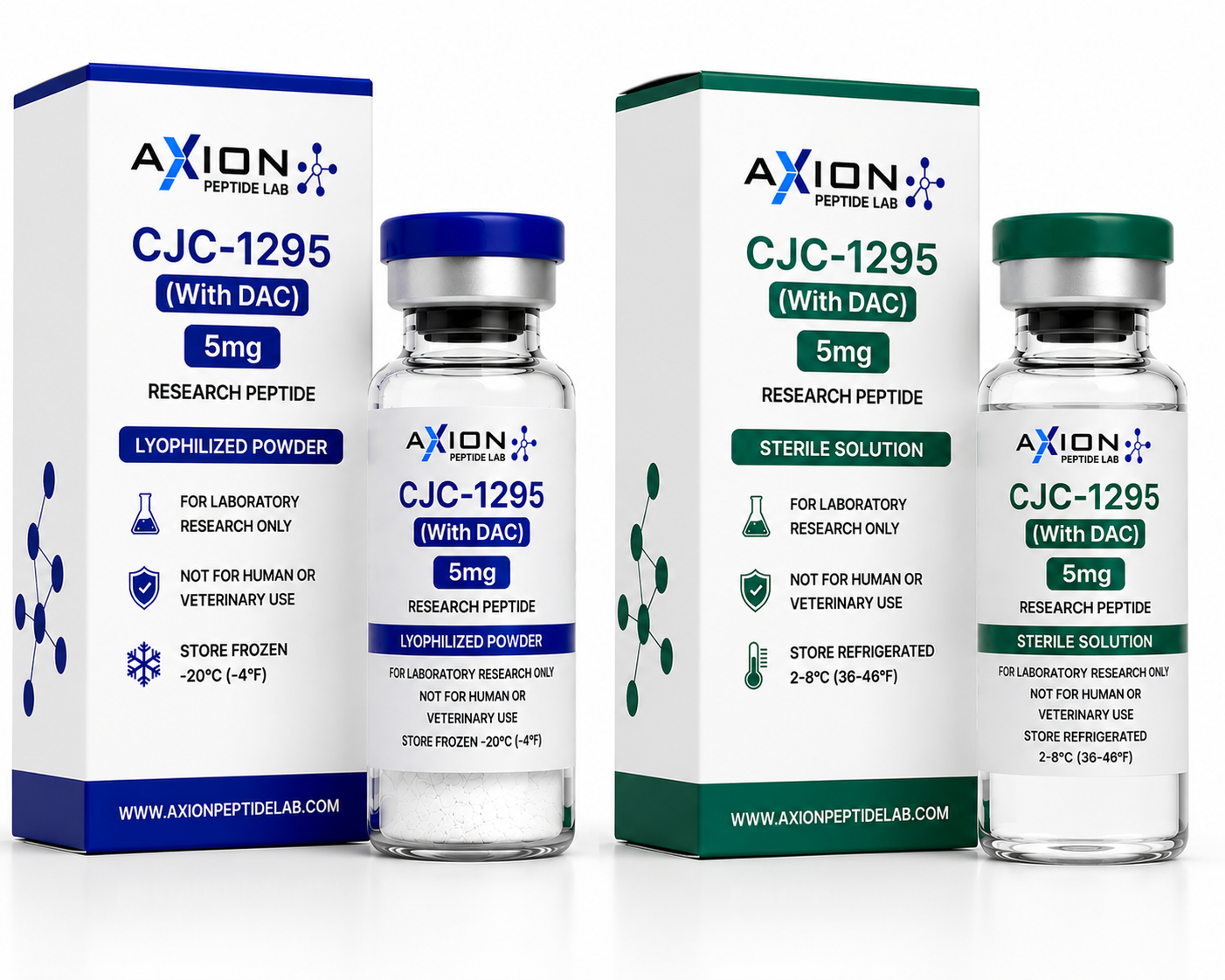
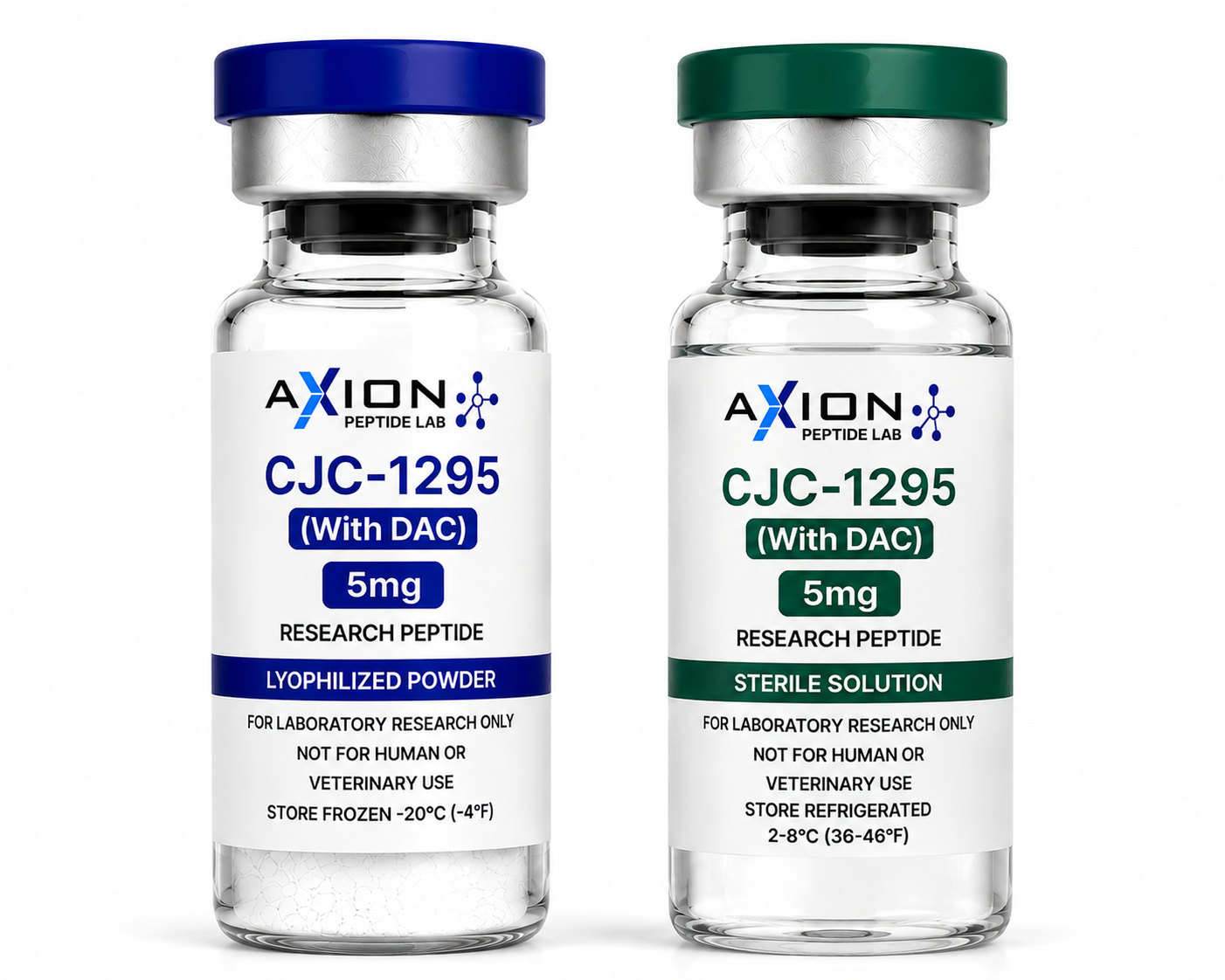
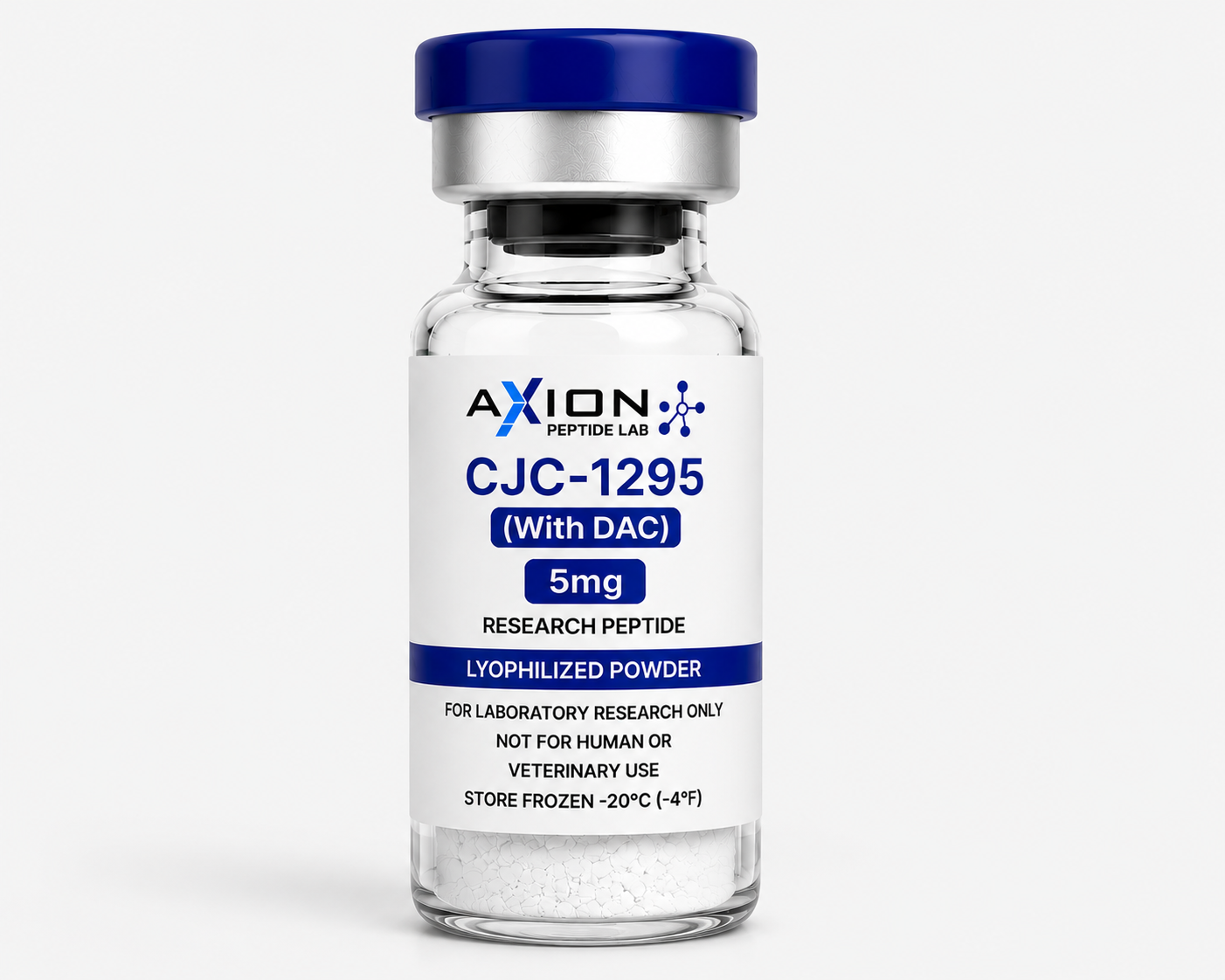
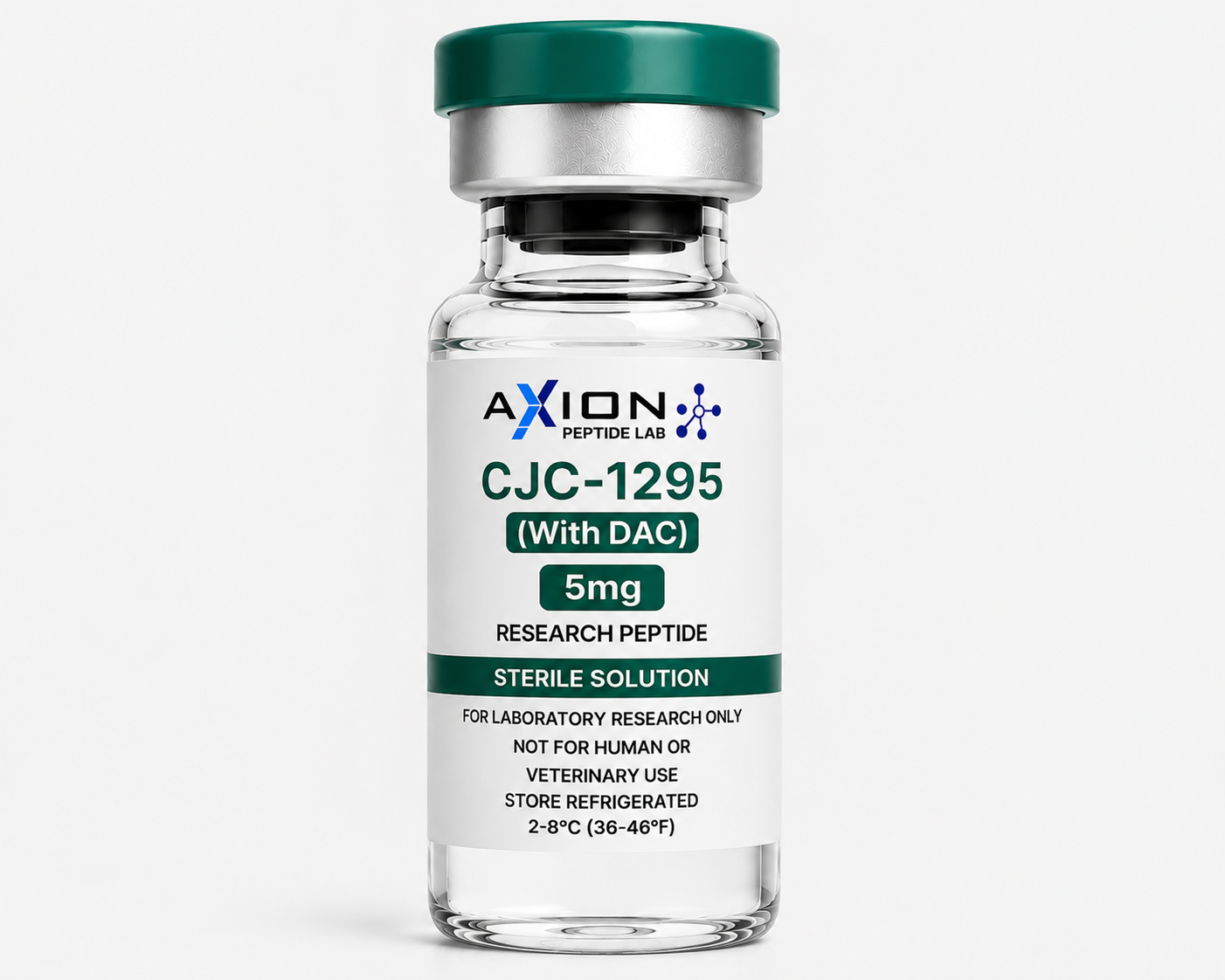
CJC-1295 (With DAC) 5mg Research Peptide is a synthetic GHRH-related peptide incorporating Drug Affinity Complex functionality. It is supplied for controlled laboratory investigation involving GHRH receptor biology, GPCR signalling, peptide-albumin interactions, protein conjugation, molecular pharmacology, peptide stability and analytical characterisation.
The 5mg designation represents the stated research quantity and is not a dosage recommendation.
For Research Use Only – Not for human or veterinary consumption or administration.
$60.90 – $87.98Price range: $60.90 through $87.98
CJC-1295 (With DAC) 5mg Research Peptide from Axion Peptide Lab is a synthetic growth hormone-releasing hormone-related research material supplied for controlled laboratory, molecular, biochemical and analytical investigation.
CJC-1295 belongs to a class of modified growth hormone-releasing factor peptides developed for experimental investigation of GHRH receptor biology, peptide-protein interactions, molecular signalling and peptide pharmacology.
The defining feature of CJC-1295 with DAC is its Drug Affinity Complex (DAC) functionality. This structural modification was developed to enable interaction with circulating proteins such as albumin, making the molecule scientifically distinct from materials commercially described as CJC-1295 No DAC.
The 5mg designation represents the stated quantity of research material and is not a human or veterinary dosage recommendation.
For Research Use Only – Not for human or veterinary consumption or administration.
CJC-1295 is a synthetic analogue related to human growth hormone-releasing factor, commonly abbreviated GRF or GHRH.
The peptide framework is based on the biologically active N-terminal region of human GRF.
CJC-1295 incorporates structural modifications designed to influence molecular stability and experimental behaviour.
The DAC-containing version additionally includes reactive chemistry that enables covalent interaction with suitable thiol-containing plasma proteins.
This characteristic has made CJC-1295 particularly relevant to research examining how peptide modifications can alter molecular persistence and protein association.
DAC stands for Drug Affinity Complex.
The DAC technology is central to distinguishing this material from CJC-1295 No DAC.
Research describing CJC-1295 identifies a reactive maleimide-containing group capable of forming a covalent bond with free thiol groups on circulating proteins, particularly albumin.
This creates a peptide-protein conjugate and substantially changes the experimental pharmacokinetic behaviour compared with non-conjugated GHRH-related peptides.
Researchers can therefore investigate how protein association affects peptide persistence, molecular behaviour and receptor-associated signalling.
Researchers should distinguish carefully between CJC-1295 With DAC and products commercially labelled CJC-1295 No DAC.
They should not be treated as interchangeable names.
CJC-1295 with DAC contains the affinity-complex functionality associated with protein binding.
Commercial No DAC materials generally lack this reactive component and are frequently associated with shorter-acting modified GRF(1-29)-type research material.
This structural difference can influence experimental behaviour significantly.
Research findings concerning long-acting DAC-containing CJC-1295 should therefore not automatically be applied to No DAC material.
PubChem identifies CJC-1295 under CID 91971820 and describes it as a maleimido derivative of hGRF(1-29).
The listed molecular formula is:
C165H269N47O46
The listed molecular weight is approximately:
3647.2 g/mol
PubChem lists CAS 446262-90-4 for this entry.
Researchers should note that peptide salts, counterions and related preparations can have different reported molecular masses or identifiers.
Batch-specific documentation should therefore be used where exact molecular identity is critical.
One major research area for CJC-1295 involves the growth hormone-releasing hormone receptor, abbreviated GHRHR.
GHRHR is a G protein-coupled receptor involved in endogenous GHRH signalling.
CJC-1295 provides researchers with a modified peptide ligand that can be studied in experimental receptor systems.
Research may investigate ligand-receptor interactions, receptor activation and downstream molecular signalling.
Comparative experiments can also examine CJC-1295 alongside native GHRH or other synthetic analogues.
The GHRH receptor belongs to the broader G protein-coupled receptor (GPCR) family.
GPCRs represent an important class of membrane receptors involved in cellular communication.
Researchers can use CJC-1295 in controlled experimental systems to investigate peptide-GPCR interactions.
Potential endpoints may include receptor activation, intracellular signalling and comparative responses to different GHRH-related ligands.
These experiments contribute to molecular pharmacology and receptor biology rather than establishing therapeutic effects for independently supplied research material.
The DAC functionality makes CJC-1295 particularly relevant to peptide-protein interaction research.
Albumin is an abundant circulating protein containing reactive sites capable of interacting with appropriately designed molecules.
Researchers may investigate how CJC-1295’s reactive functionality contributes to protein association.
This provides a useful model for understanding how molecular conjugation can alter the experimental characteristics of peptide compounds. CJC-1295 With DAC 5mg Research Peptide
The principle is also relevant to broader research into peptide engineering and molecular delivery technologies.
CJC-1295 demonstrates how relatively specific structural modifications can substantially alter peptide behaviour.
Researchers may compare native GHRH, modified GRF peptides, DAC-containing CJC-1295 and related synthetic materials.
Such experiments can examine relationships among molecular structure, protein interaction, receptor activity and stability.
Structure-function research can also help identify which molecular regions contribute to particular experimentally measured characteristics. CJC-1295 With DAC 5mg Research Peptide
Accurate identification of each peptide is essential when conducting these comparisons.
CJC-1295 is relevant to molecular pharmacology because it combines receptor-directed peptide activity with protein-binding chemistry.
Researchers may examine ligand-receptor interactions and molecular response patterns under controlled conditions.
Comparative experiments can investigate how DAC-containing material behaves relative to non-DAC analogues.
Such work may contribute to understanding how peptide engineering affects experimental pharmacology.
Human dosing or therapeutic conclusions should not be derived from an independently supplied research product. CJC-1295 With DAC 5mg Research Peptide
Protein conjugation represents an important area of biotechnology and molecular design.
Researchers investigate methods of associating smaller molecules with larger circulating proteins to alter their experimental properties.
The reactive group incorporated into CJC-1295 provides a relevant example of this molecular-design strategy.
Studies may investigate conjugation chemistry, protein association or the resulting molecular complexes.
Analytical methods can potentially distinguish unconjugated material from protein-associated forms depending on the experimental system.
Peptide stability is important to reproducible laboratory investigation.
Researchers may examine CJC-1295 under controlled conditions to determine how environmental variables influence molecular integrity. CJC-1295 With DAC 5mg Research Peptide
Factors such as temperature, pH, solution composition and experimental duration can affect peptide stability.
Analytical techniques may be used to monitor degradation or changes in chromatographic profiles.
Product-specific storage requirements should follow the documentation supplied with the actual research material rather than generic instructions from unrelated products.
CJC-1295 can be incorporated into analytical workflows involving molecular identity, peptide mass, chromatographic behaviour and degradation.
Depending on laboratory capabilities, techniques may include high-performance liquid chromatography and mass spectrometry. CJC-1295 With DAC 5mg Research Peptide
Published analytical research has also demonstrated the use of mass-spectrometric approaches for identifying CJC-1295-related peptide material.
Researchers should use batch-specific documentation where exact identity, purity or molecular form is important.
GHRH-related peptide research includes several naturally occurring and synthetic materials.
CJC-1295 can be compared experimentally with native GHRH, modified GRF sequences and other synthetic analogues.
Researchers may investigate differences in molecular structure, receptor-associated behaviour, stability and protein interactions. CJC-1295 With DAC 5mg Research Peptide
DAC-containing CJC-1295 is particularly valuable in comparative research because its protein-binding functionality differentiates it from conventional short-lived peptide ligands.
The 5mg designation identifies the stated amount of CJC-1295 research material supplied with the product.
It does not represent a recommended human or veterinary dose.
Laboratories should determine experimental quantities according to validated research protocols, assay requirements and institutional procedures. CJC-1295 With DAC 5mg Research Peptide
Where experiments require molar calculations, researchers should use the verified molecular form and molecular weight applicable to the supplied material.
Axion Peptide Lab does not provide personal dosing, injection or administration instructions.
CJC-1295 (With DAC) 5mg may be relevant to controlled laboratory investigation involving:
These categories describe research applications rather than therapeutic indications.
Reliable peptide research requires accurate documentation.
Researchers should record product identity, batch information, experimental conditions and analytical methodology.
For CJC-1295, researchers should clearly document whether the material contains DAC because this distinction is fundamental to interpreting experimental results.
Where available, batch-specific analytical documentation can provide additional information about identity and measured specifications.
Specific purity percentages, sterility claims or other quality statements should only be published when supported by appropriate documentation for the supplied batch.
CJC-1295 (With DAC) 5mg Research Peptide should be handled by trained personnel in appropriate laboratory environments.
The material should remain clearly labelled and separated from medicines, foods, supplements and consumer products.
Researchers should follow product-specific handling and storage documentation.
Purchase, possession, importation and experimental use should comply with applicable laws, regulations and institutional requirements. CJC-1295 With DAC 5mg Research Peptide
Axion Peptide Lab supplies specialised research materials intended for controlled scientific and analytical investigation.
CJC-1295 (With DAC) 5mg provides researchers with a GHRH-related peptide format relevant to experimental projects involving receptor biology, peptide-protein conjugation, molecular signalling and analytical peptide chemistry.
Researchers should review available product and batch documentation to determine whether the material meets their experimental requirements.
Qualified laboratories, scientific organisations and researchers can buy CJC-1295 (With DAC) 5mg Research Peptide from Axion Peptide Lab for legitimate laboratory and analytical investigation.
Its combination of a GHRH-related peptide sequence and DAC protein-binding functionality makes CJC-1295 scientifically relevant to receptor, peptide-conjugation and molecular pharmacology research.
The research product should not be marketed as a bodybuilding compound, anti-ageing treatment, muscle-building product, fat-loss treatment or human growth-hormone therapy.
For Research Use Only – Not for human or veterinary consumption or administration.
It is a synthetic GHRH-related research peptide containing Drug Affinity Complex functionality, supplied in a stated 5mg research format.
DAC stands for Drug Affinity Complex, referring to the reactive functionality incorporated into CJC-1295 to enable interaction with suitable plasma proteins.
No. The DAC-containing and No DAC materials are structurally and experimentally distinct and should not be treated as interchangeable.
CJC-1295 is a synthetic analogue derived from the biologically active region of human growth hormone-releasing factor.
CJC-1295 is investigated in relation to the growth hormone-releasing hormone receptor, or GHRHR.
The DAC functionality was designed to interact covalently with suitable thiol groups on circulating proteins such as albumin, altering the peptide’s experimental behaviour.
PubChem lists a molecular weight of approximately 3647.2 g/mol for its CJC-1295 entry. Researchers should verify the exact molecular form of their supplied material.
It represents the stated quantity of research material and is not a dosage recommendation.
No. CJC-1295 is supplied strictly as research material, and human dosing, injection or self-experimentation instructions are not provided. CJC-1295 With DAC 5mg Research Peptide
Qualified research customers can purchase CJC-1295 (With DAC) 5mg Research Peptide from Axion Peptide Lab for legitimate laboratory and analytical applications, subject to availability and applicable requirements.