Research Peptide Supplier: How to Evaluate Quality, Testing and Laboratory Products
Choosing a research peptide supplier is an important procurement decision for laboratories, analytical researchers and organisations working with synthetic peptides. The suitability of a research material depends on much more than its product name or advertised purity. Chemical identity, batch traceability, analytical documentation, formulation and storage requirements can all affect the reliability of laboratory work.
Axion Peptide Lab supplies research peptides and related laboratory compounds for scientific and analytical applications. Its catalogue includes individual peptides, modified compounds, peptide blends and other research materials, with product-specific information available through the online shop.
This guide explains what laboratories should look for when comparing suppliers, how to interpret common quality claims and which questions to ask before purchasing research peptides.
It also examines purchasing considerations for the United States, United Kingdom and European markets, where import rules and institutional requirements can differ. research peptide supplier
What Is a Research Peptide Supplier?
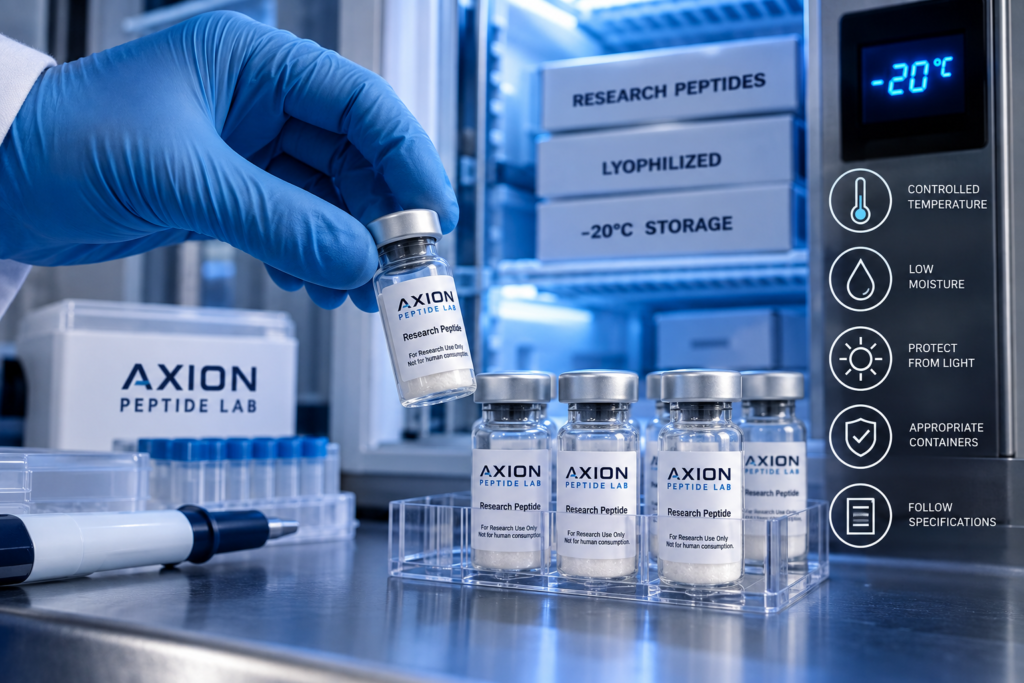
A research peptide supplier provides peptide materials intended for scientific investigation rather than approved medical treatment.
Peptides are compounds made from amino acid residues connected through peptide bonds. Their molecular characteristics depend on amino acid sequence, chemical modifications, stereochemistry and formulation.
Research materials may be used in analytical chemistry, molecular biology, receptor pharmacology, peptide stability investigations and other controlled scientific applications.
A supplier’s responsibility is not simply to display a product name. Accurate product identification and appropriate supporting information help laboratories determine whether a material is suitable for their intended work. research peptide supplier
Research materials are not pharmaceutical products
Research-use-only materials must not be confused with medicines manufactured and authorised for clinical administration. research peptide supplier
A product labelled for laboratory research is not automatically manufactured under pharmaceutical good manufacturing practice, tested for sterility or approved by a medicines regulator.
The distinction remains important even when the compound shares a name with an investigational or approved pharmaceutical ingredient. research peptide supplier
Researchers should assess the actual material and its documented characteristics.
Why Research Peptide Supplier Quality Matters
Laboratory results depend partly on the materials used to generate them.
If the identity or composition of a peptide is uncertain, interpreting an experimental outcome becomes more difficult.
A difference between expected and actual material characteristics may influence analytical measurements, receptor assays or stability observations. research peptide supplier
Reproducibility
Reproducibility concerns whether experimental findings can be obtained consistently under comparable conditions.
Material identity and batch characteristics are among the variables that laboratories may need to control.
Traceability
Traceability connects a physical research material to its supplier records, batch identifier and analytical documentation. research peptide supplier
This allows researchers to identify which material was used in a particular experiment.
Analytical suitability
A peptide may be appropriate for one scientific application but unsuitable for another.
For example, a preliminary screening experiment may have different material requirements from a quantitative reference-standard study.
Procurement confidence
Clear product specifications help purchasing teams compare materials using relevant evidence rather than relying exclusively on marketing descriptions. research peptide supplier
These factors explain why the selection of a research peptide supplier should begin with scientific requirements.
Seven Characteristics of a Research Peptide Supplier
A useful supplier evaluation considers several independent factors.
1. Accurate product identification
The supplier should identify the compound being offered.
Where relevant, useful information may include the chemical name, molecular sequence, molecular mass and structural modifications. research peptide supplier
Similar commercial names do not necessarily indicate equivalent compounds.
2. Clear product specifications
Specifications should distinguish nominal quantity, physical form and other relevant characteristics.
For peptide blends, the individual components and their respective amounts should be identified.
3. Appropriate analytical documentation
Analytical records can help researchers evaluate identity, purity and content.
The appropriate tests depend on the material and intended scientific application.
4. Batch traceability
Batch identification supports recordkeeping and helps connect a supplied product to its associated documentation.
5. Product-specific storage information
Peptides vary in their sensitivity to environmental conditions.
Handling requirements should reflect the actual material and formulation.
6. Transparent purchasing information
Researchers benefit from accurate product listings, current prices, delivery information and clear customer support channels. research peptide supplier
7. Responsible research-use policies
A supplier should distinguish laboratory research materials from medicines intended for human or veterinary use.
No single characteristic establishes overall supplier quality. The most useful evaluation considers them together.
Research Peptide Identity: Why the Exact Molecule Matters
Peptide identity is one of the most important considerations in laboratory procurement.
Two compounds may share a research category while differing in amino acid sequence or chemical modification.
Those differences can influence molecular mass, stability, chromatographic behaviour and biological interactions.
Amino acid sequence
The order of amino acid residues determines the peptide’s primary structure.
A substitution, deletion or addition can change the molecular identity.
Structural modifications
Synthetic peptides may contain modifications designed to influence chemical or biological properties.
These can include terminal modifications, side-chain changes or other structural features.
Stereochemistry
The spatial arrangement of amino acid residues may affect peptide behaviour.
Certain structural differences are not adequately characterized through a simple molecular-mass result alone.
Commercial naming
Product names can be convenient for purchasing but may not fully describe the compound.
A laboratory should not assume that a brand name or common abbreviation provides sufficient chemical identification.
For research involving peptide analogues, this distinction becomes particularly important.
Research Peptide Purity: Understanding the 99% Claim
Purity is frequently highlighted in research peptide marketing.
However, a purity percentage has limited meaning unless the analytical method and measurement basis are understood. research peptide supplier
What is chromatographic purity?
High-performance liquid chromatography can separate a sample into detectable components.
A chromatographic purity result may describe the relative area of the principal peak compared with other peaks under the analytical conditions. research peptide supplier
This is not necessarily the same as the fraction of the sample’s total mass represented by the intended peptide.
Why purity and content are different
A sample may contain water, counterions or other constituents that influence its total mass.
Consequently, high chromatographic purity does not automatically establish the exact peptide quantity present.
A quantitative content assay addresses a different question.
Does 99% purity mean the peptide is authentic?
Not by itself.
A chromatogram may show a dominant peak without independently confirming the compound’s molecular identity.
Additional analytical evidence may be required.
What should researchers ask?
When reviewing a purity claim, consider which analytical method was used, what the percentage represents and whether the result corresponds to the supplied batch. research peptide supplier
A clearly explained analytical result is more informative than an unsupported percentage.
HPLC Testing for Research Peptides
High-performance liquid chromatography is widely used in peptide characterization.
It separates compounds according to their interactions with the chromatographic system.
Different methods may be appropriate for different peptides and impurities.
What HPLC can show
An HPLC chromatogram can provide information about the detectable components in a sample.
It may help distinguish the principal compound from certain synthesis-related impurities or degradation products.
What HPLC cannot establish alone
A chromatogram does not necessarily prove complete molecular identity.
It may also fail to distinguish compounds that co-elute under the selected conditions.
Certain sample constituents may not be adequately detected by the chosen detector.
Method suitability
An analytical procedure should be appropriate for its intended purpose.
The ICH Q2(R2) framework discusses characteristics such as specificity, accuracy, precision and analytical range.
For a research laboratory, the relevant level of method qualification depends on the intended scientific use.
Comparing HPLC reports
Two purity percentages obtained using different methods may not be directly comparable.
Differences in separation conditions, detection and calculation can influence the reported result.
Laboratories should therefore consider the supporting analytical information rather than compare percentages in isolation. research peptide supplier
LC-MS and Research Peptide Identity Testing
Liquid chromatography–mass spectrometry combines chromatographic separation with mass-spectrometric detection.
It can provide molecular-mass-related evidence supporting peptide characterization.
Molecular mass
A measured mass can help determine whether a compound is consistent with an expected molecular structure.
However, mass alone may not establish the complete amino acid sequence or distinguish every structural variant.
Additional structural evidence
Depending on the peptide, laboratories may use complementary methods such as tandem mass spectrometry, peptide mapping or amino acid analysis. research peptide supplier
Orthogonal testing
Orthogonal methods provide different kinds of analytical information.
For example, chromatographic retention behaviour and molecular-mass measurements address related but distinct questions.
European regulatory guidance for synthetic peptide medicines discusses the value of complementary identification methods. Those pharmaceutical requirements do not automatically apply to every research-only material, but the underlying analytical principles can inform laboratory evaluation.
Certificates of Analysis: What Should a Research Peptide Supplier Provide?
A Certificate of Analysis, or COA, is a document reporting selected test results associated with a material.
The value of a COA depends on its contents, the testing performed and its relationship to the actual product supplied. research peptide supplier
Common COA information
| COA field | Why it matters |
|---|---|
| Compound name | Identifies the declared material |
| Batch number | Supports traceability |
| Test date | Records when analysis occurred |
| Analytical method | Explains how the result was obtained |
| Identity evidence | Supports chemical characterization |
| Purity result | Describes a specified analytical measurement |
| Quantitative assay | May establish measured peptide content |
| Relevant specifications | Provides criteria for interpreting results |
Not every COA contains all these fields.
A document reporting HPLC purity alone should not be interpreted as evidence of every possible quality characteristic.
Batch-specific COAs
A certificate associated with one batch should not automatically be applied to another.
Laboratories should confirm whether the document corresponds to the material being purchased.
Independent testing
Independent laboratory testing may provide useful supporting evidence.
However, the laboratory name alone does not establish that every possible quality characteristic was tested.
The methods, sample identity and reported findings remain important.
Axion Peptide Lab documentation
Axion publishes information about research-product quality and COA availability.
Researchers should review the documentation available for the specific product and batch rather than assume that every listing includes identical testing. research peptide supplier
Explore Axion Quality & COA Information
Peptide Impurities: What Laboratories Should Understand
Synthetic peptide production can generate different types of impurities.
These may arise during synthesis, purification, processing or storage.
Sequence-related impurities
Some impurities contain amino acid substitutions, deletions or other sequence differences.
Chemical modifications
Unintended chemical changes can produce compounds related to the target peptide.
Degradation products
Peptides may undergo oxidation, hydrolysis, deamidation or other reactions, depending on their molecular structure and environment. research peptide supplier
Residual substances
Manufacturing and purification processes can leave non-peptide constituents.
The appropriate analytical strategy depends on the compound and its intended application.
Why impurity identity matters
Two samples with similar overall purity results may contain different impurities.
Those differences can be relevant to analytical interpretation. research peptide supplier
A useful quality assessment therefore considers the impurity profile where scientifically necessary, rather than relying exclusively on a single purity number.
Research Peptide Storage and Stability
Storage conditions can influence the characteristics of peptide materials.
There is no universal storage recommendation that applies to every synthetic peptide and formulation.
Lyophilised materials
Freeze-dried preparations may have different stability characteristics from solutions.
However, lyophilisation does not guarantee unlimited stability.
Moisture exposure, temperature and packaging can remain relevant.
Liquid preparations
Solution conditions can influence degradation and other chemical changes.
The solvent system, concentration, pH and container may all matter.
Temperature
Storage temperatures should reflect product-specific information and supporting evidence. research peptide supplier
Light exposure
Certain compounds may undergo light-related chemical changes.
Packaging
Container integrity and compatibility can influence material preservation.
Stability documentation
A useful stability statement should be supported by information appropriate to the material.
Laboratories should avoid assuming that storage instructions for one peptide automatically apply to another.
Research Peptide Supplier USA: Laboratory Procurement
Researchers in the United States may need to evaluate product quality alongside applicable regulatory and institutional requirements.
A research-use-only label does not exempt a material from all relevant laws.
Product classification
Different compounds may be subject to different restrictions.
Researchers should establish whether the intended procurement is permitted.
Institutional requirements
Universities, commercial laboratories and other organisations may maintain internal approval procedures for acquiring experimental materials.
Documentation
Procurement records may include the product description, supplier details, batch number and relevant analytical records.
Delivery eligibility
The ability to order a product online does not automatically establish that it can be shipped to every location.
Axion’s current catalogue and purchasing information should be checked for the specific product.
Research Peptide Supplier UK: Quality and Import Considerations
UK laboratories evaluating international research peptide suppliers should distinguish scientific material requirements from legal eligibility.
Material specifications
The compound’s identity, quantity and physical form should be clear.
Analytical evidence
Researchers should assess whether the available testing is suitable for the intended application.
Import considerations
Requirements may vary by compound, intended use and other circumstances.
Institutional procedures
Laboratories may need to document the acquisition and handling of experimental materials.
Shipping arrangements
Delivery eligibility and shipping terms should be confirmed rather than assumed.
Axion can be contacted for product-specific purchasing questions through its published support channels.
Research Peptide Supplier Europe: Country-Specific Requirements
European laboratory procurement can involve additional considerations because requirements vary between jurisdictions.
The European Union does not have a single universal rule that makes every research-labelled peptide freely importable.
Regulatory eligibility
Researchers should determine which requirements apply to the particular compound and intended activity.
Documentation
A laboratory may require specific records for procurement, internal quality systems or customs procedures.
Shipping
Carrier restrictions and destination eligibility can affect whether an order can be fulfilled.
Scientific suitability
Legal availability and analytical suitability are separate questions.
A material may be available for purchase without meeting a laboratory’s scientific requirements.
For international enquiries, researchers can use the Axion contact page.
Comparing Research Peptide Supplier Prices
Price matters, but it should be evaluated alongside product characteristics.
Two products with the same nominal quantity may differ in formulation, analytical documentation and other specifications.
Nominal quantity
The labelled amount provides a starting point for comparison.
Measured content
Where quantitative testing is available, measured content may provide additional information.
Product format
Different presentations may have different manufacturing and packaging costs.
Analytical documentation
Testing scope can vary between suppliers.
Shipping charges
The complete procurement cost may include delivery and other applicable charges.
Batch consistency
For repeated research, consistency across materials can matter more than a small difference in initial price.
The lowest advertised price does not necessarily represent the most suitable laboratory material.
Wholesale Research Peptide Supplier Considerations
Wholesale research peptide purchasing introduces additional procurement questions.
Larger orders may be intended for repeated laboratory studies, inventory planning or commercial research operations.
Batch planning
Researchers may need to know whether multiple units originate from the same batch.
Documentation consistency
Analytical records should be associated with the relevant materials.
Packaging configuration
The number of units and nominal quantity per unit should be clearly understood.
Inventory requirements
Storage capacity and handling procedures may influence procurement decisions.
Commercial terms
Wholesale pricing, minimum quantities and delivery arrangements should be confirmed for the specific enquiry.
Axion accepts research-related wholesale enquiries, but buyers should verify current terms rather than assume a universal discount or minimum order.

Research Peptide Blends vs Individual Compounds
A supplier may offer both individual peptides and multi-component formulations.
These products have different analytical considerations.
Individual compounds
A single-compound preparation may be more straightforward to characterize, depending on its chemical properties.
Multi-component blends
A blend contains more than one declared ingredient.
Each component may require identification and quantitative analysis.
Comparing formulations
A shared commercial name does not guarantee identical composition.
Different products may contain different component quantities or additional ingredients.
Research interpretation
Results from studies of individual peptides do not automatically establish the behaviour of a combined formulation.
Researchers should evaluate the actual composition.
Research Pens, Vials and Other Product Formats
Research materials may be supplied in different containers and preparations.
Axion’s published FAQ identifies vials, premixed preparations, pens and blends among the formats that may appear in its catalogue.
Laboratory vials
Vials can contain different physical preparations, depending on the product.
Premixed research materials
A liquid preparation introduces formulation-specific considerations, including solvent compatibility and stability.
Pen-style products
A pen-shaped container does not establish pharmaceutical approval, sterility or suitability for injection.
Blends
A blend may contain several compounds requiring separate analytical characterization.
The appropriate format depends on the laboratory’s legitimate research objectives.
Research Peptide Supplier Checklist for Laboratories
A structured evaluation can help laboratories compare suppliers consistently.
| Question | What to establish |
|---|---|
| Is the compound clearly identified? | Exact chemical identity |
| Is the quantity specified? | Nominal amount and format |
| Is analytical documentation available? | Relevant tests and results |
| Is the batch traceable? | Lot or batch identification |
| Is purity explained? | Method and measurement basis |
| Is content measured? | Quantitative assay, if needed |
| Are storage conditions clear? | Product-specific instructions |
| Is the destination eligible? | Applicable shipping and import requirements |
| Are prices current? | Product and total order cost |
| Is support available? | Route for specification enquiries |
A supplier should be evaluated against the laboratory’s requirements rather than a generic checklist alone.
Common Mistakes When Choosing a Research Peptide Supplier
Choosing solely by advertised purity
A high percentage without supporting context may not answer the laboratory’s most important analytical questions.
Assuming every COA is equivalent
Certificates can differ substantially in testing scope and detail.
Confusing purity with content
These are distinct measurements and may require different analytical methods.
Ignoring molecular modifications
A modified peptide may not be equivalent to an unmodified version.
Assuming all blends have the same composition
Commercial naming conventions are not standardized scientific specifications.
Overlooking storage requirements
Material characteristics may change under unsuitable environmental conditions.
Treating research products as medicines
Research-use labelling does not establish approval for clinical administration.
Ignoring destination restrictions
Online availability does not guarantee lawful or practical international delivery.
Why Consider Axion Peptide Lab?
Axion Peptide Lab focuses on research peptides and related laboratory materials for scientific applications.
The website provides a product catalogue, purchasing information, quality-related resources and a customer support channel.
Research-focused catalogue
Researchers can explore individual compounds and other laboratory materials through the online shop.
Product information
Listings provide product-specific details that should be reviewed before ordering.
Quality documentation
Axion publishes information about quality standards and available COA documentation.
Multiple product formats
The catalogue may include different presentations, including vials, blends and research pens.
Research-only positioning
Axion identifies its materials as intended for laboratory, analytical and scientific use rather than human or veterinary administration.
Support for enquiries
Researchers can request clarification about product specifications and purchasing arrangements.
Browse Axion Research Products
Review Quality & COA Information
Frequently Asked Questions About Research Peptide Suppliers
What is a research peptide supplier?
A research peptide supplier provides peptide materials intended for scientific, analytical and laboratory applications.
How do I compare research peptide suppliers?
Compare chemical identity, product specifications, analytical documentation, batch traceability, storage requirements and purchasing terms.
What does 99% peptide purity mean?
The meaning depends on the analytical method. A chromatographic purity result is not necessarily equivalent to the peptide’s percentage by total sample mass.
Is HPLC enough to confirm peptide identity?
Not always. Complementary techniques may be required to establish molecular identity.
What is LC-MS testing?
LC-MS combines chromatographic separation with mass-spectrometric detection and can support molecular characterization.
Should research peptides have a COA?
A COA can provide useful evidence about selected analytical characteristics. Its relevance depends on the tests reported and the laboratory’s requirements.
Does a COA guarantee sterility?
No. Sterility requires appropriate separate evidence.
Are research peptides legal in the USA?
Legal requirements depend on the compound, intended activity and applicable regulations. A research-use-only label does not provide a universal exemption.
Can UK laboratories order research peptides internationally?
Eligibility depends on the compound and relevant import requirements.
Can European laboratories purchase research peptides?
Requirements vary by country, compound and intended use.
Are wholesale research peptides available?
Some suppliers support wholesale enquiries. Quantities, documentation and commercial terms should be confirmed individually.
What is the difference between peptide purity and peptide content?
Purity describes a measured compositional characteristic, while content concerns the actual amount of the target compound present.
Are peptide blends tested differently?
Multi-component formulations may require analytical methods capable of identifying and measuring individual components.
Does a research pen mean a product is approved for injection?
No. A pen-style presentation does not establish pharmaceutical approval or suitability for administration.
What should a laboratory confirm before ordering?
Confirm the exact material, intended application, relevant documentation, storage requirements and procurement eligibility.
Choosing a Research Peptide Supplier for Reliable Laboratory Work
Selecting a research peptide supplier requires careful attention to the characteristics of the material and the needs of the scientific project.
Chemical identity, purity, quantitative content, impurity profiles and batch traceability answer different questions. None should automatically substitute for the others.
The strongest procurement decisions are based on relevant product specifications, appropriate analytical evidence and transparent purchasing information.
Axion Peptide Lab provides research-focused product listings and resources to help laboratories evaluate available materials.
Researchers can explore the current catalogue, review quality-related information and contact Axion for product-specific enquiries.
Explore the Axion Peptide Lab Shop
Read Quality & COA Information
Scientific and Regulatory References
- International Council for Harmonisation. ICH Q2(R2): Validation of Analytical Procedures. https://www.ich.org/page/quality-guidelines
- International Council for Harmonisation. ICH Q14: Analytical Procedure Development. https://www.ich.org/page/quality-guidelines
- European Medicines Agency. Guideline on the Development and Manufacture of Synthetic Peptides. https://www.ema.europa.eu/en/documents/scientific-guideline/guideline-development-manufacture-synthetic-peptides_en.pdf
- US Food and Drug Administration. Q2(R2) Validation of Analytical Procedures. https://www.fda.gov/regulatory-information/search-fda-guidance-documents/q2r2-validation-analytical-procedures
- US Food and Drug Administration. Q14 Analytical Procedure Development. https://www.fda.gov/regulatory-information/search-fda-guidance-documents/q14-analytical-procedure-development
- Axion Peptide Lab. Frequently Asked Questions. https://axionpeptidelab.com/faqs/
Research-use disclaimer: All research materials discussed are intended exclusively for legitimate laboratory, analytical and scientific applications where permitted. They are not approved for human or veterinary consumption, injection, diagnosis, treatment or self-experimentation. Product specifications, analytical documentation and destination eligibility should be verified before purchasing.