Research Peptides: Laboratory Quality, Testing and Scientific Standards
Research peptides are an important class of molecular materials used in biochemical investigation, analytical chemistry, receptor pharmacology and other areas of laboratory science. Their applications range from examining interactions between amino acid sequences and cellular receptors to developing analytical methods capable of identifying closely related compounds.
Although peptides share a common chemical foundation, individual research materials can differ considerably in molecular structure, purity, formulation and stability. These differences influence how a laboratory selects, characterises and documents a peptide for scientific work.
Understanding research peptides therefore requires more than knowing a compound’s name or nominal quantity. Researchers must also consider chemical identity, the reliability of analytical methods, impurity profiles, quantitative content and the conditions under which the material is handled.
Axion Peptide Lab maintains a catalogue of synthetic peptides and related research compounds intended for legitimate laboratory and analytical applications.
This guide explains the scientific foundations of research peptides, how their quality is evaluated and which laboratory standards are relevant to responsible experimental work.
What Are Research Peptides?
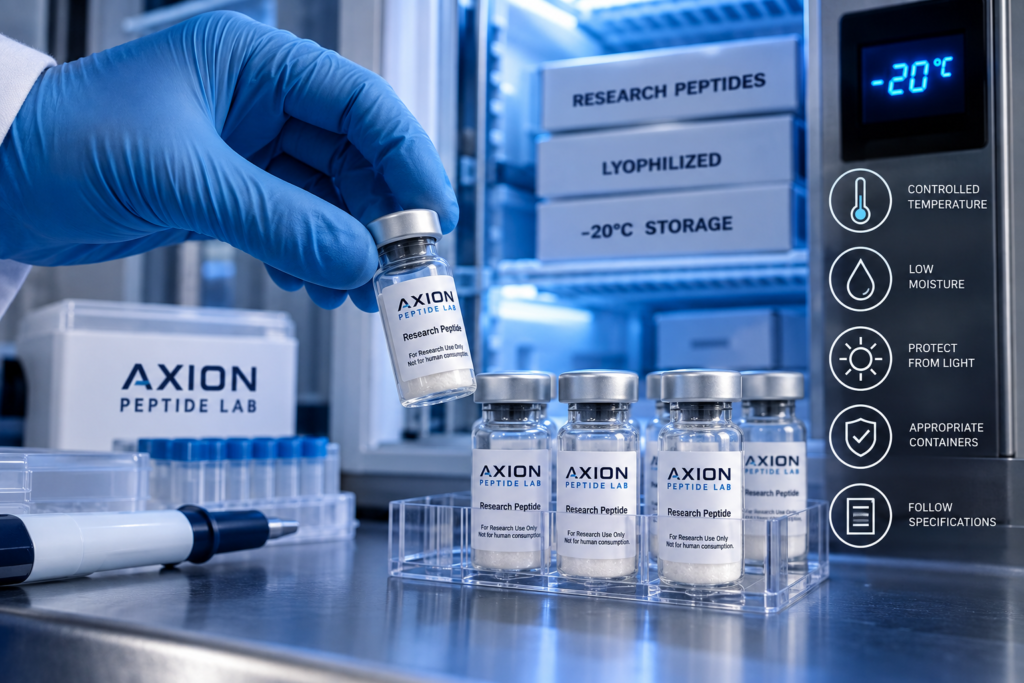
Research peptides are molecules composed of amino acid residues linked by peptide bonds and investigated for scientific purposes.
Amino acids are the molecular building blocks of peptides. The order in which they are connected determines the peptide’s primary structure.
However, the properties of a peptide are not determined by sequence alone.
Chemical modifications, stereochemistry, molecular conformation and environmental conditions can influence how the molecule behaves.
Some peptides occur naturally in biological systems. Others are synthesised or modified to investigate particular molecular characteristics.
The term research peptide describes the intended scientific context rather than a universal level of purity, manufacturing quality or regulatory approval.
Research peptide characteristics
| Characteristic | Scientific relevance |
|---|---|
| Amino acid sequence | Defines the primary molecular structure |
| Molecular mass | Supports chemical identification |
| Structural modifications | May influence stability and molecular interactions |
| Purity | Describes a defined analytical characteristic |
| Peptide content | Measures the quantity of target material |
| Physical form | Influences handling and stability considerations |
| Batch identity | Supports experimental traceability |
| Storage conditions | May affect material integrity |
These characteristics should be evaluated according to the requirements of the intended experiment.
How Research Peptides Differ from Proteins
Peptides and proteins are both constructed from amino acids.
The distinction is not defined by a single universally accepted number of residues.
Many synthetic research peptides are relatively short molecular sequences, whereas proteins often have more complex folded structures and biological functions.
Nevertheless, peptide length alone does not establish whether a molecule will adopt a particular conformation or exhibit a particular biological activity.
Primary structure
Primary structure describes the amino acid sequence.
Even a small sequence change can affect chemical identity.
Secondary structure
Some peptides adopt local structural arrangements such as helices or turns.
These arrangements may depend on solvent conditions and molecular interactions.
Higher-order structure
Longer peptides and proteins may form more complex three-dimensional structures.
The relationship between structure and function is an important subject in molecular research.
Why the distinction matters
Analytical methods suitable for a short synthetic peptide may not be sufficient for a complex protein.
Researchers should choose characterization methods based on the actual molecule rather than its broad classification.
How Are Research Peptides Synthesised?
Synthetic peptide production frequently uses solid-phase peptide synthesis, commonly abbreviated SPPS.
This approach allows amino acid residues to be assembled in a controlled sequence.
The process is widely used in peptide chemistry because it supports the production of defined molecular structures.
Amino acid assembly
Protected amino acid building blocks are introduced sequentially during synthesis.
The chemistry is designed to create the intended peptide bonds while limiting unwanted reactions.
Protective groups
Protective groups temporarily prevent selected functional groups from participating in unintended reactions.
Their removal is part of the synthesis process.
Cleavage and processing
After assembly, the peptide is separated from the synthesis support and processed according to the chemistry used.
Purification
Purification methods are selected to reduce unwanted synthesis-related substances.
Analytical characterization
The resulting material may be examined using chromatographic, mass-spectrometric or other techniques.
A successful synthesis process does not eliminate the need for analytical verification.
Why Peptide Synthesis Can Produce Impurities
Synthetic peptides can contain related substances arising from incomplete reactions, unintended modifications or degradation.
The impurity profile depends on the molecular structure and manufacturing process.
Deletion sequences
A deletion sequence lacks one or more intended amino acid residues.
Insertion-related impurities
Unintended additions can produce molecules that differ from the target sequence.
Incomplete deprotection
Residual protecting groups may alter the chemical characteristics of the product.
Oxidation
Certain amino acid residues can undergo oxidation under suitable conditions.
Deamidation
Some peptide structures are susceptible to deamidation reactions.
Other process-related substances
Residual reagents, counterions, water and solvents may also be relevant to material characterization.
The presence and significance of these substances should be assessed using appropriate analytical evidence.
A general purity percentage cannot describe the complete impurity profile of every peptide.
Major Categories of Research Peptides
Research peptides can be grouped according to their scientific characteristics or intended experimental applications.
These categories often overlap.
Receptor-active peptides
Some peptides interact with cell-surface receptors.
Researchers may investigate ligand binding, receptor activation, signalling selectivity and downstream cellular responses.
Examples of scientific interest include incretin receptor agonists and other synthetic receptor ligands.
Signalling-related peptides
Certain peptides are studied for their involvement in intracellular or extracellular signalling pathways.
Their effects depend on molecular identity and the experimental system.
Structural and matrix-associated peptides
Some peptide research concerns extracellular matrix biology, protein interactions or cellular organisation.
GHK-Cu is one example of a copper-binding peptide complex investigated in biochemical and cell-based research.
Modified peptide analogues
Chemical modifications may alter molecular stability, receptor interactions or other characteristics.
An analogue should not automatically be treated as equivalent to its parent compound.
Multi-component peptide blends
A blend contains two or more declared peptide components.
Its analytical evaluation may require separate identification and measurement of each ingredient.
Peptide reference materials
Some laboratories use well-characterised peptides for analytical method development or instrument evaluation.
Suitability as a quantitative reference standard requires appropriate characterization and documentation; a routine research product is not automatically a certified reference material.
Research Peptides in Receptor Pharmacology
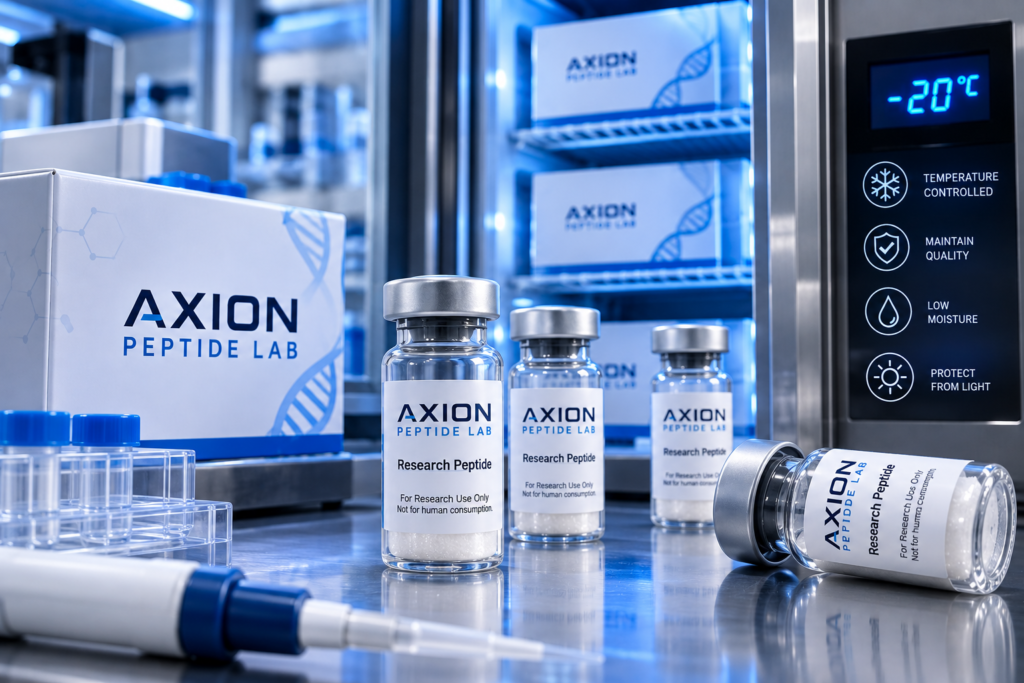
Receptor pharmacology is an important field in peptide research.
Many naturally occurring signalling molecules are peptides, and synthetic analogues can help researchers investigate receptor interactions.
Ligand binding
A ligand is a molecule that interacts with a molecular target, such as a receptor.
Binding studies can provide information about the interaction between a peptide and its target.
Receptor activation
An agonist activates a receptor and initiates downstream signalling.
However, receptor activation is not a single uniform event.
Different cellular systems can produce different responses.
Receptor selectivity
Selectivity describes how a compound interacts with different molecular targets.
A peptide may exhibit activity at more than one receptor.
Biased signalling
Some receptor ligands can favour particular downstream signalling pathways.
This phenomenon is studied in G protein-coupled receptor pharmacology.
Experimental limitations
Cell-based findings do not automatically predict results in an entire organism.
Assay conditions, receptor expression and other experimental variables affect interpretation.
Retatrutide as an Example of Modern Peptide Research
Retatrutide illustrates how synthetic peptide design can be used to investigate multiple receptor systems.
The investigational molecule activates GIP, GLP-1 and glucagon receptors.
This triple-receptor profile distinguishes it from dual GIP/GLP-1 agonists and single GLP-1 receptor agonists.
Retatrutide has been studied in clinical research involving metabolic outcomes, but clinical evidence for the investigational molecule must not be applied automatically to independently supplied research products.
For a detailed examination of its receptor mechanisms, analytical characterization and clinical literature, read Axion’s Retatrutide Research: Triple-Receptor Agonist Science guide once published.
The example demonstrates why precise chemical identification is essential when studying modified synthetic peptides.
What Does Research Peptide Purity Mean?
Purity describes a specified analytical characteristic of a sample.
It is not a universal measurement that can be interpreted without knowing the method used.
A supplier may report a chromatographic purity percentage, but that percentage does not necessarily establish total peptide content or the absence of all impurities.
Chromatographic purity
Chromatographic purity is often calculated from detector responses associated with separated sample components.
Chemical identity
Chemical identity concerns whether the material is the intended compound.
Quantitative content
Content refers to the measured quantity of the target compound.
Impurity profile
The impurity profile concerns the identity and quantity of other substances present.
These are distinct analytical questions.
A research material may perform well in one category without satisfying every possible requirement.
Research Peptides and the Meaning of 99% Purity
The phrase 99% purity is common in research-peptide marketing.
Its scientific meaning depends on the underlying analytical evidence.
For example, an HPLC report may indicate that the principal peak accounts for 99% of the integrated chromatographic area under specified conditions.
That result does not automatically mean 99% of the total sample mass is the intended peptide.
Some substances may not produce an equivalent detector response, while others may not be detected by the selected method.
Water and counterions can also affect total material mass.
Why this matters for laboratory work
A laboratory conducting quantitative experiments may require information about actual peptide content.
A laboratory performing preliminary chromatographic characterization may have different requirements.
The relevant question is not whether a purity number appears impressive, but whether the analytical evidence is suitable for the scientific purpose.
HPLC Testing for Research Peptides
High-performance liquid chromatography is one of the most widely used analytical techniques in peptide research.
It separates sample components according to their interactions with a stationary phase and mobile phase.
Reversed-phase HPLC
Reversed-phase chromatography is frequently used in peptide analysis.
Separation is influenced by interactions between the peptide and chromatographic system.
Retention behaviour
A compound’s retention time can provide useful information under defined analytical conditions.
However, matching retention times alone may not establish molecular identity.
Peak integration
Chromatographic software can calculate peak areas.
The interpretation of these areas depends on the method and detector.
Co-eluting impurities
Two substances may not be adequately separated by a particular method.
A single apparent peak can therefore contain more than one component.
Method development
Researchers may evaluate selectivity, repeatability, detection capability and other characteristics when developing an HPLC procedure.
The method should be appropriate for the intended scientific question.
LC-MS and Mass Spectrometry in Peptide Analysis
Mass spectrometry is another important technique for characterizing research peptides.
It provides information about ions detected according to their mass-to-charge ratios.
When combined with liquid chromatography, it can support both separation and molecular characterization.
Molecular-mass confirmation
A mass-spectrometric result can help determine whether a material is consistent with an expected molecular mass.
Charge states
Peptides can produce ions carrying different charges.
Correct interpretation requires consideration of these charge states.
Adduct formation
Detected ions may include adducts associated with other chemical species.
Tandem mass spectrometry
Tandem mass spectrometry can provide additional structural information in suitable applications.
Analytical limitations
A molecular-mass match does not necessarily prove complete structural identity.
Certain sequence variants or stereochemical differences may require additional evidence.
For this reason, laboratories often consider complementary analytical techniques.
Why Orthogonal Analytical Testing Matters
Orthogonal testing involves using methods that provide different types of information about a material.
For research peptides, chromatography and mass spectrometry may offer complementary evidence.
A chromatographic method may reveal several detectable components.
Mass spectrometry may help characterize the molecular masses associated with those components.
Additional methods may be required to answer more specific questions.
Examples of complementary techniques
| Technique | Potential analytical contribution |
|---|---|
| HPLC | Chromatographic composition |
| LC-MS | Molecular-mass-related evidence |
| Tandem MS | Additional structural information |
| Amino acid analysis | Amino acid composition or quantitative information |
| Peptide mapping | Structural characterization |
| Karl Fischer analysis | Water content |
| Suitable counterion analysis | Counterion characterization |
Not every technique is necessary for every material.
The analytical strategy should reflect the intended use and the properties of the peptide.
Certificates of Analysis for Research Peptides
A Certificate of Analysis, commonly abbreviated COA, reports selected analytical findings associated with a material.
A COA can support laboratory evaluation, but its usefulness depends on the actual information provided.
Product identification
The document should clearly identify the declared material.
Batch identification
A batch or lot number helps connect the document to the physical product.
Testing methods
The analytical methods should be described sufficiently to interpret the reported results.
Purity findings
Where reported, the purity result should be understood in the context of the method.
Identity evidence
Molecular identification may require additional analytical results.
Quantitative assay
Some research applications require measured peptide content.
Test date
The date records when the material was analysed.
Important limitation
A COA reporting HPLC purity or molecular mass does not independently establish sterility, endotoxin limits or pharmaceutical suitability.
Those characteristics require separate testing and appropriate evidence.
Axion Peptide Lab provides general information about available product documentation through its Quality & COA page.

Research Peptide Batch Traceability
Batch traceability helps laboratories maintain accurate experimental records.
A batch identifier connects a supplied material with relevant procurement and analytical information.
Why batch records matter
Research projects may involve repeated experiments over extended periods.
If materials originate from different batches, researchers may need to consider whether relevant characteristics differ.
Suggested laboratory records
Useful records can include:
- Compound name and declared identity.
- Supplier and product identifier.
- Batch or lot number.
- Date received.
- Available analytical documentation.
- Applicable storage instructions.
- Material usage records.
Comparing different batches
Identical product labels do not prove that two batches have identical measured characteristics.
Where batch consistency is important, laboratories should determine which analytical comparisons are necessary.
Research Peptide Stability: Chemical and Physical Considerations
Peptide stability is influenced by molecular structure and environmental conditions.
A peptide may undergo chemical degradation or physical changes depending on its formulation.
Temperature
Higher temperatures can accelerate some degradation reactions.
However, the relationship between temperature and stability is compound-specific.
Moisture
Water can influence chemical reactions and the characteristics of certain dry preparations.
Light
Some peptide materials may be susceptible to light-related changes.
Oxygen
Oxidation can be relevant to susceptible amino acid residues.
pH
Solution pH may influence degradation pathways and molecular stability.
Container compatibility
Interactions between a formulation and its packaging can affect material integrity.
Researchers should rely on verified product-specific storage information rather than assume that all peptides require identical conditions.
Lyophilised vs Liquid Research Peptides
Research peptides may be supplied in different physical forms.
The choice of format affects handling, storage and analytical considerations.
Lyophilised research peptides
Lyophilisation removes water through a controlled freeze-drying process.
The resulting material may have different stability characteristics from a liquid formulation.
However, lyophilised material can still degrade under unsuitable conditions.
Liquid research peptides
Liquid preparations introduce formulation-specific variables such as solvent composition, pH and concentration.
These factors may influence chemical stability.
Comparing formats
| Characteristic | Lyophilised preparation | Liquid preparation |
|---|---|---|
| Physical form | Dry material | Solution |
| Water exposure | Generally reduced | Solvent-dependent |
| Stability considerations | Moisture, temperature, packaging | pH, solvent, temperature, packaging |
| Analytical evaluation | Product-specific | Product-specific |
| Storage requirements | Must be verified | Must be verified |
Neither format is automatically superior for every research application.
Peptide Blends and Multi-Component Research Materials
Some research products combine multiple peptides.
These formulations introduce additional analytical considerations.
Component identity
Each declared ingredient should be identified where required by the research application.
Component quantity
The total nominal mass of a blend does not establish the measured quantity of every ingredient.
Chromatographic separation
An analytical method may need to distinguish several compounds and their impurities.
Stability
Different components may have different degradation characteristics.
Research interpretation
Results obtained using an individual peptide cannot automatically establish the properties of a combined formulation.
For example, a blend containing GHK-Cu, BPC-157 and TB-500 should be evaluated according to its actual composition and analytical documentation.
Research Peptides vs Pharmaceutical Medicines
Research materials and approved medicines serve different purposes.
A compound can be investigated scientifically without being approved for clinical use.
Research-use-only materials
These are supplied for legitimate scientific or analytical work where permitted.
Investigational medicines
Investigational medicinal products are studied within regulated clinical development programmes.
Approved medicines
Approved medicines are subject to the applicable regulatory authorization and manufacturing requirements for their intended use.
Why the distinction matters
A research peptide sharing the name of a clinical-trial compound is not automatically equivalent to the investigational medicine used in that trial.
Differences in manufacturing, formulation, impurities and quality controls may be relevant.
A research-use-only label does not establish pharmaceutical-grade manufacturing or authorization for administration.
Research Peptides and Regulatory Compliance in the USA
The legal status of a research peptide depends on the particular compound and intended activity.
In the United States, the Food and Drug Administration regulates medicines and other products according to applicable law.
A research-use-only statement does not automatically exempt a product from regulatory requirements.
Laboratories should consider the relevant legal classification of a material, institutional policies and applicable procurement restrictions.
Scientific research should be conducted within the appropriate legal and ethical framework.
Research Peptides in the United Kingdom
UK research laboratories should distinguish legitimate scientific materials from medicines intended for clinical use.
Relevant considerations may include substance-specific restrictions, import requirements and institutional research policies.
The fact that a product is described as a peptide does not establish its legal classification.
Similarly, a product being available on an international website does not guarantee eligibility for importation into the UK.
Researchers should verify applicable requirements for the actual material and intended purpose.
Research Peptides in Europe
European research procurement can involve national and European Union requirements.
These may differ according to the compound, destination and intended activity.
Laboratories should determine whether a material can be lawfully acquired and used for the proposed work.
Research-only labelling does not replace compliance with relevant legislation.
Laboratory Documentation and Experimental Reproducibility
Good scientific recordkeeping helps researchers interpret and reproduce their work.
Material documentation is one part of this process.
Identify the exact material
Record the chemical identity and any relevant modifications.
Record batch information
Batch numbers help distinguish materials acquired at different times.
Preserve analytical records
Relevant COAs and other documentation should be retained according to institutional procedures.
Document storage conditions
Material history may be relevant when evaluating stability-sensitive compounds.
Record experimental variables
Research outcomes can depend on assay design, controls, instrumentation and environmental conditions.
Material quality alone does not guarantee experimental reproducibility, but inadequate material characterization can introduce avoidable uncertainty.
Research Peptides at Axion Peptide Lab
Axion Peptide Lab provides an online catalogue of research peptides and related compounds for laboratory and analytical applications.
Researchers can explore individual peptide products, selected blends and other research materials through the Axion Peptide Lab shop.
Product-specific details should be reviewed before acquisition.
Research product selection
The appropriate material depends on the scientific objective and the analytical characteristics required.
Quality documentation
Axion publishes information about its approach to product quality and available documentation.
Testing and COA availability should be confirmed for the relevant product and batch.
Product formats
Different products may be offered in different preparations.
The physical format should be evaluated alongside the compound’s identity and stability requirements.
Research enquiries
Laboratories requiring clarification about specifications or documentation can contact Axion Peptide Lab.
Common Misunderstandings About Research Peptides
All research peptides have the same quality
Research peptides vary in molecular identity, composition, analytical characterization and handling requirements.
A high purity percentage proves everything
A purity result does not independently establish identity, quantitative content or every possible impurity.
All COAs provide the same evidence
Certificates differ in analytical methods, measurements and reporting detail.
A research label makes every compound legal
Applicable laws depend on the material and intended activity.
A laboratory vial is automatically sterile
Container design does not establish sterility.
A peptide with published clinical studies is approved for use
Scientific research and regulatory authorization are separate matters.
Frequently Asked Questions About Research Peptides
What are research peptides?
Research peptides are peptide molecules investigated for scientific, biochemical or analytical purposes.
How are research peptides made?
Many synthetic research peptides are produced using chemical synthesis techniques, including solid-phase peptide synthesis.
What is peptide purity?
Purity is a measured characteristic that must be interpreted according to the analytical method used.
What is the difference between purity and content?
Purity describes a specified compositional characteristic, while content concerns the measured amount of the target compound.
What is HPLC peptide testing?
HPLC is a chromatographic technique used to separate and evaluate detectable sample components.
What is LC-MS peptide testing?
LC-MS combines chromatography with mass spectrometry to provide complementary analytical information.
What is a peptide COA?
A Certificate of Analysis reports selected test results associated with a material or batch.
Are all research peptides lyophilised?
No. Research materials may be supplied in different physical preparations.
Can peptide stability vary?
Yes. Stability depends on molecular structure, formulation and environmental conditions.
Are research peptides approved medicines?
Research-use-only materials should not be treated as approved medicines.
Are research peptides legal internationally?
Requirements depend on the specific compound, destination and intended activity.
Can laboratories compare peptide batches?
Yes, where appropriate analytical methods and relevant documentation are available.
Are peptide blends different from individual compounds?
Yes. Blends contain multiple components and may require additional analytical characterization.
Where can researchers explore peptide materials?
Researchers can browse the Axion Peptide Lab research catalogue.
Conclusion: Understanding Research Peptides Through Scientific Evidence
Research peptides provide valuable opportunities to investigate molecular structures, receptor interactions, chemical stability and analytical methods.
However, meaningful scientific work requires accurate material identification and an understanding of the limitations of available quality measurements.
Purity, content, molecular identity and batch traceability are separate considerations. A single marketing claim cannot replace a complete evaluation of the material’s suitability for a specific experiment.
Laboratories should also distinguish research-use-only materials from approved medicines and ensure that their work complies with applicable requirements.
Axion Peptide Lab provides a catalogue of research peptides and related laboratory materials, together with product information and quality-related resources.
Explore Research Peptides at Axion Peptide Lab
Review Quality & COA Information
Scientific and Regulatory References
- Merrifield RB. Solid Phase Peptide Synthesis. I. The Synthesis of a Tetrapeptide. Journal of the American Chemical Society, 1963. https://doi.org/10.1021/ja00897a025
- Steen H, Mann M. The ABC’s (and XYZ’s) of Peptide Sequencing. Nature Reviews Molecular Cell Biology, 2004. https://doi.org/10.1038/nrm1468
- International Council for Harmonisation. ICH Q2(R2): Validation of Analytical Procedures. https://www.ich.org/page/quality-guidelines
- International Council for Harmonisation. ICH Q14: Analytical Procedure Development. https://www.ich.org/page/quality-guidelines
- European Medicines Agency. Guideline on the Development and Manufacture of Synthetic Peptides. https://www.ema.europa.eu/
- US Food and Drug Administration. Research Use Only and Investigational Use Only In Vitro Diagnostic Products. https://www.fda.gov/
Research-use disclaimer: Research peptides and related compounds discussed in this article are intended exclusively for legitimate laboratory, analytical and scientific investigation where permitted. They are not intended for human or veterinary consumption, injection, diagnosis, treatment or self-experimentation. Product specifications, analytical documentation and legal eligibility should be verified before procurement.