
Retatrutide Triple Receptor Agonist: 7 Powerful Scientific Insights
Retatrutide triple receptor agonist research examines how one engineered peptide can activate three distinct metabolic hormone receptors: the glucose-dependent insulinotropic polypeptide receptor (GIPR), the glucagon-like peptide-1 receptor (GLP-1R), and the glucagon receptor (GCGR). retatrutide triple receptor agonist
Known by its development identifier LY3437943, retatrutide has attracted scientific attention because its receptor profile differs from compounds that activate only GLP-1R or the combination of GIPR and GLP-1R. retatrutide triple receptor agonist
The three receptors belong to the class B family of G protein-coupled receptors (GPCRs). They participate in metabolic signalling, but their functions are not interchangeable. GIP and GLP-1 are associated with incretin signalling, while glucagon plays a central role in hepatic glucose metabolism and other energy-related processes.
By combining agonist activity at all three receptors, retatrutide provides a way to examine how several hormonal signalling systems interact within a single pharmacological profile.
Research has progressed from receptor-level investigations to controlled clinical trials, including phase 2 findings published in 2023 and phase 3 results published in 2026. retatrutide triple receptor agonist
Those clinical studies concern a specific pharmaceutical-development compound used under controlled research conditions. They do not establish the identity, purity, clinical equivalence or suitability for administration of independently supplied laboratory research materials. retatrutide triple receptor agonist
This guide examines seven important aspects of retatrutide’s molecular pharmacology, published evidence and laboratory analytical considerations. retatrutide triple receptor agonist
1. What Is a Retatrutide Triple Receptor Agonist?
A retatrutide triple receptor agonist is a synthetic peptide designed to activate three hormone receptor systems rather than one.
An agonist is a molecule that binds to a receptor and promotes a signalling response.
The term triple receptor agonist describes the number of receptor targets, not three separate ingredients combined in a formulation. retatrutide triple receptor agonist
Retatrutide is a single engineered peptide with activity at three receptor types.
The Three Receptor Targets
| Receptor | Full name | Principal scientific relevance |
|---|---|---|
| GIPR | Glucose-dependent insulinotropic polypeptide receptor | Incretin signalling and glucose-dependent insulin responses |
| GLP-1R | Glucagon-like peptide-1 receptor | Incretin activity, gastric regulation and appetite-related signalling |
| GCGR | Glucagon receptor | Hepatic glucose metabolism and energy-related pathways |
The receptor profile distinguishes retatrutide from a single GLP-1 receptor agonist.
Why Three Receptors?
The underlying scientific rationale is that GIP, GLP-1 and glucagon participate in different but interconnected aspects of metabolic regulation. retatrutide triple receptor agonist
Combined receptor activation may influence several pathways at once.
However, the effects cannot be predicted simply by adding together three isolated receptor responses. Receptor expression, tissue distribution, signalling duration and physiological feedback all contribute to the observed outcome. retatrutide triple receptor agonist
Is Retatrutide a Natural Hormone?
No. Retatrutide is an engineered peptide.
Although its receptor targets normally respond to endogenous peptide hormones, retatrutide is not identical to GIP, GLP-1 or glucagon.
Its molecular design is intended to produce a particular multi-receptor pharmacological profile.
Retatrutide and LY3437943
LY3437943 is the development identifier associated with retatrutide.
Both names refer to the same investigational pharmaceutical compound in the scientific literature.
This distinction is useful when searching research publications, trial registrations and molecular pharmacology references.
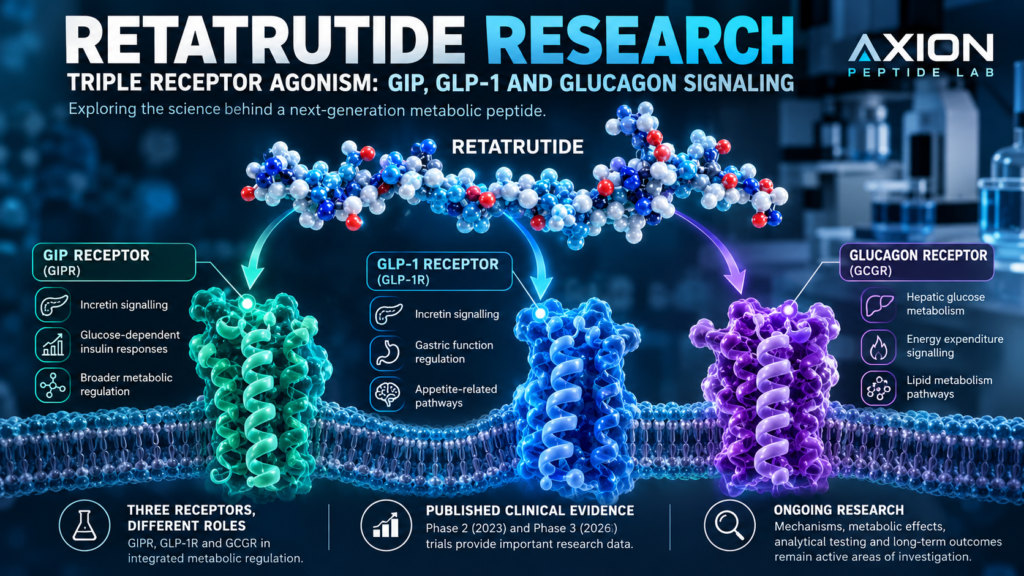
2. Retatrutide Triple Receptor Agonist Mechanism of Action
The retatrutide triple receptor agonist mechanism of action begins with molecular recognition at GIPR, GLP-1R and GCGR.
These receptors have related structural features but differ in their endogenous ligands, expression patterns and physiological roles. retatrutide triple receptor agonist
GIP Receptor Activation
GIP is released from intestinal K cells in response to nutrient exposure.
Its receptor is involved in glucose-dependent insulin secretion, particularly through signalling in pancreatic beta cells.
GIPR activation can influence intracellular cyclic AMP and other downstream signalling processes.
GIP signalling is also studied in tissues beyond the pancreas, although the physiological significance of those actions depends on the specific system.
GLP-1 Receptor Activation
GLP-1 is an endogenous incretin hormone produced by intestinal L cells and certain neuronal populations.
GLP-1R activation is associated with glucose-dependent insulin secretion and regulation of several digestive and appetite-related processes.
The receptor participates in complex neural and peripheral signalling networks.
These effects depend on the tissue, experimental conditions and wider physiological context.
Glucagon Receptor Activation
Glucagon is an endogenous hormone with an important role in hepatic glucose regulation.
GCGR activation can promote pathways associated with glycogen breakdown and glucose production.
Glucagon signalling has also been examined in relation to energy expenditure and lipid metabolism.
These effects are not uniformly beneficial or harmful. They must be interpreted within the integrated metabolic system. retatrutide triple receptor agonist
How the Three Pathways Interact
Retatrutide’s receptor activity involves pathways that can influence one another.
For example, glucagon receptor activity can affect hepatic glucose production, while incretin-associated signalling contributes to glucose-dependent insulin regulation.
The overall response depends on the balance of receptor activity and the organism’s regulatory mechanisms.
Why Receptor Count Alone Is Insufficient
A molecule targeting three receptors is not automatically more effective or safer than one targeting two.
Pharmacological effects depend on potency, efficacy, exposure, tissue-specific receptor expression and the biological outcomes measured.
For related background, see Peptide Receptors and Peptide Signalling Pathways.
3. How Retatrutide Activates Intracellular Signalling
Retatrutide interacts with class B GPCRs, which transmit extracellular information through intracellular signalling proteins.
Although the three receptor targets share some signalling features, they do not necessarily produce identical responses.
Step 1: Ligand Recognition
Retatrutide interacts with a compatible receptor-binding region.
Binding can stabilise receptor conformations associated with activation.
Step 2: G Protein Coupling
Activated receptors can interact with heterotrimeric G proteins. retatrutide triple receptor agonist
Gs-mediated signalling is particularly relevant to the canonical pathways associated with GIPR, GLP-1R and GCGR.
Step 3: Adenylyl Cyclase Regulation
Activated Gs can stimulate adenylyl cyclase.
This enzyme converts ATP into cyclic AMP, commonly abbreviated as cAMP.
Step 4: Intracellular Signal Transmission
cAMP can regulate downstream effectors, including protein kinase A and exchange proteins directly activated by cAMP.
The resulting responses depend on the cellular environment.
Step 5: Tissue-Specific Effects
In pancreatic beta cells, cAMP-associated signalling can contribute to glucose-dependent insulin secretion.
In hepatocytes, glucagon-associated signalling regulates metabolic pathways involved in glucose production.
Other tissues may respond differently.
Step 6: Signal Regulation
Activated receptors and downstream proteins are subject to regulatory mechanisms such as desensitization, internalization, GTP hydrolysis and second-messenger clearance.
Step 7: Cellular Recovery
Signalling components may return toward baseline through multiple mechanisms operating at different rates.
The duration of a receptor response is not necessarily identical to the duration of peptide binding.
Why This Matters for Retatrutide Research
The compound’s activity must be understood as a network of receptor-dependent events. retatrutide triple receptor agonist
A positive result in one receptor assay does not independently establish a corresponding whole-organism effect.
For deeper explanations, see Peptide Signal Transduction and Peptide Receptor Desensitization.

4. Retatrutide Triple Receptor Agonist Clinical Research
Published retatrutide triple receptor agonist clinical research provides information about the compound’s effects under controlled trial conditions.
These studies examine clinical outcomes, not merely receptor activation.
Phase 2 Research Published in 2023
A randomized, double-blind, placebo-controlled phase 2 study evaluated retatrutide in 338 adults with obesity or overweight accompanied by a weight-related condition.
The study assessed changes in body weight over 48 weeks.
Reported least-squares mean changes at week 48 included the following:
| Study group | Reported mean body-weight change |
|---|---|
| Placebo | −2.1% |
| Combined 4 mg trial group | −17.1% |
| Combined 8 mg trial group | −22.8% |
| 12 mg trial group | −24.2% |
These are published clinical-trial group descriptions, not recommended amounts or instructions for administering research materials.
The trial also documented adverse events, including gastrointestinal effects, and reported heart-rate changes during follow-up.
The results supported further investigation but did not resolve every question about long-term safety or comparative effectiveness.
Phase 3 Research Published in 2026
The phase 3 TRIUMPH-1 study evaluated retatrutide in 2,339 adults with obesity without diabetes.
The published study included an 80-week treatment period.
Reported mean body-weight changes included:
| Study group | Reported mean body-weight change |
|---|---|
| Placebo | −3.9% |
| Retatrutide 4 mg trial group | −17.6% |
| Retatrutide 9 mg trial group | −23.7% |
| Retatrutide 12 mg trial group | −25.0% |
The study expanded the clinical evidence available for the pharmaceutical-development compound.
However, interpretation requires attention to eligibility criteria, adverse events, trial duration and the outcomes selected for measurement.
What Clinical Trials Can Establish
Controlled trials can provide evidence concerning specific outcomes in defined populations under the conditions studied.
They can also identify adverse events and generate information about tolerability. retatrutide triple receptor agonist
What Clinical Trials Cannot Automatically Establish
Results from the published trials do not independently establish:
- Long-term outcomes beyond the observation periods.
- Comparative superiority over another medicine without suitable comparative evidence.
- Safety in populations that were not adequately studied.
- Identity or quality of unrelated commercial research materials.
- Suitability of laboratory products for human administration.
Scientific Interpretation
Retatrutide’s clinical research provides an important bridge between receptor pharmacology and whole-organism responses.
Nevertheless, mechanistic hypotheses and measured clinical outcomes should remain clearly distinguished.
5. Retatrutide vs Single and Dual Receptor Agonists
A useful way to understand retatrutide is to compare its receptor profile with other categories of metabolic peptide agonists.
Single Receptor Agonists
Single receptor agonists principally activate one selected receptor type.
GLP-1 receptor agonism is a well-studied example.
Dual Receptor Agonists
Dual receptor agonists are designed to activate two receptor types.
Tirzepatide is an example of combined GIPR and GLP-1R agonism.
Triple Receptor Agonists
Retatrutide activates GIPR, GLP-1R and GCGR.
This adds glucagon receptor activity to the combined incretin receptor profile.
| Characteristic | Single GLP-1R agonist | GIPR/GLP-1R dual agonist | Retatrutide |
|---|---|---|---|
| GLP-1R activity | Yes | Yes | Yes |
| GIPR activity | Not a defining feature | Yes | Yes |
| GCGR activity | Not a defining feature | Not a defining feature | Yes |
| Principal classification | Single receptor agonist | Dual receptor agonist | Triple receptor agonist |
| Mechanistic emphasis | GLP-1R pathways | Combined incretin pathways | Combined incretin and glucagon receptor pathways |
Why Direct Trial Comparisons Matter
Clinical studies can differ in participant characteristics, study duration, endpoints and other important variables.
Comparing headline outcomes across unrelated trials does not reliably establish which compound is more effective.
Receptor Potency and Efficacy
Two compounds may both activate GLP-1R while differing in receptor potency, signalling efficacy or binding kinetics.
A simple receptor-count comparison does not capture those differences.
Research Relevance
The most scientifically useful comparison examines receptor activity, molecular design, signalling characteristics and evidence quality separately.
6. Retatrutide Research Applications and Scientific Limitations
The retatrutide triple receptor agonist mechanism creates several areas of interest for laboratory and translational research.
Multi-Receptor Pharmacology
Retatrutide provides a model for studying how one molecule can activate several related receptors.
Researchers may examine differences in concentration–response relationships and signalling efficacy across GIPR, GLP-1R and GCGR.
Receptor Selectivity
Receptor selectivity concerns the extent to which a compound interacts with particular molecular targets.
Because retatrutide is designed to activate three receptors, its profile cannot be described accurately using the assumptions applied to a highly selective single-receptor agonist.
Metabolic Signalling
The compound is relevant to research involving glucose regulation, incretin pathways and energy-related signalling. retatrutide triple receptor agonist
These topics involve multiple tissues and cannot be reduced to one intracellular pathway.
Receptor Desensitization
Researchers may examine how receptor responsiveness changes following activation.
The three receptor systems may differ in their regulatory behaviour.
Signal Termination
Intracellular responses can decline through G protein deactivation, second-messenger degradation, phosphatase activity and other mechanisms.
These processes help determine signalling duration.
Pharmacokinetics and Molecular Exposure
The time course of exposure can influence how long a compound is available to interact with receptors.
However, receptor occupancy and measured downstream effects do not necessarily follow identical time courses.
Clinical Evidence Gaps
Questions about long-term outcomes, rare adverse events and effects in additional populations require appropriately designed research.
Analytical Research
Independent laboratories may evaluate the identity, composition, impurities and stability of retatrutide research materials.
Such work addresses material characterisation rather than clinical effectiveness.
7. Retatrutide Triple Receptor Agonist Analytical Testing and Quality
Retatrutide triple receptor agonist analytical testing is important because molecular identity and material composition affect the interpretation of laboratory results.
A product label alone cannot establish the identity or quality of a peptide sample.
Molecular Identity
Researchers may use suitable analytical methods to determine whether a sample is consistent with the intended molecular identity.
Mass spectrometry can provide evidence about molecular mass.
Additional techniques may be required to assess structural details.
HPLC Purity Testing
High-performance liquid chromatography separates sample components according to their chromatographic behaviour. retatrutide triple receptor agonist
An HPLC chromatogram can reveal multiple peaks and support evaluation of selected impurities.
However, chromatographic peak-area percentage is not necessarily equivalent to absolute target peptide content. retatrutide triple receptor agonist
LC-MS Characterisation
Liquid chromatography–mass spectrometry combines separation with mass-based detection.
This can support identity assessment and the characterisation of certain impurity species.
Peptide Content
The stated amount of target peptide should be distinguished from total sample mass.
Water, counterions and other constituents may contribute to the total.
Degradation Products
Peptides may undergo chemical or physical changes during storage and handling.
Relevant pathways can include oxidation, hydrolysis, deamidation or aggregation where structurally applicable.
The presence and significance of any particular degradation pathway must be established experimentally.
Batch-Specific Documentation
A Certificate of Analysis may report selected test results for an identified production batch.
Researchers should review the actual methods, results, batch identifiers and limitations rather than relying solely on general quality statements.
Research Material Equivalence
Even if two products are labelled with the same compound name, their formulations, analytical profiles and manufacturing controls may differ.
Clinical results obtained with one formulation cannot automatically be transferred to another.
For further background, see HPLC Peptide Purity Testing, LC-MS Peptide Analysis and Peptide Certificate of Analysis.

Retatrutide Research Products at Axion Peptide Lab
Axion Peptide Lab lists retatrutide-related research materials in several nominal quantities and configurations.
The following product pages are relevant to readers examining the catalogue:
Alluvi Retatrutide 20mg
This listing identifies a nominal 20 mg research product configuration.
Alluvi Retatrutide 40mg
This listing identifies a nominal 40 mg research product configuration.
Alluvi Retatrutide 40mg ×2 Bundle
View Alluvi Retatrutide 40mg ×2 Bundle
This listing identifies a bundle containing two nominal 40 mg research units.
These quantities describe catalogue configurations and are not recommendations for administration.
Important Product Distinction
The clinical studies discussed in this article investigated a pharmaceutical-development compound under controlled research conditions.
They do not verify the molecular identity, analytical purity, pharmaceutical equivalence or suitability for human administration of Axion Peptide Lab research products.
Researchers should review current product specifications and available batch-specific documentation before selecting materials for legitimate laboratory work.
Retatrutide Triple Receptor Agonist: Common Scientific Misunderstandings
Three Receptors Do Not Mean Three Separate Peptides
Retatrutide is one engineered molecule with activity at three receptor targets.
Triple Agonism Does Not Mean Equal Potency
The compound may exhibit different potency and efficacy profiles across its receptor targets.
Receptor Activity Is Not the Same as Clinical Efficacy
An in vitro signalling response cannot independently establish a clinical outcome.
Trial Results Do Not Validate Unrelated Research Materials
Published studies concern the particular material and conditions used in those studies.
Glucagon Receptor Activation Has Complex Effects
GCGR signalling is involved in glucose production and other metabolic processes. Its contribution must be understood in context.
A High HPLC Area Percentage Does Not Establish Absolute Content
Chromatographic purity and peptide content measure different properties.
Research-Use Labelling Is Not Proof of Analytical Quality
Appropriate evidence is needed to support identity, purity and other quality claims.

Frequently Asked Questions About Retatrutide Triple Receptor Agonist Research
1. What is a retatrutide triple receptor agonist?
A retatrutide triple receptor agonist is an engineered peptide that activates GIP, GLP-1 and glucagon receptors. Its development identifier is LY3437943.
2. Which three receptors does retatrutide activate?
Retatrutide activates GIPR, GLP-1R and GCGR.
3. What is the retatrutide triple receptor agonist mechanism of action?
Its mechanism involves receptor binding and activation of intracellular signalling pathways associated with the three metabolic hormone receptors.
4. Is retatrutide the same as GLP-1?
No. GLP-1 is an endogenous hormone, while retatrutide is an engineered peptide with activity at three receptors.
5. How is retatrutide different from tirzepatide?
Retatrutide activates GIPR, GLP-1R and GCGR. Tirzepatide activates GIPR and GLP-1R.
6. Has retatrutide been studied in human clinical trials?
Yes. Published research includes phase 2 and phase 3 clinical trials evaluating the pharmaceutical-development compound.
7. Does triple receptor agonism guarantee better outcomes?
No. Receptor count alone cannot establish comparative effectiveness, safety or suitability for any population.
8. How can laboratories evaluate retatrutide identity?
Appropriate methods may include chromatography, mass spectrometry and additional analytical techniques selected for the required specifications.
9. Does a 20 mg or 40 mg research listing indicate a clinical dose?
No. Those figures describe nominal product quantities, not medical dosing instructions.
10. Are independently supplied retatrutide research products suitable for human use?
Published clinical findings do not establish the safety, pharmaceutical equivalence or suitability for human administration of independently supplied research materials.
Conclusion: Understanding the Retatrutide Triple Receptor Agonist
The retatrutide triple receptor agonist represents an important development in research on multi-receptor peptide pharmacology.
Its molecular profile combines activity at GIPR, GLP-1R and GCGR, connecting three distinct but interacting metabolic hormone signalling systems.
This provides a scientific basis for studying integrated receptor responses rather than examining incretin or glucagon signalling entirely in isolation.
Published clinical trials have expanded the evidence concerning the pharmaceutical-development compound, while receptor-level studies provide mechanistic context.
These forms of evidence should not be treated as interchangeable.
Clinical outcomes do not independently establish the identity or quality of laboratory research materials, and receptor activation does not automatically predict every physiological response.
For researchers, the most useful interpretation combines molecular pharmacology, careful evaluation of published findings, appropriate analytical testing and clear recognition of experimental limitations.
The study of retatrutide continues to illustrate how engineered peptides can interact with multiple receptor systems and why rigorous evidence is essential when translating molecular observations into broader scientific conclusions. retatrutide triple receptor agonist
Scientific References
- Jastreboff AM, Kaplan LM, Frías JP, et al. (2023). Triple–Hormone-Receptor Agonist Retatrutide for Obesity — A Phase 2 Trial. New England Journal of Medicine, 389, 514–526.
https://doi.org/10.1056/NEJMoa2301972 - Jastreboff AM, Kaplan LM, Davies MJ, et al. (2026). Retatrutide, a Triple Hormone Receptor Agonist, for Treatment of Obesity. New England Journal of Medicine.
https://doi.org/10.1056/NEJMoa2604169 - Drucker DJ. (2018). Mechanisms of Action and Therapeutic Application of Glucagon-like Peptide-1. Cell Metabolism, 27, 740–756.
https://doi.org/10.1016/j.cmet.2018.03.001 - Holst JJ. (2007). The Physiology of Glucagon-like Peptide 1. Physiological Reviews, 87, 1409–1439.
https://doi.org/10.1152/physrev.00034.2006 - Campbell JE, Drucker DJ. (2013). Pharmacology, Physiology, and Mechanisms of Incretin Hormone Action. Cell Metabolism, 17, 819–837.
https://doi.org/10.1016/j.cmet.2013.04.008 - Müller TD, Finan B, Clemmensen C, DiMarchi RD, Tschöp MH. (2017). The New Biology and Pharmacology of Glucagon. Physiological Reviews, 97, 721–766.
https://doi.org/10.1152/physrev.00025.2016 - IUPHAR/BPS Guide to Pharmacology. Receptor and ligand pharmacology database.
https://www.guidetopharmacology.org/ - ClinicalTrials.gov. TRIUMPH-1, NCT05929066.
https://clinicaltrials.gov/study/NCT05929066
These references support discussion of receptor pharmacology and published research. They do not establish the analytical identity, purity, safety or clinical equivalence of any independently supplied Axion Peptide Lab product.
Research-use notice: This article is intended for scientific education and legitimate laboratory research. Axion Peptide Lab research materials are not intended for human or veterinary administration. The discussion of clinical studies does not constitute medical advice, administration guidance or claims of clinical benefit for independently supplied research products.