What Does Peptide Purity Mean? Complete Guide to HPLC, COAs and Research Peptide Quality
What Does Peptide Purity Mean? Peptide purity refers to the degree to which a peptide sample is free from contaminants and impurities. This reflects its quality and effectiveness for research purposes. This metric is often assessed through high-performance liquid chromatography (HPLC), which separates the components of the peptide mixture to determine purity levels.
Certificates of Analysis (COAs) accompany high-quality peptides, providing verification of their purity and identity.
Understanding peptide purity is essential for researchers to ensure reliable results. Impurities may alter the behavior and interactions of the peptides in biological assays, significantly impacting experimental outcomes. Researchers must also consider the stability of peptides; degraded or improperly stored samples can lead to misleading conclusions.
To enhance reliability, it is advisable to source peptides from reputable suppliers who adhere to strict quality control measures. Regular monitoring and re-evaluation of peptide purity throughout experiments can help maintain the integrity of the research.
Understanding what peptide purity means requires knowing how purity was measured. It is critical to understand the analytical method used, what the reported percentage represents, and the limitations of the test.
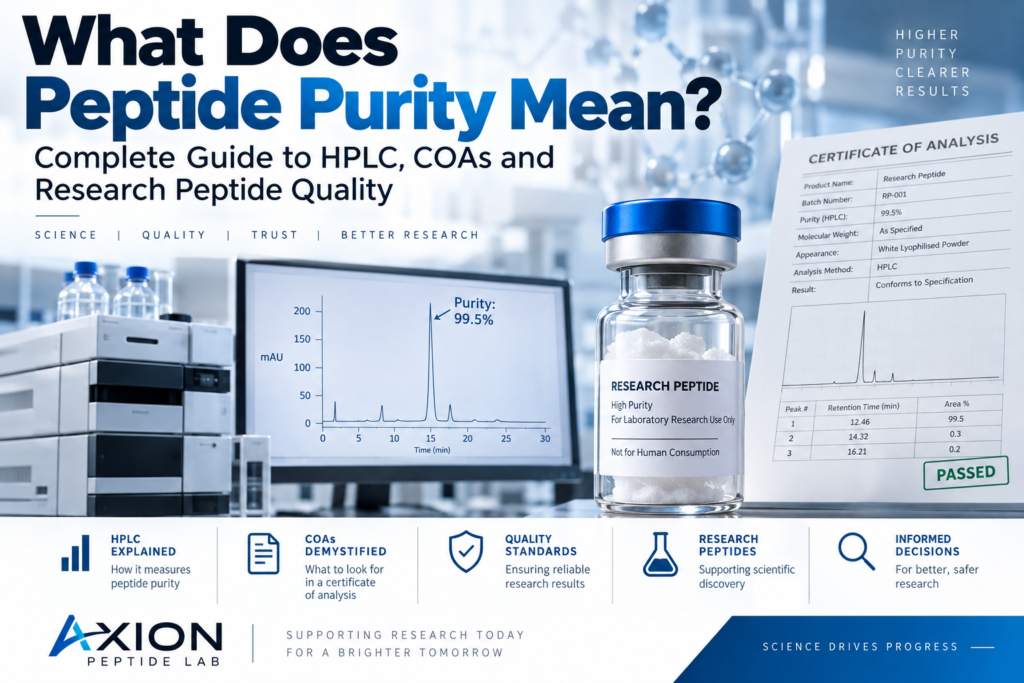
If you have ever looked at a peptide Certificate of Analysis and seen a result such as 98%, 99% or 99.5% purity, you may naturally assume the number means that the entire contents of the sample are that percentage peptide.
The reality is more complicated.
Understanding what peptide purity means requires knowing how purity was measured, what analytical method was used, what the reported percentage represents, and what the test cannot tell you.
In many research-peptide Certificates of Analysis, purity refers to chromatographic purity measured by high-performance liquid chromatography, or HPLC. A figure such as 99.2% usually describes the relative chromatographic response associated with the principal peptide peak under a particular analytical method.
It does not automatically mean that 99.2% of everything physically present in a vial is peptide by weight.
It also does not, by itself, prove sterility, endotoxin status, peptide quantity, biological activity, clinical effectiveness or suitability for human use.
Those characteristics require different analytical methods and, in the case of medicines, a much broader regulatory and clinical evidence package.
This distinction has become increasingly important as scientific and public interest in peptides has grown, particularly around GLP-1, GIP and metabolic peptide research involving compounds such as semaglutide, tirzepatide and investigational retatrutide.
This guide explains exactly what peptide purity means, how laboratories measure it, and how researchers should interpret results such as 99% purity. It will highlight why purity and peptide content are different, and what to look for when reviewing a peptide Certificate of Analysis.
Understanding peptide purity is essential for ensuring the quality and reliability of research peptides. Various analytical techniques, including High-Performance Liquid Chromatography (HPLC), are employed to assess purity levels. Researchers must recognize that a high purity percentage does not equate to guaranteed efficacy or safety in clinical applications.
Research-use products supplied by Axion Peptide Lab are intended for laboratory research where stated. They should not be interpreted as licensed medicines or products intended for human consumption.
What Are Peptides?
Peptides are molecules made from amino acids joined together by peptide bonds.
Amino acids can be arranged into many different sequences. The sequence, length, chemical modifications and three-dimensional behaviour of a peptide can significantly influence its properties.
Peptides occur naturally throughout biology and participate in processes including:
hormonal signalling,
cell communication,
metabolic regulation,
immune signalling,
appetite signalling,
growth,
and nervous-system activity.
Researchers can also produce peptides synthetically.
Synthetic peptides are used in biochemical research, analytical chemistry, pharmaceutical development, receptor studies and many other areas of laboratory science.
When a peptide is produced synthetically, however, the manufacturing process may also generate small amounts of related substances.
These can include incomplete sequences, modified sequences, oxidation products, deletion products, isomers or other process- and degradation-related impurities.
Analytical testing is therefore required to characterise the resulting material.
The FDA’s analytical-method guidance describes identity, strength, quality, purity and potency as distinct quality characteristics that analytical procedures may be designed to evaluate.
That distinction is important throughout this guide because purity is only one element of peptide characterisation.
A sample can have a dominant chromatographic peak without that fact alone proving that the peak corresponds to the intended peptide. Researchers frequently combine HPLC with additional analytical techniques such as mass spectrometry to confirm identity.
In simple terms, peptide purity describes how much of the detected sample corresponds to the desired peptide rather than detectable peptide-related impurities under a defined analytical method.
But that definition needs an important qualification:
The meaning of the percentage depends on the test used to generate it.
A research peptide COA might state:
Purity by HPLC: 99.3%
This usually means the main chromatographic peak associated with the target peptide accounted for approximately 99.3% of the relevant integrated chromatographic response under that specific HPLC method.
It does not necessarily mean:
99.3% of the total vial weight is peptide,
99.3% of all possible impurities have been detected,
the material is 99.3% sterile,
or the peptide is 99.3% effective.
Those interpretations would confuse different analytical concepts, emphasizing the importance of understanding what does peptide purity mean.
Purity is important because impurities can interfere with research. If a sample contains significant peptide-related impurities, those compounds could potentially influence analytical results.
Purity is important because impurities can interfere with research.
A researcher investigating receptor binding, chemical stability, structural behaviour or another laboratory endpoint ideally needs to understand the composition of the material being studied.
If a sample contains significant peptide-related impurities, those compounds could potentially influence analytical results.
For that reason, synthetic peptide characterisation commonly uses chromatographic techniques capable of separating the main target peptide from related substances.
A scientific review of synthetic pharmaceutical peptides describes several chromatographic techniques used for peptide characterisation, including reversed-phase HPLC, LC-MS, size-exclusion chromatography and ion-exchange chromatography.
Purity testing therefore provides useful information about sample quality, but researchers should interpret it as part of a larger analytical picture.
How Is Peptide Purity Measured?
One of the most widely used techniques is high-performance liquid chromatography.
For peptides, reversed-phase HPLC is particularly common.
During analysis, a sample travels through a chromatography column.
Different molecules interact differently with the stationary phase and mobile phase, meaning they can leave the column at different times.
A detector records those components as peaks.
The resulting graph is called a chromatogram.
If the target peptide is the major component detected under the method, it typically produces the dominant chromatographic peak.
Other detectable components may appear as smaller peaks.
The areas of these peaks can then be integrated and used to estimate chromatographic purity.
Understanding HPLC Peptide Purity
Imagine a simplified HPLC chromatogram where the integrated responses are:
Main peptide peak: 99.1%
Impurity A: 0.5%
Impurity B: 0.3%
Impurity C: 0.1%
The reported chromatographic purity might therefore be around:
99.1% by HPLC
This suggests that the main peptide represented the overwhelming majority of the relevant chromatographic detector response under that method. what does peptide purity mean
That can be valuable information.
However, there are several reasons researchers should avoid treating that number as an absolute measurement of everything in the sample. what does peptide purity mean
Why HPLC Purity Is Method-Dependent
An HPLC result is produced under defined conditions.
Those conditions can include:
the chromatography column,
mobile phases,
gradient programme,
flow rate,
temperature,
detector wavelength,
sample concentration,
injection volume,
and data-processing parameters.
Changing those conditions can affect how well different compounds separate.
This is especially relevant to peptides because some peptide-related impurities may have chemical properties very similar to those of the target compound.
Research examining pharmaceutical peptide peak purity has highlighted the possibility of co-eluting impurities—different compounds that may emerge from a chromatographic system at nearly the same time and appear within the same apparent peak.
That means a large, clean-looking peak should not automatically be interpreted as proof that no related impurity is present.
The analytical method must be capable of resolving the relevant impurities.
What Does 99% Peptide Purity Mean?
This is one of the most common questions researchers encounter.
If a COA states:
Purity: 99% by HPLC
it generally means that approximately 99% of the relevant integrated chromatographic response has been attributed to the main peptide peak under that analytical method. what does peptide purity mean
It does not automatically mean that 99% of the total physical material inside the vial consists of peptide molecules. what does peptide purity mean
Why?
Because a lyophilised peptide sample may contain components that are not represented in an HPLC area-percentage calculation in the same way.
Depending on the material and manufacturing process, these can include:
water,
counterions,
salts,
residual solvents,
buffer-related components,
or other non-peptide material.
This is why researchers need to distinguish between purity and peptide content.
Peptide Purity vs Peptide Content
Purity and content are related concepts, but they are not interchangeable.
Peptide Purity
Chromatographic purity generally asks:
Of the relevant components detected using this chromatographic method, what proportion of the response belongs to the principal peptide peak?
Peptide Content
Peptide content asks a different question:
How much actual peptide material is present in the sample?
For example, a sample could theoretically have:
99% HPLC purity
but
a lower percentage of peptide by total dry mass.
That could occur because the non-peptide portion of the sample includes water, counterions or other components that do not appear as ordinary peptide-related impurity peaks in the same HPLC calculation.
Therefore:
99% HPLC purity is not necessarily equivalent to 99% peptide content.
Researchers requiring quantitative peptide content should look for an appropriate quantitative assay rather than assuming that chromatographic purity answers the question. what does peptide purity mean
Purity vs Identity: Another Important Difference
A sample can have a dominant chromatographic peak without that fact alone proving that the peak corresponds to the intended peptide.
That is why researchers frequently combine HPLC with another analytical technique such as mass spectrometry.
Mass spectrometry can measure mass-to-charge characteristics and provide evidence that the detected compound corresponds to the expected molecular mass.
A 2024 scientific publication on synthetic peptide characterisation describes mass spectrometry as an important technique for evaluating peptide authenticity and integrity, including approaches such as LC-MS and MALDI-TOF-MS.
A strong analytical package may therefore use:
HPLC to investigate chromatographic purity,
and
mass spectrometry to support molecular identity.
Those tests complement one another, improving the overall understanding of what does peptide purity mean.
Does Mass Spectrometry Prove Purity?
Not necessarily.
Mass spectrometry is extremely useful for identifying molecules, but interpretation can become complex.
Different substances ionise with different efficiencies, and structurally related peptide impurities can sometimes require specialised analytical strategies.
Recent pharmaceutical research has explored high-resolution mass spectrometry specifically to identify and quantify peptide impurities that co-elute during chromatography. what does peptide purity mean
Therefore, researchers should avoid reducing peptide quality to one instrument result. what does peptide purity mean
The strongest interpretation usually comes from multiple complementary analytical methods. what does peptide purity mean
What Is a Peptide Impurity?
A peptide impurity is a component present alongside the intended peptide that is not the target molecular species.
During peptide synthesis and storage, potential related substances can arise through several mechanisms.
Examples include truncated sequences, missing amino acids, additional amino acids, oxidation, deamidation, hydrolysis, isomerisation and other chemical changes.
Scientific literature discussing peptide impurity analysis notes that different peptide-related impurities may also produce different detector responses during HPLC analysis.
That matters because an impurity producing a weaker or stronger detector signal than the target peptide can complicate direct interpretation of simple area percentages. what does peptide purity mean
For pharmaceutical analysis, sophisticated validated methods may therefore use relative response factors or other approaches to improve impurity quantification.
For ordinary research COAs, researchers should at minimum understand what method produced the stated purity result.
What Is a Peptide Chromatogram?
A chromatogram is the visual output generated by a chromatography system.
Most chromatograms show:
retention time along the horizontal axis,
and
detector response along the vertical axis.
Peaks appear as different components leave the chromatography column and reach the detector.
When reading a peptide COA, researchers should ideally see more than a simple statement such as:
Purity: 99.7%
A chromatogram provides additional analytical context. what does peptide purity mean
It can show whether the sample produced one overwhelmingly dominant peak, whether several smaller peaks were visible, and approximately when those components were detected.
However, visual appearance alone still does not validate the method.
What Is Retention Time?
Retention time is the time required for an analyte to pass through the chromatographic system and reach the detector under particular analytical conditions. what does peptide purity mean
For example, a peptide may generate its principal peak at:
14.6 minutes
But that number should not be treated as a universal fingerprint for the molecule.
Retention time can change depending on the column, mobile phases, gradient, temperature and other method conditions.
It becomes useful when interpreted within a specific analytical procedure and, when appropriate, compared against a reference material.
What Is Peak Area?
Peak area represents the integrated detector response associated with a chromatographic peak.
Area-normalisation calculations may compare the main target peak against other detected peaks. what does peptide purity mean
If the main peak accounts for nearly all of the integrated response, the resulting HPLC purity percentage can be very high.
However, detector response is not always identical for every possible impurity. what does peptide purity mean
This is another reason sophisticated pharmaceutical impurity methods may go beyond basic area normalisation.
For an ordinary research peptide COA, the key question is:
What exactly does the reported percentage represent?
Does Higher Peptide Purity Always Mean Better Research Quality?
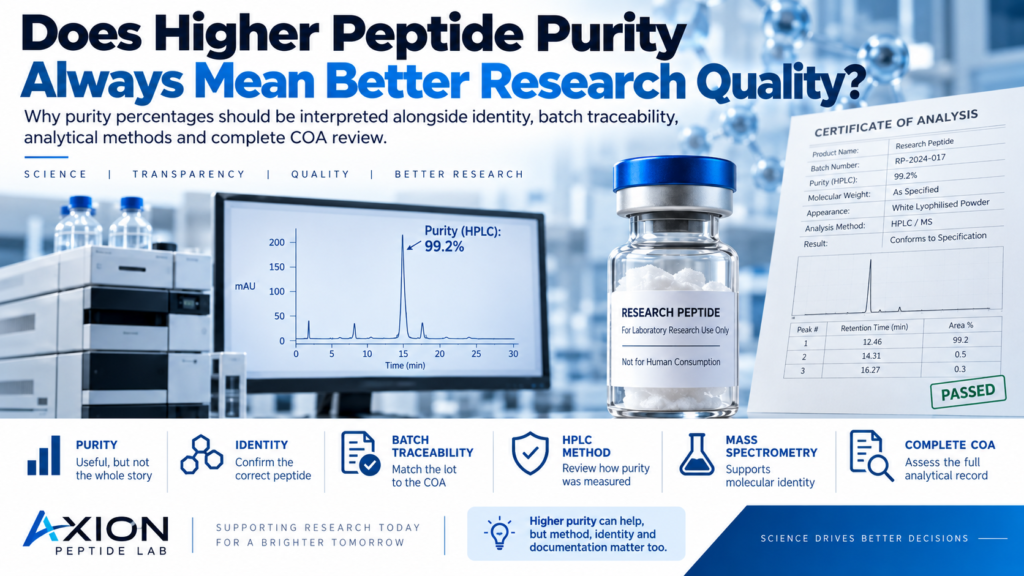
Higher chromatographic purity can be desirable because it indicates fewer detectable peptide-related components under the test method.
But the highest number on a website should not automatically determine which material is analytically superior.
For example:
A documented 98.8% result from a traceable batch using appropriate HPLC and mass-spectrometric analysis may provide researchers with more useful information than an unsupported marketing statement claiming “>99.9% purity.”
Researchers should look beyond the headline percentage.
Important questions include:
Which laboratory performed the test?
Does the lot number match?
When was the analysis performed?
What HPLC method was used?
Was identity confirmed separately?
Can the original analytical report be verified?
Were other relevant tests performed?
Purity is valuable when it exists within a traceable analytical framework.
Peptide Purity vs Sterility
A common misunderstanding is that extremely high peptide purity implies that the product must also be sterile.
It does not. what does peptide purity mean
Chemical purity and sterility are entirely different quality characteristics.
HPLC separates and measures chemical components detectable through the analytical system.
Sterility testing investigates whether viable microorganisms are present.
A COA reporting:
99.5% HPLC purity
does not prove:
sterility confirmed
unless an appropriate sterility test was independently conducted. what does peptide purity mean
Researchers should not infer microbiological properties from chromatography data. what does peptide purity mean
Peptide Purity vs Endotoxin Testing
Endotoxin testing is also different.
Endotoxins are associated with certain bacteria and require dedicated analytical approaches.
A peptide’s HPLC purity does not establish its endotoxin level.
Likewise, mass spectrometry confirming molecular identity does not prove low endotoxin.
If endotoxin information matters for a specific research application, researchers should look for an appropriate endotoxin result rather than assuming that a purity percentage covers it. what does peptide purity mean
Purity vs Potency and Biological Activity
Another important distinction is between analytical purity and biological activity.
HPLC may indicate that a sample contains a high proportion of the target chromatographic component.
That does not automatically prove that the material has a particular level of biological potency.
Potency or biological activity can require separate assays specifically designed around the biological property being investigated.
FDA analytical guidance similarly treats purity, potency, identity and strength as distinct characteristics rather than interchangeable terms. what does peptide purity mean
What Should a Good Peptide COA Show?
A useful peptide Certificate of Analysis should allow researchers to understand what was tested and connect the results to a particular batch.
Important information may include the compound name, lot number, testing date, analytical laboratory, analytical method, chromatographic purity and identity results.
Additional data can include peptide content, appearance, water content, residual solvents, counterion information, endotoxin testing, microbial testing, sterility testing or specific impurity analysis when those characteristics are relevant.
Not every research application requires every possible test. what does peptide purity mean
The important principle is that different tests answer different questions.
Why Batch-Specific Purity Matters
Imagine that a supplier manufactured one batch in January and another in September.
Testing from the January batch cannot automatically establish the purity of the September batch.
Changes can occur between manufacturing runs.
For meaningful traceability, researchers should look for documentation associated with the specific lot being supplied.
Compare the lot number appearing on the COA with the batch identifier associated with the research material.
If they do not match, additional clarification may be necessary.
Why Peptide Purity Matters in Weight-Regulation Research
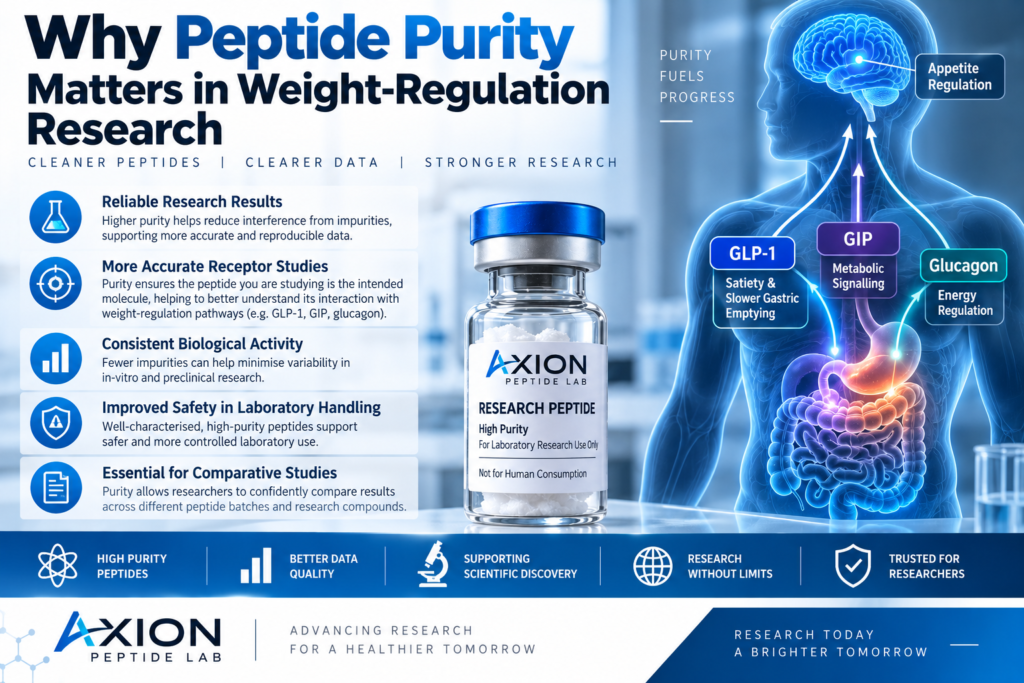
Peptide purity has become an increasingly visible topic because of the rapid growth of metabolic peptide research.
Searches for peptides for weight loss often lead people to compounds involving pathways such as:
GLP-1,
GIP,
glucagon,
and other metabolic signalling systems.
However, three different concepts must remain separate:
scientific research into a molecule,
a licensed pharmaceutical medicine,
and
a research-use laboratory product. what does peptide purity mean
A high-purity research peptide does not become an approved medicine simply because analytical testing reports a high HPLC percentage.
Likewise, a COA does not establish clinical safety or effectiveness.
How Peptides Are Connected to Weight Regulation
The body uses peptide hormones to transmit information between tissues.
After food intake, signalling systems in the gastrointestinal tract communicate with the pancreas, brain and other organs.
These pathways can influence processes such as:
appetite,
satiety,
insulin secretion,
glucagon signalling,
gastric emptying,
blood glucose regulation,
and energy balance.
This biology has led to major scientific interest in compounds capable of interacting with metabolic peptide receptors.
GLP-1 and GIP are two important examples. what does peptide purity mean
What Is GLP-1?
GLP-1 stands for glucagon-like peptide-1.
It is a naturally occurring incretin hormone involved in metabolic signalling.
GLP-1 receptor activation can affect appetite, glucose-dependent insulin secretion, glucagon regulation and gastric emptying.
Pharmaceutical research has produced longer-acting compounds that activate the GLP-1 receptor.
Semaglutide is one widely known example. what does peptide purity mean
What Is GIP?
GIP stands for glucose-dependent insulinotropic polypeptide.
Like GLP-1, it participates in nutrient-responsive metabolic signalling.
Researchers have investigated whether simultaneously targeting GIP and GLP-1 receptors can produce different metabolic effects from targeting GLP-1 alone.
This contributed to the development of tirzepatide.
More recently, researchers have investigated triple-receptor approaches involving GIP, GLP-1 and glucagon signalling.
Retatrutide is an important investigational example. what does peptide purity mean
Semaglutide and Peptide Purity
Semaglutide is a GLP-1 receptor agonist extensively studied in metabolic medicine.
Importantly, certain semaglutide pharmaceutical products are licensed medicines.
In the UK, the MHRA states that Wegovy is licensed for weight management in defined patient populations. The regulator also approved additional Wegovy formulations and dosing options during 2026, including an oral semaglutide tablet for weight management.
This does not mean that every material labelled “semaglutide” has the same regulatory status.
A laboratory research material containing semaglutide should not be represented as equivalent to licensed Wegovy.
A research COA may provide analytical information about the research material, but it does not transfer the regulatory status of an authorised pharmaceutical product onto that material. what does peptide purity mean
Tirzepatide and Peptide Purity
Tirzepatide activates both GIP and GLP-1 receptors.
In the United States, the FDA approved Zepbound containing tirzepatide for chronic weight management in eligible adults in November 2023.
In the UK, NICE recommends tirzepatide as an option for weight management for people meeting defined criteria, and its guidance was updated in January 2026.
Again, regulated pharmaceutical tirzepatide should be distinguished from a research-use material carrying the same compound name.
A purity result associated with a laboratory research sample describes an analytical characteristic of that sample.
It does not make it a licensed Mounjaro or Zepbound product. what does peptide purity mean
Retatrutide and Peptide Purity
Retatrutide is a different case.
It activates GIP, GLP-1 and glucagon receptors and is commonly described as a triple receptor agonist.
As of September 2026, retatrutide remains investigational.
Lilly states that retatrutide has not yet been approved by any regulatory agency, even though several Phase 3 studies have reported positive results during 2026.
The FDA likewise states that retatrutide is not a component of an FDA-approved drug and has not been found safe and effective by the FDA for any condition. what does peptide purity mean
This provides a useful example of why peptide purity and regulatory approval must never be confused.
Even a hypothetical retatrutide research sample showing very high analytical purity would still not make retatrutide an approved medicine.
Chemical purity does not equal regulatory approval.
Semaglutide vs Tirzepatide vs Retatrutide
The three compounds are often discussed together because they interact with related metabolic signalling systems, but they are not identical.
Semaglutide primarily acts at the GLP-1 receptor.
Tirzepatide acts at GIP and GLP-1 receptors.
Retatrutide acts at GIP, GLP-1 and glucagon receptors.
Their regulatory status is also different. what does peptide purity mean
Authorised semaglutide and tirzepatide products have approved medical uses in the USA and UK under defined conditions. Retatrutide remains an investigational compound as of September 2026.
These distinctions should be maintained when writing about metabolic peptide research.
What Does Clinical Research Actually Show?
Clinical research evaluates much more than chemical purity.
Clinical trials can investigate:
effectiveness,
dose response,
adverse events,
tolerability,
treatment discontinuation,
long-term outcomes,
and effects within defined populations. what does peptide purity mean
The quality of the investigational material used in a clinical development programme is important, but a purity result alone does not predict the outcome of a clinical trial.
Similarly, clinical results obtained with regulated investigational or pharmaceutical preparations should not automatically be applied to unrelated research-use materials. what does peptide purity mean
When discussing clinical research, readers should consider the exact compound, formulation, study population, protocol, dose, duration and regulatory context. what does peptide purity mean
Safety and Reported Adverse Effects
Chemical purity does not mean absence of pharmacological risk.
A molecule can be extremely pure and still produce significant biological effects or adverse reactions.
For licensed GLP-1-related medicines, regulators provide safety information based on clinical and post-marketing data. what does peptide purity mean
The UK’s MHRA advises that GLP-1 and dual GIP/GLP-1 medicines should only be used according to their licensed indications and under appropriate prescribing supervision. Its updated 2026 guidance discusses known safety considerations and regulatory monitoring. what does peptide purity mean
Therefore:
99% purity does not mean 99% safe.
Purity and safety answer completely different questions.
Research Peptides vs Prescription Medicines
This distinction is essential for researchers and consumers alike.
A licensed prescription medicine has undergone formal regulatory assessment for specified indications, manufacturing controls, formulations and patient populations.
A research-use peptide is supplied for laboratory investigation. what does peptide purity mean
Its COA may describe analytical characteristics such as:
identity,
chromatographic purity,
molecular mass,
or peptide content.
That analytical information does not transform the material into an authorised medicine.
Researchers looking for laboratory materials can review the research catalogue at AxionPeptideLab.com, while maintaining the important distinction between research-use products and licensed prescription medicines.
For Research Use Only – Not for human consumption.
UK Regulatory Considerations
UK suppliers should take particular care when presenting research materials online.
The MHRA explains that classification as a medicinal product can depend on several factors, including explicit and implied claims, pharmacological or metabolic properties, intended purpose and how the product is presented through packaging, advertising, websites and social media. what does peptide purity mean
This means a “research use only” statement should not be combined with contradictory therapeutic claims suggesting that the product being sold is intended to treat obesity, diabetes or another medical condition.
Scientific literature and clinical research can be discussed educationally. what does peptide purity mean
However, research-use materials should remain clearly separated from medicinal claims. what does peptide purity mean
Current and Future Peptide Research
Peptide science continues to advance quickly.
Scientists are investigating:
multi-receptor agonism,
improved peptide stability,
longer-acting structures,
novel delivery systems,
more selective receptor targeting,
peptide combinations,
and improved analytical techniques. what does peptide purity mean
Analytical chemistry is advancing alongside therapeutic research.
For example, researchers are developing more sophisticated chromatography and mass-spectrometric methods to distinguish low-level peptide impurities that may be difficult to resolve using simpler methods.
As peptide structures become increasingly complex, understanding what a purity number truly represents will become even more important. what does peptide purity mean
Frequently Asked Questions About Peptide Purity
What does peptide purity mean?
Peptide purity generally describes the proportion of the analytical response attributable to the target peptide compared with detectable related impurities under a defined analytical method. In many COAs, the figure refers to HPLC chromatographic purity. what does peptide purity mean
What does 99% peptide purity mean?
A 99% HPLC purity result generally means that approximately 99% of the relevant integrated chromatographic response is associated with the principal peptide peak under that test method. It does not necessarily mean that peptide accounts for 99% of total vial mass. what does peptide purity mean
Is 99% peptide purity good?
High chromatographic purity indicates that the target peptide dominates the chromatographic profile under the method used. However, researchers should also consider identity testing, batch traceability, methodology and other relevant quality characteristics rather than evaluating a sample solely by one percentage. what does peptide purity mean
Is 99% purity the same as 99% peptide content?
No. Peptide content and chromatographic purity measure different things. Water, counterions, salts and other non-peptide components may affect the total composition of a sample without appearing as ordinary peptide impurity peaks in a simple HPLC area-percentage calculation. what does peptide purity mean
How is peptide purity tested?
HPLC is commonly used to evaluate peptide purity. The sample is separated chromatographically and detected components appear as peaks. The relative response associated with the main target peak can then be compared with other relevant peaks.
What is HPLC peptide purity?
HPLC peptide purity is a chromatographic measurement estimating how much of the detected response under the method corresponds to the target peptide rather than other detected components. what does peptide purity mean
Can HPLC prove peptide identity?
HPLC provides useful separation and retention information, but researchers commonly use additional techniques such as mass spectrometry to provide stronger evidence supporting molecular identity. what does peptide purity mean
What does mass spectrometry tell you about a peptide?
Mass spectrometry provides information about molecular mass and can help confirm that the detected material is consistent with the expected peptide. It complements chromatographic purity analysis.
Does high peptide purity mean the sample is sterile?
No. Chemical purity and sterility are different characteristics. Sterility requires dedicated microbiological testing.
Does high peptide purity mean low endotoxin?
No. HPLC purity does not establish endotoxin levels. Endotoxin requires an appropriate dedicated assay.
Does high peptide purity mean the peptide is safe?
No. Purity is a chemical quality characteristic. Safety requires separate toxicological, pharmacological, clinical and regulatory evidence where human use is involved.
Can two peptide samples both show 99% purity but differ in quality?
Yes. They could have different identities, impurity profiles, peptide content, water levels, counterions, storage histories, test methods or batch documentation. The percentage alone does not describe every aspect of quality.
How can researchers verify peptide purity?
Researchers should review the full Certificate of Analysis, confirm that the batch number matches, identify the testing laboratory, inspect the HPLC data and analytical method, and review complementary identity testing such as mass spectrometry where available.
Are peptides for weight loss the same as research peptides?
No. Some peptide-related compounds have licensed pharmaceutical products for weight management, while other compounds remain investigational. Research-use materials are a separate category and should not be represented as prescription medicines. what does peptide purity mean
Is retatrutide an approved weight-loss medicine?
No. As of September 2026, retatrutide remains investigational and has not been approved by a regulatory agency. Positive Phase 3 trial results do not themselves constitute regulatory approval.
Final Thoughts: What Does Peptide Purity Really Mean?
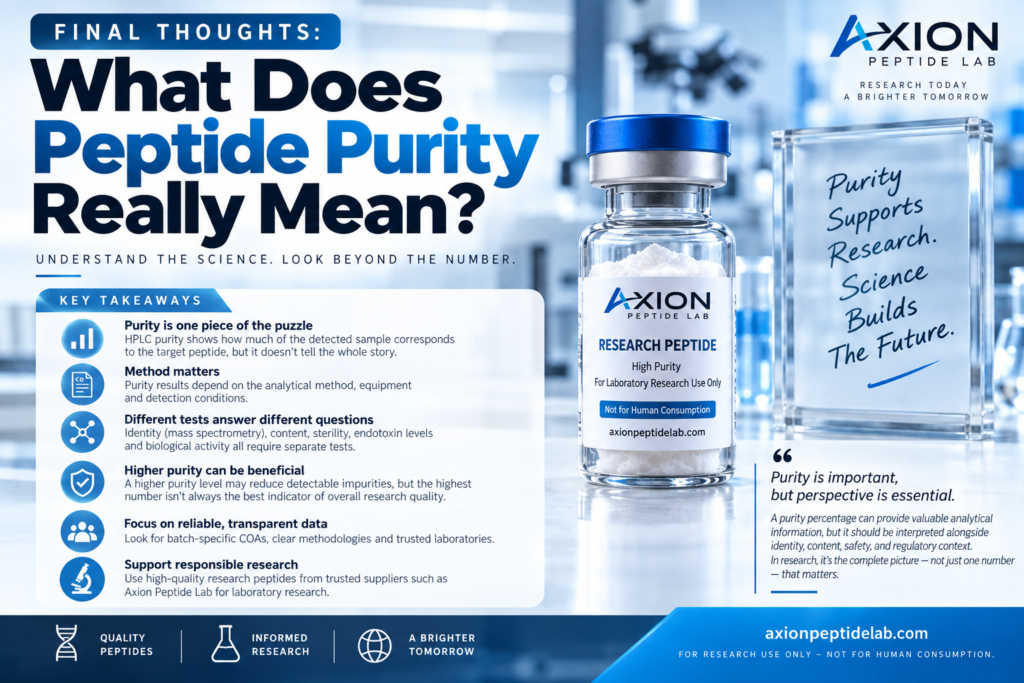
Understanding what peptide purity means requires looking beyond a single number.
A result such as:
99.2% purity by HPLC
can provide valuable information about the chromatographic composition of a peptide sample.
But it should be interpreted precisely.
It does not automatically mean that 99.2% of the total vial mass is peptide.
It does not establish sterility.
It does not establish endotoxin status.
It does not prove exact peptide content.
It does not confirm biological potency.
It does not establish safety.
And it does not transform a laboratory research material into an approved pharmaceutical medicine.
Instead, purity should be considered alongside identity, peptide content, batch traceability, analytical methodology and other tests appropriate to the research application.
HPLC can provide information about chromatographic purity.
Mass spectrometry can provide evidence supporting molecular identity.
Separate quantitative or microbiological assays may answer additional questions.
For researchers evaluating laboratory peptides, this broader analytical perspective is far more informative than choosing material solely because a website displays the highest percentage.
The same principle becomes especially important in rapidly developing areas such as GLP-1, GIP, and metabolic peptide research. Understanding what does peptide purity mean requires looking beyond a single number.
Semaglutide, tirzepatide and retatrutide demonstrate how compounds acting on related biological pathways can exist at different stages of pharmaceutical development and regulatory approval.
A purity certificate tells researchers something about the tested material. what does peptide purity mean
It does not tell them everything.
Researchers exploring laboratory materials can review the research catalogue at AxionPeptideLab.com and evaluate available analytical documentation using the principles explained in this guide. what does peptide purity mean
For Research Use Only – Not for human consumption.
References and Further Reading
U.S. Food and Drug Administration — Analytical Procedures and Methods Validation for Drugs and Biologics. Guidance covering analytical procedures supporting identity, strength, quality, purity and potency.
FDA / ICH Q2(R2) — Validation of Analytical Procedures. Current framework for analytical procedure validation.
PubMed — Synthetic Pharmaceutical Peptides Characterization by Chromatography Principles and Method Development. Review of chromatographic techniques used to characterise peptide materials and impurities.
PubMed — Characterization of Synthetic Peptides by Mass Spectrometry. Overview of mass-spectrometric techniques for synthetic peptide identity and integrity testing.
PubMed — Strategy for Assessing Peak Purity of Pharmaceutical Peptides Using Two-Dimensional Liquid Chromatography and Mass Spectrometry. Research addressing co-eluting peptide impurities.
MHRA — GLP-1 Medicines for Weight Loss and Diabetes: What You Need to Know. UK regulatory and safety information on licensed GLP-1 and dual GIP/GLP-1 medicines.
NICE — Tirzepatide for Managing Overweight and Obesity. Evidence-based UK guidance concerning authorised tirzepatide use.
MHRA — Borderline Products: How to Tell if Your Product Is a Medicine. Guidance explaining how claims, intended purpose and presentation influence regulatory classification in the UK.
FDA — Concerns With Unapproved GLP-1 Drugs Used for Weight Loss. Includes FDA’s current position regarding unapproved retatrutide.
Eli Lilly — Current Retatrutide Development Information. Current investigational status and Phase 3 programme information as of 2026.