Alluvi Glow GHK-Cu – BPC-157 & TB-500 70mg
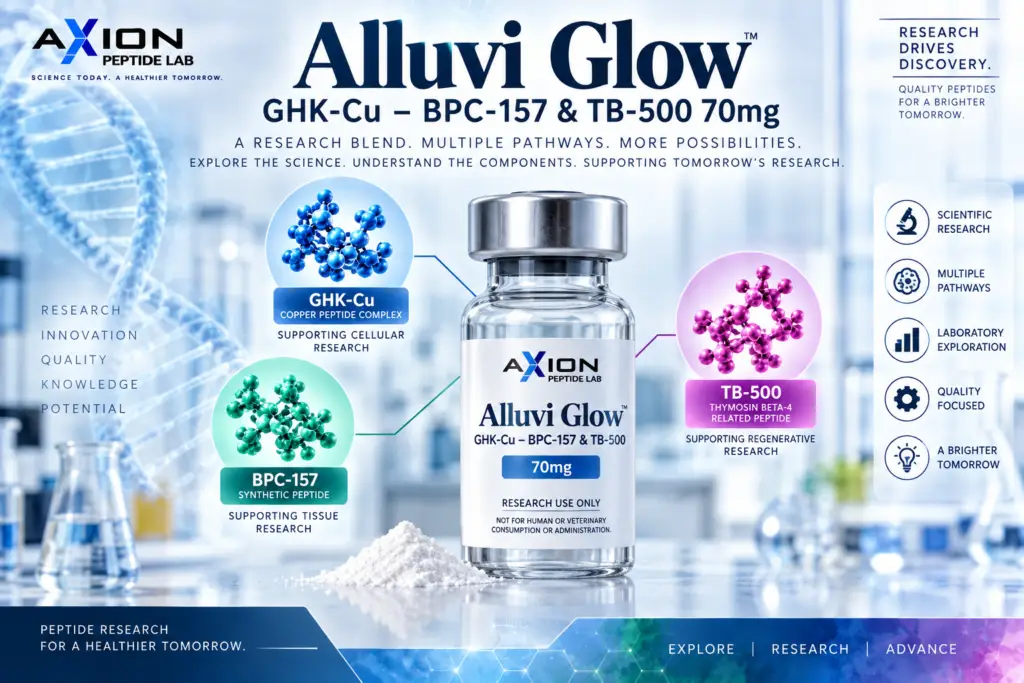
Introduction: What Is Alluvi Glow GHK-Cu – BPC-157 & TB-500 70mg?
Alluvi Glow GHK-Cu – BPC-157 & TB-500 70mg is a multi-component peptide research blend developed for laboratory, analytical and scientific investigation. The formulation brings together three widely discussed research compounds—GHK-Cu, BPC-157 and TB-500—within a single 70mg research product.
Rather than representing one individual peptide pathway, Alluvi Glow combines compounds with different molecular characteristics and research backgrounds. This makes the blend relevant to researchers interested in areas such as peptide chemistry, cellular signalling, analytical characterisation and multi-pathway experimental research.
The three named components are:
GHK-Cu — a copper complex of the naturally occurring tripeptide glycyl-L-histidyl-L-lysine (GHK). GHK-Cu has been investigated in laboratory and biomedical research involving copper-dependent biology, extracellular-matrix processes and cellular signalling.
BPC-157 — a synthetic 15-amino-acid peptide that has attracted considerable experimental interest. Much of the published research associated with BPC-157 remains preclinical, making it important to distinguish experimental findings from established human clinical evidence.
TB-500 — a term frequently encountered in peptide research and commonly associated with thymosin beta-4-related research. However, TB-500 terminology and product identity can vary, so the exact identity and sequence of a particular research material should be confirmed through its product specifications and available analytical documentation rather than assumed from the name alone.
Together, these components make Alluvi Glow 70mg a multi-compound research material rather than a single-peptide preparation.
Why Combine GHK-Cu, BPC-157 and TB-500 in a Research Blend?
Modern peptide research increasingly investigates how different biochemical pathways interact.
A single-compound experiment can be useful when researchers need to isolate a particular variable. A multi-component formulation, by contrast, may be relevant when an experimental design specifically requires investigation of several compounds or pathways within the same research framework.
The concept behind a GHK-Cu, BPC-157 and TB-500 blend can therefore be understood as a multi-pathway research approach.
However, combining three compounds does not automatically demonstrate that they produce a synergistic effect.
Evidence concerning GHK-Cu alone, for example, cannot simply be combined with separate findings about BPC-157 and TB-500 to prove that the complete Alluvi Glow GHK-Cu – BPC-157 & TB-500 70mg formulation produces a particular biological outcome.
The finished blend must be considered separately from evidence relating to its individual components.
Understanding the “70mg” Label
The 70mg designation identifies the stated total quantity associated with the Alluvi Glow formulation.
Researchers should not assume how those 70 milligrams are divided among GHK-Cu, BPC-157 and TB-500 without consulting the verified product specification.
For scientific work, the precise amount of each component can be important because experimental reproducibility depends on accurately understanding the material being studied.
Researchers should therefore review product-specific information and available batch documentation before designing an experiment around the blend.
Is Alluvi Glow a “Glow Peptide”?
The term “Glow peptide” has become increasingly visible in online discussions of peptide blends, particularly formulations involving GHK-Cu.
It is important to understand that “Glow” is not a formal pharmacological classification.
Peptides and peptide-related compounds are scientifically characterized according to factors such as their molecular structure, amino-acid sequence, receptor or molecular interactions and biological pathways—not whether they are marketed under the term “Glow.”
In Alluvi Glow, the word forms part of the product and brand identity. The underlying research discussion should still focus on the actual compounds present: GHK-Cu, BPC-157 and TB-500.
Research Evidence Needs to Be Considered Carefully
These three compounds do not have identical evidence bases.
GHK-Cu has a history of experimental investigation involving copper-peptide biology and cellular processes.
BPC-157 has generated considerable interest in preclinical research, but many popular claims surrounding the compound extend beyond what robust human clinical evidence currently establishes.
TB-500 requires additional care because terminology surrounding TB-500 and thymosin beta-4 can be inconsistent. Researchers should confirm the precise material being evaluated before applying findings from thymosin beta-4 literature to a TB-500-labelled research product.
This distinction between what has been demonstrated, what remains experimental and what is simply claimed online will be maintained throughout this guide.
Alluvi Glow at Axion Peptide Lab
For legitimate researchers, Alluvi Glow GHK-Cu – BPC-157 & TB-500 70mg is available through Axion Peptide Lab as a research material intended for controlled laboratory, analytical and scientific applications.
Researchers evaluating the product should consider the stated composition, product format and available product- or batch-specific documentation when determining whether the material is appropriate for a particular experimental workflow.
The presence of GHK-Cu, BPC-157 or TB-500 in scientific literature does not mean an independently supplied research product is an approved medicine or that experimental findings can be interpreted as guaranteed clinical outcomes.
This article will therefore examine GHK-Cu, BPC-157 and TB-500 individually before considering the blend as a whole, including their molecular characteristics, published research, evidence limitations, research applications and regulatory considerations for researchers in the USA and UK.
For Research Use Only – Not for human or veterinary consumption or administration.
What Are Peptides?
To understand Alluvi Glow GHK-Cu – BPC-157 & TB-500 70mg, it is useful to first understand what peptides are and why they are widely investigated in laboratory research.
Peptides are molecules composed of amino acids connected by peptide bonds. Amino acids are also the building blocks of proteins, but peptides generally contain shorter amino-acid chains than the larger, more complex structures typically described as proteins.
Peptides occur naturally throughout biology and participate in many forms of cellular communication and physiological regulation. Other peptides are synthesized or modified specifically so researchers can investigate their molecular properties, biochemical interactions and potential roles within biological pathways.
However, the word “peptide” describes a broad molecular category rather than one specific function. Two peptides can differ substantially in structure, biological activity, stability and research applications.
This is particularly important when considering a research blend containing GHK-Cu, BPC-157 and TB-500, because these names should not be treated as three interchangeable versions of the same substance.
What Is a Peptide?
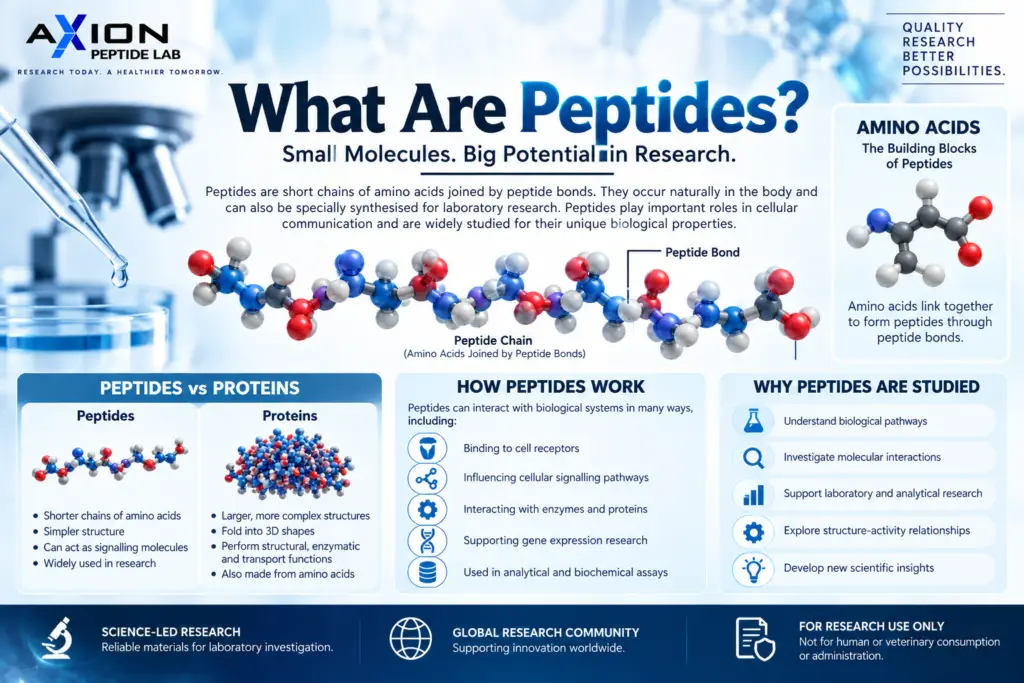
At its simplest, a peptide consists of amino acids joined together through peptide bonds.
A peptide bond forms when the carboxyl group of one amino acid connects with the amino group of another. Repeating this process creates an amino-acid chain.
The order of those amino acids is known as the peptide’s sequence.
Sequence matters because even relatively small changes can influence properties such as:
- molecular shape;
- charge;
- solubility;
- stability;
- binding interactions;
- receptor activity; and
- biological behaviour.
This is why researchers need accurate compound identification when conducting peptide experiments.
A product being labelled simply as a “research peptide” provides far less scientific information than knowing its precise molecular identity and composition.
Peptides vs Proteins: What’s the Difference?
Peptides and proteins are both constructed from amino acids, and the distinction between the two is not governed by one universally absolute length cutoff.
In general, however, peptides are shorter amino-acid chains, while proteins are usually larger structures that can fold into complex three-dimensional configurations.
The distinction is useful scientifically, but size alone does not determine biological importance.
A relatively short peptide can participate in significant signalling processes, while larger proteins may perform structural, enzymatic, transport or regulatory functions.
The three components discussed in this article also illustrate why terminology matters.
GHK is a tripeptide composed of three amino-acid residues, while GHK-Cu refers to the complex formed when GHK coordinates a copper ion.
BPC-157 is generally described as a synthetic 15-amino-acid peptide.
TB-500 requires more careful treatment because commercial and research terminology surrounding TB-500 and thymosin beta-4-related materials is not always consistent. Researchers should therefore confirm the identity and sequence associated with a specific TB-500 product rather than assuming that every use of the term refers to full-length thymosin beta-4.
How Do Peptides Work in Biological Research?
Peptides can interact with biological systems in many different ways.
Some naturally occurring peptides act as signalling molecules, allowing cells and tissues to communicate.
Depending on the peptide, researchers may investigate interactions involving:
- cell-surface receptors;
- intracellular signalling pathways;
- enzymes;
- proteins;
- metal ions;
- extracellular-matrix components;
- gene-expression pathways; and
- other molecular targets.
There is therefore no single “peptide mechanism.”
For example, the mechanism researchers investigate for a GLP-1 receptor agonist is fundamentally different from the copper-associated biology studied with GHK-Cu.
This is one reason broad statements such as “peptides do X” are usually scientifically inadequate.
The correct question is:
Which peptide, interacting with which molecular target, under which experimental conditions?
Why Are Peptides Important in Laboratory Research?
Peptides are valuable research tools because their defined molecular structures can allow scientists to investigate specific biological questions.
Depending on the compound and experimental model, peptide research may involve:
Receptor pharmacology — examining how a peptide interacts with a particular receptor.
Cell-signalling research — investigating downstream molecular changes following exposure to a peptide.
Structure-activity research — studying how changes in amino-acid sequence or molecular structure alter activity.
Analytical characterisation — examining identity, composition, purity profiles or related molecular properties using appropriate laboratory techniques.
Biochemical assays — using peptides to investigate enzymes, proteins, receptors or other biological components.
Comparative research — comparing related peptides or different experimental compounds under controlled conditions.
Multi-component research — studying combinations of compounds when the experimental question specifically involves several pathways or molecules.
Alluvi Glow falls into this broader multi-component research context because it brings together three named research compounds.
Natural, Synthetic and Modified Peptides
Another important distinction is how a peptide originates.
Some peptides occur naturally in biological systems.
Others are produced synthetically to reproduce a known sequence.
Researchers may also study modified peptide analogues, where the molecular structure has been intentionally changed to investigate stability, receptor activity or another experimental property.
GHK provides a useful example.
GHK is a naturally occurring tripeptide, while GHK-Cu specifically describes its copper complex. The presence of copper is scientifically important and should not be ignored when describing the material simply as a peptide.
BPC-157 is generally discussed as a synthetic peptide used in experimental research.
The identity of TB-500-labelled materials should be established from the relevant specification because the term is sometimes used inconsistently in commercial contexts.
Why Molecular Identity Matters
Accurate identification is fundamental to reproducible laboratory science.
Researchers need to know what material they are actually studying before they can meaningfully interpret experimental results.
Relevant information may include:
- compound name;
- amino-acid sequence where applicable;
- molecular form;
- stated quantity;
- product composition;
- batch information; and
- analytical documentation where available.
This becomes even more important for a multi-component product such as Alluvi Glow GHK-Cu – BPC-157 & TB-500 70mg.
If a study is designed around three components, researchers need accurate information about those components rather than relying solely on the commercial name “Glow.”
Are All Research Peptides Medicines?
No.
The existence of scientific research involving a peptide does not automatically make that peptide an approved medicine.
These categories should remain separate:
Naturally occurring peptide
→ A molecule found in biological systems.
Research peptide or research material
→ Material supplied for laboratory, analytical or scientific investigation.
Investigational compound
→ A substance undergoing formal experimental or clinical development.
Approved medicine
→ A specific pharmaceutical product reviewed and authorised by the appropriate regulatory authority for defined clinical use.
One compound name can sometimes appear in more than one of these contexts, but the products themselves should not automatically be considered equivalent.
This distinction is particularly important for research peptide suppliers and laboratories.
What Are Peptide Blends?
A peptide blend contains more than one research component within the same formulation.
Researchers may investigate blends when their experimental design requires examination of multiple compounds or pathways.
However, combining compounds creates additional scientific questions.
Researchers may need to consider:
- the identity of every component;
- the quantity of each component;
- analytical compatibility;
- experimental controls;
- interactions among components;
- stability under the selected laboratory conditions; and
- whether findings can be attributed to one compound or the combination.
Evidence supporting an individual component also does not automatically prove the properties of the complete blend.
For example:
Evidence concerning GHK-Cu
separate evidence concerning BPC-157
separate evidence concerning thymosin beta-4-related biology
does not automatically equal:
clinical evidence for Alluvi Glow 70mg.
The complete formulation would require its own evidence before specific combined effects could be established.
Why This Matters for Alluvi Glow 70mg
Understanding basic peptide science provides the foundation for examining Alluvi Glow GHK-Cu – BPC-157 & TB-500 70mg accurately.
The important scientific questions are not simply whether the formulation contains “peptides.”
Researchers should instead ask:
What exactly are the components?
How are they structurally different?
What pathways have been investigated for each compound?
How strong is the evidence?
What evidence applies to individual compounds versus the complete blend?
These distinctions become especially important with GHK-Cu, BPC-157 and TB-500 because each has a different research history and different evidence limitations.
The next section examines Alluvi Glow 70mg itself, including its three named components, the meaning of the 70mg designation and why composition should be verified before interpreting or designing research around a multi-peptide blend.
For Research Use Only – Not for human or veterinary consumption or administration.
What Is Alluvi Glow 70mg?
Alluvi Glow GHK-Cu – BPC-157 & TB-500 70mg is a multi-component research blend combining three distinct compounds—GHK-Cu, BPC-157 and TB-500—within a single laboratory research product.
The formulation is designed for controlled scientific, analytical and laboratory investigation rather than clinical use. Unlike a single-compound research material, Alluvi Glow allows researchers to work with several named components within one defined formulation when this is appropriate for their experimental design.
The product can be understood at a basic level as:
GHK-Cu
+
BPC-157
+
TB-500
Alluvi Glow 70mg Research Blend
However, combining these compounds does not make them one new peptide. Each component retains its own molecular characteristics, research background and evidence base.
Understanding those differences is essential before interpreting research involving the complete blend.
Understanding the Alluvi Glow Research Blend
The term “Glow” is used as part of the Alluvi product identity, but it should not be confused with a formal scientific classification.
There is no single pharmacological category officially defined as a “Glow peptide.”
Instead, researchers should evaluate the actual components present in the formulation.
In this case, those components are GHK-Cu, BPC-157 and TB-500.
Each represents a different area of peptide-related research:
GHK-Cu is a copper-peptide complex associated with research into copper-dependent biology, cellular signalling and extracellular-matrix processes.
BPC-157 is a synthetic 15-amino-acid peptide that has been investigated primarily through preclinical experimental models.
TB-500 is a name commonly encountered in thymosin beta-4-related research discussions, although the terminology requires particular care because TB-500-labelled materials should not automatically be assumed to be identical to full-length thymosin beta-4.
This diversity is what makes the blend scientifically more complex than a single-peptide research product.
What Is GHK-Cu in Alluvi Glow?
GHK-Cu refers to a copper complex involving the tripeptide GHK, or glycyl-L-histidyl-L-lysine.
GHK itself contains only three amino-acid residues, but its ability to coordinate copper is an important part of why the compound has attracted scientific attention.
Published research has explored GHK-Cu in areas involving cellular processes, extracellular-matrix biology, copper homeostasis and gene-expression-related mechanisms.
For the purposes of Alluvi Glow research, GHK-Cu should therefore be understood as a specific copper-peptide complex, not simply as a generic “skin peptide.”
This distinction matters because popular descriptions of GHK-Cu sometimes move quickly from laboratory observations to cosmetic or therapeutic claims that require stronger evidence.
The dedicated GHK-Cu section later in this guide will examine those findings and limitations in greater detail.
What Is BPC-157 in Alluvi Glow?
BPC-157 is generally described in scientific literature as a synthetic peptide composed of 15 amino acids.
It has attracted substantial attention because experimental studies have investigated it across several biological models.
However, the evidence surrounding BPC-157 needs careful interpretation.
A considerable proportion of the research frequently cited in discussions about BPC-157 comes from preclinical studies, including laboratory and animal models.
That means findings from those experiments should not automatically be interpreted as proof of clinical effectiveness in humans.
Within Alluvi Glow GHK-Cu – BPC-157 & TB-500 70mg, BPC-157 represents one component of a larger research formulation.
Research findings involving BPC-157 alone also do not automatically establish how the complete three-component formulation behaves.
What Is TB-500 in Alluvi Glow?
TB-500 requires particularly precise terminology.
The name is commonly associated with research discussions involving thymosin beta-4, a naturally occurring peptide involved in several cellular processes.
However, TB-500 terminology has been used inconsistently in commercial research markets.
For that reason, researchers should not automatically assume:
TB-500 = full-length thymosin beta-4
without verifying the actual molecular identity of the material.
For rigorous experimental work, researchers should review relevant product specifications and available analytical documentation to determine what material is represented by the TB-500 component.
This distinction is important because scientific findings involving one precisely identified molecule cannot automatically be transferred to another material solely because similar terminology appears on its label.
What Does the 70mg in Alluvi Glow Mean?
The 70mg designation refers to the stated total quantity of the Alluvi Glow formulation.
However, the total quantity should not be confused with the amount of each individual component.
For example, a 70mg total does not automatically mean:
70mg GHK-Cu
- 70mg BPC-157
- 70mg TB-500.
Nor should the total automatically be divided equally among the three compounds.
The exact allocation must come from the verified formulation specification.
This distinction matters for both scientific accuracy and SEO product information.
A product page or article should only state a specific ratio such as:
GHK-Cu — X mg
BPC-157 — X mg
TB-500 — X mg
when those quantities are confirmed by the actual Alluvi Glow formulation documentation.
Researchers require this information because concentration and component ratios can materially affect experimental design and interpretation.
Why Combine GHK-Cu, BPC-157 and TB-500?
Multi-component formulations can be relevant when researchers want to investigate several compounds or biochemical systems within the same experimental framework.
In principle, a blend may support research questions involving:
- multiple signalling pathways;
- comparative peptide behaviour;
- cellular-response models;
- compound interactions;
- analytical characterisation of mixtures; and
- multi-component experimental systems.
However, this does not establish that the three compounds have a clinically proven synergistic effect.
“Synergy” has a specific scientific meaning.
To demonstrate synergy, researchers would need an appropriately designed experiment comparing the combination with its individual components and determining whether the combined response exceeds what would reasonably be expected from the separate compounds.
Simply placing GHK-Cu, BPC-157 and TB-500 in the same formulation does not prove this.
Individual Evidence vs Evidence for the Blend
This distinction is one of the most important concepts for understanding Alluvi Glow.
Imagine that researchers find:
Study A → evidence concerning GHK-Cu
Study B → evidence concerning BPC-157
Study C → evidence concerning thymosin beta-4-related biology
Those three studies do not automatically become:
Study D → evidence proving the effects of Alluvi Glow 70mg.
The complete formulation would require its own appropriately designed research before specific combined effects could be established.
This principle helps prevent a common problem in peptide marketing where evidence from several individual compounds is combined to create claims for a finished blend that was never actually evaluated in the cited studies.
Why Composition Matters in Multi-Peptide Research
Research involving mixtures creates additional variables compared with single-compound experiments.
Researchers may need to consider:
- exact component identity;
- quantity of each component;
- component ratios;
- analytical compatibility;
- experimental controls;
- potential molecular interactions;
- product stability;
- batch consistency; and
- reproducibility.
A well-designed experiment should also consider whether observed results can be attributed to one component or whether the formulation needs to be evaluated as a whole.
This is why accurate product documentation is particularly valuable for GHK-Cu BPC-157 TB-500 research blends.
Alluvi Glow 70mg vs Individual Peptides
A single-component research product and a three-component blend serve different experimental purposes.
A researcher studying GHK-Cu alone can more easily isolate observations associated with that particular material.
The same principle applies to BPC-157 or a precisely identified TB-500-related material.
With Alluvi Glow, several components are present simultaneously.
That can be relevant when the experimental question concerns the complete mixture, but it introduces additional variables.
Neither approach is inherently superior.
The appropriate format depends on the research question.
Is Alluvi Glow 70mg a Prescription Medicine?
No. Alluvi Glow GHK-Cu – BPC-157 & TB-500 70mg is positioned as a laboratory research material, not a prescription medicine.
The existence of experimental literature involving one or more of its components does not convert the finished research blend into an approved pharmaceutical product.
Likewise, findings from cellular or animal studies should not be presented as guaranteed human outcomes.
The distinction is:
Scientific research material
→ laboratory and analytical investigation
versus
Licensed prescription medicine
→ a specific pharmaceutical product authorised for defined clinical use by the relevant regulatory authority.
These categories should not be treated as interchangeable.
Alluvi Glow 70mg at Axion Peptide Lab
Alluvi Glow GHK-Cu – BPC-157 & TB-500 70mg is available through Axion Peptide Lab for legitimate laboratory, analytical and scientific research.
Researchers considering the formulation should review the product specifications and any available product- or batch-specific documentation to determine whether its identity, composition and format are appropriate for their experimental requirements.
Claims concerning purity, sterility, testing, exact component quantities or storage conditions should always correspond to the documentation for the specific product or batch rather than being assumed across an entire research catalogue.
The next sections examine the three components individually, beginning with GHK-Cu, to understand what each compound is, why it is studied and what the scientific evidence actually supports.
For Research Use Only – Not for human or veterinary consumption or administration.
What Is GHK-Cu?
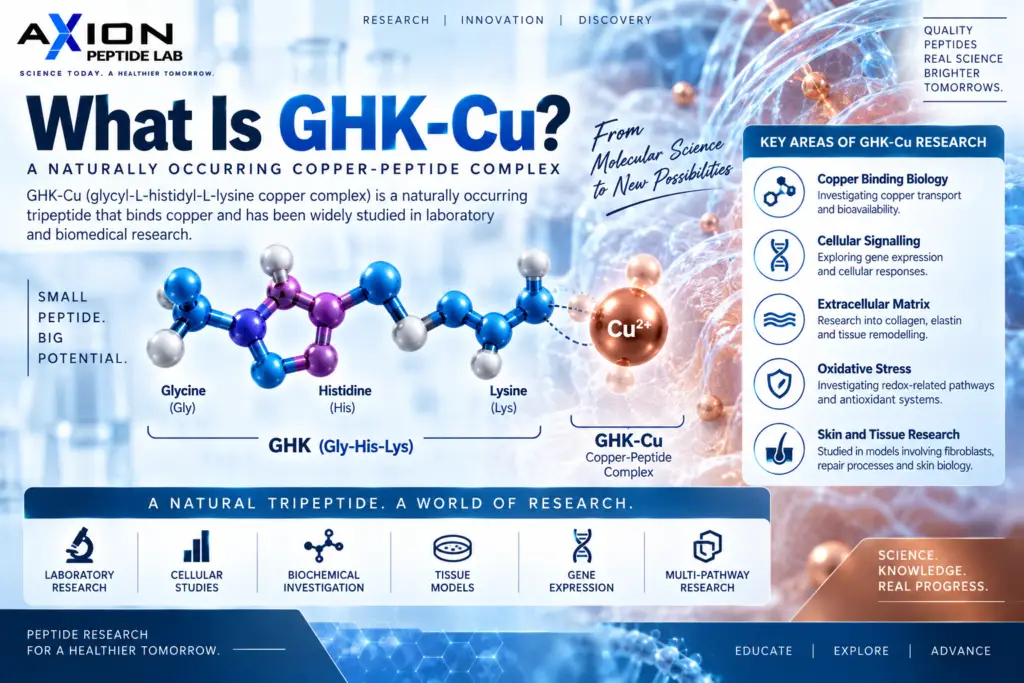
One of the three components of Alluvi Glow GHK-Cu – BPC-157 & TB-500 70mg is GHK-Cu, a naturally occurring copper-binding peptide complex that has been investigated for decades across biochemical, cellular and tissue-related research.
GHK is short for glycyl-L-histidyl-L-lysine, a tripeptide consisting of three amino acids: glycine, histidine and lysine. When GHK coordinates a copper ion, the resulting complex is commonly referred to as GHK-Cu or the GHK-copper complex.
This distinction matters.
GHK-Cu should not simply be described as a generic “copper peptide.” Its scientific identity, copper-binding properties and biological interactions are central to understanding why researchers continue to study it.
Within Alluvi Glow 70mg, GHK-Cu represents a different research pathway from BPC-157 and TB-500 and should therefore be evaluated according to its own evidence base.
GHK-Cu Structure and Identity
GHK is a relatively small peptide with the amino-acid sequence:
Gly-His-Lys
or:
Glycine – Histidine – Lysine
The histidine residue contributes to the peptide’s ability to coordinate metal ions such as copper.
The resulting GHK-Cu complex has attracted scientific interest because copper itself is an essential trace element involved in numerous biological processes.
Copper participates in the activity of several enzymes and proteins associated with cellular metabolism, antioxidant systems, connective-tissue biology and other biochemical functions.
However, free copper must also be tightly regulated within biological systems.
This creates an interesting research question: how might a naturally occurring copper-binding peptide such as GHK participate in the transport, availability or biological handling of copper?
That question forms part of the scientific foundation of GHK-Cu research.
Is GHK-Cu Naturally Occurring?
GHK was originally identified as a naturally occurring peptide in human plasma and has subsequently been detected in other biological contexts.
Its ability to bind copper led to extensive research into the GHK-Cu complex.
Researchers have investigated how GHK and GHK-Cu may participate in cellular communication and tissue-related processes.
The fact that a molecule occurs naturally, however, does not automatically establish that an externally supplied research material has therapeutic effects.
“Natural” describes biological occurrence.
It does not mean:
clinically proven
or
automatically safe for unrestricted use.
Research evidence must still be evaluated according to study design and quality.
Why Is GHK-Cu Studied?
GHK-Cu has been investigated across a broad range of experimental areas.
Published research has explored subjects including:
- copper-binding biology;
- extracellular-matrix processes;
- collagen-related experimental models;
- fibroblast activity;
- cellular signalling;
- gene-expression patterns;
- oxidative-stress-related pathways;
- tissue-remodelling models; and
- cellular responses associated with repair processes.
These areas explain why GHK-Cu appears frequently in scientific discussions surrounding tissue biology and skin-related research.
However, the wording matters.
For example:
“GHK-Cu has been investigated in experimental models involving collagen and extracellular-matrix biology”
is substantially different from:
“GHK-Cu will rebuild your skin.”
The first describes an area of scientific investigation.
The second makes a clinical or cosmetic outcome claim that requires much stronger evidence.
GHK-Cu and Extracellular-Matrix Research
One important area of GHK-Cu research involves the extracellular matrix.
The extracellular matrix is the network of proteins and other molecules surrounding cells that contributes to tissue structure and cellular communication.
Components of the extracellular matrix include proteins such as:
- collagen;
- elastin;
- fibronectin; and
- various proteoglycans.
Researchers have investigated whether GHK-Cu influences cellular processes associated with extracellular-matrix production, breakdown and remodelling.
This has contributed to interest in GHK-Cu within experimental models involving fibroblasts and connective-tissue biology.
However, extracellular-matrix activity observed in laboratory experiments should not automatically be converted into claims about human rejuvenation, scar removal or guaranteed tissue repair.
GHK-Cu and Collagen Research
GHK-Cu is also frequently discussed alongside collagen research.
Collagen is one of the major structural proteins in connective tissues.
Experimental studies have investigated relationships between GHK-Cu and processes involving collagen synthesis or remodelling.
This research contributes to the compound’s prominence in skin and tissue science.
But again, the evidence should be described precisely.
A study demonstrating an effect on a collagen-related marker in a laboratory model is not equivalent to proving that a particular GHK-Cu research product will produce a specific visible result in humans.
This distinction is particularly important when writing SEO content because phrases such as “copper peptide benefits” can easily lead to exaggerated interpretations.
GHK-Cu and Cellular Signalling
Another research area involves how GHK-Cu may influence cellular signalling.
Cells continuously respond to chemical signals from their environment.
These signals can affect processes such as:
- gene transcription;
- protein production;
- enzyme activity;
- cell migration;
- proliferation; and
- extracellular-matrix regulation.
Research involving GHK-Cu has explored several of these processes.
Some studies have also examined changes in gene-expression patterns associated with GHK exposure.
Such findings are scientifically interesting because they suggest that a small tripeptide complex may participate in broader regulatory networks.
However, gene-expression changes are not automatically beneficial.
Researchers must determine what changes occur, under which conditions, in which cells and whether they produce biologically meaningful outcomes.
GHK-Cu and Oxidative-Stress Research
Copper plays roles in enzymes involved in oxidative biology, making redox-related research another area of interest.
Researchers have investigated GHK-Cu in experimental contexts involving oxidative stress and antioxidant-associated pathways.
This does not mean GHK-Cu should automatically be marketed as an “antioxidant treatment.”
Instead, the scientifically appropriate interpretation is that researchers continue to investigate how the copper-peptide complex interacts with cellular systems involved in redox regulation.
Why Is GHK-Cu Associated With Skin Research?
GHK-Cu has become strongly associated with skin research because several of the biological areas investigated—fibroblast activity, extracellular-matrix biology and collagen-related processes—are relevant to skin structure.
This has also contributed to the popularity of the term “copper peptide” in cosmetic science.
However, three categories should remain separate:
Laboratory research involving GHK-Cu
Cosmetic products containing copper peptides
Medicinal products making therapeutic claims
These categories can have different evidence requirements, formulations and regulatory considerations.
The presence of GHK-Cu in one category does not automatically validate claims made in another.
GHK-Cu and the “Glow Peptide” Name
The inclusion of GHK-Cu is one reason blends such as Alluvi Glow 70mg may be associated with the broader online term “Glow peptide.”
But “Glow peptide” is not a formal scientific classification.
Researchers should focus on the actual molecular composition rather than the marketing terminology.
For Alluvi Glow, the relevant scientific identity is:
GHK-Cu + BPC-157 + TB-500
not simply:
“Glow peptide.”
This distinction improves both scientific accuracy and transparency.
What Does the Scientific Evidence for GHK-Cu Show?
GHK-Cu has a substantial experimental research history, but the strength of evidence varies depending on the specific claim being examined.
The literature includes:
Biochemical research
Examining copper binding and molecular interactions.
Cellular research
Investigating fibroblasts, extracellular-matrix processes, signalling and gene expression.
Animal and tissue models
Exploring biological responses under controlled experimental conditions.
Human/cosmetic research
Some research has investigated topical copper-peptide applications and skin-related outcomes.
These evidence levels should not be combined indiscriminately.
A useful hierarchy is:
Biochemical evidence
↓
Shows molecular interactions
Cellular evidence
↓
Shows what happens in particular cells under defined conditions
Animal/preclinical evidence
↓
Provides information within whole-organism experimental models
Human clinical evidence
↓
Tests defined interventions in people
Each level answers different scientific questions.
What GHK-Cu Research Does Not Prove
Scientific interest in GHK-Cu does not establish every claim made about it online.
Research should not automatically be interpreted as proof that GHK-Cu:
- reverses aging;
- permanently removes wrinkles;
- heals injuries;
- treats disease;
- regenerates damaged organs;
- produces guaranteed hair growth; or
- provides a specific therapeutic outcome.
Those are much stronger claims than stating that GHK-Cu has been investigated in particular biological pathways.
A responsible research article should explain both what scientists have observed and what remains uncertain.
GHK-Cu Within Alluvi Glow 70mg
The presence of GHK-Cu in Alluvi Glow GHK-Cu – BPC-157 & TB-500 70mg does not mean that research findings involving isolated GHK-Cu automatically apply to the entire blend.
This distinction is fundamental.
If a published experiment investigates:
GHK-Cu alone
the resulting findings support conclusions about the material and experimental conditions used in that study.
They do not automatically establish:
GHK-Cu + BPC-157 + TB-500 = the same outcome.
A multi-component formulation introduces additional variables and would need to be evaluated accordingly.
GHK-Cu Research at Axion Peptide Lab
For legitimate researchers investigating copper-peptide chemistry, cellular signalling or related laboratory questions, GHK-Cu-containing materials can provide a basis for controlled experimental work.
Within the Alluvi Glow 70mg research blend available from Axion Peptide Lab, GHK-Cu forms one part of a three-component formulation alongside BPC-157 and TB-500.
Researchers should evaluate the exact product specification and available batch documentation when determining suitability for an experimental protocol.
Product-specific claims concerning purity, composition, testing, sterility or storage should be based on verified documentation rather than assumed from general information about GHK-Cu.
The next section examines BPC-157, including its molecular identity, why it has attracted substantial research interest and why the predominantly preclinical nature of its evidence is important when interpreting popular claims.
For Research Use Only – Not for human or veterinary consumption or administration.
What Is BPC-157?
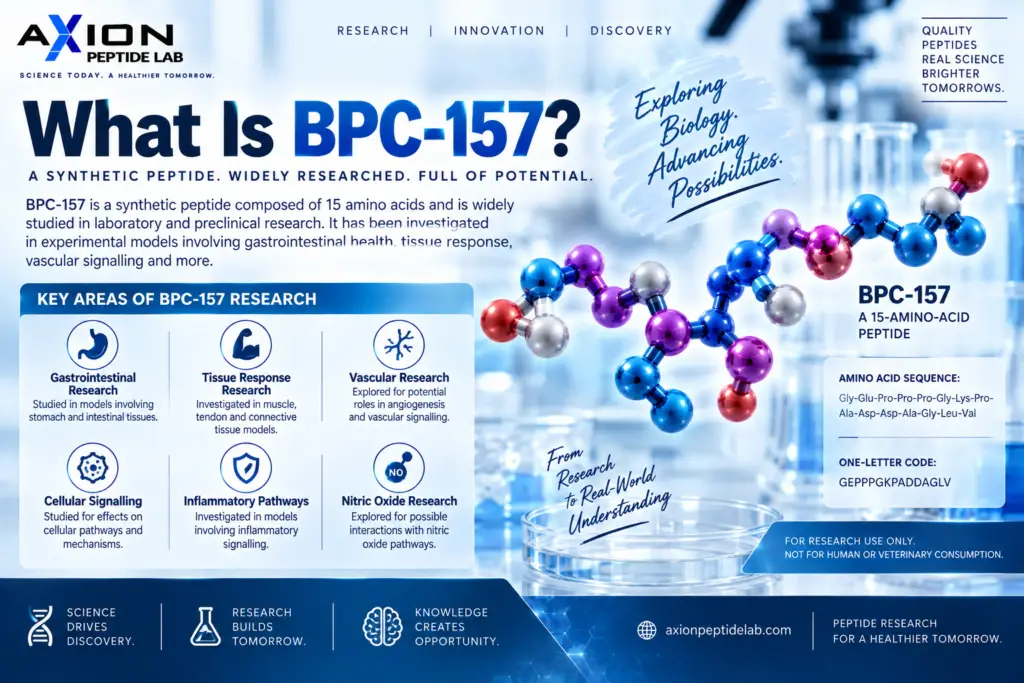
BPC-157 is one of the three research components in Alluvi Glow GHK-Cu – BPC-157 & TB-500 70mg. It is generally described as a synthetic peptide composed of 15 amino acids and has become widely discussed in experimental research involving gastrointestinal biology, tissue-response models, vascular signalling and other cellular processes.
The amino-acid sequence commonly reported for BPC-157 is:
Gly-Glu-Pro-Pro-Pro-Gly-Lys-Pro-Ala-Asp-Asp-Ala-Gly-Leu-Val
or:
GEPPPGKPADDAGLV
Although BPC-157 has attracted substantial attention online, its popularity should not be confused with the maturity of its clinical evidence.
A significant portion of the published research surrounding BPC-157 comes from preclinical studies, particularly animal and laboratory models. This means claims about established human therapeutic effects require considerable caution.
Within Alluvi Glow 70mg, BPC-157 should therefore be understood as an experimental research component, not as an approved treatment.
BPC-157 Structure and Research Background
BPC-157 is a relatively short peptide containing 15 amino-acid residues.
It is frequently described in research literature as being derived conceptually from a sequence associated with a gastric protein referred to as body protection compound, which is where the abbreviation “BPC” originates.
Researchers have investigated BPC-157 in numerous experimental models, contributing to its visibility in peptide research.
However, there is an important distinction between:
a compound being investigated
and
a compound having established clinical efficacy.
Preclinical experiments are often designed to identify mechanisms, generate hypotheses and determine whether additional research is justified. They are not substitutes for well-controlled human clinical trials.
Why Is BPC-157 Studied?
Published experimental research involving BPC-157 has explored several biological areas.
These include models involving:
- gastrointestinal tissues;
- vascular responses;
- inflammatory signalling;
- tissue-response processes;
- cellular migration;
- angiogenesis-related mechanisms;
- musculoskeletal experimental models; and
- interactions with several signalling systems.
These areas help explain why BPC-157 appears frequently in discussions about peptide science.
The scientifically appropriate wording, however, is that BPC-157 has been investigated in these experimental contexts.
That is different from stating that it has been clinically proven to heal a particular injury, repair an organ or treat a disease.
BPC-157 and Gastrointestinal Research
One of the most prominent areas in the BPC-157 literature involves the gastrointestinal system.
Preclinical researchers have examined BPC-157 in experimental models involving the stomach, intestinal tissues and other parts of the gastrointestinal tract.
This research has contributed to hypotheses about possible relationships between BPC-157 and tissue-protective or signalling processes.
However, animal gastrointestinal models cannot automatically predict what would happen in humans.
Differences in:
- physiology;
- metabolism;
- experimental exposure;
- study design;
- disease models; and
- biological endpoints
can all affect whether preclinical findings ultimately translate into clinically meaningful outcomes.
This is why statements such as “BPC-157 has been studied in gastrointestinal models” are more scientifically defensible than claiming that BPC-157 is a proven treatment for gastrointestinal disorders.
BPC-157 and Tissue-Response Research
BPC-157 is also frequently discussed in relation to tissue-response research.
Experimental studies have investigated biological processes relevant to connective tissue, muscle, tendon and other tissue models.
Researchers may examine factors such as:
- cellular migration;
- vascular responses;
- extracellular-matrix interactions;
- signalling molecules;
- inflammatory mediators; and
- tissue organization.
These models can help scientists understand biological mechanisms and identify questions for future research.
But evidence from an experimental tissue model should not be translated directly into claims such as:
“BPC-157 repairs injuries.”
That statement would imply an established therapeutic outcome.
A more accurate description is:
BPC-157 has been investigated in preclinical models involving tissue-response and repair-related biological processes.
BPC-157 and Vascular Research
Another area of scientific interest involves vascular biology.
Blood vessels are involved in nutrient delivery, oxygen transport and numerous tissue processes.
Some experimental BPC-157 research has examined vascular responses and pathways associated with angiogenesis, the biological process through which new blood vessels form from existing vasculature.
Researchers have also investigated potential interactions between BPC-157 and signalling systems associated with vascular function.
Again, mechanistic research does not automatically establish clinical benefit.
An observed change in a vascular marker or animal model may provide a hypothesis that requires further testing rather than a final medical conclusion.
BPC-157 and Nitric Oxide Research
BPC-157 has also been discussed in experimental literature involving the nitric oxide (NO) system.
Nitric oxide is an important signalling molecule involved in vascular biology and numerous other physiological processes.
Some preclinical studies have investigated whether BPC-157 interacts with nitric-oxide-related pathways.
This is scientifically relevant because changes in NO signalling can influence several biological systems.
However, the precise mechanisms and clinical relevance require careful interpretation.
Rather than describing BPC-157 as a “nitric oxide booster,” research-focused content should state that relationships between BPC-157 and nitric-oxide-related signalling have been explored experimentally.
BPC-157 and Inflammatory Signalling
Inflammation is another complex biological process frequently discussed in relation to BPC-157.
Researchers can study inflammatory responses by examining:
- cytokines;
- immune-cell behaviour;
- signalling pathways;
- oxidative processes; and
- tissue responses.
Some experimental studies involving BPC-157 have reported changes in inflammation-associated markers or outcomes.
However, this does not establish BPC-157 as an approved anti-inflammatory medicine.
Inflammation itself involves numerous pathways, and an effect observed in one experimental model may not reproduce in another biological system.
What Does BPC-157 Research Actually Show?
The most important point for interpreting BPC-157 research is the evidence hierarchy.
The available literature has historically been heavily weighted toward preclinical research.
A simplified evidence framework is:
Cellular and biochemical research
↓
Can investigate mechanisms and molecular interactions.
Animal research
↓
Can examine effects within whole-organism experimental models.
Early human research
↓
Can begin evaluating how findings translate to people.
Large randomized controlled clinical trials
↓
Provide substantially stronger evidence for clinical safety and efficacy.
Much of the enthusiasm surrounding BPC-157 has developed before the accumulation of the kind of large, replicated human clinical-trial evidence expected for an established medicine.
This limitation should be stated clearly whenever BPC-157 is discussed.
Why Animal Studies Are Not Enough
Animal studies are an important part of biomedical research.
They can help researchers investigate:
- biological mechanisms;
- pharmacological effects;
- potential toxicity;
- dose-response relationships; and
- whether further investigation is justified.
But successful results in animals do not guarantee successful results in humans.
Many experimental compounds that appear promising during preclinical development fail to demonstrate sufficient effectiveness or acceptable safety during later clinical testing.
Therefore:
promising animal research ≠ proven human treatment.
This principle is especially important for BPC-157 because online discussions sometimes present preclinical findings as though they were established clinical facts.
Is BPC-157 an Approved Medicine?
BPC-157 should not be described as an FDA-approved or MHRA-authorised medicine.
Its appearance in research literature and online peptide catalogues does not establish regulatory approval for treating injuries, gastrointestinal conditions or other medical problems.
Regulatory status should also be checked against current authoritative sources whenever an article is updated because rules and agency positions can change.
For a research-focused website, the appropriate positioning is:
BPC-157 research material
rather than:
BPC-157 treatment.
BPC-157 vs GHK-Cu
BPC-157 and GHK-Cu are both components of Alluvi Glow, but they are molecularly distinct.
GHK-Cu
→ Copper complex of the GHK tripeptide
→ Three-amino-acid peptide component plus coordinated copper
→ Research involving copper biology, extracellular-matrix processes and cellular signalling
BPC-157
→ Synthetic 15-amino-acid peptide
→ Different molecular structure
→ Research heavily represented by preclinical gastrointestinal, vascular and tissue-response models
The fact that both appear in the same research blend does not mean they work through identical pathways.
This diversity is one of the reasons multi-component research requires careful experimental controls.
BPC-157 Within Alluvi Glow 70mg
Within Alluvi Glow GHK-Cu – BPC-157 & TB-500 70mg, BPC-157 is one component of a three-compound research formulation.
Evidence involving BPC-157 alone should not automatically be applied to the complete blend.
The correct distinction is:
BPC-157 study
→ evidence concerning the BPC-157 material and conditions actually investigated
versus
Alluvi Glow study
→ would require investigation of the specific GHK-Cu + BPC-157 + TB-500 formulation.
This is particularly important when discussing possible combined or synergistic effects.
A blend cannot be assumed to produce the sum of every result ever reported for its individual components.
What Researchers Should Verify
Researchers considering a BPC-157-containing material should evaluate product-specific information rather than relying solely on the compound name.
Relevant factors can include:
- stated compound identity;
- amino-acid sequence;
- product format;
- stated quantity;
- batch identification;
- analytical documentation where available; and
- research-use designation.
For a blend such as Alluvi Glow, the quantity of BPC-157 within the total 70mg formulation should be confirmed from the verified product specification rather than inferred.
The same principle applies to GHK-Cu and TB-500.
BPC-157 Research at Axion Peptide Lab
Axion Peptide Lab provides BPC-157-containing research materials for legitimate laboratory, analytical and scientific investigation.
Within Alluvi Glow 70mg, BPC-157 is combined with GHK-Cu and TB-500 to create a multi-component research formulation.
Researchers should review the relevant product and available batch documentation when assessing whether the material meets the requirements of a particular experiment.
The scientific literature surrounding BPC-157 can provide useful background for experimental design, but preclinical findings should not be represented as guaranteed human outcomes or as evidence that the Alluvi Glow blend is an approved medicine.
The next section examines TB-500, including why its relationship to thymosin beta-4 requires particularly careful terminology and compound identification.
For Research Use Only – Not for human or veterinary consumption or administration.
What Is TB-500?
TB-500 is the third named component of Alluvi Glow GHK-Cu – BPC-157 & TB-500 70mg and is commonly discussed in peptide research alongside thymosin beta-4 (Tβ4).
However, TB-500 requires more careful terminology than many research compounds.
The terms “TB-500” and “thymosin beta-4” should not automatically be treated as scientifically interchangeable. Thymosin beta-4 is a specifically characterized naturally occurring peptide, whereas TB-500 is a term widely used in research-product markets and may refer to a thymosin beta-4-related material or fragment depending on the product.
For this reason, researchers working with a TB-500-labelled material should verify its exact molecular identity, amino-acid sequence and product specification rather than assuming its composition from the name alone.
This distinction is particularly important within Alluvi Glow 70mg because conclusions from published thymosin beta-4 research cannot automatically be transferred to a TB-500 component unless the molecular identity is established.
What Is Thymosin Beta-4?
Thymosin beta-4, commonly abbreviated Tβ4, is a naturally occurring peptide consisting of 43 amino-acid residues.
It is widely distributed in mammalian cells and tissues and has attracted scientific interest because of its interactions with actin, a major structural protein of the cellular cytoskeleton.
The cytoskeleton helps cells maintain their structure and participates in processes including:
- cell shape;
- cell movement;
- intracellular organization;
- cell division; and
- responses to the surrounding environment.
One of the best-characterized molecular properties of thymosin beta-4 is its ability to bind G-actin, the monomeric form of actin.
This actin-related biology has contributed substantially to scientific interest in Tβ4.
Is TB-500 the Same as Thymosin Beta-4?
This question deserves a careful answer:
Not necessarily.
In online peptide discussions, the terms TB-500 and thymosin beta-4 are sometimes used as though they describe exactly the same molecule.
That assumption can create problems for scientific research.
Full-length thymosin beta-4 has a defined 43-amino-acid sequence and molecular identity.
The term TB-500, by contrast, has been used commercially for materials described in different ways, including thymosin beta-4-related sequences or fragments.
Therefore, researchers should verify:
- amino-acid sequence;
- molecular identity;
- molecular weight where documented;
- product specification;
- stated quantity; and
- available analytical documentation.
If a product contains a fragment rather than full-length thymosin beta-4, research conducted using full-length Tβ4 cannot automatically be assumed to apply to that fragment.
Why Compound Identity Matters
Scientific literature is based on specific materials.
Imagine that a peer-reviewed experiment reports a particular result using:
Full-length thymosin beta-4
and a separate laboratory product is labelled:
TB-500
Before citing that study as evidence for the TB-500 product, researchers need to establish whether the two materials are actually molecularly equivalent.
If they are different, then the study provides background information about thymosin beta-4—not direct evidence for the separate TB-500 material.
This principle is fundamental to reproducible peptide research:
Similar names do not establish identical molecules.
Why Is Thymosin Beta-4 Studied?
Thymosin beta-4 has been investigated across several areas of experimental biology.
Published research includes studies involving:
- actin regulation;
- cytoskeletal organization;
- cell migration;
- angiogenesis-related pathways;
- tissue-response models;
- inflammatory signalling;
- extracellular-matrix processes; and
- cellular repair-related mechanisms.
These areas explain why thymosin beta-4-related terminology frequently appears in discussions about experimental tissue research.
However, these research areas should not be converted automatically into claims that TB-500 is clinically proven to heal injuries or regenerate tissues.
TB-500 and Actin Research
Actin is one of the most abundant proteins in many eukaryotic cells and plays a central role in cellular structure and movement.
Actin exists in different states, including:
G-actin — globular actin monomers
and
F-actin — filamentous structures formed through actin polymerization.
Thymosin beta-4 is known for its ability to interact with G-actin, contributing to the regulation of the cellular actin pool.
This relationship is scientifically important because actin dynamics influence numerous cellular processes.
Researchers have therefore investigated thymosin beta-4 in experimental models involving cell migration, cytoskeletal organization and tissue responses.
Again, whether a specific TB-500 material shares these properties depends on its actual molecular identity.
TB-500 and Cell-Migration Research
Cell migration is essential to many biological processes.
Cells can move in response to chemical signals, structural changes and environmental conditions.
Researchers investigating thymosin beta-4-related biology have examined processes associated with:
- cellular movement;
- cytoskeletal reorganization;
- migration signalling; and
- tissue-response mechanisms.
Such findings are relevant to basic biological research.
However, observing altered cell migration in a laboratory model is not equivalent to proving that a peptide produces a particular therapeutic result in humans.
TB-500 and Angiogenesis-Related Research
Another area associated with thymosin beta-4 research involves angiogenesis, the biological process through which new blood vessels develop from existing vasculature.
Researchers can investigate angiogenesis by studying:
- endothelial cells;
- vascular signalling;
- cell migration;
- growth factors; and
- structural changes in blood vessels.
Some thymosin beta-4 research has examined these processes.
This provides mechanistic information that may help researchers understand how the peptide interacts with vascular biology.
It does not establish TB-500 as an approved treatment for vascular or tissue conditions.
TB-500 and Tissue-Response Research
Thymosin beta-4-related literature also includes experimental studies involving tissue responses.
This has contributed to widespread online descriptions of TB-500 as a “recovery” or “healing” peptide.
Those labels can oversimplify the evidence.
A scientifically appropriate description is that thymosin beta-4 and related materials have been investigated in experimental models involving cellular migration, cytoskeletal biology, vascular responses and tissue-associated processes.
This wording describes the research without promising an outcome that has not been established for a particular product.
TB-500 and Inflammatory Research
Researchers have also explored thymosin beta-4 in experimental models involving inflammatory signalling.
Inflammation is a complex biological response involving numerous:
- immune cells;
- cytokines;
- signalling proteins;
- vascular processes; and
- cellular pathways.
Changes observed in one experimental model cannot necessarily be generalized to another.
For that reason, thymosin beta-4-related findings should not automatically be interpreted as evidence that a TB-500 product is an approved anti-inflammatory therapy.
What Does the Evidence Actually Show?
As with BPC-157, understanding the type of evidence is essential.
Research associated with thymosin beta-4 spans molecular, cellular, animal and some human clinical investigation. However, this does not mean that every TB-500-labelled research material has undergone those same studies.
Researchers should separate:
Evidence for full-length thymosin beta-4
from
Evidence for a particular thymosin beta-4 fragment
from
Evidence for a specific TB-500-labelled research material
from
Evidence for the complete Alluvi Glow formulation.
These are four different evidentiary questions.
TB-500 vs BPC-157
TB-500 and BPC-157 are frequently mentioned together online, but they are not the same compound.
BPC-157
→ Synthetic 15-amino-acid peptide
→ Experimental literature heavily weighted toward preclinical models
→ Research involving gastrointestinal, vascular and tissue-response biology
Thymosin beta-4/TB-500-related research
→ Different molecular identity
→ Full-length Tβ4 contains 43 amino acids
→ Strong connection to actin and cytoskeletal biology
→ Research involving cell migration, vascular and tissue-response processes
→ Exact TB-500 product identity must be verified
The fact that both appear in Alluvi Glow 70mg does not mean they share identical mechanisms.
TB-500 vs GHK-Cu
The difference from GHK-Cu is even clearer.
GHK-Cu
→ Copper complex of the GHK tripeptide
→ Copper-binding biology
→ Extracellular-matrix and cellular-signalling research
TB-500 / Tβ4-related material
→ Peptide identity must be established
→ Thymosin beta-4 biology strongly involves actin
→ Cytoskeletal and cell-migration research
These different molecular characteristics demonstrate why Alluvi Glow should be understood as a multi-component research formulation rather than one peptide acting through a single mechanism.
TB-500 Within Alluvi Glow 70mg
Within Alluvi Glow GHK-Cu – BPC-157 & TB-500 70mg, TB-500 represents one of three named components.
For rigorous scientific use, researchers should verify precisely what the TB-500 designation represents in the formulation.
Relevant documentation may include:
- stated compound identity;
- amino-acid sequence;
- molecular form;
- stated quantity;
- batch information; and
- analytical documentation where available.
The amount of TB-500 within the overall 70mg formulation should likewise be taken from the verified Alluvi product specification rather than inferred.
Does Combining TB-500 With BPC-157 and GHK-Cu Prove Synergy?
No.
The presence of three research compounds within one formulation does not establish synergistic activity.
Evidence involving:
GHK-Cu alone
BPC-157 alone
thymosin beta-4 or another TB-500-related material alone
does not automatically prove the effects of:
Alluvi Glow GHK-Cu + BPC-157 + TB-500.
The complete formulation would require appropriate experimental investigation before specific combined effects could be established.
Is TB-500 an Approved Medicine?
A TB-500-labelled research material should not be represented as an FDA-approved or MHRA-authorised medicine unless a specific regulatory authorization actually exists for the precise product and indication being discussed.
Research literature does not itself constitute regulatory approval.
Likewise, experimental findings should not be used to provide human dosing, self-administration or treatment recommendations for a research product.
Current regulatory information should always be checked with authoritative agencies when evaluating the status of a particular compound.
TB-500 Research at Axion Peptide Lab
Within Alluvi Glow GHK-Cu – BPC-157 & TB-500 70mg, Axion Peptide Lab provides a multi-component material intended for legitimate laboratory, analytical and scientific investigation.
Researchers evaluating its TB-500 component should consult the product specification and available batch-specific documentation to establish its identity and suitability for the intended experiment.
This identity-first approach is particularly important when interpreting thymosin beta-4 literature because research findings should be connected to the molecule actually investigated—not simply to a similar commercial name.
With all three individual components now established, the next section can compare GHK-Cu vs BPC-157 vs TB-500 side by side, including their molecular characteristics, major research areas and differences in the maturity of their evidence.
For Research Use Only – Not for human or veterinary consumption or administration.
GHK-Cu vs BPC-157 vs TB-500: What’s the Difference?
Understanding the difference between GHK-Cu vs BPC-157 vs TB-500 is essential when evaluating Alluvi Glow GHK-Cu – BPC-157 & TB-500 70mg. Although all three names appear within the same research blend, they are not interchangeable compounds and should not be assumed to act through identical biological pathways.
GHK-Cu is a copper-binding tripeptide complex. BPC-157 is generally described as a synthetic 15-amino-acid peptide. TB-500 is commonly associated with thymosin beta-4-related research, although the exact molecular identity of a TB-500-labelled material should be verified rather than assumed.
The simplest comparison is:
GHK-Cu → Copper-peptide biology
BPC-157 → Experimental peptide research across several preclinical biological models
TB-500/Tβ4-related material → Actin, cytoskeletal and cell-migration-related research
These distinctions help explain why a multi-component formulation such as Alluvi Glow should be evaluated differently from a single-compound research product.
GHK-Cu vs BPC-157 vs TB-500 at a Glance
| Research characteristic | GHK-Cu | BPC-157 | TB-500 / Tβ4-related material |
| General identity | Copper complex of GHK | Synthetic peptide | Product identity should be verified |
| Peptide characteristics | GHK is a tripeptide | 15-amino-acid peptide | Full-length Tβ4 contains 43 amino acids; TB-500 terminology may vary |
| Key structural feature | Copper coordination | Defined synthetic peptide sequence | Thymosin beta-4-related identity requires clarification |
| Common research context | Copper biology, extracellular matrix, cellular signalling | Gastrointestinal, vascular and tissue-response models | Actin, cytoskeleton, cell migration and tissue-response research |
| Copper binding | Central characteristic | Not defining characteristic | Not defining characteristic |
| Actin-related biology | Not primary defining mechanism | Not primary defining mechanism | Important in full-length thymosin beta-4 biology |
| Evidence profile | Biochemical, cellular, preclinical and some human/cosmetic research | Predominantly preclinical literature | Depends on whether evidence concerns Tβ4, a fragment or specific TB-500 material |
| Approved medicine? | Research material should not be represented as an approved medicine | Should not be represented as an approved medicine | TB-500 research material should not be represented as an approved medicine |
| Role in Alluvi Glow | One component | One component | One named component; exact identity should be verified |
This comparison also highlights why evidence from one component cannot automatically establish the properties of the other two or of the finished blend.
How Is GHK-Cu Different?
GHK-Cu is unique among the three because its scientific identity centers on a peptide-metal complex.
GHK consists of:
Glycine – Histidine – Lysine
The peptide can coordinate copper, producing the complex commonly known as GHK-Cu.
This copper-binding property has contributed to research involving:
- copper homeostasis;
- extracellular-matrix biology;
- fibroblast-associated processes;
- collagen-related experimental models;
- cellular signalling;
- gene-expression patterns; and
- oxidative-stress-related pathways.
This makes GHK-Cu substantially different from BPC-157 and thymosin beta-4-related materials at the molecular level.
It should therefore not simply be grouped with them under a generic idea that all three are “repair peptides.”
That terminology can obscure meaningful differences in their chemistry and evidence.
How Is BPC-157 Different?
BPC-157 has a different molecular identity and research history.
It is generally represented by the 15-amino-acid sequence:
GEPPPGKPADDAGLV
Much of the scientific interest surrounding BPC-157 comes from experimental models involving:
- gastrointestinal biology;
- tissue responses;
- vascular signalling;
- angiogenesis-related mechanisms;
- nitric-oxide-related pathways; and
- inflammatory processes.
Unlike GHK-Cu, copper coordination is not the defining characteristic of BPC-157.
Unlike full-length thymosin beta-4, actin binding is not its primary defining molecular feature.
BPC-157 therefore occupies its own research category within the Alluvi Glow formulation.
How Is TB-500 Different?
TB-500 presents a different challenge because the terminology itself must be examined.
Full-length thymosin beta-4 (Tβ4) is a naturally occurring 43-amino-acid peptide with well-characterized interactions involving actin.
The term TB-500, however, has been used commercially in ways that may refer to thymosin beta-4-related materials or fragments.
This means the first question in a TB-500 experiment should be:
What molecule is actually present?
Only after establishing the molecular identity can researchers determine which scientific literature is directly relevant.
For full-length thymosin beta-4, major research areas include:
- G-actin binding;
- cytoskeletal regulation;
- cell migration;
- angiogenesis-related processes;
- tissue-response models; and
- inflammatory signalling.
If the TB-500 component is a different sequence or fragment, evidence involving full-length Tβ4 should not automatically be attributed to it.
Do GHK-Cu, BPC-157 and TB-500 Work Through the Same Pathway?
No.
There is no single “Glow peptide pathway.”
These compounds have different molecular characteristics and have been investigated through different biological frameworks.
A simplified research map looks like this:
GHK-Cu
↓
Copper coordination
↓
Copper-related biochemistry
Cellular signalling
Extracellular-matrix research
BPC-157
↓
Experimental peptide signalling
↓
Gastrointestinal models
Vascular research
Tissue-response research
Tβ4/TB-500-related research
↓
Actin-associated biology
↓
Cytoskeletal regulation
Cell migration
Tissue-response research
Some experimental areas overlap, particularly tissue-related research, but overlapping research topics do not establish identical mechanisms.
Why Do All Three Appear in Alluvi Glow 70mg?
The scientific rationale for a multi-component formulation is different from that of a single-peptide material.
Alluvi Glow GHK-Cu – BPC-157 & TB-500 70mg places the three named research components within one formulation, allowing the complete mixture to be investigated where an experimental design specifically calls for a multi-component system.
Researchers may be interested in questions involving:
- multiple biochemical pathways;
- interactions among research compounds;
- analytical behaviour of peptide mixtures;
- comparative cellular responses; and
- multi-component experimental models.
However, the presence of multiple compounds does not establish that they have a beneficial interaction.
That requires experimental evidence.
Does GHK-Cu + BPC-157 + TB-500 Have a Proven Synergistic Effect?
A synergistic effect should not be assumed.
Scientific synergy means that the effect produced by a combination is greater than what would be expected from the individual components under defined conditions.
Demonstrating this requires appropriately designed experiments.
For example, researchers might need experimental groups examining:
Control
GHK-Cu alone
BPC-157 alone
TB-500-related material alone
GHK-Cu + BPC-157
GHK-Cu + TB-500
BPC-157 + TB-500
GHK-Cu + BPC-157 + TB-500
Only then, with suitable endpoints and statistical analysis, could researchers begin evaluating whether interactions are additive, synergistic, neutral or potentially antagonistic.
Simply combining the compounds in one vial does not answer that question.
Which Has the Strongest Scientific Evidence?
There is no useful single answer because the evidence concerns different questions.
GHK-Cu has an established history of biochemical and cellular research, including copper-binding and extracellular-matrix-related investigation.
BPC-157 has a substantial experimental literature, but its evidence has historically been heavily weighted toward preclinical models, which limits strong conclusions about human clinical effects.
Thymosin beta-4 has its own molecular, cellular, preclinical and clinical research history. But that literature cannot automatically be described as “TB-500 evidence” unless the TB-500 material being discussed is established to be molecularly relevant to the study.
Researchers should therefore ask:
What specific claim is being evaluated?
What molecule was actually studied?
Was the experiment cellular, animal or human?
Was the study controlled?
Has the result been independently replicated?
Does the evidence concern the individual compound or the Alluvi Glow formulation?
These questions are more useful than attempting to rank the three peptides as simply “best” or “strongest.”
Can Research Findings From One Component Be Applied to the Others?
No.
A finding involving GHK-Cu does not prove that BPC-157 produces the same response.
A BPC-157 animal study does not establish an effect for TB-500.
A thymosin beta-4 experiment does not automatically prove an effect for an unidentified TB-500 fragment.
Most importantly:
Evidence for the individual components does not automatically become evidence for Alluvi Glow 70mg.
This is a crucial distinction for accurate scientific and SEO content.
Single-Compound Research vs Alluvi Glow
Single-compound materials can be useful when researchers want to isolate a variable.
For example:
GHK-Cu alone
→ allows investigation specifically focused on GHK-Cu.
BPC-157 alone
→ allows BPC-157 to be studied independently.
Precisely identified Tβ4/TB-500-related material alone
→ allows investigation of that specific molecule.
A multi-component product such as Alluvi Glow 70mg is different because researchers must account for all components simultaneously.
This can make the formulation relevant to specific multi-component experimental questions while also making interpretation more complex.
Why the 70mg Composition Matters
When comparing GHK-Cu, BPC-157 and TB-500 within Alluvi Glow, researchers should know the verified quantity of each component.
The total 70mg designation alone does not reveal the ratio.
Researchers should not assume that the formulation contains equal quantities of all three compounds.
The exact composition should be taken from the relevant product specification or batch documentation.
This is especially important when comparing experimental results because different component ratios can influence the interpretation of a multi-compound system.
Are GHK-Cu, BPC-157 and TB-500 Prescription Medicines?
Research materials carrying these names should not be presented as prescription medicines simply because scientific literature exists for related compounds.
The distinction remains:
Laboratory research material
→ Intended for controlled scientific and analytical investigation.
Investigational compound
→ May be undergoing formal research but is not automatically approved.
Approved medicine
→ A specific pharmaceutical product authorised by a regulator for defined clinical use.
The Alluvi Glow formulation belongs in the research-material context, not the prescription-medicine category.
GHK-Cu vs BPC-157 vs TB-500: Key Takeaway
The most important differences can be summarized as:
GHK-Cu
→ Copper-binding tripeptide complex
→ Strong association with copper biology, cellular signalling and extracellular-matrix research
BPC-157
→ Synthetic 15-amino-acid peptide
→ Predominantly preclinical research involving gastrointestinal, vascular and tissue-response models
TB-500/Tβ4-related material
→ Exact identity requires verification
→ Full-length thymosin beta-4 is strongly associated with actin and cytoskeletal biology
Alluvi Glow 70mg
→ Combines all three named components into one research formulation
→ Does not automatically inherit every reported effect of the individual compounds
→ Requires its own evidence before specific combined or synergistic effects can be established
For legitimate researchers, Axion Peptide Lab provides Alluvi Glow and related research materials for laboratory, analytical and scientific investigation. Researchers should consult product-specific specifications and available documentation when assessing the identity and composition of materials for experimental use.
The next section examines the question this comparison naturally raises: how might GHK-Cu, BPC-157 and TB-500 be studied together in a multi-pathway research model, and what would be required to demonstrate genuine interactions between them?
For Research Use Only – Not for human or veterinary consumption or administration.
How Might the Components of Alluvi Glow Be Studied Together?
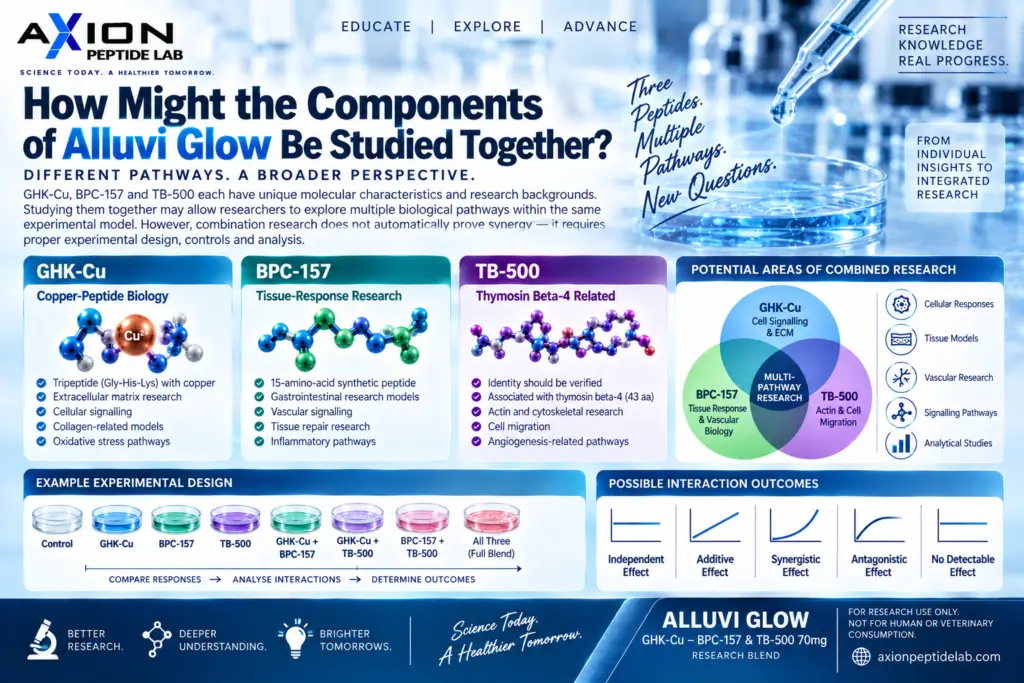
One of the most interesting scientific questions surrounding Alluvi Glow GHK-Cu – BPC-157 & TB-500 70mg is how its three named components might be investigated together.
GHK-Cu, BPC-157 and TB-500 are associated with different areas of experimental research. This makes their inclusion within a single formulation potentially relevant to multi-component and multi-pathway laboratory studies.
However, an important distinction must be established from the beginning:
Combining three research compounds does not prove that they work synergistically.
Scientific evidence concerning GHK-Cu, BPC-157 or thymosin beta-4-related biology individually cannot simply be added together to predict the behaviour of the complete Alluvi Glow formulation.
The combined blend represents a separate experimental question.
What Is Multi-Pathway Peptide Research?
Biological systems rarely operate through one isolated pathway.
Cells communicate through networks involving receptors, enzymes, signalling proteins, structural molecules, metal ions, transcription factors and extracellular components.
Multi-pathway research examines how more than one of these systems behaves within the same experimental model.
For Alluvi Glow, researchers may be interested in the different research contexts associated with its three components:
GHK-Cu
→ copper-related biochemistry, cellular signalling and extracellular-matrix research
BPC-157
→ experimental gastrointestinal, vascular and tissue-response models
TB-500/Tβ4-related material
→ actin-associated biology, cytoskeletal processes and cell-migration research
The presence of these different research contexts makes the formulation more complex than a single-peptide material.
Why Study Multiple Compounds Together?
Single-compound experiments are valuable because they allow researchers to isolate variables.
If researchers expose a model only to GHK-Cu, for example, interpreting a resulting molecular change may be more straightforward than if several compounds are present simultaneously.
Combination research asks a different question:
What happens when defined compounds are present within the same experimental system?
Researchers might investigate whether the combination produces:
- independent responses;
- overlapping responses;
- additive effects;
- synergistic interactions;
- antagonistic interactions; or
- no meaningful interaction.
None of these outcomes should be assumed before experimentation.
This is why multi-component research requires appropriate controls and careful interpretation.
GHK-Cu + BPC-157 Research Context
GHK-Cu and BPC-157 have both appeared in research involving tissue-associated biological processes, but they are molecularly different compounds.
GHK-Cu research includes areas involving:
- copper coordination;
- extracellular-matrix biology;
- fibroblast-associated processes;
- collagen-related experimental models; and
- cellular signalling.
BPC-157 research has included experimental models involving:
- gastrointestinal biology;
- vascular signalling;
- tissue responses;
- angiogenesis-related processes; and
- inflammatory signalling.
The overlap in broad research topics can create interest in studying the two compounds within the same experimental framework.
However, overlapping research areas do not prove complementary or synergistic activity.
A scientifically controlled experiment would be required to determine how the compounds interact under defined conditions.
BPC-157 + TB-500 Research Context
BPC-157 and TB-500 are frequently discussed together online, particularly under terms such as “peptide stack.”
For scientific content, that terminology should be handled cautiously.
Online popularity does not establish clinical evidence.
BPC-157 has a research literature that is heavily preclinical, while TB-500 terminology can refer to materials whose relationship to full-length thymosin beta-4 needs to be established.
Before comparing or combining the two experimentally, researchers should therefore answer two basic questions:
What exact BPC-157 material is being studied?
and
What exact molecule does the TB-500 designation represent?
Only after molecular identity is established can relevant scientific literature be applied appropriately.
GHK-Cu + TB-500 Research Context
GHK-Cu and thymosin beta-4-related materials also represent different molecular research areas.
GHK-Cu is particularly associated with copper-peptide biology and extracellular-matrix research, whereas full-length thymosin beta-4 is well known for interactions involving G-actin and cytoskeletal regulation.
A laboratory study might therefore examine how different cellular or molecular endpoints behave when both materials are present.
But again, the scientific question is whether an interaction occurs—not an assumption that one already exists.
Studying GHK-Cu + BPC-157 + TB-500 Together
The complete Alluvi Glow 70mg research blend introduces all three named components into one formulation.
Conceptually, researchers might investigate the blend through models involving:
- cellular signalling;
- extracellular-matrix biology;
- cell migration;
- peptide interactions;
- biochemical assays;
- analytical characterisation;
- comparative cellular-response studies; or
- other appropriately validated experimental systems.
The precise experiment should determine which claims can eventually be made.
For example, observing a change in a cellular marker would support a conclusion about that marker under those particular experimental conditions.
It would not automatically prove a broad therapeutic effect.
What Does “Synergy” Actually Mean?
The word synergy is commonly used in supplement and peptide marketing, but scientifically it has a much more specific meaning.
Suppose compound A produces a measurable response and compound B also produces a response.
If the two compounds are combined, several outcomes are possible:
Independent effect
→ Each compound behaves largely independently.
Additive effect
→ The combined response approximates the expected contribution of both.
Synergistic effect
→ The interaction produces an effect greater than an appropriately defined expected combined effect.
Antagonistic effect
→ One compound reduces or modifies the effect of another.
No detectable effect
→ The combination produces no meaningful difference for the endpoint studied.
Therefore, simply observing that GHK-Cu, BPC-157 and TB-500 have each been studied separately does not establish synergy.
How Could Researchers Test for Combined Effects?
A well-controlled experimental design could compare multiple conditions rather than evaluating only the finished blend.
Conceptually, groups might include:
Control
GHK-Cu alone
BPC-157 alone
precisely identified TB-500-related material alone
GHK-Cu + BPC-157
GHK-Cu + TB-500
BPC-157 + TB-500
GHK-Cu + BPC-157 + TB-500
Researchers could then compare predefined experimental endpoints across groups.
The specific methods would depend on the scientific question, model and validated laboratory protocol.
This approach helps distinguish whether an observation is associated with one component or with an interaction among several components.
Why Experimental Controls Matter
Controls are fundamental to meaningful laboratory research.
Without appropriate controls, researchers may observe a change but be unable to determine what caused it.
For a multi-component formulation, controls can help answer questions such as:
- Is GHK-Cu responsible for the observation?
- Is BPC-157 responsible?
- Is the TB-500-related material responsible?
- Do two compounds interact?
- Is the complete three-component blend different?
- Could the result be caused by another experimental variable?
This is one reason studying a blend can be more complicated than studying an isolated compound.
Why the Exact Alluvi Glow Composition Matters
Multi-component research also depends on knowing how much of each compound is actually present.
The product’s 70mg designation identifies the stated total amount associated with the formulation, but it does not by itself establish the quantity of each component.
Researchers should use the verified product specification to determine the exact allocation of:
GHK-Cu
BPC-157
and
TB-500
within the formulation.
The ratios matter because changing the relative amount of one component could potentially alter the behaviour of an experimental system.
For this reason, composition should never be guessed from the total 70mg label.
Why Evidence for Individual Peptides Cannot Simply Be Combined
Suppose a study reports a particular laboratory observation involving GHK-Cu.
A second study reports another observation involving BPC-157.
A third publication describes full-length thymosin beta-4.
It would be scientifically incorrect to combine the conclusions and state that Alluvi Glow necessarily produces all three outcomes.
The studies may differ in:
- compound identity;
- concentration;
- experimental model;
- exposure conditions;
- study duration;
- endpoints;
- methodology; and
- quality of evidence.
Most importantly, none may have investigated the specific Alluvi Glow formulation.
Therefore:
Evidence for ingredient A + evidence for ingredient B + evidence for ingredient C ≠ evidence for finished blend ABC.
Preclinical Findings vs Human Clinical Evidence
This distinction becomes even more important when experimental findings are discussed online.
A cellular study may reveal an interesting mechanism.
An animal study may provide evidence that the mechanism operates within a more complex biological system.
Neither automatically proves that the same result will occur in humans.
Likewise, research on individual compounds cannot establish the clinical safety or effectiveness of a multi-component formulation.
This is why Alluvi Glow should be discussed as a laboratory research blend, not as a clinically proven treatment.
Multi-Component Research vs “Peptide Stacking”
The term “peptide stacking” is common in online communities, but it can imply personal-use practices rather than controlled laboratory science.
For an evidence-based research article, multi-component peptide research is the more appropriate concept.
The distinction is meaningful:
Peptide stacking in consumer discussions
→ may involve anecdotal claims, personal-use protocols or unsupported combinations.
Multi-component laboratory research
→ involves defined compounds, controlled conditions, experimental endpoints, documentation and appropriate analysis.
Axion’s research content should remain within the second category.
Analytical Research on Peptide Blends
Not every Alluvi Glow experiment needs to investigate biological effects.
Multi-component formulations can also create interesting analytical chemistry questions.
Researchers may investigate areas such as:
- compound identification;
- mixture composition;
- chromatographic behaviour;
- mass-spectrometric characterisation;
- degradation profiles;
- stability under defined laboratory conditions; and
- interactions that affect analytical measurements.
For these experiments, precise knowledge of each component is particularly important.
Why Reproducibility Matters
A scientific finding becomes more valuable when independent researchers can reproduce it.
For multi-component peptide research, reproducibility depends on clearly documenting variables such as:
- molecular identity;
- component ratios;
- experimental model;
- analytical methods;
- controls;
- environmental conditions; and
- endpoints.
A vague description such as “Glow peptide blend” provides insufficient information for rigorous replication.
Researchers need to know exactly what was studied.
Alluvi Glow Research at Axion Peptide Lab
Alluvi Glow GHK-Cu – BPC-157 & TB-500 70mg is available through Axion Peptide Lab as a multi-component research material intended for legitimate laboratory, analytical and scientific investigation.
Its formulation can provide a basis for appropriately designed experiments where researchers specifically need to investigate a combination of GHK-Cu, BPC-157 and the defined TB-500 component.
Researchers should consult the relevant product specifications and available batch documentation to confirm composition and molecular identity before designing experiments.
Claims concerning purity, sterility, testing, storage or precise component ratios should likewise be based on documentation applicable to the specific product or batch.
Key Takeaway
The scientific value of studying GHK-Cu, BPC-157 and TB-500 together lies in asking questions—not assuming answers.
The three components have different molecular characteristics and different research histories. Their inclusion within Alluvi Glow creates opportunities for controlled multi-component investigation, but it does not prove that the blend has synergistic, therapeutic or clinical effects.
The correct research progression is:
Identify the individual compounds
→ Understand their separate evidence
→ Verify the composition of the blend
→ Design appropriate controls
→ Measure predefined experimental outcomes
→ Determine whether meaningful interactions actually exist
This evidence-first approach provides a stronger scientific foundation for understanding Alluvi Glow GHK-Cu – BPC-157 & TB-500 70mg than relying on anecdotal descriptions of peptide combinations.
The next section examines what the published scientific research actually shows about GHK-Cu, BPC-157 and thymosin beta-4-related biology—and, equally importantly, what the existing evidence does not establish about the complete Alluvi Glow formulation.
For Research Use Only – Not for human or veterinary consumption or administration.
What Does Scientific Research Actually Show?
When evaluating Alluvi Glow GHK-Cu – BPC-157 & TB-500 70mg, one of the most important questions is not simply what each component is claimed to do, but what published scientific research actually supports.
GHK-Cu, BPC-157 and thymosin beta-4-related materials have all appeared in scientific literature. However, the quantity, quality and type of evidence differ substantially between the three.
There is another critical distinction:
Evidence for GHK-Cu, BPC-157 or thymosin beta-4 individually is not automatically evidence for the complete Alluvi Glow 70mg blend.
To understand the science correctly, the evidence needs to be separated into individual compounds, experimental models and levels of research.
Evidence for GHK-Cu
Among the three components discussed in Alluvi Glow, GHK-Cu has a long history of biochemical and experimental investigation.
GHK is the tripeptide glycyl-L-histidyl-L-lysine, while GHK-Cu refers to its copper complex.
Published studies have investigated GHK-Cu in relation to:
- copper-binding biology;
- extracellular-matrix regulation;
- fibroblast activity;
- collagen-related processes;
- matrix metalloproteinases;
- cellular signalling;
- oxidative-stress-related mechanisms; and
- tissue-remodelling models.
For example, laboratory research using cultured fibroblasts has reported effects of GHK-Cu on matrix metalloproteinase-2 and tissue inhibitors of metalloproteinases, supporting scientific interest in extracellular-matrix remodelling.
Earlier animal research also investigated GHK-Cu in rat wound models and reported changes in extracellular-matrix components, including collagen and glycosaminoglycans.
These findings provide a biological basis for continued GHK-Cu research.
They do not, however, mean that every GHK-Cu formulation—or a blend containing GHK-Cu—will reproduce those results.
How Strong Is the Human Evidence for GHK-Cu?
The human evidence is more limited than the large amount of online discussion around copper peptides might suggest.
A 2026 systematic review of GHK-Cu in aesthetic medicine identified 20 eligible studies, of which 18 were preclinical and only two were randomized controlled trials. The authors concluded that GHK-Cu has a reasonable biological basis supported by preclinical evidence, while also emphasizing methodological variability and the limited number of well-designed clinical trials.
This distinction matters.
There is a difference between saying:
“GHK-Cu has substantial experimental evidence.”
and:
“GHK-Cu has been clinically proven for every claimed application.”
The first statement is defensible.
The second is not.
What Does the GHK-Cu Evidence Mean for Alluvi Glow?
GHK-Cu research provides scientific background for understanding one component of Alluvi Glow 70mg.
It does not demonstrate that the finished GHK-Cu + BPC-157 + TB-500 formulation produces the same observations.
The concentration, formulation, experimental model and presence of additional compounds could all influence results.
Therefore:
GHK-Cu evidence ≠ Alluvi Glow evidence.
Evidence for BPC-157
BPC-157 has attracted substantial interest, particularly in discussions involving musculoskeletal and tissue-response research.
However, its evidence base requires especially careful interpretation because it remains dominated by preclinical research.
A 2025 systematic review examining BPC-157 in orthopaedic sports medicine screened hundreds of records and ultimately included 36 studies. Of those, 35 were preclinical and only one was a clinical study. The review found promising findings in animal models but also emphasized the lack of meaningful clinical safety data.
More recent reviews have reached a similar overall conclusion: BPC-157 has a broad experimental literature, but the gap between preclinical observations and rigorous human clinical evidence remains substantial.
What Have BPC-157 Studies Investigated?
Preclinical research has examined BPC-157 in experimental models involving:
- muscle;
- tendons;
- ligaments;
- bone;
- gastrointestinal tissues;
- vascular responses;
- angiogenesis-related signalling;
- fibroblast activity;
- inflammatory pathways; and
- nitric-oxide-related mechanisms.
These findings can help researchers develop hypotheses about how BPC-157 interacts with biological systems.
But they should not be translated directly into statements that BPC-157 is clinically proven to repair injuries or treat disease.
What Human BPC-157 Research Exists?
Human research remains very limited.
A 2026 review evaluating BPC-157’s translational development reported that published human evidence consisted of only a few small studies with fewer than 30 participants in total and that none constituted randomized controlled trials capable of supporting evidence-based clinical recommendations.
One published 2025 pilot safety study involved only two participants. Although the investigators reported no adverse effects during the limited study, a two-person uncontrolled study cannot establish the overall safety of a compound across a larger population.
This demonstrates why study size matters.
A small observational or pilot study can generate useful information.
It cannot provide the same level of confidence as a large, randomized, controlled and independently replicated clinical trial.
What Does the BPC-157 Evidence Mean for Alluvi Glow?
The evidence supports describing BPC-157 as an experimental peptide with a substantial preclinical research history.
It does not justify describing Alluvi Glow as a clinically proven healing or recovery product.
Even if future research establishes particular effects for isolated BPC-157, those findings would still need to be separately evaluated within the GHK-Cu + BPC-157 + TB-500 formulation.
Therefore:
BPC-157 animal evidence ≠ proven human efficacy
and
BPC-157 evidence ≠ Alluvi Glow evidence.
Evidence for TB-500 and Thymosin Beta-4-Related Research
The evidence surrounding TB-500 requires an additional layer of caution because researchers must first establish exactly which molecule is being discussed.
Full-length thymosin beta-4 (Tβ4) is a well-characterized peptide containing 43 amino acids.
Scientific literature strongly supports its role as an actin-binding peptide. Reviews describe Tβ4 as an important G-actin-sequestering molecule involved in regulation of the cellular actin pool and cytoskeletal dynamics.
Thymosin beta-4 research has investigated areas including:
- actin regulation;
- cytoskeletal dynamics;
- cell migration;
- angiogenesis;
- cellular differentiation;
- inflammatory signalling; and
- tissue-response processes.
A substantial body of molecular and preclinical literature therefore exists for thymosin beta-4.
Why TB-500 Evidence Must Be Interpreted Carefully
The problem is that the commercial term TB-500 is not always sufficiently precise to establish molecular identity.
Researchers should not automatically cite a study involving full-length thymosin beta-4 as evidence for every material marketed under the TB-500 name.
The scientifically appropriate sequence is:
Identify the TB-500 material
→ Verify its amino-acid sequence and molecular form
→ Determine whether it corresponds to full-length Tβ4 or another related material
→ Then identify the relevant literature.
Without that verification, the safer terminology is “TB-500/thymosin beta-4-related research” rather than claiming that all Tβ4 evidence directly applies.
Has Thymosin Beta-4 Been Studied in Humans?
Unlike BPC-157, thymosin beta-4 has progressed into human clinical investigation in certain research contexts.
Published reviews have discussed clinical studies involving Tβ4 in areas such as dermal and corneal research and other tissue-related applications.
That is scientifically important, but it still does not mean a commercially labelled TB-500 research material is equivalent to a particular Tβ4 formulation used in a clinical study.
Product identity and formulation matter.
What Evidence Exists for the Complete Alluvi Glow 70mg Blend?
This is perhaps the most important question in this entire section.
Scientific searches may identify publications concerning:
GHK-Cu
BPC-157
and
thymosin beta-4
individually.
That is not the same as finding a controlled study of the specific Alluvi Glow GHK-Cu – BPC-157 & TB-500 70mg formulation.
Without direct research on the complete formulation, it would be inappropriate to claim that Alluvi Glow has been clinically demonstrated to produce the combined effects associated with its individual components.
The correct scientific interpretation is:
Individual-component evidence provides background and hypotheses for blend research.
It does not establish the effects of the finished blend.
Why Can’t We Simply Combine the Studies?
Consider three hypothetical studies.
Study A investigates GHK-Cu in cultured fibroblasts.
Study B investigates BPC-157 in an animal tendon model.
Study C investigates full-length thymosin beta-4 in human corneal research.
These studies involve different:
- molecules;
- research models;
- formulations;
- concentrations;
- exposure conditions;
- endpoints;
- species; and
- levels of evidence.
Adding their conclusions together does not create a clinical study of Alluvi Glow.
This is one of the most common mistakes made when discussing multi-peptide formulations online.
Cell Studies vs Animal Studies vs Human Clinical Trials
Not all scientific studies answer the same question.
Understanding the evidence hierarchy helps researchers and readers avoid overstating results.
1. Biochemical Research
Biochemical experiments can examine:
- molecular binding;
- chemical interactions;
- peptide structure;
- enzyme activity; and
- molecular stability.
These experiments can reveal how a molecule behaves under controlled laboratory conditions.
They cannot establish a human therapeutic effect.
2. In Vitro or Cellular Research
Cellular experiments may examine:
- signalling pathways;
- gene expression;
- protein production;
- cell migration;
- proliferation; and
- extracellular-matrix markers.
These studies are valuable for investigating mechanisms.
But a cultured cell is not a complete human organism.
3. Animal Research
Animal studies provide a more complex biological system.
Researchers can investigate:
- tissue responses;
- pharmacology;
- distribution;
- toxicity;
- functional outcomes; and
- interactions between organ systems.
Animal studies are an essential part of biomedical science, but animal results do not guarantee equivalent results in humans.
4. Human Observational or Pilot Research
Small human studies can provide early information about feasibility, pharmacology, potential effects or safety signals.
However, uncontrolled studies are particularly vulnerable to:
- placebo effects;
- selection bias;
- confounding;
- small sample sizes; and
- lack of appropriate comparison groups.
They are therefore generally insufficient to establish clinical efficacy.
5. Randomized Controlled Clinical Trials
Well-designed randomized controlled trials provide substantially stronger evidence because researchers can compare defined interventions against appropriate controls while reducing several forms of bias.
Replication by independent researchers strengthens the evidence further.
6. Regulatory Approval
Regulatory approval is another separate concept.
A compound appearing in scientific publications does not mean that a particular research product has been approved as a medicine.
Regulators evaluate specific pharmaceutical products, formulations, manufacturing processes, indications, safety data and evidence of effectiveness.
Therefore:
Published research ≠ regulatory approval.
Why Preclinical Research Still Matters
The limitations of preclinical evidence do not make it useless.
Quite the opposite.
Preclinical research is essential for discovering mechanisms and determining whether scientific questions deserve further investigation.
For compounds such as GHK-Cu, BPC-157 and thymosin beta-4-related materials, laboratory studies can help researchers investigate:
- molecular interactions;
- cellular pathways;
- structure-activity relationships;
- analytical characteristics;
- potential biological mechanisms; and
- questions for future experiments.
The problem occurs only when preliminary findings are presented as established human outcomes.
Promising Does Not Mean Proven
Scientific language should reflect uncertainty.
Terms such as:
“investigated”
“observed in preclinical models”
“associated with”
“may influence”
and
“requires further research”
are appropriate when supported by the evidence.
Terms such as:
“guaranteed healing”
“proven regeneration”
“repairs injuries”
“reverses aging”
or
“clinically proven blend”
require substantially stronger evidence and should not be inferred from preclinical research.
What Does the Science Tell Us About Alluvi Glow 70mg Today?
The available scientific literature provides useful background for each named component of Alluvi Glow GHK-Cu – BPC-157 & TB-500 70mg.
GHK-Cu has established biochemical and preclinical research, including extracellular-matrix and copper-peptide biology, while clinical evidence remains much more limited than the broader experimental literature.
BPC-157 has generated substantial preclinical interest, but modern reviews continue to emphasize the very limited human evidence and lack of the large controlled clinical trials necessary for strong clinical conclusions.
Full-length thymosin beta-4 has a well-characterized relationship with actin and a substantial research history extending from molecular studies to certain clinical investigations. However, those findings should not automatically be attributed to a TB-500-labelled material without confirming molecular identity.
For the complete Alluvi Glow 70mg formulation, claims about combined effects, clinical efficacy or synergy would require evidence directly evaluating that formulation.
That leads to the most scientifically accurate conclusion:
Alluvi Glow should be approached as a multi-component research material whose individual ingredients provide scientifically interesting research questions—not as a formulation whose combined human effects can be assumed from studies of its individual components.
Researchers should therefore evaluate the exact product specification, component identity and available batch documentation alongside the published literature when designing experiments.
The next section examines why products containing GHK-Cu are increasingly associated with the online term “Glow peptide,” what that phrase actually means, and where scientific terminology ends and marketing terminology begins.
For Research Use Only – Not for human or veterinary consumption or administration.
Alluvi Glow 70mg and the “Glow Peptide” Trend
The term “Glow peptide” has become increasingly visible in online discussions about peptide research, particularly when GHK-Cu, BPC-157 and TB-500 are mentioned together. This has naturally led to growing interest in formulations such as Alluvi Glow GHK-Cu – BPC-157 & TB-500 70mg.
But what exactly is a Glow peptide?
The first thing researchers and readers should understand is that “Glow peptide” is not a formal scientific or pharmacological classification.
Unlike terms such as tripeptide, copper-binding peptide or peptide hormone, “Glow peptide” does not describe a recognized molecular family. Instead, it is generally used as a convenient name for certain peptide blends—often formulations containing GHK-Cu alongside other research compounds.
For Alluvi Glow, the scientifically relevant information is therefore not simply the word “Glow.”
It is the actual formulation:
GHK-Cu + BPC-157 + TB-500
with a stated total quantity of:
70mg
Understanding that distinction makes it easier to separate scientific research from online trends and marketing terminology.
What Does “Glow Peptide” Mean?
There is no universally accepted scientific definition of Glow peptide.
The term is generally associated with peptide formulations marketed or discussed around skin, tissue and cellular research themes.
GHK-Cu is frequently central to these formulations because copper-peptide research has investigated areas involving:
- extracellular-matrix biology;
- fibroblast-associated processes;
- collagen-related pathways;
- cellular signalling;
- copper biology; and
- tissue-remodelling models.
When additional compounds such as BPC-157 and TB-500 are included, the resulting formulation may be described commercially as a Glow blend, Glow peptide blend or similar name.
These names can be useful for identifying a product, but they should not replace its actual molecular composition.
Is “Glow” the Name of a Specific Peptide?
No.
There is no single peptide molecule scientifically named Glow peptide.
GHK-Cu is a defined copper-peptide complex.
BPC-157 is a defined synthetic peptide.
Full-length thymosin beta-4 is a defined 43-amino-acid peptide, while the exact identity represented by a TB-500-labelled research material should be verified.
“Glow” is therefore better understood as a formulation or product designation rather than the name of another molecule.
For this reason, researchers searching for Alluvi Glow 70mg should examine the individual components rather than assuming “Glow” describes a separate active compound.
Why Is GHK-Cu Associated With the Glow Peptide Trend?
GHK-Cu is one of the main reasons the word “Glow” appears in this category of peptide blends.
Scientific interest in GHK-Cu has included research involving skin-related biology, fibroblasts and extracellular-matrix processes.
Because collagen and extracellular-matrix biology are closely connected to skin structure, GHK-Cu has also become well known in cosmetic-science discussions.
This has contributed to broader consumer terminology such as:
copper peptide
skin peptide
and
Glow peptide.
However, scientific evidence should not be replaced by the product nickname.
The more accurate statement is:
GHK-Cu has been investigated in experimental models involving extracellular-matrix, fibroblast and skin-associated biological processes.
That does not mean every GHK-Cu-containing research blend has been clinically demonstrated to produce visible cosmetic results.
Why Are BPC-157 and TB-500 Added to Glow Blends?
BPC-157 and TB-500-related materials are associated with different areas of experimental research from GHK-Cu.
BPC-157 has been investigated predominantly in preclinical models involving areas such as:
- gastrointestinal biology;
- vascular signalling;
- tissue-response processes;
- inflammatory pathways; and
- angiogenesis-related mechanisms.
Thymosin beta-4-related research has investigated:
- actin biology;
- cytoskeletal organization;
- cellular migration;
- vascular processes; and
- tissue-response models.
This creates a conceptual basis for researchers to investigate multiple pathways within a combined formulation.
But it does not prove that adding BPC-157 and TB-500 to GHK-Cu makes the mixture more effective.
That question requires direct experimental evidence.
What Makes Alluvi Glow 70mg Different?
Alluvi Glow GHK-Cu – BPC-157 & TB-500 70mg identifies three named research components within one formulation.
The defining characteristics are:
GHK-Cu
→ copper-peptide component
BPC-157
→ synthetic 15-amino-acid research peptide
TB-500
→ thymosin beta-4-related designation whose exact molecular identity should be verified
70mg
→ stated total quantity associated with the formulation
The 70mg label should not automatically be interpreted as meaning that each component contains the same amount.
Researchers should consult the verified formulation specification or relevant batch documentation for the exact component quantities.
Glow Peptide vs GHK-Cu Alone
A GHK-Cu research product and an Alluvi Glow research blend are not the same experimental material.
GHK-Cu alone allows researchers to investigate the copper-peptide complex without introducing the additional variables represented by BPC-157 and TB-500.
Alluvi Glow introduces multiple compounds simultaneously.
This means:
GHK-Cu research
may be better suited to a study specifically investigating copper-peptide biology.
Meanwhile:
Alluvi Glow research
may be relevant when the experimental question specifically involves a defined multi-component system.
Neither approach is automatically scientifically superior.
The correct choice depends on the research question.
Glow Peptide Blend vs BPC-157 + TB-500 Blend
Another important distinction exists between a Glow formulation and a two-component BPC-157 + TB-500 research blend.
A two-component blend generally focuses on:
BPC-157 + TB-500
while Alluvi Glow adds:
GHK-Cu
to create a three-component formulation.
That additional compound changes the experimental system.
Researchers should therefore avoid assuming that findings involving a BPC-157 + TB-500 combination automatically apply to:
GHK-Cu + BPC-157 + TB-500.
The additional component may introduce different molecular interactions, analytical characteristics or biological responses.
Are Glow Peptides Proven Treatments?
The phrase Glow peptide should not be interpreted as the name of an approved treatment.
A product can be widely discussed online without having undergone the controlled clinical research required to establish medical safety and effectiveness for a specific indication.
This is particularly important because evidence surrounding the individual Alluvi Glow components differs substantially.
GHK-Cu has a broad biochemical and preclinical research history, with some human/cosmetic investigation.
BPC-157 literature remains heavily dominated by preclinical studies.
Thymosin beta-4 has its own research history, including human investigation in certain contexts, but that evidence cannot automatically be attributed to every TB-500-labelled material.
And none of those evidence bases automatically establishes the effects of the complete Alluvi Glow 70mg formulation.
“Glow” Does Not Mean Clinically Proven Skin Rejuvenation
The product name can easily create a misunderstanding.
Readers may interpret “Glow” as a promise of:
- younger-looking skin;
- wrinkle reduction;
- accelerated tissue repair;
- increased collagen;
- scar removal; or
- other visible outcomes.
Those conclusions should not be inferred from the name.
A product name identifies a formulation.
A clinical claim requires appropriate evidence.
This distinction is particularly important when research products are discussed online, where scientific terminology and wellness marketing can easily become mixed together.
Why Has the Glow Peptide Trend Become Popular?
Several factors likely contribute to the broader interest in Glow peptide formulations.
First, GHK-Cu already has significant visibility within copper-peptide and cosmetic-science discussions.
Second, BPC-157 and TB-500 have become widely discussed within online peptide communities because of preclinical research involving tissue-associated biological processes.
Third, combining multiple recognizable peptide names creates an easy-to-remember product category.
Finally, increasing public interest in peptide science has brought many previously specialist research compounds into mainstream online conversations.
Popularity, however, should never be treated as evidence.
Search volume does not equal scientific validation.
How Researchers Should Evaluate a Glow Peptide Blend
Instead of relying on the term “Glow,” researchers should evaluate the formulation scientifically.
Important questions include:
- What compounds are actually present?
- What is the amino-acid sequence of each peptide?
- What does TB-500 represent in this specific formulation?
- What is the stated quantity of each component?
- Is analytical documentation available?
- What experimental model is appropriate?
- Which published studies involve the same molecular material?
- Are findings preclinical or clinical?
- Has the complete blend itself been investigated?
- Are claims being made beyond the available evidence?
These questions provide substantially more useful information than the marketing name alone.
Alluvi Glow vs Other Glow Research Blends
Not every product marketed as a Glow peptide blend should be assumed to contain the same formulation.
Different suppliers may use different:
- ingredients;
- peptide sequences;
- quantities;
- component ratios;
- manufacturing specifications;
- analytical methods; and
- product formats.
Therefore, two products carrying the word “Glow” may not be scientifically equivalent.
Researchers should compare actual product specifications rather than names alone.
This is especially important when trying to reproduce an experiment.
Is Alluvi Glow the Same as Every GHK-Cu + BPC-157 + TB-500 Blend?
Not necessarily.
Even when two products list the same three component names, differences may still exist in:
- component ratios;
- molecular identity;
- material characteristics;
- formulation;
- analytical specifications; and
- batch characteristics.
For TB-500 in particular, confirming the molecular identity remains essential.
Scientific reproducibility depends on knowing precisely what material was investigated.
Why Product Documentation Matters
A research product should be evaluated according to the documentation applicable to the actual material or batch.
Researchers may want to review information concerning:
identity
composition
quantity
analytical characterization
batch information
and
handling requirements
where those details are available.
Claims such as exact purity, sterility or third-party testing should not be assumed simply because a product is described as a research peptide.
They should be supported by appropriate product or batch documentation.
Alluvi Glow 70mg at Axion Peptide Lab
Alluvi Glow GHK-Cu – BPC-157 & TB-500 70mg is available from Axion Peptide Lab as a multi-component material intended for legitimate laboratory, analytical and scientific research.
Rather than presenting Alluvi Glow as a proven cosmetic or therapeutic product, the formulation should be evaluated according to its molecular composition and the scientific evidence relevant to each component.
Researchers should review the applicable product specification and available batch documentation when determining whether the formulation is appropriate for a particular experimental design.
Key Takeaway: Science Behind the Glow Peptide Trend
The term “Glow peptide” may be useful for identifying a popular category of peptide blends, but it is not a scientific classification and should not be interpreted as a therapeutic promise.
For Alluvi Glow 70mg, the scientifically meaningful information is its three-component formulation:
GHK-Cu + BPC-157 + TB-500
The individual components have different structures, mechanisms of interest and levels of scientific evidence.
Their presence within the same blend creates opportunities for multi-component research, but it does not establish clinical effectiveness or prove synergy.
For researchers, the best approach is therefore simple:
Look beyond the word “Glow.”
Verify the compounds.
Evaluate the evidence.
Check the formulation.
Follow the data.
The next section compares Alluvi Glow 70mg with individual research peptides, explaining when a single-compound material may offer experimental advantages and when a defined multi-component formulation may be relevant to a research question.
For Research Use Only – Not for human or veterinary consumption or administration.
Alluvi Glow vs Individual Research Peptides
When evaluating Alluvi Glow GHK-Cu – BPC-157 & TB-500 70mg, researchers face an important experimental question: when is it more appropriate to investigate a multi-component peptide blend, and when is a single research compound the better choice?
There is no universal answer.
A formulation containing GHK-Cu, BPC-157 and TB-500 introduces multiple variables into the same experimental system. By contrast, investigating GHK-Cu, BPC-157 or a precisely identified TB-500-related material individually allows researchers to isolate the behaviour of a single compound more easily.
The correct choice depends on the research hypothesis, experimental design and endpoints being measured.
What Is Single-Compound Peptide Research?
Single-compound research involves investigating one defined material at a time.
For example, a researcher might investigate:
GHK-Cu alone
to examine copper-peptide chemistry, extracellular-matrix-related processes or cellular signalling.
Another experiment might use:
BPC-157 alone
to investigate a defined experimental pathway in a cellular or preclinical model.
A separate project might examine:
full-length thymosin beta-4 or another precisely characterized TB-500-related material
to study actin-associated biology or other defined research questions.
The major advantage is experimental isolation.
If only one research compound is introduced, determining whether an observed change is associated with that compound can be more straightforward.
What Is Multi-Component Peptide Research?
Multi-component research introduces two or more defined compounds into the same experimental system.
Alluvi Glow 70mg belongs to this category because it contains three named research components:
GHK-Cu + BPC-157 + TB-500
Rather than asking only what one compound does, researchers can investigate how a defined combination behaves as a system.
Possible research questions could involve:
- whether measurable interactions occur;
- whether one component modifies another response;
- whether combined effects are additive;
- whether antagonistic interactions occur;
- how the mixture behaves analytically; or
- whether the complete formulation produces a different experimental profile from its individual components.
These are valid research questions, but they require more complex experimental designs.
Alluvi Glow vs GHK-Cu Alone
GHK-Cu alone provides a more focused research material when the primary question concerns copper-peptide biology.
GHK-Cu research has included areas involving:
- copper coordination;
- extracellular-matrix biology;
- fibroblast-associated processes;
- collagen-related experimental models;
- gene-expression patterns; and
- cellular signalling.
If a researcher wants to isolate one of these questions, introducing BPC-157 and TB-500 could add unnecessary variables.
Alluvi Glow becomes more relevant when the research question specifically concerns a multi-component formulation.
Therefore:
GHK-Cu alone → more isolated experimental variable
Alluvi Glow → broader multi-component experimental system
Neither is inherently better. They answer different scientific questions.
Alluvi Glow vs BPC-157 Alone
The same principle applies to BPC-157.
A BPC-157-only research material can be more suitable when the experiment is specifically designed to investigate BPC-157.
This is particularly important because much of the published BPC-157 literature concerns the compound individually rather than in a three-component Glow formulation.
If researchers want to compare their findings with existing BPC-157 literature, using an isolated material may reduce the number of confounding variables.
With Alluvi Glow, an observed response could theoretically be associated with:
BPC-157
GHK-Cu
TB-500
or
an interaction among multiple components.
Additional control groups would therefore be needed to determine which explanation is best supported.
Alluvi Glow vs TB-500 Alone
Research involving TB-500 requires another consideration: molecular identity.
A single-component experiment allows researchers to define precisely which thymosin beta-4-related material is being studied.
This can be particularly useful when comparing findings against published literature involving full-length thymosin beta-4.
With Alluvi Glow, researchers should still establish the exact identity of the TB-500 component before determining which scientific literature is applicable.
Therefore, a TB-500-only experiment may be useful when the primary objective is to investigate the specific material independently.
Alluvi Glow vs BPC-157 + TB-500 Blend
Researchers may also encounter two-component formulations containing:
BPC-157 + TB-500
These should not be considered equivalent to Alluvi Glow.
Alluvi Glow introduces a third component:
GHK-Cu
This changes the experimental system.
A finding involving BPC-157 + TB-500 cannot automatically be applied to:
GHK-Cu + BPC-157 + TB-500.
Likewise, evidence concerning Alluvi Glow would not automatically establish the properties of a two-component blend.
The precise formulation matters.
Advantages of Single-Compound Research
Single-compound experiments can offer several methodological advantages.
They may make it easier to:
- isolate variables;
- identify compound-specific responses;
- compare results with existing literature;
- investigate concentration-response relationships;
- characterize molecular mechanisms;
- identify analytical behaviour; and
- reproduce experiments.
If a measurable change occurs after introducing only one compound, there are fewer variables competing to explain the observation.
This can make mechanistic interpretation more straightforward.
Advantages of Multi-Component Research
Multi-component research serves a different purpose.
Biological systems contain complex networks rather than isolated pathways. Researchers may therefore want to understand how multiple defined compounds behave together.
A formulation such as Alluvi Glow GHK-Cu – BPC-157 & TB-500 70mg may be relevant when the research hypothesis specifically concerns:
- interactions among components;
- multi-pathway cellular responses;
- comparative mixture behaviour;
- combined analytical characteristics; or
- differences between isolated and combined materials.
The key is that the experimental question should justify the complexity.
Adding more compounds does not automatically make an experiment better.
More Ingredients Do Not Automatically Mean Better Results
A common marketing assumption is:
more peptides = more benefits.
Scientific research does not work that way.
Adding another compound could theoretically produce:
an additive response
a synergistic response
no meaningful change
or even:
an antagonistic interaction.
Researchers cannot know which outcome applies without measuring it.
Therefore, a three-component formulation should not automatically be described as stronger, superior or more effective than an individual peptide.
Those conclusions require direct comparative evidence.
Why Experimental Design Matters
Suppose researchers want to determine whether the complete Alluvi Glow formulation behaves differently from its individual components.
Testing only Alluvi Glow would provide limited information.
A stronger design could include:
Control
GHK-Cu
BPC-157
defined TB-500-related material
GHK-Cu + BPC-157
GHK-Cu + TB-500
BPC-157 + TB-500
Alluvi Glow / all three components
Researchers could then compare predefined endpoints across the experimental groups.
This design makes it easier to distinguish individual effects from combination effects.
Why Component Ratios Matter
Research involving a blend requires more than simply knowing the names of its ingredients.
The relative quantity of each component can matter.
For example, two formulations could both contain:
GHK-Cu + BPC-157 + TB-500
but contain different ratios of the three components.
Scientifically, those should not automatically be considered equivalent formulations.
Researchers working with Alluvi Glow should therefore consult the verified product specification for the exact component quantities rather than assuming the 70mg total is divided equally.
Why Product Identity Matters
Researchers should also distinguish between a product name and a molecular specification.
“Alluvi Glow” identifies the formulation.
But reproducible science requires more information, including where applicable:
- compound identity;
- amino-acid sequence;
- component quantities;
- molecular form;
- product format;
- batch information; and
- analytical documentation.
This is particularly important for the TB-500 component because commercial terminology may not always establish whether the material corresponds to full-length thymosin beta-4 or another related sequence.
Which Is Better: Alluvi Glow or Individual Peptides?
From a research perspective, the question should not be framed simply as “Which is better?”
A better question is:
“Which material best matches the experimental hypothesis?”
For a copper-peptide experiment:
GHK-Cu alone may provide the cleaner experimental variable.
For a BPC-157-specific experiment:
BPC-157 alone may make comparison with existing literature easier.
For thymosin beta-4-related research:
a precisely characterized single compound may be preferable.
For an experiment specifically investigating interactions among all three components:
Alluvi Glow may provide the relevant multi-component formulation.
The research objective determines the appropriate material.
Does Alluvi Glow Have More Scientific Evidence Because It Contains Three Compounds?
No.
The quantity of ingredients does not determine the strength of evidence.
A three-component formulation may actually require more direct research because scientists must understand both the individual compounds and their interactions.
Evidence for:
GHK-Cu
BPC-157
thymosin beta-4-related biology
does not automatically equal:
evidence for Alluvi Glow.
The complete formulation remains its own experimental subject.
Can Individual Peptide Studies Be Used to Understand Alluvi Glow?
Yes—but primarily as background evidence and hypothesis-generating information.
Individual studies can help researchers understand:
- known molecular properties;
- potential pathways of interest;
- previous experimental models;
- relevant analytical techniques; and
- questions worth investigating.
They cannot establish the outcome of the complete formulation before it has been appropriately tested.
This distinction helps prevent overinterpretation of the scientific literature.
Alluvi Glow and Research Reproducibility
Reproducibility is especially important when working with multi-component formulations.
Researchers should document enough information for another laboratory to understand what was investigated.
Relevant information may include:
product identity
component identity
component ratios
batch information
experimental conditions
control groups
analytical methods
and
measured endpoints.
Simply stating that an experiment used a “Glow peptide” would provide insufficient scientific detail.
Choosing Research Materials at Axion Peptide Lab
Axion Peptide Lab provides Alluvi Glow and individual research materials for laboratory, analytical and scientific investigation.
Researchers selecting between an individual compound and Alluvi Glow GHK-Cu – BPC-157 & TB-500 70mg should base the decision on experimental requirements rather than assumptions about which formulation is “stronger.”
Where a study requires isolation of one variable, an individual research material may be appropriate.
Where the hypothesis specifically concerns a defined combination, a multi-component formulation may be relevant.
In either case, researchers should evaluate the applicable product specification and available batch documentation before beginning experimental work.
Key Takeaway: Blend vs Individual Research Peptides
The main difference between Alluvi Glow and individual research peptides is experimental complexity.
Single compound
→ fewer variables
→ easier mechanistic isolation
→ more direct comparison with compound-specific literature
Alluvi Glow 70mg
→ three named components
→ more variables
→ potentially useful for multi-component research
→ requires controls to distinguish individual and combined responses
Neither approach is universally superior.
The scientifically appropriate choice depends on the question being investigated.
Most importantly, the presence of GHK-Cu, BPC-157 and TB-500 within the same formulation does not establish greater effectiveness, clinical benefit or proven synergy.
Those conclusions require evidence.
The next section examines the equally important subject of safety, evidence limitations and research considerations, including why experimental findings require cautious interpretation and why research materials should not be treated as medicines.
For Research Use Only – Not for human or veterinary consumption or administration.
Safety, Evidence Limitations and Research Considerations
Scientific interest in Alluvi Glow GHK-Cu – BPC-157 & TB-500 70mg should be accompanied by an equally careful discussion of safety, evidence limitations and responsible research practices.
GHK-Cu, BPC-157 and thymosin beta-4-related materials have each appeared in scientific literature, but they do not share the same evidence base. More importantly, research involving an individual compound cannot automatically establish the safety or biological behaviour of a formulation containing all three.
For researchers, this leads to a fundamental principle:
Scientific interest does not eliminate scientific uncertainty.
Alluvi Glow should therefore be evaluated as a multi-component research material, with conclusions limited to what appropriately designed experiments and verified documentation can support.
Why Preclinical Findings Require Cautious Interpretation
A large portion of peptide research begins with biochemical, cellular or animal studies.
These experiments are essential to biomedical science. They allow researchers to investigate molecular mechanisms, cellular pathways and biological responses before more extensive research is considered.
However, results from a laboratory model cannot automatically be translated into human outcomes.
An effect observed in:
a cultured cell
does not necessarily occur in:
an animal
and an effect observed in:
an animal model
does not necessarily occur in:
a human clinical trial.
This is particularly important for BPC-157, where the published evidence has historically been dominated by preclinical research.
The Evidence Hierarchy Matters
A useful way to evaluate claims is to consider where the supporting evidence sits within the research hierarchy.
Biochemical evidence
→ investigates molecular interactions and chemical behaviour
Cellular evidence
→ investigates effects in defined cell systems
Animal evidence
→ investigates effects within more complex living organisms
Early human research
→ provides preliminary information in people
Randomized controlled trials
→ provide substantially stronger evidence about defined clinical questions
Independent replication and systematic review
→ increase confidence in findings
Regulatory authorization
→ concerns a specific product, formulation and indication after formal evaluation
These categories are related, but they are not interchangeable.
A compound having a promising animal study does not mean it has become a clinically proven medicine.
Known Effects vs Unknown Effects
One of the most important concepts in experimental research is recognizing the difference between known and unknown variables.
Researchers may have information about:
- molecular structure;
- peptide sequence;
- known binding interactions;
- experimental pathways;
- previously reported laboratory observations; and
- analytical characteristics.
At the same time, uncertainties may remain regarding:
- long-term biological effects;
- interactions between compounds;
- concentration-dependent behaviour;
- degradation products;
- formulation-specific effects;
- reproducibility across experimental models; and
- the behaviour of a multi-component mixture compared with isolated compounds.
Unknown effects should not automatically be treated as either beneficial or harmful.
They should be treated as questions requiring evidence.
Why Combination Safety Cannot Be Assumed
A particularly important issue with Alluvi Glow 70mg is that it contains multiple named components.
Even if researchers have separate information concerning:
GHK-Cu
BPC-157
and
TB-500/thymosin beta-4-related material,
that does not establish the safety profile of:
GHK-Cu + BPC-157 + TB-500 together.
Combination research can introduce interactions that are absent when the compounds are investigated separately.
Those interactions could theoretically be:
- additive;
- synergistic;
- antagonistic;
- concentration dependent; or
- experimentally insignificant.
Without direct investigation, the outcome should not be assumed.
Evidence for Individual Components Is Not Evidence for Alluvi Glow
This principle applies throughout the scientific evaluation of the product.
Suppose a publication reports a particular observation involving GHK-Cu.
That study supports conclusions about:
the GHK-Cu material used
under
the experimental conditions used.
It does not automatically support the same conclusion for BPC-157, TB-500 or Alluvi Glow.
Similarly:
BPC-157 evidence ≠ Alluvi Glow evidence
and
thymosin beta-4 evidence ≠ automatically TB-500 evidence.
For the complete Alluvi Glow formulation, direct experimental evidence would be required before formulation-specific effects could be established.
Why TB-500 Identity Remains Important
TB-500 presents an additional research consideration because the commercial term may not always establish the precise molecular material being supplied.
Full-length thymosin beta-4 is a defined 43-amino-acid peptide.
A material labelled TB-500 should therefore be evaluated using its actual product specification and available analytical documentation.
Researchers should determine whether the material corresponds to:
- full-length thymosin beta-4;
- a related fragment;
- another defined peptide sequence; or
- another documented molecular form.
This information affects which scientific studies can legitimately be used as supporting background.
Research Materials Are Not Automatically Medicines
Another critical distinction is the difference between a research-use-only material and an approved pharmaceutical product.
A research material is supplied for controlled scientific, analytical or laboratory investigation.
An approved medicine has undergone regulatory evaluation for a particular formulation, manufacturing process, indication and intended clinical use.
The existence of published research does not convert a laboratory material into an approved medicine.
Therefore, Alluvi Glow GHK-Cu – BPC-157 & TB-500 70mg should not be presented as a treatment, prescription medicine or clinically proven therapeutic product.
“For Research Use Only” Is More Than a Label
The phrase:
For Research Use Only – Not for human consumption
communicates the intended context of the material.
It means the product is positioned for scientific and analytical investigation rather than personal therapeutic use.
Research-focused information should therefore avoid providing:
- human dosing recommendations;
- injection instructions;
- self-administration protocols;
- treatment schedules;
- personal medical advice; or
- promises of therapeutic outcomes.
These subjects are fundamentally different from legitimate laboratory research information.
Why Purity Claims Need Documentation
Purity is an important analytical characteristic for peptide research, but it should not be assumed.
Statements such as:
“99% pure”
“99.9% purity”
or
“ultra-high purity”
should only be used when supported by appropriate documentation for the relevant material or batch.
Analytical techniques that may be used in peptide characterization can include methods such as chromatography and mass spectrometry, depending on the material and laboratory.
However, simply mentioning analytical techniques does not prove that a particular batch underwent those tests.
Product-specific claims should match the documentation actually available.
Third-Party Testing Should Not Be Assumed
The same principle applies to third-party testing.
If independent laboratory analysis is available for a specific batch, that documentation may provide useful additional information.
But it is scientifically inappropriate to state that every Axion Peptide Lab product is independently tested unless that is actually true and documented across the entire catalogue.
A more responsible approach is to evaluate testing information product by product and batch by batch.
Sterility Claims Require Evidence
The word “sterile” has a specific meaning and should not be used casually.
A clear liquid research material should not automatically be called a:
“sterile solution”
simply because it appears clear or is packaged in a vial.
Sterility requires appropriate manufacturing controls and/or validated testing.
Where sterility has not been specifically documented, terminology such as:
research solution
or
liquid research format
is more appropriate.
The same caution applies to claims about endotoxin levels, microbial limits or other microbiological characteristics.
Storage Conditions Should Come From Product Documentation
Research peptides can differ substantially in their stability characteristics.
Temperature, light exposure, moisture, formulation, packaging and other environmental variables may influence stability.
However, researchers should not assume that every peptide requires the same storage conditions.
Specific claims such as:
“store at 2–8°C”
or
“stable for X months”
should be based on documentation applicable to the actual product.
The safest research approach is to follow the product-specific storage and handling information supplied with the relevant material or batch.
Reconstitution Should Not Be Guessed
If a research material requires preparation before an experiment, researchers should rely on validated laboratory protocols and product documentation.
The correct solvent, concentration and preparation conditions can depend on:
- molecular identity;
- formulation;
- experimental objective;
- analytical method; and
- stability characteristics.
A generic internet protocol should not be assumed to apply to every research peptide.
For a multi-component blend such as Alluvi Glow, this becomes even more important because several compounds are present within the same formulation.
Why Batch Information Matters
Research reproducibility depends on knowing what material was used.
Batch-specific information can help researchers document:
- product identity;
- manufacturing lot;
- analytical results where available;
- stated composition; and
- other product-specific characteristics.
If researchers later attempt to reproduce an experiment, this documentation can help determine whether differences in the research material may have influenced the results.
Certificates of Analysis and Research Documentation
A Certificate of Analysis (COA) can provide useful analytical information, but the contents of a COA vary.
Depending on the product and testing performed, documentation may contain information concerning:
- material identity;
- batch or lot number;
- analytical results;
- purity where measured;
- molecular information; or
- other quality characteristics.
Researchers should examine what the document actually demonstrates rather than assuming that the presence of a COA proves every possible quality attribute.
For example, a purity analysis does not automatically establish sterility.
Different claims require different evidence.
Product Labels Should Match the Evidence
Research-product labels and website descriptions should reflect what can actually be substantiated.
Useful factual information may include:
product name
compound identity
stated quantity
research-use designation
product format
and
verified analytical information where available.
Claims such as:
“clinically proven”
“guaranteed healing”
“medical grade”
“pharmaceutical grade”
or
“100% safe”
should not be used without the level of evidence necessary to substantiate them.
Safety Information Is Not the Same as Medical Advice
A research website can responsibly explain evidence limitations, molecular identity and laboratory considerations without providing personal medical recommendations.
For example, it is appropriate to explain:
BPC-157 human evidence remains limited.
It is not appropriate for research-product content to convert that discussion into personalized advice about whether someone should use BPC-157.
Researchers and consumers should also understand that the absence of reported adverse effects in a small experiment does not prove the absence of risk.
Why Long-Term Uncertainty Matters
Another limitation surrounding many experimental peptides is the lack of extensive long-term human data.
Short studies cannot necessarily detect:
- uncommon adverse events;
- delayed effects;
- long-term interactions;
- effects in different populations; or
- outcomes associated with prolonged exposure.
This is one reason safety should not be inferred simply from the absence of problems in limited experimental reports.
Absence of evidence of harm is not the same as evidence of absence of harm.
Responsible Research With Alluvi Glow 70mg
Researchers considering Alluvi Glow GHK-Cu – BPC-157 & TB-500 70mg should approach the material using the same principles applied to other experimental compounds:
Verify identity.
Confirm composition.
Review available documentation.
Define the research question.
Use appropriate experimental controls.
Document the material and batch.
Measure predefined endpoints.
Interpret findings according to the level of evidence.
Avoid conclusions that extend beyond the experiment.
This approach improves both scientific quality and reproducibility.
Safety and Evidence: Key Takeaway
The research surrounding GHK-Cu, BPC-157 and thymosin beta-4-related biology provides numerous scientifically interesting questions.
But scientific interest should never be confused with established clinical safety or effectiveness.
For Alluvi Glow 70mg, the most important principles are:
Individual-component research does not establish blend safety.
Preclinical findings do not automatically predict human outcomes.
TB-500 molecular identity should be verified.
Purity, sterility, testing and storage claims require appropriate documentation.
Research materials should not be presented as approved medicines.
Combined or synergistic effects require direct experimental evidence.
These limitations do not diminish the value of research. They define the questions that still need to be answered.
The next section examines the important distinction between research peptides and prescription medicines, including why a laboratory research product should not be treated as interchangeable with a regulated pharmaceutical product.
For Research Use Only – Not for human or veterinary consumption or administration.
Research Peptides vs Prescription Medicines
Understanding the difference between research peptides and prescription medicines is essential when evaluating Alluvi Glow GHK-Cu – BPC-157 & TB-500 70mg.
The two categories are not interchangeable.
A compound may appear in scientific publications, laboratory experiments or early-stage research without being an approved medicine. Likewise, evidence involving a particular molecule does not automatically apply to every research product containing that molecule—or to a multi-component formulation such as Alluvi Glow.
The most important distinction is straightforward:
Research materials are supplied for scientific investigation. Prescription medicines are authorized pharmaceutical products intended for defined clinical use.
What Is a Research Peptide?
A research peptide is a peptide material supplied for legitimate scientific, analytical or laboratory investigation.
Researchers may use peptide materials to study areas such as:
- molecular structure;
- receptor interactions;
- cellular signalling;
- biochemical pathways;
- analytical characteristics;
- peptide stability;
- structure-activity relationships; and
- responses within validated experimental models.
The term research peptide describes the intended research context. It does not itself establish pharmaceutical approval, clinical efficacy or suitability for human administration.
For Alluvi Glow, the relevant context is multi-component peptide research involving the named GHK-Cu, BPC-157 and TB-500 components.
What Is a Prescription Medicine?
A prescription medicine is a regulated pharmaceutical product authorized for particular medical uses under the applicable regulatory framework.
In the United States, the Food and Drug Administration (FDA) evaluates drug applications using evidence concerning factors such as safety, effectiveness, manufacturing and product quality.
In the United Kingdom, medicines are regulated through the relevant UK medicines framework, with the Medicines and Healthcare products Regulatory Agency (MHRA) playing a central regulatory role.
Importantly, authorization concerns a specific pharmaceutical product.
It should not be transferred automatically to another material merely because the same or a related molecule appears on its label.
Research Does Not Equal Approval
One of the most common misconceptions surrounding experimental compounds is:
“If scientists have studied it, it must be an approved medicine.”
That is incorrect.
Scientific research is part of the process through which researchers investigate molecules and generate evidence.
A compound can have:
laboratory studies
animal studies
published papers
or even
human experimental research
without becoming an approved medicine for a particular indication.
Regulatory authorization requires a separate formal process.
Therefore:
Published study ≠ approved medicine.
Why This Matters for BPC-157
BPC-157 demonstrates the distinction particularly well.
The compound has appeared in numerous experimental publications, particularly preclinical research.
But the existence of those studies does not mean a BPC-157 research material should be marketed as a prescription treatment for injuries, gastrointestinal disorders or other medical conditions.
The appropriate description remains:
experimental/research peptide
unless discussing a specifically authorized pharmaceutical product—which should be identified separately and accurately.
Why This Matters for TB-500
TB-500 requires additional caution because researchers should first establish what molecule the name represents in a particular product.
Full-length thymosin beta-4 has a defined molecular identity and its own scientific literature.
A TB-500-labelled research material should not automatically inherit:
- the evidence;
- regulatory status;
- clinical findings; or
- safety information
of full-length thymosin beta-4 unless the scientific relationship between the materials is established.
This is why molecular identity matters before regulatory or clinical conclusions are drawn.
Why This Matters for GHK-Cu
GHK-Cu has been investigated extensively in biochemical, cellular and skin-related research contexts.
Copper peptides also appear in cosmetic science.
However, the presence of GHK-Cu in published research or cosmetic formulations does not make Alluvi Glow 70mg an approved prescription medicine.
The regulatory and scientific status of a complete formulation must be evaluated independently.
Research Product vs Pharmaceutical Product
The differences can be summarized as follows:
| Characteristic | Research Peptide Material | Prescription Medicine |
| Primary purpose | Laboratory, analytical or scientific investigation | Defined clinical use |
| Intended for self-treatment | No | Only according to authorized medical use and professional prescribing requirements |
| Regulatory authorization implied by product name | No | Authorization applies to the specific medicine |
| Research evidence required | Depends on experimental purpose | Formal evidence evaluated for authorization |
| Human dosing instructions | Not appropriate for research-only materials | Defined through approved prescribing information |
| Therapeutic claims | Should not be made without applicable authorization/evidence | Limited to authorized and legally permitted claims |
| Batch/product documentation | Relevant to research quality and reproducibility | Pharmaceutical manufacturing and quality systems apply |
| Equivalent to Alluvi Glow 70mg | — | No |
This distinction protects both scientific accuracy and responsible communication.
“Same Molecule” Does Not Always Mean “Same Product”
Another important concept is product equivalence.
Even when two materials contain the same named molecule, they may differ in:
- formulation;
- manufacturing controls;
- excipients;
- concentration;
- analytical specifications;
- packaging;
- stability data;
- sterility status; and
- intended use.
Therefore, a laboratory research material should not be presented as equivalent to a regulated pharmaceutical simply because a familiar compound name appears on both.
What Does “For Research Use Only” Mean?
For Alluvi Glow GHK-Cu – BPC-157 & TB-500 70mg, the research-use designation establishes the intended context of the product.
It means the material is positioned for:
laboratory research
analytical investigation
and
scientific experimentation
rather than personal medical treatment.
Accordingly, research-focused product information should not provide human:
- dosage schedules;
- injection instructions;
- administration protocols;
- treatment cycles; or
- personalized medical recommendations.
Those would conflict with the research-only positioning of the material.
Intended Use Matters
The words surrounding a research product matter just as much as the label.
Calling something “For Research Use Only” while simultaneously describing how consumers should use it to treat an injury, lose weight, improve appearance or manage a medical condition creates an obvious contradiction.
Responsible research marketing should remain consistent.
For Alluvi Glow, appropriate subjects include:
- molecular composition;
- peptide identity;
- analytical documentation;
- scientific literature;
- experimental pathways;
- research limitations; and
- laboratory applications.
The focus should remain on research rather than personal treatment.
Can a Research Peptide Later Become a Medicine?
Potentially—but only through the appropriate research and regulatory pathway.
Many medicines begin as experimental compounds.
A simplified development process may involve:
Discovery
→ Laboratory research
→ Preclinical investigation
→ Clinical trials
→ Regulatory review
→ Authorization for a defined indication, if evidence supports it
Many experimental compounds never complete this process.
Some fail because they do not demonstrate sufficient effectiveness.
Others encounter safety, manufacturing or other development challenges.
Therefore, being scientifically interesting is only the beginning of the process.
Clinical Trials Do Not Automatically Mean Approval
Even entry into human clinical trials does not mean a compound has been proven safe and effective.
Clinical development exists specifically to answer those questions.
Early trials may investigate areas such as:
- tolerability;
- pharmacokinetics;
- preliminary safety;
- biological activity; and
- feasibility.
Later trials generally require larger populations and stronger comparative designs.
A compound should not be described as approved merely because it has entered clinical research.
Why Regulatory Status Can Change
Peptide and pharmaceutical regulation can evolve as:
- new evidence emerges;
- products enter clinical development;
- regulators issue new guidance;
- medicines receive authorization;
- safety signals are identified; or
- enforcement priorities change.
For this reason, regulatory statements on research-product websites should be periodically reviewed against current information from authoritative regulators such as the FDA and MHRA.
Alluvi Glow 70mg Is a Research Formulation
Alluvi Glow GHK-Cu – BPC-157 & TB-500 70mg should therefore be understood as a multi-component research formulation, not a substitute for an approved medicine.
Its individual components can be discussed in relation to published scientific literature, provided that the limitations of that literature are communicated accurately.
But evidence involving:
GHK-Cu alone
BPC-157 alone
or
thymosin beta-4 alone
does not establish the safety or clinical effectiveness of:
Alluvi Glow 70mg.
The complete formulation represents a separate research question.
Why This Distinction Helps Researchers
Keeping research materials separate from medicines improves scientific clarity.
Researchers can focus on questions such as:
What molecule is present?
What is its structure?
What pathways have been investigated?
What evidence exists?
What remains unknown?
How should an experiment be controlled?
Can the findings be reproduced?
These questions are more scientifically useful than starting from an assumption that a research material is already a treatment.
Research Materials at Axion Peptide Lab
Axion Peptide Lab supplies Alluvi Glow and related materials for legitimate laboratory, analytical and scientific research.
Product descriptions should be evaluated alongside applicable specifications and available batch documentation.
Where analytical information is provided, researchers should consider exactly what the documentation establishes rather than assuming attributes such as purity, sterility or third-party testing without supporting evidence.
Most importantly, Axion research materials should remain clearly separated from pharmaceutical products intended for human treatment.
Key Takeaway: Research Peptide Does Not Mean Prescription Medicine
The distinction can be summarized simply:
Research peptide
→ a material for scientific investigation
Investigational compound
→ a molecule being formally studied, potentially including clinical development
Prescription medicine
→ a specific regulated pharmaceutical product authorized for defined medical use
These terms should never be treated as synonyms.
For Alluvi Glow GHK-Cu – BPC-157 & TB-500 70mg, the appropriate category is research material.
Its individual components have scientifically interesting research histories, but that does not establish the complete blend as a clinically proven or authorized treatment.
The next section examines USA regulatory considerations, including why intended-use claims, product presentation and research-only language matter when research peptides are marketed in the United States.
For Research Use Only – Not for human or veterinary consumption or administration.
USA Regulatory Considerations for Alluvi Glow 70mg
Understanding the USA regulatory considerations for Alluvi Glow GHK-Cu – BPC-157 & TB-500 70mg is important for researchers, laboratories and suppliers working with peptide research materials.
In the United States, the words “For Research Use Only” do not by themselves determine how a product will be viewed under federal law.
The product’s overall intended use, labeling, website content, advertising, customer-facing instructions and surrounding marketing claims can all be important.
This distinction is particularly relevant to the peptide sector because the U.S. Food and Drug Administration (FDA) has taken enforcement action against businesses that labelled products “for research purposes only” or “not for human consumption” while simultaneously marketing them in ways that established an intended human drug use.
For Alluvi Glow 70mg, the safest research-focused approach is therefore consistency:
Research product
→ Research claims
→ Research audience
→ Research documentation
→ No human-use instructions or therapeutic promises
The FDA’s Role in Peptide Products
The FDA regulates drugs under the Federal Food, Drug, and Cosmetic Act and other applicable federal laws.
A substance does not become an approved drug simply because scientific publications exist about it.
FDA approval applies to a specific drug product evaluated for its intended use, manufacturing, quality, safety and effectiveness.
Likewise, the presence of a substance in FDA databases does not necessarily mean it has been approved as a medicine.
This is especially relevant for experimental peptides and peptide-related compounds.
Intended Use Is a Critical Concept
For research-peptide businesses, intended use is one of the most important regulatory concepts to understand.
A seller cannot necessarily transform a product marketed for human treatment into a research chemical simply by placing:
“For Research Use Only”
on the bottle.
FDA warning letters show that the agency examines the wider context in which products are offered.
In a March 2026 warning letter, for example, FDA stated that products labelled for “laboratory research purposes only” and “not for human consumption, medical use or veterinary use” were nevertheless considered intended as drugs for human use based on other website statements and product labeling.
This means consistency across the entire website matters.
Why a Research-Only Disclaimer Is Not Enough
A research disclaimer can communicate legitimate intended use, but it should match the rest of the product presentation.
Consider two approaches.
Consistent research positioning:
“GHK-Cu has been investigated in experimental models involving extracellular-matrix biology.”
versus:
Human therapeutic positioning:
“Use this peptide to repair your injury.”
The first discusses scientific research.
The second presents a human therapeutic purpose.
Putting “For Research Use Only” underneath the second statement does not erase the meaning of the therapeutic claim.
FDA enforcement provides real examples of this issue. The agency has specifically warned businesses where research-only disclaimers appeared alongside claims indicating products were intended to affect human body structure or function or treat disease.
What This Means for Alluvi Glow Content
For Alluvi Glow GHK-Cu – BPC-157 & TB-500 70mg, website content should remain focused on legitimate scientific topics such as:
- molecular identity;
- peptide structure;
- published research;
- analytical characterization;
- biochemical pathways;
- experimental models;
- evidence limitations;
- product composition;
- research documentation; and
- laboratory applications.
Research-only content should avoid turning those topics into personal-use instructions.
For example, an article may discuss published BPC-157 research.
That is different from telling a customer how much BPC-157 to administer, how frequently to administer it or how to use it to treat an injury.
BPC-157 Regulatory Considerations in the USA
BPC-157 deserves particular attention because of its popularity in online peptide communities.
FDA has previously placed BPC-157 among bulk substances that raise significant safety concerns in the compounding context. The agency’s concerns have included limited safety information and peptide-related risks.
More recently, FDA’s Pharmacy Compounding Advisory Committee considered BPC-157 free base and BPC-157 acetate during its July 2026 meeting concerning bulk substances proposed for the Section 503A Bulks List.
This regulatory activity reinforces an important point:
BPC-157 research should not be described as though BPC-157 were an ordinary FDA-approved medicine.
Published preclinical research does not establish FDA approval.
TB-500 Regulatory Considerations in the USA
TB-500 is another important component from a regulatory and scientific perspective.
Current FDA materials identify TB-500 as a seven-amino-acid peptide related to the 17–23 region of thymosin beta-4. FDA’s substance database identifies the sequence LKKTETQ and notes that the availability of a UNII identifier does not imply regulatory review or approval.
FDA’s 2026 evaluation of TB-500-related bulk substances also reported a lack of adequate clinical and nonclinical safety information and highlighted uncertainties involving human safety, immunogenicity and peptide-related impurities.
This makes precise terminology particularly important.
Rather than assuming that every finding concerning full-length 43-amino-acid thymosin beta-4 applies directly to TB-500, researchers should identify the exact material and determine whether the literature actually concerns that sequence.
Why the TB-500 Identity Distinction Matters
This current FDA information strengthens a point made earlier in this article.
Full-length thymosin beta-4
and
TB-500
should not automatically be treated as identical terms.
FDA’s substance information describes TB-500 as an N-terminal acetylated 17–23 fragment of thymosin beta-4, rather than full-length thymosin beta-4.
Consequently, research findings involving full-length Tβ4 should not automatically be attributed to a TB-500 research product without establishing scientific relevance.
For Alluvi Glow, the exact TB-500 identity represented by the product specification should therefore be documented clearly.
GHK-Cu Regulatory Considerations in the USA
GHK-Cu also has regulatory considerations that depend heavily on product form and intended use.
FDA’s compounding materials have previously identified GHK-Cu for injectable routes of administration among bulk substances raising significant safety concerns.
This does not mean every scientific discussion of GHK-Cu is prohibited.
It does mean that sellers should avoid turning research information into unsupported claims encouraging unapproved human administration.
Research articles can discuss GHK-Cu chemistry, copper binding and published experimental findings without positioning an Alluvi Glow research product as an injectable therapeutic.
Research Peptides and Compounding Are Different Issues
Another common source of confusion is pharmacy compounding.
Compounding is a regulated practice involving preparation of drug products under specific circumstances.
It should not be confused with simply selling research chemicals.
Federal law places restrictions on which bulk drug substances can be used by compounders seeking exemptions under Sections 503A and 503B of the FD&C Act. FDA maintains information and evaluations concerning these bulk substances.
Therefore:
research-use designation
does not mean
authorized for pharmacy compounding.
Likewise:
a substance being discussed by FDA’s compounding advisory committee
does not mean
FDA has approved it as a drug.
Avoid Human Dosing and Administration Instructions
For a genuinely research-focused product, customer-facing content should not provide instructions for personal administration.
That includes instructions about:
- human doses;
- injection amounts;
- injection frequency;
- treatment cycles;
- personal “stacks”;
- therapeutic protocols;
- how much bacteriostatic water to use for self-administration; or
- instructions for treating a medical condition.
FDA has explicitly expressed concern about products presented as research materials while being sold directly to consumers with dosing instructions for human use.
For Alluvi Glow, laboratory research information should therefore remain clearly separated from human-use guidance.
Avoid Disease-Treatment Claims
Research content should also avoid statements presenting Alluvi Glow as a treatment for conditions such as:
arthritis
tendon injuries
gastrointestinal disease
chronic pain
skin disease
or other medical conditions.
A scientifically appropriate article can discuss what researchers have investigated.
For example:
“BPC-157 has been investigated in preclinical tendon models.”
This describes research.
By contrast:
“BPC-157 heals tendon injuries.”
presents a therapeutic conclusion that goes substantially beyond the evidence and may also contribute to an intended drug-use interpretation.
Structure/Function Claims Also Matter
Disease claims are not the only issue.
Under U.S. drug law, intended use can also involve claims that a product is intended to affect the structure or function of the body.
FDA warning letters involving online peptide sellers demonstrate this point directly.
Therefore, avoiding words such as “cure” while continuing to promise specific physiological effects does not necessarily solve the regulatory problem.
The entire message needs to remain consistent with legitimate research use.
Be Careful With Social Media Marketing
The same principles should extend beyond the product page.
Research-only positioning should remain consistent across:
website pages
blogs
product descriptions
FAQs
TikTok
Telegram
email marketing
and other promotional channels.
A website that says “For Research Use Only” while its social posts encourage personal therapeutic use creates conflicting evidence about intended use.
For a research brand, scientific education and product marketing should therefore follow the same compliance framework.
Product Images Matter Too
Images and packaging can also communicate intended use.
For research-oriented Alluvi Glow graphics, appropriate language includes:
Alluvi Glow 70mg
GHK-Cu + BPC-157 + TB-500
Research Peptide Blend
For Research Use Only
Not for Human Consumption
By contrast, graphics promising:
rapid injury recovery
younger skin
healing
pain relief
or other human outcomes can undermine the research-only positioning.
Visual claims should therefore receive the same scrutiny as written product descriptions.
Avoid Unsupported Quality Claims
Regulatory risk is not limited to therapeutic claims.
Quality claims should also be truthful and supportable.
Statements such as:
99.9% pure
pharmaceutical grade
medical grade
sterile
FDA approved
FDA registered peptide
or
independently tested
should not be used unless the precise statement is accurate and appropriately documented.
An FDA substance identifier, for example, is not evidence that a peptide has been FDA approved. FDA’s own substance database explicitly states that UNII availability does not imply regulatory review or approval.
Alluvi Glow 70mg and U.S. Research-Only Positioning
For Axion Peptide Lab, a defensible U.S.-focused presentation of Alluvi Glow GHK-Cu – BPC-157 & TB-500 70mg should consistently emphasize legitimate research.
The product can be described through its:
scientific identity
composition
research background
analytical characteristics
published literature
and
evidence limitations.
Claims about specific batch purity, testing, sterility, composition or storage should be based on applicable product documentation.
Most importantly, research-only language should be reflected throughout the entire customer experience rather than appearing only as a footer disclaimer.
Key Takeaway: USA Regulatory Considerations
For U.S. research-peptide marketing, the central lesson is that context and intended use matter.
A “For Research Use Only” statement is not a shield for otherwise human-directed drug marketing.
FDA enforcement has repeatedly demonstrated that the agency can consider surrounding claims and instructions when determining intended use.
For Alluvi Glow 70mg, the strongest research-focused approach is therefore:
Describe the molecules accurately.
Discuss the scientific literature responsibly.
Separate preclinical findings from established human evidence.
Verify TB-500 identity.
Avoid human dosing and administration instructions.
Avoid disease-treatment and unsupported physiological claims.
Use only documented quality claims.
Keep research-only positioning consistent across the website, product images and marketing channels.
This approach supports both scientific accuracy and a clearer distinction between legitimate laboratory materials and products marketed as unapproved medicines.
The next section examines UK regulatory considerations, including the role of the MHRA, the distinction between research materials and medicinal products, and how intended-use and advertising claims can affect peptide-product positioning in the United Kingdom.
For Research Use Only – Not for human or veterinary consumption or administration.
Conclusion: Understanding Alluvi Glow GHK-Cu – BPC-157 & TB-500 70mg
Alluvi Glow GHK-Cu – BPC-157 & TB-500 70mg brings three distinct research compounds together within a single multi-component formulation.
Throughout this guide, we have examined the scientific background behind each component, the differences between individual and combination research, the limitations of current evidence, and the importance of separating laboratory research materials from approved medicines.
The most important takeaway is that Alluvi Glow 70mg should be evaluated according to science rather than the popularity of the “Glow peptide” name.
Three Components, Three Different Research Backgrounds
The Alluvi Glow formulation combines:
GHK-Cu — a copper-binding peptide complex investigated in areas including copper biology, extracellular-matrix processes, fibroblast-associated research and cellular signalling.
BPC-157 — a synthetic 15-amino-acid peptide with a research literature that remains predominantly preclinical.
TB-500 — a thymosin beta-4-related research designation for which precise molecular identity is particularly important when interpreting scientific literature.
Although these compounds may appear together in a single research formulation, their individual evidence bases should not be merged into one conclusion.
Research involving one component does not automatically establish the properties of the complete blend.
Individual Evidence Does Not Prove Blend Synergy
One of the central scientific principles discussed throughout this guide is:
GHK-Cu evidence + BPC-157 evidence + TB-500-related evidence does not automatically equal evidence for Alluvi Glow.
A multi-component formulation creates a new experimental system.
Its components could theoretically behave independently, additively, synergistically or antagonistically. Determining which interaction occurs requires appropriately designed experiments with relevant controls.
Therefore, the presence of three research compounds should not be interpreted as proof that the formulation is stronger, superior or more effective than an individual peptide.
Synergy is a research question—not a marketing assumption.
The “Glow Peptide” Name Should Be Interpreted Carefully
“Glow peptide” has become a recognizable term in online peptide discussions, particularly around formulations containing GHK-Cu.
However, Glow peptide is not a formal scientific or pharmacological classification.
Different products described as Glow blends may contain different compounds, quantities, ratios and molecular forms.
Researchers should therefore look beyond the product category name and evaluate:
- exact compound identity;
- formulation composition;
- component quantities;
- product format;
- applicable analytical information;
- batch documentation; and
- available scientific evidence.
This is particularly important when comparing Alluvi Glow with other GHK-Cu, BPC-157 or TB-500-containing research formulations.
Scientific Evidence Has Limits
Peptide research can generate exciting hypotheses, but the strength of a conclusion depends on the strength of the evidence supporting it.
Biochemical findings can identify molecular interactions.
Cell experiments can reveal potential mechanisms.
Animal studies can explore biological responses within more complex systems.
Human research can begin addressing questions that preclinical models cannot answer.
But these levels of evidence are not interchangeable.
A result observed in a cell culture or animal model should not automatically be presented as a proven human outcome.
This distinction is especially important for experimental compounds such as BPC-157 and for conclusions concerning the complete Alluvi Glow 70mg formulation.
Research Materials Are Not Prescription Medicines
Another fundamental distinction is between a research-use-only material and an approved pharmaceutical product.
Alluvi Glow should not be presented as a prescription medicine or a substitute for one.
Research-focused information should therefore concentrate on areas such as:
molecular identity
scientific literature
analytical characterization
experimental design
biological pathways
and
evidence limitations.
It should not provide personal dosing, self-administration instructions, treatment protocols or promises of medical outcomes.
Product Documentation Matters
Researchers should also avoid assuming product characteristics that have not been documented.
Claims concerning:
purity
sterility
third-party testing
storage conditions
component ratios
or other analytical characteristics should be based on documentation applicable to the relevant product or batch.
This is particularly important for multi-component formulations because reproducible research requires researchers to understand precisely what material was investigated.
A Research-First Approach to Alluvi Glow 70mg
The strongest approach to Alluvi Glow GHK-Cu – BPC-157 & TB-500 70mg research is therefore built around five principles:
Verify the material.
Know what compounds are actually present.
Understand the evidence.
Separate biochemical, cellular, animal and human findings.
Design the experiment appropriately.
Use controls capable of distinguishing individual-component effects from combination effects.
Document the research material.
Record applicable product, batch and analytical information.
Interpret results cautiously.
Do not extend conclusions beyond what the experiment demonstrates.
These principles are more valuable to scientific research than assumptions based on trends or marketing terminology.
Explore Alluvi Glow 70mg at Axion Peptide Lab
Researchers interested in investigating a multi-component formulation containing GHK-Cu, BPC-157 and TB-500 can explore Alluvi Glow GHK-Cu – BPC-157 & TB-500 70mg through Axion Peptide Lab.
Before selecting any research material, researchers should review the relevant product specifications and available documentation to determine whether the formulation is appropriate for their experimental requirements.
Axion Peptide Lab provides research materials for legitimate laboratory, analytical and scientific investigation, with product information designed to help researchers identify and evaluate materials for appropriate research applications.
Final Takeaway
Alluvi Glow 70mg represents an interesting example of the growing scientific and commercial interest surrounding multi-component peptide research.
Its three named components have different molecular characteristics and different bodies of scientific literature.
The most scientifically responsible conclusion is therefore not that Alluvi Glow has already been proven to produce a particular outcome.
Instead, it is that the formulation creates questions worth investigating.
What happens when these components are studied together?
How do their individual properties compare?
Do measurable interactions occur?
Are those interactions additive, synergistic, antagonistic or insignificant?
How reproducible are the findings?
Those are questions for controlled research.
And ultimately, that is what peptide science should be about:
not assuming the answer—but designing better experiments to discover it.
For Research Use Only – Not for human or veterinary consumption or administration.
One Response