GHK-Cu Peptide for Sale: Research, Copper Peptide Science, Quality & Sourcing Guide
GHK-Cu Peptide for Sale: Research, Copper Peptide Science, Quality & Sourcing Guide
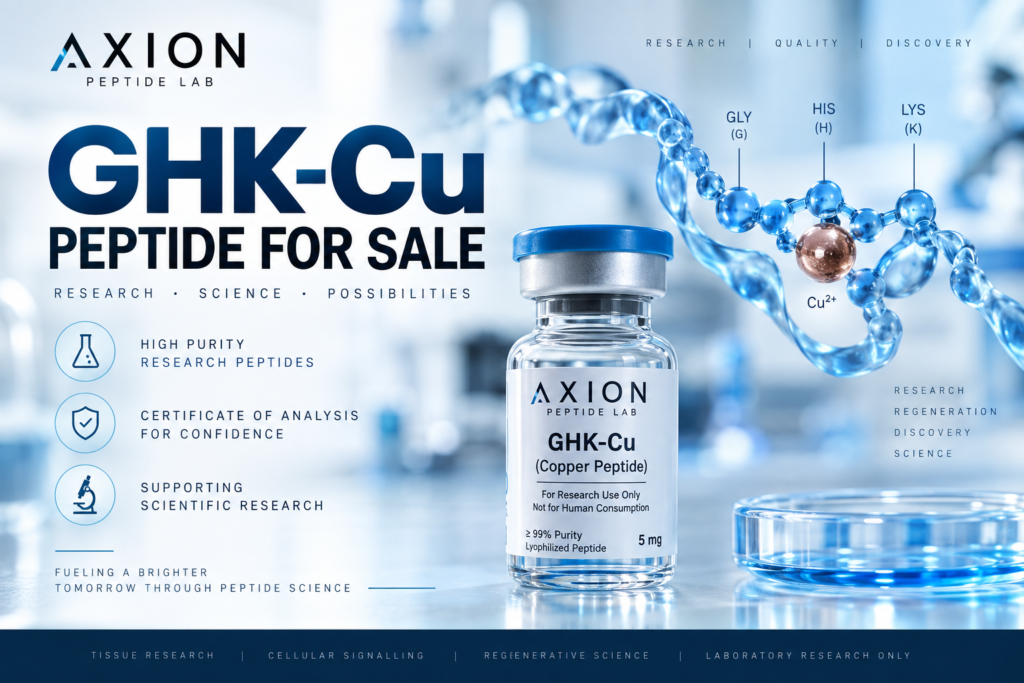
Interest in GHK-Cu peptide for sale has grown alongside wider scientific interest in copper peptides, regenerative biology, skin research and peptide-based signalling. However, understanding GHK-Cu requires separating laboratory evidence from marketing claims and distinguishing research materials from medicines intended for human use.
Many researchers are actively looking for ghk-cu peptide for sale to conduct their studies more effectively.
GHK-Cu—often called the GHK copper complex or copper tripeptide-1—has been investigated for decades in areas such as extracellular-matrix biology, fibroblast activity, tissue remodelling, oxidative stress and skin regeneration.
It should not, however, be confused with metabolic compounds such as semaglutide, tirzepatide or investigational retatrutide. Those compounds act primarily through metabolic hormone receptors associated with appetite, glucose regulation and energy balance, while GHK-Cu belongs to a substantially different field of peptide research.
For legitimate laboratories evaluating GHK-Cu peptide for research, understanding the underlying science, quality documentation and regulatory context is therefore essential.
For Research Use Only – Not for human consumption.
1. What Is GHK-Cu? Understanding the Copper Peptide
The growing market for ghk-cu peptide for sale has led to increased research into its benefits.
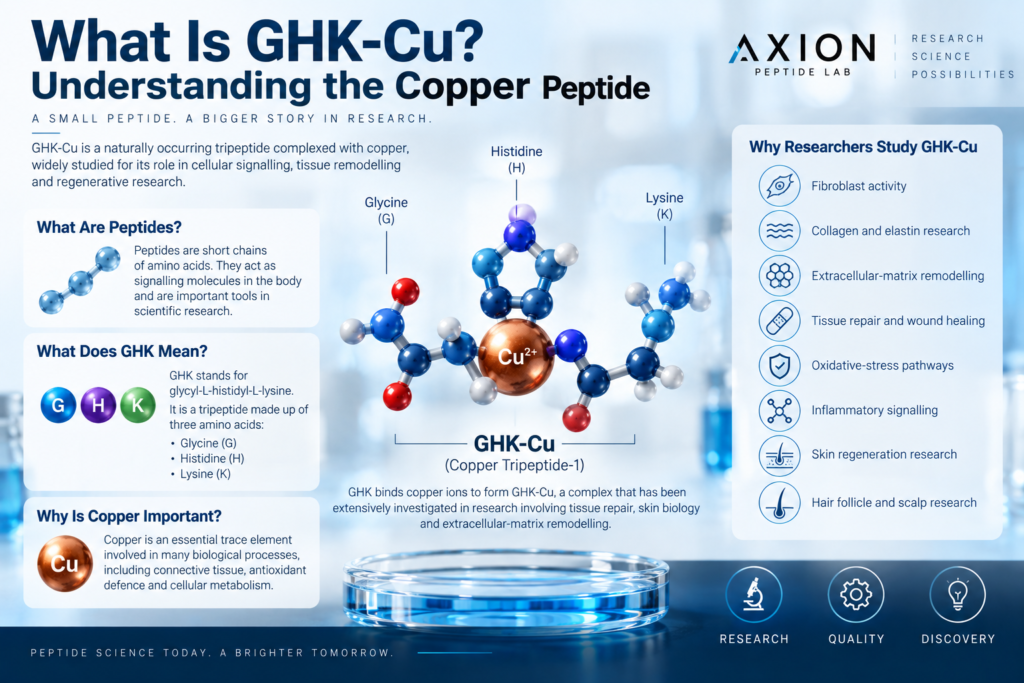
What Are Peptides?
Peptides are relatively short chains of amino acids connected by peptide bonds.
Amino acids are the molecular building blocks used to construct both peptides and proteins. The order in which amino acids occur can influence how a peptide behaves, which molecules it interacts with and what biological pathways researchers may observe.
Peptides occur naturally throughout biological systems and may function as:
- signalling molecules
- hormones
- receptor ligands
- regulatory molecules
- antimicrobial molecules
- components of cellular communication
Scientists can also produce peptides synthetically for analytical, biochemical and laboratory research.
Although peptides and proteins are both built from amino acids, proteins are generally larger and structurally more complex. Peptides are typically shorter and may be particularly useful for studying precise molecular interactions.
What Does GHK Mean?
GHK stands for:
Glycyl-L-histidyl-L-lysine
It is a tripeptide, meaning that it contains three amino acids:
- glycine
- histidine
- lysine
GHK was originally identified as a naturally occurring human peptide and has since been studied for its interactions with copper and various aspects of cellular biology.
When GHK binds a copper ion, the resulting complex is generally referred to as:
GHK-Cu
or
copper tripeptide-1
The histidine-containing structure of GHK helps it coordinate copper ions, which is one reason the peptide has attracted scientific interest.
Why Is Copper Important?
Copper is an essential trace element involved in multiple biological processes.
Copper-containing proteins and enzymes participate in areas such as:
- connective-tissue biology
- cellular respiration
- antioxidant defence
- pigmentation
- iron metabolism
- enzymatic reactions
Free copper ions, however, must be carefully regulated biologically because uncontrolled metal activity can contribute to oxidative reactions.
Copper-binding molecules help influence how copper is transported and made available within biological systems.
GHK’s ability to coordinate copper therefore created a scientific basis for studying the GHK-Cu complex rather than looking only at the peptide or copper independently.
Why Researchers Study GHK-Cu
GHK-Cu has been investigated across several areas of biological research, particularly those involving tissue repair and extracellular-matrix biology.
Published research and reviews have discussed effects involving:
- fibroblast activity
- collagen-related processes
- elastin
- glycosaminoglycans
- extracellular-matrix remodelling
- tissue repair
- angiogenesis
- oxidative-stress pathways
- inflammatory signalling
A widely cited review described GHK-Cu in relation to collagen, elastin, glycosaminoglycan production and fibroblast function, while also discussing broader regenerative pathways. Much of this literature includes laboratory and preclinical evidence rather than large modern clinical trials.
More recent reviews continue to describe substantial scientific interest in GHK-Cu while emphasizing important gaps in standardized clinical evidence.
That distinction is important when evaluating claims surrounding GHK-Cu peptide for sale. Laboratory findings can justify continued research, but they should not automatically be converted into promises of medical benefit in humans.
2. How GHK-Cu Works in Research: Copper Binding, Tissue Remodelling & Cellular Signalling
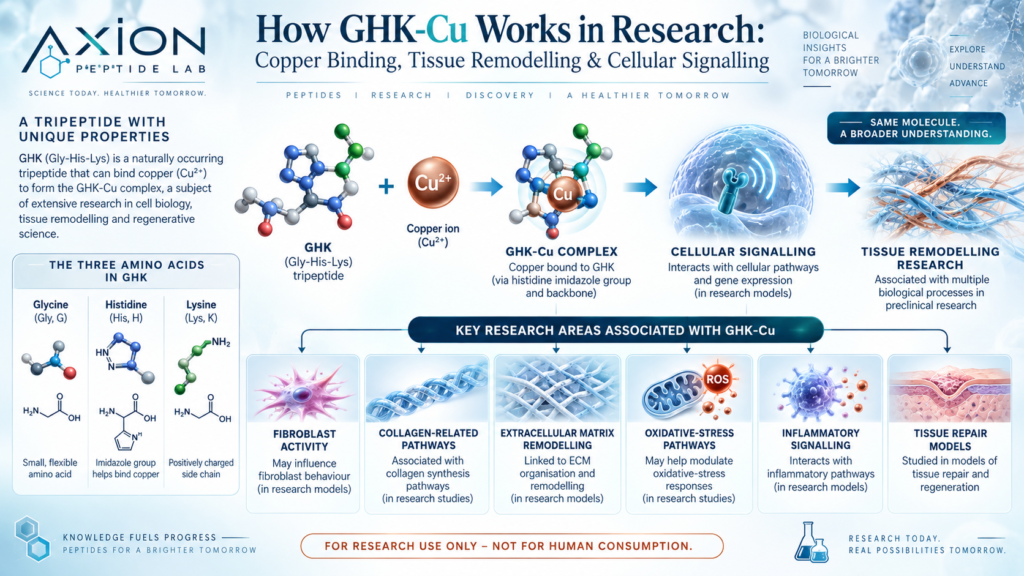
GHK-Cu research involves more than one single receptor or pathway.
Unlike metabolic compounds that are defined largely by receptor agonism, GHK-Cu is studied through a broader set of biochemical and cellular interactions.
A simplified research model can be represented as:
GHK + Cu²⁺ → GHK-Cu complex → molecular/cellular interactions → measurable biological responses
Exactly how those responses develop can depend on the experimental system, concentration, tissue model and study conditions.
GHK-Cu and Cellular Signalling
Researchers have proposed that GHK and GHK-Cu may influence multiple signalling networks rather than acting through one narrowly defined pathway.
Research has explored effects involving:
- gene expression
- tissue-repair signalling
- inflammatory pathways
- antioxidant mechanisms
- extracellular-matrix regulation
- cellular migration
This broad activity has contributed to interest in GHK-Cu across dermatology, biomaterials, tissue engineering and regenerative research.
However, broad molecular activity can also make interpretation more complex.
An observed effect in cultured cells does not necessarily mean the same response will occur in an intact human tissue.
Extracellular Matrix and Collagen Research
The extracellular matrix, or ECM, is the structural environment surrounding cells.
It contains components including:
- collagen
- elastin
- proteoglycans
- glycosaminoglycans
- structural proteins
Fibroblasts play an important role in producing and maintaining many of these components.
GHK-Cu research has frequently focused on fibroblast behaviour and matrix remodelling.
Older experimental literature has reported changes in collagen-related processes, glycosaminoglycan production and tissue-remodelling pathways.
This is one reason GHK-Cu became particularly well known within skin and wound-repair research.
The availability of ghk-cu peptide for sale is crucial for ongoing research and product development.
Understanding the quality of ghk-cu peptide for sale is essential for researchers to ensure reliable results.
Wound-Healing and Regeneration Research
Normal wound healing is a complex biological process involving inflammation, cellular proliferation, vascular responses, matrix deposition and eventual tissue remodelling.
Collagen is particularly important in this process because it forms a major part of the extracellular matrix and contributes to different stages of repair.
Researchers studying GHK-Cu have explored areas such as:
- fibroblast migration
- keratinocyte behaviour
- angiogenesis
- collagen deposition
- tissue remodelling
- inflammatory signalling
These findings have contributed to the peptide’s reputation as a regenerative research compound.
But the strength of evidence depends heavily on the model.
Results from cell culture, animal models and small clinical studies should not be presented as though they provide identical levels of certainty.
Skin Research and GHK-Cu
GHK-Cu is perhaps most widely recognized in connection with skin research.
Scientific interest includes:
- skin ageing
- collagen-related biology
- elasticity
- extracellular-matrix turnover
- wound repair
- barrier penetration
- cosmetic formulation
One major challenge is delivery through the skin.
GHK-Cu is hydrophilic, while the outer skin barrier—the stratum corneum—is relatively lipophilic. This can limit penetration.
A 2025 review examining GHK-Cu skin permeation highlighted the need for better research into how free and encapsulated GHK-Cu moves through the skin barrier.
Another 2025 review noted significant interest in GHK-Cu within anti-wrinkle products but described published information on permeability, effectiveness and physicochemical properties as insufficient, including a notable lack of dedicated clinical studies.
Hair and Follicle Research
Copper peptides also appear in discussions surrounding hair-follicle and scalp biology.
Researchers have investigated whether tissue-remodelling, vascular or cellular signalling mechanisms associated with copper peptides could have relevance to follicle biology.
However, this should be described as an area of investigation—not as evidence that laboratory GHK-Cu is an approved treatment for hair loss.
A research compound should never be marketed as a medical therapy simply because preclinical findings appear biologically interesting.
3. Is GHK-Cu a Peptide for Weight Loss? Understanding the Difference
The phrase peptides for weight loss has become extremely popular online.
But scientifically, it is too broad.
Peptides are a diverse class of molecules. Some interact with metabolic receptors involved in appetite and glucose regulation, while others have completely different biological functions.
GHK-Cu is an excellent example of why all peptides should not be grouped together.
How Peptides Can Be Connected to Weight Regulation
Certain peptide hormones participate in communication between the gastrointestinal tract, pancreas, brain and other metabolic tissues.
These signals can influence:
- appetite
- satiety
- insulin secretion
- glucagon activity
- digestion
- food intake
- nutrient sensing
- energy balance
These are the biological systems that underpin modern research into metabolic peptide medicines.
How Metabolic Peptide Pathways Work
To fulfill research needs, many are seeking ghk-cu peptide for sale through various channels.
Following food intake, the gastrointestinal tract can release hormones that communicate nutrient availability to other organs.
Two particularly important hormones are:
GLP-1 — glucagon-like peptide-1
and
GIP — glucose-dependent insulinotropic polypeptide
These are incretin hormones.
Their receptors are major targets in modern metabolic research.
What Is GLP-1?
GLP-1 participates in glucose-dependent insulin signalling and has been extensively studied in relation to:
- appetite
- satiety
- food intake
- pancreatic function
- gastrointestinal activity
Pharmaceutical compounds have been developed to produce longer-lasting GLP-1 receptor activation.
What Is GIP?
GIP is another incretin hormone.
As studies continue, the demand for ghk-cu peptide for sale is expected to rise significantly.
It also participates in glucose-dependent insulin signalling while having biological effects distinct from GLP-1.
Combining GLP-1 and GIP receptor activity became an important strategy in the development of newer metabolic medicines.
Semaglutide
As interest in ghk-cu peptide for sale grows, scientists continue to explore its potential applications.
Semaglutide is primarily a GLP-1 receptor agonist.
Specific semaglutide pharmaceutical products are licensed for defined medical indications in the United States and United Kingdom.
The fact that licensed products exist does not mean unrelated research semaglutide products automatically share those approvals.
Tirzepatide
Tirzepatide activates:
GIP + GLP-1 receptors
It is therefore described as a dual incretin receptor agonist.
The FDA approved Zepbound, a specific tirzepatide pharmaceutical product, for chronic weight management in defined adults in November 2023; tirzepatide was already approved as Mounjaro for type 2 diabetes.
UK MHRA guidance similarly identifies tirzepatide/Mounjaro among licensed medicines for specified uses.
Retatrutide
Retatrutide takes the multi-receptor concept further by activating:
GIP + GLP-1 + glucagon receptors
This makes it a triple receptor agonist.
Retatrutide remains investigational as of September 2026. Lilly states that it is still being evaluated in Phase 3 clinical trials and has not been approved by the FDA or another regulatory agency.
GHK-Cu vs Semaglutide, Tirzepatide and Retatrutide
The compounds differ fundamentally:
| Compound | Main research mechanism | Main research context |
|---|---|---|
| GHK-Cu | Copper binding, extracellular-matrix and cellular pathways | Regeneration, tissue and skin research |
| Semaglutide | GLP-1 receptor agonism | Metabolic and obesity research |
| Tirzepatide | GIP + GLP-1 receptor agonism | Metabolic and obesity research |
| Retatrutide | GIP + GLP-1 + glucagon agonism | Investigational metabolic research |
GHK-Cu should therefore not be marketed as a GLP-1-style weight-loss compound.
Its research history is primarily associated with tissue biology and regeneration rather than established appetite or weight-regulation pathways.
This distinction improves scientific accuracy and prevents misleading claims.
4. What Does GHK-Cu Research Actually Show?
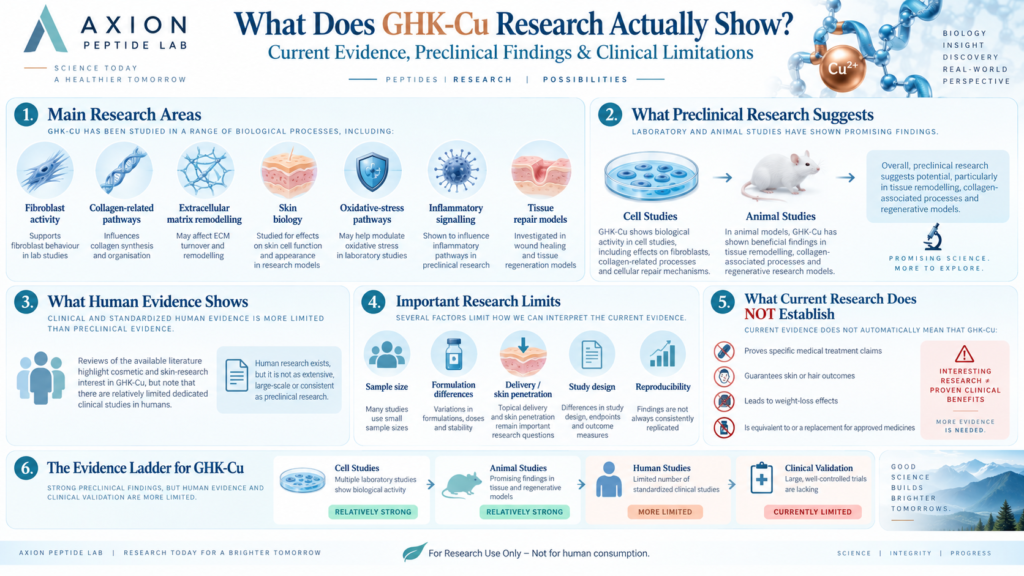
Interest in GHK-Cu is supported by a substantial scientific literature, but that literature varies considerably in evidence quality.
The most responsible interpretation separates:
mechanistic evidence → cell studies → animal studies → human clinical evidence
Skin and Tissue-Remodelling Research
Laboratory studies and reviews have associated GHK-Cu with processes involving:
- collagen
- fibroblasts
- extracellular matrix
- elastin
- glycosaminoglycans
- inflammatory responses
- tissue repair
These mechanisms make GHK-Cu scientifically interesting.
They do not automatically establish a clinical indication.
A molecule may alter collagen-related signalling in cultured cells while still requiring extensive clinical research before meaningful medical claims can be made.
Preclinical Evidence
A large portion of GHK-Cu literature comes from experimental models.
Preclinical research may involve:
- isolated cells
- reconstructed tissues
- laboratory animals
- biochemical assays
- gene-expression models
These models are valuable because they can reveal potential mechanisms.
But researchers must consider limitations.
A concentration used in cell culture may not be achievable in human tissue.
An animal model may not reproduce human physiology exactly.
And an observed molecular change may not translate into a meaningful clinical outcome.
Human Evidence
Human evidence for GHK-Cu is more limited than the online popularity of copper peptides sometimes suggests.
A 2025 review of topical GHK and related derivatives described GHK-Cu as widely used in cosmetic anti-wrinkle products but highlighted a surprising lack of clinical studies specifically evaluating GHK-Cu and Pal-GHK.
A 2026 systematic review concluded that GHK-Cu has shown regenerative, anti-inflammatory and antioxidant properties in preclinical models but also noted a lack of standardized clinical guidelines and the need for further evidence.
This is an important distinction for SEO content.
An authoritative article should not claim that GHK-Cu has been clinically proven to produce every effect observed in laboratory research.
Skin Penetration Remains an Important Question
For topical research, skin penetration presents another challenge.
The outer layer of the skin is designed to prevent substances from entering easily.
A 2025 review noted that GHK-Cu is relatively hydrophilic and has limited ability to move through the lipophilic stratum corneum, prompting interest in delivery systems such as liposomes.
This means formulation can substantially affect experimental outcomes.
Researchers comparing different topical preparations should therefore consider:
- vehicle
- concentration
- stability
- encapsulation
- skin model
- exposure duration
- analytical method
What Existing Research Does Not Establish
Existing evidence should not automatically be interpreted to mean that research-use GHK-Cu:
- treats skin diseases
- reverses ageing
- guarantees hair growth
- heals wounds in humans
- causes weight loss
- replaces approved medicines
- is safe for injection
- is appropriate for self-administration
Effective research relies on finding quality ghk-cu peptide for sale from trusted sources.
These statements require product-specific regulatory authorization and adequate clinical evidence.
Why Research Design Matters
When assessing a GHK-Cu study, researchers should examine:
- number of subjects or samples
- experimental controls
- concentration
- route of exposure
- formulation
- duration
- endpoints
- analytical methods
- statistical significance
- clinical relevance
- reproducibility
A dramatic laboratory result from a small or highly artificial model should not be treated as equivalent to a large randomized clinical trial.
That distinction is fundamental to responsible peptide research.
5. GHK-Cu Peptide for Sale: What Laboratory Researchers Should Look For
Researchers searching for GHK-Cu peptide for sale should look beyond product photographs and price.
The central question should be:
Is the material sufficiently characterized for the intended scientific study?
Compound Identity
A research product should clearly identify the material being supplied.
Useful information may include:
- compound name
- peptide sequence
- molecular information
- stated quantity
- physical form
- lot or batch number
Researchers should verify that GHK-Cu is clearly distinguished from uncomplexed GHK when the experimental design requires the copper complex.
Purity Information
Purity can matter substantially in peptide research.
Peptide synthesis may generate:
- truncated sequences
- deletion products
- synthesis by-products
- degradation products
- related impurities
A stated purity percentage can be useful, but researchers should also ask how that value was determined.
A number without an analytical method provides less information than a traceable batch-specific report.
Certificate of Analysis
A Certificate of Analysis, or COA, may include information such as:
- compound identity
- lot number
- stated purity
- testing date
- analytical method
- molecular-mass information
A COA should ideally correspond to the specific batch being supplied.
Generic documentation that cannot be linked to a particular lot is less useful for reproducibility.
A COA also should not be treated as proof of every quality characteristic. It is one part of analytical documentation.
HPLC
High-performance liquid chromatography, commonly abbreviated HPLC, can separate components of a sample.
In peptide analysis, it may be used to assess relative sample composition and estimate purity.
Researchers reviewing HPLC information should consider whether:
- the batch number matches
- the method is identified
- chromatographic data are available
- testing relates to the material supplied
Mass Spectrometry
Mass spectrometry can provide molecular-mass information that supports compound identification.
HPLC and mass spectrometry answer different analytical questions.
For this reason, using multiple complementary analytical approaches can provide more useful characterization than relying on one number alone.
Batch Traceability
Batch traceability supports research reproducibility.
If a study produces an unexpected result, researchers may need to determine:
- which lot was used
- when it was tested
- how it was stored
- whether another batch behaves similarly
This is why batch numbers and product documentation matter.
Storage and Stability
Peptides can be affected by:
- moisture
- temperature
- light
- oxidation
- repeated handling
Researchers should follow appropriate storage information for the supplied material and document laboratory conditions where relevant.
Selecting a Research Supplier
When comparing a GHK-Cu peptide supplier, legitimate researchers may consider:
- transparent product identity
- accessible research documentation
- lot traceability
- appropriate research-only labelling
- storage information
- clear communication
- scientifically responsible product descriptions
Price alone should not determine suitability for a laboratory project.
Legitimate researchers investigating GHK-Cu, copper-peptide biology and related pathways can review available research products and product information through AxionPeptideLab.com.
For Research Use Only – Not for human consumption.
6. Safety, Research Peptides vs Medicines & USA/UK Regulatory Considerations
A research peptide and an approved medicine are not the same thing.
This distinction is especially important when discussing GHK-Cu because the compound can appear in scientific, cosmetic and compounding discussions.
Research Material vs Medicine
A laboratory research product is supplied for scientific investigation.
A licensed medicine is a specific finished product that has undergone regulatory assessment regarding:
- quality
- safety
- efficacy
- manufacturing
- formulation
- labelling
- indications
A compound name does not transfer approval from one product to another.
Current U.S. GHK-Cu Considerations
FDA’s current compounding materials provide important context.
As of the FDA’s May 14, 2026 update, GHK-Cu except for injectable routes of administration is listed in Category 1 among bulk substances under evaluation for the Section 503A bulks list. FDA states that it intends to consult its Pharmacy Compounding Advisory Committee regarding potential inclusion.
That classification does not mean GHK-Cu has been FDA-approved as a medicine.
Category 1 concerns FDA’s interim compounding framework and substances still under evaluation.
Injectable GHK-Cu Safety Concerns
FDA separately discusses GHK-Cu for injectable routes among nominations that were withdrawn.
The agency states that compounded injectable products containing GHK-Cu may pose immunogenicity risks associated with aggregation and peptide-related impurities and notes that human safety data are limited.
That makes it inappropriate for a research supplier to use generalized GHK-Cu literature as justification for telling consumers how to inject, reconstitute or dose a research product.
Research-focused educational material should not provide:
- self-injection instructions
- human dosing schedules
- medical treatment protocols
- claims that laboratory vials are approved medicines
Research Use Only Must Mean Research Use
Writing “For Research Use Only” on a product does not justify marketing it as a consumer treatment elsewhere on the same website.
The intended use should remain consistent across:
- product descriptions
- advertising
- FAQs
- social content
- instructions
- customer communication
If the website makes medical treatment or human-use claims, a disclaimer alone may not resolve the underlying regulatory issue.
UK Regulatory Considerations
In the UK, the Medicines and Healthcare products Regulatory Agency (MHRA) regulates medicines.
UK marketing authorization requires evidence concerning a product’s quality, safety and efficacy, and authorized products have defined regulatory documentation.
The MHRA also evaluates borderline products where presentation or claims may cause something marketed as a cosmetic, supplement or other product to fall within the definition of a medicine.
The agency specifically considers both explicit and implicit claims as well as pharmacological, metabolic or immunological properties.
Therefore, a UK-facing research website should not imply that laboratory GHK-Cu is an authorized medicine unless there is a product-specific marketing authorization supporting that statement.
How UK Researchers Can Verify Medicines
The MHRA’s product database provides current information on licensed medicines, including:
- patient information leaflets
- summaries of product characteristics
- marketing-authorization information
- public assessment reports
The database can be used to confirm whether a specific pharmaceutical product has an authorization.
Research Product Marketing
For Axion Peptide Lab, GHK-Cu content should therefore remain focused on:
- laboratory science
- peptide characterization
- copper-binding research
- analytical documentation
- published scientific literature
Avoid describing a research product as:
- an injectable treatment
- an anti-ageing medicine
- a wound-healing medicine
- a hair-loss treatment
- a weight-loss treatment
This distinction supports both scientific integrity and clearer regulatory positioning.
7. Current and Future GHK-Cu & Peptide Research
GHK-Cu continues to attract scientific attention because many fundamental questions remain open.
Its research history spans several decades, yet modern experimental methods can examine the peptide at levels that earlier studies could not.
Regenerative Research
Future studies may further investigate relationships between GHK-Cu and:
- fibroblast function
- extracellular-matrix remodelling
- tissue repair
- oxidative stress
- inflammatory pathways
- vascular signalling
The 2026 systematic review of GHK-Cu in aesthetic medicine demonstrates that interest remains active while also emphasizing the need for stronger standardized clinical evidence.
Skin Delivery Research
Delivery remains a major scientific challenge.
Researchers are exploring whether formulation strategies can improve delivery of GHK-Cu through skin.
Areas of investigation include:
- liposomes
- encapsulation
- delivery vehicles
- formulation chemistry
- penetration models
The lack of robust skin-permeation data itself represents an important research opportunity.
Gene-Expression and Cellular Research
Earlier research has suggested that GHK may influence a wide range of gene-expression patterns and cellular pathways.
Modern transcriptomic and proteomic approaches may help researchers determine which reported effects are reproducible, biologically significant and relevant across different cell types.
Where More Evidence Is Needed
Important unanswered questions include:
- pharmacokinetics
- tissue distribution
- stability
- standardized formulations
- long-term safety
- concentration-response relationships
- clinically meaningful endpoints
- reproducibility across laboratories
More human research would also help separate promising preclinical mechanisms from clinically demonstrated effects.
Regenerative vs Metabolic Peptide Research
GHK-Cu also illustrates how diverse peptide science has become.
Regenerative peptides and metabolic receptor agonists should not be treated as one category merely because all are peptides.
For example:
GHK-Cu research may focus on tissue remodelling and copper-related biology.
Semaglutide research primarily involves GLP-1 receptor signalling.
Tirzepatide research involves combined GIP and GLP-1 receptor signalling.
Retatrutide research examines experimental triple GIP/GLP-1/glucagon agonism.
The future of peptide science will likely involve increasingly specific studies of how molecular structure relates to a particular receptor, pathway or biological environment.
For legitimate researchers, selecting well-characterized materials with appropriate documentation remains fundamental to producing useful scientific results.
8. Frequently Asked Questions, Conclusion & References
1. What is GHK-Cu peptide?
GHK-Cu is a copper complex of the tripeptide glycyl-L-histidyl-L-lysine.
It has been widely investigated in laboratory and preclinical research involving tissue remodelling, extracellular-matrix biology, skin and regenerative pathways.
2. What does GHK-Cu stand for?
GHK-Cu peptide has garnered significant attention for its potential applications in regenerative medicine and skin health. Its unique properties facilitate various biological processes, including wound healing and collagen synthesis, making it an attractive candidate for further exploration. Researchers are encouraged to utilize high-quality GHK-Cu peptide sourced from reputable suppliers to ensure the integrity of their findings. As the field of peptide research progresses, a deeper understanding of GHK-Cu’s mechanisms may unlock new therapeutic avenues.
Glycine + Histidine + Lysine
Cu represents the copper ion coordinated by the peptide.
3. Is GHK-Cu the same as copper peptide?
GHK-Cu is one type of copper peptide.
The terms are often used interchangeably in cosmetic discussions, but “copper peptide” is broader and can theoretically refer to other copper-binding peptide complexes.
4. What is copper tripeptide-1?
Copper tripeptide-1 is a name commonly used for GHK complexed with copper.
It is frequently encountered in cosmetic ingredient terminology and scientific discussions of GHK-Cu.
5. What is GHK-Cu studied for?
Research has explored GHK-Cu in connection with:
- fibroblast biology
- collagen-related pathways
- extracellular-matrix remodelling
- tissue repair
- oxidative stress
- inflammatory signalling
- skin biology
Much of the evidence is preclinical, and clinical evidence remains less extensive.
6. How does GHK-Cu work in laboratory research?
GHK binds copper to create a copper-peptide complex.
Researchers investigate how this complex interacts with molecular and cellular systems associated with tissue remodelling, cellular signalling and extracellular-matrix biology.
The mechanism appears broader than a single receptor pathway.
7. Is GHK-Cu a peptide for weight loss?
GHK-Cu is not primarily an established metabolic or weight-regulation peptide.
Its research history is much more strongly associated with tissue repair, extracellular-matrix biology and skin research.
Compounds such as semaglutide and tirzepatide act through metabolic hormone receptors and are scientifically distinct.
8. How is GHK-Cu different from semaglutide?
GHK-Cu is a copper-binding peptide complex primarily investigated in regenerative and tissue biology.
Semaglutide is a GLP-1 receptor agonist used in specific regulated pharmaceutical medicines and extensively studied in metabolic disease and obesity.
The compounds have fundamentally different mechanisms.
9. How is GHK-Cu different from tirzepatide?
Tirzepatide activates both the GIP and GLP-1 receptors.
GHK-Cu is not a GIP/GLP-1 agonist and should not be described as though it produces the same metabolic effects.
10. Is GHK-Cu FDA approved?
FDA’s 2026 compounding materials list non-injectable GHK-Cu as a bulk substance under evaluation in Category 1 of the Section 503A framework. That status is not FDA approval of GHK-Cu as a medicine.
FDA also identifies potential safety concerns associated with compounded injectable GHK-Cu and notes limited human safety data.
11. Is GHK-Cu approved as a medicine in the UK?
A research product should not be represented as an MHRA-authorized medicine without a specific marketing authorization.
The MHRA product database is the appropriate source for checking the licensing information of individual UK medicines.
12. What should researchers look for when buying GHK-Cu peptide?
Researchers evaluating GHK-Cu peptide for sale may consider:
- compound identity
- batch number
- purity information
- Certificate of Analysis
- analytical testing
- storage information
- research-use labelling
- supplier transparency
The requirements should ultimately reflect the needs of the particular experimental design.
13. What is a GHK-Cu Certificate of Analysis?
A COA is an analytical document associated with a product or batch.
It may include:
- product name
- lot number
- purity information
- analytical method
- test date
- identity data
Researchers should ideally verify that the COA corresponds to the actual batch being supplied.
14. What does “For Research Use Only” mean?
It means the material is intended for legitimate scientific, analytical or laboratory investigation rather than treatment or self-administration.
Research-use marketing should remain consistent with that designation.
15. Can research-use GHK-Cu be used for human consumption?
No.
A product specifically designated for laboratory research is not intended for human consumption or self-administration.
Clinical or cosmetic literature about the molecule does not automatically establish the safety, quality or suitability of an independently supplied laboratory research product.
Conclusion
GHK-Cu is one of the best-known copper peptide complexes in modern peptide science.
Its structure combines the naturally occurring tripeptide GHK—glycyl-L-histidyl-L-lysine—with copper, creating a complex that has been extensively investigated in areas involving fibroblasts, collagen-related biology, extracellular-matrix remodelling and tissue regeneration.
The science is promising, but responsible interpretation matters.
Recent reviews continue to highlight substantial interest in GHK-Cu while also identifying important gaps in human clinical evidence, standardized protocols, formulation science and skin-permeation research.
GHK-Cu should also be clearly separated from compounds commonly discussed under peptides for weight loss.
Semaglutide, tirzepatide and investigational retatrutide act through metabolic hormone receptors. GHK-Cu is primarily studied through copper binding, tissue remodelling and related cellular processes.
For legitimate laboratory researchers searching for GHK-Cu peptide for sale, useful sourcing considerations include identity, purity information, batch traceability, analytical documentation and appropriate research-use labelling.
Researchers can review available GHK-Cu and related laboratory research products through AxionPeptideLab.com.
For Research Use Only – Not for human consumption.
References and Further Reading
For further research, prioritize authoritative and peer-reviewed sources rather than relying solely on commercial product claims.
PubMed / National Library of Medicine
Useful for peer-reviewed GHK, GHK-Cu, skin, tissue-regeneration and peptide-research literature. Recent reviews include assessments of topical GHK-Cu, skin permeation and regenerative research.
U.S. Food and Drug Administration (FDA)
Use FDA sources for current information on GHK-Cu within the U.S. compounding framework and safety concerns associated with injectable compounded GHK-Cu.
MHRA / GOV.UK
Use MHRA information to verify UK medicine classifications, marketing authorizations and regulatory requirements.
New England Journal of Medicine
For metabolic-peptide comparisons, peer-reviewed research documents the distinct GIP/GLP-1/glucagon mechanism of retatrutide and other incretin-based developments.
Official pharmaceutical and clinical-trial sources
For compounds such as tirzepatide and retatrutide, regulatory and clinical status should always be checked against current FDA, MHRA, ClinicalTrials.gov and sponsor information. Retatrutide remains investigational as of September 2026.
Researchers need to source ghk-cu peptide for sale from reputable suppliers to maintain integrity in their work.
The market for ghk-cu peptide for sale has expanded, reflecting its growing importance in scientific research.
The scientific community is increasingly focusing on the availability of ghk-cu peptide for sale.