How to Read a Peptide COA: Complete Guide to Purity, HPLC, Mass Spectrometry and Research Peptide Testing
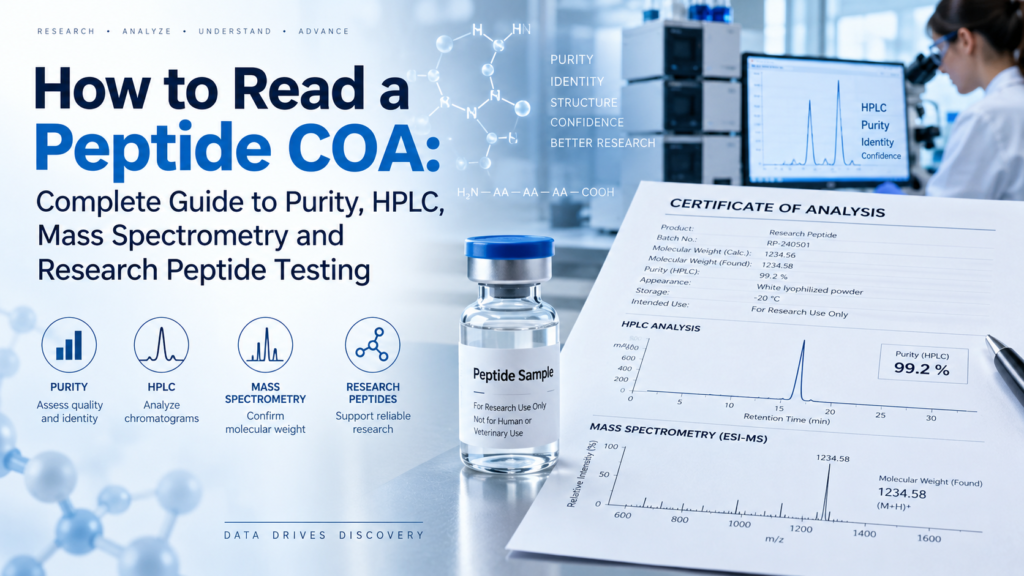
If you work with research peptides, knowing how to read a peptide COA is one of the most important parts of evaluating laboratory materials.
A Certificate of Analysis, commonly shortened to COA, is a laboratory document containing analytical information about a particular sample or batch. Depending on the laboratory and the tests ordered, it may contain information about peptide identity, chromatographic purity, molecular mass, batch identification and other quality attributes.
However, a COA is only useful when you understand what the numbers actually mean.
A result showing “99% purity,” for example, does not automatically mean that 99% of everything inside a vial is peptide by mass. Likewise, a mass spectrometry result matching the expected molecular mass does not prove sterility, biological effectiveness or suitability for human use.
Different analytical tests answer different questions.
This guide explains how to read a peptide COA step by step, including:
- HPLC purity
- chromatograms
- retention time
- peak area
- mass spectrometry
- theoretical versus observed molecular mass
- peptide identity
- batch numbers
- analytical methods
- sterility and endotoxin testing
- peptide content versus purity
- common COA red flags
- independent laboratory verification
Because metabolic peptide research has become an important area of scientific interest, this guide also explains how COA interpretation relates to compounds commonly discussed in GLP-1, GIP and weight-regulation research, including semaglutide, tirzepatide and investigational retatrutide.
Important: Products supplied by Axion Peptide Lab are intended for laboratory research purposes where stated. Research-use-only products should not be interpreted as licensed medicines or as products intended for human consumption.
What Is a Peptide COA?
A peptide Certificate of Analysis is a document reporting analytical results associated with a particular peptide sample or production lot.
At its most useful, a COA creates traceability between:
the compound being supplied,
the specific batch,
the sample submitted for testing,
the analytical method,
the laboratory performing the analysis,
and the resulting analytical data.
Analytical testing is an important part of pharmaceutical and chemical quality control because identity, purity, strength and other quality characteristics cannot reliably be established simply by appearance.
FDA guidance on analytical procedures similarly emphasizes that analytical methods should be suitable for their intended purpose when being used to assess characteristics such as identity, quality, strength and purity.
For researchers, this leads to an important principle:
Do not judge a peptide COA by the purity percentage alone.
A useful COA needs to be read as a complete analytical record.
What Are Peptides?
Peptides are molecules formed from chains of amino acids joined through peptide bonds.
Amino acids can be thought of as molecular building blocks. When amino acids connect in defined sequences, they can form peptides with very different structural and biological properties.
Naturally occurring peptides participate in numerous biological processes, including:
hormone signalling,
cell communication,
metabolism,
immune signalling,
growth regulation,
appetite signalling,
and nervous-system activity.
Scientists can also manufacture synthetic peptides for analytical, biochemical, pharmaceutical and laboratory research.
Because biological activity depends heavily on molecular structure, peptide researchers need confidence that the material being studied corresponds to the expected compound.
This is one reason analytical techniques such as chromatography and mass spectrometry are important.
How to Read a Peptide COA Step by Step
When learning how to read a peptide COA, it helps to follow the same sequence every time rather than immediately looking at the largest purity number on the page.
Start with identification and traceability.
Then examine the analytical methods.
Finally, interpret what each result actually establishes.
1. Check the Peptide Name
The certificate should clearly identify the compound that was analysed.
Depending on the laboratory, this may include:
- peptide name
- chemical name
- research identifier
- amino-acid sequence
- CAS number
- molecular formula
- expected molecular weight
Not every COA will contain every one of these fields.
The important point is that the material being reported should be clearly identifiable.
A document showing only something vague such as “peptide sample” provides significantly less traceability than one identifying the actual analyte.
2. Check the Batch or Lot Number
The batch or lot number is one of the most important pieces of information on a peptide COA.
A laboratory result applies to the sample associated with that test.
It should therefore be possible to connect the analytical report with the corresponding batch of research material.
For example, if a vial displays:
Lot: AX-RT-2608
but the COA displays:
Lot: AX-RT-2503
the document may describe a completely different batch.
A high-quality historical test result does not automatically establish the characteristics of a newly manufactured batch.
This is why researchers should look for batch-specific peptide COAs rather than relying exclusively on generic certificates that remain online indefinitely.
3. Look for the Testing Date
The testing date tells you when analysis was performed.
This matters because analytical data describes the tested sample at a particular point in time.
Peptides can be influenced by factors including:
temperature,
moisture,
oxidation,
light exposure,
pH,
storage conditions,
and time.
A COA is therefore not a permanent guarantee that nothing about a material can ever change.
It records the analytical result associated with the submitted sample at the time of testing.
4. Identify the Laboratory
A useful COA should identify the laboratory responsible for producing the result.
Researchers may also want to determine whether testing was:
in-house, meaning performed by the supplier or manufacturer,
or
independent third-party testing, meaning performed by a separate analytical laboratory.
Third-party testing can provide additional independence, but the laboratory name alone still does not automatically establish that every statement on a certificate is correct.
Researchers should examine the complete report.
Where verification systems are available, report numbers, QR codes, certificate identifiers or verification keys may allow the report to be checked directly with the issuing laboratory.
Understanding HPLC on a Peptide COA
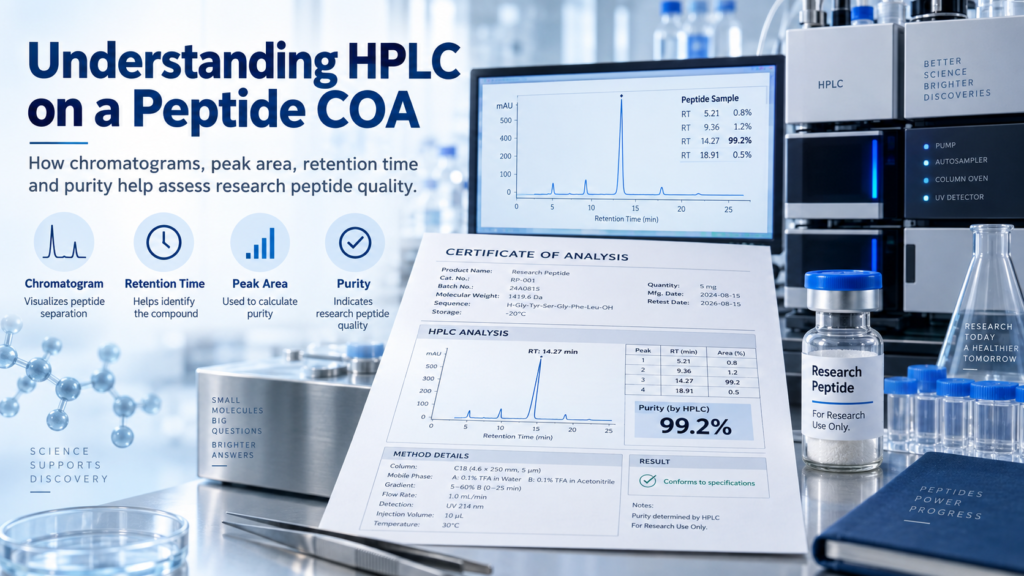
One of the most common terms encountered when researching how to read a peptide COA is HPLC.
HPLC stands for high-performance liquid chromatography.
Chromatography is used to separate components of a sample so they can be detected and analysed individually.
Reversed-phase liquid chromatography is particularly important in peptide quality analysis. Peer-reviewed research has described reversed-phase liquid chromatography as a central technique for evaluating peptide-related impurities, while also noting that co-eluting impurities can present analytical challenges.
What Does HPLC Purity Mean?
An HPLC analysis typically produces a chromatogram containing peaks.
Ideally, the target peptide produces the dominant peak.
Smaller peaks may correspond to other detectable components, including peptide-related impurities or degradation products.
A reported chromatographic purity result might appear as:
Purity: 99.2% by HPLC
This generally refers to the proportion of integrated detector response attributed to the principal target peak under the particular analytical conditions used.
It does not necessarily mean that 99.2% of the total physical powder by weight is active peptide.
That distinction is extremely important.
What Is a Peptide Chromatogram?
A chromatogram is essentially a visual representation of what the chromatography system detected over the course of the analysis.
The horizontal axis generally represents retention time.
The vertical axis represents the detector response.
As compounds move through the chromatography system, they emerge at different times based on their interactions with the column and mobile phase.
Each detectable component can appear as a peak.
The largest expected peptide peak should typically correspond to the target compound under the validated or defined method.
Researchers should not simply look at whether a chromatogram “looks clean.”
Method parameters affect what can be detected and separated.
What Is Retention Time?
Retention time refers to how long it takes an analyte to pass through the chromatographic system and reach the detector under defined conditions.
A COA might show a principal peak at, for example:
8.74 minutes
That number by itself does not universally identify a particular peptide.
Retention time depends on the method, including:
column chemistry,
mobile-phase composition,
gradient,
flow rate,
temperature,
and other conditions.
It becomes more meaningful when interpreted within a defined analytical method and, where appropriate, compared with a reference standard.
The chromatography software calculates the area associated with detected peaks.
A purity result may be calculated using the area of the primary peptide peak relative to the combined areas of relevant detected peaks.
Imagine a simplified chromatogram containing:
Main peptide peak: 99.1%
Impurity peak A: 0.5%
Impurity peak B: 0.3%
Impurity peak C: 0.1%
The reported chromatographic purity could be approximately 99.1%.
But this should still be interpreted as a chromatographic measurement rather than as a complete chemical inventory of everything inside the vial.
HPLC Purity Is Not the Same as Peptide Content
This is one of the most important concepts in this entire guide.
Purity and content are not necessarily the same measurement.
HPLC purity evaluates detectable components under the chromatographic method.
It does not automatically establish the exact total amount of peptide material contained in a vial.
A lyophilised preparation can contain materials that do not necessarily contribute to the chromatographic purity calculation in the same way as peptide-related peaks.
For example, depending on manufacturing and analytical conditions, the preparation may contain:
water,
counterions,
salts,
buffer components,
or residual processing-related material.
Therefore:
99% HPLC purity ≠ automatically 99% peptide by total vial mass.
If exact peptide quantity or content is important to an experiment, researchers should determine whether an appropriate quantitative assay has been performed.
Understanding Mass Spectrometry on a Peptide COA
The second major analytical technique frequently encountered on peptide certificates is mass spectrometry, often abbreviated MS.
Mass spectrometry is extremely useful for characterising synthetic peptides.
A 2024 scientific review on synthetic peptide characterisation described mass spectrometry as an important approach for evaluating peptide authenticity and integrity, including LC-MS and MALDI-TOF-MS approaches.
What Does Mass Spectrometry Tell You?
Mass spectrometry primarily helps answer an identity-related question:
Does the measured molecular mass correspond to the expected molecule?
A report might show:
Theoretical molecular mass: 4,813.45 Da
Observed molecular mass: 4,813.62 Da
An appropriately matching result provides evidence supporting molecular identity.
However, mass spectrometry does not automatically answer every quality question.
For example, a molecular mass match alone does not establish:
sterility,
endotoxin level,
exact vial content,
clinical safety,
biological potency,
or suitability for human administration.
Analytical tests have defined purposes.
One of the biggest mistakes when reading peptide COAs is treating a single test as though it proves everything.
Why Can a Mass Spectrum Show Several Peaks?
Peptides analysed by techniques such as electrospray mass spectrometry can carry multiple electrical charges.
Because of this, the instrument may detect ions corresponding to different charge states.
Researchers may therefore see several peaks rather than one simple peak equal to the peptide’s molecular weight.
Specialised software can interpret or deconvolute these signals to estimate the neutral molecular mass.
This is another reason raw analytical data needs to be interpreted within the correct scientific context.
HPLC Versus Mass Spectrometry
HPLC and mass spectrometry provide complementary information.
A simple way to understand the distinction is:
HPLC: primarily helps evaluate chromatographic purity and separation of detectable components.
Mass spectrometry: helps confirm molecular identity based on mass-related information.
Neither method makes the other unnecessary.
A material could potentially produce a dominant chromatographic peak while still requiring confirmation that the peak corresponds to the intended molecular species.
Likewise, detecting the expected molecular mass does not automatically demonstrate that the entire sample has high chromatographic purity.
Combining analytical approaches can therefore provide substantially more information than relying on only one result.
What Other Tests Might Appear on a Peptide COA?
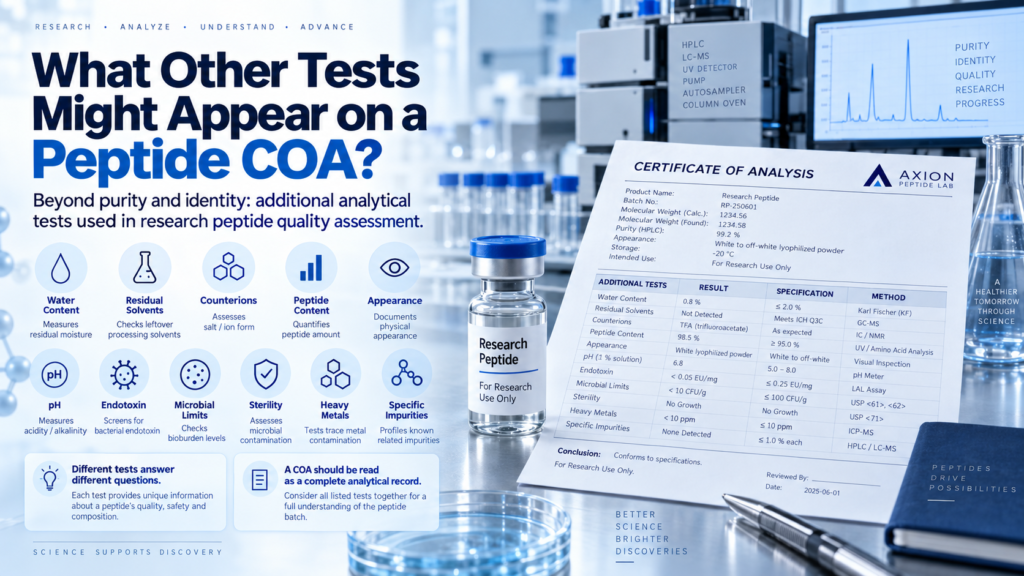
More comprehensive analytical packages may contain additional information beyond HPLC and mass spectrometry.
Depending on the material and intended laboratory application, these could include tests for:
- water content
- residual solvents
- counterions
- peptide content
- appearance
- pH
- endotoxin
- microbial limits
- sterility
- heavy metals
- specific impurities
Researchers should evaluate which tests are relevant to their actual experimental application.
A certificate containing more tests is not automatically better if those tests are irrelevant or poorly documented.
Analytical methods should be appropriate for their intended purpose.
Endotoxin Testing Is Different From HPLC
Endotoxins are substances associated with the outer membranes of certain bacteria.
HPLC purity does not automatically establish endotoxin status.
Mass spectrometry identity testing does not establish endotoxin status either.
Endotoxin testing requires an appropriate dedicated analytical method.
Therefore, researchers should never interpret a high HPLC purity percentage as meaning “endotoxin free.”
Those are different quality characteristics.
Sterility Testing Is Also Different
Sterility testing assesses microbial contamination using dedicated microbiological methods.
An HPLC chromatogram is not a sterility test.
Mass spectrometry is not a sterility test.
Consequently, a COA stating:
99.8% HPLC purity
does not mean:
99.8% sterile
These concepts are analytically unrelated.
If sterility is necessary for a particular research protocol, researchers need evidence from an appropriate sterility test rather than assuming chemical purity establishes microbiological status.
How to Verify a Peptide COA
Learning how to read a peptide COA also means learning how to verify its traceability.
A practical verification process begins with several questions.
Does the batch number match?
Compare the certificate with the lot information supplied with the research material.
Is the laboratory identified?
Look for the name of the testing laboratory.
Is there a report or certificate number?
Independent laboratories commonly assign analytical reports unique identifiers.
Can the certificate be verified?
If the laboratory operates an online verification system, use the laboratory’s own service rather than relying exclusively on an image hosted by a supplier.
Is the testing recent and batch-specific?
A certificate from an unrelated historical lot is less informative about a current batch.
Are actual analytical results shown?
Look beyond marketing statements such as:
“Lab tested”
or
“Research grade.”
Researchers should look for the underlying analytical evidence.
Are the analytical methods identified?
A number without a method provides much less context.
Common Peptide COA Red Flags
No single irregularity automatically proves that a laboratory certificate is false, but certain features should encourage additional verification.
These include:
missing batch information,
no laboratory identity,
no testing date,
no report identifier,
a certificate that cannot be connected to the supplied lot,
only a purity percentage with no analytical context,
cropped analytical reports,
unexplained modifications to laboratory documents,
identical certificates repeatedly used for different batches,
or claims that HPLC alone proves sterility, biological effectiveness or safety.
A professional-looking PDF is not itself analytical evidence.
Researchers should focus on traceability, methodology and verifiable results.
Why Peptide COAs Matter in Weight-Regulation Research
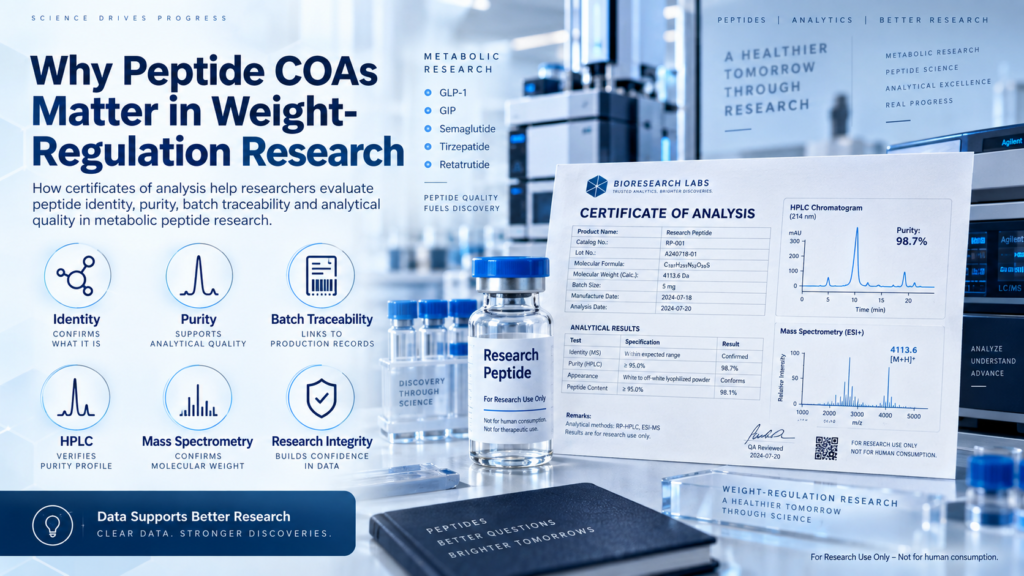
Interest in peptides has expanded substantially because peptide signalling pathways participate in metabolic regulation.
This has created considerable research attention around compounds interacting with pathways involving:
GLP-1,
GIP,
glucagon,
amylin,
and other metabolic signals.
However, discussion of “peptides for weight loss” can easily blur important distinctions.
Some compounds have become licensed prescription medicines.
Others remain experimental or investigational molecules.
Research-use laboratory materials are a separate category again.
A COA describing an analytical sample does not change the regulatory status of the molecule.
Why Are Peptides Connected to Weight Regulation?
The body uses peptide hormones as signalling molecules.
Following food intake, the digestive system releases multiple hormones that communicate information about nutrients to organs such as the pancreas and brain.
These pathways influence processes including:
insulin secretion,
glucagon signalling,
gastric emptying,
appetite,
satiety,
glucose regulation,
and energy balance.
Two particularly important metabolic hormones are GLP-1 and GIP.
What Is GLP-1?
GLP-1 stands for glucagon-like peptide-1.
It is an incretin hormone involved in metabolic signalling following food intake.
GLP-1 receptor activation can influence:
glucose-dependent insulin secretion,
appetite signalling,
glucagon regulation,
and gastric emptying.
These biological effects led to extensive pharmaceutical research into longer-acting GLP-1 receptor agonists.
Semaglutide is one important example.
What Is GIP?
GIP is commonly known as glucose-dependent insulinotropic polypeptide.
Like GLP-1, it participates in nutrient-responsive metabolic signalling.
Modern peptide research has increasingly examined whether targeting multiple metabolic receptors simultaneously can produce effects different from targeting GLP-1 alone.
That research led to dual-receptor compounds such as tirzepatide and investigational triple-receptor compounds such as retatrutide.
How Metabolic Peptide Pathways Work
Metabolic regulation is not controlled by one hormone.
Instead, the body operates through interconnected signalling networks involving the gut, pancreas, liver, adipose tissue, nervous system and other tissues.
After nutrients are consumed, hormonal signals communicate information about energy availability.
Researchers investigate these pathways by studying how specific receptors respond when activated or inhibited.
This has produced several important categories of metabolic compounds:
single-receptor agonists,
dual-receptor agonists,
and multi-receptor agonists.
Understanding these mechanisms is useful when interpreting peptide research, but receptor activity should not be confused with regulatory approval or clinical suitability.
Semaglutide in Weight-Regulation Research
Semaglutide is a GLP-1 receptor agonist.
It has been extensively studied in metabolic disease and weight-management research.
Importantly, semaglutide is not merely an experimental research compound.
Prescription semaglutide products have authorised medical indications.
In the United States, Wegovy is FDA-approved for chronic weight management in eligible populations, and its authorised indications have expanded over time. The FDA approved a higher-dose Wegovy option in March 2026.
In the UK, semaglutide is also authorised for specific weight-management indications, and the MHRA approved additional Wegovy formulations and dosing options during 2026.
That regulatory fact is important because licensed prescription Wegovy should not be confused with a vial sold as a laboratory research reagent containing semaglutide.
The name of the molecule may be related, but the products do not automatically have the same manufacturing, quality, regulatory or intended-use status.
Tirzepatide in Weight-Regulation Research
Tirzepatide differs from semaglutide because it acts through both the GIP and GLP-1 receptors.
It has undergone extensive clinical research for metabolic disease and obesity.
Tirzepatide is also an authorised prescription medicine.
In the United States, the FDA approved Zepbound, containing tirzepatide, for chronic weight management in eligible adults in 2023.
In the United Kingdom, NHS and NICE information recognises tirzepatide, commonly supplied under the Mounjaro brand, as a prescription treatment used for type 2 diabetes and obesity under defined eligibility and prescribing conditions.
Again, prescription tirzepatide and research-use tirzepatide material should not be treated as interchangeable categories.
Retatrutide: Current Research and Investigational Status
Retatrutide has received substantial scientific attention because it acts at three metabolic receptor systems:
GIP
GLP-1
and
glucagon receptors
This has led to the term triple receptor agonist or triple agonist.
A Phase 2 randomised trial published in the New England Journal of Medicine evaluated retatrutide in adults with obesity and reported substantial reductions in body weight over 48 weeks, with gastrointestinal events among the most commonly reported adverse effects.
During 2025 and 2026, Eli Lilly subsequently announced positive results from several Phase 3 studies. However, Lilly’s September 2026 development pipeline continues to list retatrutide as a molecule being studied for obesity and other metabolic indications rather than an approved marketed medicine.
The FDA also states that retatrutide is not a component of an FDA-approved drug and has not been found safe and effective by the FDA for any condition.
Therefore, retatrutide should currently be described as an investigational compound, not as an approved weight-loss medicine.
Semaglutide vs Tirzepatide vs Retatrutide: Key Research Differences
Although these compounds are frequently discussed together, their receptor profiles differ.
Semaglutide
Primarily targets the GLP-1 receptor.
Tirzepatide
Targets both GIP and GLP-1 receptors.
Retatrutide
Targets GIP, GLP-1 and glucagon receptors.
Their regulatory status also differs.
Semaglutide and tirzepatide have authorised prescription uses for weight management in the United States and United Kingdom under specific products and conditions.
Retatrutide remains investigational as of September 2026.
This distinction should be maintained whenever discussing these compounds.
What Does Clinical Research Actually Show?
Clinical trials provide evidence about defined study populations under controlled protocols.
They do not automatically prove that an unregulated or research-use product bought elsewhere will reproduce the results of an authorised pharmaceutical product or investigational clinical-trial material.
Researchers should therefore examine:
trial design,
participant population,
duration,
dose groups,
comparison groups,
primary outcomes,
adverse events,
dropout rates,
funding,
and publication status.
Peer-reviewed trials should also be distinguished from company press releases reporting preliminary or top-line results.
For example, retatrutide’s Phase 2 obesity trial was published in the New England Journal of Medicine. More recent Phase 3 results have also been publicly announced by Lilly, but regulatory review is a separate process from successful clinical trials.
Safety and Reported Adverse Effects
A peptide COA should never be interpreted as a medical safety certificate.
Clinical safety is evaluated through pharmacology, toxicology and clinical trials—not HPLC purity alone.
Prescription GLP-1-related medicines have labelled warnings, contraindications and adverse-effect information that patients and clinicians should review through official prescribing information.
For example, UK MHRA guidance warns that GLP-1 and dual GIP/GLP-1 medicines can have significant adverse effects and should be used according to their authorised prescribing conditions.
The MHRA also updated semaglutide product information in February 2026 regarding a very rare risk involving non-arteritic anterior ischaemic optic neuropathy.
These regulatory safety updates demonstrate why medical safety conclusions cannot be derived from laboratory purity numbers.
A compound can be chemically pure while still possessing significant pharmacological risks.
Research Peptides Versus Prescription Medicines
This distinction is essential.
A prescription medicine has been reviewed and authorised by the relevant regulator for defined medical uses, formulations and patient populations.
A research-use-only peptide is supplied for laboratory or analytical research and should not be presented as though it were an approved therapeutic product.
A research peptide COA may provide analytical information about:
identity,
purity,
composition,
and other tested attributes.
It does not transform the research product into an approved medicine.
Likewise, clinical evidence relating to a licensed pharmaceutical preparation cannot automatically be transferred to an unrelated laboratory research material containing a similarly named molecule.
Researchers interested in analytical materials can review the research peptide catalogue at AxionPeptideLab.com, while keeping the research-use designation separate from licensed pharmaceutical products.
For Research Use Only – Not for human consumption.
UK Regulatory Considerations for Research Peptides
Researchers and suppliers in the UK need to pay close attention to how products are presented.
The MHRA explains that determining whether a product is considered medicinal can involve factors such as:
the product’s intended purpose,
its pharmacological properties,
labelling,
packaging,
website content,
advertising,
and both explicit and implied medical claims.
This means that simply placing a disclaimer on a product does not necessarily override contradictory therapeutic marketing.
For a research-use business, product descriptions should therefore maintain a clear distinction between scientific discussion and claims about the product being sold.
Clinical studies can be discussed in their proper scientific context.
However, research-use materials should not be advertised as though they are approved medicines or intended for self-administration.
UK researchers looking for current information about authorised medicines should consult official MHRA product information, NHS resources and NICE guidance. how to read a peptide COA
A Practical Example: How to Re how to read a peptide COAad a Peptide COA
Imagine a hypothetical certificate containing the following information:
Compound: Research Peptide X
Lot: RPX-260901
Test date: 12 September 2026
HPLC purity: 99.31%
Theoretical molecular mass: 4,820.50 Da
Observed molecular mass: 4,820.61 Da
Laboratory: Independent Analytical Laboratory
Report ID: LAB-260912-481
How should a researcher interpret this?
First, check whether RPX-260901 matches the batch being evaluated.
Second, verify the laboratory and report ID where possible.
Third, examine the HPLC data.
A reported chromatographic purity of 99.31% indicates that under the analytical method used, the dominant integrated signal corresponded to the target peak.
Next, examine mass spectrometry.
An observed molecular mass close to the theoretical value provides evidence supporting the expected molecular identity.
Now examine what the certificate does not say.
Unless separate tests are included, this hypothetical certificate does not automatically establish:
sterility,
endotoxin level,
exact total peptide quantity,
long-term stability,
biological activity,
clinical effectiveness,
or human safety.
That is the correct way to interpret analytical data: according to what was actually measured.
Current and Future Peptide Research
Peptide research continues to move toward increasingly sophisticated molecular designs.
Researchers are examining:
multi-receptor agonists,
longer-acting peptides,
combination pathways,
amylin-related pathways,
glucagon signalling,
incretin biology,
drug-delivery technology,
peptide stability,
and more selective molecular targeting.
Metabolic research provides a particularly clear example of this progression.
GLP-1 receptor agonism was followed by widespread investigation of dual receptor systems such as GIP/GLP-1 and then triple receptor systems involving GIP, GLP-1 and glucagon.
Retatrutide is one example of this newer multi-receptor research direction. how to read a peptide COA
At the same time, analytical chemistry is becoming increasingly important as peptide molecules and impurities become more complex.
Advanced chromatographic techniques can help resolve impurities that might otherwise co-elute with target peptides, illustrating why a single purity percentage should never replace careful analytical review.
Why Researchers Should Understand COAs Before Comparing Suppliers
Price and stated purity percentages are easy to compare.
Analytical quality is more complicated.
Researchers evaluating peptide materials should consider the entire documentation package.
Ask:
Is the analysis batch-specific?
Who performed the testing?
Can the report be verified?
Does it include identity testing?
Does it include chromatographic purity?
Are analytical methods clearly identified?
Does the lot number match the material?
Are additional tests available when relevant?
These questions provide far more useful information than simply asking which supplier claims the highest purity percentage.
For laboratory researchers exploring research materials, AxionPeptideLab.com provides a catalogue of research-use products. Any applicable batch documentation should be evaluated using the principles descri how to read a peptide COAbed throughout this guide.
Frequently Asked Questions About Peptide COAs
What is a peptide COA?
A peptide COA, or Certificate of Analysis, is a document reporting analytical information associated with a peptide sample or batch. It may include compound identity, lot information, HPLC purity, mass spectrometry results and other analytical tests.
How do you read a peptide COA?
Start by checking the compound name, batch number, testing date and laboratory. Then examine what analytical methods were used. HPLC commonly provides chromatographic purity information, while mass spectrometry can provide evidence supporting molecular identity. Finally, check whether additional tests such as content, water, endotoxin or sterility are included where relevant. how to read a peptide COA
What does 99% purity mean on a peptide COA?
It commonly refers to chromatographic purity measured using HPLC. It generally indicates that approximately 99% of the relevant integrated chromatographic signal was associated with the main target peak under the method used. It should not automatically be interpreted as meaning 99% of the total physical vial mass is peptide. how to read a peptide COA
Is HPLC purity the same as peptide content?
No.
Chromatographic purity and quantitative peptide content answer different analytical questions.
A sample can have high chromatographic purity while containing water, salts, counterions or other material that affects its total mass.
What is HPLC peptide testing?
High-performance liqu how to read a peptide COAid chromatography separates components in a sample based on their behaviour under defined chromatographic conditions.
The resulting chromatogram can be used to investigate purity and peptide-related impurities. how to read a peptide COA
What is mass spectrometry peptide testing?
Mass spectrometry measures mass-to-charge characteristics of molecules.
For synthetic peptides, it can provide important evidence that the detected molecule corresponds to the expected molecular mass. how to read a peptide COA
Is mass spectrometry better than HPLC?
They perform different analytical functions.
HPLC is commonly used for separation and chromatographic purity evaluation.
Mass spectrometry provides information supporting molecular identity.
Using complementary analytical techniques provides more information than relying exclusively on either method.
Does a high HPLC purity result mean a peptide is sterile?
No.
Chemical purity and sterility are different characteristics.
Sterility requires an appropriate microbiological test.
Does HPLC detect endotoxins?
A standard peptide HPLC purity test should not be treated as an endotoxin test.
Endotoxin requires a dedicated analytical method.
Can a COA prove that a peptide is safe?
No.
A COA documents specified analytical tests.
Safety requires substantially different evidence, including appropriate toxicology, pharmacology and clinical evaluation. how to read a peptide COA
How can you verify a peptide COA?
Check that the batch number matches the material, identify the issuing laboratory and look for a report or certificate identifier. Where the laboratory provides independent report verification, verify the document directly through the laboratory’s own system. how to read a peptide COA
Should every peptide batch have a different COA?
If a supplier is representing analytical results as batch-specific, the documentation should correspond to the particular tested lot.
An old certificate from another production batch does not establish that a newly produced batch has identical analytical characteristics.
What is the difference between semaglutide, tirzepatide and retatrutide?
Semaglutide primarily targets the GLP-1 receptor.
Tirzepatide targets GIP and GLP-1 receptors.
Retatrutide targets GIP, GLP-1 and glucagon receptors.
Semaglutide and tirzepatide have authorised prescription weight-management products in the US and UK, while retatrutide remains investigational as of September 2026. how to read a peptide COA
Is retatrutide FDA approved?
No. As of September 2026, retatrutide remains investigational. The FDA states that retatrutide is not a component of an FDA-approved drug and has not been found safe and effective by the FDA for any condition.
Are research peptides the same as prescription medicines?
No.
Licensed prescription medicines are authorised for specific medical indications, formulations and populations.
Research-use-only materials are intended for scientific or laboratory purposes and should not be represented as approved medicines simply because they contain a compound with the same or similar name.
Final Thoughts: How to Read a Peptide COA Correctly
Understanding how to read a peptide COA requires more than finding a purity percentage.
A meaningful evaluation considers the entire analytical record.
Start with the batch number.
Confirm the laboratory.
Check the testing date.
Understand the analytical method.
Use HPLC to evaluate chromatographic purity in the context of the method.
Use mass spectrometry to examine evidence supporting molecular identity.
Do not confuse chromatographic purity with total peptide content.
Do not interpret chemical analysis as evidence of sterility or endotoxin status unless those characteristics were separately tested.
And most importantly, do not interpret a peptide COA as evidence that a research compound is safe, clinically effective or authorised for human use.
The rapid development of GLP-1, GIP and multi-receptor metabolic research makes these distinctions increasingly important. how to read a peptide COA
Semaglutide and tirzepatide demonstrate how peptide-related compounds can progress through formal clinical trials and regulatory review into authorised prescription medicines.
Retatrutide demonstrates another stage of that process: promising clinical research does not itself equal regulatory approval. how to read a peptide COA
For researchers, strong analytical documentation helps provide traceability and allows laboratory materials to be evaluated based on measurable evidence rather than marketing claims.
Researchers exploring laboratory materials can visit AxionPeptideLab.com and evaluate available research products and their associated documentation using the principles described in this guide. how to read a peptide COA
For Research Use Only – Not for human consumption.
References and Further Reading
U.S. Food and Drug Administration — Analytical Procedures and Methods Validation for Drugs and Biologics. Guidance concerning analytical procedures used to assess identity, strength, quality, purity and potency.
FDA / ICH Q2(R2) — Validation of Analytical Procedures. Current framework covering validation principles for analytical procedures.
PubMed — Characterization of Synthetic Peptides by Mass Spectrometry. Scientific overview of mass-spectrometric approaches used to characterise synthetic peptides.
PubMed — Peak Purity Assessment of Pharmaceutical Peptides Using Liquid Chromatography and Mass Spectrometry. Research examining chromatographic approaches to peptide impurity analysis.
New England Journal of Medicine — Triple-Hormone-Receptor Agonist Retatrutide for Obesity: A Phase 2 Trial. Peer-reviewed clinical research on retatrutide.
FDA — Wegovy / Semaglutide prescribing and approval information.
FDA — Zepbound / Tirzepatide chronic weight-management approval.
FDA — Information concerning unapproved GLP-1-related products and investigational retatrutide.
MHRA — GLP-1 medicines for weight loss and diabetes. Current UK regulatory and safety guidance.
NICE — Tirzepatide for managing overweight and obesity. UK evidence-based prescribing recommendations.
MHRA — Borderline products and medicinal-product classification. Guidance explaining how intended purpose, presentation, websites and medical claims can affect regulatory classification. how to read a peptide COA