
Peptide Batch Testing: 9 Essential Quality Control Checks for Research Materials
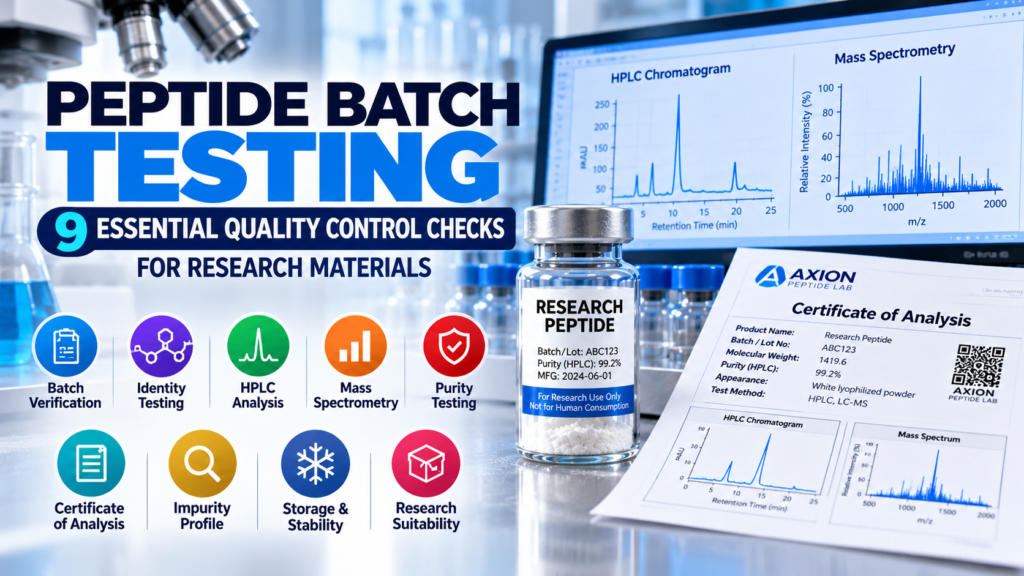
Peptide batch testing is an important part of evaluating research materials before they are incorporated into laboratory workflows. Rather than relying solely on a product name, stated quantity or general purity claim, researchers can examine analytical information associated with a particular production lot.
This distinction matters because laboratory research depends on traceability.
When researchers know exactly which batch was tested, which analytical methods were used and which results were obtained, they have more information for documenting experiments, comparing materials and investigating unexpected findings.
Peptide batch testing can involve several complementary quality-control approaches, including high-performance liquid chromatography (HPLC), mass spectrometry, identity verification, purity analysis, documentation review and lot traceability.
No single test answers every quality question.
Instead, laboratories can build a more complete picture by evaluating multiple characteristics of the research material.
This guide examines 9 essential peptide batch testing checks, explains what common analytical methods can—and cannot—tell researchers, and shows how batch-specific documentation can contribute to more reproducible laboratory research.
For Research Use Only – Not for Human Consumption.
What Is Peptide Batch Testing?
Peptide batch testing refers to analytical evaluation performed on material associated with a particular production batch or lot.
A batch is a defined quantity of material produced under a particular manufacturing or processing sequence.
A lot number provides an identifier that allows the material to be traced.
This means that instead of documentation simply stating:
Research Peptide — 99% Purity
batch-specific documentation might identify:
Product: Research Peptide
Lot: ABC123
Analytical Method: HPLC
Reported Result: 99.1%
Identity Analysis: Mass spectrometry
Testing Date: Recorded
The second example provides substantially greater traceability.
Researchers can potentially connect the analytical result with the physical material used in an experiment.
Why Is Peptide Batch Testing Important?
Scientific research depends on controlling and documenting experimental variables.
The research material itself is one of those variables.
Imagine that a laboratory performs an experiment using a particular peptide in January and repeats the experiment six months later.
The product name is the same.
The stated quantity is the same.
The experimental protocol is the same.
But the second material originated from a different production batch.
If the results differ, researchers may want to determine whether batch differences could have contributed.
Without lot records, this becomes considerably harder.
Peptide batch testing therefore contributes to several areas of laboratory quality management.
Traceability
Researchers can connect experimental materials with specific lots.
Reproducibility
Future experiments can document whether the same or different batches were used.
Quality Control
Analytical testing can evaluate characteristics such as purity and molecular identity.
Documentation
Batch-specific records provide more useful information than generic product claims.
Investigation of Unexpected Results
If experimental observations change, researchers can examine whether material differences may be relevant.
These benefits make batch identification an important component of responsible laboratory recordkeeping.
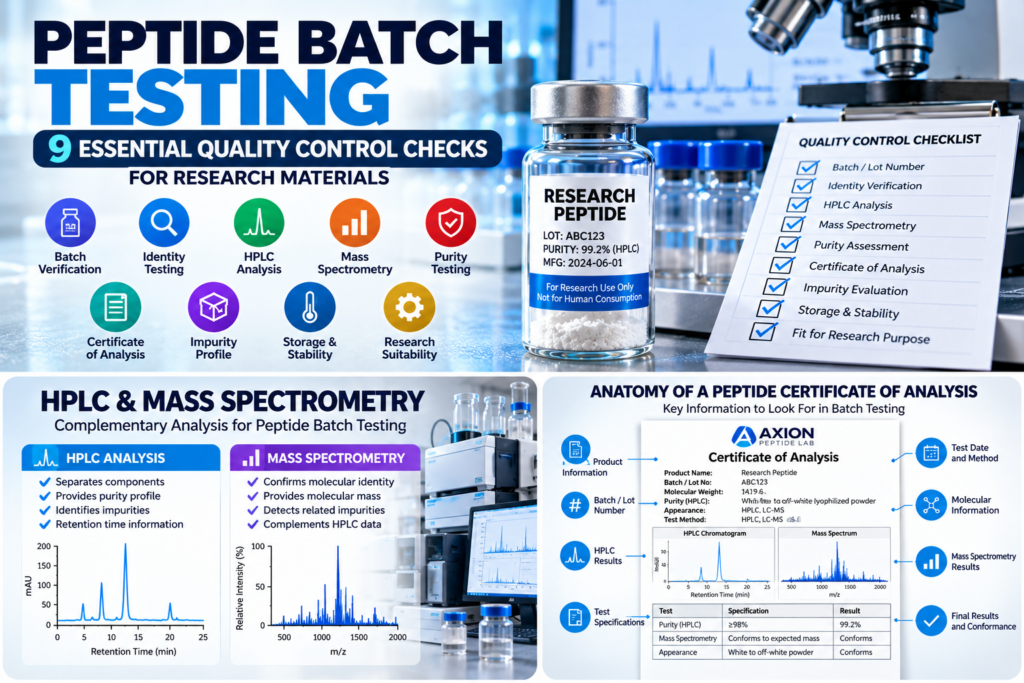
1. Confirm the Batch or Lot Number
The first step in peptide batch testing is confirming exactly which material is being evaluated.
A lot number acts as the link between:
- the physical research material;
- analytical testing;
- the Certificate of Analysis;
- laboratory inventory; and
- experimental records.
Without this connection, even detailed analytical results can become difficult to interpret.
For example, suppose a supplier has a mass spectrum for a particular peptide.
Researchers should still ask:
Which batch was tested?
If the laboratory’s material belongs to a different lot, the analytical result may not necessarily represent the specific material being used.
What Should Researchers Record?
A laboratory inventory may record:
- peptide name;
- product identifier;
- supplier;
- lot or batch number;
- quantity;
- date received;
- storage location;
- associated COA;
- relevant analytical results; and
- experiments using the material.
This information creates a stronger chain of traceability.
Why Lot Traceability Matters
Consider two vials that look identical.
Both have the same compound name.
Both contain the same nominal amount.
However:
Vial A: Lot 001
Vial B: Lot 002
Scientifically, those identifiers matter.
Researchers should avoid treating separate batches as automatically identical simply because their labels contain the same product name.
2. Verify Peptide Identity
After establishing batch identity, researchers can evaluate whether analytical evidence supports the expected molecular identity of the peptide.
This is different from purity testing.
A sample can potentially contain a dominant chromatographic component without that fact alone proving that the component is the intended molecule.
This is why peptide identity testing is important.
Expected Molecular Characteristics
A peptide’s amino-acid sequence corresponds to particular molecular characteristics.
Analytical techniques can therefore provide evidence that helps researchers compare the observed material with the expected compound.
Mass spectrometry is particularly important for this purpose.
Depending on the laboratory and research requirements, identity evaluation can involve:
- mass spectrometry;
- LC-MS;
- high-resolution MS;
- MALDI-TOF MS;
- tandem mass spectrometry; or
- other appropriate analytical techniques.
The objective is to obtain analytical evidence supporting the expected compound identity.
Identity Is Not the Same as Purity
This distinction is fundamental.
Identity asks: Is this the expected molecule?
Purity asks: What does the impurity profile look like under the analytical conditions used?
A complete quality-control strategy may therefore need to answer both questions.
3. Perform Peptide HPLC Testing
High-performance liquid chromatography is one of the most commonly discussed methods in peptide batch testing.
HPLC separates components within a sample based on their interaction with the chromatographic system.
The resulting chromatogram displays peaks.
Researchers can evaluate characteristics such as:
- retention time;
- principal peak;
- additional detectable peaks;
- relative peak areas; and
- chromatographic purity.
What Does an HPLC Chromatogram Show?
Imagine an HPLC chromatogram with one large peak and several smaller peaks.
The dominant peak may correspond to the primary component, while smaller peaks can indicate additional detectable components under those analytical conditions.
Researchers can calculate relative peak areas to estimate chromatographic purity.
However, interpretation depends on the analytical method.
Relevant variables can include:
- column type;
- mobile phase;
- gradient;
- flow rate;
- temperature;
- detection wavelength;
- sample concentration;
- injection volume; and
- run duration.
For this reason, a purity number is more informative when the analytical methodology is known.
HPLC Does Not Answer Every Question
An HPLC result should not automatically be interpreted as a complete description of everything physically present in a vial.
Chromatographic purity and total peptide content are different concepts.
Other characteristics may require separate analytical methods.
Therefore, researchers should avoid interpreting:
99% HPLC purity
as automatically meaning:
99% of the entire vial mass is the target peptide.
Those statements are not necessarily equivalent.
4. Review Mass Spectrometry Results
Mass spectrometry is another major component of peptide quality control.
Where HPLC provides chromatographic information, mass spectrometry can provide molecular-mass information.
This makes the two approaches complementary.
A peptide has an expected molecular mass based on its structure.
Researchers can compare analytical results against the expected molecular information to support identity assessment.
HPLC + Mass Spectrometry
A useful way to understand the relationship is:
HPLC: What components are detectable chromatographically?
Mass spectrometry: What molecular-mass information is associated with the analyzed material?
Together, the techniques provide a broader analytical picture.
This is why researchers evaluating peptide batch documentation may look for both chromatographic and mass-spectrometric information.
LC-MS Peptide Analysis
Liquid chromatography-mass spectrometry combines chromatographic separation with mass detection.
This can be especially valuable when researchers need information concerning both separation and molecular characteristics.
Different research applications may require different analytical configurations.
There is no single testing method appropriate for every peptide or every experimental objective.
5. Evaluate Peptide Purity
Purity is among the most prominent specifications used when comparing research peptides.
Researchers may encounter products described as:
≥95% purity
≥98% purity
≥99% purity
However, a percentage should always be interpreted according to the analytical method that generated it.
If purity was determined by HPLC, the number generally reflects chromatographic analysis under defined conditions.
It does not necessarily provide complete information about:
- water content;
- residual solvents;
- counterions;
- inorganic material;
- total peptide content;
- molecular identity; or
- every possible impurity.
These characteristics can require other analytical methods.
Why Peptide Purity Testing Matters
Impurities may arise during synthesis, purification, processing or storage.
Depending on the peptide and manufacturing process, possible considerations may include:
- incomplete sequences;
- truncated sequences;
- deletion products;
- oxidation;
- deamidation;
- hydrolysis;
- synthesis-related residues; and
- degradation products.
Different analytical techniques reveal different characteristics.
Researchers should therefore interpret purity results within the broader analytical context.
6. Examine the Certificate of Analysis
A Certificate of Analysis, or COA, can bring together important information concerning a tested peptide batch.
A useful COA should do more than display a large purity percentage.
Researchers can examine whether it includes:
- compound name;
- batch or lot number;
- test date;
- analytical method;
- purity result;
- chromatographic information;
- expected molecular information;
- observed mass information;
- physical description;
- specifications; and
- results.
The exact contents will depend on the material and testing program.
Match the COA With the Batch
One of the most important checks is straightforward:
Does the lot number on the COA correspond with the research material?
If the numbers do not match, researchers should not automatically assume the document represents that batch.
Batch-specific documentation is valuable precisely because it creates this traceable connection.
COA vs Generic Example
Researchers should also distinguish between:
an example COA
and
a batch-specific COA.
An example document can demonstrate what information may be available.
A batch-specific COA provides analytical information associated with a particular lot.
The latter is substantially more useful for experimental traceability.
7. Evaluate Potential Peptide Impurities
The seventh peptide batch testing consideration involves the impurity profile.
Peptide synthesis involves repeated chemical reactions.
Although purification processes are designed to isolate the desired product, related materials can potentially remain.
Possible peptide-related impurities can vary according to the sequence and synthesis process.
Researchers may encounter considerations involving:
- truncated sequences;
- deletion sequences;
- incomplete coupling products;
- oxidation products;
- deamidation;
- hydrolysis products;
- residual synthesis-related compounds; and
- degradation products.
Not every impurity is relevant to every peptide.
This is why analytical methods should be selected according to the particular research material.
Why Impurity Profiles Matter
Two batches could theoretically have similar overall purity percentages but different impurity profiles.
For some experimental applications, those differences may be relevant.
This illustrates why laboratories should avoid reducing peptide quality to one number.
Purity percentage is one piece of analytical information.
The complete chromatographic and analytical context can provide considerably more insight.
8. Review Storage and Stability
Testing a peptide batch provides information about the material at a particular point in time.
What happens afterward also matters.
Research materials can potentially change when exposed to inappropriate environmental conditions.
Factors affecting stability may include:
- temperature;
- moisture;
- oxygen;
- light;
- repeated temperature changes;
- storage duration; and
- physical state.
Different peptides can have different stability profiles.
Laboratories should therefore follow storage information appropriate to the specific research material.
Why Storage Records Matter
Suppose Batch A was tested and met laboratory specifications.
The material was then stored incorrectly for an extended period.
The original analytical result cannot necessarily establish that the material remained unchanged.
This means quality control should continue after receipt.
Researchers may record:
- date received;
- initial physical condition;
- designated storage location;
- recommended storage conditions;
- dates of relevant handling events; and
- any observed changes.
Good storage documentation supports stronger experimental records.
9. Determine Whether the Batch Is Fit for the Research Purpose
The final quality-control check is not simply:
“Did the batch pass?”
A more scientifically useful question is:
“Does this material meet the requirements of the intended experiment?”
Different laboratory applications can require different specifications.
For example, researchers performing exploratory work may have different analytical requirements from laboratories developing quantitative reference methods.
Before selecting a peptide batch, researchers should define:
Required Identity Evidence
What level of identity confirmation does the experiment require?
Required Purity
What impurity profile is acceptable?
Required Documentation
Does the laboratory require HPLC, MS, COA or other analytical information?
Required Quantity
How much material is necessary for the experiment?
Required Physical Format
What material presentation is appropriate for the workflow?
Required Storage
Can the laboratory maintain appropriate environmental conditions?
Required Traceability
What records must be preserved for future experimental review?
Once these requirements are established, laboratories can evaluate materials more systematically.
Peptide Batch Testing vs Peptide Quality Control
The terms are closely related but not identical.
Peptide batch testing refers specifically to analytical evaluation associated with a defined batch or lot.
Peptide quality control is broader.
Quality control can include:
- material specifications;
- batch testing;
- analytical procedures;
- documentation;
- packaging inspection;
- storage;
- traceability;
- laboratory handling; and
- ongoing review.
Batch testing is therefore one component of a broader quality-control system.
Peptide Batch Testing vs Peptide Purity Testing
These terms should also be distinguished.
Peptide purity testing focuses primarily on evaluating purity.
Peptide batch testing can include purity testing plus additional assessments such as:
- identity;
- molecular mass;
- batch documentation;
- COA review;
- traceability; and
- other quality characteristics.
A laboratory interested in overall batch quality should therefore avoid relying exclusively on a purity percentage.
Why Independent Peptide Testing Can Matter
Depending on the research project, laboratories may choose to perform their own analytical testing or use qualified third-party analytical services.
Independent testing can provide additional information about a material.
The appropriate level of verification depends on:
- research objective;
- laboratory quality system;
- material risk;
- analytical requirements;
- available instrumentation; and
- experimental sensitivity.
Some laboratories may have in-house HPLC and mass-spectrometry capabilities.
Others may send materials to external analytical laboratories.
The key principle remains the same:
Analytical conclusions should be based on appropriate methods and documented evidence.
Peptide Batch Testing and Research Reproducibility
Reproducibility is one of the strongest reasons to maintain batch records.
Imagine a published experiment simply states:
A peptide was used in the experiment.
Important information is missing.
A more reproducible record could identify:
- compound;
- supplier;
- catalogue number;
- lot number;
- purity specification;
- relevant analytical characterization;
- storage conditions; and
- experimental preparation.
This information gives future researchers much greater context.
Batch traceability does not eliminate experimental variation.
It does, however, document an important variable.
How to Read Peptide Batch Documentation
Researchers reviewing batch documentation can follow a simple sequence.
Step 1: Identify the Compound
Confirm that the document identifies the expected research material.
Step 2: Find the Lot Number
Check whether the batch number corresponds with the physical material.
Step 3: Review the Test Date
Determine when the analytical testing was performed.
Step 4: Identify the Analytical Methods
Look for techniques such as HPLC or mass spectrometry.
Step 5: Review Purity Results
Understand what method generated the stated purity.
Step 6: Review Identity Information
Compare expected and observed molecular information where applicable.
Step 7: Examine Supporting Data
Review chromatograms, spectra or other relevant analytical results where available.
Step 8: Compare Results With Specifications
Determine whether the analytical results meet the laboratory’s predetermined requirements.
This process provides a more structured approach than simply looking for a purity percentage.
Research Peptide Batch Testing Across Different Materials
The same general quality-control principles can be applied across many types of research materials, although exact analytical requirements differ by compound.
Retatrutide Research Material
Retatrutide is investigated scientifically in connection with GLP-1, GIP and glucagon receptor pathways.
Researchers working with retatrutide research materials can document batch numbers and evaluate relevant purity and identity information according to experimental requirements.
Tirzepatide Research Material
Tirzepatide is studied in relation to GIP and GLP-1 receptor activity.
Laboratories should distinguish research materials from prescription pharmaceutical products and maintain appropriate research-use documentation.
Cagrilintide Research Material
Cagrilintide is investigated in amylin-related scientific research.
Batch traceability can help researchers document exactly which material was used in individual experiments.
GHK-Cu Research Material
GHK-Cu represents a chemically different research material from incretin-related compounds.
This reinforces an important principle:
Analytical and storage assumptions should not automatically be generalized from one peptide to another.
AOD-9604 Research Material
Researchers evaluating AOD-9604 can apply the same core framework: identity, purity, documentation, traceability and fit for experimental purpose.
BPC-157 Research Material
BPC-157 research materials should likewise be evaluated according to appropriate laboratory specifications rather than unsupported consumer claims.
All Axion Peptide Lab materials referenced here are intended strictly for laboratory research.
Peptide Batch Testing Checklist
Researchers can use the following checklist when reviewing a batch:
Identification
☐ Correct peptide name
☐ Lot number present
☐ Product identifier recorded
Identity Testing
☐ Appropriate identity analysis available
☐ Expected molecular information documented
☐ Observed analytical information reviewed
Purity
☐ Purity result available
☐ Analytical method identified
☐ Chromatographic information reviewed where applicable
COA
☐ Certificate of Analysis available
☐ COA lot matches product lot
☐ Test date recorded
☐ Analytical results provided
Packaging
☐ Container intact
☐ Label legible
☐ Batch information visible
Storage
☐ Storage requirements reviewed
☐ Laboratory can maintain required conditions
☐ Storage location documented
Research Suitability
☐ Specifications meet experimental requirements
☐ Documentation retained
☐ Material recorded in laboratory inventory
Common Peptide Batch Testing Mistakes
1. Looking Only at the Purity Number
Purity alone does not establish identity or complete quality.
2. Ignoring the Lot Number
Batch-specific testing loses much of its traceability value if researchers cannot connect the result with the physical material.
3. Assuming HPLC Confirms Everything
HPLC provides valuable chromatographic information, but complementary methods may be required for identity and other quality attributes.
4. Assuming Mass Spectrometry Measures Purity in the Same Way as HPLC
The techniques answer different analytical questions.
5. Using a Generic COA as Batch Evidence
Researchers should determine whether documentation actually corresponds with the material’s lot.
6. Ignoring Storage History
Testing describes the material at a particular time. Subsequent handling can matter.
7. Assuming Every Peptide Requires the Same Testing
Analytical requirements should be determined by the compound and intended experiment.
Frequently Asked Questions About Peptide Batch Testing
What is peptide batch testing?
Peptide batch testing is analytical evaluation of research material associated with a specific production batch or lot.
Why is peptide batch testing important?
It provides laboratories with batch-specific information that can support quality control, traceability and experimental documentation.
What tests are commonly used for research peptides?
Depending on the material and purpose, analytical methods can include HPLC, mass spectrometry, LC-MS and other appropriate techniques.
What does HPLC show for peptides?
HPLC separates detectable components under defined chromatographic conditions and can provide information about the sample’s purity profile.
What does mass spectrometry show?
Mass spectrometry provides molecular-mass information that can help support compound identity.
Is HPLC purity the same as total peptide content?
Not necessarily. Chromatographic purity and total peptide content are distinct analytical concepts.
What is a peptide lot number?
A lot number is an identifier associated with a particular production batch and helps laboratories maintain traceability.
Should the COA lot number match the peptide vial?
For batch-specific documentation, researchers should verify that the COA corresponds with the lot being evaluated.
Can two batches of the same peptide differ?
Separate production batches can potentially differ in analytical characteristics, which is one reason lot identification and batch-specific documentation are valuable.
Is peptide batch testing the same as purity testing?
No. Purity testing can be one component of broader batch testing, which may also include identity analysis, mass information, documentation and traceability.
Can appearance confirm peptide purity?
No. Visual appearance alone cannot reliably establish molecular identity or chemical purity.
Are research peptides medicines?
Research-use-only materials are laboratory materials and should not be treated as approved pharmaceutical products merely because a compound name is also associated with pharmaceutical research.
Final Thoughts: Peptide Batch Testing Strengthens Laboratory Traceability
Peptide batch testing gives researchers a structured way to evaluate laboratory materials beyond product names and marketing claims.
The strongest evaluation considers several complementary factors:
- batch and lot identification;
- peptide identity;
- HPLC analysis;
- mass spectrometry;
- purity;
- Certificate of Analysis documentation;
- impurity considerations;
- storage and stability; and
- suitability for the intended research purpose.
No single number provides the complete picture.
A reported purity percentage can be useful, but researchers gain substantially more information when it is connected with a specific lot, analytical method and supporting documentation.
For laboratories purchasing research materials, maintaining these records can strengthen traceability and make future experimental review easier.
Researchers can explore the Axion Peptide Lab Research Peptide Catalogue for laboratory research materials and use our educational resources on research peptide quality, peptide purity, Certificates of Analysis and research peptide testing to better understand the documentation associated with peptide research.
For Research Use Only – Not for Human Consumption.
Authoritative Peptide Research Resources
Researchers studying peptides can benefit from consulting authoritative regulatory resources and peer-reviewed scientific literature covering peptide development, synthesis, characterization, and laboratory research.
For authoritative regulatory information about peptide products and their development, see the FDA’s guidance on Clinical Pharmacology Considerations for Peptide Drug Products. This resource provides regulatory guidance relevant to the development and evaluation of peptide drug products.
For current scientific publications covering peptide biology, chemistry, molecular mechanisms, and research applications, explore Nature’s Peptide Research Collection. Nature provides access to scientific research and developments across numerous areas of peptide science.
Researchers looking for peer-reviewed scientific literature can also explore PubMed’s extensive collection of peptide studies. PubMed is particularly useful for locating published research on peptide chemistry, biological activity, analytical methods, molecular pathways, and emerging areas of peptide investigation.
For a scientific introduction to laboratory peptide synthesis and commonly used research methodologies, see this PubMed resource on peptide synthesis. It provides useful scientific background for researchers interested in understanding how peptide materials can be produced and studied in laboratory environments.
For more detailed information about chemical methods used in peptide production, researchers can consult this peer-reviewed review of peptide synthesis methods. The publication discusses important developments and approaches associated with modern peptide chemistry.
Researchers interested in how peptides are identified, measured, and characterized can also review Nature Reviews Methods Primers on Peptidomics. Peptidomics uses advanced analytical approaches to investigate peptide populations and can provide valuable insights into peptide identification and characterization.
These external scientific resources provide additional background for readers who want to explore peptide research beyond this guide and examine regulatory guidance, peer-reviewed studies, peptide synthesis techniques, and modern analytical methodologies in greater detail.