
Peptides for Weight Loss: Research, GLP-1s, Safety & What the Science Shows
However, these compounds should not all be placed in the same category. Some peptide-based compounds have been developed into licensed prescription medicines for specific indications, while others remain investigational compounds being evaluated in clinical trials. Laboratory research peptides are another separate category and should not be confused with medicines approved for human use.
Interest in peptides for weight loss has grown rapidly in both the USA and UK, driven largely by advances in metabolic research and the development of medicines that target hormone pathways involved in appetite, blood glucose regulation and energy balance. Terms such as GLP-1, GIP, semaglutide, tirzepatide and retatrutide now appear frequently in scientific research, healthcare discussions and online searches.
Understanding these differences is particularly important when researching peptides and weight management.
Peptides are short chains of amino acids that can function as biological signalling molecules. Many naturally occurring peptide hormones help coordinate processes throughout the body. In metabolic science, researchers are particularly interested in signalling pathways associated with appetite, satiety, glucose metabolism, insulin secretion, gastrointestinal function and energy regulation.
One of the most important areas of modern metabolic research involves the incretin system. This includes glucagon-like peptide-1 (GLP-1) and glucose-dependent insulinotropic polypeptide (GIP). Scientists have developed compounds capable of activating receptors associated with these hormones, creating an expanding field of single-, dual- and triple-receptor agonist research.
This helps explain why three names frequently appear when people research peptides for weight loss:
Semaglutide acts primarily as a GLP-1 receptor agonist and is the active ingredient in prescription medicines authorized for particular medical indications.
Tirzepatide targets both GIP and GLP-1 receptors. Certain tirzepatide-containing medicines have received regulatory authorization for specific indications, although authorization, prescribing requirements and availability vary by country.
Retatrutide, by contrast, is being investigated as a triple agonist targeting GIP, GLP-1 and glucagon receptors. Its investigational status must be clearly distinguished from established prescription medicines.
These differences matter because promising clinical research does not automatically mean that a compound has been approved as a medicine. Regulatory agencies evaluate factors including efficacy, safety, manufacturing quality and the balance between potential benefits and risks before medicines can be authorized for particular uses.
The same distinction applies to products labelled For Research Use Only (RUO). These materials are intended for legitimate laboratory, analytical and scientific research. They should not be presented as prescription medicines or substitutes for clinically authorized treatments and are not intended for human consumption.
For researchers, the expanding study of GLP-1, GIP, glucagon and related metabolic pathways provides an important area of scientific investigation. Axion Peptide Lab supports this research context by providing a catalogue of research-use materials for appropriate laboratory and R&D applications.
Throughout this guide, we will examine what peptides are, how metabolic peptide pathways work, the roles of GLP-1 and GIP, and the scientific evidence surrounding semaglutide, tirzepatide and retatrutide. We will also look closely at clinical research, reported adverse effects, regulatory considerations in the USA and UK, and the important distinction between prescription medicines and research-use compounds.
The goal is not to treat every product described online as a “weight-loss peptide,” but to understand what the scientific evidence actually shows and where each compound currently sits within research and medicine.
What Are Peptides?

Peptides are short chains of amino acids, the same basic building blocks that form proteins. Amino acids join together through chemical bonds known as peptide bonds, creating molecules that can perform many different biological functions.
Although peptides and proteins are made from amino acids, peptides are generally smaller. Their relatively compact structures allow many naturally occurring peptides to function as biological signalling molecules, carrying instructions between cells and helping coordinate processes throughout the body.
This signalling role is one reason peptides have become an important area of metabolic research. Scientists study peptide pathways involved in processes such as appetite and satiety, glucose regulation, insulin secretion, digestion and energy balance. However, this does not mean that every peptide influences body weight or that every substance marketed online as a “weight-loss peptide” has been clinically demonstrated to produce weight loss.
Some of the most important peptides in metabolic science occur naturally in the body. Researchers can also develop synthetic molecules that reproduce or modify aspects of naturally occurring peptide signalling. Depending on the compound and its regulatory status, these molecules may become licensed prescription medicines, remain investigational drugs undergoing clinical trials, or be supplied strictly as materials for laboratory research. Peptides for Weight Loss
Understanding these distinctions is essential when exploring peptides for weight loss, because the scientific evidence, intended use and regulatory status can differ considerably from one compound to another.
How Peptides Work in the Human Body
Many peptides work by interacting with specific receptors located on or within cells. A useful way to understand this process is to think of a peptide as a biological signal and its receptor as the structure capable of recognizing that signal.
When the appropriate molecule interacts with its receptor, it can initiate a series of cellular responses. Different peptide hormones therefore participate in different physiological processes depending on the receptors they activate and where those receptors are located.
Metabolic regulation provides a particularly important example. After food is consumed, the gastrointestinal system does much more than simply digest nutrients. It also releases hormonal signals that communicate with organs including the pancreas and brain.
Two important hormones in this field are glucagon-like peptide-1 (GLP-1) and glucose-dependent insulinotropic polypeptide (GIP). Both belong to a group of hormones known as incretins and are involved in the physiological response to nutrient intake.
GLP-1 signalling, for example, has roles in glucose-dependent insulin secretion, glucagon regulation, gastrointestinal function and appetite-related pathways. Because of these effects, the GLP-1 receptor has become an important target in metabolic medicine and scientific research. Peptides for Weight Loss
This research eventually contributed to the development of GLP-1 receptor agonists—molecules designed to activate the GLP-1 receptor. Semaglutide is one well-known example.
Scientists have subsequently explored whether targeting more than one metabolic receptor could produce different effects. Tirzepatide, for example, has activity at both GIP and GLP-1 receptors, while retatrutide is an investigational compound being studied for activity across GIP, GLP-1 and glucagon receptors.
These developments demonstrate why modern research into peptides for weight loss and metabolic regulation is increasingly focused on receptor pathways rather than the broad idea that peptides simply “burn fat.”
Natural Peptides vs Synthetic Peptide-Based Compounds
An important distinction must be made between naturally occurring peptides and synthetic peptide-based compounds.
Natural peptide hormones are produced within the body and participate in normal physiological signalling. GLP-1 and GIP, for example, are naturally occurring hormones involved in metabolic responses following nutrient intake.
Researchers can design synthetic compounds that interact with the same or related receptors. These compounds may be modified to change properties such as their biological activity or how long their effects persist.
But being peptide-based does not automatically make a compound an approved medicine.
A synthetic peptide-related compound may fall into several very different categories. It might be an active ingredient in an authorized prescription medicine, an investigational drug undergoing controlled clinical trials, or a laboratory research material intended exclusively for experimental work.
This distinction is particularly relevant when comparing semaglutide, tirzepatide and retatrutide. Their mechanisms overlap through metabolic receptor pathways, but their clinical evidence and regulatory status should be evaluated individually rather than treating them as interchangeable “weight-loss peptides.”
Researchers purchasing materials from Axion Peptide Lab should similarly distinguish laboratory products from pharmaceutical medicines. Products supplied and labelled For Research Use Only are intended for legitimate laboratory, analytical and R&D applications. They are not intended for human consumption and should not be represented as medicines or substitutes for prescription treatments.
Understanding what peptides actually are—and how precisely their signalling can depend on particular receptors—provides the foundation for the next question: why are certain peptide pathways so closely connected with appetite, metabolism and weight regulation?
Why Are Peptides Connected to Weight Regulation?
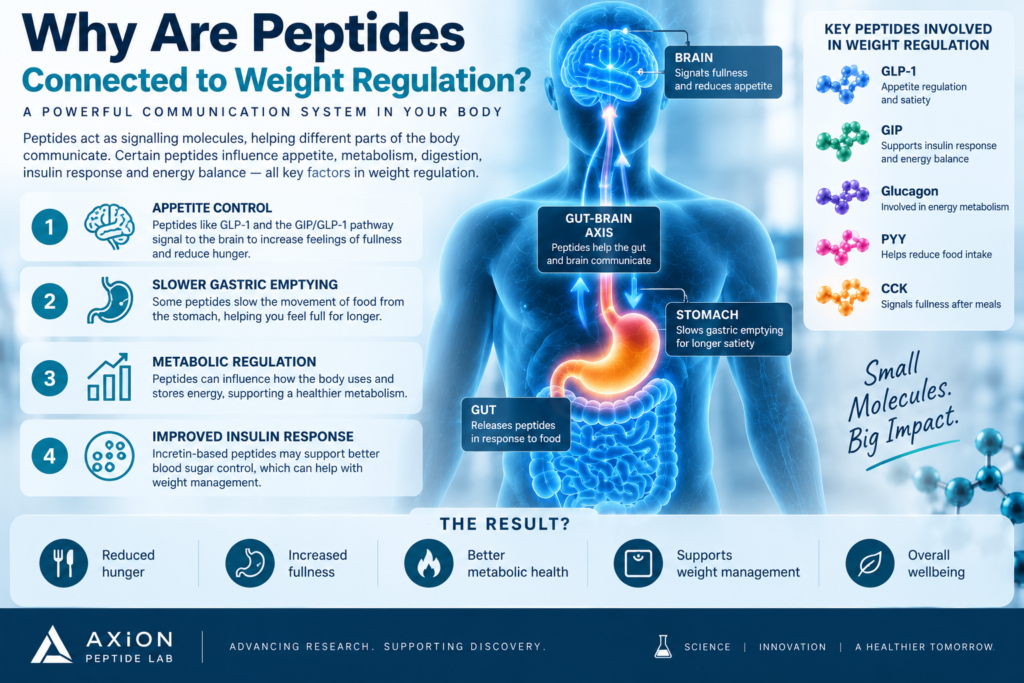
The connection between peptides and weight regulation comes primarily from the role certain peptide hormones play in the body’s metabolic signalling systems. Body weight is influenced by a complex network involving the brain, gastrointestinal tract, pancreas, adipose tissue and other organs. These systems exchange chemical signals that help regulate hunger, satiety, food intake, glucose metabolism and energy balance.
Certain naturally occurring peptide hormones form part of this communication network. Rather than directly “burning fat,” they interact with specific receptors and influence biological processes that can affect how much food is consumed and how nutrients are handled.
This distinction is important when discussing peptides for weight loss. Not every peptide affects body weight, and compounds targeting metabolic peptide pathways can differ substantially in their mechanisms, clinical evidence and regulatory status.
Modern metabolic research has focused particularly on the incretin system, including the hormones GLP-1 and GIP. Research into these pathways has contributed to the development of medicines such as semaglutide and tirzepatide, while scientists continue investigating additional multi-receptor compounds such as retatrutide.
Appetite and Satiety Signalling
Appetite is not controlled solely by willpower or by how empty the stomach feels. The body uses a sophisticated signalling network to communicate information about nutrient intake and energy availability.
After eating, the gastrointestinal tract releases several hormonal signals. Some of these signals communicate with the brain and other organs, contributing to the regulation of hunger and satiety—the feeling of having eaten enough.
GLP-1 is particularly relevant to this process. It is a naturally occurring hormone released primarily from intestinal cells in response to nutrient intake. GLP-1 receptors are present in several tissues, and signalling through these receptors is involved in both glucose regulation and appetite-related pathways.
This biological relationship has made the GLP-1 receptor an important target for metabolic research.
Compounds known as GLP-1 receptor agonists are designed to activate this receptor. Semaglutide is an example of a GLP-1 receptor agonist. Its effects on appetite and energy intake are among the mechanisms relevant to its clinical use and study in weight management.
Researchers have also investigated whether combining GLP-1 activity with other metabolic pathways could produce different effects.
Tirzepatide, for example, acts at both GIP and GLP-1 receptors, while the investigational compound retatrutide is being studied for activity at GIP, GLP-1 and glucagon receptors.
This progression from single- to dual- and triple-receptor approaches represents an important direction in metabolic peptide research.
Glucose Regulation and Insulin Signalling
Another reason certain peptides are relevant to metabolic research is their relationship with blood glucose and insulin signalling.
When carbohydrates and other nutrients are consumed, glucose concentrations in the bloodstream can rise. The pancreas responds by releasing insulin, which helps regulate blood glucose by facilitating glucose uptake and influencing metabolic processes in different tissues.
The gastrointestinal system contributes to this response through the incretin effect.
Two major incretin hormones are:
GLP-1 — glucagon-like peptide-1
and
GIP — glucose-dependent insulinotropic polypeptide.
These hormones are released in response to nutrient intake and can enhance glucose-dependent insulin secretion. The term “glucose-dependent” is important because their insulin-related effects are linked to prevailing glucose concentrations. Peptides for Weight Loss
This relationship between the gut and pancreas has made incretin signalling a major area of research in metabolic diseases.
Scientists have consequently developed molecules that remain active at incretin receptors for considerably longer than naturally occurring hormones. This allows researchers and clinicians to investigate how sustained receptor activation affects glucose regulation, appeti Peptides for Weight Losste and other metabolic outcomes.
Semaglutide primarily targets the GLP-1 receptor, whereas tirzepatide targets both the GIP and GLP-1 receptors. Peptides for Weight Loss
Retatrutide extends this research concept further. It is being investigated as a triple receptor agonist with activity at GIP, GLP-1 and glucagon receptors. Because retatrutide remains investigational, findings from clinical research should not be interpreted as meaning that it is automatically an approved weight-management medicine.
Understanding these receptor differences is essential when comparing compounds commonly discussed under the broad search term “peptides for weight loss.”
Gastric Emptying and Food Intake
The relationship between peptide signalling and body weight also involves the gastrointestinal system.
Gastric emptying describes the process by which food moves from the stomach into the small intestine. The rate of this process can influence digestion, post-meal glucose responses and feelings of fullness.
GLP-1 signalling can affect gastric emptying, particularly in ways that may contribute to metabolic responses following food intake. However, appetite and weight-related effects of GLP-1 receptor agonists should not be reduced to the idea that they simply “keep food in the stomach longer.” Their actions involve multiple physiological pathways, including signalling associated with appetite and energy intake.
Clinical studies of incretin-based medicines have therefore examined outcomes such as body weight, f Peptides for Weight Lossood intake, glucose control and adverse effects rather than relying on a single proposed mechanism. Peptides for Weight Loss
This is also why claims that a particular peptide simply “melts fat” or directly targets areas such as abdominal fat should be treated cautiously. Weight regulation is multifactorial, and scientifically supported conclusions should come from well-designed studies rather than marketing claims or individual testimonials.
For legitimate researchers, these interconnected pathways—appetite signalling, incretin activity, insulin secretion and gastrointestinal physiology—have created a substantial field of metabolic investigation. Axion Peptide Lab provides research-use materials for appropriate laboratory and R&D applications within this broader research environment. Products designated For Research Use Only are not medicines and are not intended for human consumption.
The connection between peptides and weight regulation therefore lies primarily in biological signalling and receptor activity, not in peptides functioning as universal weight-loss substances. Understanding this distinction provides the foundation for examining the specific metabolic pathways—particularly GLP-1, GIP and glucagon signalling—that have become central to modern peptide research.
How Metabolic Peptide Pathways Work
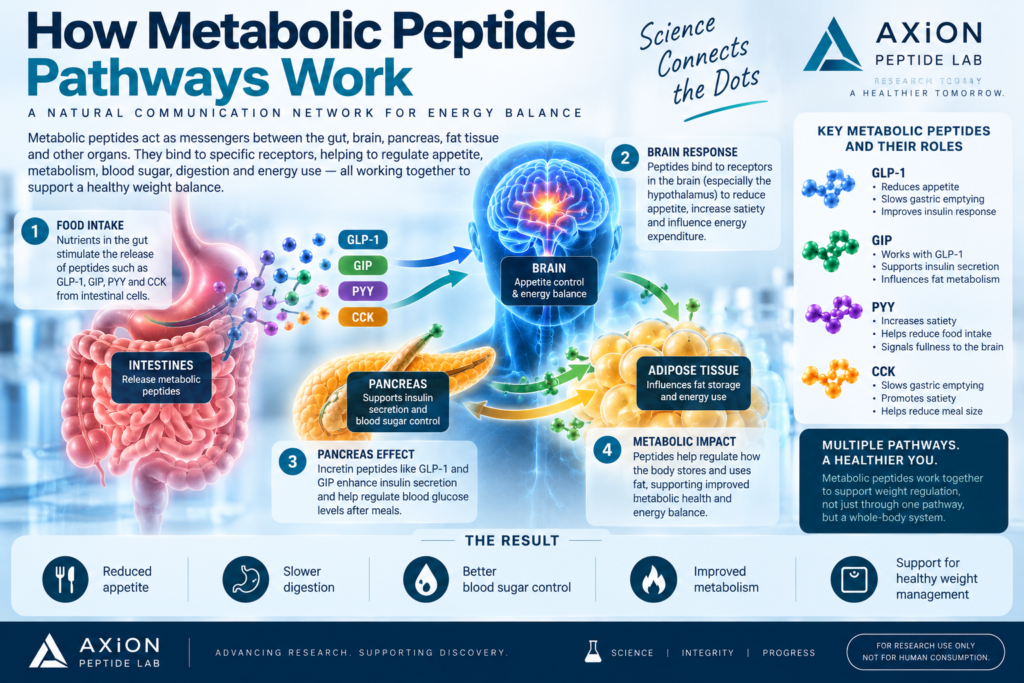
Metabolic peptide pathways are communication systems that help coordinate processes such as appetite, blood glucose regulation, insulin secretion, digestion and energy balance. Understanding these pathways is essential when researching peptides for weight loss, because many modern metabolic compounds are designed to interact with specific hormone receptors rather than acting as simple “fat-burning” substances.
The gastrointestinal tract, pancreas, brain and other tissues continuously exchange hormonal signals in response to food intake and changes in energy availability. Peptide hormones are an important part of this network. They bind to particular receptors and trigger cellular responses that can influence metabolic function.
Among the pathways receiving significant attention are those involving GLP-1, GIP and glucagon. These pathways have contributed to the development of single-receptor medicines, dual-receptor medicines and investigational multi-receptor compounds.
The Gut–Brain Axis
The gut–brain axis describes the two-way communication network connecting the gastrointestinal system with the central nervous system. Communication occurs through several mechanisms, including neural, hormonal and metabolic signals.
When nutrients enter the gastrointestinal tract, specialized cells can release hormones that provide information about nutrient availability. These signals can interact with receptors in peripheral tissues and influence neural pathways associated with hunger, fullness and food intake.
GLP-1 is one of the peptide hormones involved in this system. It is released following nutrient intake and participates in several physiological processes, including glucose-dependent insulin secretion and appetite-related signalling.
This helps explain why the GLP-1 pathway has become important in research into obesity and metabolic disease.
Rather than thinking of GLP-1 receptor agonists simply as substances that “suppress hunger,” it is more accurate to view them as compounds interacting with a broader metabolic signalling network.
The brain receives and integrates information from multiple hormonal and neural signals. This contributes to decisions concerning hunger, satiety and energy intake.
Consequently, researchers investigating peptides and weight regulation increasingly examine the interaction between the gastrointestinal tract, nervous system and endocrine system rather than studying any one mechanism in isolation. Peptides for Weight Loss
Incretin Hormones
The incretin system is one of the most important metabolic pathways underlying current research into peptide-based medicines.
The two principal incretin hormones are:
GLP-1 — glucagon-like peptide-1
GIP — glucose-dependent insulinotropic polypeptide
Both are released from the gastrointestinal tract following nutrient intake and contribute to the body’s metabolic response to a meal.
One of their important functions is promoting glucose-dependent insulin secretion. This means that when blood glucose is elevated following nutrient intake, incretin signalling can enhance the pancreatic insulin response.
GLP-1 also has additional physiological actions relevant to metabolic research, including effects involving glucagon secretion, gastrointestinal function, appetite and food intake.
Naturally occurring GLP-1 does not remain active indefinitely. Pharmaceutical researchers therefore developed longer-acting molecules capable of activating the GLP-1 receptor for extended periods.
This research led to the development of GLP-1 receptor agonists, including semaglutide.
Research subsequently expanded beyond targeting GLP-1 alone. Scientists investigated whether simultaneously influencing multiple metabolic receptors could produce different effects.
This is where GIP became particularly important.
Tirzepatide acts as a dual GIP and GLP-1 receptor agonist. Rather than targeting only the GLP-1 pathway, the molecule has activity at both incretin receptors.
Clinical research into these different approaches has substantially expanded scientific understanding of how incretin pathways can influence metabolic outcomes.
However, receptor activity alone does not establish whether one compound is safer or more effective than another. Those conclusions require appropriately designed clinical trials.
Single, Dual and Triple Receptor Agonism
One of the easiest ways to understand modern metabolic peptide research is to examine how many receptor pathways a compound is designed to target.
Single-Receptor Agonism
A single-receptor agonist primarily targets one receptor pathway.
Semaglutide is a well-known example because it acts as a GLP-1 receptor agonist.
Its activity at the GLP-1 receptor influences several metabolic processes, including pathways associated with glucose regulation, appetite and energy intake.
Semaglutide has been extensively evaluated in clinical trials, and semaglutide-containing prescription medicines have received regulatory authorization for particular indications. The exact product, indication and regulatory jurisdiction must still be distinguished when discussing its approved medical use.
Dual-Receptor Agonism
The next approach involves targeting two metabolic receptors.
Tirzepatide is a GIP and GLP-1 receptor agonist, meaning it combines activity at both major incretin receptor pathways within a single molecule.
This dual mechanism distinguishes tirzepatide from GLP-1-only receptor agonists such as semaglutide.
Researchers have investigated whether simultaneously targeting these pathways can produce clinically meaningful effects on metabolic outcomes, including body weight and glucose regulation.
Again, the mechanism itself should not be interpreted as proof that a compound is inherently “better.” Clinical outcomes, adverse effects, patient characteristics and regulatory evidence all need to be considered.
Triple-Receptor Agonism
Research has progressed further into compounds designed to interact with three metabolic receptor pathways.
Retatrutide is a prominent example.
It is being investigated for agonist activity at:
GIP receptors + GLP-1 receptors + glucagon receptors.
The addition of glucagon receptor activity represents an important difference between retatrutide and compounds such as semaglutide and tirzepatide.
Glucagon is another peptide hormone involved in metabolic regulation. Its physiological functions include participation in glucose and energy metabolism, making the glucagon receptor an interesting target for researchers investigating multi-receptor strategies.
However, retatrutide is an investigational compound. Promising clinical-trial findings should not be interpreted as automatically giving an experimental compound the same regulatory status as an authorized prescription medicine.
This distinction is particularly important when people encounter semaglutide, tirzepatide and retatrutide together in discussions about peptides for weight loss.
At a simplified mechanistic level, the distinction can be represented as:
| Compound | Principal receptor targets | General category |
| Semaglutide | GLP-1 | Single-receptor agonist |
| Tirzepatide | GIP + GLP-1 | Dual-receptor agonist |
| Retatrutide | GIP + GLP-1 + glucagon | Investigational triple-receptor agonist |
These mechanisms help researchers understand why the compounds are scientifically related while also demonstrating why they should not be treated as interchangeable substances.
For laboratory researchers, metabolic receptor signalling—including GLP-1, GIP and glucagon pathways—continues to represent an important area of investigation. Research materials available through Axion Peptide Lab are supplied for appropriate laboratory and R&D applications. Products designated For Research Use Only are not medicines and are not intended for human consumption.
Understanding single, dual and triple receptor agonism provides the foundation for examining two of the most important hormones behind this field in greater detail: GLP-1 and GIP.
Understanding GLP-1 and GIP
Two of the most important hormone pathways in modern research into peptides for weight loss are GLP-1 and GIP. Both are naturally occurring incretin hormones, meaning they are released in response to nutrient intake and contribute to the body’s metabolic response after eating.
Research into these hormones has transformed the understanding of appetite regulation, insulin secretion and metabolic signalling. It has also contributed to the development of compounds that activate one or more incretin receptors.
Understanding GLP-1 and GIP is therefore essential for understanding why semaglutide, tirzepatide and investigational compounds such as retatrutide have different mechanisms of action.
What Is GLP-1?
GLP-1, or glucagon-like peptide-1, is a naturally occurring peptide hormone produced primarily in the gastrointestinal tract following food intake.
GLP-1 performs several physiological functions. One of its best-established roles involves helping regulate blood glucose by enhancing glucose-dependent insulin secretion. In other words, GLP-1 signalling can increase insulin secretion when glucose concentrations are elevated.
GLP-1 signalling is also associated with the regulation of glucagon secretion, gastrointestinal function and pathways involved in appetite, satiety and food intake.
These combined actions made the GLP-1 receptor an important target for researchers studying diabetes, obesity and metabolic regulation. Peptides for Weight Loss
A challenge with naturally occurring GLP-1 is that it is rapidly broken down in the body. Scientists therefore developed molecules capable of activating the GLP-1 receptor while remaining active for considerably longer periods.
These compounds are known as GLP-1 receptor agonists.
Semaglutide is a prominent example. Rather than being identical to naturally occurring GLP-1, semaglutide is designed to activate the GLP-1 receptor and has pharmacological properties that allow prolonged activity.
Clinical research has demonstrated that targeting GLP-1 receptors can influence outcomes including glucose regulation, appetite, energy intake and body weight in appropriate populations. However, the clinical effects and safety profile of each GLP-1 receptor agonist need to be evaluated individually.
This distinction prevents the misleading assumption that every substance associated with GLP-1 has identical effects.
What Is GIP?
GIP, or glucose-dependent insulinotropic polypeptide, is another naturally occurring incretin hormone.
Like GLP-1, GIP is released from specialized cells in the gastrointestinal tract following nutrient intake. It contributes to the body’s post-meal metabolic response and can stimulate glucose-dependent insulin secretion.
Historically, much of the pharmaceutical attention surrounding incretin-based treatments focused on GLP-1. However, research into GIP and its interaction with other metabolic pathways has expanded significantly.
The GIP receptor is found in several tissues, and its biological role is more complex than simply increasing insulin secretion. Scientists continue to investigate how GIP signalling interacts with glucose metabolism, energy balance and other metabolic processes.
This research became particularly significant with the development of compounds capable of targeting both the GIP and GLP-1 receptors simultaneously.
Tirzepatide is the best-known clinical example of this approach.
Rather than acting exclusively through GLP-1 signalling, tirzepatide functions as a dual GIP/GLP-1 receptor agonist. Its mechanism therefore distinguishes it from GLP-1-only receptor agonists such as semaglutide.
Why Researchers Study GLP-1 and GIP Together
Human metabolism is regulated through interconnected signalling systems rather than a single hormone or receptor.
This has led researchers to investigate whether targeting multiple complementary metabolic pathways within one molecule could produce different effects from targeting GLP-1 alone.
Tirzepatide represents an important development in this area.
At a simplified level:
Semaglutide → GLP-1 receptor
Tirzepatide → GIP + GLP-1 receptors
This distinction has generated substantial interest in studies comparing different approaches to incretin-based metabolic treatment.
However, it is important not to assume that adding another receptor automatically makes a compound more effective or safer. Pharmacology is considerably more complicated than simply counting receptor targets.
Researchers must examine factors including receptor activity, dosage, pharmacokinetics, treatment duration, study population, adverse events and clinical outcomes.
Well-designed clinical trials are therefore essential. Peptides for Weight Loss
This is particularly important when comparing weight-loss percentages reported in separate trials. A study of one compound may have different participants, treatment durations, doses and protocols from another. Results from separate studies should consequently not be treated as though they came from a direct head-to-head comparison.
Research into combined GIP and GLP-1 signalling has nevertheless helped establish multi-recep Peptides for Weight Losstor agonism as an important direction in metabolic science. Peptides for Weight Loss
What About Glucagon Receptors?
The next development in this field involves another metabolic hormone: glucagon.
Glucagon is a peptide hormone produced by pancreatic alpha cells and plays an important role in maintaining glucose availability, particularly by signalling the liver to increase glucose output when required. It is also involved in broader aspects of energy metabolism.
Historically, glucagon might seem like an unusual pathway to combine with incretin activity because some of its effects differ from those associated with insulin. However, researchers have become interested in whether carefully balanced activity across GLP-1, GIP and glucagon receptors could produce useful metabolic effects.
This concept has contributed to the development of triple-receptor agonists.
Retatrutide is one of the most prominent compounds being investigated using this approach.
Its principal receptor profile can be simplified as:
Retatrutide → GIP + GLP-1 + glucagon receptors
The inclusion of glucagon receptor activity is therefore one of the major mechanistic differences between retatrutide and tirzepatide.
Researchers are investigating how this combination may affect factors such as energy intake, glucose metabolism, energy expenditure and body weight. Clinical trials are necessary to establish the benefits, limitations and safety profile of this strategy.
Crucially, retatrutide is an investigational compound rather than simply another established prescription weight-loss medicine. Its regulatory status must always be checked against current information from relevant authorities before making claims about approval or clinical availability.
This illustrates an important principle when researching peptides for weight loss: similar biological pathways do not mean identical evidence or regulatory status.
GLP-1, GIP and glucagon represent interconnected but distinct components of metabolic signalling. Studying these pathways has progressed from single-receptor agonism to dual- and triple-receptor approaches, creating one of the most active areas of contemporary metabolic research. Peptides for Weight Loss
For legitimate laboratory researchers studying peptide signalling and related areas, Axion Peptide Lab supplies research-use materials for appropriate scientific and R&D applications. Products designated For Research Use Only are not medicines and are not intended for human consumption.
With the roles of GLP-1, GIP and glucagon established, the next step is to examine the specific peptide-based compounds commonly discussed in weight-loss research—and, importantly, distinguish licensed medicines from compounds that remain investigational.
Peptide-Based Compounds Commonly Discussed in Weight-Loss Research
The growing scientific interest in peptides for weight loss has introduced several peptide-based compounds into mainstream discussions about obesity, appetite regulation and metabolic health. However, these compounds do not all have the same mechanism, level of clinical evidence or regulatory status.
This distinction is particularly important because the phrase “weight-loss peptides” is often used online as though it describes a single category of interchangeable products. In reality, there are substantial differences between naturally occurring peptide hormones, approved prescription medicines, investigational drug candidates and products supplied exclusively for laboratory research.
Among the most widely discussed compounds are semaglutide, tirzepatide and retatrutide. They are scientifically related through their effects on metabolic receptor pathways, but they should not be treated as equivalent.
Licensed Medicines vs Investigational Peptide Compounds
Before comparing individual compounds, it is important to understand what regulatory approval means.
A licensed or approved prescription medicine has undergone regulatory review for particular indications, formulations and patient populations. In the United States, medicines are regulated by the U.S. Food and Drug Administration (FDA). In the United Kingdom, medicines are regulated by the Medicines and Healthcare products Regulatory Agency (MHRA).
Approval does not apply broadly to every product containing—or claiming to contain—the same molecule. Regulatory authorization relates to specific pharmaceutical products manufactured and supplied under defined standards.
An investigational compound, on the other hand, is still being studied. Researchers may evaluate it through preclinical research and different phases of clinical trials to determine its pharmacology, efficacy and safety. Peptides for Weight Loss
Promising clinical-trial results do not by themselves turn an investigational compound into Peptides for Weight Lossan approved medicine. Peptides for Weight Loss
This distinction becomes particularly important with retatrutide. Although it has attracted considerable attention because of results from clinical research, it should be described according to its current regulatory status, rather than being grouped automatically with established prescription products.
Research-use materials represent another distinct category. Products labelled For Research Use Only (RUO) are intended for legitimate laboratory, analytical and scientific investigation. An RUO product should not be represented as an approved pharmaceutical product or promoted for self-administration.
Semaglutide: Targeting the GLP-1 Receptor
Semaglutide is a GLP-1 receptor agonist and is among the best-known compounds associated with modern incretin-based treatment.
Its mechanism is based primarily on activation of the GLP-1 receptor.
GLP-1 is a naturally occurring incretin hormone involved in several metabolic processes, including glucose-dependent insulin secretion and pathways associated with appetite and food intake. Semaglutide was designed to provide sustained GLP-1 receptor activity compared with the relatively short activity of naturally occurring GLP-1.
Semaglutide has been extensively evaluated in human clinical trials, including studies involving obesity and weight management. Peptides for Weight Loss
Importantly, the molecule should be distinguished from individual pharmaceutical brands and indications. Specific semaglutide-containing medicines have received regulatory authorization for particular uses, doses and patient populations.
This means that statements such as “semaglutide is approved” can sometimes be overly broad. An authoritative article should identify which product, indication and jurisdiction are being discussed.
The dedicated semaglutide section later in this guide will examine its mechanism, major clinical evidence and regulatory position in greater detail.
Tirzepatide: Dual GIP and GLP-1 Receptor Agonism
Tirzepatide represents a different approach to metabolic receptor signalling.
Rather than targeting the GLP-1 receptor alone, tirzepatide acts as a dual GIP and GLP-1 receptor agonist.
Its activity can therefore be summarized as:
GIP + GLP-1
This dual-receptor mechanism is one of the principal differences between tirzepatide and semaglutide.
Clinical researchers have investigated tirzepatide across metabolic conditions, including obesity and type 2 diabetes. Large clinical-trial programs have examined outcomes such as body weight, glycaemic measures and adverse events.
Certain tirzepatide-containing prescription medicines have received regulatory authorization for specific indications. As with semaglutide, the precise product, indication and country need to be considered rather than assuming that every tirzepatide product encountered online is an authorized medicine. Peptides for Weight Loss
This is especially relevant when discussing research peptides versus prescription medicines. A laboratory product labelled as tirzepatide for research purposes is not automatically equivalent to a regulated pharmaceutical product containing tirzepatide.
The article’s dedicated tirzepatide section should examine the clinical evidence and regulatory distinctions in more detail.
Retatrutide: Investigational Triple-Receptor Agonism
Retatrutide has become one of the most closely watched compounds in metabolic peptide research because it extends the multi-receptor concept further.
It is being investigated as a triple receptor agonist targeting:
GIP + GLP-1 + glucagon receptors
The additional glucagon receptor activity distinguishes retatrutide mechanistically from both semaglutide and tirzepatide.
Researchers are investigating whether coordinated activity across these three receptor pathways could influence multiple components of metabolic regulation. Published clinical research has generated significant scientific interest, including research involving people with obesity.
However, the distinction between clinical research and regulatory approval is critical.
Retatrutide should be described as an investigational compound unless and until the relevant regulator officially authorizes a specific pharmaceutical product and indication. Clinical-trial results, regardless of how promising they may appear, should not be presented as evidence that an investigational product is already an approved medicine.
This distinction also applies to laboratory materials sold for research. A research-use retatrutide product should not be marketed as though it were an authorized pharmaceutical treatment.
Why These Compounds Should Not Be Treated as Interchangeable
Semaglutide, tirzepatide and retatrutide are frequently compared because they interact with related metabolic pathways, but their receptor profiles differ substantially.
At the simplest level:
| Compound | Principal receptor activity | Research/clinical distinction |
| Semaglutide | GLP-1 | Active ingredient in authorized prescription products for specific indications |
| Tirzepatide | GIP + GLP-1 | Active ingredient in authorized prescription products for specific indications |
| Retatrutide | GIP + GLP-1 + glucagon | Investigational compound; regulatory status must be checked against current authorities |
The number of receptor targets should not be interpreted as a simple ranking system. A triple agonist is not automatically “three times stronger” or inherently better than a dual or single agonist.
Clinical effectiveness depends on many variables, including pharmacology, dose, study population, treatment duration and individual biological responses. Safety profiles can also differ. Peptides for Weight Loss
Similarly, weight-loss percentages reported in independent clinical trials should not automatically be compared as though participants were enrolled in the same experiment. Head-to-head randomized trials provide much stronger comparative evidence than simply placing headline results from unrelated studies side by side.
Research Peptides Are Not Prescription Medicines
The distinction between research peptides and prescription medicines is particularly important for researchers visiting Axion Peptide Lab. Peptides for Weight Loss
A pharmaceutical medicine intended for patients operates within a regulated clinical framework involving manufacturing requirements, approved indications, prescribing information and professional medical oversight.
Research materials serve a different purpose.
Products supplied by Axion Peptide Lab and designated For Research Use Only are intended for appropriate laboratory, analytical and R&D applications. They are not medicines, are not intended for human consumption, and should not be considered substitutes for authorized prescription products.
Researchers interested in metabolic peptide pathways can explore the Axion Peptide Lab research peptide catalogue for materials relevant to legitimate scientific investigation.
For consumers seeking treatment for obesity or another medical condition, the appropriate route is different: questions concerning prescription GLP-1 or related medicines should be discussed with a qualified healthcare professional. Peptides for Weight Loss
Understanding these categories prevents one of the biggest sources of confusion surrounding peptides for weight loss. Semaglutide, tirzepatide and retatrutide may be discussed within the same field of metabolic science, but their mechanisms, evidence and regulatory positions need to be evaluated independently.
The next sections can therefore examine semaglutide, tirzepatide and retatrutide individually, beginning with the evidence and mechanism surrounding semaglutide.
Semaglutide and Weight Peptides for Weight LossResearch
Semaglutide is one of the most extensively studied compounds associated with modern peptides for weight loss research. It belongs to a class of medicines known as GLP-1 receptor agonists, which were originally developed around the biological actions of the naturally occurring hormone glucagon-like peptide-1 (GLP-1).
Interest in semaglutide has expanded considerably because clinical research has demonstrated meaningful effects on body weight in certain populations. However, it is important to distinguish the semaglutide molecule, authorized prescription medicines containing semaglutid Peptides for Weight Losse, and products supplied strictly for laboratory research.
These categories are not interchangeable. Prescription medicines are manufactured and supplied within regulated pharmaceutical systems, while products labelled For Research Use Only are intended for laboratory investigation and are not intended for human consumption.
What Is Semaglutide?
Semaglutide is a long-acting GLP-1 receptor agonist. It is structurally related to naturally occurring GLP-1 but has been modified to provide substantially longer biological activity.
Natural GLP-1 is an incretin hormone released primarily from the gastrointestinal tract after nutrient intake. It participates in several metabolic processes, including glucose-dependent insulin secretion, glucagon regulation, appetite signalling and gastrointestinal function.
Because naturally occurring GLP-1 is rapidly degraded, researchers developed longer-acting GLP-1 receptor agonists capable of maintaining receptor activity for extended periods. Semaglutide emerged from this area of pharmaceutical research.
Semaglutide is the active ingredient in different prescription products. Importantly, the regulatory indication depends on the specific product and jurisdiction. A semaglutide product authorized for one medical indication should not automatically be assumed to have authorization for every other use.
This distinction is particularly important in discussions about weight management because semaglutide is also widely discussed online using broad terms such as “weight-loss peptide.”
Scientifically, describing semaglutide as a GLP-1 receptor agonist is more precise.
How Does Semaglutide Work?
Semaglutide works primarily by activating the GLP-1 receptor.
GLP-1 receptors are involved in several physiological processes relevant to metabolic regulation. When activated, they can influence pancreatic function, gastrointestinal processes and signalling associated with appetite and energy intake.
One important effect involves glucose-dependent insulin secretion. GLP-1 receptor activation can enhance insulin secretion when blood glucose concentrations are elevated.
GLP-1 signalling can also influence glucagon secretion. Together, these actions contribute to the regulation of blood glucose.
For weight management, another important component is the effect of GLP-1 receptor signalling on appetite and food intake. Clinical research indicates that semaglutide can reduce energy intake and influence appetite-related processes.
Gastrointestinal effects are also relevant. GLP-1 receptor agonism can influence gastric emptying, although semaglutide’s effects on body weight should not be reduced to the simplistic explanation that food merely “stays in the stomach longer.”
Its pharmacological effects involve multiple interacting systems.
It is therefore misleading to describe semaglutide simply as a fat-burning peptide. Semaglutide does not work by directly targeting or melting body fat. Its effects on body weight occur through broader metabolic and appetite-related pathways that can ultimately influence energy intake and body composition. Peptides for Weight Loss
What Do Semaglutide Clinical Trials Show?
Semaglutide has been evaluated in a substantial clinical research program, including the STEP (Semaglutide Treatment Effect in People with obesity) trials.
One landmark randomized controlled trial published in the New England Journal of Medicine evaluated once-weekly semaglutide 2.4 mg in adults with overweight or obesity without diabetes. Participants also received lifestyle intervention.
At 68 weeks, the study reported an estimated mean body-weight change of approximately −14.9% in the semaglutide group compared with −2.4% in the placebo group.
This was an important finding and contributed to the growing clinical interest in GLP-1 receptor agonism for chronic weight management.
However, the figure requires context.
It represents an average result from a controlled clinical trial, not a guarantee of how much weight any individual will lose. Participants varied in their responses, and the study was conducted under a defined protocol with eligibility criteria and lifestyle interventions.
Longer-term research has also become important because obesity is a chronic condition. Researchers have therefore investigated what happens during continued treatment and after treatment is discontinued.
Evidence from follow-up research indicates that weight regain can occur after semaglutide withdrawal, reinforcing the importance of viewing pharmacological weight management within the context of long-term disease management rather than as a temporary or guaranteed solution.
Semaglutide research has also expanded beyond weight change alone. Clinical programs have examined metabolic measures and cardiovascular outcomes in appropriate populations.
When interpreting these studies, it is important to distinguish between different doses, populations and endpoints. Results from one semaglutide trial cannot automatically be applied to every person or every semaglutide-containing product.
Semaglutide Regulatory Status in the USA
In the United States, semaglutide is found in several FDA-approved prescription medicines, but they have different indications and formulations.
Wegovy is the semaglutide brand specifically associated with chronic weight management and related authorized indications in appropriate patients.
Ozempic also contains semaglutide but was originally authorized for type 2 diabetes and has its own FDA-approved indications.
Rybelsus is an oral semaglutide formulation with its own approved indications.
This illustrates why referring simply to “FDA-approved semaglutide” without identifying the product and indication can be misleading.
Regulatory status can also evolve. The final published article should therefore verify current indications directly through the U.S. Food and Drug Administration and current prescribing information rather than relying on older secondary sources. Peptides for Weight Loss
Semaglutide Regulatory Status in the UK
Semaglutide-containing medicines are also authorized for specific indications in the United Kingdom.
In the UK, authorization by the Medicines and Healthcare products Regulatory Agency (MHRA), recommendations from NICE, and availability through the NHS are related but separate issues.
A medicine having marketing authorization does not necessarily mean that every person can receive it through the NHS. NICE recommendations and NHS eligibility criteria can determine how particular medicines are provided within publicly funded healthcare.
For authoritative information, readers should consult the MHRA, NICE and NHS.
Prescription Semaglutide vs Research-Use Semaglutide
Another important distinction concerns research-use materials.
An authorized pharmaceutical product containing semaglutide and a laboratory product labelled “semaglutide” are not automatically equivalent simply because they reference the same molecule.
Approved medicines are produced according to defined pharmaceutical manufacturing requirements and supplied with regulated prescribing information, authorized indications and professional medical oversight.
Research materials serve a different purpose.
For legitimate researchers investigating GLP-1 signalling and related metabolic pathways, Axion Peptide Lab supplies laboratory materials for appropriate scientific and R&D applications. Products designated For Research Use Only (RUO) are not medicines and are not intended for human consumption or self-administration.
Consumers interested in semaglutide for medical weight management should instead consult an appropriately qualified healthcare professional and obtain prescription medicines through legitimate regulated healthcare and pharmacy channels. Peptides for Weight Loss
Semaglutide therefore represents an important milestone in the development of peptide-based approaches to weight management, particularly because it demonstrates what can be achieved by targeting a single metabolic receptor pathway.
The next major development took the concept further. Rather than targeting GLP-1 alone, tirzepatide combines GIP and GLP-1 receptor activity, creating a dual-receptor approach that has become another major focus of metabolic and weight-management research.
Tirzepatide and Weight Management Research
Tirzepatide represents an important development in research into peptides for weight loss because it targets two incretin receptor pathways rather than GLP-1 alone. It is described as a dual GIP and GLP-1 receptor agonist, distinguishing it mechanistically from GLP-1-only receptor agonists such as semaglutide. Peptides for Weight Loss
Clinical trials have investigated tirzepatide extensively in people with obesity, overweight and type 2 diabetes. The results have contributed to broader scientific interest in whether targeting multiple metabolic receptors can produce clinically meaningful effects on appetite, energy intake, glucose regulation and body weight.
However, as with semaglutide, it is essential to distinguish between authorized tirzepatide-containing prescription medicines and tirzepatide materials supplied strictly for laboratory research. A research-use product is not an approved medicine and is not intended for human consumption. Peptides for Weight Loss
What Is Tirzepatide?
Tirzepatide is a synthetic peptide-based compound designed to activate both the GIP receptor and GLP-1 receptor.
These receptors respond to two naturally occurring incretin hormones:
GIP — glucose-dependent insulinotropic polypeptide
GLP-1 — glucagon-like peptide-1
Both hormones are released in response to nutrient intake and participate in metabolic signalling, including the regulation of glucose-dependent insulin secretion.
Tirzepatide combines activity at both receptor pathways within a single molecule. For this reason, it is commonly described as a dual incretin receptor agonist.
Its simplified receptor profile can be represented as:
Tirzepatide → GIP + GLP-1
This differentiates tirzepatide from semaglutide:
Semaglutide → GLP-1
Tirzepatide → GIP + GLP-1
The distinction is scientifically important, but the additional receptor should not be interpreted simply as making tirzepatide “twice as strong.” Receptor pharmacology is more complicated than the number of pathways targeted, and clinical effectiveness must ultimately be established through controlled trials.
How Does Tirzepatide Work?
Tirzepatide activates receptors associated with both GIP and GLP-1 signalling.
GLP-1 receptor activity is associated with several metabolic processes, including glucose-dependent insulin secretion and pathways involved in appetite and food intake.
GIP is also an incretin hormone involved in the body’s response to nutrient intake. Activation of the GIP receptor contributes to glucose-dependent insulin secretion and has additional metabolic effects that continue to be studied.
By incorporating both pathways, tirzepatide provides researchers with an example of multi-receptor agonism.
In clinical settings, tirzepatide’s pharmacological activity can influence glucose regulation and food intake. Reduced energy intake is one of the mechanisms contributing to the changes in body weight observed in clinical studies. Peptides for Weight Loss
As with other incretin-based compounds, however, describing tirzepatide as a substance that simply “burns fat” would be inaccurate. Changes in body weight result from a complex interaction between appetite, energy intake, metabolic signalling and other physiological factors.
What Does Tirzepatide Clinical Research Show?
One of the most important clinical research programs investigating tirzepatide is the SURMOUNT program, which has examined its effects in people with obesity or overweight across different populations and clinical circumstances.
A landmark Phase 3 trial, SURMOUNT-1, was published in the New England Journal of Medicine in 2022.
The study included 2,539 adults with obesity, or overweight with at least one weight-related complication, without diabetes. Participants were randomly assigned to receive once-weekly tirzepatide at 5 mg, 10 mg or 15 mg, or placebo, alongside lifestyle intervention.
After 72 weeks, the mean percentage changes in body weight were approximately:
| Study group | Mean body-weight change |
| Tirzepatide 5 mg | −15.0% |
| Tirzepatide 10 mg | −19.5% |
| Tirzepatide 15 mg | −20.9% |
| Placebo | −3.1% |
These findings demonstrated substantial average weight reductions within the controlled clinical-trial environment.
However, these figures require careful interpretation.
They are group averages, not promises of individual results. Participants were selected according to trial eligibility criteria, followed a defined research protocol and received lifestyle intervention. Individual responses varied. Peptides for Weight Loss
The results also should not simply be placed beside numbers from an unrelated semaglutide or retatrutide study and interpreted as proof that one compound is superior. Different clinical trials can vary in duration, participants, doses, endpoints and other methodological factors.
Direct comparative conclusions are strongest when supported by appropriately designed head-to-head trials.
Tirzepatide and Longer-Term Weight Management
Researchers have also investigated what happens when tirzepatide treatment is continued or withdrawn.
This is an important question because obesity is generally considered a chronic disease, meaning that maintaining weight changes over time can be as important as achieving initial weight reduction.
Research from the SURMOUNT program has examined maintenance of weight reduction and the consequences of withdrawing treatment. Findings reinforce a broader observation seen with pharmacological obesity treatments: discontinuing therapy can be associated with weight regain in some participants.
This does not mean everyone responds identically. Rather, it highlights why weight-management medicines are studied as part of longer-term clinical strategies rather than as short-term solutions.
It also reinforces why people considering prescription weight-management treatment should discuss benefits, risks and long-term management with an appropriately qualified healthcare professional.
Tirzepatide Safety and Reported Adverse Effects
Clinical trials have also evaluated the safety and tolerability of tirzepatide. Peptides for Weight Loss
Among the most frequently reported adverse effects are gastrointestinal symptoms, including nausea, diarrhoea, vomiting and constipation. In clinical studies, gastrointestinal effects have often been reported during periods when doses were being increased.
Not every participant experiences the same adverse effects, and frequency and severity can vary.
Prescription tirzepatide products also carry specific warnings, precautions and contraindications that depend on the relevant regulatory jurisdiction and current product information.
For this reason, an evidence-based discussion should rely on current prescribing information and regulatory sources rather than social-media claims about whether the compound is simply “safe” or “unsafe.”
The full safety profile should always be interpreted through current information from regulators and peer-reviewed clinical research.
Tirzepatide Regulatory Status in the USA
In the United States, tirzepatide is the active ingredient in FDA-approved prescription products with specific indications.
Mounjaro contains tirzepatide and was initially approved for improving glycaemic control in adults with type 2 diabetes, alongside appropriate diet and exercise.
Zepbound also contains tirzepatide and has FDA-authorized indications associated with chronic weight management in appropriate patient populations, as well as subsequent indication developments.
The existence of different brands illustrates why tirzepatide the molecule should not be confused with a particular pharmaceutical product or indication.
Regulatory authorizations can also change as additional clinical evidence is reviewed. Current indications should therefore be verified through the U.S. Food and Drug Administration (FDA) when the article is updated.
Tirzepatide Regulatory Status in the UK
Tirzepatide-containing prescription medicines are also available within the UK’s regulated healthcare framework for specified indications.
However, three concepts should be kept separate:
MHRA authorization determines whether a particular medicinal product can be marketed for specified indications.
NICE guidance evaluates clinical and cost effectiveness and can make recommendations concerning use within NHS services.
NHS eligibility and availability determine how eligible patients may access treatment within the healthcare system.
Consequently, the fact that a medicine has UK marketing authorization does not necessarily mean that it is automatically available through the NHS to everyone seeking weight management.
Current UK information should be checked through the MHRA, NICE and NHS.
Tirzepatide vs Research-Use Tirzepatide
The distinction between prescription tirzepatide and research-use tirzepatide is especially important.
An authorized pharmaceutical product has defined manufacturing requirements, formulation, quality controls, prescribing information, approved indications and regulatory oversight.
A laboratory research product has a different intended purpose.
Researchers investigating GIP/GLP-1 signalling, incretin biology and related metabolic pathways may require research materials for experimental work. Axion Peptide Lab provides research-use products for appropriate laboratory, analytical and R&D applications.
Products designated For Research Use Only (RUO) are not prescription medicines, are not intended for human consumption or self-administration, and should not be considered substitutes for authorized tirzepatide medicines.
This distinction protects the scientific integrity of research while preventing confusion between laboratory materials and medicines intended for patients.
Tirzepatide demonstrates how metabolic peptide research progressed from targeting a single incretin receptor to targeting two complementary receptor pathways simultaneously. The next major development takes this concept even further: retatrutide, an investigational compound designed to target GIP, GLP-1 and glucagon receptors within a single molecule.
Retatrutide and Weight-Loss Research
Among the compounds currently attracting attention in research into peptides for weight loss, retatrutide is particularly significant because it extends the concept of multi-receptor agonism beyond GLP-1 and GIP. Retatrutide is being investigated as a triple receptor agonist with activity at the GIP, GLP-1 and glucagon receptors.
This mechanism distinguishes retatrutide from semaglutide, which primarily targets GLP-1 receptors, and tirzepatide, which targets GIP and GLP-1 receptors.
Importantly, retatrutide should be discussed according to its current investigational status. Clinical-trial findings can provide evidence about a compound’s potential efficacy and safety, but they do not by themselves constitute regulatory approval. Researchers, healthcare professionals and consumers should therefore distinguish clinical research involving retatrutide from authorized prescription medicines.
What Is Retatrutide?
Retatrutide is an investigational peptide-based compound being developed and studied for its effects on metabolic regulation. Its defining feature is its activity at three different hormone receptor pathways:
GIP — glucose-dependent insulinotropic polypeptide
GLP-1 — glucagon-like peptide-1
Glucagon
For comparison, the receptor profiles of the three major compounds discussed in this guide can be simplified as:
| Compound | Main receptor targets |
| Semaglutide | GLP-1 |
| Tirzepatide | GIP + GLP-1 |
| Retatrutide | GIP + GLP-1 + glucagon |
This progression from single to dual and then triple receptor agonism represents an important direction in modern metabolic research.
However, counting receptor targets does not provide a simple measure of effectiveness. A triple agonist is not automatically “three times stronger” than a single agonist. Each receptor has different physiological functions, and the balance of activity across those receptors can significantly affect a compound’s overall pharmacology.
Clinical trials are therefore necessary to determine whether a particular receptor combination produces meaningful benefits and whether those benefits are accompanied by acceptable risks.
How Does Triple Agonism Work?
Retatrutide’s mechanism brings together three metabolic signalling pathways within a single molecule.
The GLP-1 receptor is involved in glucose-dependent insulin secretion as well as signalling associated with appetite and food intake. This pathway is already well established as a therapeutic target through GLP-1 receptor agonists such as semaglutide.
The GIP receptor is another component of the incretin system. GIP participates in the body’s response to nutrient intake and contributes to glucose-dependent insulin secretion. Combined GIP and GLP-1 receptor activity forms the basis of tirzepatide’s dual-agonist approach.
Retatrutide adds a third component: glucagon receptor agonism.
Glucagon is a naturally occurring peptide hormone involved in maintaining energy and glucose availability. Among its functions, glucagon signalling can increase hepatic glucose production and is involved in broader aspects of energy metabolism.
Researchers are investigating whether carefully balanced glucagon receptor activity, when combined with GIP and GLP-1 receptor agonism, could produce useful metabolic effects while the incretin components provide complementary actions.
This creates the simplified mechanism:
GIP receptor activity + GLP-1 receptor activity + glucagon receptor activity → triple agonism
The scientific interest lies in how these pathways interact rather than in any one pathway operating independently.
What Does Retatrutide Clinical Research Show So Far?
Retatrutide attracted substantial scientific attention following publication of a Phase 2 clinical trial in the New England Journal of Medicine in 2023.
The randomized, double-blind, placebo-controlled trial evaluated retatrutide in adults with obesity or overweight plus at least one weight-related condition, excluding participants with diabetes.
Participants received different doses of retatrutide or placebo over 48 weeks.
The study reported dose-dependent reductions in body weight. At 48 weeks, mean body-weight changes included approximately −24.2% in the 12 mg group, compared with approximately −2.1% with placebo.
This result generated considerable interest because of the magnitude of average weight reduction observed within the trial.
However, several qualifications are essential.
First, this was a Phase 2 clinical trial. Phase 2 studies provide valuable information about efficacy, dosing and safety, but they are not equivalent to completing a full regulatory development program.
Second, the percentage represents an average trial result, not a guarantee of what an individual would experience.
Third, retatrutide results should not simply be placed alongside headline percentages from independent semaglutide and tirzepatide trials and interpreted as proof that retatrutide is superior. Differences in study duration, participant characteristics, doses, protocols and statistical methods can make cross-trial comparisons misleading.
Larger Phase 3 studies are therefore particularly important for establishing a more complete picture of retatrutide’s potential benefits and risks.
Why Phase 3 Research Matters
Drug development typically progresses through several stages of clinical investigation.
Early studies can examine initial safety, pharmacology and dosing. Phase 2 trials generally provide more substantial evidence about potential efficacy and help researchers identify appropriate doses.
Phase 3 trials usually involve larger populations and are designed to provide stronger evidence regarding efficacy and safety.
For an investigational metabolic compound such as retatrutide, these larger studies are especially important because researchers need to understand more than the maximum percentage of weight reduction observed.
Important questions include:
- How consistent are the effects across different patient populations?
- What happens with longer treatment?
- What adverse effects occur and how frequently?
- How often do adverse events cause participants to discontinue treatment?
- How does the benefit-risk profile compare with existing treatments?
- What happens to body weight after treatment is discontinued?
- Are there clinically important effects beyond weight reduction?
These questions demonstrate why scientific conclusions should evolve alongside the evidence rather than getting ahead of the clinical-trial process.
Reported Adverse Effects in Retatrutide Research
Safety is an equally important component of retatrutide research.
In the published Phase 2 obesity trial, the most frequently reported adverse events were gastrointestinal and included effects such as nausea, diarrhoea, vomiting and constipation. Gastrointestinal effects were generally more common at higher doses and during dose escalation.
Researchers continue to evaluate these and other potential safety outcomes in larger clinical studies.
It is particularly important not to assume that because retatrutide shares some receptor activity with established medicines, its safety profile must automatically be identical.
The addition of glucagon receptor activity creates a different pharmacological profile, and investigational compounds require their own safety evaluation.
Anyone encountering claims that retatrutide is completely safe, has “no side effects,” or produces guaranteed weight loss should therefore approach those claims cautiously.
Is Retatrutide Approved for Weight Loss?
This is one of the most important questions surrounding retatrutide and a valuable search-intent question for an article targeting peptides for weight loss.
Retatrutide remains an investigational drug as of September 2026 and should not be described as an FDA-approved or MHRA-authorized weight-loss medicine unless its regulatory status subsequently changes.
Its presence in clinical trials does not constitute authorization for routine clinical use.
Because drug-development programs and regulatory decisions can change, readers should verify current information through authoritative sources such as the U.S. Food and Drug Administration (FDA), UK Medicines and Healthcare products Regulatory Agency (MHRA) and ClinicalTrials.gov.
This distinction is especially important when retatrutide is compared online with prescription medicines containing semaglutide or tirzepatide.
Retatrutide Research Materials vs Prescription Medicines
The existence of retatrutide materials sold for laboratory research should not be confused with regulatory authorization for medical treatment.
A compound can be available to qualified researchers for experimental purposes while simultaneously remaining investigational for human therapeutic use.
Products designated For Research Use Only (RUO) are intended for legitimate laboratory, analytical and scientific investigation. They are not prescription medicines and should not be marketed as substitutes for regulated pharmaceutical products.
For legitimate researchers studying metabolic peptide signalling, receptor activity and related laboratory applications, Axion Peptide Lab provides research-use materials through its research peptide catalogue.
All applicable Axion Peptide Lab research products should be clearly presented as:
For Research Use Only – Not for human consumption.
This distinction is particularly important for retatrutide because public interest in its clinical-trial results may cause consumers to search for ways of obtaining the investigational compound outside controlled clinical research. A laboratory research product should not be presented as a route to personal weight-loss treatment.
Retatrutide nevertheless represents an important development in metabolic science. By combining GIP, GLP-1 and glucagon receptor activity, it provides researchers with an opportunity to investigate how three interconnected metabolic pathways may operate within a single pharmacological approach. Peptides for Weight Loss
With semaglutide, tirzepatide and retatrutide now established individually, the next section can address one of the most important search questions directly: How do semaglutide, tirzepatide and retatrutide actually differ?
Semaglutide vs Tirzepatide vs Retatrutide: What’s the Difference?
Semaglutide, tirzepatide and retatrutide are frequently discussed together in conversations about peptides for weight loss, but they are not the same compound and should not be treated as interchangeable. The most important differences involve the receptors they target, their mechanisms of action, the amount and maturity of clinical evidence available, and their regulatory status.
At a basic level, the progression can be understood as single-, dual- and triple-receptor agonism. Semaglutide primarily targets the GLP-1 receptor, tirzepatide targets both GIP and GLP-1 receptors, while retatrutide is being investigated for activity at GIP, GLP-1 and glucagon receptors.
These differences have important scientific implications, but having more receptor targets does not automatically make a compound safer, more effective or more appropriate for a particular person.
Receptor Targets: Single vs Dual vs Triple Agonism
One of the clearest differences between the three compounds is their receptor profile.
| Compound | Main receptor targets | Approach |
| Semaglutide | GLP-1 | Single-receptor agonist |
| Tirzepatide | GIP + GLP-1 | Dual-receptor agonist |
| Retatrutide | GIP + GLP-1 + glucagon | Investigational triple-receptor agonist |
Semaglutide is a GLP-1 receptor agonist. GLP-1 is a naturally occurring incretin hormone involved in glucose-dependent insulin secretion, appetite-related signalling and other aspects of metabolic regulation.
Tirzepatide combines GIP and GLP-1 receptor agonism within a single molecule. Both GIP and GLP-1 are incretin hormones released in response to nutrient intake, although they have distinct physiological actions.
Retatrutide extends the multi-receptor concept further by combining GIP and GLP-1 receptor activity with glucagon receptor agonism. This additional pathway is one of the reasons retatrutide has attracted considerable scientific interest.
However, it would be inaccurate to interpret this progression as:
one receptor = good, two = better, three = best.
Receptor pharmacology is much more complicated. The degree of activity at each receptor, pharmacokinetics, dose, treatment duration and interactions among signalling pathways can all affect clinical outcomes.
How Their Mechanisms Differ
Although all three compounds are connected to metabolic signalling, their mechanisms are not identical.
Semaglutide’s effects are primarily mediated through the GLP-1 receptor. GLP-1 receptor activation can influence glucose-dependent insulin secretion and signalling associated with appetite and energy intake.
Tirzepatide adds GIP receptor activity to GLP-1 receptor agonism. Researchers have investigated how coordinated signalling through these two incretin pathways affects glucose regulation, appetite, food intake and body weight.
Retatrutide adds another pathway through the glucagon receptor. Glucagon participates in glucose and energy metabolism, making its receptor an interesting target when combined with incretin signalling. Peptides for Weight Loss
This means that the three compounds represent different approaches to metabolic regulation rather than simply different strengths of the same drug.
A simplified comparison is:
Semaglutide → GLP-1 signalling
Tirzepatide → GIP + GLP-1 signalling
Retatrutide → GIP + GLP-1 + glucagon signalling
This progression also demonstrates how research into peptides for weight loss has evolved from focusing on individual receptors toward investigating coordinated activity across multiple metabolic pathways.
Approved Medicines vs Investigational Compounds
Perhaps the most important difference is regulatory status.
Semaglutide is the active ingredient in regulated prescription medicines authorized for specific indications. In the United States, for example, semaglutide is used in different prescription products with distinct FDA-authorized indications.
Tirzepatide is similarly the active ingredient in authorized prescription medicines for particular indications.
Retatrutide is different. Peptides for Weight Loss
As of September 2026, retatrutide remains an investigational compound and should not be described as an FDA-approved or MHRA-authorized weight-loss medicine unless regulators subsequently announce an approval.
Clinical trials are part of the process used to establish whether an investigational compound has sufficient evidence of efficacy and safety to support regulatory review. Participation in those trials does not itself make a compound an approved medicine.
Regulatory status can change, so current information should always be checked through authoritative sources such as the U.S. Food and Drug Administration (FDA) and UK Medicines and Healthcare products Regulatory Agency (MHRA).
What Does the Clinical Evidence Show?
All three compounds have generated substantial interest because clinical research has reported meaningful changes in body weight in studied populations. However, the strength and maturity of the evidence are different.
Semaglutide has a large clinical evidence base, including the STEP clinical-trial program. In the landmark STEP 1 trial, adults with overweight or obesity without diabetes who received semaglutide 2.4 mg alongside lifestyle intervention experienced an estimated mean body-weight change of approximately −14.9% at 68 weeks, compared with approximately −2.4% with placebo.
Tirzepatide has been investigated through the SURMOUNT program. In SURMOUNT-1, mean body-weight changes at 72 weeks were approximately −15.0%, −19.5% and −20.9% with tirzepatide 5 mg, 10 mg and 15 mg respectively, compared with approximately −3.1% with placebo.
Retatrutide’s Phase 2 obesity trial reported a mean body-weight change of approximately −24.2% at 48 weeks in the 12 mg group, compared with approximately −2.1% with placebo.
At first glance, it might be tempting to rank the compounds simply by these percentages. That would be scientifically inappropriate.
Can Semaglutide, Tirzepatide and Retatrutide Trial Results Be Directly Compared?
Not reliably from headline percentages alone.
The major studies were separate clinical trials involving different protocols, treatment durations, doses and participant populations.
For example:
| Compound | Example major trial | Duration | Selected reported mean weight change* |
| Semaglutide | STEP 1 | 68 weeks | ~−14.9% |
| Tirzepatide | SURMOUNT-1 | 72 weeks | Up to ~−20.9% |
| Retatrutide | Phase 2 obesity trial | 48 weeks | Up to ~−24.2% |
*These figures come from separate trials and must not be interpreted as a head-to-head ranking of the compounds.
A participant enrolled in one study is not necessarily comparable with a participant in another. Clinical-trial protocols can differ in eligibility requirements, baseline characteristics, lifestyle interventions, statistical methods, treatment discontinuation and other variables.
This is why head-to-head randomized controlled trials are particularly valuable.
Direct comparative evidence has, for example, become available for tirzepatide and semaglutide in obesity research. Such studies are more informative for comparative questions than simply placing results from STEP and SURMOUNT trials beside each other.
Retatrutide requires particular caution because its development program remains investigational. Larger and longer-term trials are necessary to establish a more complete understanding of its efficacy and safety.
What About Safety and Side Effects?
The compounds also need to be compared on more than weight change.
Gastrointestinal adverse effects—including nausea, diarrhoea, vomiting and constipation—have been reported across clinical research involving incretin-based therapies. Their frequency and severity can vary by compound, dose, study population and treatment stage.
Each medicine also has its own warnings, precautions and contraindications. Consequently, similarities in receptor activity do not mean that semaglutide, tirzepatide and retatrutide have identical safety profiles.
Retatrutide warrants additional caution in comparisons because it incorporates glucagon receptor activity and remains under investigation. Its complete long-term benefit-risk profile cannot simply be inferred from experience with semaglutide or tirzepatide.
Safety information for authorized medicines should therefore be obtained from current prescribing information and regulators rather than generalized claims about “weight-loss peptides.”
Which Is Better: Semaglutide, Tirzepatide or Retatrutide?
There is no scientifically responsible universal answer based simply on the number of receptors targeted or the largest weight-loss percentage reported in an individual trial.
For prescription medicines, treatment decisions involve factors such as approved indication, medical history, contraindications, adverse effects, treatment goals, availability and professional clinical assessment.
Retatrutide occupies a different category because it remains investigational rather than an established prescription weight-management medicine.
Therefore, a more accurate comparison is:
Semaglutide: established GLP-1 receptor agonist with extensive clinical evidence and authorized pharmaceutical products for specific indications.
Tirzepatide: dual GIP/GLP-1 receptor agonist with extensive clinical evidence and authorized pharmaceutical products for specific indications.
Retatrutide: investigational GIP/GLP-1/glucagon triple agonist with promising clinical research but an ongoing development and regulatory evidence base. Peptides for Weight Loss
Prescription Products vs Laboratory Research Materials
The distinction between these compounds becomes especially important when discussing research peptides.
A regulated pharmaceutical product containing semaglutide or tirzepatide is not equivalent to a laboratory research material simply because the same compound name appears on the label.
Prescription medicines are manufactured and supplied within regulated pharmaceutical systems and have defined formulations, quality requirements, prescribing information and approved indications.
Laboratory products have a different intended purpose.
For legitimate researchers studying GLP-1, GIP, glucagon and related metabolic pathways, Axion Peptide Lab provides research-use materials for appropriate laboratory, analytical and R&D applications.
Products designated For Research Use Only (RUO) are not medicines, are not intended for human consumption or self-administration, and should not be considered substitutes for authorized prescription products.
Ultimately, semaglutide, tirzepatide and retatrutide demonstrate how rapidly metabolic peptide science has progressed—from targeting one receptor, to two receptors, and now three interconnected pathways. But determining what these advances actually mean requires looking beyond mechanisms and headline weight-loss percentages.
The next section therefore examines the more important question: what does the clinical research on peptides for weight loss actually show, and how strong is the evidence?
What Does Clinical Research Actually Show About Peptides for Weight Loss?
Interest in peptides for weight loss has been driven largely by results from clinical trials investigating metabolic pathways such as GLP-1, GIP and glucagon signalling. Studies involving compounds such as semaglutide and tirzepatide have established strong clinical evidence for specific regulated medicines, while investigational compounds such as retatrutide continue to be evaluated through clinical-development programs.
However, understanding what the research actually shows requires more than looking at the largest weight-loss percentage reported in a headline. Peptides for Weight Loss
Researchers must consider study design, participant characteristics, treatment duration, dose, comparator groups, adverse events and the regulatory status of the compound being investigated. Results from randomized controlled trials are also fundamentally different from testimonials, social-media transformations or claims made by companies selling research materials.
Randomized Controlled Trials: Why They Matter
A randomized controlled trial (RCT) is one of the most important methods used to evaluate medical interventions.
In a randomized trial, participants are assigned to different study groups according to a predefined protocol. Depending on the study, one group may receive the active intervention while another receives a placebo or an established treatment. Peptides for Weight Loss
Randomization helps reduce systematic differences between groups that could otherwise distort the results.
Many trials are also double-blind, meaning participants and relevant investigators do not know which treatment has been assigned during the blinded portion of the study. This can reduce certain forms of bias.
These design features make randomized controlled trials considerably more reliable than individual testimonials.
For example, if someone posts online that they lost a particular amount of weight while using a compound, it is impossible to determine from that statement alone whether the change resulted from the compound, dietary changes, physical activity, another treatment, illness or other factors.
Controlled clinical trials are designed to separate these variables more effectively.
Major studies of semaglutide and tirzepatide have therefore enrolled thousands of participants and compared outcomes systematically over extended periods.
Retatrutide has also undergone randomized clinical investigation, but its evidence base should be interpreted in the context of its investigational development status.
Understanding Percentage Weight Change
Clinical studies investigating obesity treatments commonly report percentage change in body weight from baseline.
This allows researchers to compare changes among participants who started the trial at different body weights.
For example, a study reporting an average 15% reduction in body weight does not mean every participant lost exactly 15%.
Some participants may have experienced larger reductions, others smaller reductions, and some may have discontinued treatment or experienced little change.
Trials may also report the proportion of participants reaching thresholds such as:
- at least 5% body-weight reduction;
- at least 10%;
- at least 15%;
- at least 20%; or
- other predefined endpoints.
These measures help researchers understand the distribution of responses, rather than relying solely on an average.
Clinical interpretation also needs to consider which statistical approach was used. Some analyses account for treatment discontinuation or missing data differently from others.
Consequently, a percentage taken from a trial abstract should not be separated from its methodology and presented as a guaranteed result.
What Semaglutide Research Shows
Semaglutide has one of the most established evidence bases among GLP-1 receptor agonists investigated for weight management. Peptides for Weight Loss
The landmark STEP 1 trial, published in the New England Journal of Medicine, investigated once-weekly semaglutide 2.4 mg alongside lifestyle intervention in adults with overweight or obesity without diabetes.
At 68 weeks, the estimated mean body-weight change was approximately −14.9% with semaglutide compared with −2.4% with placebo.
The study provided important evidence that sustained GLP-1 receptor agonism could produce clinically meaningful weight reduction in the population studied.
The broader STEP clinical program subsequently examined semaglutide across different populations and circumstances.
Importantly, research has also examined what happens after treatment ends. Follow-up evidence has demonstrated weight regain after withdrawal in many participants, highlighting the chronic nature of obesity and the difference between achieving weight reduction and maintaining it.
This is an important counterbalance to online discussions that portray pharmacological weight management as a short-term intervention with permanent results.
What Tirzepatide Research Shows
The SURMOUNT clinical-trial program has provided substantial evidence concerning tirzepatide and weight management.
In the landmark SURMOUNT-1 trial, adults with obesity or overweight and at least one weight-related complication, without diabetes, were randomly assigned to receive tirzepatide or placebo.
At 72 weeks, mean body-weight changes were approximately:
| Treatment | Mean body-weight change |
| Tirzepatide 5 mg | −15.0% |
| Tirzepatide 10 mg | −19.5% |
| Tirzepatide 15 mg | −20.9% |
| Placebo | −3.1% |
These results provided important evidence supporting the potential of combined GIP and GLP-1 receptor agonism.
Subsequent research has explored tirzepatide in additional populations and investigated issues such as maintenance of weight reduction.
Again, these percentages describe outcomes within controlled clinical trials and should not be interpreted as promises of individual results.
What Retatrutide Research Shows
Retatrutide represents a newer stage of metabolic peptide research.
Unlike semaglutide’s GLP-1 receptor agonism and tirzepatide’s combined GIP/GLP-1 activity, retatrutide is being investigated as a GIP, GLP-1 and glucagon receptor agonist.
A Phase 2 trial published in the New England Journal of Medicine reported substantial dose-dependent body-weight reductions among adults with obesity or overweight without diabetes.
At 48 weeks, the mean body-weight change in the 12 mg group was approximately −24.2%, compared with approximately −2.1% with placebo.
This finding generated significant scientific interest in triple-receptor agonism.
But the context is essential.
Retatrutide remains an investigational compound, and promising Phase 2 findings do not replace the need for larger clinical-development programs, comprehensive safety assessment and regulatory review.
The result also should not be interpreted as proving that retatrutide produces greater weight loss than tirzepatide or semaglutide.
Why Cross-Trial Comparisons Can Be Misleading
A common mistake in online discussions about weight-loss peptides is to create a ranking based on headline numbers from separate trials.
For example:
Semaglutide → approximately 15%
Tirzepatide → approximately 21%
Retatrutide → approximately 24%
This looks like a straightforward comparison, but scientifically it is not. Peptides for Weight Loss
The studies differed in duration, doses, participant populations, protocols, statistical approaches and other variables. Retatrutide’s frequently cited Phase 2 result, for example, came from a different clinical program and treatment duration from the major semaglutide and tirzepatide trials.
A direct comparison requires evidence designed specifically to answer the comparative question.
This is why head-to-head randomized trials are particularly valuable. Instead of comparing two unrelated studies, researchers assign participants within the same study to different treatments under a common protocol.
Where direct comparative evidence exists, it should therefore generally be prioritized over informal comparisons between independent trials.
Trial Results vs Real-World Outcomes
Another important distinction is the difference between clinical-trial efficacy and real-world effectiveness.
Clinical trials operate under controlled conditions. Participants meet specific eligibility requirements, follow predefined treatment protocols and receive structured monitoring.
Real-world healthcare is more variable.
People may discontinue treatment because of adverse effects, cost, availability, personal preference or other medical considerations. Adherence can differ from that seen in trials, and patients encountered in routine practice may have characteristics that were excluded from particular studies.
Consequently, average outcomes reported in clinical trials should not be interpreted as guaranteed real-world outcomes.
Individual responses can differ considerably.
This is one reason prescription weight-management decisions require individualized clinical assessment rather than simply choosing whichever compound produced the largest percentage reduction in a study.
Why Longer-Term Evidence Matters
Weight reduction is only one part of obesity research.
Researchers also need to understand:
Can weight reduction be maintained?
What happens when treatment stops?
What adverse effects emerge during longer exposure?
How do metabolic and cardiovascular outcomes change?
How frequently do participants discontinue treatment?
Does the benefit-risk balance remain favorable over time?
These questions become increasingly important as metabolic medicines are used for longer periods. Peptides for Weight Loss
Studies involving GLP-1-based therapies have shown that weight regain can occur following treatment withdrawal, reinforcing the concept that obesity is generally a chronic condition requiring long-term management. Peptides for Weight Loss
Longer-term evidence is particularly important for newer investigational compounds. Early studies can identify promising effects, but larger and longer trials provide a more com Peptides for Weight Lossplete picture of safety, efficacy and durability.
Clinical Evidence Is Not the Same as a Research Product Claim
There is another important distinction for anyone reading scientific studies while browsing laboratory peptide suppliers.
A published clinical trial involving a pharmaceutical-grade investigational or approved drug does not automatically establish the efficacy, safety, purity or suitability of an independently sold research-use product bearing the same compound name.
Clinical-trial materials are manufactured and administered according to controlled protocols. Prescription medicines are subject to pharmaceutical regulation and defined manufacturing standards.
Laboratory research materials have a different intended purpose.
For researchers studying GLP-1, GIP, glucagon and related metabolic pathways, Axion Peptide Lab supplies research-use materials for appropriate laboratory, analytical and R&D applications.
Products designated For Research Use Only (RUO) are not medicines, are not intended for human consumption or self-administration, and should not be treated as substitutes for authorized pharmaceutical products.
Ultimately, the clinical literature provides compelling evidence that manipulating particular metabolic peptide pathways can meaningfully influence body weight in certain studied populations. But good scientific interpretation requires looking beyond the headline percentages.
The strength of evidence depends on how the study was conducted, who participated, how long treatment continued, what comparator was used, what adverse effects occurred and whether the findings have been confirmed through larger and longer studies.
That leads directly to another essential part of evaluating peptides for weight loss: understanding their reported adverse effects, safety considerations and potential risks.
Safety and Reported Adverse Effects of Peptides for Weight Loss
Safety is an essential part of any evidence-based discussion about peptides for weight loss. While clinical trials involving GLP-1 and related metabolic pathways have demonstrated significant effects on body weight in certain populations, these benefits need to be considered alongside adverse effects, contraindications, treatment discontinuation and longer-term safety data.
Semaglutide and tirzepatide have been evaluated through extensive clinical-development programs and are active ingredients in authorized prescription medicines for specific indications. Retatrutide, by contrast, remains an investigational compound as of September 2026 and continues to require evaluation through its clinical-development program.
It is also important to distinguish these pharmaceutical and investigational products from research-use-only peptides. Laboratory research materials are not prescription medicines, and clinical safety data from a regulated pharmaceutical product cannot automatically be applied to independently supplied research materials bearing the same compound name. Peptides for Weight Loss
Commonly Reported Adverse Effects of Incretin-Based Medicines
Gastrointestinal adverse effects are among the most commonly reported problems associated with GLP-1 and related incretin-based therapies. Peptides for Weight Loss
Depending on the particular medicine and clinical study, frequently reported effects can include:
- Nausea
- Vomiting
- Diarrhoea
- Constipation
- Abdominal discomfort or pain
- Indigestion and other gastrointestinal symptoms
The frequency and severity of these effects are not identical across every compound, dose or patient population.
Gastrointestinal symptoms can be particularly noticeable during treatment initiation or dose escalation in some clinical programs. Some participants experience relatively mild effects, while others may experience symptoms significant enough to result in treatment discontinuation. Peptides for Weight Loss
This is why it is misleading to describe GLP-1-based medicines simply as either “safe” or “dangerous.” Medicines are evaluated according to their overall benefit-risk profile for specific indications and patient populations.
For semaglutide and tirzepatide, healthcare professionals can refer to established prescribing information describing known adverse reactions, warnings, contraindications and precautions.
For investigational compounds such as retatrutide, the evidence base continues to develop as larger and longer clinical trials are completed.
Serious Risks, Warnings and Contraindications
In addition to commonly reported gastrointestinal effects, authorized GLP-1 and related medicines carry warnings and precautions concerning potentially more serious medical events.
The exact warnings differ according to the specific medicine, formulation and regulatory jurisdiction, so they should not be generalized across every compound discussed under the term “weight-loss peptide.”
Depending on the particular authorized product, prescribing information may address issues involving conditions such as pancreatitis, gallbladder disease, kidney problems associated with dehydration, hypoglycaemia when used with certain glucose-lowering medicines, severe gastrointestinal reactions and hypersensitivity reactions.
Some products also have specific contraindications or warnings concerning particular medical histories.
For example, current U.S. prescribing information for certain GLP-1 and GIP/GLP-1 medicines contains prominent information concerning thyroid C-cell tumors observed in rodent studies, together with contraindications involving a personal or family history of medullary thyroid carcinoma or Multiple Endocrine Neoplasia syndrome type 2. The significance and wording should always be reported exactly according to the current prescribing information rather than generalized into claims that these medicines simply “cause thyroid cancer.”
This distinction matters because safety information can easily become distorted online.
A warning indicates a risk that healthcare professionals and patients need to understand and manage; it should neither be minimized nor exaggerated beyond the available evidence.
Current safety information for U.S. prescription medicines should be checked through the U.S. Food and Drug Administration (FDA). UK readers can consult the Medicines and Healthcare products Regulatory Agency (MHRA) and NHS.
Safety Is Not Identical Across Semaglutide, Tirzepatide and Retatrutide
Because semaglutide, tirzepatide and retatrutide interact with related metabolic pathways, they are frequently discussed as though their safety profiles were interchangeable.
They are not.
Semaglutide primarily targets the GLP-1 receptor and has an extensive clinical evidence base accumulated across multiple indications and patient populations.
Tirzepatide targets both GIP and GLP-1 receptors. It also has a substantial clinical evidence base, but its pharmacological profile is distinct from semaglutide.
Retatrutide is being investigated as a GIP, GLP-1 and glucagon receptor agonist. Its additional glucagon receptor activity means researchers need to evaluate its safety independently rather than assuming that experience with semaglutide or tirzepatide predicts every potential effect.
Published retatrutide research has reported gastrointestinal adverse effects such as nausea, diarrhoea, vomiting and constipation among study participants. Larger and longer-term studies remain particularly important for characterizing the compound’s overall benefit-risk profile.
This is another reason why an investigational compound should not be described as an established prescription medicine simply because early clinical results appear promising. Peptides for Weight Loss
Why Investigational Peptides Require Different Caution
Clinical drug development occurs in stages because researchers cannot establish the complete safety profile of a new compound from a small number of experiments.
Early-phase studies may identify initial pharmacological effects and common adverse events, while larger Phase 2 and Phase 3 trials provide substantially more information. Peptides for Weight Loss
Even large trials may not identify every rare adverse event. Continued monitoring after regulatory authorization can therefore provide additional safety information when medicines are used across much larger populations.
For an investigational peptide compound, uncertainty is inherently greater.
Researchers may still be determining:
Which adverse effects are most common?
Are there uncommon but serious risks?
How does long-term exposure affect safety?
How does safety differ among patient populations?
How does dose affect tolerability?
How frequently does treatment need to be discontinued?
These unanswered or developing questions are a normal part of clinical research.
They are also why phrases such as “clinically proven safe” should not be used casually for an investigational compound.
Clinical-Trial Materials vs Research-Use Products
Another major safety distinction concerns laboratory research products.
If a clinical trial reports results involving semaglutide, tirzepatide or retatrutide, those results apply to the specific investigational or pharmaceutical material, formulation, dose and protocol studied.
They do not automatically establish the safety of every product sold online under the same chemical name.
Products designated For Research Use Only (RUO) are supplied for laboratory and analytical investigation. They should not be treated as equivalent to authorized prescription medicines or clinical-trial materials.
This is especially important because consumers searching for peptides for weight loss may encounter research compounds while looking for prescription treatments. Peptides for Weight Loss
For legitimate laboratory researchers, Axion Peptide Lab supplies research-use materials for appropriate scientific, analytical and R&D applications. These products are clearly intended:
For Research Use Only – Not for human consumption.
The presence of clinical research concerning a particular molecule does not change that intended-use designation. Peptides for Weight Loss
Why Self-Administration of Research Peptides Is Not Appropriate
A research-use product is not a route around the prescription system.
Self-administering products sold strictly for laboratory research introduces uncertainties that are fundamentally different from receiving an authorized medicine through regulated healthcare channels.
Research products may not have been evaluated or authorized as finished medicines for human use, and their labeling, formulation and intended purpose differ from regulated pharmaceutical products.
Consumers interested in prescription treatment for obesity or another metabolic condition should therefore consult an appropriately qualified healthcare professional rather than attempting to reproduce clinical research using laboratory materials. Peptides for Weight Loss
Similarly, information about doses used in published clinical trials should not be interpreted as personal dosing instructions.
A dose selected for a controlled research protocol does not establish what is appropriate or safe for an individual outside that study. Peptides for Weight Loss
When Medical Advice Is Necessary
Prescription weight-management medicines require individualized medical assessment because suitability can depend on factors such as medical history, existing conditions, other medicines, pregnancy considerations, previous adverse reactions and potential contraindications.
Anyone considering an authorized prescription medicine should discuss these factors with a qualified healthcare professional.
People already taking a prescribed GLP-1 or related medicine should seek professional advice if they develop concerning or persistent symptoms rather than changing treatment based solely on information found online.
Urgent or severe symptoms require appropriate medical attention.
Regulators have also warned consumers about obtaining prescription or purported GLP-1 products through inappropriate or unregulated channels. Using legitimate healthcare professionals and regulated pharmacies provides safeguards that laboratory research suppliers are not intended to replace.
Putting the Benefits and Risks Into Perspective
Clinical research has established that targeting metabolic peptide pathways can produce substantial changes in body weight for some studied populations. However, effectiveness and safety must be evaluated together.
The scientifically meaningful question is not simply:
“Which peptide produces the most weight loss?”
It is: Peptides for Weight Loss
“What does high-quality evidence show about the benefits, risks and long-term outcomes of a particular compound for a clearly defined population?”
That distinction becomes especially important as metabolic research progresses from established GLP-1 receptor agonists toward dual and triple receptor approaches.
Semaglutide and tirzepatide demonstrate how peptide-related research can ultimately result in regulated prescription medicines after extensive clinical development and regulatory review. Retatrutide demonstrates an earlier stage of that process, where substantial clinical investigation remains essential.
And laboratory materials occupy a separate category entirely. Peptides for Weight Loss
Understanding these distinctions provides the foundation for the next section: Research Peptides vs Prescription Weight-Loss Medicines, where we can examine exactly what “For Research Use Only” means and why regulatory classification matters. Peptides for Weight Loss
Research Peptides vs Prescription Weight-Loss Medicines
One of the most important distinctions in any discussion about peptides for weight loss is the difference between research peptides and prescription medicines. Although the same compound name may appear in scientific literature, clinical trials, prescription products and laboratory catalogues, these products do not necessarily have the same regulatory status, manufacturing requirements or intended use.
This distinction is particularly relevant for compounds such as semaglutide, tirzepatide and retatrutide. Semaglutide and tirzepatide are active ingredients in regulated prescription medicines authorized for specific indications, while retatrutide remains an investigational compound. Separately, laboratory suppliers may provide reference or research materials intended exclusively for scientific investigation.
A product labelled For Research Use Only (RUO) should therefore never be assumed to be equivalent to a prescription medicine simply because it references the same molecule.
What Is a Prescription Medicine?
A prescription medicine is a medicinal product that has gone through a defined pharmaceutical development and regulatory process before being authorized for specified medical uses.
In the United States, the U.S. Food and Drug Administration (FDA) evaluates evidence concerning factors such as a medicine’s quality, safety and effectiveness before approving a particular drug product for specified indications.
In the United Kingdom, the Medicines and Healthcare products Regulatory Agency (MHRA) is responsible for regulating medicines and medical devices and assessing medicinal products within the applicable regulatory framework.
Authorization concerns more than the name of the active ingredient.
A regulated prescription medicine has a defined formulation, strength, manufacturing process, quality controls, labeling, storage requirements and prescribing information. Its authorization specifies the conditions under which the regulator has determined that the product’s benefits outweigh its known risks.
This explains why the distinction between a molecule and a finished pharmaceutical product matters.
For example, semaglutide is an active pharmaceutical ingredient associated with several prescription products. Those products can have different formulations and authorized indications. A laboratory vial labelled “semaglutide” does not become equivalent to an FDA- or MHRA-authorized medicine merely because the same molecular name appears on its label.
The same principle applies to tirzepatide.
What Does “For Research Use Only” Mean?
For Research Use Only, commonly abbreviated as RUO, identifies materials intended for scientific investigation rather than clinical treatment.
Depending on the product and research environment, these materials may be used for purposes such as analytical studies, assay development, biochemical investigation, receptor research and other controlled laboratory experiments.
The central distinction is intended use.
A research peptide is supplied to support scientific investigation. It is not being supplied as a medicine for diagnosing, preventing or treating disease.
Therefore:
For Research Use Only – Not for human consumption.
This designation should remain clear wherever research peptides are presented, particularly on websites that may also receive visitors searching Google for terms such as weight-loss peptides, GLP-1 peptides, tirzepatide or retatrutide.
Someone searching for medical weight-loss treatment and a scientist searching for a peptide for laboratory investigation have fundamentally different intentions. An authoritative website should not blur those two audiences.
Why the Distinction Matters
The difference between prescription medicines and research peptides is not simply a matter of terminology.
It affects regulation, manufacturing, quality requirements, intended use and the evidence that can legitimately be applied to a particular product.
Suppose a peer-reviewed clinical trial demonstrates that a pharmaceutical formulation containing a particular compound produced a specific outcome.
That study provides evidence concerning the material and protocol actually evaluated in the trial.
It does not automatically prove that every independently manufactured laboratory product carrying the same chemical name will have the same purity, formulation, stability, pharmacological characteristics, safety or clinical effect.
Likewise, a Certificate of Analysis or laboratory purity measurement can provide useful information for researchers, but it does not transform an RUO product into an approved medicine.
Analytical purity and regulatory approval are different concepts.
Regulatory approval of a medicine involves a much broader body of evidence covering manufacturing, pharmaceutical quality, preclinical research, human clinical studies, safety and efficacy.
Approved Compounds and Research Materials Can Share a Name
This point can be confusing because the same compound name may legitimately appear in several contexts.
Consider semaglutide.
Semaglutide is the active ingredient in authorized pharmaceutical products. At the same time, semaglutide may be studied experimentally in laboratories.
Similarly, tirzepatide is the active ingredient in authorized prescription medicines while also being a molecule of scientific interest.
The intended use of the specific product is therefore critical.
An RUO product labelled tirzepatide should not be described as though it were the same finished pharmaceutical product dispensed by a regulated pharmacy.
Retatrutide provides an even clearer example because it remains an investigational compound as of September 2026. Published clinical research into retatrutide does not make independently supplied research material an authorized weight-loss medicine.
This is why researchers and consumers should look beyond the molecule’s name and ask:
What exactly is this product intended for?
Research Peptides Are Not Alternatives to Prescription Medicines
Research-use peptides should not be marketed as a way to bypass healthcare professionals, prescriptions or regulated pharmacies.
A person seeking medical treatment for obesity should use appropriate healthcare channels. A qualified healthcare professional can evaluate factors such as medical history, other medications, contraindications and whether an authorized treatment is appropriate.
Research products serve an entirely different audience and purpose.
This distinction also means that laboratory suppliers should avoid providing individualized human dosing instructions for RUO materials. Dosages appearing in published clinical studies describe specific experimental protocols; they should not be converted into instructions for self-administration of research products.
The fact that scientists investigated a particular dose under controlled clinical conditions does not establish that independently obtained research material can safely be used in the same way.
Research Peptides From Axion Peptide Lab
Axion Peptide Lab provides peptide materials for legitimate laboratory, analytical and research and development applications.
Researchers investigating areas such as GLP-1 signalling, GIP pathways, glucagon receptor biology and metabolic peptide research can explore the Axion Peptide Lab research catalogue for materials relevant to appropriate experimental work.
The commercial distinction should remain explicit:
Axion Peptide Lab research products are For Research Use Only – Not for human consumption.
They should not be described as prescription medicines, approved weight-loss treatments or substitutes for pharmaceutical products supplied through regulated healthcare systems.
This positioning is particularly important when discussing peptides for weight loss because readers may arrive at an article with very different intentions.
A scientist may be researching receptor pharmacology or experimental metabolic pathways. A member of the public may instead be looking for information about prescription weight-management treatment.
The article should serve both readers responsibly by directing laboratory researchers toward research resources while directing medical-treatment questions toward qualified healthcare professionals and regulated healthcare channels.
How to Verify Whether a Product Is an Approved Medicine
Consumers should not rely solely on advertisements, social-media posts or product names to determine whether something is an authorized medicine.
For the United States, regulatory information can be checked through the U.S. Food and Drug Administration (FDA).
For the United Kingdom, medicine authorization and safety information can be checked through the Medicines and Healthcare products Regulatory Agency (MHRA). Information concerning NHS treatment and recommendations can also be found through NHS and NICE.
These authoritative sources are more reliable for determining regulatory status than claims appearing on commercial websites.
A Simple Way to Understand the Difference
The distinction can be summarized clearly:
| Category | Primary purpose | Human medical use |
| Authorized prescription medicine | Treatment of specified medical conditions according to its authorization | Yes, when appropriately prescribed/used |
| Investigational drug | Evaluation through controlled research and clinical development | Only within applicable authorized research/clinical frameworks |
| Research-use peptide | Laboratory, analytical and scientific investigation | No – not intended for human consumption |
These categories should remain separate throughout any authoritative discussion of peptides for weight loss.
Scientific interest in a molecule does not make every version of that molecule a medicine. Likewise, successful clinical trials do not automatically authorize an investigational compound, and high laboratory purity does not convert a research chemical into a pharmaceutical product.
For Axion Peptide Lab, maintaining this distinction provides a clear and responsible foundation for presenting its catalogue to legitimate researchers while keeping research materials separate from medical treatment.
The regulatory details also vary by country. The next section therefore examines UK regulatory considerations for peptide-based weight-management medicines and research compounds, including the roles of the MHRA, NICE and NHS.
Peptides for Weight Loss in the UK: Regulatory Considerations
For UK readers researching peptides for weight loss, understanding the regulatory landscape is particularly important. Terms such as GLP-1, semaglutide, tirzepatide and retatrutide frequently appear together online, but UK law and healthcare guidance do not treat all of these compounds in the same way.
In the UK, the Medicines and Healthcare products Regulatory Agency (MHRA) regulates medicines, while the National Institute for Health and Care Excellence (NICE) evaluates treatments and makes recommendations about their use within the NHS in England. The NHS then operates treatment pathways subject to relevant eligibility and implementation arrangements.
Consequently, three questions need to be kept separate:
Is the medicine authorized in the UK?
Is it recommended by NICE for a particular population?
Is an individual eligible to receive it through the NHS?
These are not necessarily the same thing.
How the MHRA Regulates Weight-Management Medicines
The MHRA assesses medicines for quality, safety and effectiveness before granting authorization for particular uses in the UK.
Importantly, authorization applies to a particular medicinal product and indication. The fact that one formulation containing a particular active ingredient is authorized does not mean that every product bearing the same compound name is an authorized medicine.
This distinction is especially relevant to semaglutide.
Current MHRA guidance distinguishes between semaglutide products. Wegovy is licensed for weight loss/weight management in appropriate populations, whereas Ozempic and Rybelsus are licensed for diabetes rather than weight loss. Tirzepatide under the Mounjaro brand is licensed for both type 2 diabetes and weight management within its authorized indications. (GOV.UK)
The UK landscape continues to evolve. In June 2026, for example, the MHRA authorized a Wegovy semaglutide tablet for weight loss and weight management, making it the UK’s first GLP-1 receptor agonist tablet authorized for that purpose. The MHRA noted at authorization that NHS availability would be a separate matter requiring the established assessment process. (GOV.UK)
This demonstrates why articles about peptides for weight loss in the UK need to be kept current. Regulatory status can change as new formulations and medicines complete the authorization process.
NICE and NHS Guidance
MHRA authorization does not automatically mean unrestricted NHS availability.
NICE evaluates clinical and cost effectiveness and issues guidance concerning how particular treatments should be used within the NHS in England.
Eligibility can involve criteria relating to factors such as BMI, weight-related health conditions and the appropriate weight-management service or treatment pathway.
For example, NICE has published specific recommendations concerning tirzepatide for managing overweight and obesity. NICE guidance also establishes particular criteria for semaglutide use within weight-management services. (Nice)
This means someone searching for “peptides for weight loss UK” should not assume that because a medicine has been authorized by the MHRA, they will automatically qualify to receive it through the NHS.
Similarly, online statements that a particular medicine is “available on the NHS” can oversimplify a more complicated system involving clinical eligibility, NICE recommendations and implementation arrangements.
Current information should therefore be checked through NICE and NHS rather than relying solely on commercial weight-loss websites.
Prescription GLP-1 and Related Medicines in the UK
Several incretin-based medicines are licensed in the UK, but their authorized uses differ.
Current MHRA guidance lists products containing semaglutide, tirzepatide and liraglutide, among others. Crucially, not every GLP-1 medicine is authorized specifically for weight management. (GOV.UK)
For example:
| Compound | Example UK brand | Weight-management position |
| Semaglutide | Wegovy | Authorized for weight management within specified indications |
| Semaglutide | Ozempic | Authorized for diabetes, not as a weight-loss medicine |
| Tirzepatide | Mounjaro | Authorized for weight management and type 2 diabetes within specified indications |
| Retatrutide | — | Not authorized for use in the UK |
The precise indications and product information should always be checked against current MHRA documentation because regulatory decisions can change.
This is particularly important with retatrutide.
Is Retatrutide Approved in the UK?
No. As of September 2026, retatrutide has not been authorized for use in the UK.
The MHRA explicitly warned the public in July 2026 against online hype surrounding retatrutide and stated that it had not been authorized for UK use. (GOV.UK)
This distinction is essential because retatrutide has received considerable attention following promising clinical research.
A successful clinical trial does not constitute MHRA authorization.
Similarly, calling retatrutide a “weight-loss medicine” without clearly identifying its investigational status could create the false impression that it is already an established prescription treatment.
For an evidence-led article, terms such as “investigational triple receptor agonist” or “compound being evaluated in clinical trials” are more appropriate.
UK Rules Around Advertising Prescription Weight-Loss Medicines
UK businesses also need to consider restrictions on advertising prescription-only medicines (POMs) to the public.
This is especially relevant to websites publishing SEO content about GLP-1 medicines.
The MHRA has taken action against businesses whose advertising promoted prescription-only weight-loss medicines directly or indirectly to members of the public. In September 2026, the agency reiterated that treatment providers may advertise their consultation or treatment services, but advertising regulations prohibit public advertisements likely to lead to the use of a particular prescription-only medicine. (GOV.UK)
The MHRA has also warned businesses against promoting medicinal products before they have received UK marketing authorization. (GOV.UK)
This has an important implication for an Axion Peptide Lab article:
The article should remain educational and research-focused when discussing prescription or investigational compounds. It should not turn sections discussing prescription medicines into consumer advertisements encouraging readers to purchase those medicines.
Commercial links to Axion Peptide Lab should instead relate specifically to legitimate laboratory research materials and clearly preserve their research-use designation.
Research Peptides in the UK
Research peptides occupy a fundamentally different category from authorized prescription medicines.
A material supplied For Research Use Only is intended for legitimate scientific, laboratory or analytical work. It should not be marketed as though it were an MHRA-authorized medicine.
This distinction remains important even when a research product carries the name of a molecule that is also used pharmaceutically.
For example, the existence of authorized semaglutide or tirzepatide medicines does not automatically make independently supplied research materials containing those names authorized medicines.
Similarly, the existence of clinical trials involving retatrutide does not make an independently supplied retatrutide research product an authorized UK treatment.
For legitimate researchers studying GLP-1, GIP, glucagon and related metabolic pathways, Axion Peptide Lab provides research materials for appropriate laboratory, analytical and R&D applications.
All applicable products should remain clearly identified:
For Research Use Only – Not for human consumption.
Why Buying From Unregulated Sources Is a Different Issue
UK regulators have repeatedly warned consumers about obtaining purported weight-loss medicines from unregulated websites and social-media sellers.
The MHRA warned in July 2026 that products obtained through rogue sellers may be counterfeit or contaminated and advised people to obtain prescription weight-management medicines through legitimate healthcare channels. (GOV.UK)
This reinforces the need to maintain a clear boundary between two audiences.
A consumer seeking medical weight management should speak with an appropriately qualified healthcare professional and use legitimate regulated pharmacy channels.
A researcher seeking laboratory materials may instead be looking for products specifically manufactured and labelled for scientific research.
An RUO supplier should not encourage the first audience to use laboratory materials as a substitute for the regulated medical pathway.
Why UK Regulatory Status Should Always Be Checked
The field of metabolic medicine is evolving quickly.
The MHRA authorized additional semaglutide formulations during 2026 and has continued updating safety information concerning GLP-1 and dual GIP/GLP-1 medicines. For example, current MHRA guidance includes strengthened information concerning acute pancreatitis and other emerging safety considerations. (GOV.UK)
Regulatory statements in an article about peptides for weight loss should therefore be treated as date-sensitive.
The strongest editorial approach is to state:
“Regulatory status checked September 2026.”
Then periodically review the article against current information from the MHRA, NICE and NHS.
For Axion Peptide Lab, the core distinction should remain consistent regardless of future regulatory changes: research-use products are laboratory materials, not prescription medicines, and are not intended for human consumption.
This UK framework provides one half of the regulatory picture for the article. The next section examines peptides for weight loss in the USA, including FDA-approved medicines, investigational compounds and the distinction between pharmaceutical drugs and research-use products.
Peptides for Weight Loss in the USA: FDA Approval, Research Compounds and Regulatory Considerations
For people researching peptides for weight loss in the USA, regulatory status is one of the most important factors to understand. The rapid growth of interest in GLP-1 receptor agonists and newer metabolic compounds has created significant confusion between FDA-approved prescription medicines, compounded drugs, investigational compounds and products marketed for laboratory research.
These categories are not interchangeable.
The U.S. Food and Drug Administration (FDA) evaluates specific drug products for safety, effectiveness and quality before they can be marketed as FDA-approved medicines. An approval applies to a particular product and its authorized indications—it does not mean that every product sold online under the same ingredient name is FDA approved.
This distinction is especially important for semaglutide, tirzepatide and retatrutide.
FDA-Approved Weight-Management Medicines
The FDA has approved specific prescription medicines that target metabolic peptide pathways for chronic weight management in appropriate patient populations.
Semaglutide is a GLP-1 receptor agonist. Wegovy is an FDA-approved semaglutide product with indications that include reducing excess body weight and maintaining weight reduction long term in specified populations. The FDA also approved a higher-dose Wegovy formulation in March 2026 for certain adults. (U.S. Food and Drug Administration)
However, not every semaglutide product has the same indication.
Other prescription products containing semaglutide have separate FDA-approved uses. This is why statements such as “semaglutide is FDA approved for weight loss” need context: the specific pharmaceutical product and indication matter.
Tirzepatide provides another example.
The FDA approved Zepbound (tirzepatide) for chronic weight management in adults meeting specified obesity or overweight criteria. Tirzepatide is also the active ingredient in Mounjaro, which was previously approved for improving glycaemic control in adults with type 2 diabetes. (U.S. Food and Drug Administration)
Therefore:
| Compound | Example U.S. prescription product | Regulatory distinction |
| Semaglutide | Wegovy | FDA-approved for specified weight-management indications |
| Semaglutide | Ozempic | FDA-approved prescription product with different indications |
| Tirzepatide | Zepbound | FDA-approved for specified chronic weight-management indications |
| Tirzepatide | Mounjaro | FDA-approved prescription product with different indications |
| Retatrutide | — | Investigational; not an FDA-approved medicine |
This demonstrates why an evidence-based article about peptides for weight loss should distinguish active ingredients from individual prescription products.
Investigational Peptide Compounds in the USA
An investigational drug is fundamentally different from an FDA-approved medicine.
Before a new drug can receive FDA approval, researchers generally need to establish its pharmacology, safety and effectiveness through a clinical-development program. Human research typically progresses through different clinical-trial phases before sufficient evidence is available to support regulatory review.
Retatrutide is particularly relevant here.
It is being investigated as a GIP, GLP-1 and glucagon receptor agonist and has generated substantial scientific interest because of results from obesity clinical trials.
However, as of September 2026, retatrutide is not an FDA-approved drug. Recent FDA enforcement documents continue to identify retatrutide products marketed for human use as unapproved new drugs. (U.S. Food and Drug Administration)
This means that phrases such as “FDA-approved retatrutide,” “approved retatrutide weight-loss medicine,” or “retatrutide prescription treatment” would currently be misleading.
Clinical investigation and FDA approval are separate stages.
A compound can demonstrate promising results in Phase 2 or Phase 3 research without yet being authorized for routine medical use.
Clinical Trials Are Different From Buying an Investigational Product Online
Another important distinction concerns clinical-trial participation.
When an investigational drug is administered during an authorized clinical trial, participants are enrolled according to a defined research protocol. The trial includes eligibility criteria, specified formulations and doses, monitoring procedures, adverse-event reporting and ethical and regulatory oversight.
Purchasing a substance carrying the same compound name from an unrelated website is not equivalent to participating in a clinical trial.
The existence of a clinical trial therefore should never be interpreted as evidence that an investigational product is generally authorized for consumer purchase or self-administration.
This is especially important with retatrutide because public interest in the compound has grown before completion of its regulatory development.
Research-Use Products vs FDA-Approved Drugs
Research-use materials create another source of confusion.
A product sold for legitimate laboratory research may carry the name of a compound that is also being investigated clinically—or even a molecule that exists in an approved pharmaceutical product.
That does not make the laboratory product FDA approved.
FDA approval concerns a specific drug product manufactured, formulated and labeled according to its approved application.
For example, a research material labelled semaglutide is not automatically equivalent to FDA-approved Wegovy simply because both reference semaglutide.
The same applies to tirzepatide.
A laboratory material labelled tirzepatide is not automatically equivalent to FDA-approved Zepbound or Mounjaro.
And a retatrutide research material cannot be represented as an FDA-approved weight-loss medicine because retatrutide itself remains investigational.
Why “For Research Use Only” Does Not Permit Medical Claims
The phrase “For Research Use Only” is not a blanket exemption that allows a product to be marketed simultaneously as a treatment.
This point is particularly important for U.S. peptide websites.
In August 2026, the FDA issued warning letters to multiple peptide sellers. In one case, the agency determined that products marketed as semaglutide, tirzepatide and retatrutide were unapproved new drugs based on how the website represented their intended uses. The FDA specifically cited claims related to affecting body functions or treating conditions. (U.S. Food and Drug Administration)
The practical lesson for a research supplier is significant:
Simply placing “For Research Use Only” or “Not for Human Consumption” somewhere on a website does not necessarily overcome surrounding marketing that portrays the same product as something consumers should use to lose weight or treat disease.
For Axion Peptide Lab, content aimed at U.S. researchers should therefore maintain a clear separation between:
scientific discussion of published research
and
commercial promotion of laboratory research materials.
Research products should be presented for legitimate laboratory, analytical and R&D applications—not as consumer weight-loss solutions.
FDA Concerns About Unapproved GLP-1 Products
The FDA has also specifically warned about unapproved versions of GLP-1 drugs used for weight loss.
According to the agency, unapproved versions do not undergo the FDA’s premarket review for safety, effectiveness and quality. The FDA recommends that patients who require prescription GLP-1 medicines obtain prescriptions from healthcare professionals and use state-licensed pharmacies. (U.S. Food and Drug Administration)
This is an important distinction for consumers searching online.
Someone looking for medical treatment should use the regulated healthcare pathway.
Someone conducting legitimate scientific research has a different purpose and may require laboratory materials.
These two audiences should not be directed toward the same use of a research product.
Compounded Drugs Are Another Separate Category
Compounded medicines also need to be distinguished from both FDA-approved medicines and laboratory research products.
A compounded drug is not the same thing as an FDA-approved drug. The FDA notes that compounded drugs do not undergo the same premarket review for safety, effectiveness and quality as FDA-approved medicines. (U.S. Food and Drug Administration)
There are specific circumstances and legal requirements governing pharmacy compounding in the United States.
Therefore, an accurate classification should not simply divide the market into “FDA-approved” and “research peptides.” At minimum, readers may encounter:
FDA-approved prescription products → compounded preparations → investigational drugs → laboratory research materials.
Each operates under a different regulatory framework.
Why U.S. Researchers Need to Understand Intended Use
For legitimate researchers, peptides and peptide-related compounds can provide valuable materials for investigating receptor pharmacology, biochemical pathways, assay development and metabolic signalling.
Axion Peptide Lab’s appropriate commercial positioning within this environment is therefore as a supplier of laboratory research materials—not as an alternative source of prescription weight-loss medicines.
Applicable products should remain clearly designated:
For Research Use Only – Not for human consumption.
Researchers can explore the Axion Peptide Lab research catalogue for appropriate laboratory and R&D applications, while individuals seeking obesity treatment should consult qualified healthcare professionals about FDA-approved options.
This separation is especially important in the current U.S. regulatory environment. Recent FDA enforcement demonstrates that regulators look beyond disclaimers to the overall intended use communicated through product descriptions and marketing claims. (U.S. Food and Drug Administration)
How to Verify Whether a Weight-Loss Medicine Is FDA Approved
Readers should verify regulatory claims directly rather than relying on social-media posts or seller descriptions.
The U.S. Food and Drug Administration provides current information about approved medicines, prescribing information, drug safety communications and enforcement actions.
For ongoing investigational research, ClinicalTrials.gov can help readers identify registered clinical studies and their status.
These sources are particularly valuable because the field is changing rapidly. A statement about an investigational compound that is accurate today could become outdated following a future regulatory decision.
For that reason, regulatory sections of an article about peptides for weight loss in the USA should include a visible “Regulatory status last checked” date and be reviewed regularly.
The central principle nevertheless remains consistent: FDA-approved medicines, investigational drugs and laboratory research peptides are different categories. Keeping those distinctions clear allows researchers to follow developments in metabolic peptide science without presenting research materials as medicines or encouraging their use for self-directed weight loss.
The next section can now look beyond currently established approaches and examine current and future research into metabolic peptides, including multi-receptor agonists and the next generation of metabolic research.