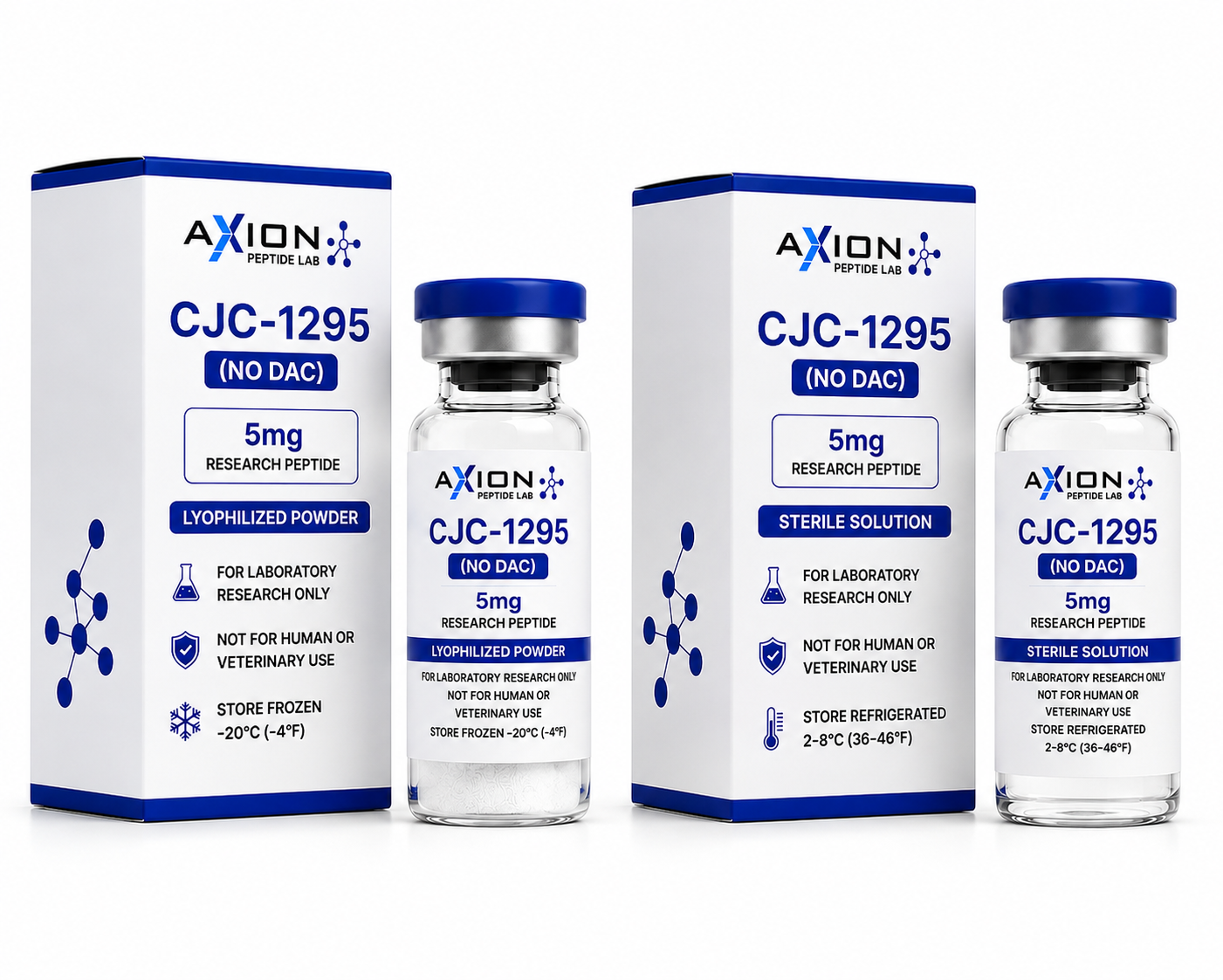
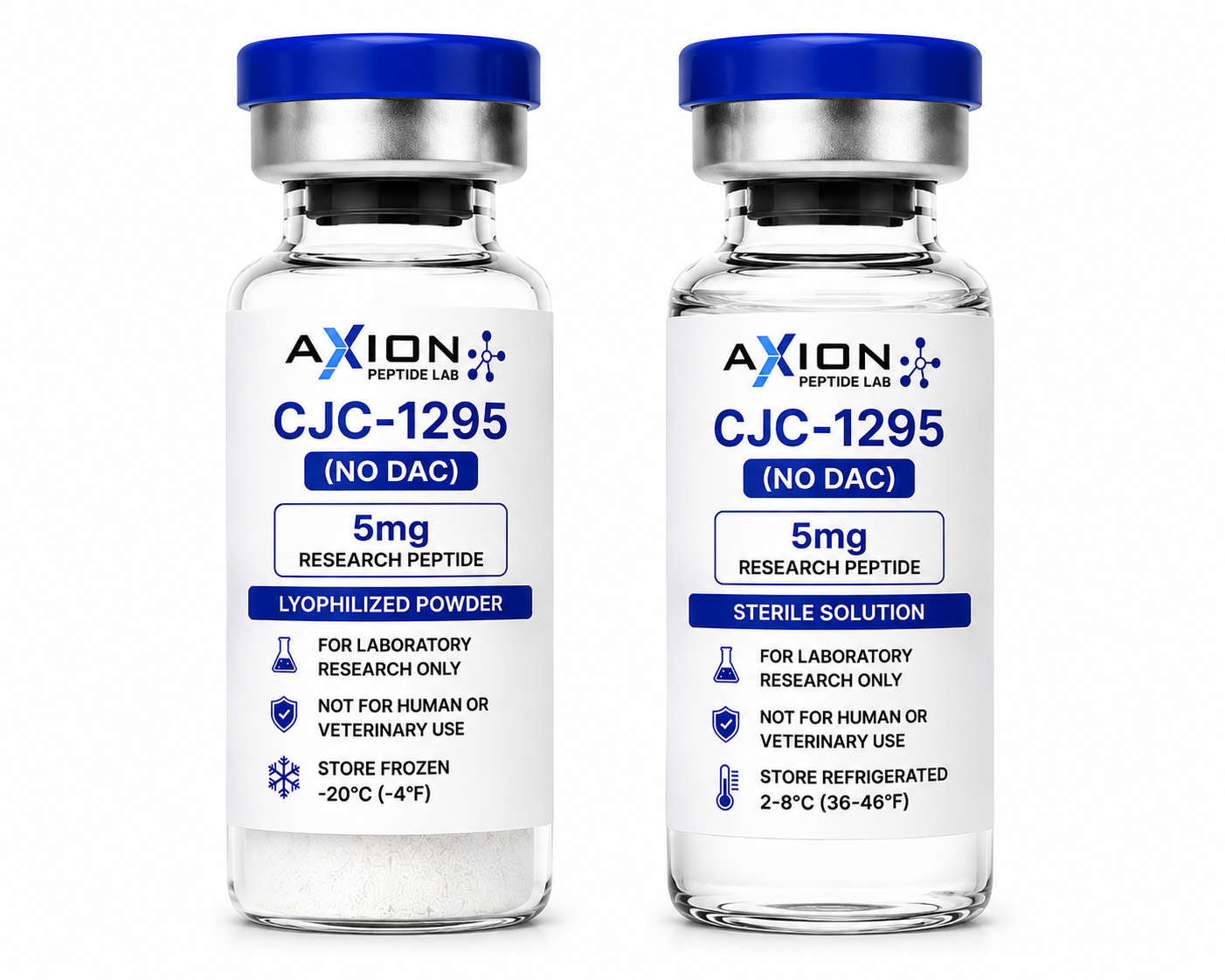
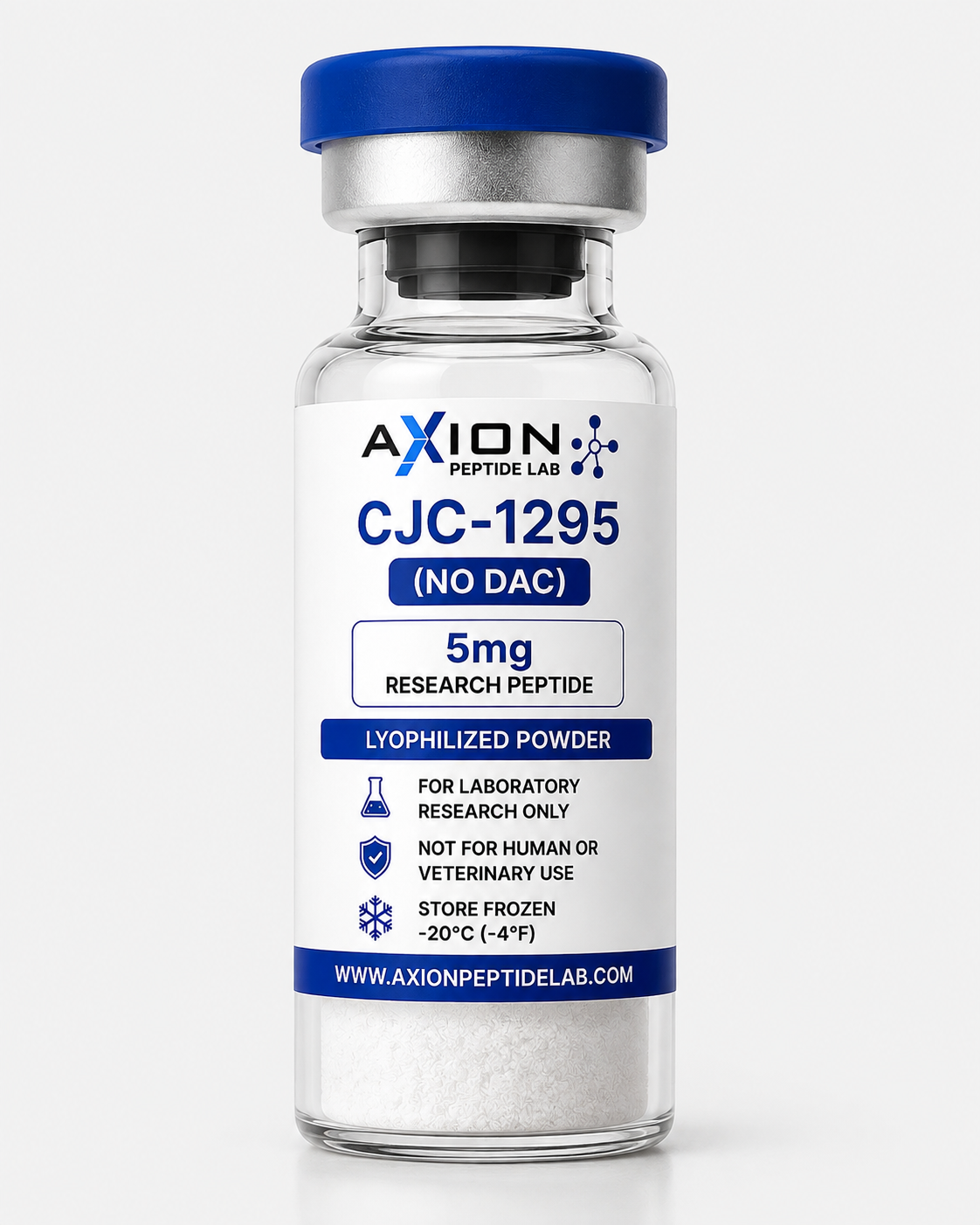
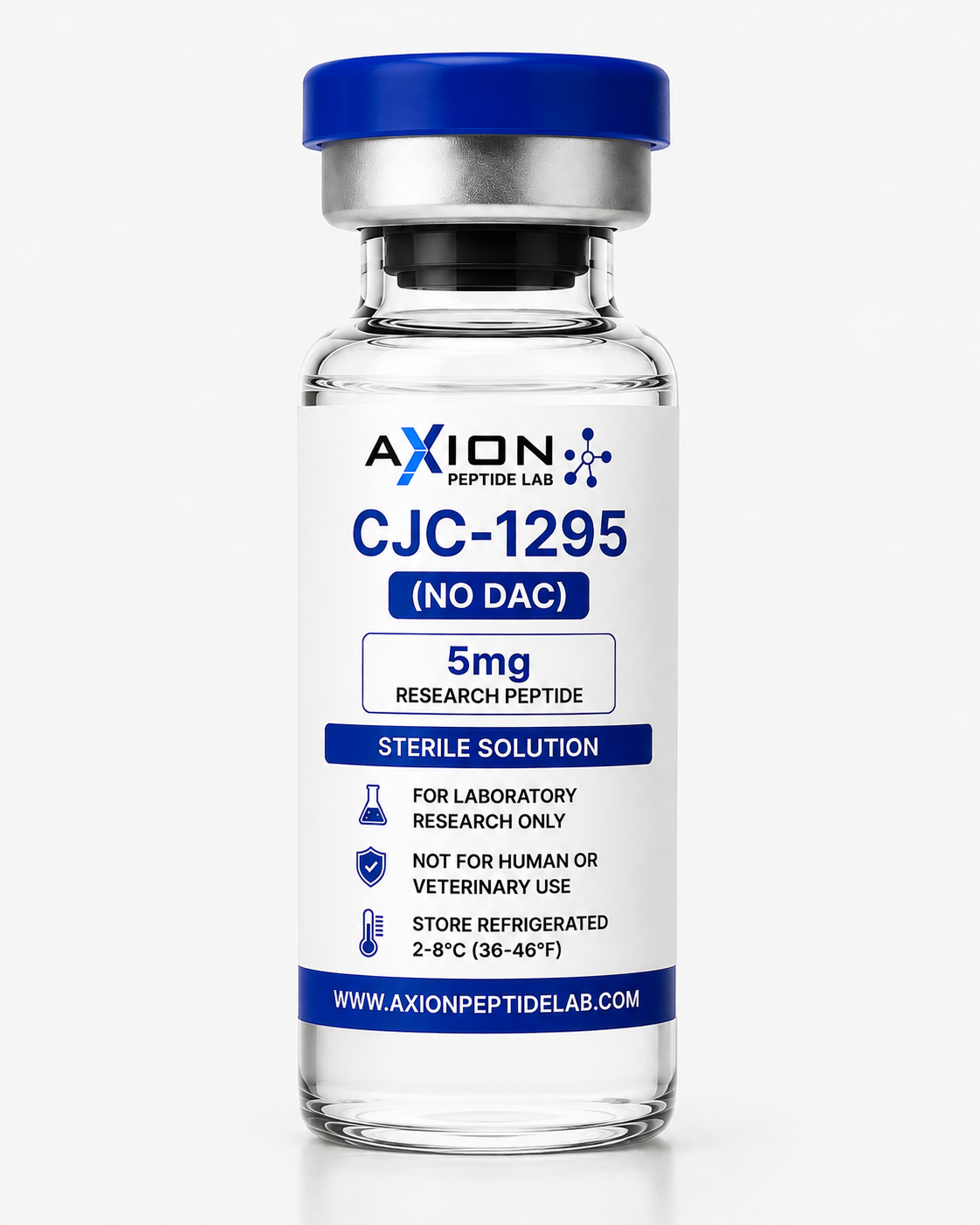
CJC-1295 (No DAC) 5mg Research Peptide is a GHRH-related synthetic peptide supplied for controlled laboratory investigation involving GHRH receptor biology, peptide-receptor interactions, GPCR signalling, structure-function relationships, peptide stability and analytical characterisation.
“No DAC” distinguishes the material from DAC-containing long-acting CJC-1295. Exact molecular identity should be verified using product-specific documentation.
The 5mg designation represents the stated research quantity and is not a dosage recommendation.
For Research Use Only – Not for human or veterinary consumption or administration.
$54.14 – $81.21Price range: $54.14 through $81.21
CJC-1295 (No DAC) 5mg Research Peptide from Axion Peptide Lab is supplied for controlled laboratory, molecular, biochemical and analytical investigation involving growth hormone-releasing hormone-related peptide systems.
The term No DAC distinguishes this research material from the longer-acting Drug Affinity Complex-associated CJC-1295 described in published research. This distinction is important because different CJC-related research materials can have different molecular characteristics and experimental behaviour.
CJC-1295 (No DAC) is commonly investigated in experimental systems involving GHRH-related signalling, receptor interactions, peptide structure-function relationships, molecular pharmacology and analytical peptide characterisation.
The 5mg designation represents the stated quantity of research material and is not a dosage or administration recommendation.
For Research Use Only – Not for human or veterinary consumption or administration.
CJC-1295 belongs to a family of synthetic peptides designed around the biological activity of growth hormone-releasing hormone, commonly abbreviated GHRH.
GHRH is an endogenous hypothalamic peptide involved in signalling through the growth hormone-releasing hormone receptor.
Synthetic GHRH-related peptides provide researchers with tools for investigating receptor biology, peptide stability, molecular signalling and structure-function relationships.
The terminology surrounding CJC-1295 requires particular care.
The original scientific literature describing CJC-1295 primarily investigated a GHRH analogue incorporating a Drug Affinity Complex, or DAC, designed to extend persistence through albumin binding.
Products commercially described as CJC-1295 No DAC do not contain that albumin-binding DAC functionality.
DAC stands for Drug Affinity Complex.
The DAC technology associated with the original CJC-1295 research material was designed to enable covalent binding to circulating albumin, thereby altering the compound’s pharmacokinetic properties.
“No DAC” indicates that this particular research material does not incorporate that functionality.
This distinction is more than a naming difference.
Adding or removing a structural component can substantially alter the molecular properties and experimental behaviour of a peptide.
Researchers should therefore avoid applying pharmacokinetic values reported for DAC-containing CJC-1295 directly to No DAC research material.
Commercial peptide terminology can be inconsistent.
The phrase CJC-1295 No DAC is frequently used by suppliers for material associated with Modified GRF(1-29) or similar shorter-acting GHRH-related peptides.
However, researchers should not rely solely on commercial naming conventions when precise molecular identity is required.
Exact sequence, molecular formula, molecular weight, counterion or salt form should be established using documentation for the actual product and batch.
This is particularly important for analytical research because small structural differences can influence chromatographic behaviour, molecular mass and experimental activity.
One important area for CJC-1295 (No DAC) research involves the growth hormone-releasing hormone receptor, commonly abbreviated GHRHR.
GHRHR is a G protein-coupled receptor involved in endogenous GHRH signalling.
Synthetic GHRH-related peptides can be investigated in controlled experimental systems designed to examine receptor interactions and downstream molecular responses.
Researchers may compare different peptide structures, concentrations or experimental conditions to understand receptor-associated behaviour.
These studies should remain within laboratory and preclinical research settings and should not be translated into claims that the commercial research material provides established human benefits.
Peptide-receptor interactions represent a major area of molecular pharmacology.
Researchers can investigate how peptide structure influences binding and receptor-associated signalling.
CJC-related research materials can provide useful comparative tools when studying modified GHRH sequences.
Experimental work may examine receptor selectivity, signalling characteristics, molecular interactions or structure-function relationships.
Appropriate positive and negative controls are important when interpreting results.
Researchers should also carefully document the exact identity of the peptide used so that experiments can be reproduced accurately. CJC-1295 No DAC 5mg Research Peptide
Synthetic peptide research often examines how modifications to an amino-acid sequence influence molecular behaviour.
Natural peptides can sometimes undergo rapid enzymatic degradation.
Researchers therefore investigate modified sequences to determine how structural changes affect stability, receptor interactions and experimental activity.
CJC-1295 (No DAC) is relevant to this broader field because it belongs to a class of modified GHRH-related research peptides.
Comparative experiments can examine different GHRH analogues under identical conditions.
This can help researchers understand relationships between molecular structure and experimentally measured properties. CJC-1295 No DAC 5mg Research Peptide
Peptide stability is an important variable in laboratory research.
Environmental conditions, enzymes, temperature, pH and other factors may influence peptide integrity.
Researchers studying CJC-1295 (No DAC) can investigate degradation behaviour under controlled conditions. CJC-1295 No DAC 5mg Research Peptide
Analytical techniques may be used to detect changes in molecular integrity over time.
Such work can contribute to method development and experimental reproducibility.
Storage requirements should always follow the documentation supplied with the specific Axion Peptide Lab product rather than generic instructions found for unrelated CJC materials.
CJC-1295 (No DAC) can be incorporated into analytical workflows designed to investigate peptide identity and molecular characteristics.
Depending on available instrumentation, researchers may use chromatographic, spectrometric or other validated analytical techniques.
Potential endpoints include molecular identity, chromatographic profile, molecular mass and degradation behaviour. CJC-1295 No DAC 5mg Research Peptide
Researchers requiring a specific sequence, molecular weight, salt form or purity level should verify those characteristics using the documentation associated with the actual product and batch.
Generic online information should not substitute for batch-specific analytical data.
GHRH-related peptides are relevant to molecular pharmacology because they provide tools for studying ligand-receptor systems.
Researchers may investigate how different peptide modifications influence receptor-associated responses.
Comparative studies can include native GHRH sequences, modified fragments and other synthetic analogues.
Such experiments may help characterise molecular interactions and signalling behaviour.
CJC-1295 (No DAC) should be treated as an experimental research material rather than an approved medicine or established therapeutic product. CJC-1295 No DAC 5mg Research Peptide
The GHRH receptor belongs to the broader G protein-coupled receptor family.
GPCRs represent one of the most extensively investigated groups of membrane receptors.
Researchers interested in GPCR biology may incorporate GHRH-related peptides into suitable experimental systems.
Studies can investigate receptor activation, intracellular signalling, ligand specificity and pathway interactions.
Experimental findings depend heavily on the model, methodology and molecular identity of the material being studied.
Results should therefore be interpreted within the limits of the experimental design.
The existence of both DAC-containing and No DAC CJC-related materials creates opportunities for comparative peptide research.
Researchers may examine how structural differences influence analytical behaviour, stability or molecular interactions.
However, meaningful comparisons require precise identification of both materials.
The original published human research on long-acting CJC-1295 should not automatically be presented as evidence for commercially labelled CJC-1295 No DAC.
Researchers should distinguish clearly between these forms when reviewing literature or reporting experimental findings. CJC-1295 No DAC 5mg Research Peptide
The 5mg designation represents the stated quantity of CJC-1295 (No DAC) research material associated with the product.
It does not represent a recommended human dose.
Experimental quantities should be determined according to validated laboratory protocols, research objectives and institutional procedures.
Axion Peptide Lab does not provide human dosing, injection, administration or self-experimentation guidance.
Researchers requiring concentration calculations for laboratory assays should work from verified product specifications and their established experimental methodology.
Controlled laboratory investigation may include:
These categories describe scientific research areas and not therapeutic indications.
Accurate documentation is particularly important for CJC-1295 (No DAC) because commercial naming conventions can vary.
Researchers should verify the exact product identity and available specifications before incorporating the material into an experimental workflow.
Important parameters may include sequence, molecular form, stated quantity and available analytical information.
Certificate of Analysis and independent testing availability may vary according to product and batch.
Specific purity percentages or analytical claims should only be published when supported by relevant batch documentation. CJC-1295 No DAC 5mg Research Peptide
CJC-1295 (No DAC) 5mg Research Peptide should be handled by appropriately trained personnel in suitable laboratory environments.
The material should remain clearly labelled and separated from medicines, supplements, foods and consumer products.
Researchers should follow applicable laboratory safety procedures and product-specific storage documentation.
Customers are responsible for ensuring that purchase, possession, importation and experimental use comply with applicable regulations and institutional requirements. CJC-1295 No DAC 5mg Research Peptide
Axion Peptide Lab supplies specialised peptide materials intended for controlled laboratory, molecular and analytical research.
CJC-1295 (No DAC) 5mg provides researchers with a GHRH-related peptide format suitable for appropriately designed experimental projects.
Researchers should review available product specifications and documentation before purchase, particularly where exact molecular identity is essential to the experimental design. CJC-1295 No DAC 5mg Research Peptide
Qualified laboratories, researchers and scientific organisations can buy CJC-1295 (No DAC) 5mg Research Peptide from Axion Peptide Lab for legitimate scientific and analytical investigation.
Its relationship to GHRH-derived peptide research makes it relevant to experimental work involving receptor biology, peptide signalling, molecular pharmacology and structure-function relationships.
This research product should not be marketed as a muscle-building product, anti-ageing treatment, fat-loss product, bodybuilding compound or human growth-hormone therapy. CJC-1295 No DAC 5mg Research Peptide
For Research Use Only – Not for human or veterinary consumption or administration.
It is a GHRH-related synthetic research peptide supplied in a stated 5mg format for controlled laboratory, molecular and analytical investigation.
No DAC indicates that the research material does not contain the Drug Affinity Complex functionality associated with long-acting DAC-containing CJC-1295.
DAC stands for Drug Affinity Complex. It was designed to alter the persistence of the original CJC-1295 research compound through albumin binding.
No. The absence of the DAC functionality creates an important structural and experimental distinction between the materials.
Commercial terminology frequently associates CJC-1295 No DAC with Modified GRF(1-29)-type material, but exact molecular identity should be verified using the specific product documentation rather than assumed from the name alone.
Research areas can include GHRH receptor biology, peptide-receptor interactions, GPCR signalling, structure-function relationships, peptide stability and analytical characterisation.
It represents the stated quantity of research material associated with the product. It is not a dosage recommendation.
No. Researchers should distinguish the materials and avoid directly transferring pharmacokinetic findings between structurally different forms.
No. The material is restricted to laboratory and analytical research, and human administration or self-experimentation guidance is not provided. CJC-1295 No DAC 5mg Research Peptide
Qualified research customers can purchase CJC-1295 (No DAC) 5mg Research Peptide from Axion Peptide Lab for legitimate laboratory and analytical research, subject to availability and applicable requirements.