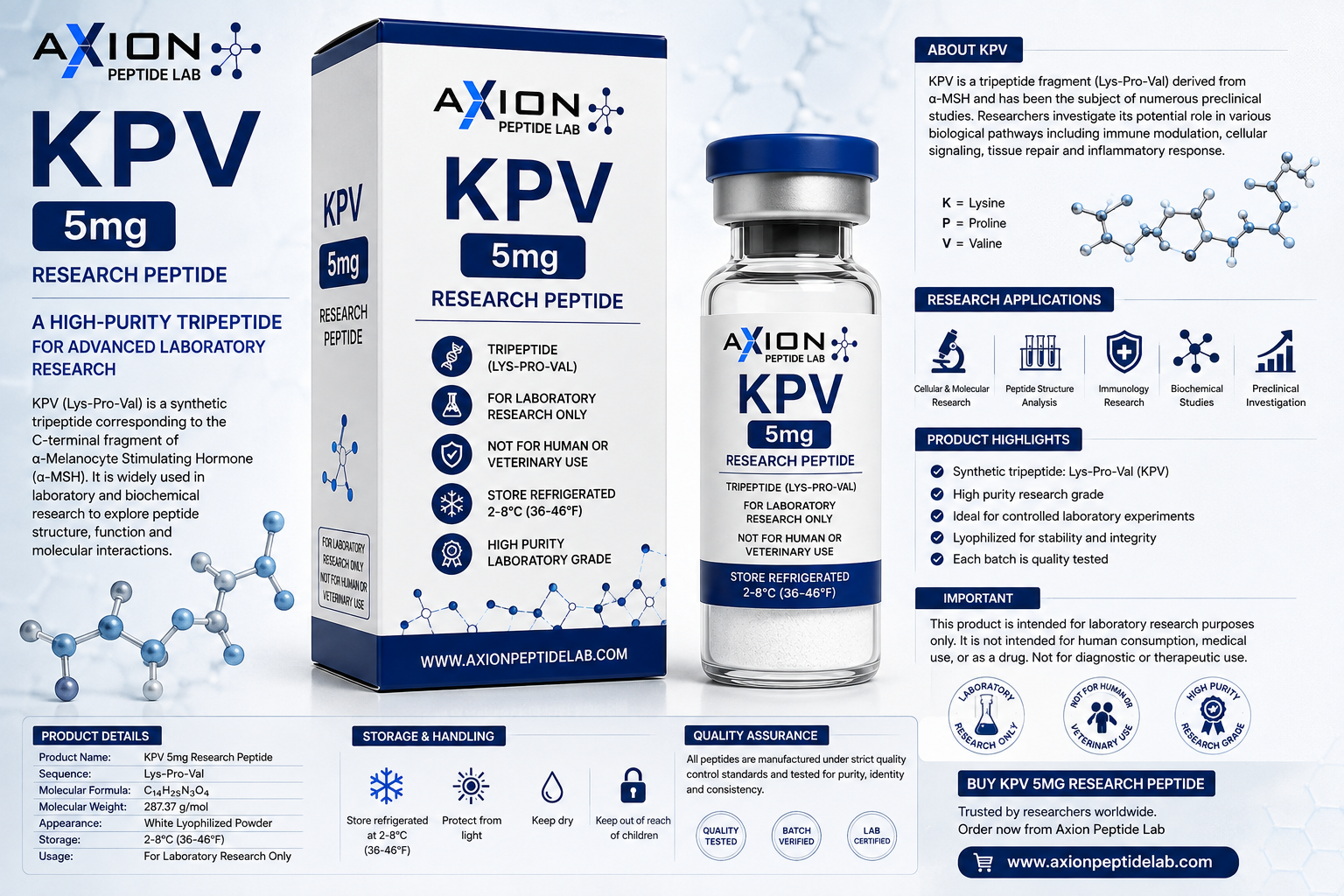
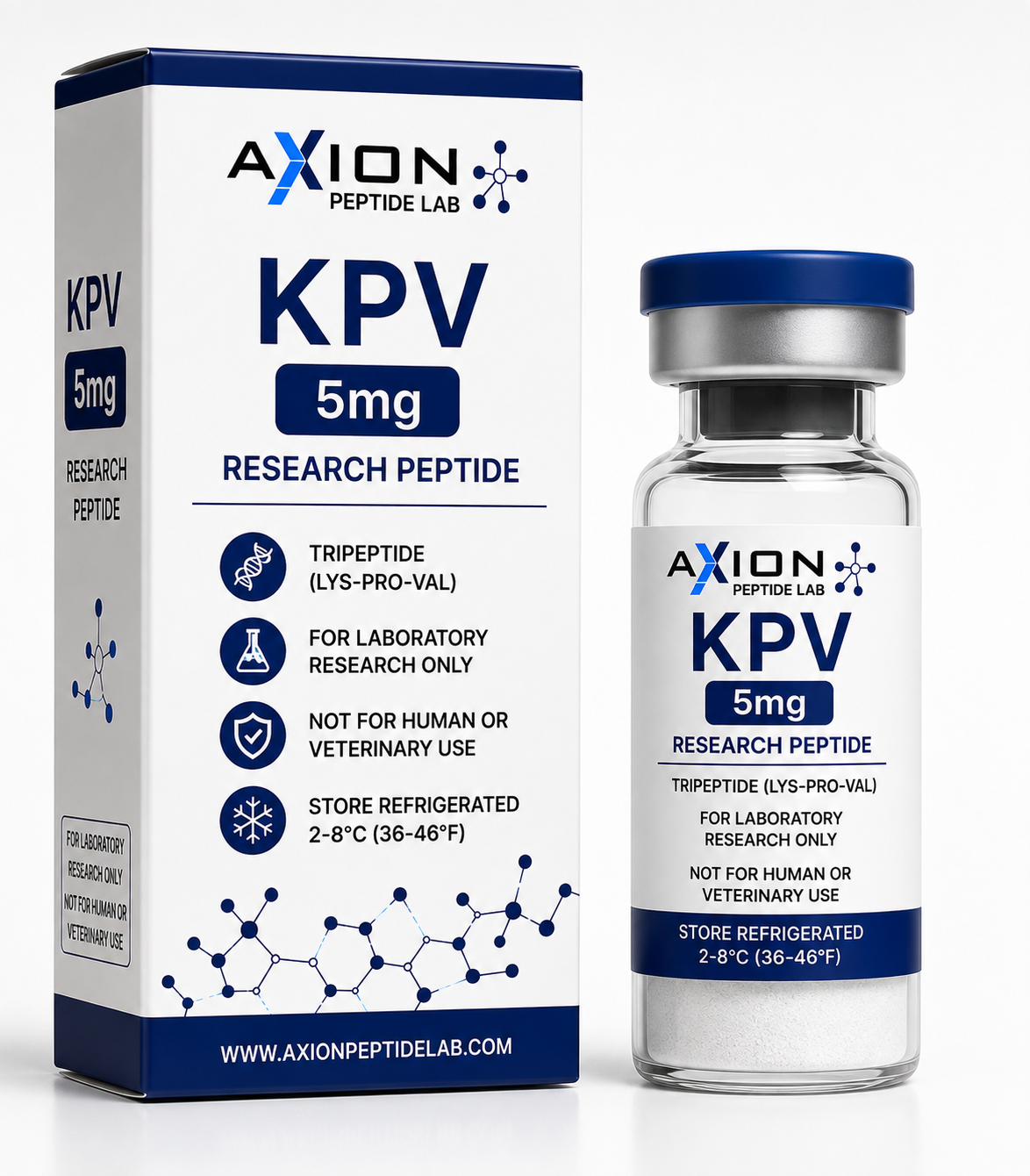
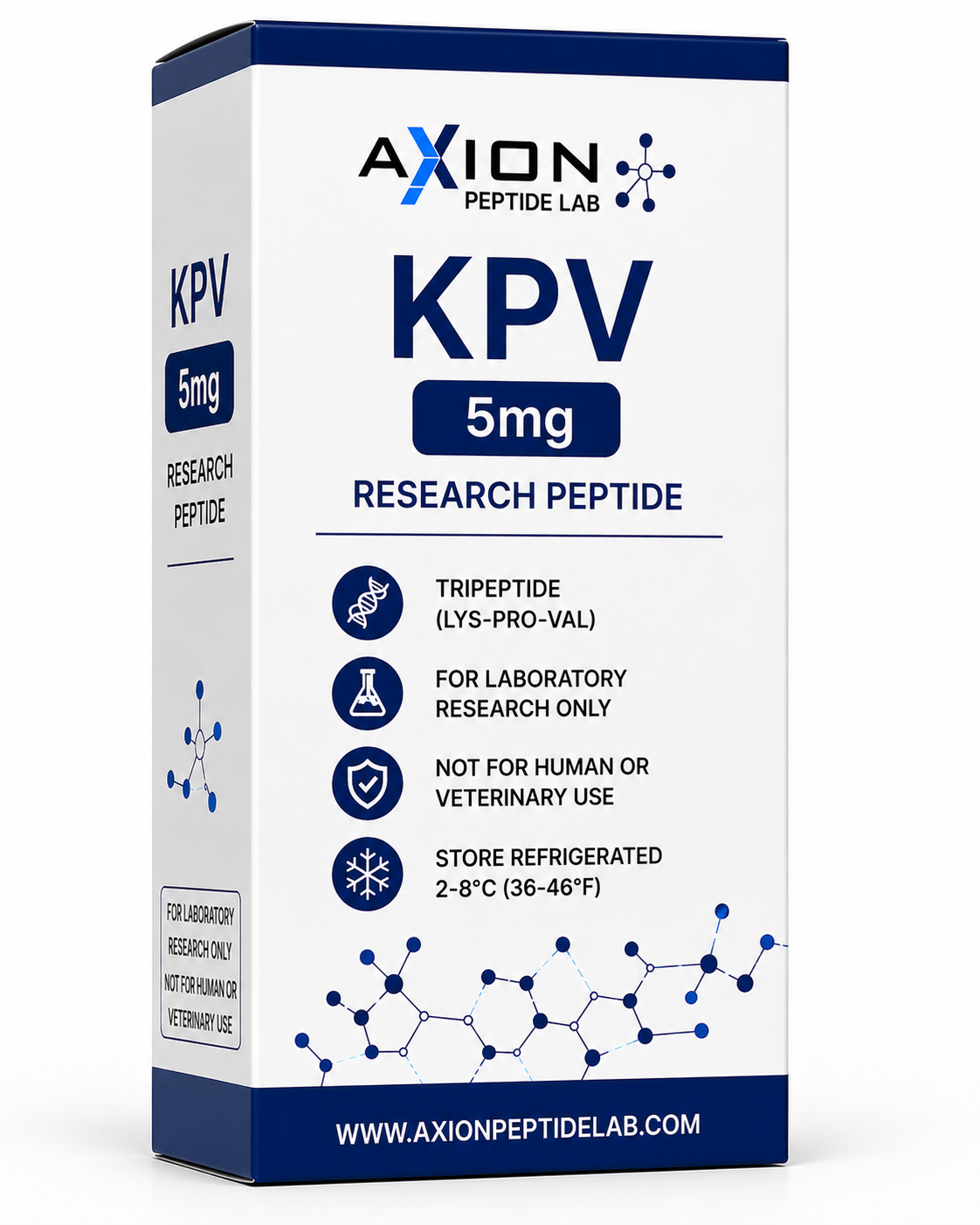
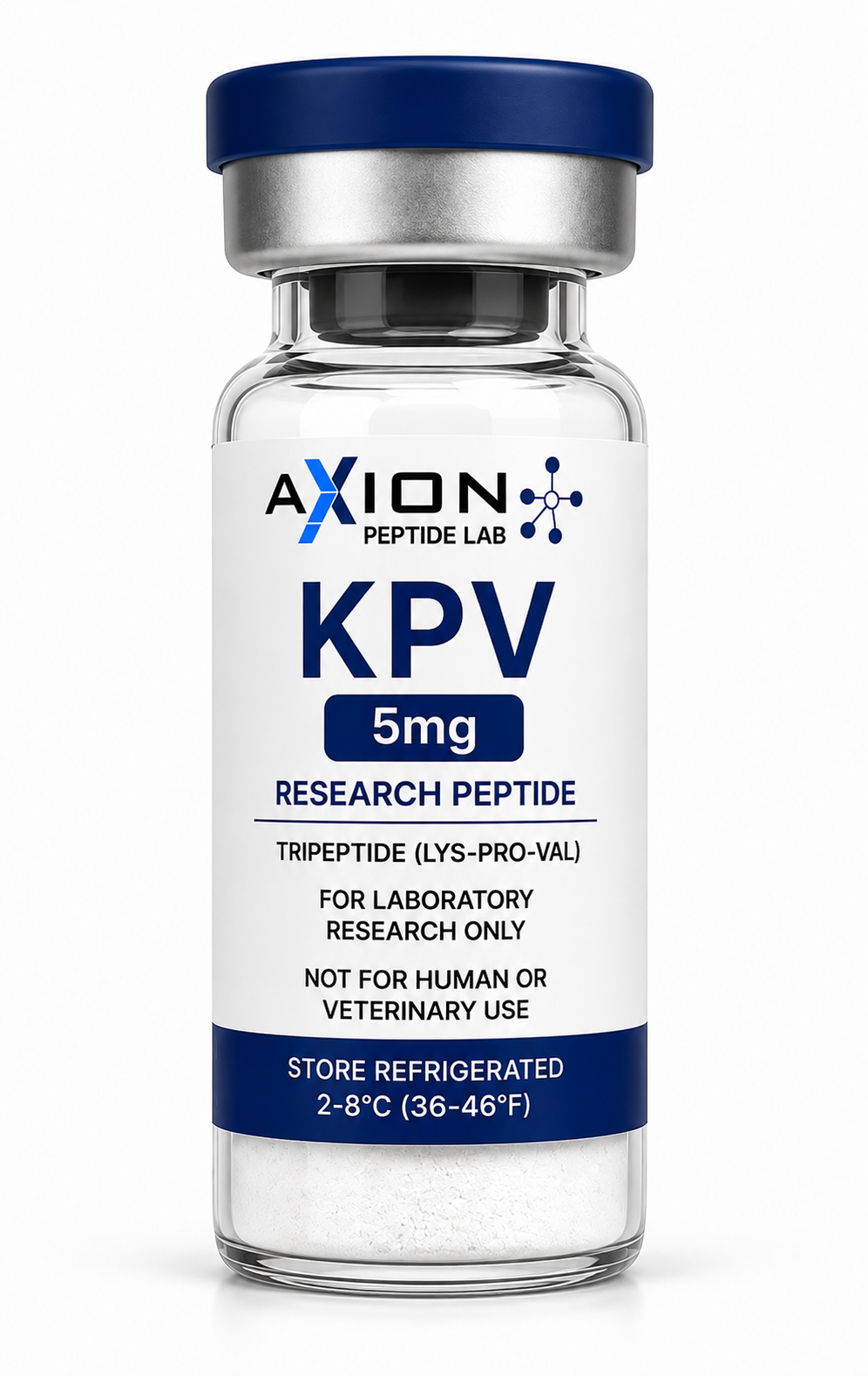
KPV 5mg Research Peptide is a synthetic tripeptide composed of lysine, proline and valine (Lys-Pro-Val). KPV corresponds to a C-terminal tripeptide sequence associated with α-MSH and provides a compact molecular model for controlled peptide research.
Potential laboratory applications include peptide chemistry, peptide-fragment investigation, structure-function studies, comparative molecular research, stability and analytical characterisation.
The 5mg designation represents the stated research quantity and is not a dosage recommendation.
For Research Use Only – Not for human or veterinary consumption or administration.
$36.54
KPV 5mg Research Peptide from Axion Peptide Lab is a synthetic tripeptide research material supplied for controlled biochemical, molecular and analytical laboratory investigation. KPV consists of three amino-acid residues—lysine, proline and valine—and is commonly represented by the sequence Lys-Pro-Val.
KPV is scientifically interesting because it corresponds to the C-terminal tripeptide sequence associated with α-melanocyte-stimulating hormone (α-MSH). Its compact molecular structure provides researchers with a practical model for studying short peptide chemistry, peptide-fragment behaviour, structure-function relationships and experimentally defined molecular interactions.
The 5mg designation represents the stated research quantity and is not a dosage recommendation.
KPV supplied by Axion Peptide Lab is intended exclusively for appropriately controlled scientific research.
For Research Use Only – Not for human or veterinary consumption or administration.
KPV is the abbreviation derived from the single-letter codes for the amino acids:
K – Lysine
P – Proline
V – Valine
Together, these residues form the short peptide Lys-Pro-Val.
Because KPV contains three amino-acid residues, it is classified as a tripeptide. This comparatively simple structure makes it an interesting experimental material for laboratories investigating fundamental aspects of peptide chemistry and molecular biology.
Short peptides can be particularly useful for determining how individual residues influence experimentally observed molecular characteristics.
One of the principal reasons for scientific interest in KPV is its relationship with α-melanocyte-stimulating hormone, commonly abbreviated α-MSH.
KPV corresponds to a C-terminal tripeptide sequence associated with this larger peptide.
Studying fragments of larger peptides can help researchers investigate whether particular sections of a sequence contribute to measurable molecular characteristics.
KPV can therefore be compared with α-MSH-related sequences, modified analogues or other peptide fragments in carefully controlled experimental systems.
Importantly, KPV should not automatically be assumed to reproduce all biological characteristics associated with the larger α-MSH molecule.
KPV provides a relatively straightforward model for short peptide chemistry.
Each of its three residues contributes different structural characteristics.
Lysine contains a basic side chain, proline has a distinctive cyclic side-chain structure, and valine contains a branched hydrophobic group.
Researchers can examine how these characteristics collectively influence the behaviour of the peptide under defined experimental conditions.
KPV may also be compared with altered sequences in which individual residues are substituted, removed or repositioned.
These comparisons can provide useful information about sequence-dependent molecular behaviour.
Understanding how molecular structure relates to experimental function is a fundamental area of peptide science.
Because KPV is a compact tripeptide, it can be incorporated into structure-function studies without the structural complexity of substantially larger peptides.
Researchers may compare KPV with modified analogues or related fragments to determine whether sequence changes influence stability, molecular interactions or analytical behaviour.
Experimental designs should include appropriate controls and clearly defined endpoints.
Observed laboratory activity should be reported according to the specific model in which it was measured rather than extrapolated into unsupported clinical claims.
KPV has appeared in preclinical scientific literature examining different cellular and molecular processes.
These findings provide hypotheses for continued experimental investigation.
Laboratories may examine KPV using cell-based systems, biochemical assays or other validated research platforms where appropriate.
Potential experiments can investigate molecular interactions, signalling-associated changes or other defined biochemical endpoints.
Results depend strongly on the experimental model, peptide preparation, concentration, assay conditions and analytical methodology.
Preclinical observations do not establish that a research preparation can diagnose, prevent or treat disease in humans.
Reliable analytical characterisation is important when working with peptide research materials.
KPV can be examined using techniques suitable for short peptide molecules.
Depending on laboratory capabilities and research objectives, researchers may use chromatographic and mass-spectrometric techniques to investigate molecular identity, separation behaviour and sample composition.
High-performance liquid chromatography may support separation and purity assessment, while mass spectrometry can provide molecular identity information.
Specific analytical claims should be based on actual results from the applicable batch rather than assumed from generic reference information.
Peptide stability can affect experimental reproducibility and analytical interpretation.
Researchers may investigate KPV under carefully controlled environmental conditions to determine how different variables influence its molecular integrity.
Experimental variables may include temperature, pH, solvent environment, light exposure and duration.
Samples can be evaluated at predefined intervals using appropriate analytical methods.
Such experiments can help researchers identify potential degradation patterns and establish suitable experimental handling conditions.
Storage recommendations for a specific commercial preparation should come from verified product or batch documentation.
When supplied as a lyophilized research material, KPV can be incorporated into laboratory workflows requiring controlled peptide preparation.
Lyophilization is commonly used in peptide research to provide material in a dry format.
Researchers should document the physical format of the material and use validated laboratory procedures appropriate to their experiment.
Any solvent selection, preparation conditions or concentration calculations should be determined according to the research protocol and applicable product documentation.
The presence of a 5mg label does not provide instructions for human preparation or administration.
The 5mg designation represents the stated quantity of KPV research material associated with the product.
It is not a human or veterinary dosage recommendation.
Researchers requiring molar quantities should perform calculations using the verified molecular form and specifications relevant to their particular material.
Chemical form can matter when calculating molecular quantities, especially when salts, counterions or hydration states are present.
Product-specific documentation should therefore be consulted whenever precise quantitative analysis is required. KPV 5mg Research Peptide
KPV can be particularly useful in comparative peptide research.
Scientists may investigate KPV alongside longer α-MSH-related sequences, alternative peptide fragments or synthetically modified analogues.
Comparative experiments can examine whether peptide length, sequence composition or structural modifications affect measurable laboratory characteristics.
Researchers can also create controlled sequence variants to investigate the contribution of individual amino-acid residues.
This approach can support broader studies of peptide sequence-function relationships and molecular recognition.
Scientific publications involving KPV include preclinical experiments conducted using biochemical, cellular and animal models. KPV 5mg Research Peptide
These studies have contributed to continued scientific interest in the molecule.
However, preclinical findings must be interpreted according to the limitations of each experimental system.
Results from an isolated biochemical assay or animal model cannot automatically be extrapolated to human outcomes.
For this reason, responsible KPV product descriptions should distinguish established molecular information from experimental hypotheses.
Axion Peptide Lab supplies KPV as research material rather than as a medicine, supplement or therapeutic product.
KPV 5mg Research Peptide may be relevant to controlled investigations involving:
These areas represent laboratory research categories and should not be interpreted as medical indications.
Good documentation is essential for reproducible scientific research.
Researchers should record relevant product identification, batch information, experimental conditions, preparation procedures and analytical methods.
Where available, product-specific analytical documentation should be reviewed before quantitative experimentation. KPV 5mg Research Peptide
Certificate of Analysis and independent testing availability can vary according to product and batch.
Exact purity, identity, sterility or other quality claims should only be published when supported by appropriate documentation applicable to the supplied batch.
This approach improves scientific transparency and prevents generic marketing claims from being confused with verified analytical specifications.
KPV 5mg should remain clearly identified as laboratory research material.
Research facilities should separate experimental compounds from medicines, food products and materials intended for personal consumption.
Researchers should follow applicable laboratory safety procedures, institutional requirements and local regulations.
Purchasers are responsible for determining whether acquisition, possession, importation and intended research applications comply with regulations applicable in their jurisdiction. KPV 5mg Research Peptide
Researchers looking to buy KPV 5mg Research Peptide can source this synthetic tripeptide research material from Axion Peptide Lab for legitimate scientific and analytical applications.
Its compact Lys-Pro-Val sequence and relationship to the C-terminal region of α-MSH make KPV an interesting research material for peptide chemistry, peptide-fragment investigation, structure-function studies, stability research and analytical characterisation.
Axion Peptide Lab supplies the product specifically for controlled laboratory research rather than personal or therapeutic use.
For Research Use Only – Not for human or veterinary consumption or administration.
KPV is a synthetic tripeptide composed of lysine, proline and valine. The 5mg designation identifies the stated research quantity supplied with the product.
KPV represents the single-letter amino-acid codes K for lysine, P for proline and V for valine.
The sequence is Lys-Pro-Val, abbreviated KPV.
KPV contains three amino-acid residues and is therefore classified as a tripeptide.
Yes. KPV corresponds to a C-terminal tripeptide sequence associated with α-melanocyte-stimulating hormone.
Potential research areas include peptide chemistry, peptide-fragment analysis, structure-function studies, molecular interactions, stability, comparative peptide investigation and analytical characterisation.
No. The 5mg designation represents the stated quantity of research material. It is not a recommendation for human or veterinary dosing.
Yes. Researchers may use appropriate chromatographic, mass-spectrometric and complementary analytical methods to investigate peptide identity and other characteristics.
No. Axion Peptide Lab supplies KPV 5mg strictly for laboratory research. It is not intended for human or veterinary consumption or administration.
KPV 5mg Research Peptide is available from Axion Peptide Lab for legitimate laboratory, biochemical and analytical research applications, subject to availability and applicable requirements.