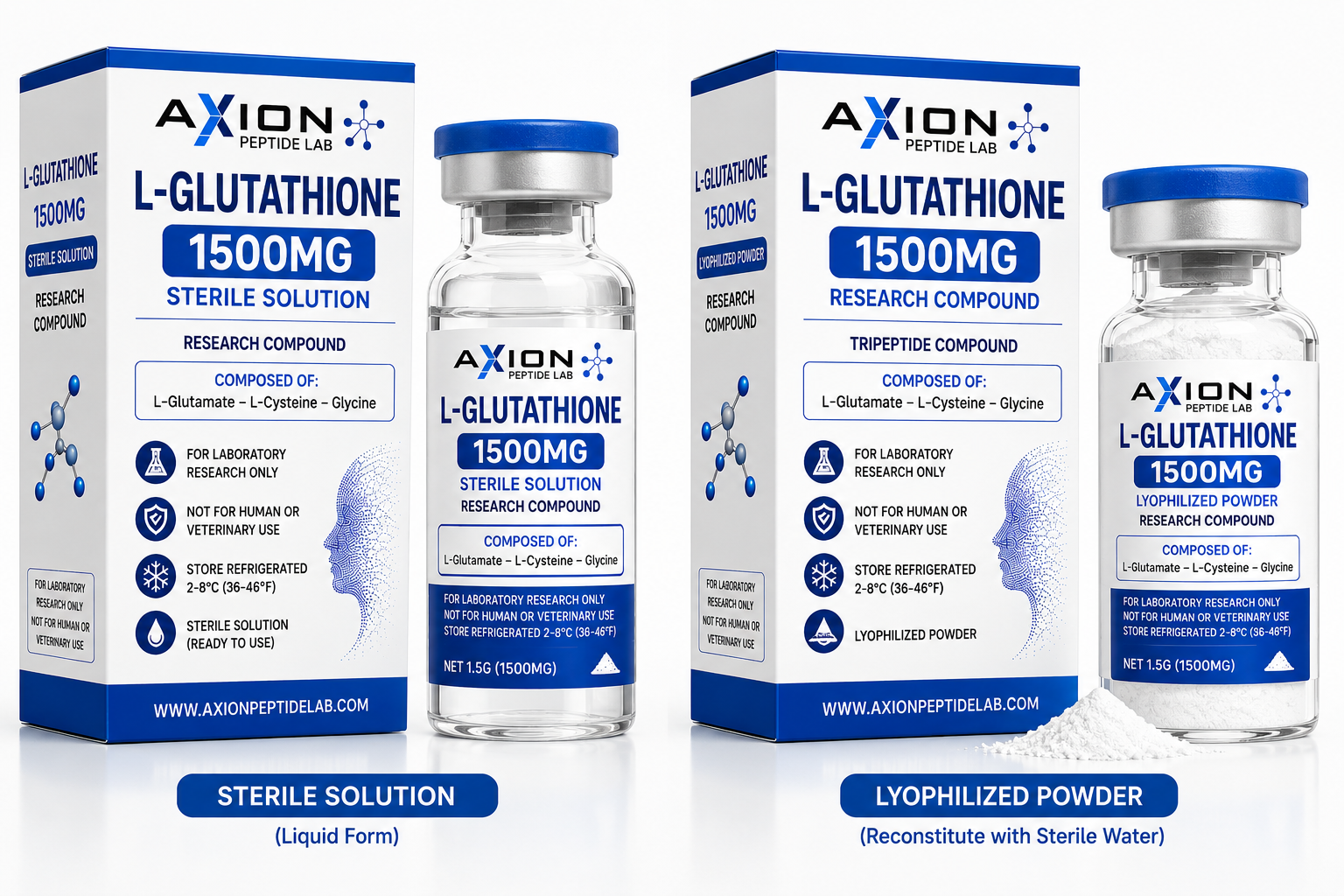
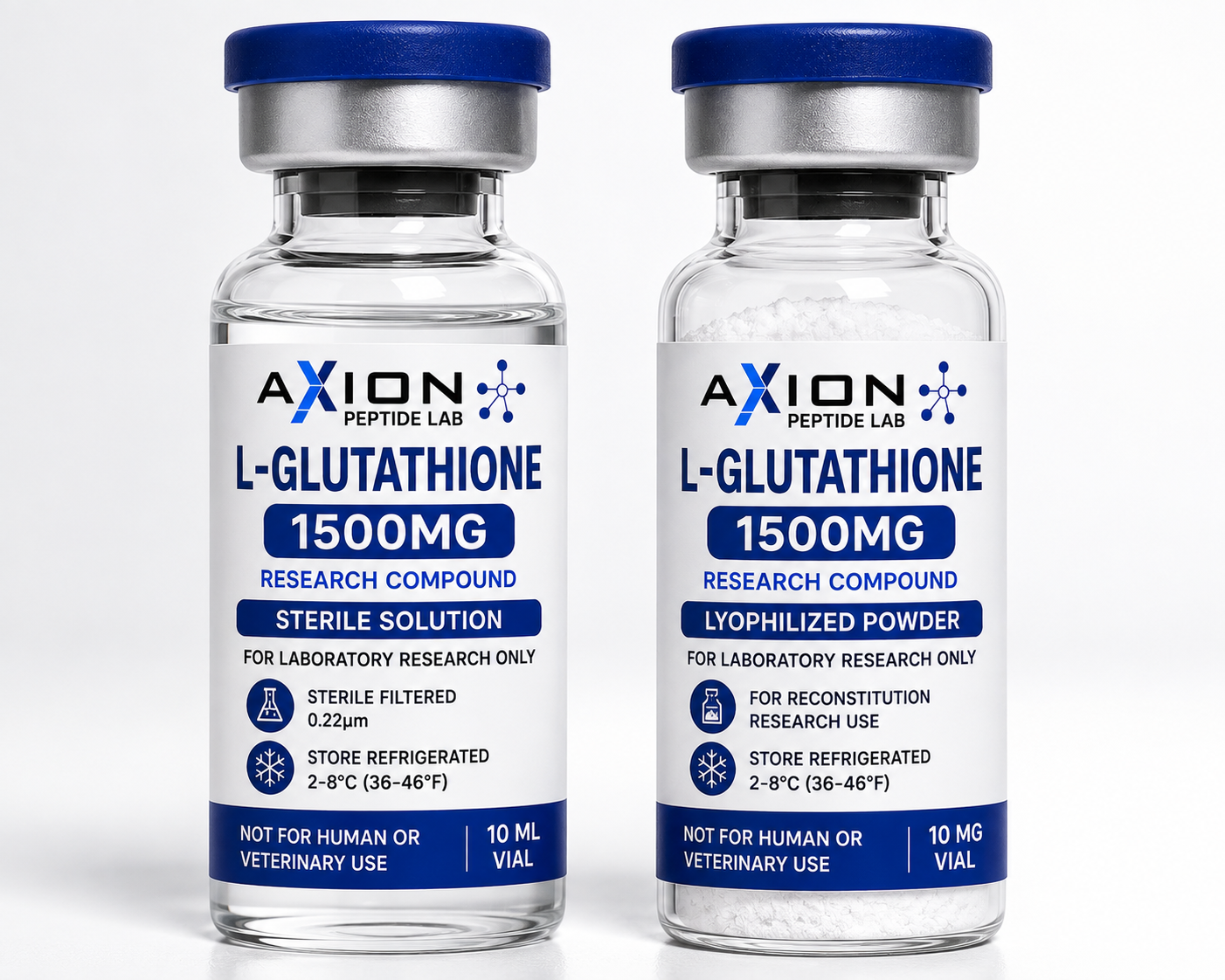
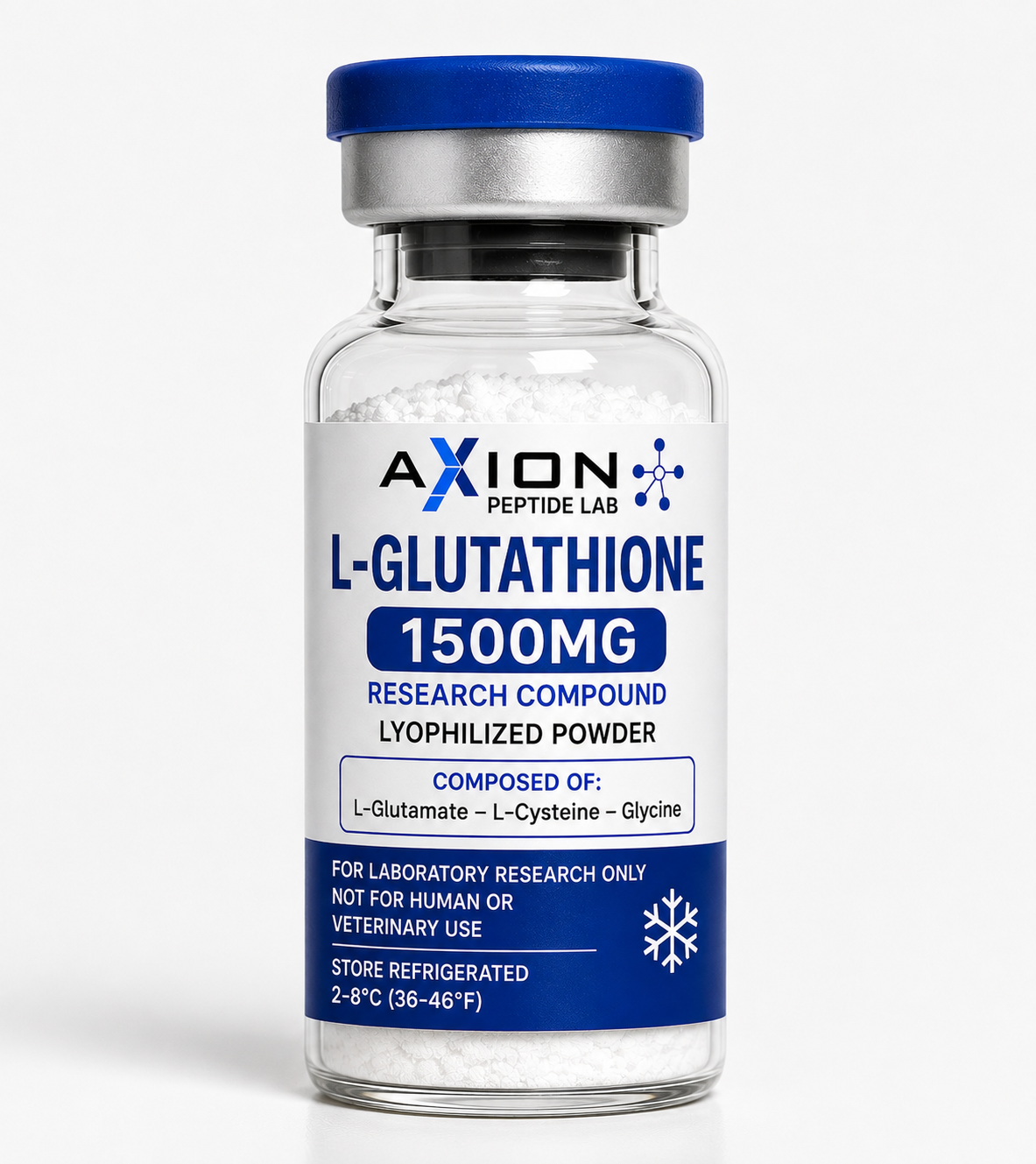
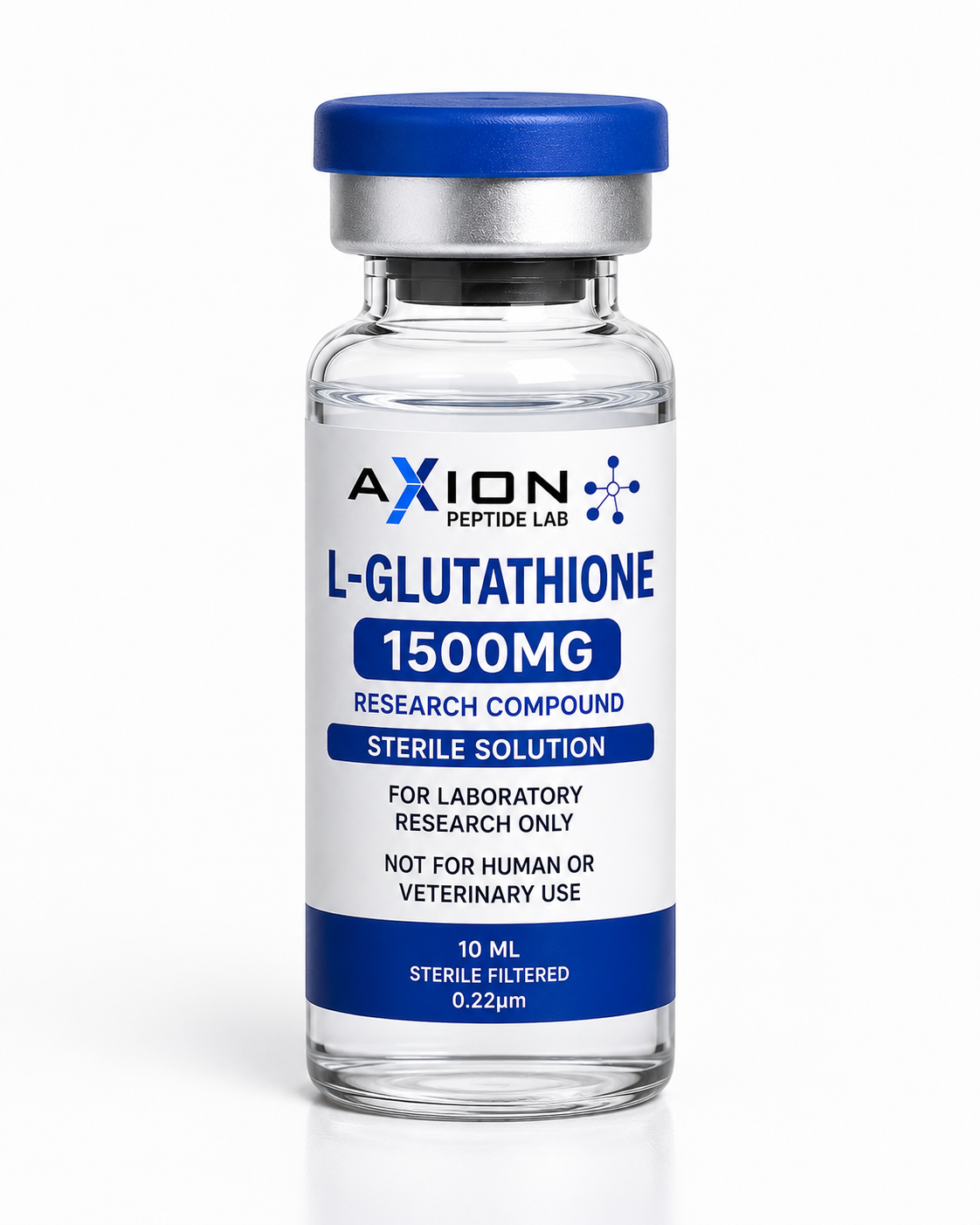
L-Glutathione 1500mg Research Compound is a tripeptide research material composed of glutamate, cysteine and glycine for controlled biochemical and analytical laboratory investigation.
Glutathione is widely studied in relation to GSH/GSSG redox systems, thiol chemistry, glutathione-associated enzymes, cellular biochemistry and analytical characterisation. Its distinctive gamma-glutamyl linkage and cysteine thiol group make it particularly relevant to molecular and redox research.
The 1500mg designation represents the stated research quantity and is not a dosage recommendation.
For Research Use Only – Not for human or veterinary consumption or administration.
$54.15 – $64.99Price range: $54.15 through $64.99
L-Glutathione 1500mg Research Compound from Axion Peptide Lab is a tripeptide research material intended for controlled biochemical, molecular, redox, thiol-chemistry and analytical laboratory investigation.
Glutathione is a naturally occurring molecule composed of three amino-acid components: glutamate, cysteine and glycine. It is commonly abbreviated GSH when referring to reduced glutathione. Its oxidised disulfide form is commonly abbreviated GSSG.
One of glutathione’s most scientifically distinctive structural features is the unusual gamma-glutamyl linkage between glutamate and cysteine. The cysteine residue also contains a chemically reactive thiol group, making glutathione particularly relevant to controlled experiments involving thiol chemistry, oxidation-reduction systems and cellular biochemistry.
The 1500mg designation represents the stated research quantity and is not a dosage recommendation.
Axion Peptide Lab supplies L-Glutathione 1500mg exclusively for legitimate laboratory, analytical and scientific research.
For Research Use Only – Not for human or veterinary consumption or administration.
Glutathione is a naturally occurring tripeptide found across many biological systems.
Unlike larger peptides containing long amino-acid chains, glutathione consists of only three amino-acid components:
Glutamate – Cysteine – Glycine
Its small size does not make the molecule chemically simple.
The distinctive bonding arrangement between glutamate and cysteine differentiates glutathione from a conventional peptide in which amino acids are linked exclusively through standard alpha-peptide bonds.
This unusual structural characteristic, combined with the cysteine thiol group, contributes to glutathione’s importance in biochemical and analytical research.
The reduced form of glutathione is generally abbreviated GSH.
GSH contains a free thiol group associated with its cysteine component.
Thiol groups are chemically important because they can participate in oxidation-reduction reactions and other molecular interactions.
Researchers may therefore incorporate reduced glutathione into controlled experiments examining thiol chemistry, redox state, biochemical reactions and molecular transformations.
When exact molecular form is important to an experiment, researchers should verify whether their specific material represents reduced glutathione or another form using applicable product documentation.
Glutathione can also exist in an oxidised disulfide form known as GSSG.
During oxidation, two glutathione molecules can become linked through a disulfide bond involving their cysteine residues.
The relationship between GSH and GSSG is extensively studied in redox biochemistry.
Researchers may measure these molecular forms independently or investigate their relationship under defined experimental conditions.
The GSH/GSSG system therefore provides an important experimental framework for studying cellular redox chemistry.
The relationship between reduced and oxidised glutathione is frequently investigated as part of biochemical redox research.
Laboratories can examine changes in GSH and GSSG under controlled conditions and quantify these species using appropriately validated analytical methods.
Accurate measurement is important because sample preparation, oxidation during handling and analytical methodology can influence observed values.
Researchers should therefore use experimental procedures designed specifically for their analytical objectives.
The cysteine residue within glutathione contains a thiol functional group.
This chemical feature makes L-Glutathione particularly relevant to experiments investigating sulfur-containing biomolecules and thiol-dependent reactions.
Researchers can study oxidation, reduction, conjugation and other experimentally measurable transformations involving glutathione.
Controlled thiol-chemistry experiments can also contribute to broader understanding of protein chemistry and cellular biochemical systems.
One of the defining structural characteristics of glutathione is its gamma-glutamyl linkage.
In conventional peptides, amino acids are typically connected through bonds involving their alpha-carboxyl groups.
Glutathione differs because the glutamate component connects to cysteine through its gamma-carboxyl group.
This characteristic is important to glutathione’s molecular identity and provides researchers with an interesting model for studying non-standard peptide bonding.
Redox biology investigates oxidation and reduction processes within biological systems.
Glutathione is widely studied in this field because of its ability to transition between reduced and oxidised states.
Researchers can examine how experimental conditions influence glutathione-associated redox systems.
These studies may involve isolated biochemical systems, cell-based models or analytical preparations.
Observed changes should be interpreted according to the specific experimental design rather than automatically extrapolated to clinical outcomes.
Glutathione is also relevant to research involving the glutathione peroxidase family of enzymes.
These enzymes participate in biochemical reactions involving glutathione.
Laboratories may investigate enzyme kinetics, substrate interactions and reaction products using appropriately designed biochemical assays.
Different glutathione peroxidase isoforms can have distinct characteristics, so the specific enzyme system used should be clearly documented. L-Glutathione 1500mg
Another important enzyme in glutathione-associated biochemistry is glutathione reductase.
This enzyme participates in reactions involving oxidised and reduced glutathione.
Researchers can investigate glutathione reductase activity using controlled enzyme assays and analytical methodologies.
Such experiments may contribute to broader studies of redox cycling and biochemical pathway regulation.
Glutathione S-transferases, commonly abbreviated GSTs, represent another major research area.
GST enzymes are investigated for their interactions with glutathione and numerous molecular substrates.
Researchers may use L-Glutathione in controlled enzyme-activity, substrate-specificity and molecular-interaction experiments involving GST systems.
Results can vary according to the enzyme isoform and experimental conditions.
Glutathione is extensively investigated in cellular biochemistry.
Researchers may examine glutathione-associated systems in cultured cells to explore changes in redox state, biochemical pathways and molecular responses.
Variables such as cell type, experimental conditions, exposure duration and analytical technique can substantially influence results. L-Glutathione 1500mg
Cellular findings should therefore remain interpreted within the experimental model used.
Mitochondrial biochemistry represents another field in which glutathione-related systems are investigated.
Researchers may examine mitochondrial redox conditions, thiol chemistry and interactions between glutathione-associated pathways and cellular energy systems.
Appropriate isolation, sample preparation and analytical controls are important because mitochondrial measurements can be sensitive to experimental conditions.
L-Glutathione can be incorporated into a variety of molecular and biochemical experimental systems.
Researchers may investigate interactions with enzymes, reactive molecular species, proteins or other biochemical components.
Because glutathione participates in multiple chemical processes, carefully controlled experiments are essential for distinguishing direct molecular interactions from broader secondary effects. L-Glutathione 1500mg
Reliable glutathione research requires suitable analytical methods.
Common approaches may include:
High-performance liquid chromatography (HPLC)
Liquid chromatography-mass spectrometry (LC-MS)
Mass spectrometry (MS)
Spectrophotometric methods
Validated biochemical assays
The appropriate method depends on whether the experiment is designed to examine identity, concentration, redox state, degradation or another analytical parameter.
High-performance liquid chromatography is widely used for glutathione-related analytical research.
Suitable chromatographic methods can help separate glutathione from related compounds or reaction products.
Researchers may develop methods specifically for GSH, GSSG or other glutathione-associated species.
Column chemistry, mobile phase, detection method, sample preparation and derivatisation procedures can all influence analytical performance.
Quantitative experiments should incorporate suitable calibration standards and controls.
Mass spectrometry provides another valuable platform for glutathione research.
When combined with liquid chromatography, MS can provide molecular information following chromatographic separation.
Researchers may use LC-MS to investigate glutathione, related compounds and selected molecular transformations.
Method development should account for matrix effects, ionisation characteristics and the specific molecular species being investigated. L-Glutathione 1500mg
Glutathione may also be investigated in controlled stability studies.
Researchers can examine how environmental variables influence molecular integrity over time.
Potential experimental variables include temperature, pH, light exposure, oxygen availability, formulation composition and storage duration.
Samples can be analysed at predetermined intervals to evaluate measurable chemical changes.
Product-specific storage conditions should be based on applicable documentation rather than general assumptions.
The 1500mg designation identifies the stated quantity of research material associated with this product.
It is not a human or veterinary dosage recommendation.
Researchers should determine quantities and experimental concentrations according to validated laboratory protocols, study objectives and applicable product documentation.
No personal-use protocol is implied by the product quantity.
L-Glutathione 1500mg may be relevant to controlled investigation involving:
These are scientific research categories rather than medical indications.
Reproducible research requires accurate documentation.
Researchers should record product identity, batch information, experimental conditions, sample preparation and analytical methodology.
Where available, batch-specific analytical documentation should be reviewed before quantitative experiments.
Certificate of Analysis and independent testing availability may vary according to product and batch.
Exact claims regarding purity, sterility, concentration or other specifications should only be made when supported by documentation applicable to the supplied material.
Researchers looking to buy L-Glutathione 1500mg Research Compound can source this tripeptide research material from Axion Peptide Lab for legitimate scientific and analytical investigation.
Its glutamate-cysteine-glycine composition, distinctive gamma-glutamyl linkage and cysteine thiol group make glutathione particularly relevant to redox chemistry, GSH/GSSG investigation, enzyme research, cellular biochemistry, mitochondrial studies and analytical characterisation.
Axion Peptide Lab supplies this material exclusively for appropriate laboratory research.
For Research Use Only – Not for human or veterinary consumption or administration.
Glutathione is a naturally occurring tripeptide composed of glutamate, cysteine and glycine and is extensively investigated in biochemical and redox research.
Yes. Glutathione consists of three amino-acid components and is classified as a tripeptide, although it contains a distinctive gamma-glutamyl linkage.
GSH is the commonly used abbreviation for reduced glutathione, which contains a free cysteine-associated thiol group.
GSSG refers to oxidised glutathione, in which two glutathione molecules are connected through a disulfide bond.
The relationship between reduced GSH and oxidised GSSG is widely investigated in experimental redox biochemistry.
The cysteine component contains a thiol group that participates in oxidation-reduction chemistry and other biochemical reactions.
Research frequently includes glutathione peroxidases, glutathione reductase and glutathione S-transferases.
Yes. Appropriate validated HPLC, LC-MS and mass-spectrometric methods can support controlled analytical investigation of glutathione and related molecular species.
1500mg represents the stated research quantity associated with the product. It is not a human or veterinary dosage recommendation.
L-Glutathione 1500mg Research Compound is available from Axion Peptide Lab for legitimate biochemical, molecular, redox and analytical laboratory investigation, subject to availability and applicable requirements.