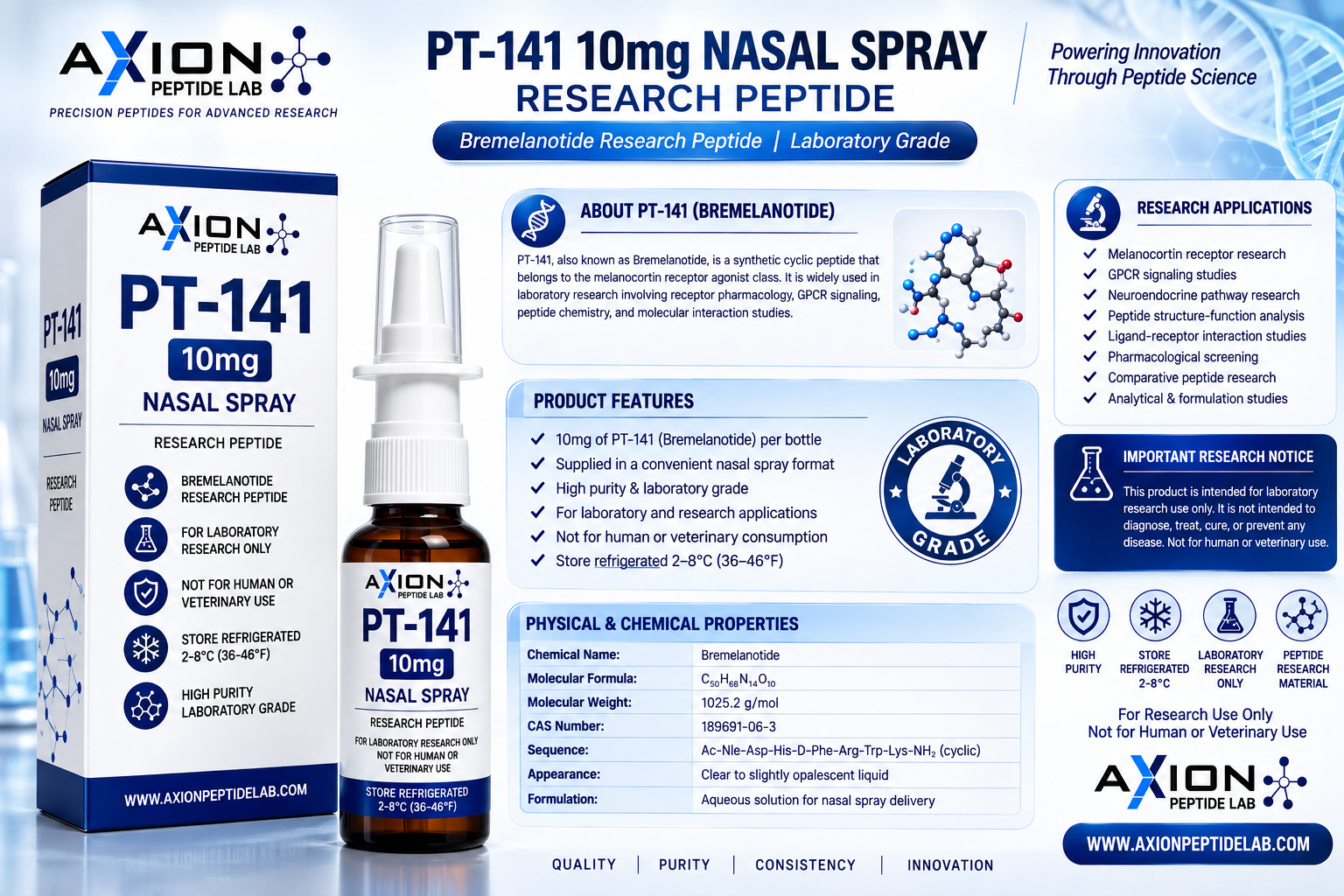
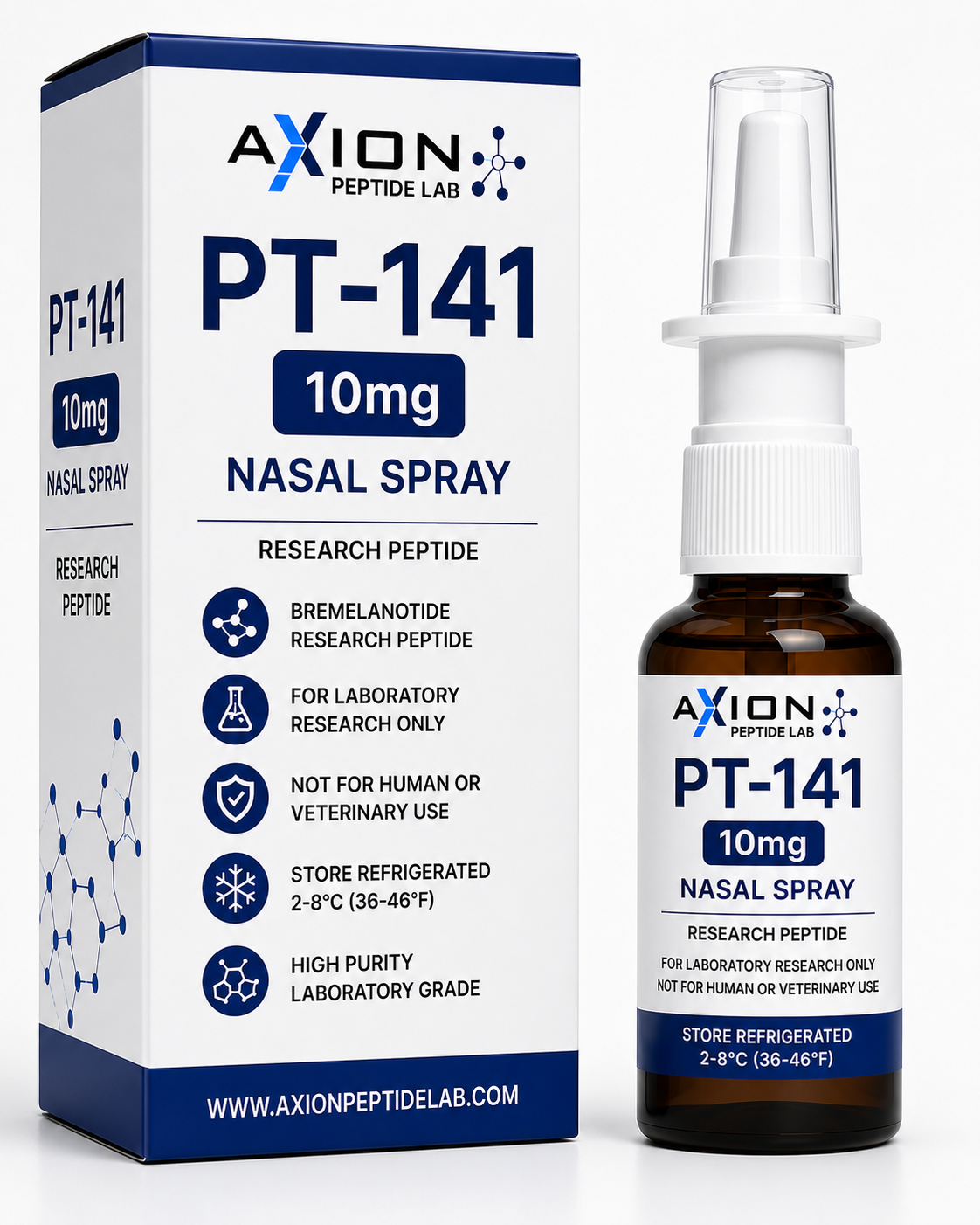
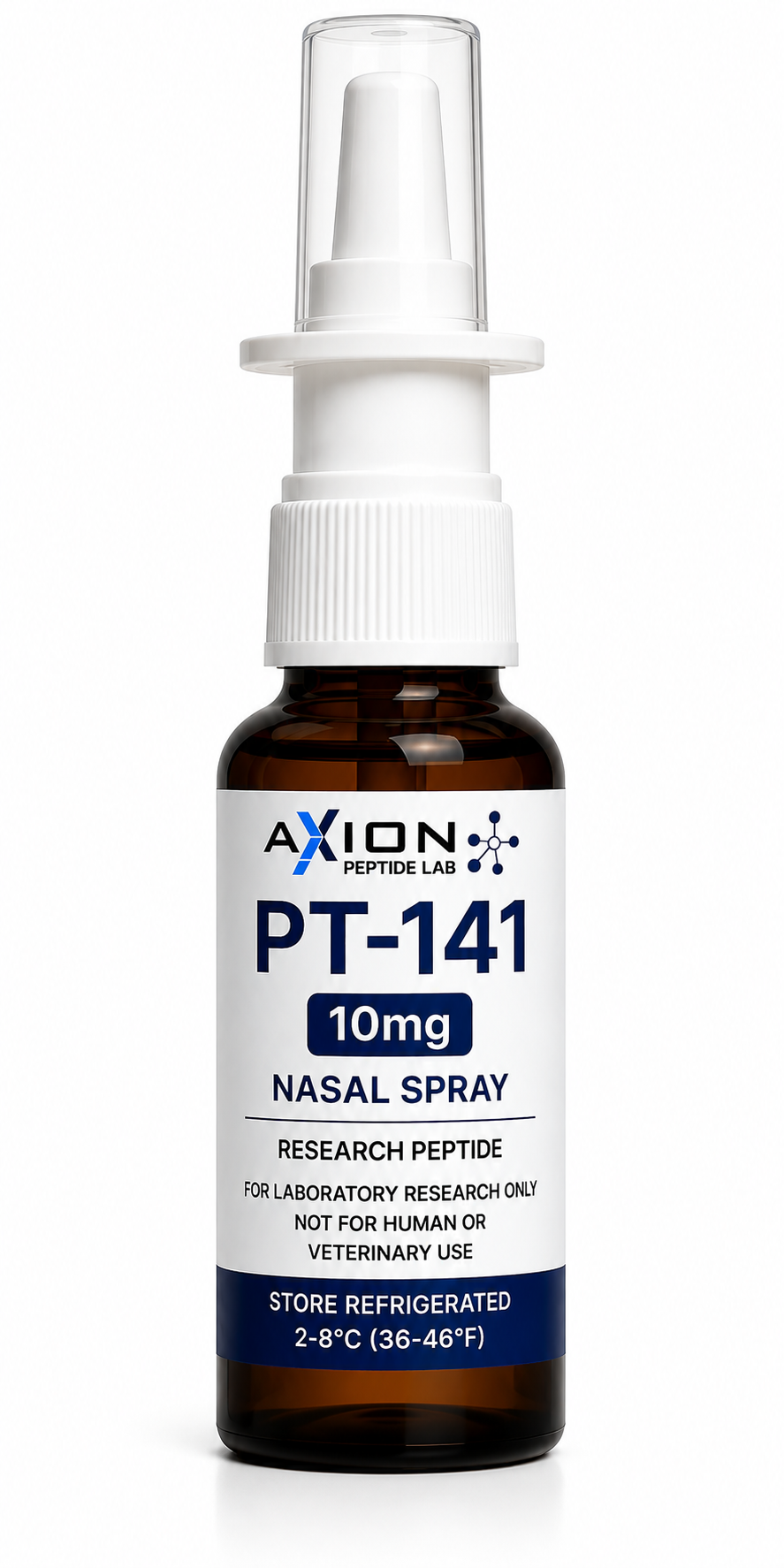
PT-141 10mg Nasal Spray is a bremelanotide research preparation supplied in a liquid spray format for controlled laboratory investigation. PT-141 is a synthetic cyclic peptide associated with melanocortin receptor pharmacology and GPCR research.
Potential laboratory applications include receptor biology, cyclic peptide chemistry, structure-function investigation, comparative molecular pharmacology, formulation studies, stability and analytical characterisation.
The 10mg designation represents the stated research quantity and is not a dosage recommendation. Nasal Spray describes the research presentation only.
For Research Use Only – Not for human or veterinary consumption or administration.
$64.04
PT-141 10mg Nasal Spray from Axion Peptide Lab is a bremelanotide research preparation supplied in a liquid spray format for controlled laboratory, biochemical and analytical investigation. PT-141, also known as bremelanotide, is a synthetic cyclic peptide associated with melanocortin receptor research and has become an established molecule of interest in peptide pharmacology, receptor signalling, structure-function investigation and analytical chemistry.
The 10mg designation represents the stated research quantity associated with this preparation and is not a dosage recommendation. “Nasal Spray” describes the research presentation only and should not be interpreted as instructions or a recommendation for human intranasal administration.
This product is supplied strictly as research material.
For Research Use Only – Not for human or veterinary consumption or administration.
PT-141 is the developmental designation historically associated with bremelanotide.
Bremelanotide is a synthetic cyclic peptide derived from melanocortin peptide research. It consists of seven amino-acid or amino-acid-derived residues and incorporates structural characteristics that distinguish it from simple linear peptides.
The reported condensed structure of bremelanotide includes:
Ac-Nle-Asp-His-D-Phe-Arg-Trp-Lys
with cyclisation involving the peptide structure.
This architecture makes PT-141 an interesting molecule for laboratories studying cyclic peptide chemistry, melanocortin receptor interactions and peptide structure-function relationships.
PT-141 belongs to a field of research involving the melanocortin receptor system.
Melanocortin receptors are members of the G protein-coupled receptor, or GPCR, superfamily.
Several melanocortin receptor subtypes have been characterised, including MC1R, MC2R, MC3R, MC4R and MC5R.
Bremelanotide is classified as a melanocortin receptor agonist.
This makes the molecule relevant to experimental work involving receptor pharmacology, ligand-receptor interactions, GPCR signalling and comparative melanocortin research.
Researchers should define the particular receptor subtype and experimental model being investigated rather than assuming identical activity across every melanocortin receptor.
One important structural characteristic of PT-141 is its cyclic peptide architecture.
Cyclisation can influence peptide conformation and molecular behaviour compared with related linear sequences.
Researchers may therefore use PT-141 as part of experiments investigating how structural constraints affect receptor interaction, stability or analytical characteristics.
Comparisons with related melanocortin peptides or synthetic analogues can provide additional insight into peptide structure-function relationships.
Such experiments can be particularly valuable in medicinal chemistry and molecular pharmacology research.
Bremelanotide free base is reported with the molecular formula:
C50H68N14O10
and a molecular weight of approximately:
1025.2 g/mol
The free-base CAS Registry Number is:
189691-06-3
Different salt or hydrated forms can have different molecular formulas and molecular weights.
Researchers should therefore confirm whether their specific PT-141 material is supplied as free base, acetate or another documented form before performing quantitative molecular calculations.
Batch-specific documentation should take priority over generic reference values.
The melanocortin receptor family provides an established framework for receptor biology research.
PT-141 can be incorporated into controlled experiments examining ligand interaction, receptor activation and downstream signalling-associated endpoints.
Because melanocortin receptors belong to the GPCR family, PT-141 may also be relevant to broader studies of GPCR pharmacology.
Researchers may compare receptor subtypes, investigate concentration-response relationships or evaluate structurally related peptide ligands.
Suitable positive, negative and vehicle controls should be incorporated according to the experimental design.
GPCRs represent a major class of membrane receptors involved in cellular communication.
Experimental ligands such as PT-141 provide tools for investigating how receptor engagement can be translated into measurable intracellular responses.
Laboratory research may examine receptor selectivity, signalling dynamics, ligand potency or comparative molecular behaviour.
These experiments should remain carefully separated from consumer-facing therapeutic claims.
A measurable response in a receptor assay does not by itself demonstrate a clinical outcome in humans.
PT-141’s cyclic structure provides opportunities for comparative structure-function investigation.
Researchers may compare the molecule with related melanocortin sequences, fragments or synthetic analogues.
Changes to amino-acid composition, stereochemistry or peptide conformation can influence receptor interaction and other measurable characteristics.
Such experiments help researchers investigate relationships between molecular architecture and observed experimental activity.
PT-141 can consequently serve as a reference molecule in appropriately designed comparative peptide studies.
Analytical characterisation is an essential part of peptide research.
PT-141 may be investigated using laboratory methods suitable for cyclic peptides.
Depending on the research objective and available instrumentation, scientists may employ high-performance liquid chromatography, mass spectrometry or complementary analytical techniques.
These methods can support identity assessment, separation studies, degradation investigation and other analytical objectives.
Researchers requiring exact purity values should consult documentation applicable to the specific product and batch.
Generic assumptions about purity should not replace batch-specific analytical evidence.
Stability is another important research consideration.
Peptide characteristics can change depending on environmental and formulation conditions.
Scientists may investigate PT-141 under controlled variations in temperature, pH, light exposure, solvent composition and time.
Analytical monitoring can then be used to identify changes in molecular integrity or chromatographic behaviour.
Results obtained from one formulation should not automatically be transferred to another.
Researchers should follow verified product-specific storage information where available.
The PT-141 10mg Nasal Spray presentation provides a liquid format that may be incorporated into controlled formulation experiments.
Researchers may investigate compatibility, analytical recovery, solution behaviour and stability within defined formulation environments.
The presence of excipients or other formulation components can influence experimental observations.
Where formulation composition is important, researchers should consult product-specific documentation.
The spray dispenser is simply part of the research presentation and does not establish an approved or validated intranasal route for this Axion preparation.
The 10mg label identifies the stated research quantity associated with the preparation.
It is not a recommendation for human dosing.
Researchers performing quantitative experiments should use verified product information to establish concentration and molecular form.
Experimental quantities should be determined according to validated research protocols, analytical requirements and institutional procedures.
Axion Peptide Lab does not provide personal dosing or administration protocols for research products.
Comparative peptide research is one potential application for PT-141.
Scientists may investigate bremelanotide alongside other melanocortin-related molecules to examine how differences in peptide structure influence experimental behaviour.
Comparative work can include receptor interaction, analytical properties, stability and molecular structure.
Appropriate controls can help distinguish effects associated specifically with PT-141 from effects caused by experimental conditions or formulation components.
Bremelanotide is also known as an active pharmaceutical ingredient in an FDA-approved prescription product.
That fact should not be used to imply that every commercially available PT-141 research preparation is an approved medicine.
Product formulation, manufacturing controls, route of administration, regulatory status and intended use can differ substantially.
Axion Peptide Lab’s PT-141 10mg Nasal Spray should therefore be described according to its actual status: a laboratory research preparation.
It should not be represented as equivalent to a prescription bremelanotide product.
PT-141 research may be relevant to controlled investigation involving:
These represent research categories rather than medical indications.
Researchers should maintain accurate records of product identity, batch information, formulation details, experimental conditions and analytical methods.
Where available, batch-specific documentation should be reviewed before quantitative experimentation.
Certificate of Analysis and independent testing availability may vary by product and batch.
Exact claims regarding purity, sterility, concentration or formulation characteristics should only be made when supported by documentation applicable to the supplied material.
The product should remain clearly labelled and separated from medicines and consumer products.
Researchers looking to buy PT-141 10mg Nasal Spray can source this bremelanotide research preparation from Axion Peptide Lab for legitimate laboratory, molecular and analytical investigation.
Its cyclic peptide architecture and established relationship with melanocortin receptor pharmacology make PT-141 an interesting experimental material for receptor research, GPCR investigation, peptide chemistry, structure-function studies, formulation research and analytical characterisation.
The nasal spray presentation provides a convenient liquid research format while remaining strictly intended for laboratory applications.
For Research Use Only – Not for human or veterinary consumption or administration.
PT-141 is the developmental designation associated with bremelanotide, a synthetic cyclic peptide investigated in melanocortin receptor research.
PT-141 is commonly used as a synonym for bremelanotide. Researchers should still verify the precise chemical form, such as free base or acetate, from product-specific documentation.
Bremelanotide is a seven-residue cyclic peptide incorporating modified amino-acid features.
Bremelanotide is classified as a melanocortin receptor agonist. Melanocortin receptors belong to the GPCR superfamily.
Laboratory applications include melanocortin receptor biology, GPCR signalling, cyclic peptide chemistry, structure-function studies, formulation research and analytical characterisation.
The 10mg designation represents the stated research quantity associated with the preparation. It is not a human dosage recommendation.
Bremelanotide has a cyclic peptide structure, making it useful for comparative research involving constrained peptide architecture.
No. Although bremelanotide is an active ingredient in an approved prescription medicine, independently supplied research preparations should not be represented as approved pharmaceutical products.
No. Nasal Spray describes this research presentation only. It does not establish regulatory approval, clinical suitability or human administration instructions.
PT-141 10mg Nasal Spray is available from Axion Peptide Lab for legitimate laboratory, molecular and analytical research, subject to availability and applicable requirements.