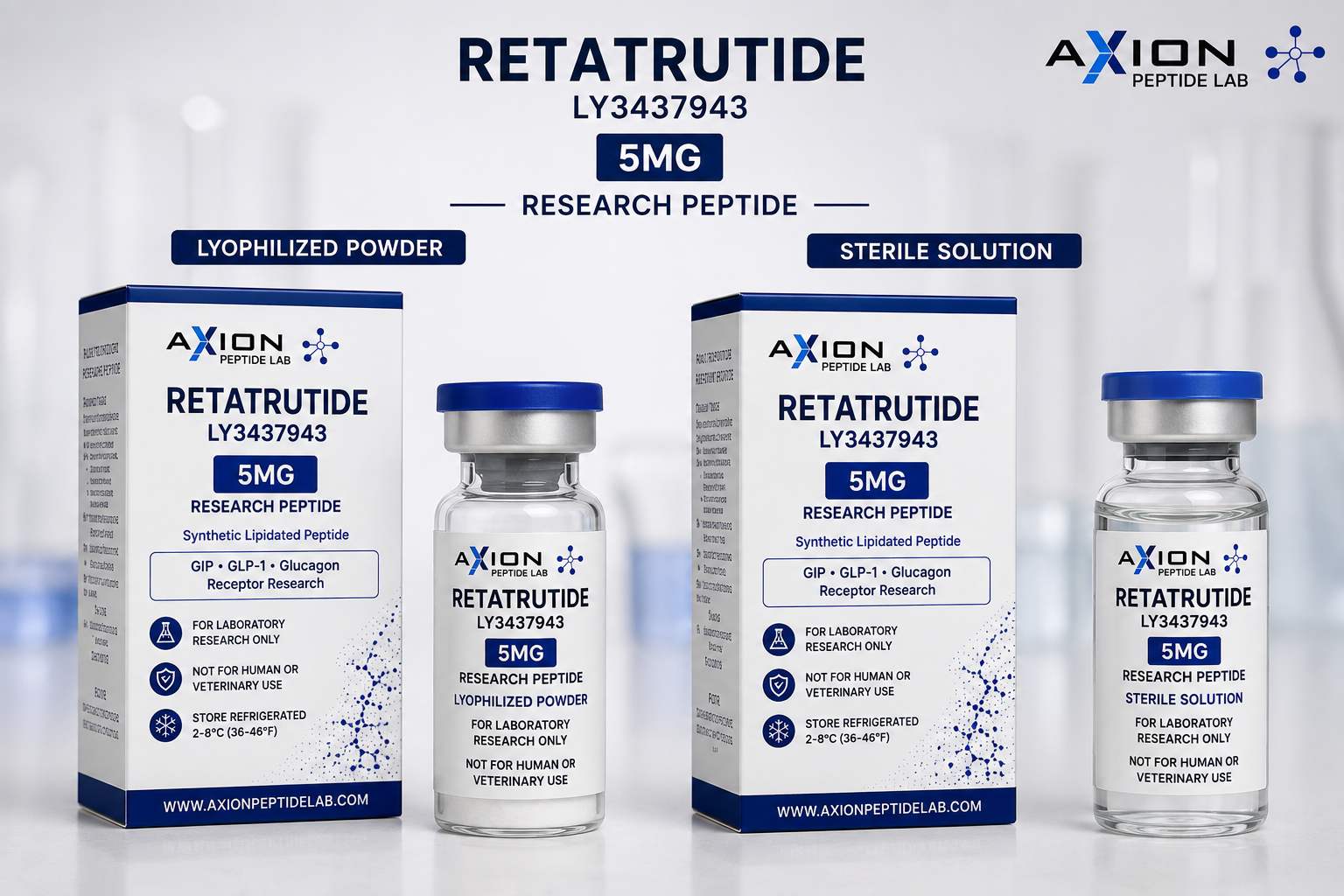
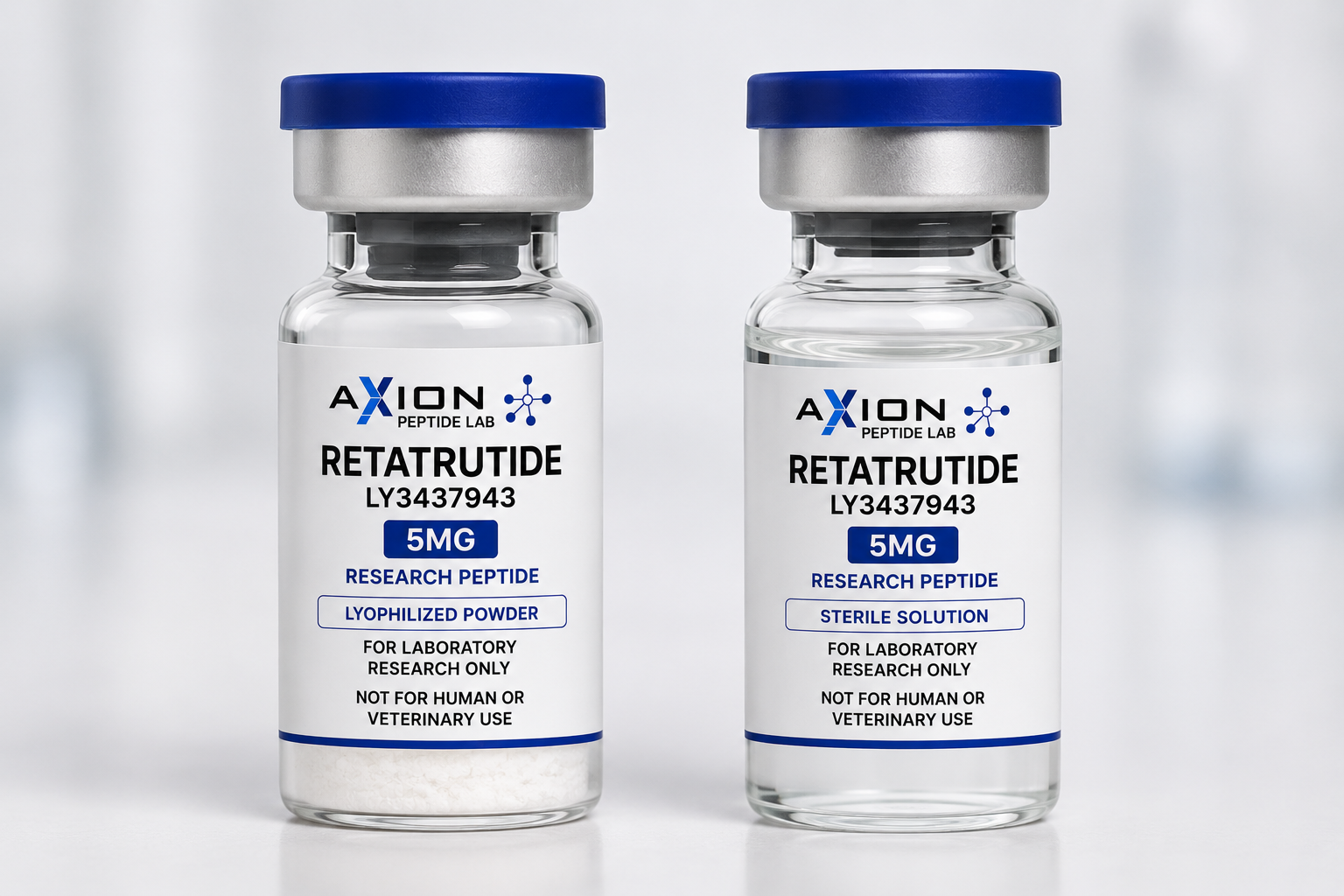
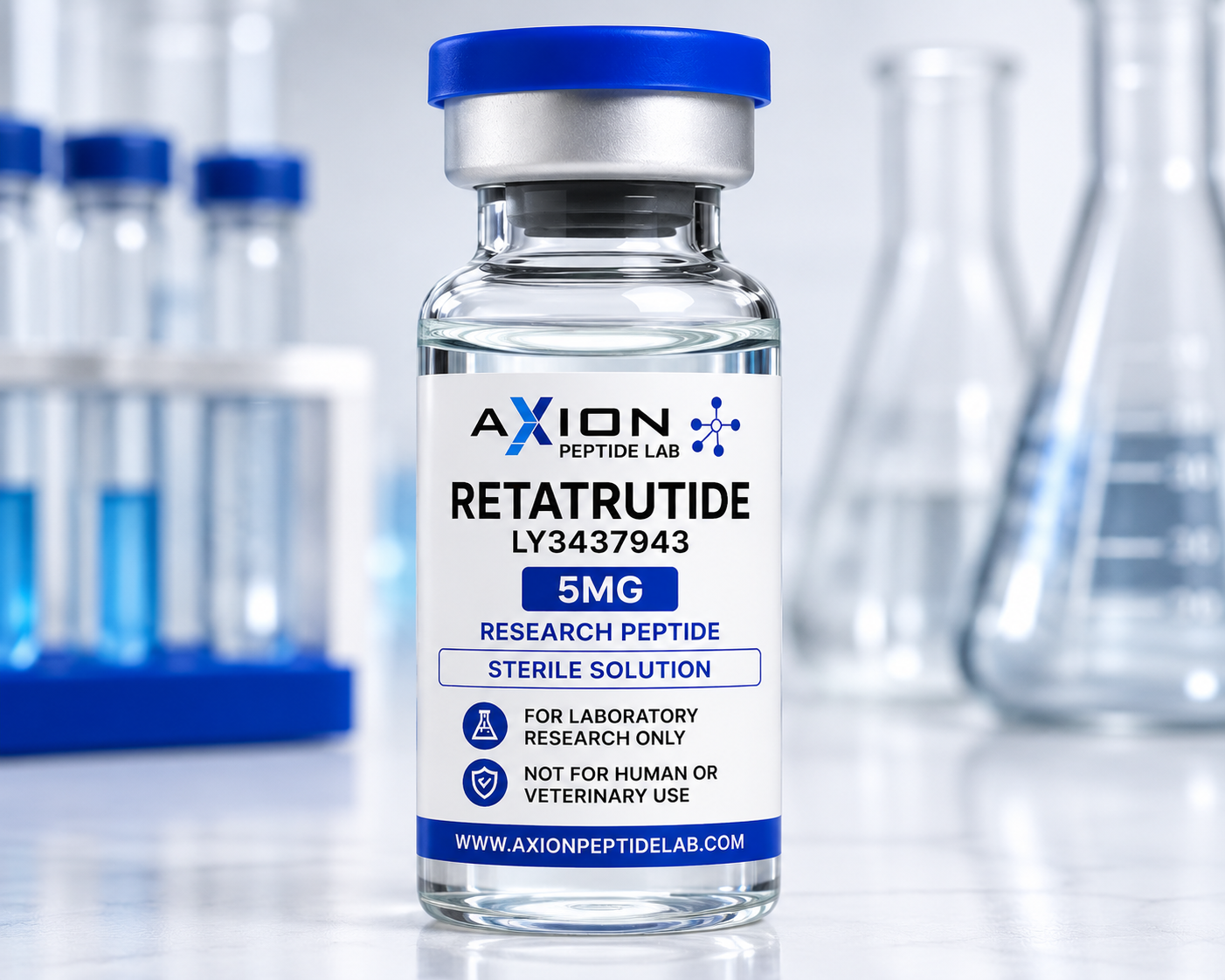
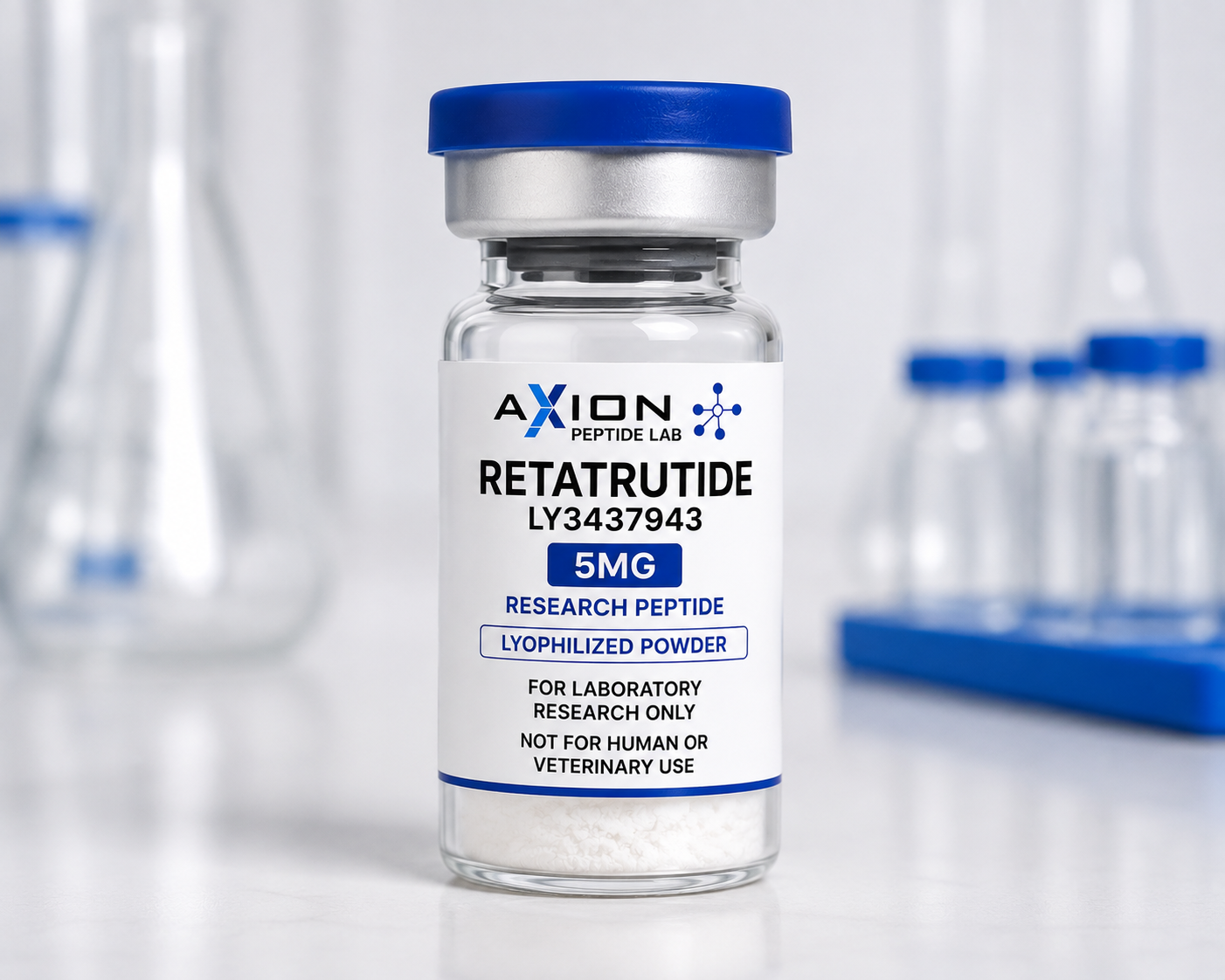
Retatrutide 5mg Research Peptide (LY3437943) is a synthetic lipidated peptide research material characterised by experimentally demonstrated agonist activity at the GIP, GLP-1 and glucagon receptors.
Its multi-receptor profile makes it relevant to controlled laboratory research involving GPCR biology, receptor pharmacology, peptide engineering, molecular signalling, structure-function relationships and analytical characterisation.
5mg represents the stated research quantity and is not a dosage recommendation.
For Research Use Only – Not for human or veterinary consumption or administration.
$101.55 – $121.86Price range: $101.55 through $121.86
Retatrutide 5mg Research Peptide from Axion Peptide Lab is a synthetic lipidated peptide research material intended for controlled receptor, molecular, biochemical and analytical laboratory investigation.
Also known by the development identifier LY3437943, retatrutide has attracted considerable scientific interest because a single molecular construct demonstrates agonist activity at three metabolically relevant receptor systems: the glucose-dependent insulinotropic polypeptide receptor (GIPR), glucagon-like peptide-1 receptor (GLP-1R) and glucagon receptor (GCGR).
This triple-receptor profile makes retatrutide particularly relevant to laboratories studying multi-receptor pharmacology, peptide-receptor interactions, G-protein-coupled receptors, molecular signalling and structure-function relationships.
The 5mg designation represents the stated quantity of research material and is not a dosage recommendation.
For Research Use Only – Not for human or veterinary consumption or administration.
Retatrutide is an investigational synthetic peptide originally identified by the development code LY3437943.
It has been engineered as a single peptide molecule capable of interacting with GIP, GLP-1 and glucagon receptors.
This distinguishes retatrutide from compounds designed to engage only one receptor and makes it particularly interesting within the broader field of unimolecular multi-receptor peptide research.
Rather than combining three separate compounds, researchers can investigate receptor activity associated with a single engineered molecular entity.
This characteristic provides opportunities for comparative receptor studies, signalling experiments and analytical investigations involving structurally related peptide agonists.
A defining scientific characteristic of retatrutide is its experimentally demonstrated activity at three receptor systems.
These are:
GIP receptor – GIPR
GLP-1 receptor – GLP-1R
Glucagon receptor – GCGR
All three belong to the G-protein-coupled receptor superfamily.
GPCRs are important experimental targets because receptor activation can initiate intracellular signalling pathways that researchers can measure under controlled conditions.
Retatrutide therefore provides an interesting model for examining how one engineered peptide interacts with multiple related receptor systems.
The GIP receptor is one component of retatrutide’s triple-receptor profile.
Laboratories studying GIPR may use controlled cellular or biochemical systems to investigate ligand binding, receptor activation, downstream signalling and comparative agonist activity.
Retatrutide can also be evaluated alongside endogenous receptor ligands or structurally different synthetic compounds.
Such comparative experiments may help researchers investigate how molecular engineering influences receptor interaction and signalling characteristics.
Retatrutide also demonstrates agonist activity at the GLP-1 receptor.
GLP-1R is another GPCR extensively investigated in molecular and cellular biology.
Controlled laboratory models may examine receptor activation, signalling pathways, receptor selectivity and ligand-receptor relationships.
Because retatrutide interacts with several receptor classes rather than GLP-1R alone, researchers may also investigate how multi-receptor activity differs from selective receptor activation.
The third component is the glucagon receptor.
GCGR is another member of the class B GPCR family and provides an additional experimental target for investigating retatrutide’s multi-receptor characteristics.
Researchers can examine GCGR-related molecular signalling independently or compare it with GIPR and GLP-1R activity.
These experiments can contribute to understanding the principles underlying multi-target peptide design.
Retatrutide is particularly interesting as an example of unimolecular polypharmacology.
Traditional experimental approaches may use separate molecules to activate different molecular targets.
A multi-receptor peptide is different because receptor activity is incorporated into a single molecular construct.
Researchers can consequently investigate how structural modifications affect activity across several receptors.
This concept has become an important area of peptide engineering and receptor pharmacology research.
Retatrutide is not simply an unmodified naturally occurring peptide.
It is an engineered, lipidated peptide containing structural modifications developed to influence its molecular and pharmacological characteristics.
From a laboratory perspective, these features make retatrutide relevant to peptide-design research.
Researchers may investigate relationships between molecular architecture, receptor interaction, physicochemical characteristics and analytical behaviour.
Its engineered structure also makes accurate identity verification particularly important when conducting quantitative research.
Structure-function research examines how molecular characteristics influence experimentally observable activity.
Retatrutide provides an interesting model because researchers can compare it with compounds displaying narrower receptor profiles. Retatrutide 5mg Research Peptide
Experiments might investigate receptor activation, relative activity, molecular interactions or signalling characteristics under standardised conditions.
Appropriate controls are important because experimental observations can depend heavily on assay design, cell type, receptor expression and analytical methodology.
Ligand-receptor interaction experiments represent another potential research area.
Researchers may investigate retatrutide using appropriately validated receptor-binding or functional assays. Retatrutide 5mg Research Peptide
Comparative experiments can evaluate activity across GIPR, GLP-1R and GCGR systems.
These studies can contribute to understanding receptor selectivity and multi-receptor peptide behaviour without assuming therapeutic outcomes from isolated laboratory findings.
Retatrutide may also be investigated using controlled cell-based experimental systems.
Engineered cell lines expressing selected receptors can help researchers examine downstream responses following receptor activation.
Depending on experimental objectives, researchers might measure signalling markers, second messengers or other predefined endpoints.
Experimental conditions should be carefully standardised to allow meaningful comparisons between compounds. Retatrutide 5mg Research Peptide
Reliable analytical characterisation is important for peptide research.
Methods such as high-performance liquid chromatography (HPLC) can support chromatographic investigation of peptide research materials.
Laboratories may examine retention behaviour, related molecular species and other chromatographic characteristics. Retatrutide 5mg Research Peptide
Quantitative purity conclusions should always be based on appropriate batch-specific analytical documentation rather than generic claims associated with the compound name. Retatrutide 5mg Research Peptide
Liquid chromatography-mass spectrometry (LC-MS) and other mass-spectrometric methods can provide valuable molecular information during peptide characterisation.
These techniques may help researchers investigate molecular identity and detect related species.
Retatrutide’s engineered structure makes accurate analytical characterisation particularly important.
Researchers performing quantitative experiments should use validated methods, calibrated instrumentation and suitable reference standards whenever required. Retatrutide 5mg Research Peptide
Retatrutide may also be useful in comparative studies involving other receptor-active research peptides. Retatrutide 5mg Research Peptide
Researchers can design experiments comparing single-, dual- and triple-receptor molecular systems.
Variables may include receptor activation profiles, molecular interactions, signalling characteristics and physicochemical behaviour.
These experiments can help researchers investigate broader principles of peptide engineering and receptor pharmacology. Retatrutide 5mg Research Peptide
Peptide stability is another potential research area.
Controlled experiments may examine how predefined environmental conditions influence the analytical characteristics of research material over time.
Variables might include temperature, light exposure, solution composition, pH and duration.
Samples collected at defined intervals can then be examined using appropriate analytical methods.
Storage conditions for the specific commercial preparation should follow applicable product and batch documentation rather than assumptions based solely on the retatrutide name.
The 5mg designation identifies the stated quantity of research peptide associated with the product.
It should not be interpreted as a recommended dose.
Axion Peptide Lab does not provide personal dosing, reconstitution, injection or therapeutic protocols for this research material.
Experimental quantities and concentrations should instead be determined according to the requirements of properly designed laboratory protocols.
Retatrutide continues to be investigated in clinical development.
Published and ongoing studies have examined the molecule across several metabolic research areas.
However, clinical-trial findings should not be interpreted as establishing an unapproved commercial research product as a medicine.
Researchers should distinguish carefully between the investigational molecule studied in controlled clinical trials and independently supplied laboratory research materials.
Axion Peptide Lab supplies Retatrutide 5mg Research Peptide for legitimate laboratory, molecular and analytical research.
Its triple GIPR, GLP-1R and GCGR activity makes retatrutide relevant to research involving receptor pharmacology, peptide engineering, molecular signalling, structure-function relationships and analytical characterisation.
Researchers should review applicable product specifications and available batch documentation before beginning quantitative studies.
For Research Use Only – Not for human or veterinary consumption or administration.
Retatrutide, also known as LY3437943, is an investigational synthetic lipidated peptide designed to demonstrate agonist activity at GIP, GLP-1 and glucagon receptors.
The molecule has demonstrated activity at the glucose-dependent insulinotropic polypeptide receptor (GIPR), glucagon-like peptide-1 receptor (GLP-1R) and glucagon receptor (GCGR).
It is described this way because one molecular construct demonstrates agonist activity across three receptor systems: GIPR, GLP-1R and GCGR.
Yes. Retatrutide is an engineered, lipidated synthetic peptide.
LY3437943 is the development identifier associated with retatrutide in scientific and clinical research.
The 5mg designation represents the stated quantity of research material. It is not a recommended human or veterinary dose.
Research areas may include GPCR biology, receptor pharmacology, peptide chemistry, molecular signalling, ligand-receptor interactions, structure-function investigation and analytical characterisation.
Appropriately developed HPLC, LC-MS and mass-spectrometric methods can support analytical investigation and characterisation of peptide research materials.
Retatrutide remains an investigational molecule. A laboratory research product should not be represented as an approved medicine or substituted for a regulated pharmaceutical product.
No. Axion Peptide Lab supplies this material exclusively for legitimate laboratory and analytical research. It is not intended for human or veterinary consumption or administration.