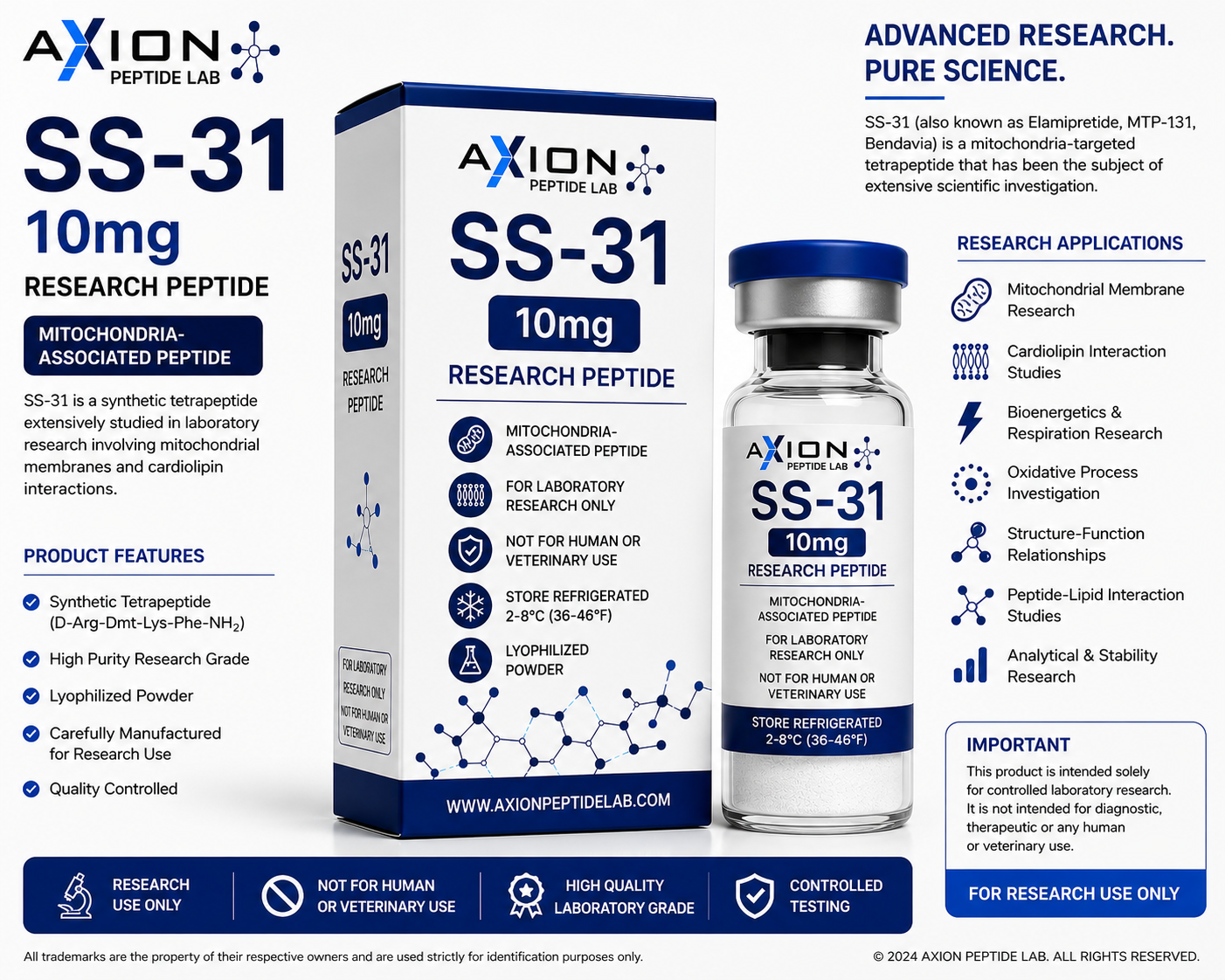
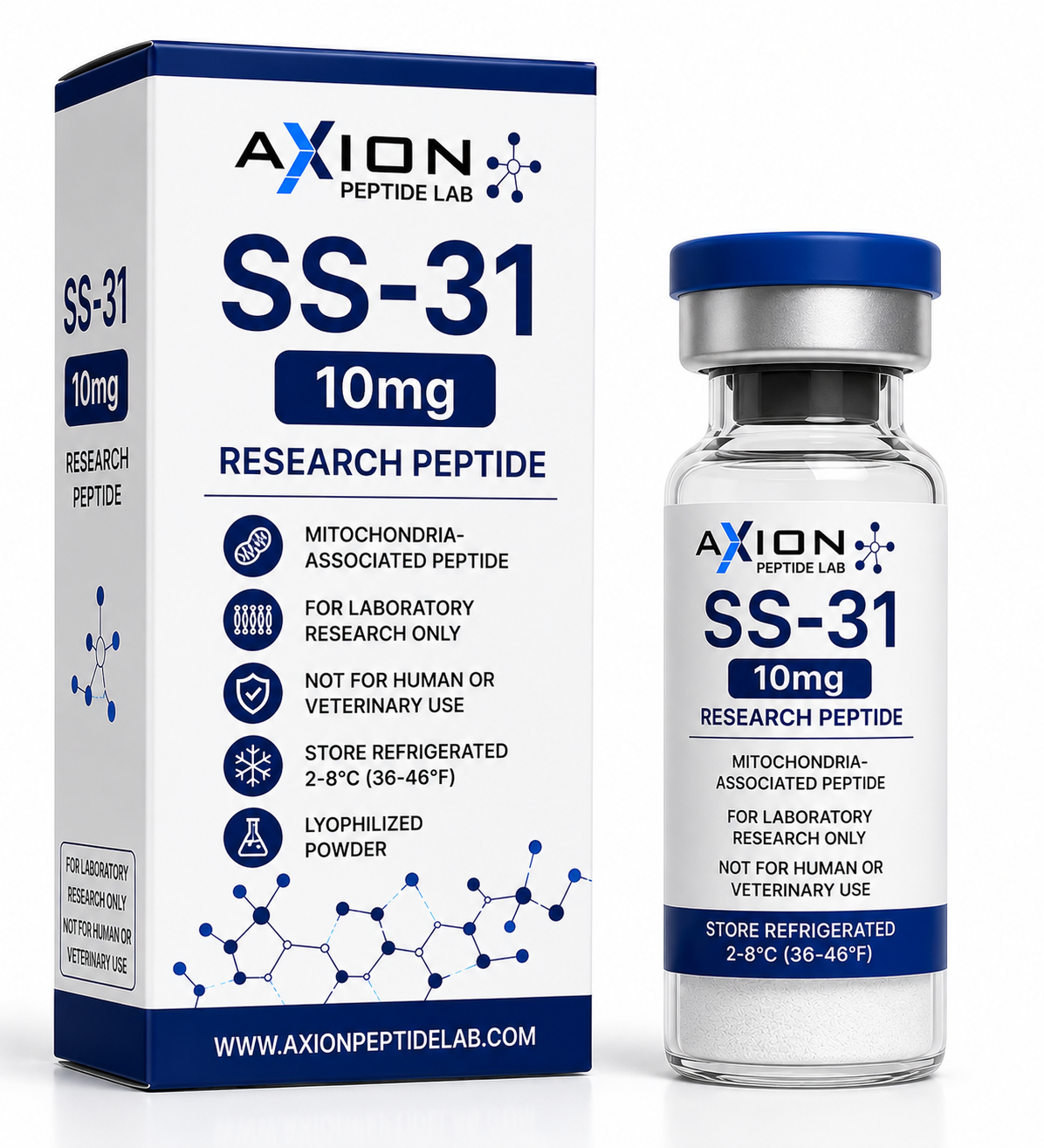
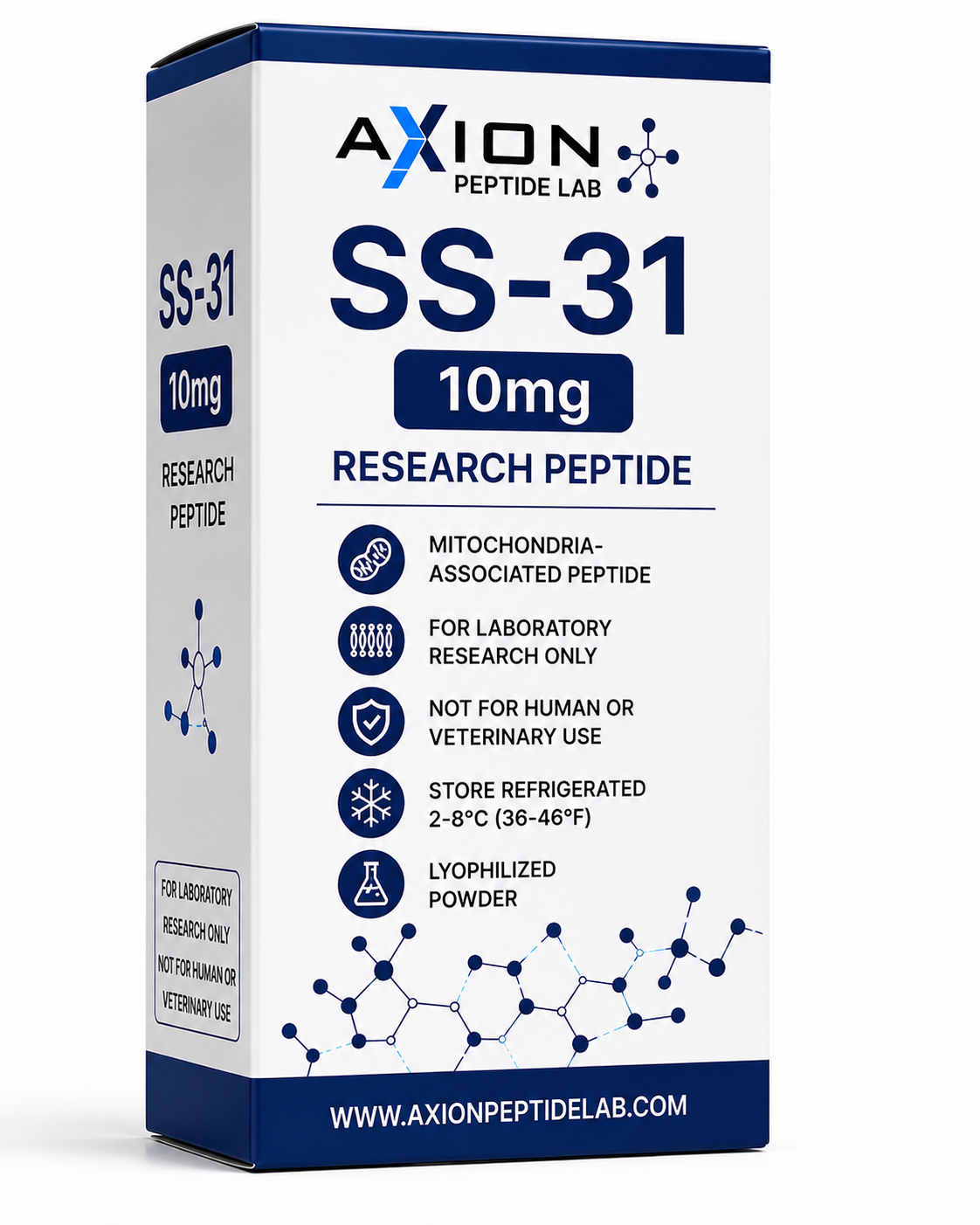
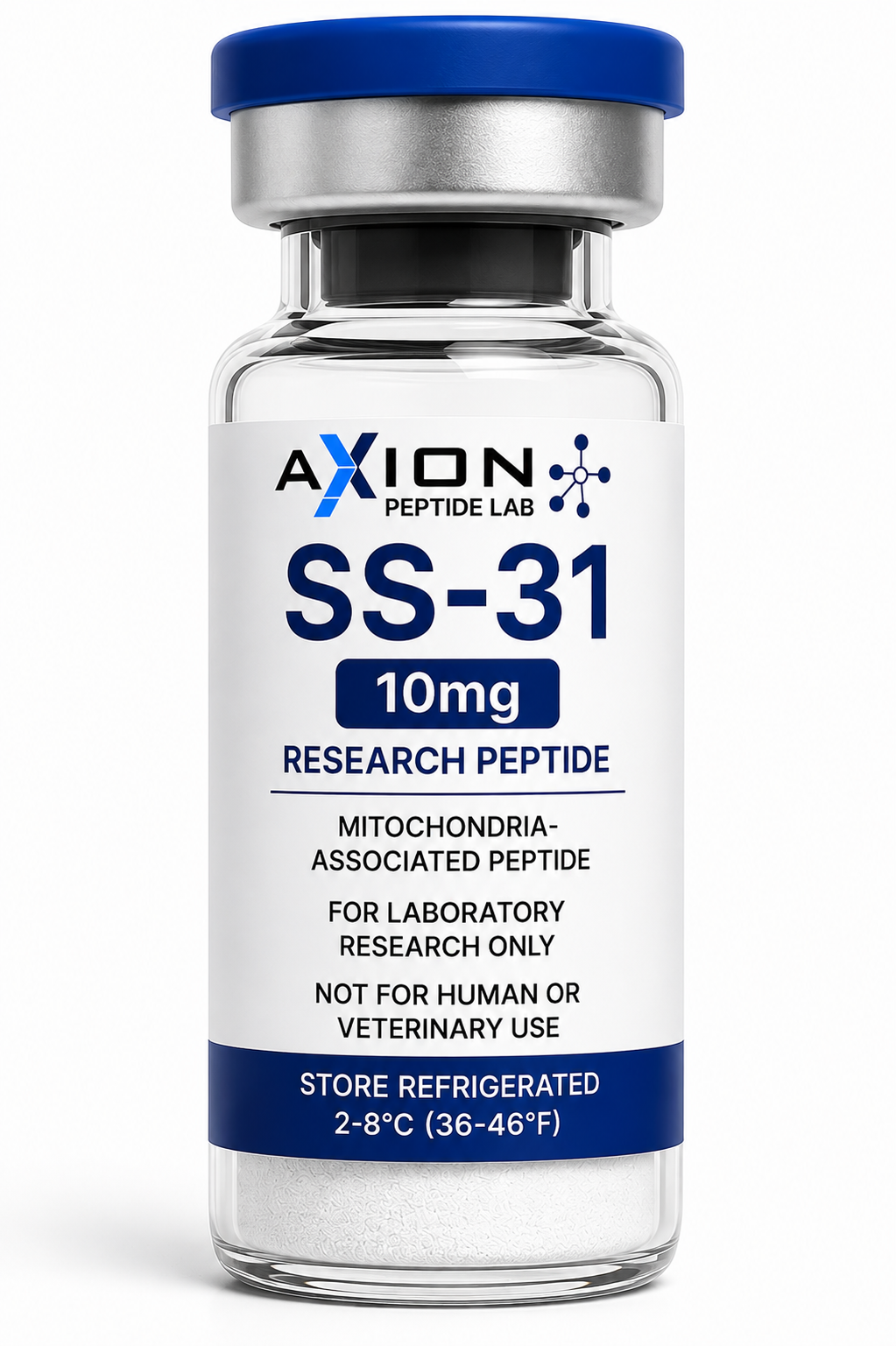
SS-31 10mg Research Peptide is a synthetic tetrapeptide, also widely known as elamipretide, supplied for controlled mitochondrial, biochemical and analytical laboratory investigation.
SS-31 is associated with research involving mitochondrial membranes and cardiolipin, making it relevant to studies of mitochondrial biology, peptide-lipid interactions, bioenergetics, structure-function relationships, stability and analytical characterisation.
The 10mg designation represents the stated research quantity and is not a dosage recommendation.
For Research Use Only – Not for human or veterinary consumption or administration.
$54.15
SS-31 10mg Research Peptide from Axion Peptide Lab is a synthetic tetrapeptide research material intended for controlled mitochondrial, biochemical, molecular and analytical laboratory investigation. SS-31 is widely known in scientific literature as a mitochondria-associated peptide and has also been studied under names including elamipretide, MTP-131 and Bendavia.
SS-31 has attracted substantial research interest because of its interaction with mitochondrial membranes and particularly with cardiolipin, a distinctive phospholipid highly enriched in the inner mitochondrial membrane.
These molecular characteristics have made SS-31 an important experimental compound for investigating mitochondrial membrane biology, bioenergetics, peptide-lipid interactions, oxidative processes and structure-function relationships.
The 10mg designation represents the stated quantity of research material and is not a dosage recommendation.
Axion Peptide Lab supplies SS-31 strictly for legitimate laboratory and analytical research.
For Research Use Only – Not for human or veterinary consumption or administration.
SS-31 is a short synthetic peptide consisting of four amino-acid or amino-acid-derived residues, making it a tetrapeptide.
It is commonly represented by the sequence:
D-Arg-Dmt-Lys-Phe-NH₂
where Dmt represents 2,6-dimethyltyrosine.
Despite its small size, SS-31 possesses structural characteristics that have made it particularly interesting in mitochondrial research.
Unlike many experimental compounds that rely primarily on conventional receptor-target interactions, SS-31 has been extensively investigated for interactions involving mitochondrial membranes and cardiolipin.
This provides researchers with opportunities to explore mitochondrial molecular biology from a peptide-lipid interaction perspective.
Mitochondria are dynamic cellular organelles involved in energy conversion and numerous biochemical processes.
Their inner membranes contain the machinery required for oxidative phosphorylation and ATP generation.
Because mitochondrial function depends heavily on membrane architecture and protein-lipid organisation, molecules capable of interacting with mitochondrial membrane components are valuable research tools.
SS-31 has therefore been investigated in experimental systems examining mitochondrial structure, membrane organisation, respiration and bioenergetic processes.
Laboratory findings should always be interpreted within the specific experimental model rather than converted into unsupported clinical claims.
One of the most important areas associated with SS-31 is cardiolipin research.
Cardiolipin is a specialised phospholipid concentrated predominantly in the inner mitochondrial membrane.
Its unusual structure allows it to interact with numerous proteins and protein complexes involved in mitochondrial function.
Research literature has investigated interactions between SS-31 and cardiolipin-containing membranes.
This makes the peptide relevant to experiments examining peptide-lipid binding, membrane organisation and relationships between mitochondrial lipids and proteins.
Researchers may use model membranes, isolated mitochondrial systems, biochemical assays or other controlled platforms to investigate these interactions.
The inner mitochondrial membrane contains components of the electron transport chain and ATP-producing machinery.
Its structure and composition are therefore important areas of biochemical investigation.
SS-31 may be incorporated into experiments examining how peptide interactions influence measurable properties of mitochondrial membrane systems.
Researchers can evaluate membrane-associated biochemical endpoints using appropriate experimental controls.
Such experiments may contribute to understanding how small synthetic peptides interact with specialised lipid environments.
Experimental results should be described according to the measured endpoint rather than interpreted as evidence of therapeutic benefit.
Bioenergetics examines how biological systems transform and utilise energy.
Mitochondria are central to this field because they generate ATP through oxidative phosphorylation.
SS-31 has been studied in experimental models involving mitochondrial respiration and related bioenergetic parameters.
Researchers may investigate oxygen consumption, membrane-associated processes, electron transport or other measurable mitochondrial variables using validated laboratory methods.
Appropriate control groups are essential because mitochondrial measurements can be influenced by experimental preparation, substrate availability, temperature and numerous other factors.
Mitochondrial electron transfer can be associated with reactive oxygen species and other redox-related processes.
These pathways are important areas of cellular and biochemical research.
SS-31 has appeared in preclinical investigations examining oxidative processes within mitochondrial experimental systems.
Researchers can investigate these mechanisms using assays designed to measure specific biochemical endpoints.
The presence of SS-31 in oxidative-stress research should not be converted into claims that a commercial research preparation prevents oxidative damage or treats disease.
Preclinical molecular findings and established human therapeutic outcomes are fundamentally different categories of evidence.
SS-31 provides an interesting experimental model for investigating interactions between peptides and biological lipids.
Peptide-lipid interactions can depend on charge, amino-acid composition, membrane composition and environmental conditions.
Researchers may use artificial membrane systems containing cardiolipin or other defined phospholipids to examine how SS-31 behaves under controlled conditions.
Comparative experiments can also evaluate related peptide analogues or modified membrane compositions.
This approach can help researchers identify structural characteristics associated with particular molecular interactions.
The compact tetrapeptide architecture of SS-31 makes it useful for structure-function research.
Scientists may compare SS-31 with related sequences or modified analogues to determine how individual residues contribute to observed experimental behaviour.
The presence of D-arginine, dimethyltyrosine, lysine and phenylalanine creates distinctive physicochemical characteristics.
Researchers can alter individual residues and compare the resulting molecules using defined analytical or biochemical assays.
These experiments may contribute to understanding the structural requirements associated with peptide-membrane interactions.
Reliable analytical characterisation is important when using synthetic peptides in research.
SS-31 may be investigated using chromatographic, spectrometric and complementary analytical techniques.
High-performance liquid chromatography may be used for separation and purity assessment, while mass spectrometry can support molecular identity investigation.
Additional analytical approaches can be selected according to the specific objective of the laboratory.
Exact purity values should always come from documentation applicable to the particular batch rather than from generic marketing assumptions.
Researchers should also confirm the exact chemical form of the material before performing quantitative molecular calculations.
Peptide stability can affect both experimental reproducibility and analytical interpretation.
SS-31 may therefore be incorporated into controlled stability studies.
Researchers can investigate how temperature, pH, light exposure, solvent composition and time influence measurable peptide characteristics.
Samples may be analysed at predefined intervals to identify changes in molecular integrity or chromatographic profile.
Stability information obtained for one formulation should not automatically be transferred to another.
Product-specific handling and storage documentation should be followed where available.
The 10mg designation identifies the stated amount of SS-31 research material associated with the product.
It does not represent a recommended human or veterinary dose.
Researchers requiring molar calculations should use verified molecular information for the specific chemical form supplied.
Experimental concentrations and quantities should be selected according to validated laboratory protocols, study objectives and institutional procedures.
Axion Peptide Lab does not provide human administration or dosing protocols for research products.
SS-31 has been investigated across numerous preclinical experimental models.
Research has included biochemical systems, isolated mitochondria, cultured cells and animal models.
These studies have contributed to scientific understanding of SS-31 and have supported continuing investigation into mitochondrial membrane biology.
However, results from preclinical experiments cannot automatically be extrapolated to humans.
Product descriptions should therefore distinguish between legitimate scientific research areas and established medical outcomes.
SS-31 supplied for laboratory research should not be represented as an approved treatment.
SS-31 10mg Research Peptide may be relevant to controlled investigation involving:
These are scientific research categories and should not be interpreted as medical indications.
Good scientific practice requires careful documentation.
Researchers should record product identity, batch information, experimental conditions, analytical methods and relevant preparation details.
Where available, batch-specific analytical documentation should be reviewed before quantitative experimentation.
Certificate of Analysis and independent testing availability may vary according to product and batch.
Claims involving exact purity, identity or other specifications should only be made where supported by appropriate analytical documentation.
Maintaining accurate records can improve experimental reproducibility and allow results to be interpreted within the correct material and methodological context.
SS-31 10mg should be handled as laboratory research material.
Research facilities should maintain appropriate identification, storage and inventory procedures and keep experimental compounds separated from medicines, food products and materials intended for personal use.
Researchers and purchasers are responsible for ensuring that acquisition, possession, importation and intended experimental applications comply with applicable laws and institutional requirements.
Researchers looking to buy SS-31 10mg Research Peptide can source this synthetic tetrapeptide from Axion Peptide Lab for legitimate scientific, biochemical and analytical investigation.
Its compact structure and established research relationship with mitochondrial membranes and cardiolipin make SS-31 an interesting experimental material for mitochondrial biology, peptide-lipid interaction studies, bioenergetics, structure-function investigation and analytical characterisation.
Axion Peptide Lab supplies SS-31 specifically for controlled research applications.
For Research Use Only – Not for human or veterinary consumption or administration.
SS-31 is a synthetic tetrapeptide investigated extensively in mitochondrial and cardiolipin-related laboratory research.
Yes. SS-31 is widely associated with the research name elamipretide and has also appeared under development names including MTP-131 and Bendavia.
SS-31 is commonly represented as D-Arg-Dmt-Lys-Phe-NH₂, where Dmt represents 2,6-dimethyltyrosine.
SS-31 contains four amino-acid or amino-acid-derived residues and is classified as a tetrapeptide.
SS-31 has been investigated for interactions involving mitochondrial membranes and cardiolipin, making it relevant to mitochondrial molecular biology and bioenergetic research.
Cardiolipin is a specialised phospholipid highly enriched in the inner mitochondrial membrane and associated with mitochondrial membrane organisation and protein function.
Research areas include mitochondrial biology, cardiolipin studies, peptide-lipid interactions, bioenergetics, redox research, structure-function investigation and analytical characterisation.
The 10mg designation identifies the stated research quantity. It is not a recommendation for human or veterinary dosing.
Yes. Appropriate chromatographic, mass-spectrometric and complementary laboratory methods can be used to investigate SS-31 identity and other analytical characteristics.
SS-31 10mg Research Peptide is available from Axion Peptide Lab for legitimate mitochondrial, biochemical, molecular and analytical laboratory research, subject to availability and applicable requirements.