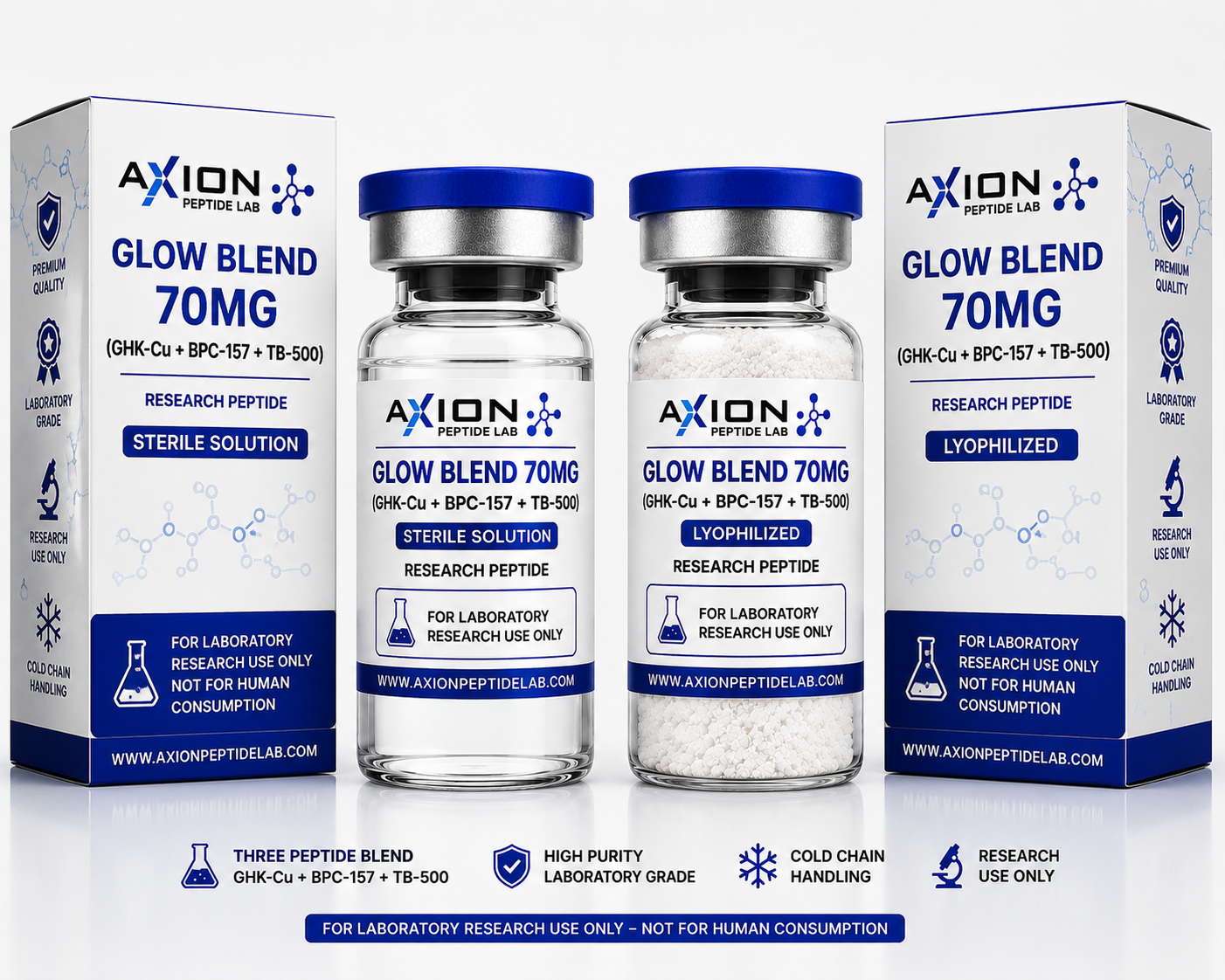
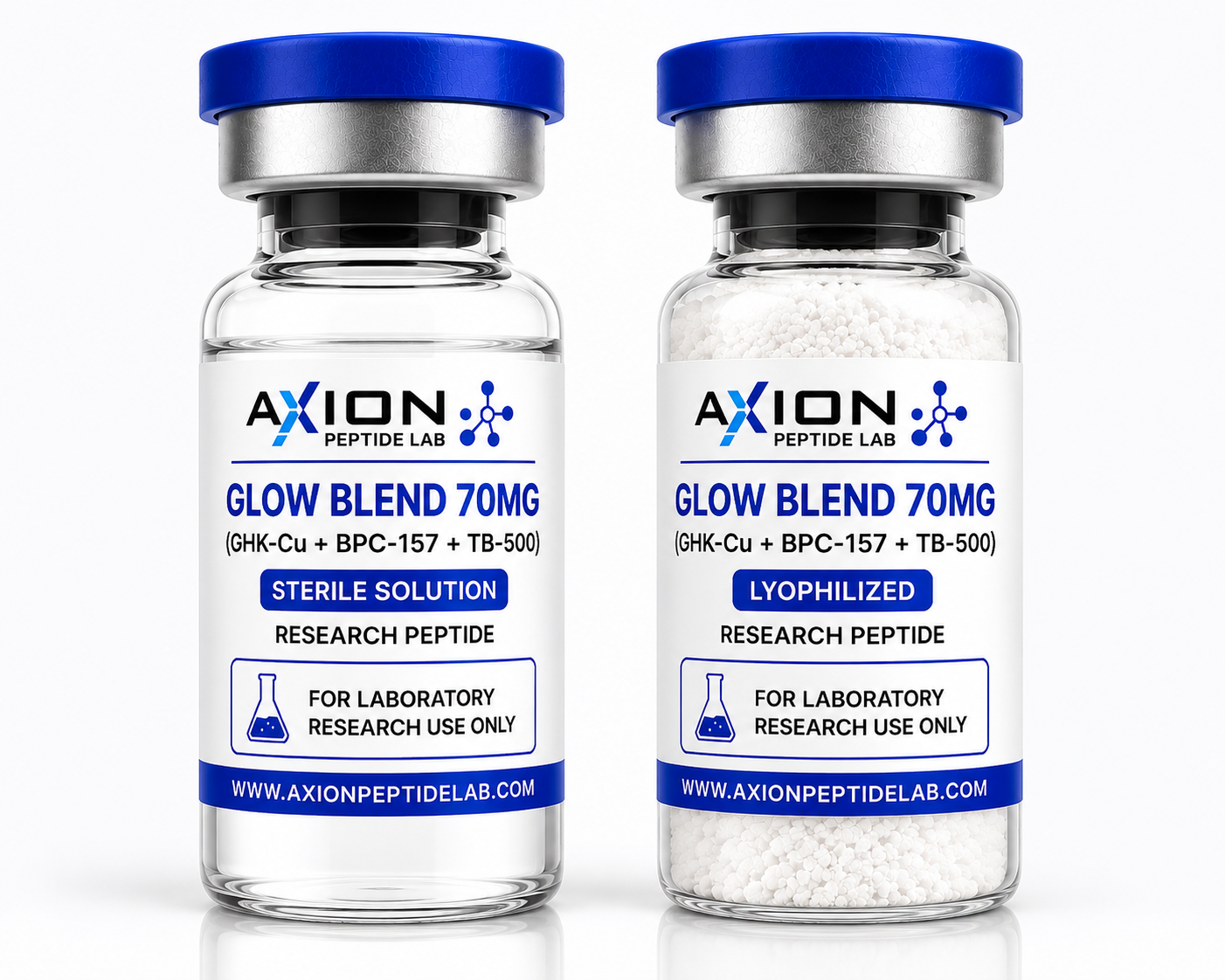
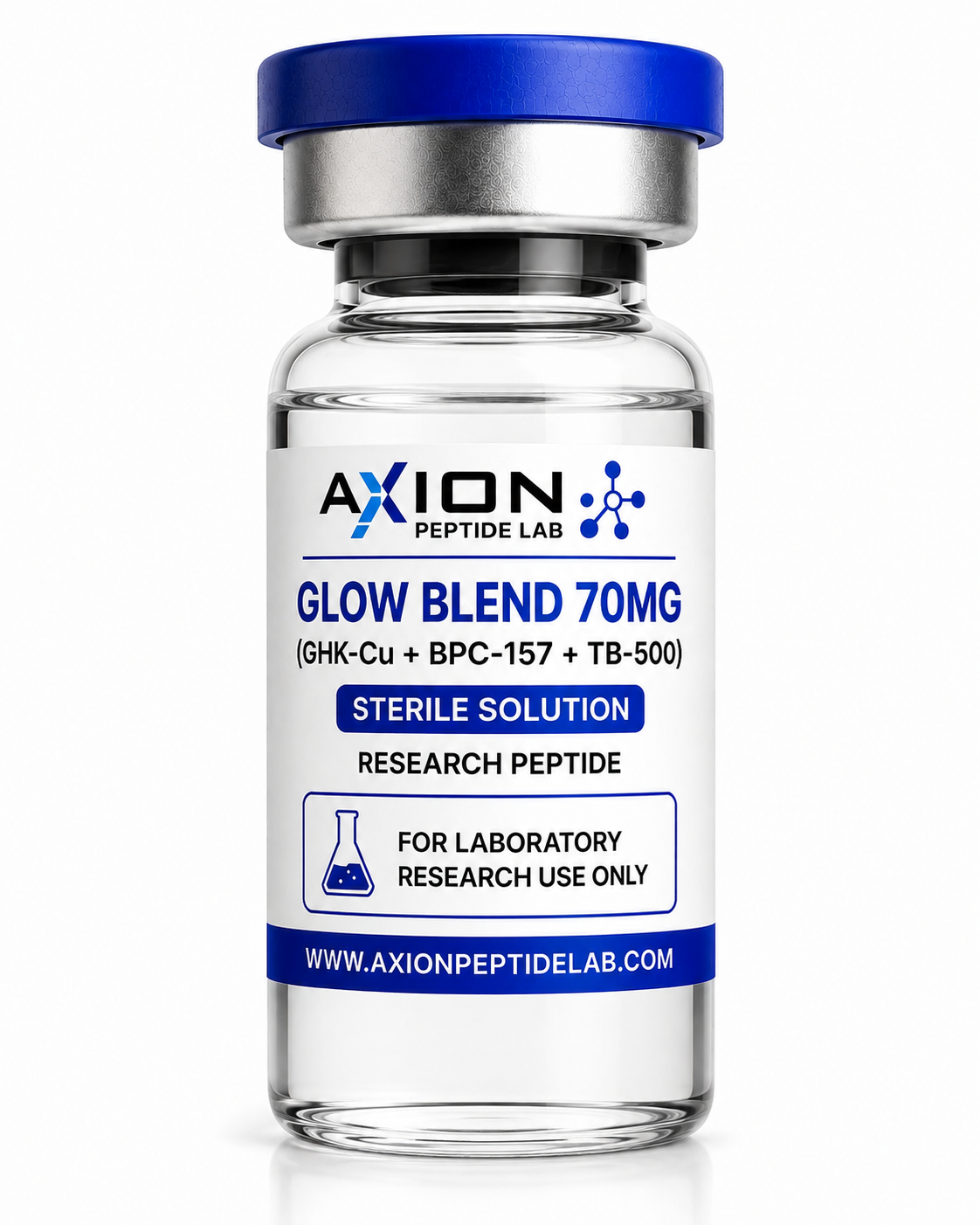
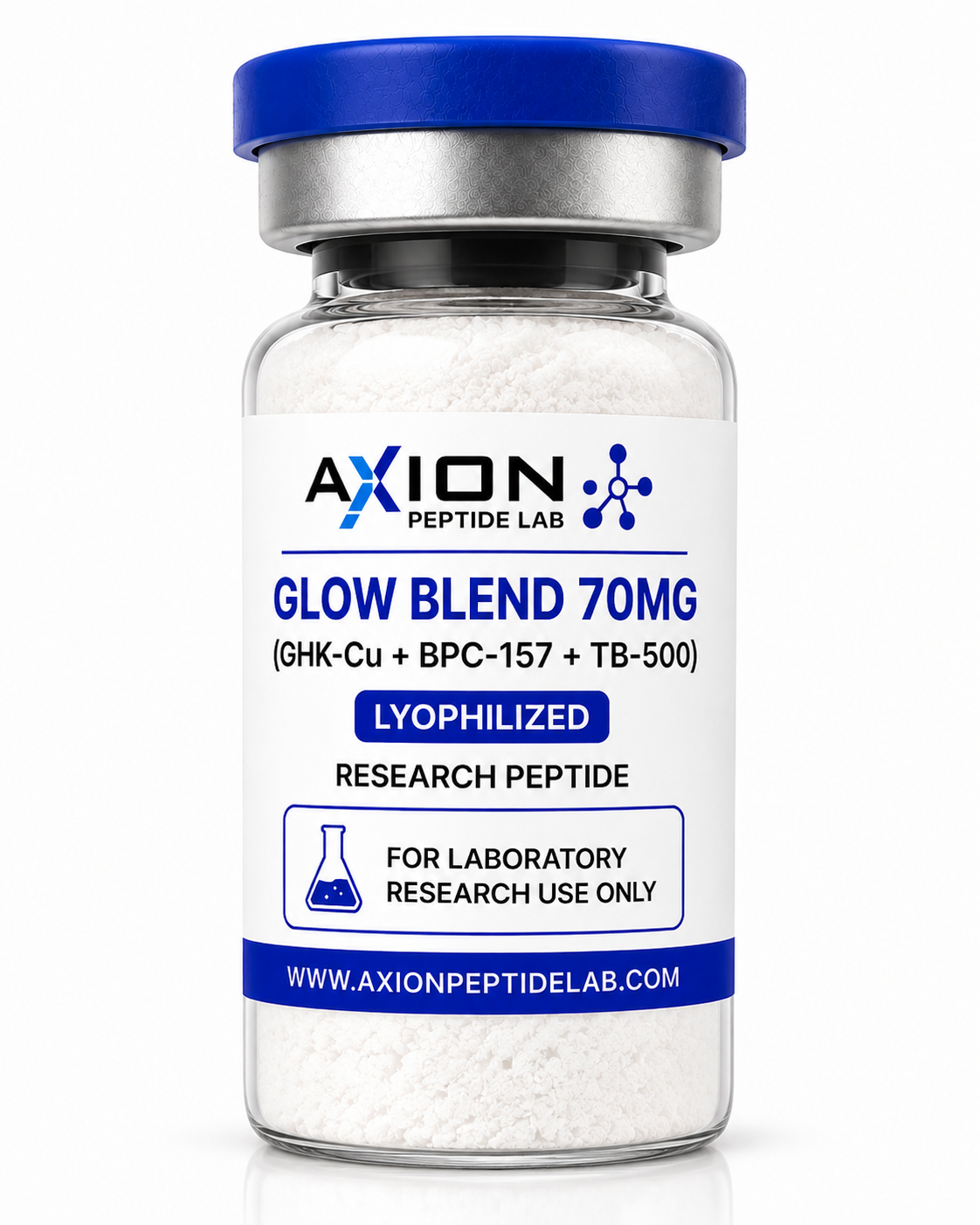
Glow Blend 70mg Research Peptide combines GHK-Cu 50mg, BPC-157 10mg and TB-500 10mg in a single multi-component research format. Designed for controlled laboratory and analytical investigation, the blend may support research involving peptide interactions, extracellular-matrix biology, cellular signalling, migration models, stability and molecular characterisation.
The 70mg designation represents the stated combined quantity of research material and is not a dosage recommendation.
For Research Use Only – Not for human or veterinary consumption.
$121.85 – $148.93Price range: $121.85 through $148.93
Glow Blend 70mg Research Peptide from Axion Peptide Lab is a three-component research formulation combining GHK-Cu, BPC-157 and TB-500 in a single laboratory research format.
A commonly used 70mg GLOW composition contains:
The formulation brings together three distinct research materials that have individually attracted scientific attention across peptide chemistry, extracellular-matrix biology, cellular signalling, migration models and related biochemical investigations.
GLOW should not be regarded as one newly created peptide molecule. Instead, it is a co-formulated research blend containing three separate components.
This distinction is important because research involving an individual component cannot automatically be attributed to the complete mixture.
The 70mg designation represents the combined stated quantity of research material and is not a dosage or administration recommendation.
For Research Use Only – Not for human or veterinary consumption.
Glow Blend 70mg is a multi-component peptide research formulation designed to place GHK-Cu, BPC-157 and TB-500 within a single experimental format.
The name “GLOW” is commonly used commercially to identify this particular type of research combination rather than a unique molecular compound.
Each component possesses different structural characteristics.
GHK-Cu is a copper complex of the naturally occurring tripeptide glycyl-L-histidyl-L-lysine.
BPC-157 is a synthetic 15-amino-acid peptide commonly described as a pentadecapeptide.
TB-500 is a research designation associated with thymosin-beta-4-related peptide research.
Combining these materials provides researchers with an opportunity to investigate multiple peptide-associated pathways within appropriately designed experimental systems.
The largest component by stated mass in this formulation is GHK-Cu at 50mg.
GHK-Cu consists of the tripeptide glycyl-L-histidyl-L-lysine complexed with copper.
It has been investigated extensively in biochemical and cellular research involving extracellular-matrix processes, fibroblast biology, copper-dependent peptide activity and molecular signalling.
Researchers have also investigated relationships between GHK-Cu and proteins associated with collagen, glycosaminoglycans and matrix-remodelling processes.
These characteristics make GHK-Cu an interesting experimental compound for laboratories examining how copper-binding peptides interact with cellular and extracellular environments.
Research observations concerning GHK-Cu should be interpreted according to the experimental model used and should not automatically be attributed to the complete Glow Blend.
The formulation also contains a stated 10mg of BPC-157.
BPC-157 is a synthetic pentadecapeptide consisting of 15 amino-acid residues.
A substantial portion of the published research surrounding BPC-157 comes from laboratory and animal models.
Researchers have investigated the peptide in experimental systems involving cellular signalling, vascular pathways, molecular interactions and tissue-related biological models.
BPC-157 has consequently become a commonly investigated material within experimental peptide science.
However, available human evidence remains limited compared with the preclinical literature.
This distinction is especially important when describing a research blend because experimental observations involving BPC-157 alone cannot demonstrate that the Glow Blend produces the same results.
The third component is TB-500 at a stated 10mg.
TB-500 is associated with research involving thymosin beta-4-related peptide sequences.
The thymosin beta-4 research literature includes investigation of cytoskeletal processes, actin interactions, cellular migration and related molecular pathways.
Commercial terminology surrounding TB-500 can vary, making precise product documentation particularly important.
Researchers should therefore verify the molecular identity and specifications associated with the actual TB-500 component contained within a particular batch.
Data concerning full-length thymosin beta-4 should not automatically be presented as evidence for every commercially designated TB-500 material.
The primary scientific interest of a three-component formulation is the ability to investigate multiple research compounds under a unified experimental design.
Researchers may compare Glow Blend 70mg with individual GHK-Cu, BPC-157 or TB-500 controls to determine whether co-formulation produces measurable differences within a particular assay.
Such experiments may help scientists investigate questions involving additive, independent or potentially interacting molecular effects.
Appropriate controls are particularly important.
Without individual-component comparison groups, it may be difficult to determine which component is responsible for an observed experimental result.
This makes rigorous experimental design essential when working with multi-component research materials.
Extracellular-matrix biology represents one possible area for controlled investigation.
The extracellular matrix contains proteins and other macromolecules that provide structural and biochemical support to cells.
GHK-Cu has received particular research attention within this field.
Researchers may investigate molecular markers associated with fibroblasts, matrix proteins, metalloproteinases or other relevant experimental endpoints.
BPC-157 and thymosin-related research have separately examined other processes associated with cellular behaviour.
Glow Blend therefore provides an experimental formulation through which appropriately equipped laboratories may investigate several molecular pathways within the same research environment.
Cellular migration is a fundamental process investigated across molecular biology and cell science.
Both BPC-157-related and thymosin-beta-4-related literature has explored pathways associated with cellular movement and signalling.
Researchers may use suitable in-vitro models to examine whether the individual compounds or their combination influence measurable cellular behaviour under defined experimental conditions.
Such experiments should include appropriate negative controls, component controls and analytical endpoints.
Findings should remain limited to the experimental system in which they were observed.
Peptide signalling involves interactions between peptide molecules and cellular pathways.
Because Glow Blend contains three structurally different components, it may be useful for comparative investigations examining multiple signalling mechanisms.
Researchers can analyse molecular markers before and after experimental exposure, compare the complete formulation with individual components or investigate concentration-dependent experimental responses.
These approaches can contribute to broader understanding of multi-component peptide research.
They do not establish clinical effectiveness or safety.
Glow Blend also provides an interesting format for peptide structure-function research.
GHK-Cu is a small copper-binding tripeptide complex, BPC-157 is a longer pentadecapeptide and TB-500 is associated with thymosin-related peptide research.
These structural differences allow researchers to examine how distinct peptide classes behave within comparable experimental environments.
Studies may evaluate molecular interactions, stability, analytical behaviour and other measurable properties.
Researchers should remember that combining compounds may alter experimental behaviour compared with testing each material independently.
Multi-component formulations introduce analytical questions that do not arise in single-peptide experiments.
Researchers may investigate whether individual components remain chemically stable when present together under specific experimental conditions.
Potential areas of investigation include peptide integrity, degradation profiles, compatibility and time-dependent analytical changes.
Suitable chromatographic or mass-spectrometric methods may help researchers distinguish individual components.
Product-specific specifications should always be obtained from documentation associated with the actual batch.
Generic specifications from unrelated suppliers should not be applied automatically to Axion Peptide Lab material.
Glow Blend 70mg may be incorporated into analytical workflows designed to characterise multi-component peptide preparations.
Depending on laboratory capabilities, researchers may investigate component identity, chromatographic profiles, molecular characteristics and degradation behaviour.
The fact that the formulation contains three separate research compounds makes accurate documentation particularly important.
Researchers requiring specific purity values, salt forms or component ratios should confirm these parameters using the documentation supplied for the relevant product and batch.
No purity percentage should be assumed simply because another vendor markets a similarly named GLOW product.
The Glow Blend 70mg Research Peptide format combines three research components into a single clearly identified preparation.
The commonly used composition is a 50:10:10 mass ratio, consisting of GHK-Cu 50mg, BPC-157 10mg and TB-500 10mg.
This equals 70mg of stated combined research material.
The figures describe product composition rather than recommended experimental or human dosages.
Researchers should determine appropriate laboratory quantities according to validated protocols, institutional procedures and experimental objectives.
Axion Peptide Lab does not provide human dosing or self-administration instructions.
Appropriately designed research may investigate:
These categories describe experimental research opportunities rather than medical indications.
Good scientific practice requires researchers to document precisely what material was used.
For a three-component formulation, records should ideally identify the product, component composition, batch information and available analytical documentation.
Researchers should also record experimental conditions and analytical methodologies.
Availability of Certificates of Analysis and independent testing may vary by product and batch.
Researchers requiring defined purity, identity or composition parameters should verify available documentation before beginning an experiment.
This is particularly important for Glow Blend because specifications advertised for products from unrelated suppliers do not establish the specifications of an Axion Peptide Lab batch.
Glow Blend 70mg should be handled by appropriately trained personnel within suitable laboratory environments.
Research materials should remain clearly labelled and separated from medicines, foods, supplements and consumer products.
Researchers should follow the storage and handling information provided with the specific product and batch.
Customers are responsible for ensuring that acquisition, possession, importation and experimental use comply with applicable regulations and institutional requirements.
Axion Peptide Lab provides specialised peptide materials for controlled scientific, biochemical and analytical research.
Glow Blend 70mg offers researchers a convenient three-component research format incorporating GHK-Cu, BPC-157 and TB-500.
The combined format may be particularly useful for researchers designing comparative or multi-component laboratory experiments.
Researchers should review available product documentation before purchase to determine whether the material is suitable for their experimental requirements.
Qualified researchers, laboratories and scientific organisations can buy Glow Blend 70mg Research Peptide from Axion Peptide Lab for legitimate laboratory and analytical investigation.
The product combines three commonly researched peptide materials in a single research format.
Before ordering, laboratories should confirm available specifications and determine whether the component composition is appropriate for their intended experimental protocol.
Glow Blend 70mg is supplied strictly as scientific research material and should not be represented as a medicine, injectable treatment, cosmetic treatment or consumer wellness product.
For Research Use Only – Not for human or veterinary consumption.
Glow Blend 70mg is a three-component research formulation containing GHK-Cu, BPC-157 and TB-500 for controlled laboratory and analytical investigation.
A common 70mg formulation consists of GHK-Cu 50mg, BPC-157 10mg and TB-500 10mg, giving 70mg total stated research material.
No. GLOW is a name used for a formulation containing multiple separate research components rather than one unique peptide molecule.
GHK-Cu is the copper complex of glycyl-L-histidyl-L-lysine, a tripeptide investigated in extracellular-matrix and cellular research.
BPC-157 is a synthetic 15-amino-acid peptide investigated predominantly in laboratory and preclinical experimental models.
TB-500 is a research designation associated with thymosin-beta-4-related peptide research. Exact molecular identity should be verified using product-specific documentation.
The individual components have separate research literatures, but findings from those studies cannot automatically be attributed to the fixed three-component blend.
70mg represents the stated combined quantity of the three research materials. It is not a human dosage recommendation.
No. Glow Blend is supplied exclusively for research purposes, and human dosing or self-administration guidance is not provided.
Qualified research customers can purchase Glow Blend 70mg Research Peptide from Axion Peptide Lab for legitimate laboratory and analytical investigation, subject to availability and applicable requirements.