
What Is a Peptide COA? Complete Guide to Certificates of Analysis, HPLC, Purity & Research Quality
What Is a Peptide COA?
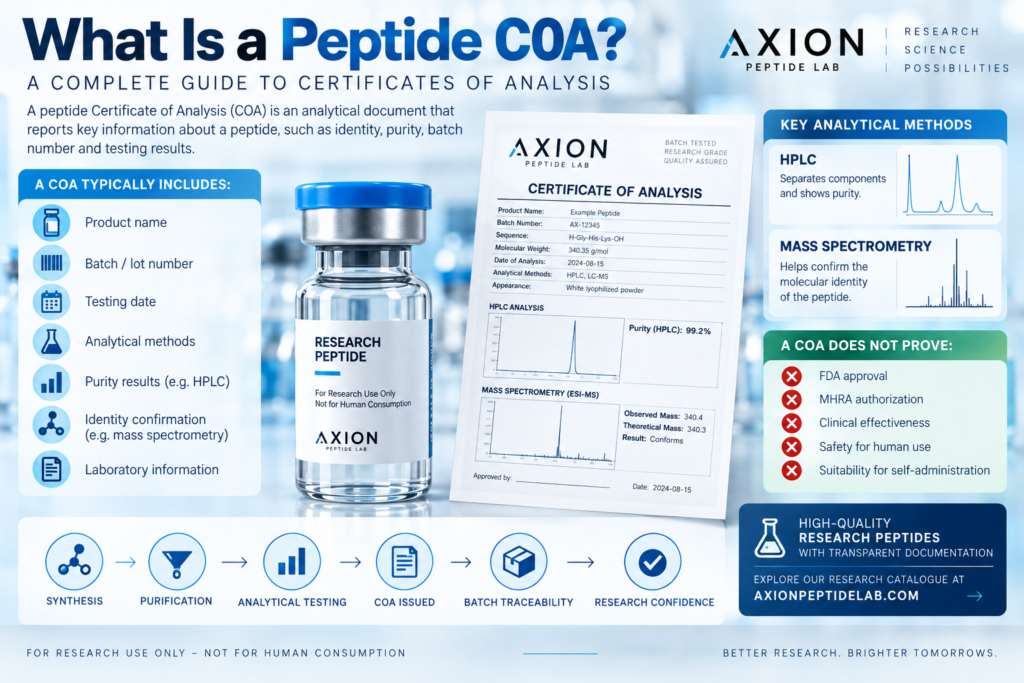
A peptide COA, or Certificate of Analysis, is a laboratory document that provides analytical information about a specific peptide sample or production batch. Researchers use this document to review whether the material has been tested for characteristics such as identity, purity, molecular weight and batch consistency.
The purpose of a peptide Certificate of Analysis is to provide a clear record of the testing associated with that particular batch. It can help laboratories confirm that the material they are working with corresponds to the expected compound and meets the analytical specifications reported by the manufacturer or testing laboratory.
A typical peptide COA may contain information such as:
- Product or compound name
- Peptide sequence, where applicable
- Batch or lot number
- Date of analysis
- Analytical testing method
- HPLC purity result
- Mass spectrometry or LC-MS data
- Expected and observed molecular weight
- Laboratory or testing information
- Reported specifications or acceptance criteria
One of the most commonly highlighted values on a peptide COA is the HPLC purity percentage. However, this number should not be viewed in isolation. A high chromatographic purity result does not automatically confirm every aspect of peptide quality, nor does it prove that the material is sterile, pharmaceutical-grade or suitable for human use.
Researchers should therefore evaluate a COA as part of a broader analytical picture rather than relying on a single percentage.
What Information Can Appear on a Peptide Certificate of Analysis?
The exact format of a COA can vary between laboratories and suppliers. Some reports provide only a summary of results, while others may include supporting analytical data such as chromatograms, mass spectra or additional testing documentation.
For research purposes, one of the most important elements is batch traceability. The batch or lot number shown on the COA should correspond with the batch identification on the research material whenever possible. This allows laboratories to connect the analytical results to the specific material used in an experiment.
Is a COA the Same as a Laboratory Test Report?
A Certificate of Analysis and a full laboratory test report are related, but they are not always the same thing.
A COA usually summarises key analytical results for a product or batch. A more detailed laboratory report may contain the underlying data generated during testing.
For example:
- An HPLC chromatogram shows the peaks produced during chromatographic separation.
- A mass spectrometry report provides information related to molecular mass and identity.
- An LC-MS report combines chromatographic separation with mass-based detection.
- A COA may summarise these findings in one document.
Understanding these differences helps researchers interpret peptide documentation more accurately and evaluate research materials with greater confidence.
For Research Use Only – Not for human consumption.
Why Are Peptide COAs Important in Research?
Peptide Certificates of Analysis are important because they help researchers understand what analytical testing has been performed on a specific peptide batch before it is used in laboratory work.
In research, consistency matters. If two experiments use materials that differ significantly in purity, identity or composition, the results may also differ. A peptide COA can therefore provide useful information that supports batch traceability, experimental reproducibility and quality assessment.
Rather than treating a peptide simply as a labelled vial or research material, researchers can use a COA to review whether the supplied compound matches the reported analytical characteristics.
Supporting Batch Traceability
One of the most valuable functions of a peptide COA is batch identification.
A research peptide may be produced in multiple batches over time. Each batch can have its own manufacturing and analytical history. A COA that includes a clear batch or lot number allows researchers to connect the analytical results with the specific material they receive.
This can be particularly important when:
- Comparing results between experiments
- Repeating a previous study
- Investigating unexpected experimental outcomes
- Recording laboratory materials in research documentation
- Evaluating consistency between different batches
Without batch-specific documentation, it may be more difficult to determine whether the analytical results shown on a COA actually relate to the material being used in the laboratory.
Helping Researchers Evaluate Reported Purity
Peptide COAs commonly include a reported HPLC purity percentage.
This value can help researchers understand the relative chromatographic purity of a sample. However, purity percentages should always be interpreted in context.
A reported HPLC result does not necessarily provide complete information about every possible characteristic of the sample. For example, HPLC purity alone does not automatically confirm:
- Molecular identity
- Absolute peptide content
- Sterility
- Endotoxin levels
- Residual solvents
- The absence of all possible contaminants
For this reason, researchers often look at multiple types of analytical information rather than relying on one number.
Confirming Peptide Identity
Another important role of analytical documentation is supporting the identification of the compound being studied.
Techniques such as mass spectrometry or LC-MS can provide information about molecular mass and help determine whether the material is consistent with the expected peptide.
This is different from chromatographic purity testing.
A sample can produce a strong main HPLC peak, but researchers may still need additional analytical information to confirm that the main component is actually the expected molecule.
This is why purity testing and identity testing should be viewed as complementary rather than interchangeable.
Supporting Experimental Reproducibility
Reproducibility is a central principle in scientific research.
If another laboratory attempts to repeat an experiment, differences in the materials used can influence the results. Documentation such as batch numbers, purity data and identity testing can make it easier to record exactly which material was used in a particular study.
This becomes especially relevant in areas such as metabolic peptide research, where researchers may study signalling pathways involving GLP-1, GIP, glucagon and other biological systems.
For scientists studying compounds commonly associated with peptides for weight loss research, analytical documentation can help distinguish the specific research material used in an experiment from licensed prescription products that may share a similar compound name.
A COA Is Only One Part of Research Quality
A Certificate of Analysis is useful, but it should not be treated as the only indicator of research quality.
Researchers may also consider:
- The analytical methods used
- Whether testing is batch-specific
- Whether supporting chromatograms or spectra are available
- How the sample was stored
- Whether the material is clearly labelled
- Whether the supplier provides transparent research documentation
The strongest quality assessment usually comes from considering all available analytical evidence together.
For laboratories sourcing research materials, reviewing the COA alongside other product documentation can support more informed experimental planning and better recordkeeping.
Researchers can explore the laboratory research catalogue available from Axion Peptide Lab for compounds intended strictly for controlled research applications.
For Research Use Only – Not for human consumption.
How to Read a Peptide COA Step by Step
Knowing how to read a peptide COA is important for researchers who want to evaluate the analytical documentation associated with a particular batch.
A Certificate of Analysis can contain several technical terms, test results and identification details. Rather than focusing only on the purity percentage, researchers should review the document as a whole and determine whether the information is complete, traceable and relevant to the material being studied.
The following elements are among the most important parts of a peptide COA.
1. Check the Product or Compound Name
The first step is to confirm that the product name shown on the COA matches the research material being evaluated.
For peptide compounds, the document may list:
- The peptide name
- Chemical name
- Peptide sequence
- Molecular formula
- Molecular weight
- Product code or sample identifier
This information helps researchers confirm that the analytical report is associated with the expected compound.
For example, if a laboratory is studying a specific metabolic peptide, the COA should clearly identify that compound rather than simply using a broad category such as “research peptide.”
Clear identification is particularly important when studying compounds associated with GLP-1, GIP or other metabolic pathways, because different peptides may act through different biological mechanisms.
2. Review the Batch or Lot Number
A batch number or lot number is one of the most important traceability elements on a peptide Certificate of Analysis.
Ideally, the batch number shown on the COA should correspond with the batch identification printed on the research material.
This allows the laboratory to connect the reported analytical results with the specific material being used in an experiment.
Batch-specific documentation can be valuable when researchers need to:
- Repeat an experiment
- Compare results across different batches
- Investigate unexpected laboratory findings
- Maintain detailed experimental records
- Review historical materials used in a study
A generic COA that does not identify a specific batch may provide less useful information than a report that can be directly connected to the material supplied.
3. Check the Date of Analysis
Researchers should also look for the testing date or date of analysis.
This indicates when the laboratory testing was performed and can provide useful context when reviewing research materials.
Depending on the document, the COA may show:
- Manufacturing date
- Testing date
- Release date
- Report date
These dates should not automatically be treated as interchangeable.
The testing date tells researchers when the analytical measurements were performed, while other dates may refer to manufacturing, documentation or quality-review processes.
4. Identify the Analytical Method Used
The next step is to determine how the peptide was tested.
Common analytical methods used in peptide research may include:
- HPLC
- LC-MS
- Mass spectrometry
- UPLC
- Amino-acid analysis
- Water-content testing
- Residual solvent testing
Not every COA will include every type of testing.
The analytical method matters because different tests provide different information.
For example, HPLC is commonly used to evaluate chromatographic purity, while mass spectrometry can provide information related to molecular mass and support compound identification.
A researcher should therefore avoid assuming that one analytical result answers every quality question.
5. Examine the HPLC Purity Result
One of the most visible values on many peptide COAs is the HPLC purity percentage.
A report may show a value such as:
Purity by HPLC: 98.7%
or
HPLC Purity: ≥98%
These two formats mean slightly different things.
The first presents a measured result, while the second may represent a specification or minimum acceptance criterion.
Researchers should look carefully to determine whether the number shown represents:
- The actual measured result
- The minimum specification
- A supplier claim
- A laboratory acceptance criterion
This distinction is important because an HPLC specification is not always the same thing as the actual analytical result for that specific batch.
6. Look at the HPLC Chromatogram
If a chromatogram is provided, researchers can review the visual output generated during the chromatographic analysis.
An HPLC chromatogram typically contains a series of peaks.
The largest peak may represent the main detected component, while smaller peaks may represent other detectable substances or related impurities.
Important elements can include:
- Main peak
- Secondary peaks
- Retention time
- Peak area
- Relative peak area
The calculated percentage associated with the main peak may contribute to the reported chromatographic purity value.
However, a large main peak alone does not independently prove the identity of the compound.
7. Review Molecular Weight and Mass Spectrometry Data
Many peptide COAs also include an expected molecular weight and an observed molecular weight.
Mass spectrometry can help researchers determine whether the analysed material has a molecular mass consistent with the expected peptide.
For example, a report may present:
- Expected molecular mass
- Observed molecular mass
- Mass spectrum
- Relevant ion peaks
The expected and observed values should generally be interpreted within the context of the analytical method used.
Mass spectrometry is especially useful because it provides information that complements chromatographic purity testing.
In simple terms:
HPLC helps evaluate separation and relative purity, while mass spectrometry helps support molecular identification.
8. Compare Specifications With Actual Results
Researchers should distinguish between a specification and an actual test result.
A specification is usually a predefined requirement or acceptance criterion.
For example:
Specification: HPLC purity ≥98%
The actual test result might be:
Result: 99.1%
A well-organised COA often shows both values so researchers can see whether the tested batch met the stated specification.
This distinction can apply to several parameters, including:
- Purity
- Appearance
- Molecular weight
- Water content
- Solubility
- Residual solvents
9. Check Whether the Results Are Batch-Specific
One of the most useful questions to ask when reviewing a peptide COA is:
Does this analytical report clearly correspond to the material being supplied?
Researchers can look for matching:
- Batch numbers
- Sample identifiers
- Test dates
- Product codes
- Compound names
The more clearly the report can be connected to the actual research material, the more useful it becomes for laboratory documentation and traceability.
10. Review the Testing Laboratory Information
A COA may also identify the laboratory that performed the analysis.
Depending on the testing arrangement, analytical work may be conducted by:
- The manufacturer
- An internal quality-control laboratory
- An independent third-party analytical laboratory
Researchers should review the information provided and understand who performed the test.
Third-party testing may provide an additional layer of independent analytical information, but researchers should still evaluate the methods, results and traceability of the report itself.
Do Not Evaluate a Peptide COA Using One Number Alone
One of the most common mistakes when reading a peptide Certificate of Analysis is focusing only on a statement such as “99% purity.”
A more complete assessment considers multiple pieces of information together, including:
- Compound identification
- Batch traceability
- HPLC data
- Mass spectrometry results
- Test dates
- Analytical methods
- Specifications
- Supporting laboratory documentation
This approach is particularly relevant in peptides for weight loss research, where compounds such as semaglutide, tirzepatide and investigational molecules such as retatrutide may be studied in different scientific contexts.
Analytical documentation can help researchers understand the material used in an experiment, but it does not make a research compound equivalent to a licensed prescription medicine.
A peptide COA should therefore be treated as a scientific quality document rather than as evidence that a material is approved or suitable for human use.
For Research Use Only – Not for human consumption.
What Does HPLC Mean on a Peptide COA?
HPLC, or High-Performance Liquid Chromatography, is one of the most commonly used analytical techniques for evaluating peptide samples. On a peptide Certificate of Analysis, HPLC data is often used to report chromatographic purity and to show how the components of a sample separated during testing.
When researchers see a statement such as “HPLC Purity: 99.0%”, it usually refers to the proportion of the detected chromatographic signal associated with the main peak under the specific conditions of that analysis.
However, this number needs to be interpreted carefully. HPLC purity does not automatically provide a complete picture of peptide identity, concentration, sterility or overall suitability for a particular research application.
What Is High-Performance Liquid Chromatography?
High-Performance Liquid Chromatography is an analytical method used to separate components within a sample.
In simplified terms, a peptide sample is dissolved in an appropriate solvent and introduced into an HPLC system. The sample travels through a specialised column containing a stationary material. Different components of the sample interact with the column and mobile phase in different ways, causing them to move through the system at different rates.
As the separated components leave the column, a detector records the resulting signal.
The output is displayed as a chromatogram containing a series of peaks.
Each peak represents a detected component or signal produced during the analysis under the chosen testing conditions.
For peptide research, HPLC can therefore help laboratories evaluate whether a sample consists predominantly of one chromatographic component or contains additional detectable components.
How to Read a Peptide HPLC Chromatogram
A typical peptide HPLC chromatogram contains several important elements.
Main Peak
The largest peak is often associated with the primary component detected in the sample.
If the peptide sample has high chromatographic purity, the chromatogram may show one dominant peak with much smaller secondary peaks.
However, the size of the main peak alone should not be treated as definitive proof of molecular identity.
Secondary Peaks
Smaller peaks can represent other detectable components within the sample.
Depending on the peptide and analytical conditions, these could potentially include:
- Related peptide species
- Degradation products
- Synthesis-related impurities
- Modified forms of the molecule
- Other substances detectable by the analytical method
The presence of secondary peaks does not necessarily reveal their exact identity. Additional analytical techniques may be required to determine what those components are.
Retention Time
Retention time refers to the amount of time a component takes to travel through the chromatographic system and reach the detector.
Researchers may compare retention times with reference materials or validated analytical methods as part of compound assessment.
However, retention time alone should not generally be treated as sufficient evidence of molecular identity.
Two different substances may sometimes produce similar retention behaviour under certain analytical conditions, which is one reason additional techniques such as mass spectrometry can be valuable.
Peak Area
The peak area represents the integrated detector response associated with a chromatographic peak.
Laboratories may compare the area of the main peak with the combined area of other detected peaks to calculate a relative purity percentage.
This is often the basis for the HPLC purity value displayed on a peptide COA.
What Does 99% HPLC Purity Mean?
A peptide COA may report values such as:
HPLC Purity: 99.2%
This generally means that the primary chromatographic peak accounted for approximately 99.2% of the integrated signal used in the purity calculation under the stated analytical conditions.
It does not necessarily mean that 99.2% of the entire vial is pure peptide by absolute weight.
This distinction is extremely important.
HPLC purity is usually a relative chromatographic measurement, not necessarily a direct measurement of total peptide content in the sample.
A sample could contain substances that are not detected effectively under the specific chromatographic conditions used.
For this reason, researchers should avoid interpreting an HPLC purity percentage as a universal measurement of every component present in the material.
Does 99% HPLC Purity Mean a Peptide Is 99% Pure in Every Sense?
No.
A high HPLC purity percentage can be useful analytical information, but it does not automatically confirm every quality characteristic researchers may need to consider.
HPLC purity alone does not necessarily establish:
- Exact molecular identity
- Absolute peptide content
- Sterility
- Endotoxin status
- Residual solvent levels
- Water content
- Counter-ion content
- Absence of every possible contaminant
- Pharmaceutical-grade status
- Suitability for human administration
This is why researchers often use multiple analytical methods when evaluating a peptide sample.
For example, HPLC may be combined with mass spectrometry or LC-MS to provide additional information about molecular identity.
HPLC Purity vs Peptide Content
Another important distinction is the difference between purity and content.
A peptide may show high chromatographic purity while still containing water, salts, counter-ions or other non-peptide material.
For example, a vial labelled with a specific peptide amount should not be assumed to contain exactly that amount solely because the COA reports a high HPLC percentage.
Determining absolute peptide content may require additional quantitative testing.
This distinction is especially important in scientific experiments where accurate material characterisation can influence reproducibility and interpretation of results.
Why HPLC Matters in Peptide Research
HPLC remains useful because it provides researchers with a relatively detailed view of the chromatographic composition of a peptide sample.
When combined with other analytical information, HPLC can support:
- Purity assessment
- Batch comparison
- Monitoring of degradation
- Detection of related impurities
- Quality-control documentation
- Experimental recordkeeping
For laboratories studying peptides for weight loss research, including compounds associated with GLP-1, GIP and glucagon pathways, understanding HPLC data can help ensure that the analytical characteristics of the research material are properly documented.
This is particularly relevant when studying compounds such as semaglutide, tirzepatide or investigational compounds such as retatrutide, because research materials should not be assumed to be identical to licensed prescription medicines simply because they share a compound name.
HPLC Should Be Viewed as Part of a Larger Analytical Picture
The most reliable interpretation of a peptide COA comes from considering several analytical results together.
A strong research documentation package may include:
- HPLC chromatograms
- Reported chromatographic purity
- Mass spectrometry data
- Molecular weight information
- Batch identification
- Analytical dates
- Clearly stated specifications
HPLC can provide valuable information about the relative chromatographic purity of a peptide sample, but it should not be treated as a complete guarantee of identity, safety, sterility or pharmaceutical quality.
Understanding this distinction allows researchers to evaluate peptide Certificates of Analysis more accurately and make better-informed decisions about materials used in controlled laboratory research.
For Research Use Only – Not for human consumption.
HPLC Purity vs Peptide Identity: What Is the Difference?
When reading a peptide Certificate of Analysis, two terms often appear together: purity and identity. Although they are related, they describe different analytical questions and should not be treated as interchangeable.
A peptide can show a high HPLC purity result without that result, by itself, proving that the main component is the exact peptide expected. This is why laboratories may use more than one analytical technique when characterising peptide materials.
In simple terms:
- Purity testing asks how much of the detected chromatographic signal is associated with the main component.
- Identity testing asks whether the material is consistent with the specific peptide it is supposed to be.
Understanding this distinction is essential when evaluating research peptide quality.
What Is Peptide Purity Testing?
Peptide purity testing is commonly performed using analytical techniques such as High-Performance Liquid Chromatography, or HPLC.
During HPLC analysis, the components in a sample are separated under defined analytical conditions. The detector records the separated components as peaks on a chromatogram.
If one peak accounts for the majority of the detected signal, the sample may be reported as having a high chromatographic purity.
For example, a COA might state:
HPLC Purity: 99.1%
This means that the main chromatographic peak represented approximately 99.1% of the integrated signal included in that particular purity calculation.
However, this result should be interpreted as a measurement produced under the conditions of that analytical method.
It does not necessarily mean that 99.1% of everything physically present in the sample is the desired peptide.
What Is Peptide Identity Testing?
Peptide identity testing focuses on determining whether the analysed material is consistent with the expected molecule.
A laboratory may use techniques such as:
- Mass spectrometry
- LC-MS
- High-resolution mass spectrometry
- Comparison with an analytical reference standard
- Sequence-related analytical techniques in more specialised settings
Mass spectrometry is particularly useful because peptides have characteristic molecular masses.
If the measured molecular mass is consistent with the expected value for the peptide, that information can support identification of the compound.
This does not mean that molecular weight alone answers every possible identity question, but it provides information that HPLC purity alone cannot.
Why a High-Purity HPLC Peak Does Not Automatically Confirm Identity
One of the most important concepts in peptide analysis is that a pure-looking chromatogram and a confirmed molecular identity are not the same thing.
Imagine a sample produces one dominant HPLC peak representing 99% of the detected chromatographic signal.
That tells the researcher that one major component dominates the chromatogram.
It does not necessarily prove that the component is the intended peptide.
Additional analytical evidence may therefore be needed to support identity.
This is particularly important when laboratories are comparing research materials that may have similar physical appearances but different molecular structures.
For example, two peptide compounds could both appear as lyophilised materials and produce relatively clean chromatograms, yet represent entirely different molecular sequences.
Why HPLC and Mass Spectrometry Are Often Used Together
HPLC and mass spectrometry can complement each other because they provide different types of analytical information.
HPLC can help researchers assess:
- Chromatographic purity
- Number and size of detectable secondary peaks
- Retention behaviour
- Batch-to-batch consistency
Mass spectrometry can help assess:
- Molecular mass
- Whether the observed mass matches the expected peptide
- Molecular identity
- Certain structural or degradation-related characteristics, depending on the analytical method
When these techniques are used together, they can provide a more complete analytical picture than either method alone.
For example, a sample may show:
HPLC Purity: 99.3%
and
Observed molecular mass: consistent with expected molecular mass
Taken together, these results provide stronger analytical information than the purity percentage alone.
What Is Orthogonal Testing?
Researchers may sometimes encounter the term orthogonal testing.
Orthogonal testing refers to using different analytical methods that evaluate a material through different scientific principles.
Instead of relying on one measurement, researchers compare results from complementary methods.
For peptide analysis, an example might include:
- HPLC for chromatographic purity
- Mass spectrometry for molecular mass
- Additional quantitative testing for peptide content
Each technique answers a different analytical question.
When the results agree, researchers have a stronger basis for characterising the material.
Purity Is Not the Same as Potency or Absolute Peptide Content
Another common misunderstanding is assuming that peptide purity, potency and content all mean the same thing.
They do not.
Chromatographic purity describes the relative composition detected using a chromatographic method.
Peptide content refers to how much actual peptide material is present in the sample.
Potency, where relevant in a validated pharmaceutical or biological context, refers to the measured ability of a material to produce a defined biological or functional response.
A peptide could theoretically display high HPLC purity while its total peptide content is influenced by other components such as:
- Water
- Counter-ions
- Salts
- Residual solvents
- Other non-peptide material
This is another reason why researchers should avoid interpreting a single HPLC percentage as a complete statement about the entire sample.
Purity Does Not Confirm Sterility
A peptide COA reporting high purity also does not automatically establish sterility.
Analytical purity testing and microbiological testing answer very different questions.
HPLC is not designed to determine whether a material is free from viable microorganisms.
Similarly, a standard purity result does not necessarily provide information regarding:
- Bacterial contamination
- Fungal contamination
- Endotoxin levels
- Bioburden
If those characteristics are relevant to a specific laboratory protocol, they would require appropriate dedicated testing.
This distinction is especially important because terminology such as “high purity” should not be interpreted as evidence that a research material meets pharmaceutical sterility standards.
Why Identity and Purity Matter in Metabolic Peptide Research
Accurate material characterisation can be particularly important in studies involving peptides for weight loss research and metabolic signalling pathways.
Researchers investigating compounds associated with:
- GLP-1
- GIP
- Glucagon
- Appetite signalling
- Glucose metabolism
- Energy regulation
need to know which compound is actually being studied and what analytical characteristics are associated with the batch.
This may apply to laboratory research involving compounds such as semaglutide, tirzepatide or investigational peptides such as retatrutide.
However, analytical confirmation of a research compound does not mean that the material becomes equivalent to an approved prescription medicine containing a similarly named active ingredient.
Licensed medicines and research-use materials remain distinct categories.
How Researchers Should Interpret Purity and Identity Together
When reviewing a peptide COA, researchers should ideally ask several questions:
- Does the HPLC result show a dominant main component?
- Are secondary peaks visible?
- Is the reported purity linked to a specific batch?
- Is molecular identity supported by mass spectrometry or another suitable method?
- Does the observed molecular mass correspond with the expected value?
- Are the analytical methods clearly stated?
- Can the results be traced to the research material supplied?
A strong analytical assessment comes from examining these results together rather than focusing on one number.
Ultimately, HPLC purity tells researchers about chromatographic composition, while identity testing helps establish what the material actually is.
Understanding this distinction is fundamental when evaluating peptide Certificates of Analysis and assessing the quality of materials intended for legitimate laboratory research.
For Research Use Only – Not for human consumption.
Mass Spectrometry and Molecular Weight on a Peptide COA
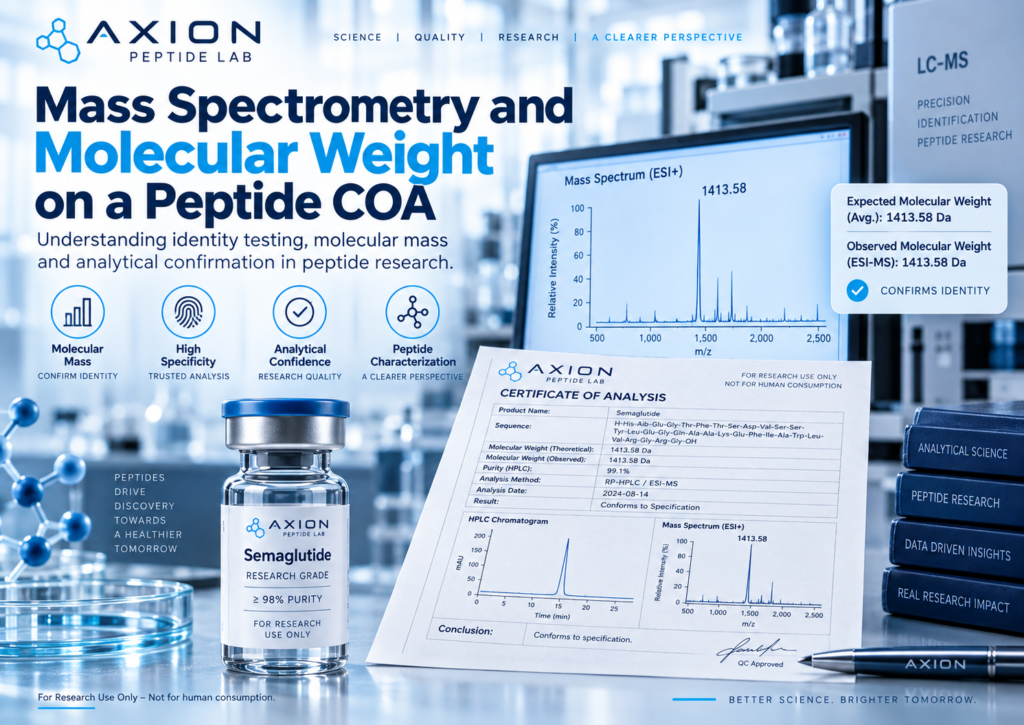
Mass spectrometry is another important analytical technique that may appear on a peptide Certificate of Analysis. While HPLC is commonly used to evaluate chromatographic purity, mass spectrometry helps researchers assess whether the molecular mass of a sample is consistent with the expected peptide.
This distinction is important because purity and identity are not the same thing. A sample may produce a clean chromatogram, but researchers may still need additional evidence to support that the main component is the intended molecule.
What Is Molecular Weight in Peptide Analysis?
Every peptide has an expected molecular mass based on its amino-acid composition and chemical structure.
A COA may therefore include two values:
- Expected molecular weight
- Observed molecular weight
The expected value is calculated from the known structure of the peptide, while the observed value comes from the analytical measurement.
If the observed result is consistent with the expected molecular mass within the limits of the analytical method, that finding can support the identity of the research material.
How Does Mass Spectrometry Work?
Mass spectrometry measures ions according to their mass-to-charge ratio.
In simplified terms, the sample is introduced into the instrument, converted into charged particles, and then analysed according to how those ions behave inside the mass spectrometer.
The instrument produces a mass spectrum, which may contain one or more peaks corresponding to different ion forms of the molecule.
Because peptides can carry multiple charges during analysis, the spectrum may appear more complex than a single peak at the exact molecular weight. Analytical software can be used to interpret these signals and estimate the molecular mass of the peptide.
What Does a Mass Spectrum Show?
A peptide mass spectrum can provide researchers with information related to:
- Molecular mass
- Expected versus observed mass
- Charge states
- Major detected molecular species
- Certain degradation or modification patterns, depending on the method
A COA may present the result in a simplified format, such as:
Expected molecular weight: 3,500 Da
Observed molecular weight: 3,501 Da
The exact interpretation depends on the peptide, ionisation method, instrument accuracy and analytical conditions.
For this reason, observed values should be assessed in context rather than compared using an arbitrary rule.
Why Molecular Weight Helps Support Peptide Identity
A molecular-weight result can provide stronger evidence of identity than HPLC purity alone.
If a sample shows:
- A dominant HPLC peak
- High reported chromatographic purity
- An observed molecular mass consistent with the expected peptide
the combined information gives researchers a more complete analytical picture.
However, molecular weight should still not be treated as absolute proof of every structural characteristic.
Different molecules can sometimes have similar or identical nominal masses, and some peptides may contain modifications that require more detailed analysis.
What Is LC-MS?
Researchers may also see the term LC-MS on a peptide COA or laboratory report.
LC-MS combines:
Liquid chromatography, which separates sample components,
with
Mass spectrometry, which measures the mass-related properties of those components.
This combination can be especially useful because researchers can examine both the chromatographic behaviour and molecular-mass information in one analytical workflow.
LC-MS may help laboratories evaluate:
- Whether the main chromatographic peak corresponds with the expected molecular mass
- Whether additional peaks have different masses
- Potential degradation products
- Related molecular species
The specific conclusions that can be drawn depend on the method and the quality of the analytical data.
Mass Spectrometry Does Not Measure Every Aspect of Quality
Like HPLC, mass spectrometry has limitations.
A molecular-weight result does not automatically establish:
- Sterility
- Endotoxin status
- Absolute peptide content
- Biological activity
- Pharmaceutical quality
- Clinical safety
- Suitability for human administration
It answers a specific analytical question related mainly to molecular mass and identification.
Researchers should therefore avoid treating any single test as a complete measure of peptide quality.
Expected Mass vs Observed Mass
The expected and observed masses on a COA may not always appear as perfectly identical numbers.
Small differences can arise because of factors such as:
- Instrument resolution
- Ionisation conditions
- Salt or counter-ion forms
- Adduct formation
- Charge states
- Analytical calculation methods
The appropriate acceptance range depends on the method being used and should be interpreted according to validated laboratory procedures.
A slight numerical difference is not automatically evidence that a peptide has failed identity testing.
Why Mass Spectrometry Matters in Peptides for Weight Loss Research
Accurate molecular identification is particularly important in laboratory research involving metabolic peptides and compounds frequently discussed in peptides for weight loss research.
Researchers studying molecules associated with pathways such as:
- GLP-1
- GIP
- Glucagon
- Appetite signalling
- Glucose regulation
- Energy balance
need confidence that the material being analysed is consistent with the intended research compound.
This can apply to laboratory research involving semaglutide, tirzepatide and investigational molecules such as retatrutide.
However, confirming the identity of a research peptide through mass spectrometry does not make that research material equivalent to a licensed prescription medicine.
Why HPLC and Mass Spectrometry Work Better Together
HPLC and mass spectrometry answer different but complementary questions.
HPLC asks:
How does the sample separate, and what proportion of the detected chromatographic signal belongs to the main component?
Mass spectrometry asks:
Is the molecular mass of the detected material consistent with the expected compound?
Using both techniques can therefore provide a stronger analytical assessment than relying on either one alone.
When reviewing a peptide COA, researchers should look for clear reporting of:
- Expected molecular weight
- Observed molecular weight
- Analytical method
- Batch number
- HPLC purity
- Supporting mass-spectrum data where available
Together, these details can improve confidence in batch characterisation and help support reproducible laboratory research.
For Research Use Only – Not for human consumption.
What Makes a High-Quality Peptide COA?
A high-quality peptide Certificate of Analysis should do more than display a purity percentage. It should provide researchers with enough analytical and traceability information to understand what was tested, how it was tested, which batch the results relate to and what the reported results actually mean.
When evaluating research peptide documentation, researchers should look at the COA as a complete analytical record rather than focusing on one headline number such as “99% purity.”
A strong COA usually combines clear sample identification, batch-specific information, suitable analytical methods and transparent reporting of results.
Batch-Specific Documentation
One of the most important characteristics of a useful peptide COA is batch specificity.
The document should ideally include a batch or lot number that corresponds with the research material supplied.
This helps establish traceability between:
- The peptide sample
- The analytical testing
- The laboratory report
- The material used in an experiment
Batch-specific documentation is particularly valuable when laboratories need to repeat experiments, compare different lots or investigate unexpected results.
A generic COA that cannot be clearly connected to a specific batch offers less traceability than documentation linked directly to the research material.
Clear Product Identification
A good peptide COA should clearly identify the compound being analysed.
Depending on the material, this may include:
- Peptide name
- Product code
- Peptide sequence
- Molecular formula
- Expected molecular weight
- Sample identification number
Clear product identification reduces ambiguity and makes it easier for researchers to determine whether the document relates to the material they intend to study.
Clearly Stated Analytical Methods
A high-quality COA should indicate which analytical methods were used.
For peptide research, these may include:
- HPLC
- UPLC
- LC-MS
- Mass spectrometry
- Water-content analysis
- Residual solvent testing
- Amino-acid analysis
- Other appropriate analytical procedures
Simply presenting a percentage without explaining how it was measured provides less useful information.
Researchers should be able to distinguish between values generated by chromatographic testing, identity testing and other analytical procedures.
HPLC Purity With Supporting Data
If a COA reports peptide purity by HPLC, the result should ideally be clearly linked to the analytical method used.
For example:
HPLC Purity: 99.1%
is more useful when the report also identifies the test method and, where available, includes the corresponding chromatogram.
The chromatogram allows researchers to examine:
- The dominant peak
- Secondary peaks
- Retention times
- Relative peak areas
This provides greater context than a purity percentage presented on its own.
Molecular Identity Information
A high-quality peptide COA should also provide appropriate information supporting the identity of the compound.
Mass spectrometry or LC-MS may be used to compare the observed molecular mass with the expected mass of the peptide.
The documentation may include:
- Expected molecular weight
- Observed molecular weight
- Mass-spectrum data
- Analytical interpretation
Purity and identity should be evaluated as separate analytical characteristics.
A high HPLC purity result alone does not automatically confirm that the main peak corresponds to the intended peptide.
Specifications and Actual Test Results
Another useful feature is a clear distinction between specifications and actual results.
A specification represents an acceptance criterion.
For example:
Specification: HPLC purity ≥98%
The measured batch result may then be listed separately:
Result: 99.2%
This format makes it easier for researchers to determine whether the tested batch met the stated analytical requirement.
Similar reporting may be used for:
- Appearance
- Molecular mass
- Purity
- Water content
- Residual solvents
- Other analytical parameters
Date of Analysis
The COA should also include relevant dates.
Depending on the report, this may include:
- Date of manufacture
- Date of sampling
- Date of analysis
- Date of report approval
The date of analysis is especially useful because it tells researchers when the testing was performed.
A report with no test date provides less context for understanding the analytical history of the batch.
Supporting Chromatograms and Spectra
Where appropriate, researchers may benefit from access to the underlying analytical data.
This may include:
- HPLC chromatograms
- UPLC chromatograms
- Mass spectra
- LC-MS results
Supporting data can help researchers understand how the reported conclusion was reached rather than relying exclusively on a summary statement.
However, raw analytical information should still be interpreted according to the relevant method and laboratory procedures.
Laboratory Identification
A peptide COA should ideally identify who performed the testing.
Analysis may be performed by:
- The manufacturer
- An internal quality-control laboratory
- An external analytical laboratory
- An independent third-party laboratory
Third-party testing can provide additional independent information, but it should not automatically be assumed to be superior simply because another laboratory performed the analysis.
Researchers should still evaluate:
- Analytical methods
- Batch linkage
- Report completeness
- Laboratory identification
- Supporting data
The quality of the analytical evidence remains more important than a marketing claim about testing.
Consistency Across the Entire Document
A strong COA should be internally consistent.
Researchers should check whether:
- The product name is consistent throughout the report
- The batch number matches the supplied material
- Molecular-weight information is plausible for the stated compound
- Test methods correspond with the reported results
- Dates and sample identifiers are clearly presented
Inconsistencies do not automatically prove that a report is invalid, but they can justify further investigation.
Why Traceability Matters in Research
Traceability is especially important in scientific research because experiments should be capable of being documented and, where possible, reproduced.
A researcher should ideally be able to record:
- Which peptide was used
- Which batch was used
- Which analytical data was associated with the batch
- When the testing was performed
- Which methods were used
This documentation may help explain differences between experimental results when multiple batches are studied over time.
High Purity Alone Does Not Equal High Overall Quality
A common mistake is assuming that the highest purity percentage automatically represents the highest-quality research material.
Quality assessment is more complex.
A strong peptide documentation package may include:
- High chromatographic purity
- Identity confirmation
- Batch traceability
- Clearly stated methods
- Relevant analytical dates
- Supporting chromatograms or spectra
- Consistent sample identification
Researchers should therefore consider the complete analytical record rather than selecting materials based solely on a headline purity percentage.
Evaluating COAs in Metabolic Peptide Research
These principles are particularly relevant for laboratories studying metabolic pathways and compounds commonly associated with peptides for weight loss research.
Research involving compounds such as semaglutide, tirzepatide or investigational molecules such as retatrutide may depend on accurate identification and consistent characterisation of experimental materials.
A properly documented COA can help researchers understand the analytical characteristics of the material being used.
However, even a detailed COA does not turn a laboratory research product into a licensed medicine or establish that it is safe or effective for human use.
Researchers assessing materials from suppliers such as Axion Peptide Lab should therefore review available analytical documentation alongside product identification, batch information and research-use labelling.
For Research Use Only – Not for human consumption.
Red Flags to Look for When Evaluating a Peptide COA
A peptide Certificate of Analysis can provide useful analytical information, but not every COA offers the same level of transparency, traceability or detail.
Researchers should avoid judging a document by appearance alone. A professionally designed certificate can still be incomplete, while a simple laboratory report may contain meaningful analytical information.
The goal is not to assume that a document is invalid because of one unusual detail. Instead, researchers should look for signs that may justify closer review or additional verification.
No Batch or Lot Number
One of the most important warning signs is the absence of a clear batch or lot number.
A peptide COA should ideally be connected to a specific batch of material. Without a batch identifier, it may be difficult to determine whether the reported analytical results actually relate to the research material supplied.
Researchers should compare the batch information on:
- The COA
- The vial or product label
- Packaging documentation
- Laboratory records
If the identifiers do not match, further clarification may be appropriate.
The COA Batch Number Does Not Match the Product
A COA may contain a batch number, but that number should correspond with the material being evaluated.
If the research peptide is labelled with one lot number while the COA shows another, the document may refer to a different production batch.
This does not automatically mean that the material is poor quality, but it weakens the traceability between the analytical test and the supplied sample.
For research documentation, batch-specific results are generally more useful than generic certificates.
No Date of Analysis
Researchers should also look for a clear testing date or date of analysis.
A report that contains no indication of when the sample was tested provides less information about the analytical history of the material.
Dates may include:
- Manufacturing date
- Sampling date
- Testing date
- Report date
Ideally, the document should make these distinctions clear.
A testing date is particularly important because it identifies when the reported measurements were actually generated.
No Analytical Method Is Listed
A purity percentage without a stated testing method should be interpreted cautiously.
For example, a report may state:
Purity: 99.5%
but fail to explain whether that value came from:
- HPLC
- UPLC
- LC-MS
- Another analytical method
Without knowing the test method, the result is harder to interpret scientifically.
A stronger COA should make it clear how the reported result was obtained.
Purity Claims Without Supporting Context
Statements such as “99% pure” can sound impressive, but researchers should ask what the number actually represents.
Important questions include:
- Was the purity measured by HPLC?
- Is the number an actual batch result or only a specification?
- Is there a chromatogram?
- What detector and method were used?
- Does the report distinguish purity from peptide content?
A headline purity claim with no supporting analytical context provides less useful information than a clearly documented result.
Missing HPLC Chromatogram
Not every COA must include a chromatogram on the main page, but if HPLC purity is heavily emphasised, access to supporting chromatographic data may help researchers evaluate the result.
A chromatogram can provide information about:
- The main peak
- Secondary peaks
- Retention time
- Relative peak areas
If a supplier or testing laboratory claims specific chromatographic results but cannot provide any associated analytical evidence when appropriate, researchers may want to investigate further.
No Identity Testing Where Identity Is Claimed
Another potential concern is a document that strongly claims molecular identity while providing only a purity result.
As discussed earlier, HPLC purity and molecular identity are different analytical concepts.
A high HPLC purity result does not, by itself, prove the exact identity of a peptide.
If identity confirmation is claimed, researchers should look for evidence from an appropriate method such as:
- Mass spectrometry
- LC-MS
- Comparison with a suitable reference method
- Other validated identification procedures
The exact technique will depend on the compound and laboratory protocol.
Expected and Observed Molecular Mass Are Missing
When mass spectrometry is performed, a useful report will often show the expected and observed molecular mass.
If a document states that mass spectrometry confirmed the peptide but provides no molecular information or supporting spectrum, the claim may be difficult to evaluate independently.
Researchers should not assume that every simplified COA must contain all raw data, but important analytical conclusions should be supported by meaningful documentation.
Cropped or Incomplete Analytical Data
Another issue to watch for is heavily cropped or incomplete documentation.
Examples can include:
- Missing chromatogram axes
- Removed sample identifiers
- Missing page numbers
- Partial laboratory details
- Cut-off test dates
- Missing method information
- Spectra without sample references
Incomplete data does not automatically mean that a result is unreliable, but it can reduce transparency and make independent interpretation more difficult.
Generic COAs Used for Multiple Products
Researchers should be cautious when the same analytical certificate appears to be used across multiple different products or batches without clear sample-specific information.
A meaningful peptide COA should normally identify the specific material that was analysed.
Generic documentation may describe standard product specifications, but it should not necessarily be treated as proof that every individual batch produced exactly the same analytical result.
Confusing Specification With Actual Result
A common source of misunderstanding is the difference between a specification and an actual laboratory result.
For example:
Specification: ≥98%
does not necessarily mean that the batch measured exactly 98% or above unless an actual result is also reported.
A complete analytical table may instead show:
Specification: ≥98%
Result: 99.1%
Researchers should check that the document distinguishes these clearly.
Missing Laboratory Identification
A COA is more transparent when researchers can determine who performed the testing.
The report may identify:
- The manufacturer
- Internal quality-control laboratory
- Contract analytical laboratory
- Independent third-party laboratory
If no laboratory information is available at all, researchers may have fewer options for understanding how and where the testing was performed.
That said, the presence of a laboratory name alone does not guarantee quality. The analytical methods and traceability still matter.
Unexplained Changes Between COAs
If researchers receive several batches of the same peptide, they may notice differences between certificates.
Some variation can be normal, but unexplained major changes may deserve closer review.
For example:
- Different testing methods without explanation
- Identical chromatograms for supposedly different batches
- Repeated identical measured results across many batches
- Major changes in molecular weight reporting
- Missing analytical information that was previously included
These observations do not automatically prove that something is wrong, but they may justify requesting clarification.
Claims That Go Beyond What a COA Can Prove
A significant red flag is when a COA is used to make claims that exceed what the analytical testing demonstrates.
For example, a peptide COA should not automatically be presented as proof that the material is:
- Clinically effective
- Medically approved
- Safe for self-administration
- Sterile
- Pharmaceutical grade
- Equivalent to a licensed medicine
unless those specific characteristics have been established through appropriate regulatory and analytical pathways.
A Certificate of Analysis is primarily an analytical quality document. It is not a substitute for regulatory approval or clinical evidence.
Be Careful With COAs for Peptides Discussed in Weight-Loss Research
This distinction is especially important when evaluating compounds associated with peptides for weight loss research.
Names such as semaglutide, tirzepatide and retatrutide can appear in both scientific literature and commercial research catalogues, but their regulatory status and intended use may differ substantially.
A COA attached to a laboratory research material should not be interpreted as evidence that the product is equivalent to a licensed prescription medicine.
This is particularly important for investigational compounds such as retatrutide, which should not be described as an approved medicine simply because analytical testing confirms the identity of research material.
Questions Researchers Can Ask Before Relying on a COA
When reviewing peptide analytical documentation, useful questions include:
- Does the batch number match the supplied material?
- Is there a clear date of analysis?
- Are the analytical methods stated?
- Is purity reported as an actual test result?
- Is molecular identity supported by an appropriate technique?
- Are chromatograms or spectra available where relevant?
- Can the testing laboratory be identified?
- Does the report make claims beyond what the analytical methods can establish?
No single missing item necessarily proves that a COA is unreliable. However, the more complete, consistent and traceable the documentation is, the easier it becomes for researchers to evaluate the material responsibly.
For laboratory research, COAs should therefore be treated as part of a broader quality-assessment process rather than as a marketing badge.
For Research Use Only – Not for human consumption.
What Are Peptides?
Peptides are short chains of amino acids, the same basic building blocks that form proteins. They occur naturally throughout the body and can act as signalling molecules involved in many biological processes, including metabolism, hormone regulation, immune activity, tissue repair and communication between cells.
From a chemical perspective, amino acids are linked together by peptide bonds. The number, sequence and arrangement of those amino acids help determine the structure and biological properties of a particular peptide.
Peptides can vary substantially in size and function. Some contain only a few amino acids, while others consist of much longer chains. Once amino-acid chains become sufficiently large and structurally complex, they are generally classified as proteins rather than peptides.
How Do Peptides Work?
Many peptides function by interacting with specific receptors located on the surface of cells or within biological systems.
A peptide may bind to a receptor in a way that triggers a signalling pathway inside the cell. This can influence processes such as:
- Hormone release
- Glucose regulation
- Appetite signalling
- Digestive activity
- Immune responses
- Cellular growth
- Tissue signalling
- Energy balance
Different peptides interact with different receptors, so the biological activity of one peptide should never be automatically applied to another.
The sequence and three-dimensional structure of a peptide are important because small structural differences can significantly alter how the molecule interacts with receptors.
Naturally Occurring Peptides
The human body naturally produces many peptide hormones and signalling molecules.
Examples include peptides involved in:
- Metabolic regulation
- Digestion
- Blood-glucose control
- Appetite and satiety
- Cardiovascular function
- Endocrine signalling
One particularly important area of metabolic research involves gastrointestinal peptide hormones that communicate information between the digestive system, pancreas and brain.
Examples include GLP-1 and GIP, which have become major subjects of metabolic and weight-regulation research.
Synthetic and Laboratory-Produced Peptides
Peptides can also be produced synthetically for laboratory and scientific research.
Researchers may create peptide compounds to investigate:
- Receptor activity
- Biological signalling
- Structure-function relationships
- Metabolic pathways
- Pharmacology
- Potential therapeutic targets
Synthetic research peptides can be manufactured using processes such as solid-phase peptide synthesis and then purified and characterised using analytical methods.
This is where documentation such as peptide Certificates of Analysis, HPLC chromatograms and mass spectrometry reports becomes important.
Researchers need analytical information to determine whether the material being studied is consistent with the expected peptide.
Peptides Are Not All the Same
The term peptide describes a very broad class of molecules.
It does not mean that every peptide has the same biological effect, safety profile or research purpose.
Different peptide compounds may interact with completely different receptors and biological systems.
For example, one peptide may primarily influence:
- Metabolic signalling
while another may be investigated for:
- Cellular repair
- Immune activity
- Hormonal signalling
- Neurological pathways
For this reason, statements about “peptides” in general should be interpreted carefully.
Scientific evidence should be evaluated for each individual compound.
Why Are Peptides Studied in Metabolic Research?
Peptides are especially important in metabolic research because several naturally occurring peptide hormones participate in the regulation of food intake, glucose metabolism and energy balance.
Researchers have studied pathways involving:
- GLP-1
- GIP
- Glucagon
- Insulin
- Amylin
- Other gut-derived signalling molecules
These pathways have contributed to the development of several important areas of metabolic research.
Some compounds originally developed from or inspired by these biological pathways have also become licensed prescription medicines after undergoing clinical development and regulatory review.
Other compounds remain investigational.
What Does “Peptides for Weight Loss” Mean?
The phrase “peptides for weight loss” is commonly used online, but scientifically it can refer to several very different categories.
These may include:
- Naturally occurring peptide hormones involved in metabolism
- Licensed prescription medicines that act on peptide-related receptors
- Investigational compounds undergoing clinical trials
- Laboratory research peptides used for experimental purposes
These categories should not be treated as interchangeable.
For example, semaglutide and tirzepatide have licensed medical uses in certain jurisdictions and indications, while other metabolic compounds may still be under investigation.
Research-use materials sold for laboratory study are also fundamentally different from licensed prescription medicines.
Peptides and GLP-1 Research
GLP-1, or glucagon-like peptide-1, is a naturally occurring peptide hormone released primarily from the gastrointestinal system after food intake.
Researchers have studied GLP-1 because of its involvement in:
- Insulin secretion
- Glucagon regulation
- Gastric emptying
- Appetite signalling
- Satiety
This biological pathway contributed to the development of GLP-1 receptor agonists.
Further research expanded into compounds targeting multiple metabolic receptors, including GLP-1 and GIP together.
Peptide Research and Laboratory Quality
As interest in peptide science has expanded, analytical quality has become increasingly important.
Researchers studying any peptide compound should understand:
- Which molecule they are working with
- Whether identity has been analytically supported
- The reported chromatographic purity
- Which batch was tested
- What analytical methods were used
This brings peptide science directly back to the importance of the peptide COA.
A Certificate of Analysis can provide researchers with analytical information about a particular research batch, including HPLC purity and molecular identification data where appropriate.
However, a COA does not determine whether a compound is medically approved, clinically effective or suitable for human use.
Research Peptides vs Licensed Medicines
A critical distinction must be maintained between laboratory research materials and licensed pharmaceutical products.
A licensed medicine undergoes regulatory review covering areas such as:
- Manufacturing quality
- Safety
- Clinical efficacy
- Approved indications
- Labelling
- Pharmacovigilance
A laboratory research peptide is instead intended for controlled scientific investigation and should be evaluated within that research context.
Axion Peptide Lab provides peptide materials intended for legitimate laboratory research and scientific investigation.
Researchers can review the available catalogue alongside relevant analytical documentation when selecting materials for appropriate experimental work.
For Research Use Only – Not for human consumption.
Why Are Peptides Connected to Weight Regulation?
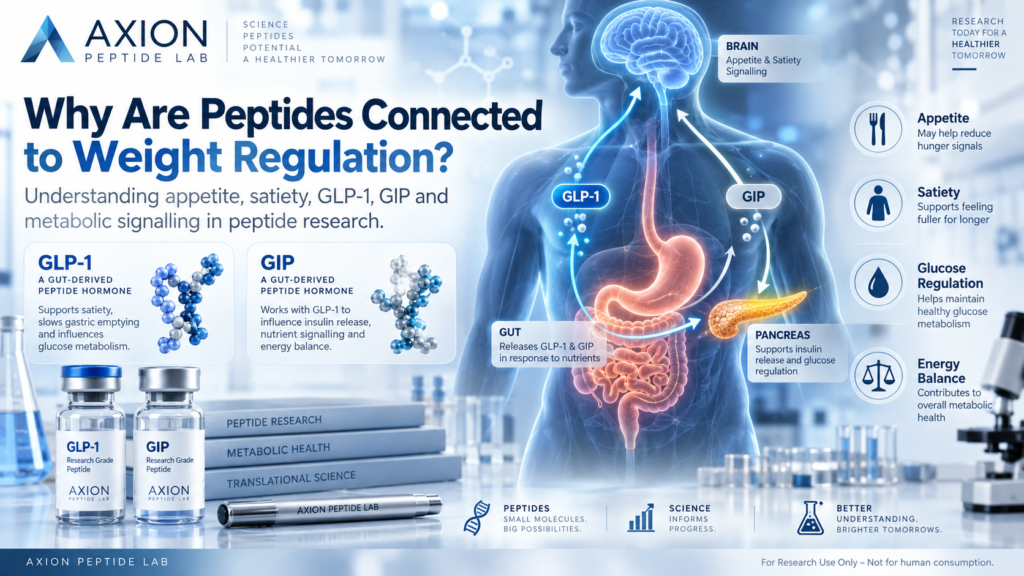
Peptides are connected to weight regulation because several naturally occurring peptide hormones play important roles in appetite, satiety, digestion, glucose metabolism and energy balance. These signalling molecules help different organs communicate with one another and influence how the body responds to food intake.
This connection has made peptide-related pathways an important area of metabolic research. Scientists have studied hormones such as GLP-1, GIP, glucagon and amylin to understand how signals from the gastrointestinal system, pancreas and brain contribute to eating behaviour and metabolic regulation.
This research has also contributed to the development of several prescription medicines and investigational compounds. However, the broad phrase “peptides for weight loss” can be misleading if it suggests that all peptides produce weight reduction. They do not.
Each peptide must be evaluated according to its specific biological target, clinical evidence and regulatory status.
Peptides Act as Metabolic Signals
Many peptides function as chemical messengers.
After food is consumed, different tissues release signalling molecules that communicate information about:
- Nutrient availability
- Blood glucose
- Gastrointestinal activity
- Energy intake
- Hunger
- Fullness
Some of these signals travel through the bloodstream and interact with receptors located in organs such as the pancreas and brain.
The resulting biological responses can influence food intake and metabolic activity.
This is one reason researchers are interested in peptide pathways when studying obesity, diabetes and other metabolic conditions.
Appetite and Satiety Signalling
Two important concepts in weight regulation are appetite and satiety.
Appetite describes the biological and psychological drive to eat, while satiety refers to signals associated with feeling full after eating.
Several peptide hormones participate in these signalling systems.
For example, gut-derived hormones released after food intake can send information to the brain indicating that nutrients have entered the digestive system.
These signals may contribute to:
- Increased feelings of fullness
- Changes in hunger
- Reduced food intake
- Regulation of meal size
The exact effect depends on the specific hormone and receptor pathway involved.
The Gut-Brain Connection
The gastrointestinal system and brain communicate continuously through hormonal and neural pathways.
This communication is sometimes described as the gut-brain axis.
Peptide hormones released from the gastrointestinal tract can form part of this signalling network.
After nutrients enter the intestine, specialised cells can release hormones that interact with receptors in several organs.
The brain then receives information related to:
- Nutrient intake
- Energy availability
- Digestive activity
- Satiety
Researchers studying weight regulation are particularly interested in how these signals influence eating behaviour over time.
Peptides and Glucose Regulation
Weight regulation and glucose metabolism are closely connected.
Several peptide hormones influence how the body responds to changes in blood glucose after meals.
Two of the most important in modern metabolic research are:
- GLP-1
- GIP
These hormones belong to a group of gastrointestinal signals known as incretins.
They are released in response to nutrient intake and contribute to the regulation of insulin secretion under appropriate physiological conditions.
This relationship between food intake, glucose metabolism and hormonal signalling helped make incretin pathways major targets of metabolic research.
GLP-1 and Appetite Research
GLP-1, or glucagon-like peptide-1, is one of the most extensively studied peptide hormones in modern metabolic science.
Naturally occurring GLP-1 contributes to several processes related to nutrient metabolism.
Research has examined its role in:
- Glucose-dependent insulin secretion
- Glucagon regulation
- Gastric emptying
- Appetite signalling
- Satiety
These findings contributed to the development of medicines that activate the GLP-1 receptor.
Semaglutide is one example of a GLP-1 receptor agonist that has been studied extensively in clinical weight-management research.
However, approved pharmaceutical products containing semaglutide should not be confused with research-use laboratory materials that may carry the same compound name.
GIP and Dual-Receptor Research
GIP, or glucose-dependent insulinotropic polypeptide, is another naturally occurring incretin hormone.
Scientists have studied GIP because of its role in nutrient signalling and insulin regulation.
More recent research has investigated compounds that target both:
- GLP-1 receptors
- GIP receptors
Tirzepatide is an important example of this dual-receptor approach.
Its development reflects a broader scientific interest in understanding whether coordinated activity across multiple metabolic receptors can produce clinically meaningful effects.
Glucagon and Multi-Receptor Research
Glucagon is another hormone involved in metabolic regulation.
Its physiological functions differ from those of GLP-1 and GIP, but researchers have increasingly studied compounds designed to interact with combinations of metabolic receptors.
This has led to investigations of triple-receptor agonists targeting:
- GLP-1
- GIP
- Glucagon receptors
Retatrutide is an example of an investigational compound developed around this multi-receptor concept.
It should be described as an investigational research compound, not as an approved weight-loss medicine unless regulatory status changes in the future.
Gastric Emptying and Food Intake
Some metabolic peptide pathways can also influence gastric emptying, which refers to the rate at which food leaves the stomach and moves into the small intestine.
Changes in gastric emptying can influence:
- Post-meal glucose responses
- Digestive timing
- Fullness
- Food intake
This represents another mechanism through which peptide-related receptor pathways can affect metabolic regulation.
However, the magnitude and clinical significance of these effects vary between compounds.
Energy Balance Is More Complex Than One Hormone
Body weight is influenced by a complex interaction of factors.
These can include:
- Energy intake
- Energy expenditure
- Genetics
- Hormonal signalling
- Sleep
- Physical activity
- Medications
- Environmental influences
- Underlying medical conditions
Peptide signalling represents only one component of this wider system.
For this reason, scientific discussions about peptides for weight loss should avoid suggesting that body weight is controlled by one hormone or receptor alone.
Modern metabolic research instead examines how multiple signalling systems interact.
Not Every Peptide Causes Weight Loss
The term “peptide” covers thousands of different molecules with very different biological functions.
Some peptides participate in metabolic signalling, while others are investigated for entirely different areas such as:
- Immune function
- Neurological signalling
- Tissue biology
- Endocrine regulation
- Cellular communication
A compound should therefore not be described as a weight-loss peptide simply because it is a peptide.
Any claim about weight reduction should be based on evidence specific to that compound.
Clinical Evidence Matters
Mechanistic research can explain why a particular peptide pathway is scientifically interesting, but biological plausibility is not the same as proven clinical effectiveness.
Researchers should distinguish between:
- Laboratory experiments
- Animal studies
- Early-stage human research
- Phase 2 clinical trials
- Phase 3 clinical trials
- Regulatory approval
A peptide may demonstrate interesting biological activity in laboratory research without eventually becoming an approved medicine.
This distinction is especially important when discussing newer compounds that are still undergoing clinical development.
Why Peptide Quality Matters in Metabolic Research
Laboratories studying metabolic signalling also need confidence in the identity and analytical characteristics of their research materials.
If researchers are investigating compounds associated with GLP-1, GIP or glucagon pathways, documentation such as a peptide COA can help provide information about:
- Batch identity
- HPLC purity
- Molecular mass
- Analytical methods
- Traceability
This helps connect the broader science of peptides for weight loss research with the analytical-quality principles discussed earlier in this guide.
A COA does not establish that a research peptide is safe, effective or suitable for human use. It provides analytical information about the research material being studied.
Researchers sourcing compounds for legitimate laboratory investigation can review relevant product and analytical documentation through the Axion Peptide Lab research catalogue.
For Research Use Only – Not for human consumption.
How Metabolic Peptide Pathways Work
Metabolic peptide pathways are communication systems that help coordinate processes such as appetite, digestion, insulin secretion, glucose regulation, nutrient handling and energy balance.
These pathways rely on signalling molecules, including peptide hormones, that bind to specific receptors in different tissues. Once a peptide interacts with its receptor, it can trigger a chain of cellular signals that influences how the body responds to food and changes in energy availability.
This receptor-based signalling is one reason peptides have become a major focus of modern metabolic research.
Peptides and Receptor Signalling
Many peptide hormones work by binding to specialised proteins called receptors.
A receptor can be thought of as a molecular recognition system. The structure of a peptide determines which receptors it can interact with and how strongly that interaction occurs.
When a peptide binds to the appropriate receptor, it may activate intracellular signalling pathways that affect processes such as:
- Hormone secretion
- Enzyme activity
- Gene expression
- Glucose handling
- Appetite signalling
- Digestive activity
Different receptors produce different biological responses.
This is why two peptides with similar structures can still produce substantially different effects.
Why Receptor Selectivity Matters
Receptor selectivity describes how strongly a compound interacts with one receptor compared with others.
Some metabolic compounds primarily target a single receptor, while others are designed to interact with multiple receptors.
For example:
- Semaglutide acts primarily as a GLP-1 receptor agonist.
- Tirzepatide targets both GIP and GLP-1 receptors.
- Retatrutide is being investigated for activity involving GIP, GLP-1 and glucagon receptors.
These receptor profiles help explain why the compounds are studied differently.
However, having activity at more receptors does not automatically mean that one compound is superior. Clinical outcomes must be established through properly designed studies.
The Gut-Brain-Pancreas Signalling Network
Metabolic regulation involves communication between several organs rather than one isolated pathway.
Three particularly important areas include:
- The gastrointestinal tract
- The brain
- The pancreas
After food is consumed, nutrients enter the digestive system and stimulate specialised cells to release hormonal signals.
Some of these signals travel through the bloodstream and interact with receptors in the pancreas and nervous system.
The resulting responses can influence:
- Insulin secretion
- Glucagon activity
- Appetite
- Satiety
- Gastric emptying
- Post-meal glucose regulation
This interconnected system helps the body respond to changes in nutrient availability.
The Role of the Gastrointestinal Tract
The gastrointestinal tract does much more than digest food.
It also functions as an important endocrine organ.
Specialised cells in the intestine release peptide hormones in response to nutrients such as:
- Carbohydrates
- Fats
- Proteins
These hormones can then communicate information about nutrient intake to other tissues.
Two of the most important hormones in this area are GLP-1 and GIP.
Both are released after food intake and form part of the incretin system.
What Is the Incretin Effect?
The incretin effect describes the observation that oral glucose can stimulate a greater insulin response than an equivalent glucose exposure delivered directly into the bloodstream.
This occurs partly because gastrointestinal hormones are released when nutrients pass through the digestive system.
GLP-1 and GIP are the two principal incretin hormones studied in humans.
They help coordinate the body’s response to food by influencing insulin secretion in a glucose-dependent manner.
This mechanism became an important area of research in diabetes and later in weight-management science.
GLP-1 Signalling
GLP-1 receptors are present in several tissues involved in metabolic regulation.
When GLP-1 receptor signalling is activated, researchers have observed effects related to:
- Glucose-dependent insulin secretion
- Glucagon regulation
- Gastrointestinal function
- Appetite
- Satiety
These properties contributed to scientific interest in developing longer-acting GLP-1 receptor agonists.
Naturally occurring GLP-1 is broken down relatively quickly in the body, whereas pharmaceutical GLP-1 receptor agonists can be designed to remain active for longer periods.
This distinction between naturally occurring hormones and engineered receptor agonists is important when discussing metabolic peptide research.
GIP Signalling
GIP is another incretin hormone released from the gastrointestinal tract following nutrient intake.
It interacts with the GIP receptor, which is involved in metabolic signalling and insulin regulation.
For many years, research focused heavily on GLP-1 alone.
More recently, scientists have investigated whether combining GLP-1 and GIP receptor activity could produce different metabolic effects.
This led to the development of dual-receptor compounds such as tirzepatide.
Glucagon Signalling
Glucagon plays a different but complementary role in metabolism.
It is produced primarily by pancreatic alpha cells and participates in the regulation of glucose availability and energy metabolism.
Glucagon receptor signalling has become increasingly important in research involving multi-receptor agonists.
Investigational compounds such as retatrutide combine glucagon receptor activity with GLP-1 and GIP receptor activity.
Researchers study this approach to understand how simultaneous receptor activation may influence:
- Energy balance
- Appetite
- Glucose metabolism
- Lipid metabolism
These effects must still be evaluated through controlled experimental and clinical research.
How Metabolic Signals Influence Appetite
Appetite regulation involves multiple regions of the brain.
Hormonal signals from the gastrointestinal system can communicate with neural pathways involved in hunger and satiety.
When these signals are received, they may influence:
- How hungry a person feels
- How quickly fullness develops
- Meal size
- Food-related motivation
This process is highly complex.
Appetite is also influenced by:
- Ghrelin
- Leptin
- Insulin
- Stress hormones
- Sleep
- Environment
- Behavioural factors
For this reason, researchers do not generally treat one peptide pathway as the sole regulator of food intake.
Gastric Emptying as a Metabolic Mechanism
Another pathway relevant to metabolic peptide research involves gastric emptying.
Gastric emptying is the movement of food from the stomach into the small intestine.
The rate of this process can influence:
- Post-meal glucose concentrations
- Nutrient absorption
- Feelings of fullness
- Timing of digestive signals
Some GLP-1-related effects involve changes in gastric emptying, although the magnitude of these effects can depend on the compound, duration of treatment and physiological adaptation.
Insulin and Glucagon Balance
Insulin and glucagon work together to help regulate blood glucose.
Insulin generally promotes glucose uptake and storage when blood glucose rises.
Glucagon helps maintain glucose availability when circulating glucose is lower.
Peptide hormones such as GLP-1 and GIP interact with this wider endocrine system.
Researchers studying metabolic peptides therefore examine how multiple hormonal pathways influence one another rather than analysing each signal in isolation.
Single-, Dual- and Triple-Receptor Research
Modern metabolic peptide research increasingly explores compounds according to the number of receptor pathways they target.
A simplified comparison looks like this:
Single-receptor agonists
Primarily target one receptor pathway, such as GLP-1.
Dual-receptor agonists
Target two pathways, such as GLP-1 and GIP.
Triple-receptor agonists
May target three metabolic receptor systems, such as GLP-1, GIP and glucagon.
This progression represents a scientific strategy for studying whether coordinated receptor activity can produce different metabolic outcomes.
It should not be interpreted as a simple ranking where more receptors automatically mean greater effectiveness or safety.
Metabolic Pathways and Peptides for Weight Loss Research
The popularity of the phrase “peptides for weight loss” largely reflects growing interest in these metabolic pathways.
However, the biological mechanisms are more precise than the general phrase suggests.
Researchers are usually studying specific receptor systems and defined compounds rather than a general category of peptides.
Important research areas include:
- GLP-1 receptor signalling
- GIP receptor signalling
- Glucagon receptor signalling
- Appetite regulation
- Glucose control
- Gastric emptying
- Energy expenditure
- Gut-brain communication
Understanding these mechanisms helps explain why compounds such as semaglutide, tirzepatide and investigational retatrutide are discussed within the same broad area of metabolic research while still representing different molecules.
Why Research Material Quality Matters
Accurate experimental results depend partly on knowing what material is being studied.
When laboratories investigate metabolic peptide pathways, analytical documentation can help establish the characteristics of the research compound being used.
A peptide Certificate of Analysis may provide information such as:
- Compound identity
- Batch number
- HPLC purity
- Molecular weight
- Mass spectrometry results
- Analytical date
This helps connect molecular biology with laboratory quality control.
If the identity or purity of a research material is poorly characterised, interpreting experimental results can become more difficult.
Pathway Activity Does Not Equal Medical Approval
Understanding how a metabolic peptide interacts with a receptor is not the same as proving that the compound is a safe and effective medicine.
Scientific development generally progresses through several stages, including:
- Laboratory research
- Preclinical studies
- Early human trials
- Larger clinical trials
- Regulatory assessment
- Post-approval monitoring where applicable
Some compounds targeting metabolic peptide pathways have completed this process for specific indications.
Others remain investigational.
Research-use materials supplied for laboratory investigation should therefore remain clearly separated from licensed prescription medicines.
Researchers working with appropriate laboratory materials can review the Axion Peptide Lab research catalogue alongside available analytical documentation and product information.
For Research Use Only – Not for human consumption.
GLP-1 and GIP in Weight-Regulation Research
GLP-1 and GIP are two naturally occurring peptide hormones that play important roles in the body’s response to food. Both belong to the incretin system, a network of gut-derived signals that helps coordinate insulin secretion, glucose regulation and other metabolic processes after nutrients are consumed.
Because these pathways are closely connected with appetite, glucose metabolism and energy balance, GLP-1 and GIP have become major areas of research in obesity and metabolic disease.
Modern compounds such as semaglutide and tirzepatide were developed from scientific understanding of these pathways, while newer investigational compounds are exploring combinations of GLP-1, GIP and other metabolic receptors.
What Is GLP-1?
GLP-1, or glucagon-like peptide-1, is a peptide hormone released mainly from specialised cells in the intestine after food intake.
Its physiological effects include involvement in:
- Glucose-dependent insulin secretion
- Regulation of glucagon
- Appetite signalling
- Satiety
- Gastrointestinal activity
- Post-meal glucose control
Naturally occurring GLP-1 is broken down relatively quickly in the body. This led researchers to investigate longer-acting compounds that can activate the GLP-1 receptor for extended periods.
These efforts contributed to the development of several GLP-1 receptor agonists used in clinical medicine.
How GLP-1 Influences Appetite and Satiety
One of the reasons GLP-1 has attracted so much interest in peptides for weight loss research is its relationship with appetite regulation.
GLP-1 signalling can communicate with regions of the brain involved in hunger and food intake.
Research has shown that GLP-1 receptor activation may influence:
- Feelings of fullness
- Hunger signals
- Meal size
- Food intake
- Food-related reward and motivation
These effects are part of a wider metabolic system rather than a single isolated mechanism.
Appetite is influenced by many hormonal, neurological, environmental and behavioural factors.
GLP-1 and Gastric Emptying
GLP-1 can also influence the rate at which food leaves the stomach.
This process is known as gastric emptying.
Changes in gastric emptying can affect:
- How quickly nutrients enter the small intestine
- Post-meal glucose responses
- Digestive timing
- Feelings of fullness
This mechanism is one of several ways that GLP-1 receptor signalling can influence metabolic responses after eating.
What Is GIP?
GIP, or glucose-dependent insulinotropic polypeptide, is another major incretin hormone.
It is released from cells in the upper small intestine following nutrient intake.
Like GLP-1, GIP contributes to the body’s insulin response after meals.
Researchers have studied GIP for its role in:
- Glucose-dependent insulin secretion
- Nutrient sensing
- Energy storage
- Lipid metabolism
- Metabolic signalling
The biology of GIP is complex, and scientists continue to study how GIP receptor activation affects metabolism in different physiological contexts.
Why GLP-1 and GIP Are Called Incretin Hormones
GLP-1 and GIP are referred to as incretin hormones because they help explain why oral glucose can produce a stronger insulin response than an equivalent glucose exposure delivered directly into the circulation.
When food enters the gastrointestinal system, GLP-1 and GIP are released.
These hormones then help signal the pancreas to increase insulin secretion when blood glucose is elevated.
This process is known as the incretin effect.
The incretin system became an important research target because impaired glucose regulation is central to conditions such as type 2 diabetes.
Why Researchers Study GLP-1 and GIP Together
For many years, metabolic drug development focused heavily on GLP-1 receptor agonism.
More recently, researchers have investigated whether activating both GLP-1 and GIP receptors may produce different metabolic effects.
This approach is known as dual-receptor agonism.
Tirzepatide is a well-known example of a compound that acts on both:
- GIP receptors
- GLP-1 receptors
Studying these pathways together has helped researchers explore how coordinated incretin signalling may influence:
- Appetite
- Glucose control
- Insulin response
- Energy balance
- Body-weight regulation
The clinical effects of any particular compound, however, must be established through controlled trials rather than assumed from receptor activity alone.
GLP-1 vs GIP: Key Differences
Although GLP-1 and GIP are both incretin hormones, they are not identical.
GLP-1 is particularly well known for its effects on:
- Appetite
- Satiety
- Gastric emptying
- Insulin secretion
GIP is also involved in insulin signalling but has additional roles in nutrient and energy metabolism.
Because their receptor systems differ, combining them can produce a biological profile that is different from activating GLP-1 alone.
This is one reason dual-agonist research has become important in modern metabolic science.
From Single-Receptor to Dual-Receptor Research
A major progression in metabolic peptide research can be viewed through receptor targeting.
Single-receptor compounds primarily act on one pathway, such as GLP-1.
Dual-receptor compounds are designed to interact with two metabolic pathways, such as GLP-1 and GIP.
Researchers are also investigating triple-receptor compounds that may target GLP-1, GIP and glucagon receptors simultaneously.
These strategies reflect increasing scientific interest in how multiple metabolic signals interact.
However, a greater number of receptor targets does not automatically mean that a compound is safer, more effective or more appropriate for clinical use.
GLP-1, GIP and Semaglutide
Semaglutide is a GLP-1 receptor agonist.
It was developed to activate GLP-1 receptor pathways for longer than naturally occurring GLP-1.
Clinical research has evaluated semaglutide in areas including glucose regulation and chronic weight management.
The clinical evidence supporting licensed semaglutide medicines should be distinguished from laboratory research materials carrying the same compound name. what is a peptide COA
A research-use peptide is not automatically equivalent to an approved pharmaceutical formulation.
GLP-1, GIP and Tirzepatide
Tirzepatide differs from semaglutide because it targets both the GIP and GLP-1 receptors.
Its dual-receptor profile has made it an important subject of metabolic and weight-management research.
Clinical trials have investigated its effects on:
- Body weight
- Glucose regulation
- Cardiometabolic markers
- Appetite-related outcomes
As with semaglutide, licensed tirzepatide medicines should remain clearly separated from laboratory research materials.
GLP-1, GIP and Retatrutide
Retatrutide represents another stage of multi-receptor research.
It has been developed to interact with:
- GIP receptors
- GLP-1 receptors
- Glucagon receptors
This makes it a triple-receptor agonist.
Researchers are studying whether simultaneous activity across these pathways can produce clinically meaningful metabolic effects.
Retatrutide should continue to be described as an investigational compound unless its regulatory status changes.
Clinical-trial participation and published research should not be confused with regulatory approval.
Why These Pathways Matter for Peptides for Weight Loss Research
The phrase “peptides for weight loss” is often used broadly, but modern research is actually focused on specific receptor pathways and defined compounds.
GLP-1 and GIP are especially important because they connect several areas of metabolism:
- Food intake
- Glucose regulation
- Insulin signalling
- Satiety
- Digestive processes
- Energy balance
Researchers studying these pathways aim to understand how different receptor combinations influence metabolic outcomes.
This work has contributed to the development of licensed medicines as well as newer investigational compounds.
Why Analytical Quality Matters in GLP-1 and GIP Research
Laboratory studies involving incretin-related compounds depend on accurate identification and characterisation of research materials. what is a peptide COA
A peptide Certificate of Analysis can provide useful information about:
- Batch number
- HPLC purity
- Molecular identity
- Analytical method
- Testing date
- Molecular weight
This helps researchers connect experimental results with the specific material used in the study.
High-quality analytical documentation is especially important when comparing compounds that target related but distinct receptor systems.
However, even a detailed COA does not establish clinical safety, effectiveness or regulatory approval.
For legitimate laboratory investigation, researchers can review relevant research materials and analytical documentation through the Axion Peptide Lab research catalogue.
For Research Use Only – Not for human consumption.
Peptide-Based Compounds Commonly Discussed in Weight-Loss Research
Scientific interest in peptides for weight loss has increased significantly because several peptide-related compounds can influence pathways involved in appetite, glucose regulation, satiety and energy balance.
However, these compounds do not all work in the same way, and they do not share the same regulatory status, clinical evidence or intended use. what is a peptide COA
Three of the most frequently discussed compounds in modern metabolic research are:
- Semaglutide
- Tirzepatide
- Retatrutide
Each interacts with different combinations of metabolic receptors, which helps explain why researchers study them separately.
It is also essential to distinguish between licensed prescription medicines, investigational compounds undergoing clinical development, and research-use laboratory materials.
A research material should never be assumed to be equivalent to an approved medicine simply because it carries the same compound name.
Why These Compounds Are Studied
Researchers became increasingly interested in metabolic peptide pathways after discovering that certain gut-derived hormones participate in the regulation of:
- Appetite
- Satiety
- Insulin secretion
- Glucagon signalling
- Gastric emptying
- Nutrient processing
- Glucose metabolism
- Energy balance
This led scientists to investigate compounds designed to activate one or more receptors involved in these systems.
Some compounds act mainly on one receptor pathway, while others are designed to interact with multiple receptors.
This has created three important areas of research:
Single-receptor agonists
Compounds primarily targeting one metabolic receptor.
Dual-receptor agonists
Compounds designed to interact with two receptor pathways.
Triple-receptor agonists
Investigational compounds targeting three metabolic receptors simultaneously.
Semaglutide, tirzepatide and retatrutide provide examples of these different research strategies.
Semaglutide: GLP-1 Receptor Research
Semaglutide is a GLP-1 receptor agonist.
It was developed to reproduce certain effects associated with GLP-1 signalling while remaining active for substantially longer than naturally occurring GLP-1.
GLP-1 receptor activation is associated with biological processes involving:
- Glucose-dependent insulin secretion
- Glucagon regulation
- Appetite signalling
- Satiety
- Gastric emptying
Semaglutide has been extensively investigated in clinical research, including studies examining weight management and metabolic outcomes.
Its development helped establish GLP-1 receptor signalling as one of the most prominent areas of modern metabolic medicine.
However, researchers should distinguish between licensed pharmaceutical products containing semaglutide and research-use materials intended solely for laboratory investigation.
Tirzepatide: Dual GIP and GLP-1 Receptor Research
Tirzepatide represents a different approach because it interacts with both:
- GIP receptors
- GLP-1 receptors
This makes tirzepatide a dual GIP/GLP-1 receptor agonist.
The scientific rationale behind dual-receptor agonism is to investigate whether coordinated activation of two incretin pathways can produce metabolic effects that differ from targeting GLP-1 alone.
Researchers have studied tirzepatide in relation to:
- Body-weight regulation
- Glucose metabolism
- Insulin signalling
- Appetite
- Cardiometabolic measures
Tirzepatide demonstrates how modern metabolic research has moved beyond single-receptor signalling toward more complex receptor combinations.
Again, licensed medicines containing tirzepatide should not be treated as equivalent to laboratory research materials.
Retatrutide: Triple-Receptor Research
Retatrutide represents an additional step in multi-receptor metabolic research.
It has been developed to interact with three receptor systems:
- GIP receptors
- GLP-1 receptors
- Glucagon receptors
Because of this profile, retatrutide is commonly described as a triple-receptor agonist.
Researchers are investigating whether coordinated activity across these pathways can affect areas including:
- Appetite
- Energy balance
- Glucose metabolism
- Lipid metabolism
- Body-weight regulation
Unlike compounds that already have established licensed uses in certain jurisdictions, retatrutide should be described as investigational unless and until its regulatory status changes.
Positive clinical-trial findings should not be confused with regulatory approval. what is a peptide COA
Why Receptor Profiles Matter
The major difference between semaglutide, tirzepatide and retatrutide can be understood through their receptor targets.
A simplified overview is:
Semaglutide
GLP-1 receptor activity
Tirzepatide
GIP + GLP-1 receptor activity
Retatrutide
GIP + GLP-1 + glucagon receptor activity
These differences can influence how each compound behaves biologically.
However, receptor count should not be interpreted as a ranking.
A compound targeting three receptors is not automatically safer, more effective or more appropriate than one targeting one or two receptors.
Those questions must be answered through properly designed clinical trials and regulatory review.
Other Peptide Pathways Studied in Weight Regulation
Although GLP-1, GIP and glucagon pathways receive substantial attention, they are not the only peptide systems relevant to metabolic research.
Researchers also investigate hormones and signalling molecules such as:
- Amylin
- PYY
- Ghrelin
- Leptin
- Insulin
- Other gastrointestinal peptide hormones
These signalling systems can influence hunger, satiety, glucose control, nutrient handling and energy balance in different ways.
This broader context is important because weight regulation is not controlled by one peptide or one receptor pathway.
Why Clinical Evidence Is More Important Than Marketing Claims
The growing popularity of metabolic peptides has also produced substantial online discussion and marketing.
Researchers should separate scientific evidence from promotional claims.
When evaluating a peptide-based compound, useful questions include:
- Has the compound been studied in humans?
- What phase of clinical development has been completed?
- Were the results published in a peer-reviewed journal?
- What endpoints were measured?
- How long did the study last?
- What adverse effects were reported?
- Has a regulator authorised the medicine for a specific indication?
- Is the material being discussed a licensed pharmaceutical product or a research-use compound?
These questions provide a much stronger framework than relying on claims such as “strongest peptide” or “best weight-loss peptide.”
Research Compounds Are Not Automatically Medicines
One of the most important distinctions in this topic is the difference between a compound studied in scientific research and a medicine approved for clinical use.
A compound may exist in:
- Laboratory studies
- Animal research
- Phase 1 trials
- Phase 2 trials
- Phase 3 trials
without yet receiving regulatory approval.
Clinical development is designed to establish evidence relating to safety, efficacy, dosing, manufacturing quality and other factors.
A laboratory research product does not bypass this process simply because a Certificate of Analysis reports high purity.
The Role of COAs in Metabolic Peptide Research
When laboratories study peptide-based compounds, analytical documentation remains important.
A peptide COA can help researchers review characteristics such as:
- Batch identification
- HPLC purity
- Molecular weight
- Mass spectrometry data
- Analytical method
- Test date
This can support experimental traceability and help laboratories document which research material was used.
However, a COA answers analytical questions about the sample. It does not establish that the material is clinically effective, medically approved or appropriate for human administration.
Research Quality and Reproducibility
Reliable research depends partly on the quality and consistency of experimental materials.
If laboratories are comparing receptor activity or metabolic pathways involving compounds such as semaglutide, tirzepatide or retatrutide, differences in material identity or quality could potentially complicate interpretation of experimental results.
Researchers should therefore consider:
- Compound identity
- Batch traceability
- Analytical purity
- Molecular confirmation
- Storage conditions
- Experimental controls
- Reproducibility
These factors help ensure that conclusions are based on well-characterised research materials.
Where Axion Peptide Lab Fits Into Research
Axion Peptide Lab provides compounds intended for legitimate laboratory research and scientific investigation.
Researchers reviewing metabolic peptide pathways can examine the available research catalogue together with relevant analytical documentation, including COA information where provided.
The purpose of these materials is to support controlled laboratory research rather than clinical treatment.
Licensed prescription medicines should be obtained through appropriate medical and pharmaceutical channels, while investigational compounds should be described according to their actual development and regulatory status.
For Research Use Only – Not for human consumption.
Semaglutide: What Does the Research Show?
Semaglutide is one of the most extensively studied compounds associated with modern GLP-1 and weight-management research. It is a glucagon-like peptide-1 (GLP-1) receptor agonist, meaning that it activates the GLP-1 receptor and reproduces some of the biological signalling associated with naturally occurring GLP-1.
Clinical research has investigated semaglutide in areas including type 2 diabetes, obesity, chronic weight management and cardiovascular outcomes. Importantly, semaglutide is not simply an experimental “weight-loss peptide.” Specific pharmaceutical formulations of semaglutide are licensed prescription medicines in both the United States and United Kingdom for defined indications.
At the same time, laboratory research materials carrying the name semaglutide should not be confused with these regulated pharmaceutical products.
How Does Semaglutide Work?
Semaglutide is designed to activate the GLP-1 receptor.
Naturally occurring GLP-1 is released from the gastrointestinal tract after food intake and participates in several metabolic processes.
GLP-1 receptor signalling is associated with:
- Glucose-dependent insulin secretion
- Regulation of glucagon
- Appetite signalling
- Satiety
- Gastric emptying
- Post-meal glucose regulation
Naturally produced GLP-1 is broken down relatively quickly. Semaglutide was developed with structural characteristics that allow prolonged GLP-1 receptor activity compared with the natural hormone.
This longer duration of action allowed researchers to investigate sustained activation of the GLP-1 pathway in metabolic disease.
What Did the STEP Clinical Research Programme Investigate?
Much of the evidence for semaglutide in weight management comes from the STEP clinical trial programme.
One of the best-known studies was STEP 1, published in the New England Journal of Medicine in 2021.
The double-blind trial included 1,961 adults with obesity, or overweight with at least one weight-related condition, who did not have diabetes. Participants were randomly assigned to semaglutide or placebo alongside lifestyle intervention for 68 weeks.
In STEP 1, mean body-weight change at week 68 was approximately −14.9% in the semaglutide group compared with −2.4% in the placebo group. Gastrointestinal events, particularly nausea and diarrhoea, were among the most commonly reported adverse events.
These findings provided important clinical evidence for semaglutide in chronic weight-management research.
However, individual responses varied, and results from a controlled clinical trial should not be interpreted as a guarantee of a particular outcome for every person.
Why Is STEP 1 Important?
STEP 1 was important because it was a relatively large Phase 3 trial conducted over more than a year and directly compared semaglutide with placebo alongside lifestyle intervention.
Researchers were able to examine outcomes including:
- Percentage change in body weight
- Proportion of participants reaching predefined weight-reduction thresholds
- Cardiometabolic measurements
- Participant-reported physical functioning
- Adverse events
- Treatment discontinuation
The study demonstrated why strong clinical evidence requires considerably more than laboratory evidence showing that a compound interacts with a particular receptor.
Clinical outcomes need to be established through controlled human studies.
Semaglutide and Appetite Regulation
One reason semaglutide is frequently discussed in peptides for weight loss research is the role of GLP-1 receptor signalling in appetite and energy intake.
GLP-1 pathways interact with areas of the nervous system involved in hunger and satiety.
Research suggests that semaglutide-associated changes in body weight are related in part to reductions in energy intake and changes in appetite signalling.
This should not be simplified into the claim that semaglutide merely “switches off hunger.”
Human appetite is influenced by numerous interacting factors, including:
- Hormonal signalling
- Brain reward pathways
- Energy requirements
- Sleep
- Stress
- Food environment
- Behavioural factors
GLP-1 receptor activation represents one part of this wider biological system.
Semaglutide Is a Licensed Medicine for Specific Uses
There is an important regulatory distinction between the molecule semaglutide and specific licensed pharmaceutical products containing semaglutide.
In the United States, Wegovy is an FDA-approved semaglutide medicine for chronic weight management in defined patient populations, alongside reduced-calorie diet and increased physical activity. Its US indications have expanded over time.
In March 2026, the FDA also approved a higher-dose semaglutide formulation, Wegovy HD, for weight loss and long-term weight maintenance in certain adults.
In the United Kingdom, semaglutide is also licensed for defined uses. NICE includes semaglutide among medicine options for weight management and maintains specific guidance concerning its use within NHS pathways.
The MHRA has continued to expand authorised semaglutide formulations and indications. In 2026, UK regulatory developments included authorisation of a higher-dose Wegovy injection for certain adults with obesity and the UK’s first oral GLP-1 semaglutide formulation authorised for weight management.
Semaglutide Is Not One Universal Product
The existence of licensed semaglutide medicines does not mean that every product labelled “semaglutide” has the same regulatory status.
This distinction is essential.
A licensed prescription medicine is manufactured and supplied under a regulated pharmaceutical framework covering matters such as:
- Manufacturing controls
- Product specifications
- Formulation
- Quality assurance
- Stability
- Approved indications
- Packaging and labelling
- Safety monitoring
A semaglutide research material supplied for laboratory investigation is a different category.
A research product should therefore not be represented as interchangeable with Wegovy, Ozempic or another licensed semaglutide medicine.
Semaglutide Research Material vs Prescription Semaglutide
This distinction is especially important for laboratories reviewing a semaglutide Certificate of Analysis.
A COA may provide information concerning:
- HPLC purity
- Molecular identity
- Molecular weight
- Batch number
- Analytical testing
- Sample traceability
These results may help characterise a research material.
They do not establish that the material has:
- FDA approval
- MHRA authorisation
- Pharmaceutical equivalence
- An approved clinical indication
- Demonstrated safety for human administration
- The same formulation as a licensed medicine
Even if a laboratory sample has high chromatographic purity and molecular identity consistent with semaglutide, it remains necessary to distinguish that research sample from an authorised pharmaceutical product.
What Does Semaglutide Research Tell Us About Peptides for Weight Loss?
Semaglutide provides an important example of how peptide-related biological research can progress from understanding a natural signalling pathway to developing and testing a regulated medicine.
The research pathway involved several stages:
Understanding GLP-1 biology
Researchers investigated the physiological functions of naturally occurring GLP-1.
Developing longer-acting receptor agonists
Scientists designed compounds capable of producing longer-lasting GLP-1 receptor activity.
Preclinical investigation
Laboratory and animal models helped characterise pharmacology and biological effects.
Clinical trials
Structured human studies evaluated safety, efficacy and metabolic outcomes.
Regulatory assessment
Regulatory authorities reviewed evidence concerning quality, safety and efficacy before authorising specific products and indications.
This development pathway demonstrates why promising laboratory research should not be treated as equivalent to an approved medical treatment.
Semaglutide Research Also Shows the Importance of Adverse-Event Monitoring
Clinical trials do not examine effectiveness alone.
They also record adverse events and treatment discontinuations.
In STEP 1, gastrointestinal effects including nausea and diarrhoea were among the most frequently reported adverse events. Gastrointestinal events also led to more treatment discontinuations in the semaglutide group than in the placebo group.
Licensed semaglutide medicines therefore have formal prescribing information containing warnings, contraindications, precautions and adverse-reaction information.
This is another major difference between clinical medicines and laboratory research materials.
Why COA Documentation Matters in Semaglutide Laboratory Research
For legitimate laboratory research involving semaglutide, analytical characterisation helps researchers understand the material being studied.
Relevant information may include:
- Compound identification
- Batch or lot number
- HPLC chromatographic purity
- Expected molecular mass
- Observed molecular mass
- Mass spectrometry data
- Analytical date
- Testing laboratory information
A peptide COA can therefore form part of the quality documentation used in experimental work.
For example, if researchers are comparing GLP-1 receptor activity across different experimental compounds, appropriate identification and batch traceability can support reproducibility.
But the role of the COA remains analytical.
A high-quality Certificate of Analysis does not convert research semaglutide into prescription semaglutide.
What Researchers Should Take Away From Semaglutide Studies
Semaglutide represents one of the clearest examples of how peptide-receptor science has influenced modern metabolic research.
The available evidence demonstrates that GLP-1 receptor signalling can have clinically significant metabolic effects when investigated through properly manufactured pharmaceutical products and controlled clinical trials.
At the same time, responsible interpretation requires researchers to distinguish among:
- Natural GLP-1 biology
- Semaglutide as a chemical compound
- Laboratory semaglutide research material
- Published clinical-trial material
- Licensed semaglutide medicines
- Specific authorised indications and formulations
These distinctions are essential when discussing semaglutide, peptides for weight loss, peptide purity and Certificates of Analysis in an accurate scientific context. what is a peptide COA
Researchers investigating GLP-1 pathways in controlled laboratory environments can review appropriate research materials and related analytical documentation through the Axion Peptide Lab research catalogue.
For Research Use Only – Not for human consumption.
Tirzepatide: GLP-1 and GIP Research
Tirzepatide is a peptide-based compound that acts on both the glucose-dependent insulinotropic polypeptide (GIP) receptor and the glucagon-like peptide-1 (GLP-1) receptor. This dual-receptor activity distinguishes tirzepatide from semaglutide, which acts primarily through the GLP-1 receptor.
Research into tirzepatide has become an important part of modern peptides for weight loss research because it demonstrates how scientists have moved from studying individual incretin pathways toward compounds designed to influence multiple metabolic signalling systems simultaneously.
Tirzepatide has undergone extensive clinical development in people with obesity, overweight and type 2 diabetes. Specific pharmaceutical products containing tirzepatide are licensed medicines in the United States and United Kingdom for defined indications. These regulated medicines must be clearly distinguished from tirzepatide materials intended solely for laboratory research. what is a peptide COA
How Does Tirzepatide Work?
Tirzepatide is commonly described as a dual GIP and GLP-1 receptor agonist.
Both GIP and GLP-1 are naturally occurring incretin hormones released in response to nutrient intake.
Their receptors participate in biological processes involving:
- Glucose-dependent insulin secretion
- Nutrient signalling
- Appetite regulation
- Satiety
- Glucose metabolism
- Energy balance
By interacting with both receptor systems, tirzepatide has a different pharmacological profile from compounds that activate the GLP-1 receptor alone.
However, dual-receptor activity should not automatically be interpreted as proof that one compound is universally better than another. Clinical effects must be established through controlled human studies.
What Is GIP?
GIP, or glucose-dependent insulinotropic polypeptide, is an incretin hormone released primarily from the small intestine after nutrients are consumed.
GIP participates in the body’s response to food and has been studied for its role in:
- Insulin secretion
- Glucose regulation
- Nutrient handling
- Lipid metabolism
- Energy storage and signalling
For many years, much metabolic drug research focused primarily on GLP-1.
The development of tirzepatide helped increase scientific interest in whether simultaneous GIP and GLP-1 receptor activation could produce clinically meaningful metabolic effects.
What Is GLP-1?
GLP-1, or glucagon-like peptide-1, is another major incretin hormone.
Its receptor is involved in biological pathways associated with:
- Glucose-dependent insulin secretion
- Glucagon regulation
- Appetite
- Satiety
- Gastrointestinal function
GLP-1 signalling had already become an established area of metabolic research before tirzepatide was developed.
Tirzepatide therefore represents an expansion of incretin-based research rather than an entirely separate biological approach. what is a peptide COA
What Did the SURMOUNT-1 Trial Study?
One of the most important clinical studies of tirzepatide for weight management was the SURMOUNT-1 trial, published in the New England Journal of Medicine in 2022.
SURMOUNT-1 was a Phase 3, randomised, double-blind, placebo-controlled trial involving 2,539 adults with obesity, or overweight with at least one weight-related complication, without diabetes.
Participants were followed for 72 weeks.
The study evaluated several tirzepatide treatment groups and compared them with placebo alongside lifestyle intervention.
The trial found substantial average reductions in body weight across the tirzepatide groups compared with placebo. Gastrointestinal events were the most frequently reported adverse effects and were generally mild to moderate, occurring particularly during treatment escalation.
Why Is SURMOUNT-1 Important?
SURMOUNT-1 provided large-scale clinical evidence examining tirzepatide specifically in people with obesity or overweight without diabetes.
Researchers assessed outcomes including:
- Percentage change in body weight
- Proportion of participants reaching predefined weight-loss thresholds
- Cardiometabolic measurements
- Adverse events
- Treatment discontinuation
The study helped establish the clinical evidence base that later contributed to regulatory evaluation of tirzepatide for chronic weight management.
This is an important example of how metabolic peptide science progresses from receptor research to large controlled clinical trials.
Tirzepatide and Appetite Regulation
Tirzepatide’s effects are associated with signalling through the GIP and GLP-1 receptor systems.
These pathways interact with biological mechanisms involved in nutrient intake and appetite regulation.
Clinical and mechanistic research has examined changes involving:
- Hunger
- Satiety
- Energy intake
- Food consumption
- Glucose regulation
However, body-weight regulation remains biologically complex.
It is influenced by far more than a single peptide receptor, including genetics, environment, sleep, physical activity, medications, psychological factors and multiple hormonal systems.
For this reason, phrases such as “weight-loss peptide” can oversimplify the underlying science.
Tirzepatide and Glucose Regulation
The incretin system plays a major role in the body’s response to food.
GIP and GLP-1 contribute to glucose-dependent insulin secretion, meaning their insulin-related effects are linked to circulating glucose conditions.
Tirzepatide’s interaction with both receptor pathways has therefore also been extensively studied in type 2 diabetes.
This history is important because metabolic research involving obesity and diabetes frequently overlaps.
Nevertheless, a compound’s effects in one clinical population should not automatically be assumed to apply identically to another population.
Tirzepatide Is a Licensed Medicine for Defined Uses
Specific tirzepatide medicines have received regulatory authorisation.
In the United States, the FDA approved Zepbound (tirzepatide) in November 2023 for chronic weight management in defined adults with obesity or overweight with at least one weight-related condition, alongside reduced-calorie diet and increased physical activity. Tirzepatide was already FDA-approved under the Mounjaro brand for improving glycaemic control in adults with type 2 diabetes.
These authorisations apply to specific regulated pharmaceutical products and indications.
They do not mean that every material labelled “tirzepatide” is an approved medicine.
Tirzepatide Research Material vs Licensed Tirzepatide
This distinction is critical when discussing tirzepatide within a peptide COA guide. what is a peptide COA
A laboratory research material labelled tirzepatide may be analytically evaluated using techniques such as:
- HPLC
- Mass spectrometry
- LC-MS
- Molecular-weight analysis
- Batch-specific testing
A Certificate of Analysis may provide information indicating that the research material has a molecular identity and chromatographic profile consistent with tirzepatide.
However, this does not mean that the material is:
- Zepbound
- Mounjaro
- FDA-approved
- MHRA-authorised
- Manufactured to the specifications of a licensed medicine
- Suitable for human administration
- Clinically interchangeable with a prescription product
Chemical identity and regulatory status are separate issues.
Why a Tirzepatide COA Matters in Laboratory Research
For legitimate laboratory research, a tirzepatide COA can help document the material used in an experiment.
Researchers may examine:
- Compound name
- Batch or lot number
- HPLC purity
- Expected molecular weight
- Observed molecular weight
- Mass spectrometry results
- Analytical method
- Testing date
This information can support experimental traceability and reproducibility.
For example, laboratories studying receptor signalling may need to demonstrate that the material used in one experiment can be linked to a particular analytically characterised batch.
A COA can help provide that documentation.
A High-Purity Tirzepatide COA Does Not Establish Pharmaceutical Equivalence
One of the most important points for researchers to understand is that even an analytically strong COA cannot establish pharmaceutical equivalence on its own.
For example, a research material may show:
HPLC purity: >99%
and an observed molecular mass consistent with tirzepatide.
Those results may provide information about chromatographic purity and identity.
They do not establish:
- Approved formulation
- Pharmaceutical manufacturing compliance
- Sterility
- Clinical safety
- Approved dosing
- Bioequivalence
- Regulatory authorisation
Researchers should therefore avoid treating purity percentage as evidence that laboratory material is equivalent to a prescription medicine.
Tirzepatide vs Semaglutide: A Mechanistic Difference
The most obvious mechanistic distinction between semaglutide and tirzepatide concerns receptor activity.
Semaglutide:
Primarily GLP-1 receptor agonism
Tirzepatide:
GIP + GLP-1 receptor agonism
This difference helps explain why researchers study the two compounds separately.
It does not mean that receptor count alone can determine which treatment is appropriate for an individual.
Differences in clinical outcomes, adverse effects, patient populations and regulatory indications need to be evaluated from clinical evidence rather than receptor mechanism alone.
What Adverse Effects Have Been Reported?
Clinical studies and regulated prescribing information document adverse effects associated with tirzepatide.
In SURMOUNT-1, gastrointestinal events were among the most commonly reported adverse effects, particularly during periods of treatment escalation.
The FDA lists common adverse effects for Zepbound including nausea, diarrhoea, vomiting, constipation and abdominal symptoms, among others, and its prescribing information contains additional warnings and precautions.
These safety findings relate to studied and regulated pharmaceutical treatment.
They should not be used to imply that research-use tirzepatide materials have established clinical safety.
Why Tirzepatide Is Important to Peptides for Weight Loss Research
Tirzepatide represents an important development in metabolic peptide science because it demonstrates the movement from single-receptor to multi-receptor approaches.
Research progression can be viewed broadly as:
Natural incretin biology
Scientists investigate how GIP and GLP-1 function naturally.
Receptor pharmacology
Researchers determine how compounds can activate these receptor systems.
Preclinical research
Mechanisms and biological effects are investigated experimentally.
Clinical development
Controlled trials assess outcomes and safety in humans.
Regulatory review
Authorities evaluate evidence concerning quality, safety and effectiveness.
This pathway is fundamentally different from simply demonstrating that a research sample has high HPLC purity.
What Researchers Should Take Away From Tirzepatide Research
Tirzepatide illustrates why discussions about peptides for weight loss need to distinguish molecular science, laboratory materials, clinical evidence and licensed medicines.
Researchers should separately consider:
- GIP receptor activity
- GLP-1 receptor activity
- Analytical peptide identity
- HPLC purity
- Preclinical findings
- Human clinical-trial evidence
- Regulatory authorisation
- Pharmaceutical manufacturing standards
A Certificate of Analysis can help address the analytical characteristics of laboratory research material.
Clinical trials address entirely different questions involving human efficacy and safety.
Regulators then assess specific pharmaceutical products using a much broader evidence package.
For laboratories investigating incretin signalling or related metabolic pathways, appropriately characterised research materials and clear analytical documentation can support controlled experimental work.
Researchers may review relevant materials through the Axion Peptide Lab research catalogue, where products are intended specifically for scientific and laboratory applications.
For Research Use Only – Not for human consumption.
Retatrutide: Current Research and Investigational Status

Retatrutide is an investigational triple hormone receptor agonist being developed for metabolic conditions including obesity and type 2 diabetes. Unlike semaglutide, which primarily targets the GLP-1 receptor, and tirzepatide, which targets GIP and GLP-1 receptors, retatrutide is designed to activate three metabolic receptor systems:
- GIP receptors
- GLP-1 receptors
- Glucagon receptors
This triple-receptor profile has made retatrutide an important subject of current peptides for weight loss research.
However, the regulatory distinction is critical: as of September 2026, retatrutide remains investigational and has not been approved by the FDA or other regulatory agencies for routine clinical use. Lilly states that it plans to submit a regulatory application to the FDA in 2027. what is a peptide COA
How Does Retatrutide Work?
Retatrutide is a single molecule designed to activate the receptors for:
GIP — glucose-dependent insulinotropic polypeptide
GLP-1 — glucagon-like peptide-1
Glucagon
Each receptor participates in different but interconnected aspects of metabolism.
GLP-1 receptor signalling is associated with processes including appetite regulation, satiety, glucose-dependent insulin secretion and gastrointestinal activity.
GIP receptor signalling is involved in nutrient sensing, insulin secretion and metabolic regulation.
Glucagon receptor signalling participates in glucose availability, substrate metabolism and energy regulation.
By combining activity at all three receptors, researchers are investigating whether retatrutide can produce metabolic effects that differ from single- or dual-receptor compounds.
Why Is Retatrutide Called a Triple Agonist?
The term triple agonist refers to retatrutide’s activity across three receptor systems.
A simplified comparison is:
Semaglutide
GLP-1 receptor agonism
Tirzepatide
GIP + GLP-1 receptor agonism
Retatrutide
GIP + GLP-1 + glucagon receptor agonism
The number of receptors involved should not be interpreted as a simple ranking of effectiveness or safety.
Clinical outcomes depend on factors including:
- Receptor activity
- Dose
- Pharmacokinetics
- Patient population
- Duration of treatment
- Adverse-event profile
- Trial design
These questions must be answered through properly controlled clinical research.
What Did the Phase 2 Retatrutide Trial Show?
One of the most important early clinical studies of retatrutide was a Phase 2 randomised, double-blind, placebo-controlled trial published in the New England Journal of Medicine in 2023.
The trial enrolled 338 adults with obesity, or overweight plus at least one weight-related condition.
Participants received different investigational doses of retatrutide or placebo for 48 weeks.
At 48 weeks, mean body-weight changes ranged from approximately −8.7% in the 1 mg group to −24.2% in the 12 mg group, compared with approximately −2.1% with placebo.
These Phase 2 results generated substantial scientific interest and supported progression into larger Phase 3 trials.
What Adverse Events Were Reported in Phase 2?
The Phase 2 study also evaluated safety.
The most frequently reported adverse events in retatrutide groups were gastrointestinal, and these events were generally dose-related and mostly mild to moderate in severity.
The trial also reported dose-dependent increases in heart rate that peaked during the study and later declined.
These findings illustrate an important principle of clinical research: substantial changes in an efficacy endpoint do not remove the need to evaluate adverse effects and longer-term safety.
What Is the TRIUMPH Phase 3 Programme?
Following the Phase 2 results, retatrutide entered a large Phase 3 development programme known as TRIUMPH.
The programme investigates retatrutide in people with obesity or overweight and several associated metabolic conditions.
Different Phase 3 studies have examined populations including people with:
- Obesity or overweight without diabetes
- Type 2 diabetes
- Cardiovascular disease
- Knee osteoarthritis
- Obstructive sleep apnea
- Other obesity-related complications
TRIUMPH-1, for example, was designed to evaluate retatrutide in adults with obesity or overweight, including subsets with knee osteoarthritis or obstructive sleep apnea.
What Did TRIUMPH-1 Report?
In May 2026, Lilly announced topline Phase 3 results from TRIUMPH-1.
According to the company, participants receiving the investigational 12 mg dose had an average body-weight reduction of 28.3% after 80 weeks in the efficacy estimand reported by Lilly.
Some participants with a higher baseline BMI who entered an extended follow-up period continued treatment for up to 104 weeks.
These results are notable, but they should be interpreted carefully.
Company-reported topline Phase 3 findings are not identical to a complete peer-reviewed publication. Detailed methods, subgroup analyses and safety data should be evaluated when the full scientific publication becomes available.
Additional Phase 3 Research in 2026
In July 2026, Lilly announced additional topline Phase 3 results from TRIUMPH-2 and TRIUMPH-3.
TRIUMPH-2 studied adults with obesity or overweight and type 2 diabetes, while TRIUMPH-3 studied adults with severe obesity and established cardiovascular disease.
Lilly reported that retatrutide met the primary endpoints in both trials and stated that the resulting clinical programme provides data intended to support future global regulatory submissions.
As of September 2026, additional retatrutide research remains ongoing, including Phase 3 trials examining different patient populations and dosing strategies.
Is Retatrutide FDA Approved?
No.
As of September 2026, retatrutide remains an investigational compound and has not received FDA approval.
Lilly continues to describe retatrutide as investigational and states that it is not currently available for public use outside its clinical research programme.
The company announced in July 2026 that it plans to submit a Biologics License Application to the FDA in the first quarter of 2027.
This distinction should remain clear throughout any article discussing retatrutide.
Positive Phase 2 or Phase 3 results do not by themselves constitute regulatory approval.
Is Retatrutide Approved in the UK?
Retatrutide should likewise not be described as a licensed UK weight-management medicine as of September 2026.
Any future UK status should be verified directly through sources such as:
- MHRA
- GOV.UK
- NICE
- Official product information
Regulatory status can change, so articles discussing investigational compounds should be reviewed periodically to ensure that statements remain current.
Retatrutide Is Not “GLP-3”
Retatrutide is sometimes informally described online as “GLP-3.”
This terminology is scientifically inaccurate.
Retatrutide does not act on a receptor called “GLP-3.” Instead, it activates three separate hormone receptor systems: GIP, GLP-1 and glucagon.
Lilly also explicitly describes the “GLP-3” label as scientifically inaccurate and identifies retatrutide as a triple hormone receptor agonist.
For scientifically accurate SEO content, terms such as triple agonist, GIP/GLP-1/glucagon receptor agonist or triple hormone receptor agonist are preferable.
Retatrutide vs Tirzepatide
Retatrutide and tirzepatide share activity at two receptor systems:
- GIP
- GLP-1
Retatrutide additionally targets the glucagon receptor.
Therefore:
Tirzepatide:
GIP + GLP-1
Retatrutide:
GIP + GLP-1 + glucagon
The addition of glucagon receptor activity creates a different pharmacological profile.
However, it would be inappropriate to conclude from receptor mechanisms alone that one compound is clinically superior.
Comparisons need to consider:
- Direct clinical evidence
- Trial populations
- Duration
- Endpoints
- Adverse events
- Regulatory status
Why Glucagon Receptor Activity Is Being Studied
Glucagon is traditionally associated with regulation of glucose availability, but glucagon receptor signalling also influences broader metabolic pathways.
Researchers are studying whether combining glucagon activity with incretin receptor agonism may influence:
- Energy expenditure
- Substrate utilisation
- Lipid metabolism
- Appetite
- Glucose regulation
- Overall energy balance
This is one scientific rationale for triple-receptor research.
However, mechanistic theories must be distinguished from outcomes demonstrated in clinical trials.
Retatrutide and Peptides for Weight Loss Research
Retatrutide illustrates how rapidly the field of peptides for weight loss research has evolved.
The scientific progression can broadly be viewed as:
Single-receptor research
GLP-1 receptor agonists such as semaglutide.
Dual-receptor research
GIP/GLP-1 receptor agonism represented by tirzepatide.
Triple-receptor research
GIP/GLP-1/glucagon receptor agonism represented by investigational retatrutide.
This progression reflects growing interest in targeting multiple biological pathways involved in metabolic regulation.
It does not mean that all peptide-based compounds are interchangeable or appropriate for the same purpose.
Research Retatrutide Is Not an Approved Medicine
This distinction is especially important when discussing retatrutide sold as a laboratory research material.
Even if a research sample has analytical documentation demonstrating:
- High HPLC purity
- Molecular weight consistent with retatrutide
- Mass spectrometry data
- Batch traceability
that does not make the research material an FDA-approved or MHRA-authorised medicine.
A Certificate of Analysis addresses analytical characteristics of a sample.
It does not establish:
- Pharmaceutical approval
- Clinical safety
- Approved dosing
- Sterility
- Human-use suitability
- Pharmaceutical equivalence
- Clinical effectiveness
Why a Retatrutide COA Matters in Laboratory Research
For legitimate laboratory work, a retatrutide Certificate of Analysis can still provide useful analytical information.
Researchers may examine:
- Product identification
- Batch or lot number
- HPLC purity
- Expected molecular weight
- Observed molecular weight
- Mass spectrometry or LC-MS data
- Analytical date
- Testing laboratory information
This information supports research traceability and can help laboratories document the material associated with a particular experiment.
This is especially relevant when studying receptor signalling or comparing multiple metabolic peptide compounds in controlled experimental systems.
COA Quality Does Not Replace Clinical Evidence
Retatrutide provides a particularly useful example of why analytical and clinical evidence must be kept separate.
A laboratory may confirm that a sample has:
High chromatographic purity
and
Molecular identity consistent with retatrutide
but those findings answer different questions from a Phase 3 clinical trial.
Analytical testing asks:
What is this research material, and what are its measurable quality characteristics?
Clinical research asks:
What happens when a defined pharmaceutical formulation is studied in humans under controlled conditions?
Regulatory review asks an even broader question involving quality, efficacy, safety, manufacturing and benefit-risk assessment.
These levels of evidence should never be treated as interchangeable.
What Researchers Should Take Away From Retatrutide Research
Retatrutide is one of the most prominent current examples of multi-receptor metabolic peptide research.
Phase 2 findings have been published in a peer-reviewed journal, and multiple Phase 3 studies have subsequently reported positive results. However, as of September 2026, retatrutide remains investigational and regulatory submissions are still planned rather than approved.
Researchers should therefore maintain a clear distinction between:
- Retatrutide as a molecule
- Laboratory retatrutide research materials
- Published Phase 2 evidence
- Phase 3 clinical-development results
- Future regulatory submissions
- Any eventual approved pharmaceutical product
Laboratories investigating triple-receptor metabolic signalling may review appropriate research materials and associated analytical documentation through the Axion Peptide Lab research catalogue.
All such materials should remain clearly identified according to their intended laboratory purpose.
For Research Use Only – Not for human consumption.
Semaglutide vs Tirzepatide vs Retatrutide: Key Research Differences
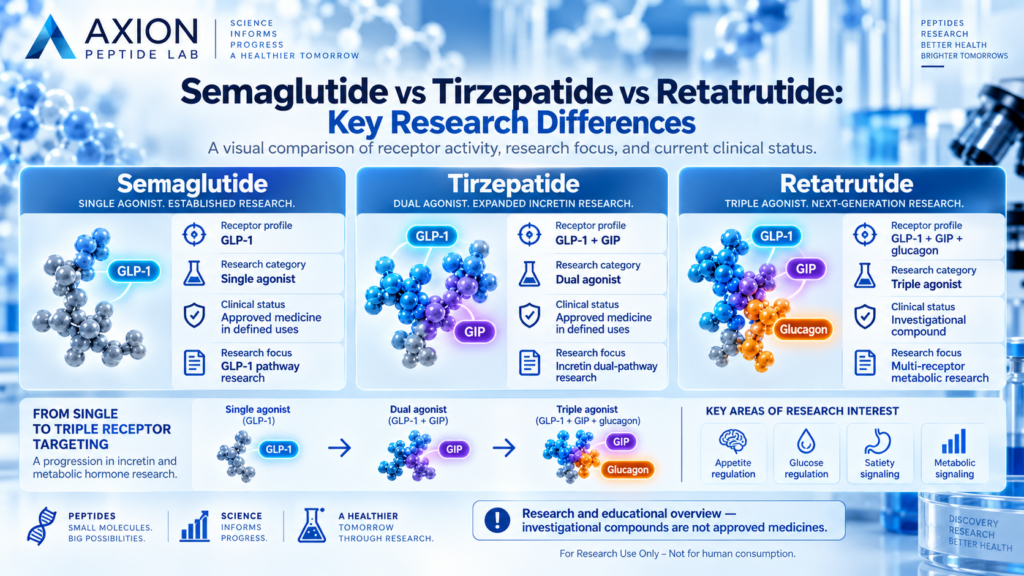
Semaglutide, tirzepatide and retatrutide are frequently discussed together in modern peptides for weight loss research, but they are distinct compounds with different receptor targets, clinical evidence bases and regulatory statuses.
The clearest mechanistic distinction is the number and type of metabolic receptors each compound activates:
- Semaglutide primarily activates the GLP-1 receptor.
- Tirzepatide activates both GIP and GLP-1 receptors.
- Retatrutide activates GIP, GLP-1 and glucagon receptors.
These differences help researchers understand why each compound may influence metabolic pathways differently.
However, receptor count should not be treated as a simple measure of clinical effectiveness. A compound that interacts with more receptors is not automatically safer, more effective or more appropriate than one acting through fewer receptors.
Clinical outcomes need to be assessed from appropriately designed human trials.
Semaglutide vs Tirzepatide vs Retatrutide at a Glance
| Research characteristic | Semaglutide | Tirzepatide | Retatrutide |
| GLP-1 receptor activity | Yes | Yes | Yes |
| GIP receptor activity | No | Yes | Yes |
| Glucagon receptor activity | No | No | Yes |
| General receptor profile | Single agonist | Dual agonist | Triple agonist |
| Major obesity research programme | STEP | SURMOUNT | TRIUMPH |
| Licensed weight-management products | Yes, in defined jurisdictions/indications | Yes, in defined jurisdictions/indications | No, investigational as of September 2026 |
| Laboratory research materials equivalent to licensed medicines? | No | No | No |
In the United States, specific semaglutide and tirzepatide products have FDA-authorised weight-management indications. Retatrutide, by contrast, remains investigational and is not currently FDA-approved.
In the UK, NICE guidance includes both semaglutide and tirzepatide among medicine options for weight management under defined eligibility and prescribing conditions.
Semaglutide: Single GLP-1 Receptor Agonism
Semaglutide acts primarily through the GLP-1 receptor.
GLP-1 receptor signalling is associated with several metabolic processes, including:
- Glucose-dependent insulin secretion
- Glucagon regulation
- Appetite signalling
- Satiety
- Gastrointestinal activity
Semaglutide has been evaluated through a large clinical-development programme, including the STEP trials in obesity and weight management.
Specific pharmaceutical formulations of semaglutide have received regulatory authorisation for defined clinical indications.
This means semaglutide occupies two very different contexts that should never be confused:
Pharmaceutical semaglutide refers to regulated prescription products produced under defined manufacturing and regulatory requirements.
Research semaglutide refers to material intended for controlled laboratory investigation.
A Certificate of Analysis can help characterise the second category, but it cannot transform a laboratory research material into the first.
Tirzepatide: Dual GIP and GLP-1 Receptor Agonism
Tirzepatide expands on incretin-based research by activating both:
- GIP receptors
- GLP-1 receptors
This makes it a dual-receptor agonist.
Its major weight-management clinical programme, SURMOUNT, has investigated outcomes including changes in body weight, metabolic measures and adverse events.
In the United States, the FDA approved Zepbound, containing tirzepatide, for chronic weight management in defined adult populations in 2023.
NICE also recommends tirzepatide as an option for weight management for eligible people within defined UK pathways.
Again, those regulatory decisions apply to specific pharmaceutical products.
A laboratory sample labelled tirzepatide should not be described as Zepbound or Mounjaro simply because analytical testing confirms that its molecular identity is consistent with tirzepatide.
Retatrutide: Triple GIP, GLP-1 and Glucagon Receptor Agonism
Retatrutide represents a further development in multi-receptor metabolic research.
It activates:
- GIP receptors
- GLP-1 receptors
- Glucagon receptors
The published Phase 2 obesity trial identified retatrutide as an agonist of all three receptor systems.
This triple-receptor profile distinguishes retatrutide mechanistically from both semaglutide and tirzepatide.
However, its regulatory status is also substantially different.
As of September 2026, retatrutide remains investigational and is not FDA-approved. Lilly states that its safety and efficacy continue to be evaluated through clinical trials.
For this reason, retatrutide should not be referred to as an approved weight-loss medicine.
Why the Number of Receptors Does Not Tell the Whole Story
It can be tempting to describe the compounds as a simple progression:
One receptor → two receptors → three receptors
But this oversimplifies the science.
The biological effects of a compound depend on factors including:
- Receptor potency
- Relative activity at each receptor
- Pharmacokinetics
- Dose exposure
- Molecular structure
- Trial population
- Treatment duration
- Adverse-event profile
Two compounds targeting the same receptor can still produce different clinical effects because their pharmacological properties are not identical.
Similarly, adding another receptor target introduces additional biological activity rather than automatically creating a superior compound.
Can Clinical Weight-Loss Percentages Be Compared Directly?
Researchers should be cautious about directly comparing headline percentages from separate clinical trials.
For example, the STEP, SURMOUNT and TRIUMPH programmes have not necessarily used identical:
- Patient populations
- Inclusion criteria
- Treatment durations
- Dose schedules
- Statistical methods
- Lifestyle interventions
- Primary endpoints
A larger numerical weight reduction reported in one trial therefore should not automatically be interpreted as proof that one compound is superior to another.
The strongest clinical comparisons generally come from appropriately designed head-to-head trials conducted under comparable conditions.
This distinction is particularly important when online discussions present trial percentages without explaining how the studies differed.
Differences in Regulatory Status
The regulatory distinction between the three compounds is one of the most important points for researchers and readers.
Semaglutide
Specific semaglutide formulations are regulated prescription medicines for defined indications in the United States and United Kingdom.
In March 2026, the FDA also authorised a higher-dose Wegovy formulation for certain adults requiring weight management.
Tirzepatide
Specific tirzepatide pharmaceutical products also have authorised uses.
The FDA approved Zepbound for chronic weight management in defined adults in November 2023.
NICE guidance likewise includes tirzepatide within UK weight-management pathways for eligible patients.
Retatrutide
Retatrutide remains under clinical investigation.
Lilly’s July 2026 information describes it as an investigational triple hormone receptor agonist and states that it is not currently FDA-approved.
Positive clinical-trial findings do not themselves constitute regulatory approval.
Research Materials vs Approved Pharmaceutical Products
This distinction becomes especially important when these compounds appear in research-peptide catalogues.
A laboratory research material and an approved medicine may contain a compound with the same chemical name while still belonging to completely different regulatory categories.
An approved pharmaceutical product is evaluated within a framework that can include:
- Manufacturing controls
- Defined formulation
- Pharmaceutical specifications
- Stability testing
- Clinical safety
- Clinical efficacy
- Approved indications
- Packaging requirements
- Regulatory inspections
- Ongoing pharmacovigilance
A research-use peptide is supplied for scientific investigation rather than clinical treatment.
The presence of a COA does not eliminate this distinction.
How Would Their COAs Differ?
From an analytical perspective, researchers might evaluate all three compounds using similar types of documentation.
A research COA may report:
- Compound name
- Batch number
- HPLC purity
- Expected molecular weight
- Observed molecular weight
- Mass spectrometry results
- Test method
- Date of analysis
The fundamental principles of COA interpretation remain the same regardless of whether the sample is semaglutide, tirzepatide or retatrutide.
Researchers should ask:
Does the COA correspond to the actual batch?
Is chromatographic purity properly documented?
Is molecular identity supported by an appropriate analytical technique?
Are specifications clearly separated from measured results?
Can the analytical data be traced to the material supplied?
A 99% COA Does Not Make the Three Compounds Equivalent
Suppose three laboratory samples each report:
HPLC Purity: 99%
One contains semaglutide, one tirzepatide and one retatrutide.
Those identical purity numbers do not mean that the compounds are biologically equivalent.
HPLC purity describes an analytical characteristic of each sample.
It does not describe:
- Which receptors the compound activates
- Clinical efficacy
- Clinical safety
- Regulatory status
- Pharmaceutical formulation
- Approved indications
This is one of the most important lessons when interpreting peptide Certificates of Analysis.
Analytical purity and biological activity are different concepts.
Molecular Structure Matters
Semaglutide, tirzepatide and retatrutide are distinct molecules.
Their structural differences influence properties including:
- Receptor interactions
- Molecular mass
- Pharmacokinetics
- Biological activity
This means researchers should not assume that analytical data for one compound can be applied to another.
Each research material should have documentation corresponding specifically to that molecule and batch.
Why Identity Testing Is Especially Important
Because these compounds can all be discussed within the same metabolic-research category, accurate identity testing is important.
A vial containing a highly pure substance is scientifically useful only if researchers know what that substance actually is.
A combination of analytical techniques may therefore be used.
For example:
HPLC can help evaluate chromatographic purity.
Mass spectrometry can provide molecular-mass information supporting identity.
LC-MS can connect chromatographic separation with mass-based detection.
When interpreted appropriately, these tests provide a more informative analytical picture than a purity percentage alone.
Differences in Clinical Evidence
All three compounds have substantial scientific interest, but their evidence bases remain at different stages.
Semaglutide has undergone extensive Phase 3 development and has authorised clinical uses.
Tirzepatide has similarly completed major clinical programmes and has authorised uses for specific populations.
Retatrutide has published Phase 2 evidence and continues through a substantial Phase 3 programme, but remains investigational as of September 2026.
This distinction demonstrates why readers should always check when an article was published or updated.
Regulatory status can change as clinical-development programmes progress.
Semaglutide, Tirzepatide and Retatrutide Should Not Be Ranked From Mechanism Alone
It would be scientifically inappropriate to conclude that:
- Semaglutide is automatically weaker because it targets one receptor
- Tirzepatide is automatically better because it targets two
- Retatrutide is automatically best because it targets three
Receptor biology does not provide that type of simple ranking.
Meaningful comparisons require consideration of:
- Controlled clinical evidence
- Patient populations
- Safety findings
- Trial duration
- Outcomes measured
- Regulatory evaluation
The appropriate interpretation depends on the specific scientific or clinical question being asked.
Why These Differences Matter for Peptides for Weight Loss Research
Semaglutide, tirzepatide and retatrutide demonstrate how the field of peptides for weight loss research has expanded from single-pathway incretin signalling toward increasingly complex multi-receptor strategies.
The comparison can be summarised mechanistically as:
Semaglutide → GLP-1
Tirzepatide → GIP + GLP-1
Retatrutide → GIP + GLP-1 + glucagon
But researchers should combine this mechanistic understanding with the equally important distinctions in clinical evidence and regulatory status.
What Researchers Should Take Away From the Comparison
For laboratory researchers, the major lessons are straightforward.
Semaglutide, tirzepatide and retatrutide:
- Are different molecules
- Have different receptor profiles
- Require compound-specific analytical documentation
- Have different clinical-development histories
- Do not currently share identical regulatory status
- Should not be compared solely using headline trial percentages
- Should never be treated as interchangeable because they appear in the same metabolic research category
A peptide Certificate of Analysis can help determine whether a particular research sample has analytical characteristics consistent with the intended compound.
It cannot determine which compound is the preferred medical treatment or establish that research-use material is equivalent to a licensed pharmaceutical product.
Researchers investigating GLP-1, GIP or glucagon-related pathways can review appropriate laboratory research materials and associated analytical documentation through the Axion Peptide Lab research catalogue.
For Research Use Only – Not for human consumption.
Why COAs Matter When Researching Metabolic Peptides
Certificates of Analysis are particularly important in metabolic peptide research because laboratories need to know what material they are studying, which batch it came from, and what analytical characteristics have been reported for that batch.
This becomes especially relevant when researchers are working with compounds connected to GLP-1, GIP, glucagon and other metabolic pathways.
For studies involving semaglutide, tirzepatide, retatrutide or other peptide-based research compounds, a peptide COA can provide important information about identity, chromatographic purity, molecular weight and batch traceability.
However, a COA should always be understood within its proper role.
It is an analytical document.
It does not prove clinical effectiveness, medical approval or suitability for human use.
COAs Help Confirm Which Research Material Is Being Studied
The first purpose of a COA is to help researchers connect analytical results with a specific compound and batch.
A laboratory may be studying a peptide because of its activity at a particular metabolic receptor.
For example:
- Semaglutide is associated with GLP-1 receptor research.
- Tirzepatide is associated with GIP and GLP-1 receptor research.
- Retatrutide is associated with GIP, GLP-1 and glucagon receptor research.
If the material used in an experiment is incorrectly identified or poorly characterised, the resulting data may become difficult to interpret.
A COA can therefore help establish that the research material is consistent with the compound the laboratory intends to investigate.
Why Batch Traceability Matters
Peptide research materials may be manufactured in multiple batches.
Even when the compound name remains the same, each production batch has its own analytical history.
A batch-specific COA may contain:
- Batch or lot number
- Test date
- HPLC purity
- Mass spectrometry data
- Expected molecular weight
- Observed molecular weight
- Product identification
This information allows researchers to document exactly which batch was used in an experiment.
That can be valuable when:
- Repeating experiments
- Comparing laboratory results
- Investigating unexpected findings
- Reviewing historical data
- Comparing different production lots
Without clear batch traceability, researchers may have difficulty linking experimental outcomes to the material that was actually tested.
Purity Can Affect Experimental Interpretation
Purity is an important consideration when designing controlled laboratory experiments.
If a sample contains significant quantities of additional detectable components, those components could potentially complicate interpretation of experimental results.
For this reason, researchers commonly review HPLC purity data when assessing peptide research materials.
An HPLC chromatogram can provide information about:
- The dominant chromatographic component
- Secondary peaks
- Relative peak areas
- Retention behaviour
- Overall chromatographic profile
The purity result can therefore contribute to the broader characterisation of the research material.
However, the purity percentage should not be interpreted as a complete quality assessment on its own.
Identity Is Just as Important as Purity
A highly pure sample is only useful scientifically if researchers also know what the primary component actually is.
For example, a sample could theoretically produce a dominant HPLC peak while still requiring additional testing to confirm that the main component is the intended peptide.
This is why researchers may also review mass spectrometry or LC-MS data.
These methods can help determine whether the observed molecular mass is consistent with the expected compound.
In metabolic peptide research, this distinction is particularly important because several compounds may be studied within the same broad biological pathway while having different molecular structures and receptor profiles.
A COA Supports Experimental Reproducibility
Reproducibility is fundamental to scientific research.
If a laboratory performs an experiment and later attempts to repeat it, researchers need accurate records describing the materials originally used.
Relevant documentation may include:
- Supplier
- Compound name
- Batch number
- Purity result
- Analytical method
- Storage conditions
- Experimental concentration
- Date of use
A COA provides part of this information.
This can help researchers compare results over time and identify whether differences between experiments may be related to different batches or research materials.
Why This Matters in GLP-1 Research
GLP-1-related research has expanded substantially in recent years.
Laboratories may investigate:
- Receptor binding
- Signal transduction
- Cellular responses
- Metabolic pathways
- Molecular stability
- Structure-function relationships
In these experiments, the identity and analytical characteristics of the research material can influence the reliability of the results.
A COA can help researchers document that the material used in a GLP-1-related experiment corresponds with the expected compound and reported batch.
Why COAs Matter in GIP and Multi-Receptor Research
The importance of analytical documentation becomes even more apparent when comparing compounds with different receptor profiles.
For example:
Semaglutide primarily targets GLP-1 receptors.
Tirzepatide targets GIP and GLP-1 receptors.
Retatrutide is being investigated for activity at GIP, GLP-1 and glucagon receptors.
If researchers compare these compounds experimentally, accurate material identification becomes essential.
A mislabeled or incorrectly identified sample could potentially lead to misleading conclusions about receptor activity.
COA documentation therefore contributes to the basic quality-control framework supporting experimental work.
COAs Can Help With Batch-to-Batch Comparison
Researchers may sometimes work with the same peptide over extended periods.
Different batches can then be compared using analytical information.
Useful comparisons may include:
- HPLC purity
- Chromatographic profile
- Molecular-weight data
- Test dates
- Sample appearance
- Other documented analytical characteristics
Consistent documentation allows laboratories to determine whether later batches appear analytically similar to earlier ones.
This can support long-term experimental consistency.
Why COAs Matter for Research Peptide Suppliers
For researchers evaluating a peptide supplier, analytical transparency can be an important consideration.
A research-focused supplier should ideally provide clear information about:
- Product identity
- Intended research use
- Batch information
- Analytical testing
- Available COA documentation
This is more useful than relying entirely on general marketing statements such as “high purity” without supporting analytical information.
Researchers reviewing materials from Axion Peptide Lab can consider available product documentation alongside their own laboratory requirements when selecting compounds for legitimate research.
A COA Does Not Prove Clinical Effectiveness
One of the most important limitations of a peptide COA is that it does not provide clinical evidence.
A Certificate of Analysis may help answer questions such as:
Is the material analytically consistent with the expected compound?
What chromatographic purity was reported?
Which batch was tested?
It cannot answer questions such as:
- Does the compound cause weight loss in humans?
- Is it medically approved?
- What dose should be used clinically?
- Is it safe for self-administration?
- Is it equivalent to a prescription medicine?
These questions require completely different types of evidence.
Analytical Evidence vs Clinical Evidence
The distinction can be simplified as follows:
Analytical evidence evaluates the research material itself.
Examples include:
- HPLC
- Mass spectrometry
- LC-MS
- Molecular-weight testing
Clinical evidence evaluates what happens when a defined pharmaceutical intervention is studied in people.
Examples include:
- Randomised controlled trials
- Phase 2 studies
- Phase 3 studies
- Safety monitoring
- Long-term outcome studies
These two categories of evidence should not be confused.
A COA Does Not Establish Regulatory Approval
Regulatory authorities evaluate much more than chemical purity.
Approval of a medicine may involve extensive review of:
- Manufacturing quality
- Clinical efficacy
- Safety
- Stability
- Pharmacology
- Dosing
- Labelling
- Risk management
- Pharmacovigilance
A peptide research sample can therefore have a detailed COA while still remaining a research-use material.
This point is especially important when discussing investigational compounds such as retatrutide.
Even if a research retatrutide sample shows high HPLC purity and molecular identity consistent with the expected compound, that does not make it an approved medicine.
COAs and Peptides for Weight Loss Research
The term peptides for weight loss is frequently used online, but researchers should approach the topic with greater precision.
Scientific research focuses on individual compounds, receptor systems and experimental questions.
A COA helps support that precision by documenting the specific material used in a study.
For metabolic peptide research, useful analytical information may include:
- Exact compound identity
- Batch number
- HPLC purity
- Molecular mass
- Mass spectrometry
- Test date
- Analytical method
This information helps laboratories distinguish between different research compounds that may otherwise be grouped together under the broad label of “weight-loss peptides.”
Good Research Begins With Well-Characterised Materials
Reliable science depends partly on the quality of the materials used to generate experimental data.
A well-documented research peptide gives laboratories a stronger foundation for:
- Reproducibility
- Experimental planning
- Data interpretation
- Batch comparison
- Recordkeeping
A COA is therefore not simply a marketing document.
When properly prepared and interpreted, it can form an important part of laboratory quality documentation.
For legitimate research involving metabolic peptides, researchers can review relevant research materials and associated analytical information through the Axion Peptide Lab research catalogue.
The analytical documentation should always be evaluated alongside the intended research purpose, experimental design and laboratory quality requirements.
For Research Use Only – Not for human consumption.
What Does Clinical Research Actually Show About Peptides for Weight Loss?
Clinical research into peptides for weight loss has expanded rapidly, particularly around compounds that act on GLP-1, GIP and glucagon-related pathways. However, not every scientific result carries the same level of evidence.
A laboratory experiment, animal study, Phase 2 trial and Phase 3 trial answer very different questions.
Understanding these differences is essential when interpreting claims about semaglutide, tirzepatide, retatrutide and other metabolic peptide compounds.
It is also important to separate evidence about a defined pharmaceutical product studied in humans from analytical information about a laboratory research material.
A peptide Certificate of Analysis may document purity or identity. It does not provide evidence that the material causes weight loss in humans.
Preclinical Research: Understanding Biological Mechanisms
Before a compound reaches large human trials, researchers typically investigate its biological properties in preclinical models.
Preclinical research can include:
- Cell-based studies
- Receptor-binding experiments
- Biochemical assays
- Animal studies
- Pharmacology studies
- Toxicology studies
These experiments help researchers understand questions such as:
- Which receptor does the compound activate?
- How strongly does it interact with the receptor?
- What signalling pathways are triggered?
- How long does the compound remain active?
- What biological effects appear in experimental models?
Preclinical studies are extremely valuable for understanding mechanisms.
However, they cannot establish that the same effects will occur to the same degree in humans.
Phase 1 Clinical Trials
Phase 1 studies are generally among the earliest stages of human clinical research.
They often examine areas such as:
- Safety
- Tolerability
- Pharmacokinetics
- Pharmacodynamics
- Dose exposure
Researchers may investigate how the body processes the compound and what short-term biological effects occur at different exposures.
Phase 1 studies are usually smaller than later clinical trials.
Positive Phase 1 findings can justify further research, but they do not establish that a compound is an effective long-term weight-management treatment.
Phase 2 Clinical Trials
Phase 2 studies generally involve larger groups and begin to provide more detailed information about efficacy, dose response and safety.
Retatrutide provides a useful example.
A Phase 2 trial published in the New England Journal of Medicine enrolled 338 adults with obesity, or overweight plus a weight-related condition, and studied multiple retatrutide doses for 48 weeks.
At 48 weeks, the reported mean body-weight changes ranged from approximately −8.7% at the 1 mg dose to −24.2% at the 12 mg dose, compared with approximately −2.1% with placebo. Gastrointestinal adverse events were the most common, and dose-dependent increases in heart rate were also observed.
These findings demonstrated substantial activity in a controlled research setting and supported progression into larger Phase 3 studies.
However, a successful Phase 2 trial does not itself constitute regulatory approval.
Phase 3 Clinical Trials
Phase 3 trials generally involve larger populations and are designed to provide more robust evidence regarding efficacy and safety.
These studies may form a major part of the evidence regulators examine when considering whether to approve a medicine.
Semaglutide and tirzepatide both have large Phase 3 obesity programmes.
For semaglutide, one of the best-known studies is STEP 1.
The trial enrolled 1,961 adults with obesity, or overweight plus a weight-related condition, without diabetes. Participants received semaglutide 2.4 mg or placebo alongside lifestyle intervention for 68 weeks.
Mean body-weight change at week 68 was approximately −14.9% with semaglutide compared with −2.4% with placebo.
For tirzepatide, the SURMOUNT-1 Phase 3 trial enrolled 2,539 adults with obesity, or overweight plus at least one weight-related complication, without diabetes.
Participants received tirzepatide or placebo for 72 weeks. The trial reported substantial and sustained body-weight reductions across tirzepatide treatment groups, while gastrointestinal events were the most commonly reported adverse effects.
What These Trials Actually Demonstrate
Trials such as STEP 1 and SURMOUNT-1 provide strong evidence that specific studied pharmaceutical formulations can produce clinically significant average weight reduction in defined populations under controlled trial conditions.
They do not demonstrate that:
- Every individual will experience the same result
- Every compound sharing the same name is equivalent
- Research-use material will behave like the pharmaceutical product
- Higher HPLC purity produces greater weight loss
- All peptide compounds have similar effects
The clinical result belongs to the specific intervention, dose, formulation, patient population and study protocol that were investigated.
This distinction is critical.
Clinical Trial Results Are Population Averages
When a clinical trial reports an average percentage change in body weight, that number does not describe every participant.
Some participants may lose more weight.
Some may lose less.
Some may discontinue treatment because of adverse effects or other factors.
Clinical trial averages therefore describe outcomes across groups rather than predicting an individual outcome.
Researchers should also examine:
- Confidence intervals
- Treatment discontinuations
- Missing data methods
- Adverse-event rates
- Participant characteristics
- Duration of follow-up
A headline percentage alone does not provide the full scientific picture.
Why Separate Trials Should Not Be Compared Like a Race
Semaglutide, tirzepatide and retatrutide studies are often compared online using the largest reported weight-loss percentages.
This can be misleading.
STEP 1, SURMOUNT-1 and the retatrutide Phase 2 trial differed in areas such as:
- Trial duration
- Number of participants
- Dose regimens
- Eligibility criteria
- Study phase
- Statistical analysis
- Treatment protocols
For this reason, a larger percentage reported in one trial does not automatically prove that the compound is clinically superior to another.
Direct comparisons are strongest when compounds are studied in carefully designed head-to-head clinical trials under similar conditions.
Clinical Research Also Measures Safety
Clinical trials do not simply ask whether body weight changes.
They also evaluate adverse effects and treatment tolerability.
For example, gastrointestinal adverse events were prominent in the major semaglutide, tirzepatide and retatrutide studies discussed in this article.
Researchers may examine:
- Nausea
- Vomiting
- Diarrhoea
- Constipation
- Abdominal symptoms
- Treatment discontinuation
- Serious adverse events
- Laboratory findings
- Changes in vital signs
The balance between benefit and risk is a major part of regulatory evaluation.
Regulatory Approval Is a Separate Step
Even successful Phase 3 trials do not automatically mean a product is approved.
Regulatory authorities review a much broader evidence package.
This may include:
- Clinical efficacy
- Safety
- Manufacturing controls
- Pharmaceutical quality
- Stability
- Dose selection
- Product labelling
- Risk-management information
Specific semaglutide and tirzepatide medicines have completed regulatory pathways for defined indications.
For example, the FDA approved Zepbound (tirzepatide) for chronic weight management in certain adults in November 2023.
Retatrutide remains investigational as of September 2026 despite substantial clinical-development progress.
Published Research vs Regulatory Status
Researchers should distinguish between four different statements:
“This compound showed an effect in a study.”
“This compound completed a Phase 3 trial.”
“A regulator reviewed the evidence.”
“A specific pharmaceutical product has been approved for a defined indication.”
These statements are not interchangeable.
A compound can produce promising results in a clinical trial without yet having regulatory approval.
Peer-Reviewed Publications Matter
Peer-reviewed journal articles provide substantially more detail than headlines, marketing materials or social-media summaries.
A strong scientific evaluation should consider:
- Trial design
- Number of participants
- Eligibility criteria
- Study duration
- Dose groups
- Primary endpoints
- Statistical methods
- Adverse events
- Limitations
- Funding sources
Publications in journals such as the New England Journal of Medicine provide detailed methods and results that allow researchers to examine the evidence more carefully.
Manufacturer Announcements vs Full Publications
Clinical-development companies may announce topline results before the complete trial is published.
These announcements can provide useful early information, particularly about whether a trial met its primary endpoint.
However, a press release generally contains less methodological detail than a complete peer-reviewed publication.
Researchers should therefore distinguish between:
- Topline company announcements
- Conference abstracts
- Full trial publications
- Regulatory reviews
The level of detail and independent scientific scrutiny differs between these sources.
What Does the Evidence Show for Semaglutide?
The STEP programme provides extensive clinical evidence that pharmaceutical semaglutide can produce meaningful average body-weight reductions in selected populations when used under the conditions studied.
In STEP 1, average weight change was approximately −14.9% after 68 weeks, compared with −2.4% with placebo.
This evidence relates to the studied pharmaceutical intervention.
It should not be transferred automatically to research-use semaglutide material.
What Does the Evidence Show for Tirzepatide?
The SURMOUNT programme has provided strong Phase 3 evidence for tirzepatide in obesity and weight-management research.
SURMOUNT-1 demonstrated substantial sustained weight reduction across tirzepatide groups over 72 weeks in adults without diabetes.
These and subsequent clinical-development data contributed to regulatory approval of specific tirzepatide pharmaceutical products for defined weight-management indications.
Again, this evidence relates to regulated formulations used in clinical trials.
What Does the Evidence Show for Retatrutide?
Retatrutide’s peer-reviewed Phase 2 obesity trial demonstrated a clear dose-related reduction in average body weight over 48 weeks, with the highest-dose group showing a mean reduction of approximately 24.2%.
These findings were scientifically significant and justified further development.
However, retatrutide remains investigational as of September 2026.
The correct interpretation is therefore:
Retatrutide has demonstrated substantial weight reduction in clinical trials, but it is still undergoing clinical development and should not be described as an approved weight-loss medicine.
What Clinical Research Does Not Tell Us About Research Peptide Vials
Clinical trials involving regulated pharmaceutical products do not validate every research material sold under the same compound name.
For example, a clinical trial of pharmaceutical semaglutide does not establish the safety or efficacy of an unrelated research-use semaglutide sample.
Clinical trial products are produced according to defined manufacturing and study requirements.
Research materials must therefore remain clearly separated from prescription medicines.
COA Evidence and Clinical Evidence Answer Different Questions
This distinction connects directly back to the central topic of this guide.
A peptide Certificate of Analysis may answer:
- What compound was tested?
- Which batch was analysed?
- What HPLC purity was reported?
- Was molecular mass consistent with the expected molecule?
Clinical research answers very different questions:
- Does a defined intervention produce a measurable effect in humans?
- How large is the effect?
- What adverse events occur?
- How does it compare with placebo or another treatment?
- What happens over time?
A COA cannot replace a clinical trial.
Likewise, a clinical trial does not automatically verify the analytical quality of an unrelated commercial research sample.
What Researchers Should Take Away From the Evidence
The strongest conclusion from current metabolic peptide research is not simply that “peptides cause weight loss.”
The evidence is much more specific.
Certain well-defined compounds acting through GLP-1, GIP and related receptor pathways have demonstrated meaningful effects on body weight in controlled human trials.
But each compound must be evaluated according to:
- Its receptor profile
- Study phase
- Trial population
- Formulation
- Duration
- Safety findings
- Regulatory status
Semaglutide and tirzepatide have specific licensed pharmaceutical uses, while retatrutide remains investigational as of September 2026.
Laboratory researchers studying these pathways should therefore keep analytical quality, clinical evidence and regulatory approval as three separate concepts.
Researchers reviewing laboratory materials through the Axion Peptide Lab research catalogue should use COAs and related analytical documentation to assess research quality, not as evidence of human therapeutic effectiveness.
For Research Use Only – Not for human consumption.
Safety and Reported Adverse Effects in Clinical Research
Safety is a central part of research into peptides for weight loss and incretin-based medicines. Clinical trials do not examine weight reduction alone; they also record adverse events, treatment discontinuations, laboratory abnormalities and potentially serious complications.
This is especially important when discussing semaglutide, tirzepatide and retatrutide because their safety evidence comes from different stages of clinical development.
Semaglutide and tirzepatide have licensed pharmaceutical products with established prescribing information and ongoing post-marketing safety monitoring. Retatrutide, by contrast, remains investigational as of September 2026, meaning its complete long-term safety profile has not yet been established.
Gastrointestinal Adverse Effects Are Commonly Reported
Across clinical research involving GLP-1 and related receptor agonists, gastrointestinal adverse events are among the most frequently reported side effects.
These can include:
- Nausea
- Diarrhoea
- Vomiting
- Constipation
- Abdominal pain or discomfort
- Dyspepsia
- Abdominal bloating
The frequency and severity of these events vary between compounds, doses, study populations and treatment periods.
For many incretin-based treatments, gastrointestinal symptoms occur more commonly during periods when treatment exposure is being increased.
Safety Findings With Semaglutide
Current US prescribing information for Wegovy identifies nausea, diarrhoea, vomiting, constipation and abdominal pain among the commonly reported adverse reactions. It also contains formal warnings and precautions addressing several less common but potentially serious risks.
These include considerations relating to:
- Acute pancreatitis
- Gallbladder disease
- Kidney injury associated with volume depletion
- Hypersensitivity
- Hypoglycaemia in relevant clinical circumstances
- Increased heart rate
- Gastrointestinal reactions
- Pulmonary aspiration during general anaesthesia or deep sedation
The US prescribing information also carries a boxed warning concerning thyroid C-cell tumours based on findings in rodents. The human relevance of those animal findings has not been established.
These warnings relate specifically to regulated pharmaceutical semaglutide products and should not be interpreted as evidence that research-use material has an established clinical safety profile.
Updated UK Safety Information for Semaglutide
Safety information continues to evolve as medicines are used in larger populations.
In February 2026, the UK MHRA updated semaglutide product information regarding a very rare risk of non-arteritic anterior ischaemic optic neuropathy, or NAION, which can cause sudden painless deterioration in vision.
This demonstrates why post-marketing surveillance remains important even after a medicine receives regulatory authorisation.
Clinical trials may involve thousands of participants, but very rare adverse effects sometimes become clearer only after much larger populations have been exposed.
Safety Findings With Tirzepatide
Current FDA prescribing information for Zepbound also identifies gastrointestinal adverse reactions as common.
In pooled weight-reduction studies, gastrointestinal adverse reactions were reported more frequently with tirzepatide than with placebo, and some participants discontinued treatment because of these effects.
The prescribing information also addresses serious risks including:
- Severe gastrointestinal adverse reactions
- Acute kidney injury associated with volume depletion
- Acute gallbladder disease
- Acute pancreatitis
- Hypersensitivity reactions
- Hypoglycaemia
- Thyroid C-cell tumour risk warnings
- Pulmonary aspiration during anaesthesia or deep sedation
Other reactions documented in the trials include injection-site reactions and, in some participants, hair loss associated with weight reduction.
As with semaglutide, these findings relate to defined pharmaceutical tirzepatide products studied in clinical trials and monitored under regulatory systems.
Acute Pancreatitis and Updated UK Warnings
In January 2026, the MHRA strengthened warnings concerning acute pancreatitis for GLP-1 receptor agonists and dual GLP-1/GIP receptor agonists, including semaglutide and tirzepatide.
The regulator noted that acute pancreatitis is a known but infrequent adverse effect and highlighted rare reports of severe, necrotising and fatal cases.
This does not mean that pancreatitis occurs commonly.
It does mean that regulators consider the risk sufficiently important to include clear warnings in authorised medicine information.
This distinction between frequency and seriousness is important when interpreting medicine-safety information.
Gallbladder-Related Events
Gallbladder-related adverse events have also been reported with incretin-based treatments.
These can include conditions such as:
- Gallstones
- Gallbladder inflammation
Several factors may contribute to gallbladder risk, including substantial or rapid weight reduction itself.
For this reason, researchers should distinguish between an adverse event observed during treatment and a simplistic claim that one mechanism alone necessarily caused it.
Clinical safety assessment often requires consideration of multiple contributing factors.
Dehydration and Kidney-Related Events
Persistent vomiting or diarrhoea can contribute to dehydration.
In some circumstances, significant volume depletion may contribute to acute kidney injury.
This is one reason regulated prescribing information does not focus only on the most common symptoms but also examines possible downstream complications.
Current tirzepatide prescribing information, for example, includes acute kidney injury due to volume depletion among its warnings and precautions.
Hypoglycaemia Depends on Clinical Context
GLP-1-related medicines stimulate insulin secretion in a glucose-dependent manner, but the risk of clinically significant hypoglycaemia can be influenced by other treatments and patient characteristics.
For example, hypoglycaemia can become more relevant when incretin medicines are used alongside other glucose-lowering drugs that themselves can produce low blood sugar.
This demonstrates why adverse-event risk should not be considered in isolation from:
- Concomitant medicines
- Underlying disease
- Patient population
- Treatment indication
Clinical safety information is therefore much more detailed than a simple list of side effects.
Retatrutide Safety Findings Remain Investigational
Retatrutide has not yet accumulated the same long-term regulatory safety evidence as authorised semaglutide or tirzepatide medicines.
In its published Phase 2 obesity trial, the most commonly reported adverse events were gastrointestinal, particularly:
- Nausea
- Diarrhoea
- Vomiting
- Constipation
These events were generally dose-related and mostly mild to moderate in severity. They occurred particularly during dose escalation.
Adverse events led to treatment discontinuation in approximately 6% to 16% of participants receiving retatrutide, depending on the dose group, compared with none in the placebo group in that Phase 2 trial.
Heart-Rate Changes With Retatrutide
The same Phase 2 trial reported dose-dependent increases in heart rate.
These increases peaked around week 24 and subsequently declined during the study.
Researchers also monitored cardiac arrhythmias and other cardiovascular safety outcomes.
These findings are important because retatrutide includes glucagon receptor activity in addition to GIP and GLP-1 receptor agonism, and its broader receptor profile requires careful safety assessment through larger and longer studies.
Other Safety Events Observed in Retatrutide Research
The Phase 2 retatrutide trial also recorded several less frequent events of interest, including:
- Hypersensitivity events
- Increased pancreatic enzyme levels
- Biliary events
- Injection-site reactions
- Renal events
- Cardiac rhythm events
- One adjudicated case of pancreatitis
Serious adverse events occurred at similar overall frequencies in the retatrutide and placebo groups in that trial, but the relatively small Phase 2 sample means uncommon risks may require much larger studies to characterise reliably.
This is one reason Phase 3 trials and post-authorisation surveillance are so important.
Why Investigational Safety Data Must Be Interpreted Carefully
A statement such as:
“No major safety signal was identified in a study”
does not mean:
“The compound has been proven completely safe.”
Smaller studies may simply be unable to detect rare adverse events.
Safety knowledge develops progressively through:
- Preclinical testing
- Phase 1 trials
- Phase 2 trials
- Phase 3 trials
- Regulatory review
- Post-marketing pharmacovigilance
Retatrutide has not yet completed the final regulatory and post-marketing stages.
Its safety profile should therefore continue to be described as investigational.
Adverse Events vs Serious Adverse Events
Researchers should also understand the difference between an adverse event and a serious adverse event.
An adverse event is an undesirable medical occurrence during a study.
A serious adverse event generally meets defined criteria such as:
- Death
- Life-threatening illness
- Hospitalisation
- Significant disability
- Other medically important outcomes
A common adverse effect can be unpleasant without necessarily being medically serious.
Conversely, a very rare adverse effect can still be important if its consequences are severe.
Both frequency and severity therefore matter when assessing safety.
Treatment Discontinuation Is an Important Safety Measure
Clinical trials often report how many participants stop treatment because of adverse effects.
This can provide useful information about tolerability.
For example, two treatments may produce similar types of gastrointestinal effects but differ in how frequently those effects cause participants to discontinue therapy.
Researchers should therefore examine more than a simple list of reported symptoms.
Useful safety outcomes include:
- Frequency of adverse events
- Severity
- Dose relationship
- Timing
- Discontinuation rates
- Serious adverse events
- Laboratory abnormalities
Clinical-Trial Safety Does Not Validate Research-Use Products
This distinction is critical for an article about peptide COAs.
Safety findings from a clinical trial involving pharmaceutical semaglutide or tirzepatide cannot automatically be applied to an unrelated research-use product with the same compound name.
A regulated clinical-trial or prescription product has defined characteristics involving:
- Manufacturing
- Formulation
- Quality control
- Stability
- Product specifications
A laboratory research material may have a COA documenting molecular identity and HPLC purity, but that does not establish a corresponding human safety profile.
A COA Cannot Establish Human Safety
A peptide Certificate of Analysis may demonstrate information such as:
- HPLC purity
- Molecular weight
- Identity testing
- Batch number
- Analytical date
None of these measurements answers the clinical question:
Is this material safe for use in humans?
That question requires a very different evidence base.
For example, a research compound could theoretically show 99% chromatographic purity while still lacking:
- Sterility testing
- Endotoxin specifications
- Pharmaceutical manufacturing controls
- Clinical toxicology data
- Validated human dosing
- Regulatory authorisation
A COA should therefore never be presented as a certificate of medical safety.
Side Effects Should Be Attributed to Specific Compounds
Another common mistake is treating all peptides for weight loss as though they share one universal side-effect profile.
They do not.
Safety findings should be discussed in relation to:
- The specific molecule
- The pharmaceutical formulation
- Dose studied
- Trial population
- Clinical indication
- Duration of exposure
Semaglutide safety data should not automatically be assigned to tirzepatide.
Tirzepatide data should not automatically be assigned to retatrutide.
And retatrutide trial findings should not be generalised to every research peptide.
Post-Marketing Monitoring Adds New Information
Approval does not mark the end of medicine-safety research.
Once a licensed medicine is used by much larger populations, regulators continue collecting reports of suspected adverse reactions.
This system is known as pharmacovigilance.
The UK’s 2026 updates concerning pancreatitis and the very rare NAION risk associated with semaglutide illustrate how safety information can continue evolving after approval.
Researchers and publishers should therefore periodically review safety sections to ensure that information remains current.
What Researchers Should Take Away From the Safety Evidence
Current clinical evidence shows that gastrointestinal adverse effects are commonly reported with semaglutide, tirzepatide and investigational retatrutide, although their exact safety profiles differ.
Licensed semaglutide and tirzepatide medicines also carry formal warnings and precautions based on clinical-trial and post-marketing evidence.
Retatrutide remains investigational, and its longer-term safety profile is still being established.
For research purposes, the key distinction is:
A COA documents analytical characteristics. Clinical trials investigate safety and efficacy. Regulatory surveillance monitors risks over time.
These are three different forms of evidence.
Researchers examining peptide materials through the Axion Peptide Lab research catalogue should therefore use Certificates of Analysis for appropriate laboratory quality assessment rather than interpreting them as evidence of medical safety.
For Research Use Only – Not for human consumption.
Research Peptides vs Prescription Medicines
One of the most important distinctions in any discussion about peptides for weight loss is the difference between a laboratory research peptide and a licensed prescription medicine.
These categories may sometimes involve compounds with the same or similar chemical names, but they are not interchangeable.
A research peptide is supplied for scientific investigation, laboratory analysis or experimental study. A prescription medicine, by contrast, is a regulated pharmaceutical product that has been evaluated and authorised for specific clinical uses.
This difference affects manufacturing standards, formulation, labelling, regulatory oversight, clinical evidence and intended use.
Understanding this distinction is essential when interpreting a peptide Certificate of Analysis.
What Is a Research Peptide?
A research peptide is a peptide material intended for controlled laboratory or scientific investigation.
Researchers may use these materials to study areas such as:
- Receptor activity
- Cellular signalling
- Molecular interactions
- Stability
- Structure-function relationships
- Analytical chemistry
- Metabolic pathways
Research peptides may be accompanied by analytical documentation such as:
- Certificate of Analysis
- HPLC chromatogram
- Mass spectrometry data
- LC-MS results
- Molecular-weight information
- Batch or lot number
These documents can help researchers characterise the material used in an experiment.
However, analytical documentation does not change the intended use of the material.
A product labelled For Research Use Only should remain within the laboratory research context.
What Is a Prescription Medicine?
A prescription medicine is a pharmaceutical product authorised by an appropriate regulatory authority for one or more defined clinical indications.
Before authorisation, regulators generally evaluate a broad evidence package that can include:
- Pharmaceutical quality
- Manufacturing controls
- Stability
- Preclinical evidence
- Clinical safety
- Clinical efficacy
- Dose selection
- Product formulation
- Labelling
- Risk-management information
After approval, medicines may also remain subject to:
- Pharmacovigilance
- Manufacturing inspections
- Safety updates
- Label changes
- Ongoing regulatory oversight
This process is substantially broader than analytical testing of a peptide sample.
The Same Compound Name Does Not Mean the Same Product
This is one of the most important concepts for researchers to understand.
A research material and a prescription medicine may both be described using a compound name such as:
- Semaglutide
- Tirzepatide
But this does not mean the products are equivalent.
A licensed pharmaceutical product has a defined:
- Formulation
- Manufacturing process
- Specification
- Stability profile
- Packaging system
- Approved indication
- Regulatory history
A laboratory research material may instead be characterised primarily for experimental use.
Therefore:
Research semaglutide is not automatically Wegovy or Ozempic.
Research tirzepatide is not automatically Zepbound or Mounjaro.
The chemical name alone does not establish pharmaceutical equivalence.
Investigational Compounds Form a Third Category
Some peptide-based compounds are neither ordinary research materials nor approved prescription medicines.
Instead, they may be investigational compounds undergoing clinical development.
Retatrutide is an important current example.
Clinical-development compounds may be studied in Phase 1, Phase 2 or Phase 3 trials while researchers collect evidence regarding:
- Safety
- Efficacy
- Pharmacokinetics
- Pharmacodynamics
- Dosing
- Long-term outcomes
Until a regulator authorises a defined pharmaceutical product for a clinical indication, an investigational compound should not be described as an approved medicine.
This distinction remains important even when clinical trials report promising results.
What Does a COA Tell Researchers?
A peptide Certificate of Analysis can provide useful information about the analytical properties of research material.
Depending on the testing performed, a COA may include:
- Product identification
- Batch number
- HPLC purity
- Molecular weight
- Mass spectrometry
- Analytical method
- Test date
These results can support laboratory quality assessment and traceability.
For example, a researcher may use a COA to determine whether a supplied batch has an HPLC profile and molecular mass consistent with the expected compound.
What a COA Does Not Tell Researchers
A COA should not be interpreted as evidence that a material is a licensed pharmaceutical product.
A Certificate of Analysis does not by itself establish:
- Regulatory approval
- Clinical efficacy
- Human safety
- Approved dosing
- Bioequivalence
- Pharmaceutical sterility
- Approved formulation
- Therapeutic suitability
This is one of the most important limitations of COA interpretation.
A high purity percentage does not convert a laboratory research product into a medicine.
HPLC Purity Is Not Pharmaceutical Approval
A peptide research material may report:
HPLC Purity: 99%
That result may be useful for laboratory characterisation.
It does not mean:
“This product is 99% equivalent to an approved medicine.”
The HPLC result describes chromatographic composition under a specific analytical method.
Regulatory approval involves a completely different set of questions.
These include whether a defined product has demonstrated sufficient:
- Quality
- Safety
- Efficacy
- Manufacturing consistency
for a specific clinical use.
Pharmaceutical Quality Involves More Than Peptide Purity
A licensed injectable medicine, for example, may require control over characteristics far beyond HPLC purity.
Depending on the product, quality considerations can include:
- Sterility
- Endotoxin control
- Particulate matter
- Container integrity
- Stability
- Preservatives or excipients
- Concentration accuracy
- Manufacturing environment
- Microbiological quality
A peptide COA reporting identity and purity does not automatically address all of these characteristics.
Researchers should therefore avoid using the phrase “pharmaceutical grade” unless the claim is specifically justified within an appropriate regulatory and manufacturing context.
Why Formulation Matters
A pharmaceutical product is more than its active compound.
Its formulation may include:
- Active ingredient
- Excipients
- Buffers
- Preservatives
- Stabilising agents
- Defined concentration
- Specific delivery system
These components can influence properties such as:
- Stability
- Shelf life
- Delivery
- Storage requirements
- Product performance
A laboratory research material may not use the same formulation as an approved medicine.
This is another reason why the presence of the same active compound name does not make the products interchangeable.
Manufacturing Standards Matter
Prescription medicines are manufactured within regulated pharmaceutical quality systems.
Manufacturing controls are intended to help ensure consistency from batch to batch.
A regulator may review areas including:
- Raw materials
- Manufacturing procedures
- Quality-control testing
- Contamination controls
- Batch release
- Stability
- Documentation
A research supplier may also perform substantial analytical testing, but a research-use product should not be presented as equivalent to an authorised pharmaceutical product unless that status has actually been established.
Clinical Evidence Applies to the Product That Was Studied
Another important distinction involves clinical-trial evidence.
If a controlled trial studies a particular pharmaceutical semaglutide formulation, the trial results apply to the intervention that was actually studied.
They do not automatically validate every commercial research material labelled semaglutide.
The same principle applies to tirzepatide and investigational compounds.
Clinical evidence depends on factors including:
- Formulation
- Manufacturing
- Dose
- Patient population
- Trial conditions
- Treatment duration
Research materials supplied for laboratory use therefore should not borrow clinical claims from prescription products.
Research Use Only Means Research Use Only
A product carrying the statement:
For Research Use Only – Not for human consumption
should be treated according to that designation.
It should not be marketed or described as:
- A treatment
- A medicine
- A prescription substitute
- A self-administration product
- A clinical alternative
Research-use labelling helps establish the intended scientific context.
For legitimate researchers, these materials may be used to study molecular and biological questions in controlled laboratory environments.
Why This Distinction Matters for Weight-Loss Peptide Searches
People searching online for peptides for weight loss may encounter very different categories of information.
They may see:
- Licensed GLP-1 medicines
- Clinical trial compounds
- Laboratory research peptides
- Scientific publications
- Commercial research catalogues
Without clear terminology, these categories can become blurred.
An authoritative scientific article should therefore make clear whether it is discussing:
- A biological molecule
- A research sample
- An investigational clinical compound
- An authorised prescription medicine
This distinction improves both scientific accuracy and reader understanding.
Semaglutide as an Example
Semaglutide illustrates the distinction particularly well.
The molecule has been extensively studied in clinical development, and specific pharmaceutical semaglutide products are licensed for defined medical indications.
At the same time, semaglutide may also appear as a laboratory research material.
A research COA could show:
- HPLC purity
- Molecular mass
- Batch information
but it would not establish that the research material is interchangeable with a licensed semaglutide medicine.
Tirzepatide as an Example
Tirzepatide provides a similar example.
Specific tirzepatide medicines have regulatory authorisations for defined clinical indications.
A laboratory research material called tirzepatide remains distinct from those products.
Even if its molecular identity is supported by mass spectrometry, this does not automatically establish:
- Pharmaceutical equivalence
- Approved formulation
- Clinical safety
- Regulatory status
Retatrutide as an Example
Retatrutide demonstrates a slightly different situation.
It remains an investigational compound rather than an approved prescription medicine as of September 2026.
Research laboratories may study the molecule in appropriate experimental settings, while clinical-development programmes investigate its potential pharmaceutical applications.
A high-quality retatrutide COA may help establish analytical identity and purity.
It does not constitute regulatory approval or establish that the research material is appropriate for human use.
Why Clear Labelling Builds Research Transparency
Clear distinctions between research products and medicines benefit both researchers and suppliers.
Research-focused product information should make the intended use obvious.
Useful elements can include:
- Research-use designation
- Product identity
- Batch information
- Analytical documentation
- Storage information
- COA availability
This provides laboratories with relevant information without making clinical claims that extend beyond the intended purpose of the material.
How Axion Peptide Lab Should Position Research Products
For Axion Peptide Lab, research products should be positioned around laboratory quality, analytical documentation and legitimate scientific use.
Appropriate commercial language can focus on:
- Research peptide catalogue availability
- Batch traceability
- COA documentation
- HPLC testing
- Molecular identity information
- Laboratory research applications
Commercial messaging should avoid presenting research compounds as substitutes for licensed prescription medicines.
A suitable research-focused message is:
Researchers seeking materials for legitimate laboratory investigation can review the Axion Peptide Lab research catalogue together with available batch and analytical documentation.
The Key Difference in One Sentence
The distinction can be summarised simply:
A research peptide COA tells researchers about analytical characteristics of laboratory material; a medicine’s regulatory authorisation is based on a much broader assessment of pharmaceutical quality, clinical safety and efficacy.
Keeping these categories separate is essential for accurate discussion of semaglutide, tirzepatide, retatrutide and the wider field of metabolic peptide research.
For Research Use Only – Not for human consumption.
UK Regulatory Considerations for Peptides and Weight-Management Medicines
The United Kingdom has a defined regulatory framework for medicines used in obesity, diabetes and other metabolic conditions. For researchers and readers examining peptides for weight loss, it is important to distinguish between three separate concepts:
- A medicine authorised by the Medicines and Healthcare products Regulatory Agency (MHRA)
- A treatment recommended for particular NHS populations by NICE
- A laboratory research material supplied strictly for scientific investigation
These categories are not interchangeable.
A peptide Certificate of Analysis may provide information concerning identity, HPLC purity and batch characteristics, but it does not establish that a research material has been authorised as a medicine in the UK.
What Is the Role of the MHRA?
The Medicines and Healthcare products Regulatory Agency, or MHRA, is the UK regulator responsible for evaluating and regulating medicines and medical products.
Before a pharmaceutical product receives a UK marketing authorisation, its evidence package is assessed for areas including:
- Quality
- Safety
- Effectiveness
- Manufacturing
- Product information
- Intended clinical use
When the MHRA describes a medicine as licensed or authorised, this relates to a specific pharmaceutical product and its approved indications.
It does not mean that every material containing the same chemical compound automatically shares that authorisation.
For example, the MHRA currently identifies specific semaglutide and tirzepatide medicines as authorised for particular uses in the UK.
MHRA Authorisation vs NICE Recommendation
MHRA authorisation and NICE recommendation serve different functions.
The MHRA determines whether a specific medicine may be marketed for particular indications based on regulatory evidence relating to quality, safety and effectiveness.
NICE — the National Institute for Health and Care Excellence — evaluates evidence to determine how medicines and other interventions should be used within NHS pathways in England.
A medicine can therefore have a broader marketing authorisation than the population for whom NICE recommends NHS treatment.
This distinction is particularly important for weight-management medicines.
Semaglutide in the UK
Semaglutide is available in several authorised pharmaceutical products, but the authorised uses depend on the specific brand and formulation.
Current MHRA guidance distinguishes between:
Wegovy
Semaglutide authorised for weight management in defined populations.
Ozempic and Rybelsus
Semaglutide products authorised for type 2 diabetes rather than as general weight-loss medicines.
This demonstrates why it is inaccurate to say simply that “semaglutide is approved for weight loss” without identifying the formulation and indication.
The regulatory authorisation belongs to the specific medicine, not merely to the molecule’s name.
New Semaglutide Developments in 2026
UK semaglutide authorisations continued to evolve during 2026.
In April 2026, the MHRA approved a single-dose 7.2 mg Wegovy pen for certain adults with obesity.
On 11 June 2026, the MHRA also authorised the UK’s first oral GLP-1 semaglutide product for weight loss and weight management, expanding the available pharmaceutical formulations of Wegovy.
These developments demonstrate why regulatory information in articles about metabolic peptides should be reviewed regularly.
A statement that was accurate one year earlier may no longer reflect current authorised formulations or indications.
Tirzepatide in the UK
Tirzepatide, marketed in the UK as Mounjaro, is a dual GIP/GLP-1 receptor agonist.
Current UK regulatory guidance identifies Mounjaro as authorised for both type 2 diabetes and weight management within its defined indications.
NICE also recommends tirzepatide for weight management for eligible adults under specified conditions.
However, NHS access does not automatically extend to every person who technically falls within the medicine’s marketing authorisation.
NHS England notes that tirzepatide availability in primary care is being introduced through a phased rollout, initially prioritising people with the highest clinical need.
NHS Eligibility Is Not the Same as Marketing Authorisation
This distinction can sometimes cause confusion.
A medicine may be legally authorised for a defined population, while NHS treatment criteria are narrower because NICE and NHS services also consider evidence-based treatment pathways, cost effectiveness and implementation capacity.
For example, NHS England currently describes defined BMI and weight-related health criteria for access to tirzepatide through the NHS, with phased primary-care implementation.
Therefore:
MHRA authorisation answers:
Can this specific medicine be marketed for this approved use?
NICE guidance answers:
For which populations and circumstances should the intervention be recommended within NHS care?
NHS implementation answers:
How is that recommendation being delivered operationally?
These are related but separate questions.
Semaglutide Through the NHS
NHS England also provides eligibility guidance for Wegovy.
Semaglutide for obesity is generally provided through specialist weight-management pathways for people who meet defined criteria.
Current NHS guidance includes BMI thresholds and adjustments for certain ethnic backgrounds where health risks can occur at lower BMI values.
Again, these are clinical access criteria.
They should not be confused with laboratory research or commercial research-peptide supply.
Prescription-Only Status Matters
The NHS states that semaglutide and tirzepatide used clinically are available only with a prescription, whether provided through the NHS or privately.
This is important because growing public demand for GLP-1-related weight-management medicines has led to significant online marketing, including illegal or counterfeit products.
The MHRA has repeatedly warned consumers about buying weight-loss medicines from unauthorised online sellers and specifically warned in July 2026 about illegal social-media advertising and counterfeit or unsafe products.
Research Peptides Are a Different Category
Laboratory research materials supplied for scientific investigation should be kept clearly separate from authorised prescription medicines.
A research peptide may be supplied with:
- A Certificate of Analysis
- HPLC data
- Mass spectrometry results
- Batch information
- Molecular-weight information
These documents can support scientific characterisation.
They do not constitute an MHRA marketing authorisation.
For example, a laboratory material analytically identified as semaglutide does not become Wegovy simply because HPLC and mass spectrometry results are consistent with semaglutide.
Similarly, research tirzepatide is not automatically Mounjaro.
“Research Use Only” Does Not Mean “Approved Medicine”
The statement:
For Research Use Only – Not for human consumption
defines the intended laboratory context of a research product.
It should not be used as a way to imply that a product can simultaneously be marketed as a medical treatment.
A research-use product should therefore not be presented as:
- A prescription medicine
- An alternative to prescribed Wegovy or Mounjaro
- A treatment for obesity
- A product for self-administration
- An MHRA-authorised pharmaceutical product
For a research-focused supplier such as Axion Peptide Lab, commercial content should remain centred on scientific applications, analytical documentation and laboratory research quality.
Retatrutide and UK Regulatory Status
Retatrutide requires particularly careful wording.
Unlike semaglutide and tirzepatide products that already have defined pharmaceutical authorisations, retatrutide remains in clinical development.
The MHRA published a paediatric investigation plan decision relating to retatrutide and obesity in July 2026.
A paediatric investigation plan is part of pharmaceutical development and should not be interpreted as a marketing authorisation.
Retatrutide should therefore continue to be described as an investigational compound, rather than an approved UK weight-management medicine, unless and until the regulatory position changes.
Clinical Development Does Not Equal Approval
This principle applies broadly to emerging metabolic compounds.
A molecule may have:
- Phase 1 evidence
- Phase 2 evidence
- Phase 3 results
- Regulatory-development activity
without yet becoming an authorised medicine.
Researchers should therefore avoid phrases such as:
“new approved weight-loss peptide”
unless an appropriate regulator has actually authorised the relevant pharmaceutical product.
A more scientifically accurate description might be:
“investigational metabolic peptide compound currently undergoing clinical development.”
A COA Does Not Replace MHRA Assessment
A peptide Certificate of Analysis and an MHRA assessment serve fundamentally different purposes.
A COA may help answer:
- Is the batch analytically consistent with the expected peptide?
- What HPLC purity was reported?
- What molecular mass was observed?
- When was the batch tested?
The MHRA considers a much wider set of questions concerning a medicinal product, including:
- Is the product manufactured to appropriate pharmaceutical standards?
- Is there sufficient evidence of effectiveness?
- What safety risks have been identified?
- What indications are justified?
- What warnings and precautions are necessary?
Consequently, a COA cannot substitute for medicines regulation.
UK Safety Monitoring Continues After Approval
Regulatory oversight also continues after a medicine reaches the market.
The MHRA can update safety information as new evidence emerges from clinical use and pharmacovigilance.
For example, its GLP-1 guidance was updated in January and February 2026 to reflect strengthened information concerning acute pancreatitis and the very rare eye condition NAION associated with semaglutide.
This demonstrates that medicine regulation is an ongoing process rather than a one-time approval event.
NICE, NHS and MHRA Sources Should Be Checked Regularly
For UK-focused articles about peptides for weight loss, the most appropriate regulatory sources include:
- MHRA
- GOV.UK
- NICE
- NHS
- Official Summary of Product Characteristics information
These should take priority over social-media posts, commercial blogs or unsourced claims concerning approval status.
Because indications and guidelines can change, regulatory statements should also include a publication or review date where practical.
For this article, the UK regulatory information should be understood as reflecting the position reviewed in September 2026.
What UK Researchers Should Take Away
For researchers, the central distinction is straightforward:
Licensed prescription medicines have been evaluated and authorised for defined clinical applications.
Investigational compounds are still undergoing research and regulatory development.
Research-use peptides are laboratory materials intended for scientific investigation rather than clinical treatment.
A peptide COA can provide valuable information concerning laboratory identity, purity and batch traceability, but it does not change one category into another.
Researchers using Axion Peptide Lab should therefore evaluate products within their intended scientific context and review available analytical documentation for legitimate laboratory applications.
Licensed medicines such as Wegovy or Mounjaro should remain within appropriate medical and pharmacy channels, while investigational compounds should be described according to their current research status.
For Research Use Only – Not for human consumption.
US Regulatory Considerations for Peptides and Weight-Management Medicines
In the United States, compounds associated with peptides for weight loss can fall into very different regulatory categories. Some are active ingredients in FDA-approved prescription medicines, some remain investigational compounds being evaluated in clinical trials, and others may be supplied strictly as laboratory research materials.
These categories should not be confused.
The U.S. Food and Drug Administration (FDA) evaluates specific pharmaceutical products for defined indications. FDA approval of a medicine containing a particular compound does not automatically mean that every product carrying the same compound name is FDA-approved.
Likewise, a peptide Certificate of Analysis showing high HPLC purity or molecular identity does not establish FDA approval, pharmaceutical equivalence or suitability for human use.
What Is the FDA’s Role?
The FDA regulates medicines marketed in the United States and evaluates evidence relating to areas including:
- Pharmaceutical quality
- Manufacturing controls
- Clinical effectiveness
- Clinical safety
- Product formulation
- Stability
- Labelling
- Approved indications
- Risk management
Before a new prescription medicine can be marketed for an approved indication, the FDA reviews a substantial body of evidence.
This regulatory assessment is fundamentally different from the analytical testing documented on a peptide COA.
A COA may characterise a laboratory sample. FDA approval concerns a defined pharmaceutical product and a much broader evidence package.
Semaglutide in the United States
Specific semaglutide products are FDA-approved medicines.
For example, Wegovy has FDA-approved indications involving chronic weight management in defined patient populations. The FDA originally approved Wegovy injection for chronic weight management in adults in 2021 and subsequently expanded its authorised uses and formulations.
In March 2026, the FDA approved Wegovy HD, a higher-dose 7.2 mg semaglutide injection, for reducing excess body weight and maintaining long-term weight reduction in certain adults with obesity or overweight plus a weight-related condition.
The FDA has also approved an oral Wegovy semaglutide formulation for defined uses.
These authorisations belong to specific Novo Nordisk pharmaceutical products.
They do not mean that any laboratory material labelled “semaglutide” is FDA-approved.
Different Semaglutide Brands Can Have Different Indications
Another important regulatory point is that the name of the molecule alone does not define the medicine’s authorised use.
Semaglutide is present in multiple pharmaceutical products, and their indications are not necessarily identical.
For researchers and publishers, it is therefore more accurate to say:
“Specific semaglutide pharmaceutical products are FDA-approved for defined indications.”
rather than:
“All semaglutide is FDA-approved for weight loss.”
This distinction is especially important when research materials are discussed on the same website as clinical evidence.
Tirzepatide in the United States
Tirzepatide is another compound with FDA-approved pharmaceutical products.
In November 2023, the FDA approved Zepbound (tirzepatide) for chronic weight management in adults with obesity or overweight plus at least one weight-related condition, together with reduced-calorie diet and increased physical activity.
Tirzepatide had previously been approved under the Mounjaro brand for glycaemic control in adults with type 2 diabetes.
This illustrates the importance of distinguishing:
- Compound name
- Brand
- Formulation
- Approved indication
Research tirzepatide is not automatically Zepbound or Mounjaro.
FDA Approval Applies to Specific Pharmaceutical Products
Suppose a laboratory sample contains material analytically consistent with tirzepatide.
The COA might report:
HPLC purity: 99.1%
and
Observed molecular mass consistent with expected tirzepatide
Those findings may provide useful analytical evidence.
They do not establish that the sample:
- Is Zepbound
- Is Mounjaro
- Is FDA-approved
- Has the same formulation
- Has demonstrated bioequivalence
- Was manufactured according to the approved product’s specifications
- Is suitable for human administration
Chemical identity and FDA regulatory status are separate questions.
Retatrutide Remains Investigational
Retatrutide requires an even clearer distinction.
As of September 2026, retatrutide is not FDA-approved.
Lilly describes retatrutide as an investigational triple hormone receptor agonist that activates GIP, GLP-1 and glucagon receptors. It remains under clinical investigation, including Phase 3 programmes involving obesity and other metabolic conditions.
Positive Phase 2 findings and Phase 3 topline results do not constitute FDA approval.
Until the FDA completes a regulatory review and approves a specific pharmaceutical product, retatrutide should continue to be described as:
Investigational
rather than:
FDA-approved weight-loss medicine
ClinicalTrials.gov and Investigational Compounds
For compounds that are still in development, researchers can use ClinicalTrials.gov to review registered clinical studies.
Trial registrations can provide information such as:
- Study title
- Sponsor
- Trial phase
- Participant population
- Intervention
- Study endpoints
- Recruitment status
- Trial locations
- Study completion dates
ClinicalTrials.gov is particularly useful when reviewing investigational compounds because trial status can change as development progresses.
However, appearing on ClinicalTrials.gov does not mean a compound has FDA approval.
It simply indicates that a clinical study has been registered.
Clinical Research Does Not Equal FDA Approval
This distinction can be summarised as follows:
Preclinical evidence
Laboratory and animal research.
Phase 1
Early human safety and pharmacology studies.
Phase 2
Dose-ranging, efficacy and additional safety research.
Phase 3
Larger confirmatory clinical studies.
FDA review
Regulatory evaluation of the submitted evidence package.
FDA approval
Authorisation of a specific pharmaceutical product for defined indications.
A compound can progress through several successful clinical trials and still remain investigational until regulatory approval is granted.
What Does “FDA-Approved” Actually Mean?
The phrase FDA-approved should be used carefully.
It refers to a specific product that has successfully completed the appropriate FDA review process.
It does not mean:
- Every material containing that molecule is approved
- Every formulation is approved
- Every dose is approved
- Every clinical use is approved
- Every research product has the same status
This distinction is highly relevant to metabolic peptide content because semaglutide and tirzepatide can appear in both legitimate pharmaceutical discussions and laboratory research contexts.
Research-Use Peptides and US Regulation
A laboratory research product may appropriately be intended for analytical, biochemical or experimental scientific work.
Such materials may be accompanied by:
- COAs
- HPLC reports
- Mass spectrometry
- Batch identification
- Molecular-weight information
However, simply placing “For Research Use Only” or “Not for human consumption” on a product does not automatically exempt it from US drug law if the product is actually being promoted or sold for human use.
This has become particularly important in the GLP-1 market.
FDA Warnings About Products Falsely Sold as “Research Use Only”
The FDA has specifically warned about unapproved products containing compounds such as semaglutide, tirzepatide and retatrutide that were labelled “for research purposes” or “not for human consumption” while being marketed directly to consumers for human use.
The FDA states that unapproved versions do not undergo FDA review for safety, effectiveness and quality before marketing.
For a legitimate laboratory supplier, this distinction is important.
Research-use labelling should reflect the actual intended market and use, rather than being used as a substitute for pharmaceutical regulatory approval.
Why This Matters for Research-Focused Websites
A US-facing research-peptide website should avoid combining research-product listings with language that implies:
- Human dosing
- Weight-loss treatment
- Self-administration
- Clinical equivalence
- Prescription substitution
- Guaranteed weight reduction
For example, describing laboratory retatrutide as an:
“FDA-approved weight-loss injection”
would be inaccurate.
Likewise, describing laboratory semaglutide as:
“the same as Wegovy”
would blur an important regulatory distinction.
The safer and more scientifically accurate approach is to discuss:
- Molecular research
- Receptor pathways
- Analytical testing
- HPLC purity
- COA documentation
- Laboratory applications
while keeping pharmaceutical and clinical claims associated with the authorised medicines to which those claims actually apply.
FDA-Approved Medicines vs Compounded Products
Compounded medicines represent another regulatory category and should not be confused with either FDA-approved medicines or ordinary laboratory research materials.
The FDA states that compounded drug products are not FDA-approved and are not reviewed by the agency for safety, effectiveness and quality before marketing in the same way as FDA-approved products.
During 2026, the FDA also took enforcement action concerning misleading claims made about compounded semaglutide and tirzepatide products.
For example, the agency warned against marketing that suggested compounded products were equivalent to or had the same regulatory standing as approved medicines.
This distinction should remain separate from the research-peptide category.
FDA Scrutiny of Unapproved GLP-1 Products Increased in 2026
US regulatory scrutiny of unapproved GLP-1-related products intensified during 2026.
In February 2026, the FDA announced plans for increased action against mass-marketed non-FDA-approved compounded GLP-1 products and misleading promotional claims.
In April 2026, the FDA also proposed excluding semaglutide, tirzepatide and liraglutide from the Section 503B bulks list after stating that it did not identify a clinical need for outsourcing facilities to compound those drugs from bulk substances under that pathway.
These developments demonstrate why US-facing commercial claims involving metabolic peptides should be reviewed carefully and regularly.
A COA Does Not Mean “FDA Tested”
Another misleading phrase researchers may encounter is:
“FDA tested.”
A peptide having a Certificate of Analysis does not ordinarily mean that the FDA itself tested that batch.
Likewise, laboratory testing does not mean that the FDA:
- Reviewed the COA
- Approved the research material
- Certified its purity
- Confirmed its identity
- Authorised it for human use
Researchers should distinguish between laboratory analytical testing and government regulatory review.
A COA Does Not Mean “FDA Approved”
This is worth stating directly:
A peptide COA is not an FDA approval certificate.
A COA can document:
- Identity testing
- HPLC purity
- Molecular weight
- Batch number
- Analytical date
FDA approval evaluates a much broader pharmaceutical package.
The two processes serve completely different purposes.
HPLC Purity Does Not Establish Pharmaceutical Status
A product reporting:
99.5% HPLC purity
may have useful chromatographic characteristics for laboratory research.
That percentage does not prove:
- Pharmaceutical sterility
- FDA-approved manufacturing
- Approved concentration
- Clinical effectiveness
- Human safety
- Bioequivalence
- Prescription status
This is why research-focused marketing should prioritise accurate analytical language rather than pharmaceutical terminology.
Approved Medicines Have Defined Manufacturing Controls
FDA-approved pharmaceutical products are manufactured under regulated quality systems.
Depending on the product, this can involve controls covering:
- Raw materials
- Manufacturing processes
- Product specifications
- Microbiological quality
- Packaging
- Stability
- Batch release
- Documentation
- Facility compliance
A research peptide supplier may conduct valuable analytical testing, but those tests alone should not be represented as equivalent to FDA pharmaceutical approval.
Safety and Effectiveness Evidence Is Product-Specific
When FDA approves a pharmaceutical product, its clinical evidence relates to the product, formulation and conditions that were actually studied.
For example, the clinical evidence supporting Zepbound does not automatically establish the effectiveness of an unrelated laboratory sample labelled tirzepatide.
Likewise, clinical evidence involving Wegovy should not be transferred directly to a research semaglutide product.
This distinction is crucial for accurate SEO content.
A research website can discuss published clinical science, but it should clearly indicate that clinical findings relate to the pharmaceutical interventions used in those studies.
US Researchers Should Evaluate Analytical Documentation Separately
For legitimate laboratory investigation, researchers may evaluate peptide materials using information including:
- Compound identification
- Batch traceability
- HPLC chromatograms
- Purity results
- Mass spectrometry
- LC-MS
- Molecular weight
- Analytical dates
These are legitimate research-quality questions.
They should remain separate from claims about treatment, dosing or human clinical use.
How Axion Peptide Lab Should Frame US-Facing Research Content
For Axion Peptide Lab, US-facing information is best positioned around legitimate laboratory science rather than medical treatment.
Appropriate research-focused topics can include:
- How to read a peptide COA
- HPLC purity interpretation
- Mass spectrometry
- Molecular identification
- Batch traceability
- GLP-1 receptor research
- GIP receptor research
- Metabolic signalling
- Laboratory quality assessment
Where approved medicines are discussed, the article should clearly attribute clinical information to the specific FDA-approved pharmaceutical product.
Where investigational compounds such as retatrutide are discussed, their investigational status should remain prominent.
What US Researchers Should Take Away
The US regulatory distinction can be summarised simply:
FDA-approved medicines
Specific pharmaceutical products authorised for defined clinical indications.
Investigational compounds
Molecules undergoing clinical research that have not yet received FDA approval for the proposed use.
Research-use materials
Laboratory products intended for legitimate scientific investigation rather than human treatment.
Compounded medicines
A separate regulated category that does not carry FDA approval simply because it contains an active ingredient also used in an FDA-approved medicine.
A peptide COA can help researchers assess analytical identity, purity and batch traceability.
It cannot transform a research material into an FDA-approved medicine.
Researchers using the Axion Peptide Lab research catalogue should therefore evaluate products strictly within their laboratory research context and use available Certificates of Analysis and related documentation for scientific quality assessment.
For Research Use Only – Not for human consumption.
How Researchers Can Evaluate a Peptide Supplier
Choosing a peptide supplier for laboratory research should involve more than comparing price, claimed purity or product availability.
For researchers, the more important questions concern analytical transparency, batch traceability, product identification, documentation and research-use positioning.
A supplier may advertise a peptide as “high purity,” but researchers should look for evidence supporting that claim and determine whether the available documentation corresponds to the actual batch being supplied.
A useful supplier evaluation therefore combines several factors rather than relying on one headline number.
Look for Batch-Specific COA Documentation
One of the first things researchers should look for is whether the supplier provides a Certificate of Analysis linked to a specific batch or lot number.
A useful COA should ideally include information such as:
- Product name
- Batch or lot number
- Date of analysis
- HPLC purity result
- Molecular-weight information
- Analytical method
- Identity testing where applicable
Batch-specific documentation is more useful than a generic certificate that cannot be clearly connected to the material received.
Researchers should compare the COA batch number with the identifier shown on the supplied product.
Evaluate How Purity Is Reported
Researchers should also examine how the supplier describes peptide purity.
A claim such as:
“99% purity”
is less informative than:
“99.1% purity by HPLC for batch XYZ123.”
The second statement provides:
- A defined analytical method
- A specific measured result
- A batch reference
Researchers should also distinguish between:
Specification: ≥98%
and
Actual result: 99.2%
A supplier that clearly separates specifications from measured results provides more useful scientific information.
Look Beyond HPLC Purity
HPLC purity is valuable, but it should not be the only analytical characteristic considered.
A strong research documentation package may also contain information from:
- Mass spectrometry
- LC-MS
- Molecular-weight analysis
- Additional analytical methods where relevant
The reason is simple:
HPLC helps assess chromatographic purity, while other analytical techniques may provide stronger evidence concerning molecular identity.
A supplier should therefore avoid presenting one high HPLC percentage as proof of every aspect of peptide quality.
Check Whether Molecular Identity Is Supported
Researchers should ask whether there is appropriate evidence that the supplied material is consistent with the expected peptide.
This may involve:
- Expected molecular weight
- Observed molecular weight
- Mass spectrometry
- LC-MS
- Other suitable identity tests
For metabolic peptide research, accurate identity can be particularly important when compounds have related biological functions but different molecular structures.
For example, semaglutide, tirzepatide and retatrutide are not interchangeable simply because they all appear within the wider field of metabolic peptide research.
Review the HPLC Chromatogram Where Available
Where an HPLC chromatogram is available, researchers can review more than the final purity number.
The chromatogram may show:
- Main peak
- Secondary peaks
- Retention time
- Relative peak areas
- Overall chromatographic profile
A chromatogram can provide additional context behind the reported purity percentage.
Researchers should remember, however, that HPLC alone does not necessarily establish the exact molecular identity of the major peak.
Check Whether Analytical Methods Are Clearly Identified
A supplier should be able to explain which analytical methods were used.
For example:
Purity by HPLC
is more useful than simply:
Purity: 99%
Likewise:
Identity supported by mass spectrometry
is more informative than an unexplained statement such as:
“Verified peptide.”
Clear method identification allows researchers to understand what the analytical result actually represents.
Consider Third-Party Testing Carefully
Some research suppliers use independent laboratories for analytical testing.
Third-party testing can add useful independent information, particularly when the laboratory, batch number and analytical methods are clearly documented.
However, researchers should avoid assuming that the words “third-party tested” automatically prove high quality.
Useful questions include:
- Which laboratory performed the testing?
- Is the report linked to the correct batch?
- What methods were used?
- Is the report complete?
- Are the results interpretable?
- Is supporting data available?
The quality of the analytical evidence matters more than the marketing phrase used to describe it.
Check Product and COA Consistency
Researchers should compare information across the product page, label and COA.
Important details should ideally remain consistent, including:
- Compound name
- Batch number
- Molecular weight
- Product code
- Form of material
- Research-use designation
Major unexplained inconsistencies can justify further verification.
For example, a COA showing one batch number while the supplied material displays another may indicate that the report does not correspond to the actual product received.
Review Research-Use Labelling
A legitimate laboratory research supplier should clearly identify products according to their intended scientific use.
For research peptides, appropriate language can include:
For Research Use Only – Not for human consumption.
This helps distinguish research materials from prescription medicines.
A research supplier should not simultaneously label a product “research use only” while marketing it as:
- A medical treatment
- A human weight-loss injection
- A substitute for a prescription medicine
- A self-administration product
Research-use positioning should be reflected consistently across product descriptions, marketing and technical documentation.
Do Not Confuse Research Materials With Licensed Medicines
Researchers should be cautious if a supplier implies that research peptides are equivalent to specific pharmaceutical brands.
For example:
- Research semaglutide should not automatically be described as Wegovy.
- Research tirzepatide should not automatically be described as Mounjaro or Zepbound.
- Research retatrutide should not be described as an approved medicine.
Even if the molecular identity is consistent with the named compound, the regulatory category remains different.
This distinction is particularly important for suppliers serving both US and UK researchers.
Evaluate Storage Information
Researchers should also review whether the supplier provides appropriate information about how research material should be stored.
Storage conditions can influence:
- Stability
- Degradation
- Experimental consistency
- Long-term material quality
Research documentation may include guidance related to:
- Temperature
- Light exposure
- Moisture
- Sealed storage
- Stability after preparation, where scientifically relevant
Storage recommendations should be based on material characteristics rather than broad claims applied to every peptide.
Consider Packaging and Identification
Clear packaging can support laboratory organisation and traceability.
Useful label information may include:
- Compound name
- Research amount
- Batch number
- Product code
- Research-use statement
- Storage information
This can help researchers maintain records and reduce the risk of sample confusion.
Packaging quality does not prove analytical quality, but accurate identification supports good laboratory practice.
Look for Transparent Product Information
A research supplier should provide enough information for researchers to understand what is being offered.
Useful product information can include:
- Compound name
- Intended research purpose
- Molecular formula
- Molecular weight
- Peptide sequence where applicable
- Research form
- Batch information
- COA availability
Researchers should be cautious of vague product listings that rely mainly on promotional claims.
Scientific product pages should prioritise technical clarity.
Check Whether the Supplier Explains What a COA Can and Cannot Prove
A responsible research supplier should avoid overstating the meaning of analytical documentation.
A COA may help document:
- Purity
- Identity
- Molecular mass
- Batch traceability
It does not automatically prove:
- Human safety
- Clinical effectiveness
- FDA approval
- MHRA authorisation
- Sterility
- Pharmaceutical equivalence
Suppliers that explain these limitations provide researchers with a more scientifically accurate understanding of the material.
Evaluate Claims About “Pharmaceutical Grade”
The term pharmaceutical grade should be treated carefully.
A high HPLC purity value alone does not establish pharmaceutical-grade status.
Pharmaceutical quality can involve much broader controls relating to:
- Manufacturing systems
- Microbiological quality
- Stability
- Product formulation
- Facility standards
- Regulatory compliance
Research suppliers should therefore avoid using pharmaceutical terminology unless that claim is genuinely supported.
Supplier Reputation Should Not Replace Analytical Evidence
Reviews, reputation and customer experience can be useful, but they should not replace scientific documentation.
For research purposes, laboratories should prioritise evidence such as:
- Batch-specific COAs
- Analytical testing
- Product traceability
- Clear technical information
- Consistent labelling
A popular supplier is not automatically a scientifically suitable supplier.
Likewise, attractive packaging does not substitute for analytical evidence.
Price Alone Should Not Determine Research Quality
The cheapest research material is not necessarily the best option.
Likewise, a higher price does not automatically mean better quality.
Researchers should consider the relationship between:
- Analytical documentation
- Batch traceability
- Product consistency
- Laboratory support
- Research suitability
- Cost
The objective is to select well-characterised material that fits the requirements of the experiment.
Questions Researchers Can Ask Before Ordering
Before selecting a supplier, researchers may find it useful to ask:
- Is a batch-specific COA available?
- Does the batch number match the material supplied?
- Is HPLC purity reported?
- Is identity supported using an appropriate analytical method?
- Are expected and observed molecular weights available?
- Is the analytical method clearly stated?
- Is the product clearly labelled for laboratory research?
- Is storage information provided?
- Is the supplier transparent about regulatory status?
- Are research materials clearly separated from prescription medicines?
These questions help shift supplier evaluation away from marketing language and toward measurable research-quality characteristics.
Evaluating Suppliers for Metabolic Peptide Research
These principles are particularly relevant for laboratories studying peptides for weight loss research and metabolic receptor pathways.
Researchers investigating compounds associated with:
- GLP-1
- GIP
- Glucagon
- Appetite signalling
- Glucose metabolism
- Energy balance
should ensure that the material used in experiments is adequately characterised.
This can be especially important when comparing compounds such as semaglutide, tirzepatide and investigational retatrutide.
The biological conclusions drawn from an experiment are only as reliable as the experimental design and materials used.
How Axion Peptide Lab Fits Into Research Procurement
For Axion Peptide Lab, the appropriate focus is on supporting legitimate laboratory researchers with clearly identified research materials and transparent analytical documentation.
Commercial information should emphasise areas such as:
- Research peptide availability
- Batch traceability
- COA documentation
- HPLC information
- Molecular identity data
- Laboratory research applications
Researchers can review the Axion Peptide Lab research catalogue and evaluate available product and analytical documentation according to their own laboratory requirements.
The purpose of this information is to support informed research procurement rather than medical self-treatment.
A Practical Research Supplier Checklist
Before choosing a research peptide supplier, laboratories can use this simplified checklist:
1. Verify the product name.
Confirm that the compound is clearly identified.
2. Check the batch number.
Make sure the COA corresponds to the supplied material.
3. Review HPLC purity.
Determine whether the purity value represents an actual measured result.
4. Look for identity testing.
Review molecular-weight or mass-spectrometry information where relevant.
5. Check the test date.
Confirm when the analytical work was performed.
6. Review supporting data.
Look for chromatograms or spectra where available.
7. Confirm research-use labelling.
Make sure the intended laboratory purpose is clearly stated.
8. Separate research materials from medicines.
Do not treat research peptides as substitutes for prescription products.
The Key Principle
The strongest research supplier is not necessarily the one making the boldest purity claim.
For laboratory research, a better indicator is whether the supplier provides clear, consistent, batch-specific and scientifically interpretable information.
A peptide COA should support that transparency by helping researchers understand what was tested, which batch was analysed and what the reported analytical results actually mean.
For legitimate research applications, Axion Peptide Lab can position its catalogue around these principles of analytical transparency, batch traceability and research-only use.
For Research Use Only – Not for human consumption.
Current and Future Research Into Metabolic Peptides
Research into metabolic peptides is moving beyond the first generation of GLP-1 receptor agonists toward multi-receptor compounds, combination therapies, new formulations and broader cardiometabolic applications.
Semaglutide helped demonstrate the clinical importance of GLP-1 receptor signalling, while tirzepatide expanded the field through combined GIP and GLP-1 receptor activity. Investigational compounds such as retatrutide are now testing whether simultaneous activity at GIP, GLP-1 and glucagon receptors can produce additional metabolic effects.
Researchers are also investigating entirely different combinations, including GLP-1 plus amylin pathways, as well as new approaches intended to improve treatment duration, delivery and metabolic outcomes.
For laboratory researchers, these developments also increase the importance of reliable analytical characterisation. As peptide structures and combination strategies become more complex, techniques such as HPLC, LC-MS, mass spectrometry and batch-specific Certificates of Analysis remain essential tools for understanding research materials.
Multi-Receptor Agonists Are a Major Research Direction
One of the clearest trends in metabolic peptide science is the development of molecules capable of interacting with more than one metabolic receptor.
The progression can broadly be illustrated as:
Single-receptor agonism
GLP-1 receptor compounds such as semaglutide.
Dual-receptor agonism
GIP/GLP-1 compounds such as tirzepatide.
Triple-receptor agonism
GIP/GLP-1/glucagon compounds such as investigational retatrutide.
The purpose of multi-receptor research is not simply to increase the number of receptors being activated.
Researchers are attempting to understand whether carefully balanced signalling across several metabolic pathways can influence:
- Appetite
- Satiety
- Glucose regulation
- Insulin signalling
- Lipid metabolism
- Energy expenditure
- Body composition
- Cardiometabolic risk factors
The relative activity at each receptor may be just as important as the number of receptors involved.
Retatrutide and the Future of Triple-Receptor Research
Retatrutide remains one of the most prominent examples of current triple-receptor research.
It is designed to activate:
- GIP receptors
- GLP-1 receptors
- Glucagon receptors
During 2026, Lilly reported positive Phase 3 results from several studies in the TRIUMPH development programme.
In TRIUMPH-1, Lilly reported substantial average weight reductions over 80 weeks in adults with obesity or overweight without diabetes. Additional Phase 3 trials have investigated populations with type 2 diabetes, cardiovascular disease, knee osteoarthritis and obstructive sleep apnea.
In July 2026, Lilly reported additional positive Phase 3 topline findings from TRIUMPH-2 and TRIUMPH-3 and stated that it plans an FDA regulatory submission for retatrutide in 2027.
These developments are important, but retatrutide remains investigational as of September 2026.
Manufacturer-reported topline results should also be distinguished from complete peer-reviewed publications containing full methods and detailed analyses.
Future Research Is Looking Beyond Weight Alone
The next phase of metabolic peptide research is increasingly focused on more than the number shown on a scale.
Researchers are examining how metabolic therapies may affect obesity-related complications and organ systems.
Areas of interest include:
- Cardiovascular outcomes
- Type 2 diabetes
- Obstructive sleep apnea
- Osteoarthritis symptoms
- Liver disease
- Lipid metabolism
- Kidney outcomes
- Body composition
- Long-term weight maintenance
For example, retatrutide’s current Phase 3 programme has investigated populations with obesity complicated by conditions such as cardiovascular disease, osteoarthritis and obstructive sleep apnea.
This reflects a broader shift from asking:
“How much weight does a compound reduce?”
toward:
“How does changing metabolic signalling affect the wider health consequences associated with obesity?”
GLP-1 and Amylin Combination Research
Another significant direction involves combining GLP-1 pathways with amylin receptor signalling.
Amylin is a peptide hormone released alongside insulin from pancreatic beta cells and is involved in processes including satiety and gastric regulation.
One prominent investigational combination is CagriSema, which combines:
- Cagrilintide, an amylin receptor agonist
- Semaglutide, a GLP-1 receptor agonist
The scientific rationale is different from the GIP/GLP-1 strategy used with tirzepatide or the triple-receptor strategy used with retatrutide.
Rather than placing all activity into the same incretin/glucagon receptor family, this approach combines two complementary metabolic signalling systems.
What Is Happening With CagriSema Research?
CagriSema has progressed through a substantial Phase 3 development programme.
In February 2026, Novo Nordisk reported results from the REDEFINE 4 Phase 3 trial comparing CagriSema with tirzepatide.
CagriSema produced substantial average weight reduction, although the study did not meet its predefined primary endpoint of demonstrating non-inferiority to tirzepatide under the trial’s statistical framework. Novo Nordisk stated that additional studies, including higher-dose combinations, were being pursued.
The company has also continued investigating CagriSema in people with type 2 diabetes through its REIMAGINE programme.
This is an important reminder that even highly promising metabolic programmes can produce mixed results depending on the trial design, comparator and predefined endpoint.
Higher-Dose and Optimised Combination Research
Future peptide research is also investigating whether metabolic effects can be improved through carefully adjusted receptor exposure rather than simply creating entirely new molecules.
Research questions include:
- Can different receptor ratios improve outcomes?
- Can higher doses produce additional benefit without unacceptable adverse effects?
- Can slower dose escalation improve tolerability?
- Can different peptide combinations produce complementary effects?
- Can weight maintenance be improved after initial reduction?
Novo Nordisk, for example, has indicated continued investigation of higher-dose CagriSema combinations during 2026.
These studies highlight the importance of dose-response research rather than assuming that one fixed formulation represents the final stage of a compound’s development.
New GLP-1 and Amylin-Based Compounds
Research is also expanding beyond existing compounds.
Novo Nordisk reported in 2026 that it was investigating zenagamtide, an experimental GLP-1/amylin-based treatment, including mid-stage clinical research examining its safety and efficacy.
These programmes demonstrate that the future of metabolic peptide science may involve several parallel strategies rather than a single dominant receptor combination.
Researchers are evaluating:
- GLP-1 alone
- GIP + GLP-1
- GIP + GLP-1 + glucagon
- GLP-1 + amylin
- Additional combination strategies
The most successful approach cannot be determined from receptor theory alone.
Clinical evidence will determine how these different strategies compare.
Combination Research Is Becoming More Sophisticated
Research is also exploring whether separately developed metabolic compounds can be combined.
In September 2026, Lilly announced that new Phase 2 data would be presented for eloraTZP, combining the selective amylin receptor agonist eloralintide with the GIP/GLP-1 receptor agonist tirzepatide.
This represents another emerging research strategy:
Instead of engineering every receptor activity into one peptide molecule, researchers may combine compounds that act through complementary pathways.
These approaches are still experimental and should not be interpreted as established or approved treatment strategies unless regulators subsequently authorise specific products.
Longer-Acting Peptide Research
Another major area of research is duration of action.
Naturally occurring peptide hormones can be rapidly degraded in the body.
Scientists therefore investigate structural modifications that may allow synthetic compounds to remain active for longer periods.
Research goals can include:
- Longer half-life
- Reduced dosing frequency
- More stable receptor activity
- Improved adherence in clinical settings
- Better formulation stability
Semaglutide and tirzepatide already demonstrate how peptide-related pharmacology can be engineered for prolonged activity.
Future compounds may extend this concept further.
Oral Delivery and Alternative Formulations
Peptide medicines have historically presented challenges for oral delivery because digestive enzymes can degrade peptide structures and the gastrointestinal tract often absorbs large molecules inefficiently.
Research has therefore explored:
- Absorption-enhancing technologies
- Protective formulations
- Alternative delivery systems
- Modified molecular structures
Developments in oral semaglutide demonstrate that oral delivery of peptide-related medicines is possible under carefully engineered pharmaceutical conditions.
Researchers continue to investigate whether future peptide therapies could reduce dependence on injectable delivery systems.
Importantly, pharmaceutical oral-delivery technology should not be confused with simply consuming a laboratory peptide orally. Formulation and absorption technologies are central to the pharmaceutical product.
Cardiovascular Outcomes Are Increasingly Important
Weight reduction is no longer the only major endpoint being studied.
Modern metabolic clinical-development programmes increasingly examine outcomes related to:
- Heart attack
- Stroke
- Cardiovascular death
- Blood pressure
- Lipids
- Inflammation
- Other cardiometabolic markers
The FDA’s current Wegovy indications, for example, include reduction of major adverse cardiovascular events in defined adults with established cardiovascular disease and obesity or overweight.
This illustrates how metabolic peptide research has expanded beyond weight-management endpoints into broader disease outcomes.
Metabolic Liver Disease Is Another Growing Research Area
Metabolic dysfunction can affect the liver as well as body weight and glucose regulation.
GLP-1-related compounds and other metabolic therapies are therefore increasingly being investigated in liver disease.
The FDA’s 2026 regulatory materials for Wegovy include an indication involving noncirrhotic metabolic dysfunction-associated steatohepatitis (MASH) with moderate-to-advanced fibrosis in defined adults.
Future studies are likely to continue examining how metabolic signalling affects liver fat, inflammation and fibrosis.
This reinforces the idea that metabolic peptides should not be viewed purely through the narrow lens of weight reduction.
Individual Variability Is an Important Research Question
Not every participant responds to metabolic treatment in the same way.
Some individuals experience substantial changes in body weight or metabolic markers, while others experience more modest effects.
Future research is increasingly interested in understanding why.
Potential areas of study include:
- Genetics
- Baseline metabolic health
- Age
- Sex
- Body composition
- Diabetes status
- Receptor biology
- Hormonal differences
- Gut microbiome characteristics
- Concurrent medicines
A better understanding of variability could eventually support more individualised metabolic medicine.
However, research in these areas remains developing and should not be used to make unsupported predictions about individual responses.
Weight Maintenance Is Becoming a Major Research Question
Another important question is what happens after initial weight reduction.
Researchers increasingly study:
- Long-term maintenance
- Weight regain
- Treatment continuation
- Treatment withdrawal
- Reduced-dose strategies
- Lifestyle intervention
- Changes in body composition
Future metabolic therapies may be evaluated not only on how much initial weight change occurs, but also on how effectively those changes can be maintained over several years.
Body Composition Matters as Well as Body Weight
Researchers are also increasingly interested in distinguishing between changes in:
- Fat mass
- Lean mass
- Visceral fat
- Overall body weight
Two people can lose the same percentage of body weight while experiencing different changes in body composition.
Future studies may therefore place greater emphasis on understanding how metabolic therapies affect muscle, fat distribution and functional health.
Post-Marketing Research Will Continue for Approved Medicines
For compounds that become authorised medicines, research does not stop at regulatory approval.
Post-marketing studies and pharmacovigilance can identify information that was difficult to detect in clinical trials, particularly rare adverse events.
Ongoing research may examine:
- Long-term safety
- Rare adverse reactions
- Real-world effectiveness
- Use in additional populations
- Cardiovascular outcomes
- Pregnancy exposure
- Interactions with other medicines
This is why the evidence base for medicines such as semaglutide and tirzepatide continues to evolve after approval.
Analytical Science Is Evolving Alongside Peptide Development
As metabolic peptides become more structurally complex, analytical testing must evolve as well.
Traditional techniques such as HPLC remain important, but researchers may increasingly combine multiple analytical methods.
These can include:
- High-resolution mass spectrometry
- LC-MS
- UPLC
- Peptide mapping
- Impurity profiling
- Stability-indicating methods
- Quantitative peptide-content analysis
Using complementary methods can provide a more complete picture of identity, purity and degradation than a single analytical measurement.
Future COAs May Contain More Detailed Analytical Information
The growing complexity of peptide research may also influence what researchers expect from a peptide Certificate of Analysis.
Instead of focusing only on a statement such as:
“Purity: 99%”
researchers may increasingly look for information involving:
- Batch-specific HPLC results
- Molecular identity
- High-resolution mass data
- Detailed impurity profiles
- Stability information
- Peptide content
- Analytical method references
- Clear sample traceability
This reflects a broader movement toward greater analytical transparency.
Why Peptide Purity Will Remain Important
Regardless of which receptor strategies become important in the future, reliable material characterisation will remain fundamental to laboratory research.
Researchers need confidence that experimental materials correspond to the molecule being studied.
This requires attention to:
- Identity
- Purity
- Batch consistency
- Stability
- Storage
- Analytical documentation
A sophisticated receptor hypothesis cannot compensate for poorly characterised experimental material.
COAs Will Remain Only One Part of Quality Assessment
Even as analytical methods improve, researchers should remember that a COA is only one component of laboratory quality assessment.
A future peptide COA might contain highly detailed analytical data while still not establishing:
- Human safety
- Clinical efficacy
- Pharmaceutical equivalence
- Regulatory approval
Those questions require separate clinical and regulatory evidence.
The distinction between analytical quality and clinical evidence will remain important as metabolic peptide science progresses.
What the Future of Peptides for Weight Loss Research May Look Like
The emerging research landscape suggests that the future of peptides for weight loss will likely involve much more than one compound or receptor pathway.
Current scientific directions include:
- Next-generation GLP-1 receptor agonists
- GIP/GLP-1 dual agonists
- GIP/GLP-1/glucagon triple agonists
- GLP-1/amylin combinations
- Multi-compound metabolic combinations
- Higher-dose and optimised formulations
- Longer-acting compounds
- Alternative delivery technologies
- Cardiovascular outcome research
- Liver-disease research
- Obstructive sleep apnea research
- Osteoarthritis-related outcomes
- Long-term weight-maintenance studies
- Improved peptide analytical testing
Some of these approaches may eventually result in authorised medicines.
Others may fail to demonstrate sufficient benefit or may encounter safety, manufacturing or regulatory challenges.
That uncertainty is a normal part of scientific development.
What Researchers Should Take Away From Future Peptide Research
Metabolic peptide science is moving rapidly from relatively simple single-receptor approaches toward increasingly sophisticated combinations of biological pathways.
However, three concepts should remain separate:
Analytical research determines what a compound is and how well a laboratory sample is characterised.
Clinical research determines what happens when defined pharmaceutical interventions are studied in people.
Regulatory review determines whether a specific product has demonstrated sufficient quality, safety and effectiveness for an authorised use.
For laboratories studying emerging metabolic pathways, reliable analytical documentation remains fundamental.
Researchers can review appropriate laboratory research materials and available Certificates of Analysis through the Axion Peptide Lab research catalogue, while keeping experimental compounds clearly separated from licensed prescription medicines.
As the science evolves, Axion Peptide Lab’s research content should likewise continue to update compound status, clinical-development information and analytical-quality discussions using current peer-reviewed and regulatory sources.
For Research Use Only – Not for human consumption.
References and Further Reading
The scientific, analytical and regulatory information discussed throughout this guide should be supported by primary research, peer-reviewed publications and authoritative regulatory sources.
For subjects involving peptide Certificates of Analysis, HPLC purity, molecular identification, GLP-1/GIP research and weight-management medicines, researchers should prioritise original sources rather than relying solely on commercial websites, social-media posts or secondary summaries.
Regulatory status and clinical-development programmes can change. References relating to approvals, indications and investigational compounds should therefore be checked again whenever this article is substantially updated.
Analytical Testing, HPLC, Identity and Peptide Quality
1. U.S. Food and Drug Administration (FDA). Q2(R2): Validation of Analytical Procedures. March 2024.
This guidance provides principles for validating analytical procedures and is particularly relevant when discussing concepts such as analytical specificity, accuracy, precision and method validation.
It provides useful background for understanding why analytical results such as HPLC purity should be interpreted according to the method used rather than viewed as isolated numbers.
2. U.S. Food and Drug Administration / ICH. Q14: Analytical Procedure Development. March 2024.
Q14 provides a scientific framework for developing analytical procedures and complements Q2(R2).
It is useful further reading for researchers interested in:
- Analytical method development
- Method performance
- Analytical procedure control
- Science-based quality assessment
3. U.S. Food and Drug Administration / ICH. Q6A: Specifications — Test Procedures and Acceptance Criteria for New Drug Substances and New Drug Products: Chemical Substances.
Q6A provides particularly useful background for this article because it discusses specifications, identity testing, assays and impurity control.
Importantly, the guidance explains that identification based solely on a single chromatographic retention time is not considered sufficiently specific. It describes combinations such as HPLC/MS as approaches that can provide stronger identification evidence.
This supports the distinction made throughout this guide between HPLC purity and molecular identity.
UK Regulatory and Clinical Guidance
4. Medicines and Healthcare products Regulatory Agency (MHRA). GLP-1 Medicines for Weight Loss and Diabetes: What You Need to Know. Updated 5 February 2026.
This GOV.UK guidance provides current UK regulatory and safety information concerning GLP-1-related medicines, including semaglutide and tirzepatide.
It is an important source for checking:
- Licensed indications
- Prescription status
- Safety warnings
- Differences between GLP-1 medicines
- Current MHRA advice
Because regulatory guidance can change, the latest version should be checked whenever this article is updated.
5. National Institute for Health and Care Excellence (NICE). Overweight and Obesity Management — NG246.
NICE guidance provides evidence-based recommendations concerning management of overweight and obesity in England.
The medicines section includes information concerning treatments such as:
- Tirzepatide
- Semaglutide
- Liraglutide
- Orlistat
NICE guidance should be used when discussing NHS recommendations rather than assuming that a medicine’s marketing authorisation automatically means universal NHS eligibility.
6. NICE. Tirzepatide for Managing Overweight and Obesity — TA1026 and associated prescribing guidance.
This source provides specific UK guidance relating to tirzepatide within weight-management pathways.
It is particularly useful for distinguishing:
- Regulatory authorisation
- NICE recommendation
- NHS eligibility
- Prescribing considerations
NHS Further Reading
7. NHS. Semaglutide — Medicine Information.
The NHS provides patient-facing information about semaglutide and distinguishes between pharmaceutical brands and their authorised uses.
For example, current NHS information distinguishes semaglutide products used for obesity management from products primarily authorised for type 2 diabetes.
NHS material is useful for accessible explanations, while detailed regulatory claims should still be verified through MHRA, NICE and official product information.
Semaglutide Clinical Research
8. Wilding JPH, Batterham RL, Calanna S, et al. Once-Weekly Semaglutide in Adults with Overweight or Obesity. New England Journal of Medicine. 2021;384:989–1002.
DOI: 10.1056/NEJMoa2032183
This is the major STEP 1 Phase 3 publication discussed in this guide.
The trial enrolled 1,961 adults with overweight or obesity without diabetes and evaluated semaglutide 2.4 mg versus placebo alongside lifestyle intervention for 68 weeks.
This publication is an important primary source for understanding the clinical weight-management evidence for pharmaceutical semaglutide.
Tirzepatide Clinical Research
9. Jastreboff AM, Aronne LJ, Ahmad NN, et al. Tirzepatide Once Weekly for the Treatment of Obesity. New England Journal of Medicine. 2022;387:205–216.
DOI: 10.1056/NEJMoa2206038
This publication reports the SURMOUNT-1 Phase 3 trial.
The study included 2,539 adults with obesity or overweight plus at least one weight-related complication, without diabetes, and evaluated tirzepatide over 72 weeks.
It provides a primary peer-reviewed source for discussions of tirzepatide’s clinical effects and reported adverse events in this population.
Retatrutide Clinical Research
10. Jastreboff AM, Kaplan LM, Frías JP, et al. Triple–Hormone-Receptor Agonist Retatrutide for Obesity — A Phase 2 Trial. New England Journal of Medicine. 2023;389:514–526.
DOI: 10.1056/NEJMoa2301972
This is a major peer-reviewed publication concerning investigational retatrutide.
The trial evaluated retatrutide as an agonist of:
- GIP receptors
- GLP-1 receptors
- Glucagon receptors
It provides important Phase 2 evidence regarding weight-related outcomes, dose response and reported adverse events.
Retatrutide’s subsequent Phase 3 development should be considered separately from this published Phase 2 study.
Current Retatrutide Development Status
11. Eli Lilly and Company. What to Know About Retatrutide. Updated July 2026.
This is an official manufacturer source rather than an independent peer-reviewed publication.
It is useful specifically for confirming Lilly’s current description of retatrutide as an investigational GIP/GLP-1/glucagon triple hormone receptor agonist.
As of September 2026, Lilly states that retatrutide remains investigational and has not yet received regulatory approval.
Manufacturer sources can be useful for current development status but should not replace peer-reviewed publications when evaluating clinical evidence.
12. Eli Lilly and Company. TRIUMPH-2 and TRIUMPH-3 Phase 3 Topline Results. 23 July 2026.
Lilly announced additional Phase 3 retatrutide results from TRIUMPH-2 and TRIUMPH-3 in July 2026 and indicated plans for a regulatory submission in 2027.
These are company-reported topline results.
They should be clearly distinguished from full peer-reviewed publications. Once complete trial reports are published in scientific journals, those publications should become the preferred references for detailed scientific interpretation.
FDA Pharmaceutical and Regulatory Information
13. U.S. Food and Drug Administration — Drugs@FDA and Official Prescribing Information.
Researchers and editors should use current FDA product information when discussing the authorised status, indications, warnings and precautions associated with specific pharmaceutical products containing compounds such as semaglutide or tirzepatide.
FDA prescribing information is preferable to secondary articles for verifying:
- Approved indication
- Product formulation
- Contraindications
- Warnings
- Adverse reactions
- Regulatory changes
Importantly, an FDA approval applies to a specific pharmaceutical product, not automatically to every laboratory material carrying the same compound name.
Clinical Trial Registries
14. ClinicalTrials.gov — U.S. National Library of Medicine / National Institutes of Health.
ClinicalTrials.gov should be checked for current information on ongoing or completed studies involving emerging metabolic compounds.
Trial registrations can provide information regarding:
- Clinical-trial phase
- Study design
- Sponsor
- Participant population
- Primary and secondary endpoints
- Recruitment status
- Trial locations
- Estimated completion dates
Clinical-trial registration does not mean that an investigational compound has received regulatory approval.
Recommended Source Hierarchy for Future Article Updates
When Axion Peptide Lab updates this guide, sources should generally be prioritised in the following order:
1. Regulatory authorities
FDA, MHRA and GOV.UK for regulatory status, approvals, warnings and official pharmaceutical information.
2. NICE and NHS
For UK clinical recommendations, NHS use and accessible medicine information.
3. Peer-reviewed primary clinical trials
Particularly publications indexed through PubMed and major journals such as the New England Journal of Medicine, The Lancet, JAMA and other recognised peer-reviewed journals.
4. ClinicalTrials.gov and other recognised trial registries
For current clinical-development status and study design.
5. ICH/FDA analytical guidance
For HPLC, analytical validation, identification, specifications and pharmaceutical-quality concepts.
6. Official trial-sponsor information
Useful for very recent topline results that have not yet reached peer-reviewed publication, provided the information is clearly identified as sponsor-reported.
Commercial blogs, social-media posts and unsourced summaries should not be used as primary evidence for medical, regulatory or analytical claims when stronger original sources are available.
Final Research Perspective
Understanding what a peptide COA is requires more than knowing how to read a purity percentage.
A meaningful assessment considers:
- Compound identity
- Batch traceability
- HPLC purity
- Molecular-weight information
- Mass spectrometry or LC-MS results
- Analytical method
- Test date
- Supporting documentation
Researchers should also remember that analytical quality, clinical evidence and regulatory approval are three separate concepts.
A COA can help characterise a laboratory research material.
Clinical trials can investigate the safety and effectiveness of defined interventions in human populations.
Regulatory authorities determine whether specific pharmaceutical products meet the requirements for authorised medical use.
Keeping these distinctions clear is particularly important in rapidly evolving areas such as GLP-1, GIP, glucagon and peptides for weight loss research.
Axion Peptide Lab provides materials intended for legitimate laboratory research, where appropriate analytical documentation can support informed research procurement, experimental traceability and scientific quality assessment.
For Research Use Only – Not for human consumption.
One Response