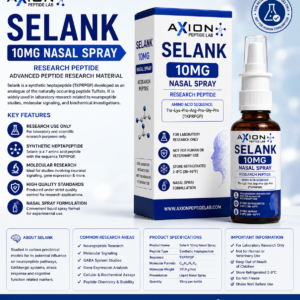
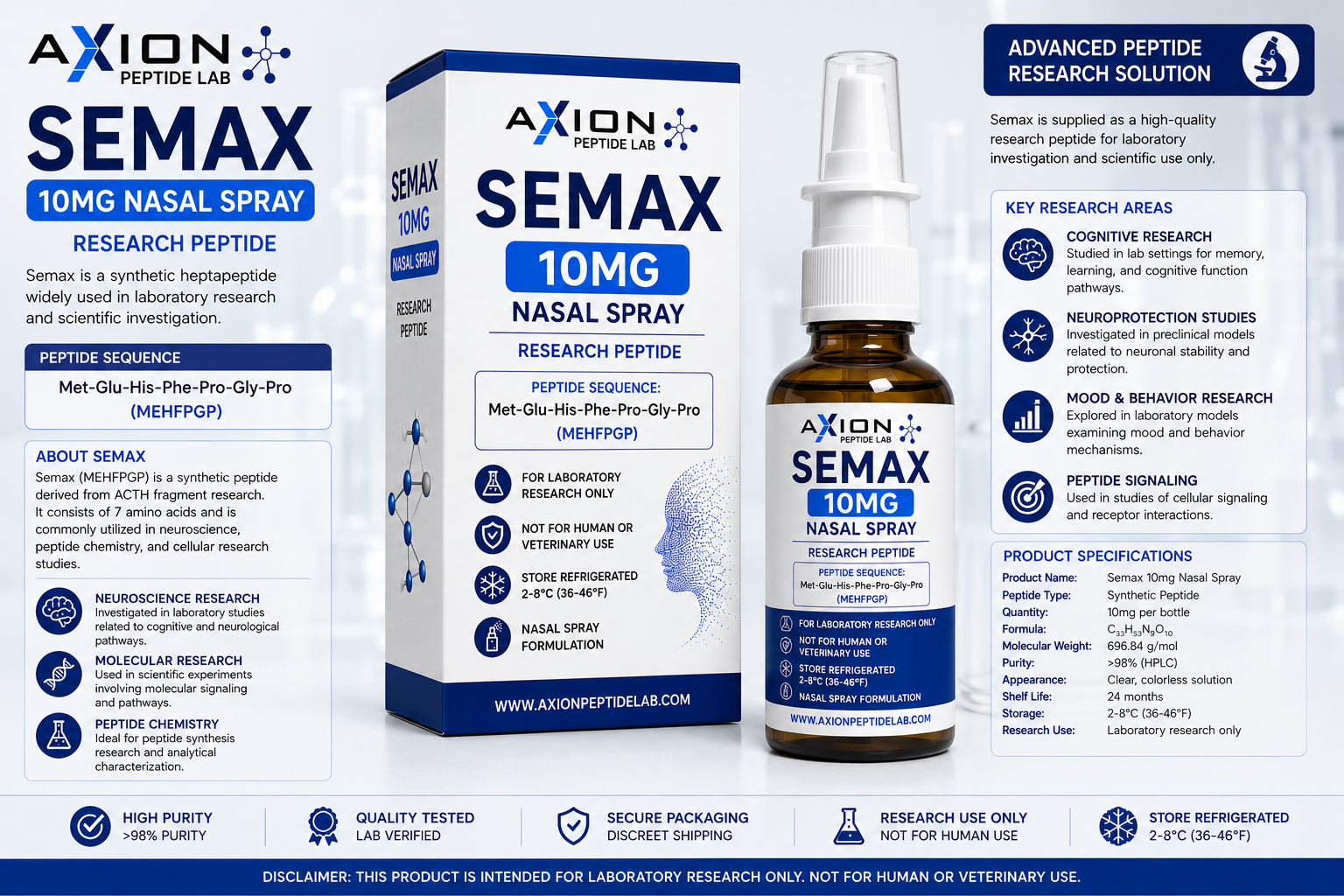
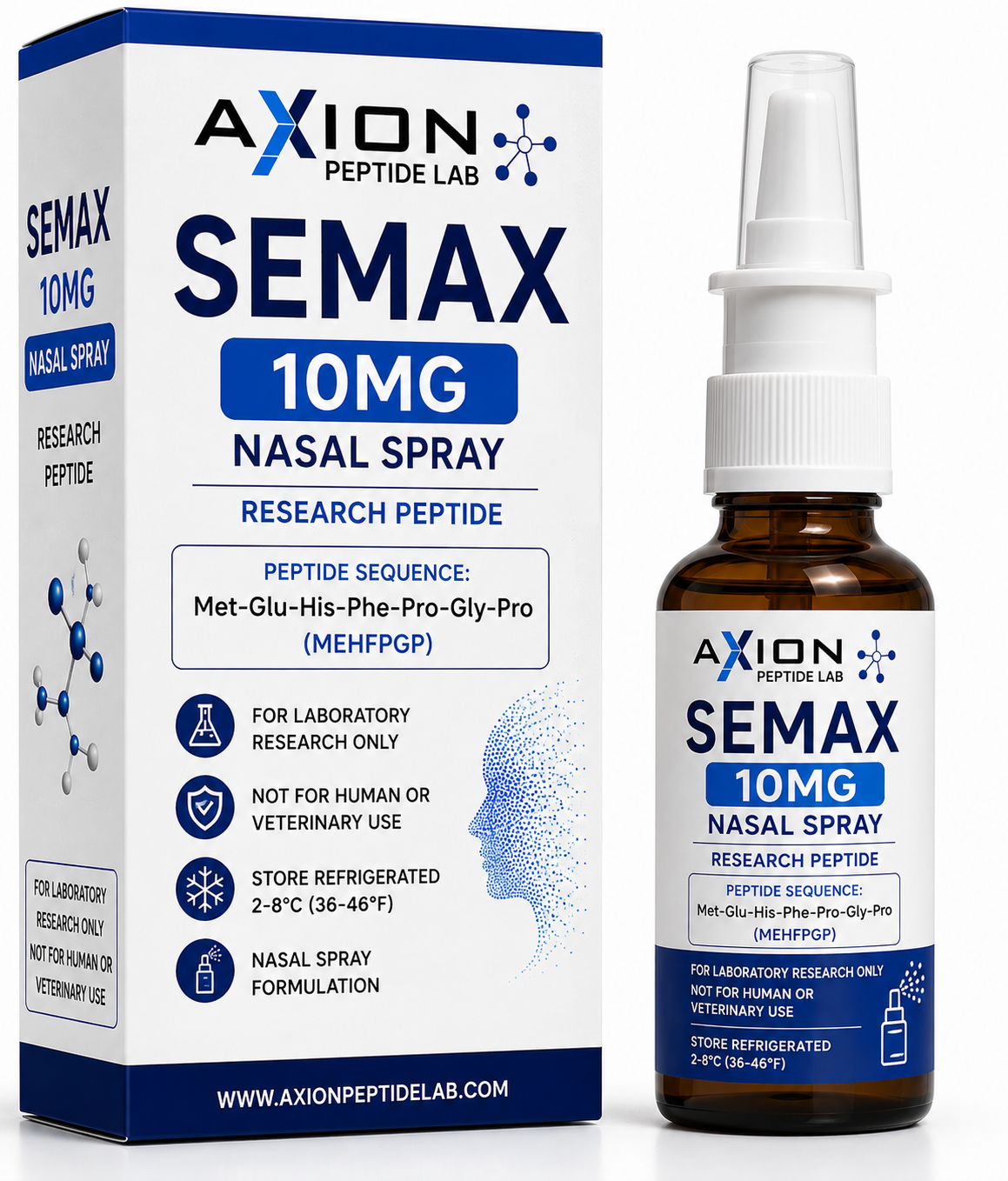
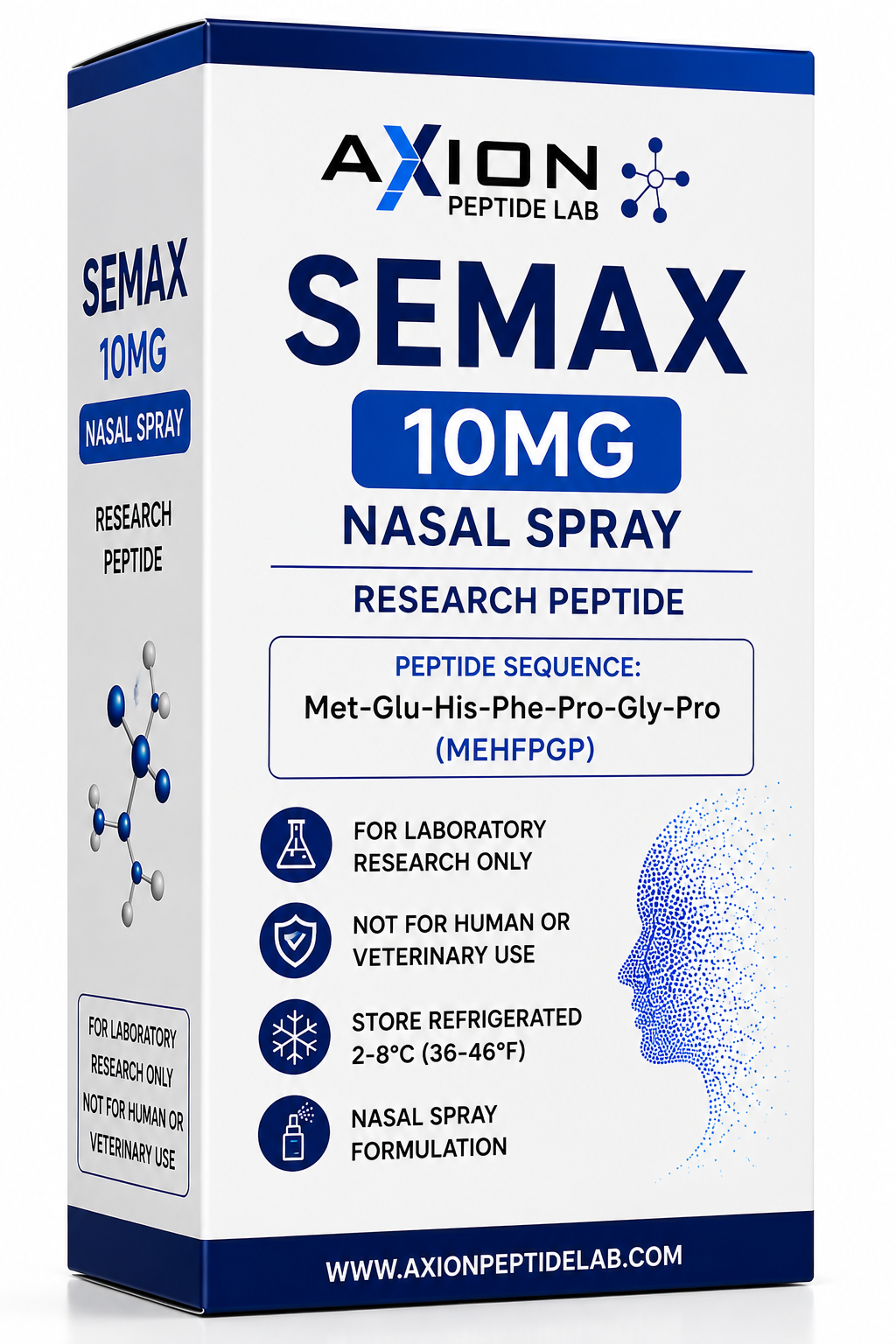
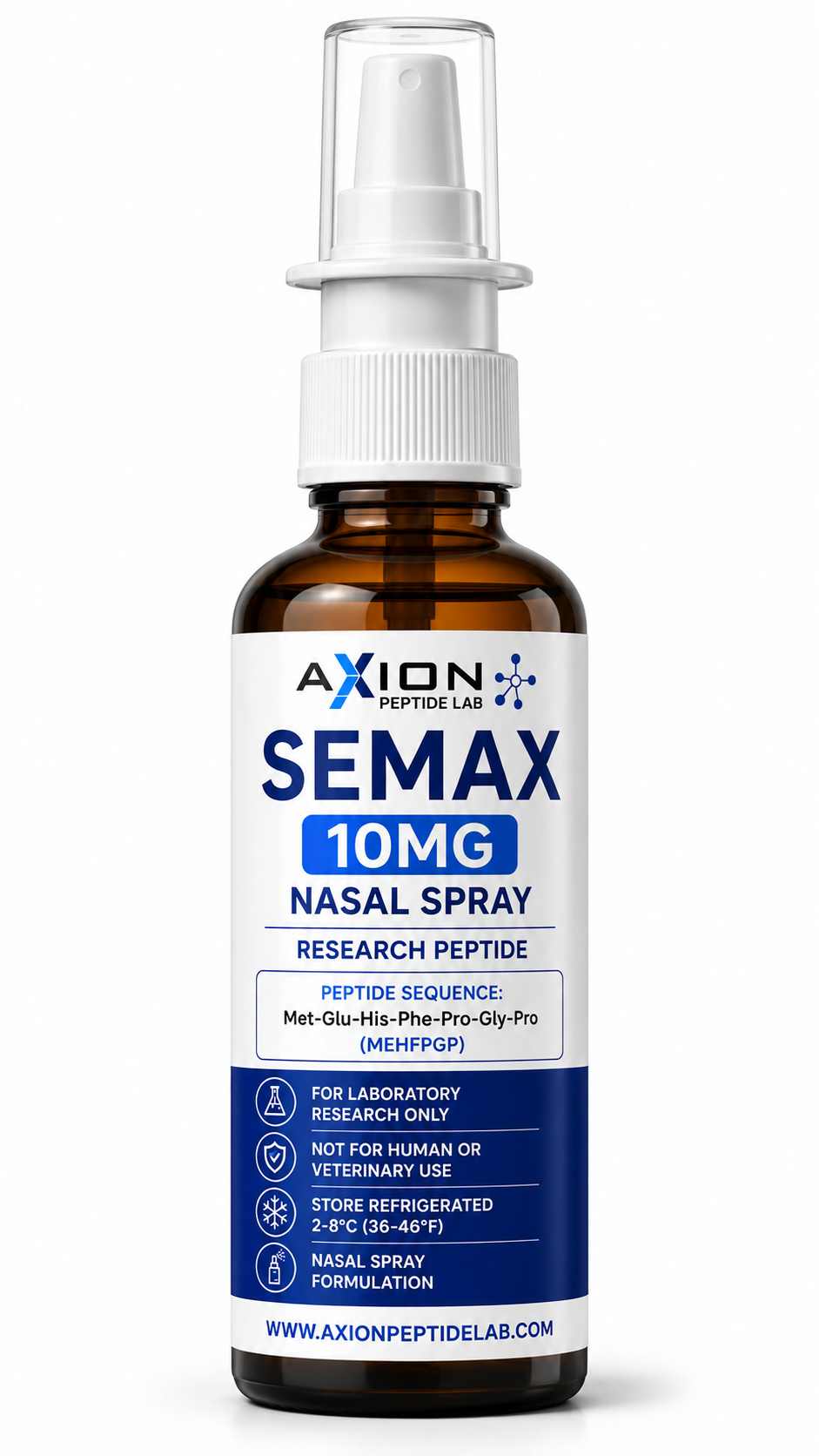
Semax 10mg Nasal Spray is a synthetic heptapeptide research preparation featuring the commonly reported sequence Met-Glu-His-Phe-Pro-Gly-Pro (MEHFPGP).
Presented in a liquid spray format, Semax is relevant to controlled research involving peptide chemistry, structure-function relationships, molecular signalling, peptide-fragment investigation, comparative peptide studies, formulation research, stability and analytical characterisation.
The 10mg designation represents the stated research quantity and is not a dosage recommendation. “Nasal Spray” describes the research presentation only.
For Research Use Only – Not for human or veterinary consumption or administration.
$135.29 Original price was: $135.29.$121.85Current price is: $121.85.
Semax 10mg Nasal Spray from Axion Peptide Lab is a synthetic heptapeptide research preparation presented in a liquid spray format for controlled laboratory, biochemical, molecular and analytical investigation. Semax has attracted scientific interest because of its defined seven-amino-acid structure and its relevance to peptide chemistry, molecular signalling research, peptide-fragment investigation, structure-function analysis and analytical characterisation.
The commonly reported amino-acid sequence of Semax is:
Met-Glu-His-Phe-Pro-Gly-Pro
This sequence can also be abbreviated:
MEHFPGP
With seven amino-acid residues, Semax is classified as a heptapeptide. Its relatively compact structure provides researchers with opportunities to investigate peptide stability, sequence characteristics, molecular interactions and relationships between peptide structure and experimentally measurable behaviour.
The 10mg designation represents the stated research quantity associated with the preparation and is not a dosage recommendation. “Nasal Spray” identifies the physical product presentation and does not constitute instructions for human administration.
Axion Peptide Lab supplies this product strictly for legitimate scientific and analytical investigation.
For Research Use Only – Not for human or veterinary consumption or administration.
Semax is a synthetic peptide consisting of seven amino-acid residues.
It was developed historically through research involving peptide fragments related to adrenocorticotropic hormone, commonly abbreviated ACTH.
Semax is structurally distinct from full-length ACTH and should be considered according to its own defined peptide sequence and physicochemical characteristics.
Its comparatively short structure makes Semax relevant to experiments examining peptide chemistry, sequence-function relationships, stability and molecular behaviour.
Researchers should distinguish experimentally observed molecular effects from therapeutic claims about commercially supplied research materials.
The commonly reported sequence of Semax is:
Met-Glu-His-Phe-Pro-Gly-Pro
or:
MEHFPGP
Each residue contributes different physicochemical characteristics.
Methionine contains a sulfur-containing side chain, glutamate contributes acidic characteristics, histidine contains an imidazole group, phenylalanine provides an aromatic side chain, while proline and glycine contribute distinctive structural properties.
Researchers can investigate how this particular sequence influences peptide conformation, stability and interactions under controlled experimental conditions.
Peptides are commonly classified partly according to the number of amino-acid residues they contain.
Because Semax consists of seven residues, it is classified as a heptapeptide.
Its size provides an interesting model for laboratories studying relatively short synthetic peptides.
Researchers can compare Semax with shortened fragments, sequence variants or modified analogues to determine how structural alterations affect experimentally measurable characteristics.
Such experiments contribute to broader understanding of peptide structure and function.
Structure-function research investigates how molecular architecture influences behaviour.
Semax can be incorporated into experiments comparing the original heptapeptide sequence with deliberately modified peptide variants.
Individual residues can be studied conceptually through comparative analogue experiments, allowing researchers to investigate whether changes in sequence correspond with differences in stability, molecular interactions or other laboratory endpoints.
Results depend heavily on experimental methodology.
Observations obtained in one model should not automatically be assumed to apply to other biological or clinical contexts.
Semax has historical connections to ACTH-related peptide-fragment research.
Peptide fragments can exhibit molecular characteristics different from their larger parent molecules.
Researchers may therefore compare Semax with related sequences to investigate how peptide length and amino-acid composition influence experimental behaviour.
Analytical techniques can help characterise these relationships.
Care should be taken not to describe Semax as equivalent to full-length ACTH because its molecular structure is substantially different.
Small peptides can participate in or influence complex molecular signalling systems.
Semax has consequently appeared in experimental literature examining molecular and cellular pathways.
Researchers may investigate defined signalling-associated endpoints under carefully controlled laboratory conditions.
Such experiments can include analysis of molecular markers, gene-expression patterns or biochemical changes.
The identification of an experimentally observed response does not by itself establish a complete mechanism.
Additional experiments and suitable controls are required to distinguish direct peptide-related effects from secondary or model-specific changes.
Cell-based systems can provide researchers with controlled environments for investigating peptide-related molecular processes.
Semax may be examined using selected cellular models where scientifically appropriate.
Variables such as cell type, exposure period, experimental concentration, formulation and analytical endpoint can significantly influence results.
Appropriate negative, vehicle and comparator controls are therefore important.
Researchers should document these variables carefully when attempting to reproduce experimental findings.
Semax also provides a useful subject for fundamental peptide chemistry.
Researchers may examine chemical properties associated with its amino-acid composition, terminal groups and peptide bonds.
Experiments can investigate molecular stability, degradation patterns, interactions or structural characteristics.
Synthetic peptide research can also compare different production or purification approaches where relevant.
Analytical confirmation is particularly important when experimental interpretation depends on precise peptide identity.
Reliable analytical characterisation is essential when working with synthetic research peptides.
Semax may be examined using techniques such as high-performance liquid chromatography and mass spectrometry.
Chromatographic analysis can support separation and compositional investigation.
Mass spectrometry can provide molecular information relevant to identity and characterisation.
Researchers requiring specific quantitative parameters should consult applicable batch documentation rather than relying on generic marketing descriptions.
High-performance liquid chromatography, commonly abbreviated HPLC, is frequently used in peptide analysis.
Researchers may develop chromatographic methods to investigate Semax or compare it with related peptide materials.
Factors such as column chemistry, mobile phase, gradient conditions and detection methodology can influence separation.
Quantitative work should incorporate suitable standards and quality-control procedures.
Methodology should be recorded accurately to support reproducibility.
Mass spectrometry provides another valuable analytical platform for peptide research.
Scientists may use mass-spectrometric techniques to investigate molecular identity and peptide-related transformations.
Combining liquid chromatography with mass spectrometry can provide detailed analytical information.
Researchers should select instrumentation and analytical conditions according to the experimental objective.
Reference materials and validated procedures should be incorporated when accurate quantitative analysis is required. Semax 10mg Nasal Spray
Peptide stability is an important consideration in experimental research.
Researchers may investigate Semax under controlled variations in temperature, pH, light exposure, solution environment and time.
Samples can be analysed at predefined intervals to identify measurable changes.
Chromatographic or mass-spectrometric methods may be incorporated into stability studies.
Results obtained for one formulation should not automatically be assumed to apply to another.
Product-specific storage and handling documentation should be followed where available.
Semax 10mg Nasal Spray is presented as a liquid research preparation.
Liquid peptide formulations can be relevant to experiments examining solution behaviour, compatibility and stability.
Researchers may investigate how different formulation environments influence measurable peptide characteristics.
Where solvent composition, preservatives, pH or other formulation details are important to an experiment, applicable product-specific documentation should be consulted.
These characteristics should not be assumed without verification. Semax 10mg Nasal Spray
The term Nasal Spray identifies the physical spray presentation associated with the product.
It does not constitute instructions or a recommendation for human administration.
A spray-format research preparation may be relevant to formulation science, dispensing-characterisation experiments and other controlled laboratory investigations.
Researchers should maintain a clear distinction between laboratory product presentation and approved medical use.
Axion Peptide Lab does not provide personal administration or dosing protocols for research products. Semax 10mg Nasal Spray
The 10mg designation identifies the stated amount of Semax associated with the preparation.
It is not a human or veterinary dosage recommendation.
Researchers conducting quantitative experiments should calculate experimental concentrations according to validated protocols and verified product specifications.
Where exact concentration or formulation information is required, applicable batch-specific documentation should be reviewed. Semax 10mg Nasal Spray
Semax can also be incorporated into comparative experiments involving other short peptides.
Researchers may compare sequence length, amino-acid composition, stability or analytical behaviour.
Semax analogues and deliberately modified sequences can also provide useful tools for structure-function research.
These experiments can help researchers identify relationships between specific structural characteristics and measurable molecular behaviour.
Scientific literature concerning Semax includes biochemical, cellular and animal-model research.
Such studies can generate hypotheses concerning molecular pathways and provide a foundation for further investigation.
However, findings from laboratory or animal models cannot automatically establish equivalent effects in humans.
Product descriptions should therefore avoid presenting experimental findings as guaranteed medical, cognitive or neurological benefits.
Axion Peptide Lab supplies Semax as a research material rather than an approved therapeutic product.
Semax 10mg Nasal Spray may be relevant to controlled investigation involving:
These represent scientific research categories rather than medical indications.
Reliable research depends on accurate documentation.
Researchers should record product identity, batch information, experimental conditions, sample preparation, analytical procedures and other relevant variables.
Where available, batch-specific analytical documentation should be reviewed before quantitative experiments.
Certificate of Analysis and independent testing availability may vary according to product and batch.
Exact claims regarding purity, sterility, concentration or formulation characteristics should only be made when supported by documentation applicable to the supplied material.
Semax 10mg Nasal Spray should remain clearly identified as laboratory research material.
Research facilities should maintain appropriate inventory, handling and storage procedures and keep experimental materials separated from medicines and products intended for personal consumption.
Purchasers and researchers are responsible for determining whether acquisition, possession, importation and intended research applications comply with applicable laws and institutional requirements.
Researchers looking to buy Semax 10mg Nasal Spray can source this synthetic heptapeptide preparation from Axion Peptide Lab for legitimate scientific and analytical investigation.
Its defined Met-Glu-His-Phe-Pro-Gly-Pro (MEHFPGP) sequence makes Semax particularly relevant to peptide chemistry, sequence analysis, structure-function research, molecular signalling investigation, comparative peptide studies, stability analysis and analytical characterisation.
The liquid spray presentation also provides a format for controlled formulation and solution-based laboratory research. Semax 10mg Nasal Spray
For Research Use Only – Not for human or veterinary consumption or administration.
Semax is a synthetic seven-amino-acid peptide commonly represented by the sequence Met-Glu-His-Phe-Pro-Gly-Pro.
The commonly reported sequence is Met-Glu-His-Phe-Pro-Gly-Pro, abbreviated MEHFPGP.
Semax contains seven amino-acid residues, so it is classified as a heptapeptide.
Semax was developed historically through research involving an ACTH-related peptide fragment, although Semax is structurally distinct from full-length ACTH.
Research areas can include peptide chemistry, sequence analysis, structure-function investigation, molecular signalling, peptide stability, formulation research and analytical characterisation.
Yes. Appropriate validated HPLC methods can be used for chromatographic investigation and characterisation of synthetic peptides such as Semax.
Yes. Mass-spectrometric methods can provide useful information concerning peptide molecular identity and analytical characteristics.
The 10mg designation identifies the stated research quantity associated with the preparation. It is not a human or veterinary dosage recommendation. Semax 10mg Nasal Spray
No. Nasal Spray describes the physical research presentation. The product is supplied strictly for controlled laboratory research and is not intended for human or veterinary administration.
Semax 10mg Nasal Spray is available from Axion Peptide Lab for legitimate peptide, molecular, formulation and analytical laboratory research, subject to availability and applicable requirements.