Research Peptide Quality: 11 Powerful Checks for Reliable Laboratory Materials
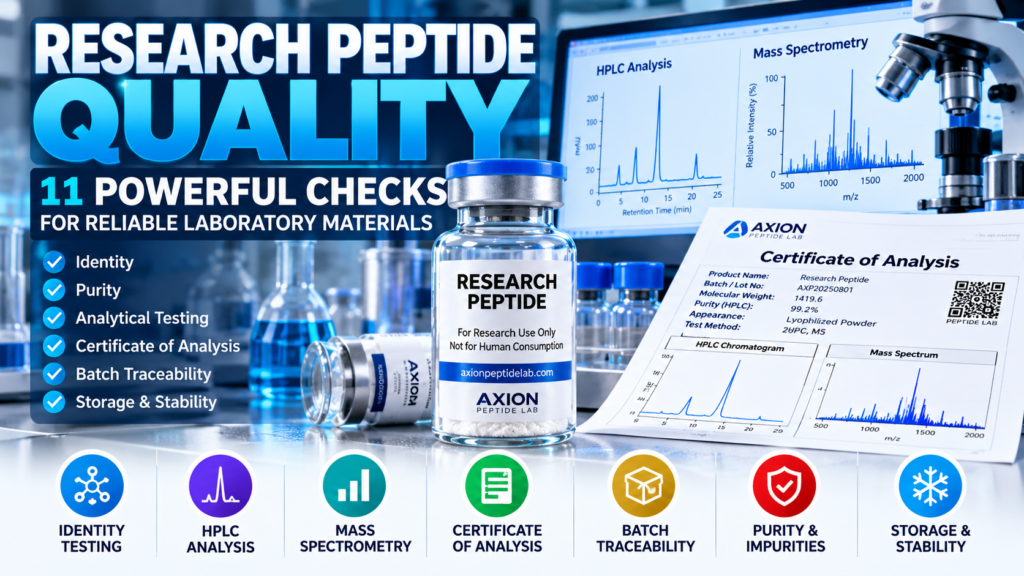
Research peptide quality is one of the most important considerations when selecting materials for laboratory investigation. A product name, vial size or advertised purity percentage alone cannot provide researchers with everything they need to evaluate a peptide material.
Researchers may also need to consider peptide identity, analytical purity, Certificate of Analysis documentation, batch traceability, analytical methodology, packaging, storage conditions and suitability for the intended experiment.
As peptide science continues to develop, laboratories have access to an increasingly diverse range of synthetic peptides and peptide-related research materials. This expanding selection creates opportunities for research, but it also makes understanding quality indicators increasingly important.
A researcher comparing laboratory materials should therefore ask more than:
“What purity percentage is listed?”
A more complete question is:
“What evidence supports the identity, purity, traceability and overall quality of this research material?”
This guide explains 11 powerful research peptide quality checks laboratories can use when evaluating peptide materials, including HPLC analysis, mass spectrometry, Certificates of Analysis, lot identification, storage considerations and supplier documentation.
Important: Products discussed in this article are laboratory research materials. For Research Use Only – Not for Human Consumption.
What Is Research Peptide Quality?
Research peptide quality is a broad description of how well a peptide material meets defined specifications and whether its characteristics are sufficiently documented for its intended laboratory application.
Quality should not be reduced to a single number.
For example, a laboratory might encounter a peptide advertised with very high chromatographic purity. That figure can be useful, but researchers may still need answers to several other questions.
Is the compound’s identity supported by analytical evidence?
Which analytical technique was used?
Does the documentation correspond to the same batch as the material?
How was the material stored?
Is the container appropriately labeled?
Are the experimental requirements compatible with the material’s specifications?
These questions illustrate why research peptide quality should be viewed as a collection of characteristics rather than a single specification.
Important quality considerations can include:
- peptide identity;
- analytical purity;
- molecular characteristics;
- Certificate of Analysis information;
- batch and lot traceability;
- analytical methodology;
- physical presentation;
- packaging integrity;
- storage requirements;
- stability;
- supplier transparency; and
- fitness for the intended laboratory experiment.
Researchers should consider these characteristics together when evaluating materials.
Why Does Research Peptide Quality Matter?
Scientific experiments depend on controlling variables.
When researchers introduce a test material into an experiment, they need reasonable confidence regarding what that material is.
If identity, purity or material history is uncertain, interpreting experimental observations becomes more difficult.
Imagine two laboratories investigating the same peptide.
Laboratory A carefully records the compound identity, supplier, lot number, analytical documentation, storage history and experimental conditions.
Laboratory B records only the peptide name.
If the laboratories obtain different results, Laboratory A has substantially more information available for investigating possible causes.
This is where research peptide quality intersects with scientific reproducibility.
Quality documentation does not guarantee that two experiments will produce identical results. Biological and analytical research involves many variables. However, stronger material characterization removes some unnecessary uncertainty.
Research peptide quality therefore matters for several reasons.
Experimental Consistency
Researchers attempting repeated experiments need to know whether the same or comparable materials were used.
Traceability
Batch numbers and supporting documentation help laboratories trace materials used in specific experiments.
Data Interpretation
Knowing more about the identity and characteristics of experimental materials can help researchers interpret unexpected findings.
Reproducibility
Detailed records make it easier for other researchers—or the same laboratory at a later date—to understand the conditions under which an experiment was performed.
Laboratory Inventory Management
Clear labels, lot information and storage records make large collections of research materials easier to manage.
For these reasons, evaluating quality should begin before a peptide enters an experimental workflow.
1. Verify Peptide Identity
The first research peptide quality check is perhaps the most fundamental:
Does the analytical evidence support the expected identity of the compound?
Identity and purity are related, but they are not the same thing.
Suppose an analytical method indicates that a sample contains one dominant component.
That alone does not necessarily establish that the dominant component is the intended peptide.
Researchers therefore use analytical techniques capable of providing information about molecular identity.
Mass Spectrometry and Peptide Identity
Mass spectrometry is widely used in peptide characterization.
In simplified terms, the technique measures mass-to-charge information from ionized molecules. The resulting data can provide evidence about the molecular mass of a peptide and assist researchers in determining whether it corresponds with the expected compound.
Depending on the laboratory and analytical objective, techniques can include:
- LC-MS;
- high-resolution mass spectrometry;
- MALDI-TOF mass spectrometry; and
- tandem mass spectrometry.
The precise analytical approach depends on what researchers need to establish.
Why Identity Testing Matters
Consider two questions:
Question 1: How much of the chromatographic signal appears to correspond to the main component?
Question 2: Is that main component actually the expected peptide?
These questions are different.
The first relates primarily to purity.
The second relates to identity.
A strong research peptide quality assessment should understand that distinction.
2. Examine Research Peptide Purity
Purity is one of the most recognizable specifications associated with research peptides.
Researchers frequently encounter statements such as:
- ≥95% purity;
- ≥98% purity;
- ≥99% purity; or
- high-purity peptide.
But what does peptide purity actually mean?
In many cases, the percentage is associated with chromatographic analysis.
That makes the analytical method important.
A reported purity percentage should not automatically be interpreted as meaning that the same percentage of the entire vial’s physical mass consists of active peptide.
Other components or characteristics may require separate analytical approaches.
These can potentially include:
- water;
- residual solvents;
- counterions;
- inorganic components; and
- other substances not represented in the same way by the chromatographic purity calculation.
Therefore, when evaluating research peptide purity, researchers should ask:
How was the purity determined?
That question provides more useful information than simply comparing percentages.
Is Higher Peptide Purity Always Better?
Higher analytical purity may be desirable for many applications, but the appropriate specification ultimately depends on the experiment.
Research design should determine material requirements—not marketing language.
Some highly sensitive analytical applications may require more stringent characterization than preliminary laboratory experiments.
Researchers should establish required specifications before selecting materials whenever possible.
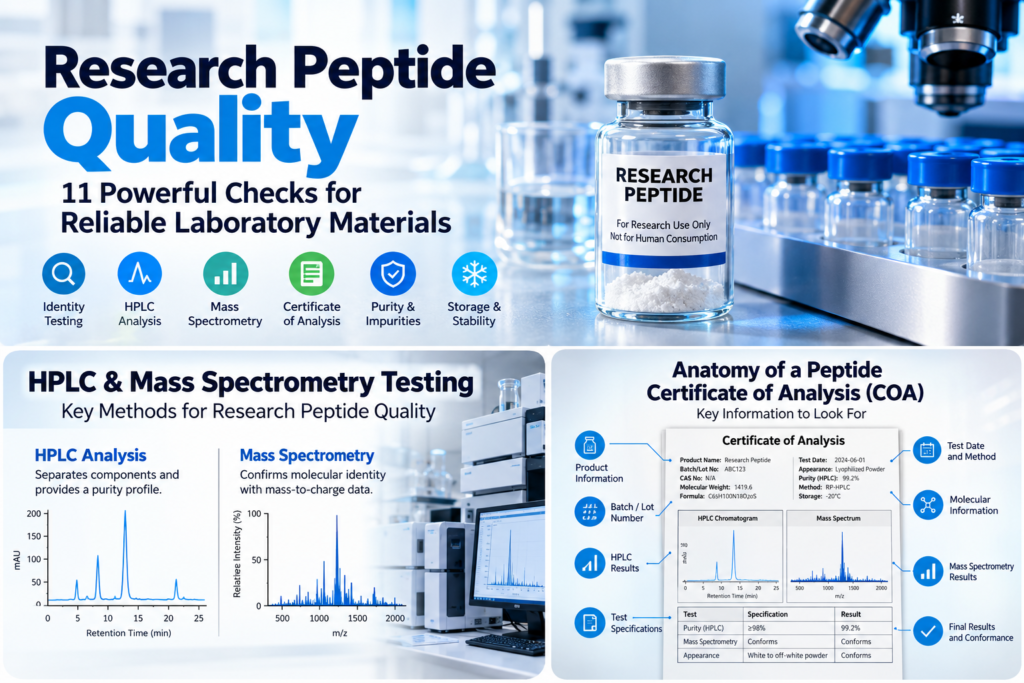
3. Review HPLC Testing
High-performance liquid chromatography, commonly abbreviated HPLC, is an important analytical technique in peptide research.
HPLC separates components of a sample according to their interactions with a chromatographic system.
The output is commonly represented as a chromatogram containing peaks.
A principal peak may represent the target component, while other detectable peaks can represent impurities or related components under the analytical conditions used.
What Can an HPLC Chromatogram Show?
An HPLC chromatogram can provide researchers with information concerning:
- retention time;
- number of detectable chromatographic components;
- relative peak areas; and
- purity estimates under the specific analytical method.
However, chromatograms must be interpreted correctly.
The result depends partly on the method used.
Variables can include:
- chromatographic column;
- mobile phase;
- gradient;
- flow rate;
- temperature;
- detector;
- wavelength;
- sample preparation; and
- run duration.
Therefore, two HPLC analyses performed under different conditions should not automatically be assumed to provide perfectly interchangeable information.
HPLC Purity vs Peptide Identity
This distinction deserves repeating because it is important.
HPLC purity is not automatically the same thing as molecular identity.
Chromatography can provide valuable separation and purity information, while complementary analytical techniques such as mass spectrometry can provide molecular information.
Using complementary analytical information can therefore create a more complete quality profile.
4. Check Mass Spectrometry Data
The next important research peptide quality indicator is mass-spectrometry information.
Mass spectrometry is especially valuable because peptides have expected molecular characteristics based on their chemical structures.
Researchers can compare experimentally observed mass information with expected molecular information.
Agreement between the expected and observed results can provide evidence supporting identity.
Why HPLC and MS Work Well Together
Consider the two techniques as answering complementary questions.
HPLC asks: What does the chromatographic profile look like?
Mass spectrometry asks: What molecular-mass information is associated with the analyzed compound?
Together, they can provide substantially more information than either an unsupported product description or purity percentage alone.
This is why researchers examining a Certificate of Analysis may look for both chromatographic and mass-spectrometric information when relevant.
5. Examine the Peptide Certificate of Analysis
A Certificate of Analysis, commonly called a COA, can be an important document when assessing research peptide quality.
However, not all COAs contain the same information.
Researchers should evaluate the document itself rather than assuming that the words “Certificate of Analysis” automatically establish quality.
A useful peptide COA may contain information such as:
- compound name;
- lot or batch number;
- test date;
- analytical method;
- purity result;
- chromatogram;
- expected molecular mass;
- observed molecular information;
- mass spectrum;
- physical description; and
- other specifications relevant to the material.
The exact contents can vary.
What Should Researchers Check on a Peptide COA?
Start with traceability.
Does the COA contain a batch or lot number?
Next, compare that number with the physical product.
Then examine the testing information.
What analytical method was used?
When was the testing performed?
Does the document provide actual results?
If HPLC is listed, is chromatographic information available?
If mass spectrometry is listed, is relevant mass information shown?
A COA becomes much more useful when researchers can connect the analytical information to the actual batch being investigated.
COA vs Specification Sheet
A specification and a COA should not automatically be considered the same document.
A specification generally describes criteria a product is intended to satisfy.
A Certificate of Analysis generally reports analytical results associated with a tested material or batch.
For example:
Specification: purity target ≥98%.
COA result: analytical purity for Batch ABC123 = 99.1%.
Understanding the distinction improves laboratory documentation.
6. Check Batch and Lot Traceability
Batch traceability is an essential but sometimes overlooked part of peptide quality control.
A laboratory may order the same research compound multiple times.
Even when the product name is identical, the materials could originate from different production batches.
A unique lot number allows laboratories to distinguish them.
Why Lot Numbers Matter
Imagine a laboratory conducts an experiment in January using Lot A.
Six months later, researchers repeat the experiment using Lot B.
The experimental results differ.
Many factors could explain the difference, but knowing that separate batches were involved provides another variable researchers can evaluate.
Without lot records, that information may be lost.
For this reason, research records can include:
- compound name;
- supplier;
- catalogue identifier;
- lot number;
- date received;
- analytical documentation;
- storage location;
- date opened or prepared where relevant; and
- experiments in which the material was used.
This creates a clearer chain of traceability.
7. Inspect Packaging and Labeling
Chemical analysis receives most of the attention when discussing research peptide quality, but packaging also matters.
The container protects the material during transportation and storage.
When receiving research materials, laboratories should inspect them for obvious physical issues.
Examples include:
- cracked containers;
- damaged seals;
- illegible labels;
- missing labels;
- missing batch information;
- contamination;
- moisture intrusion; or
- other signs of compromised packaging.
Clear identification is particularly important in laboratories storing multiple similar-looking vials.
What Should a Research Peptide Label Identify?
Depending on the product and laboratory requirements, useful label information may include:
- peptide or compound name;
- stated amount;
- batch/lot identifier;
- research-use designation; and
- other necessary identifying information.
Researchers should never rely exclusively on the appearance of a vial to distinguish one laboratory material from another.
8. Understand Lyophilized Peptide Quality
Many research peptides are supplied in lyophilized form.
Lyophilization is commonly known as freeze-drying.
It involves removing water from a frozen material under reduced pressure through a controlled process.
The technique is widely used for materials where reducing water content can support storage stability.
However, an important distinction should be made:
Lyophilized does not mean high purity.
Lyophilization describes a processing and presentation method.
Purity describes an analytical characteristic.
A lyophilized peptide still requires appropriate characterization.
Can Appearance Determine Lyophilized Peptide Quality?
Not reliably.
Researchers may see differences in:
- cake appearance;
- powder distribution;
- material attached to vial walls;
- apparent volume; and
- texture.
Visual inspection can help identify obvious physical abnormalities, but researchers cannot establish chemical purity or molecular identity simply by looking at the material.
Analytical evidence remains essential.
9. Review Storage and Stability Information
Research peptide quality does not stop when a laboratory receives a product.
Storage conditions can influence material integrity.
Peptides vary in chemical structure, so stability characteristics are not identical across every compound.
Factors that can potentially affect stability include:
- temperature;
- moisture;
- oxygen exposure;
- light;
- repeated environmental changes;
- physical state; and
- storage duration.
Researchers should therefore consult appropriate documentation for each specific research material.
Laboratory Storage Records
Good laboratory practice can include recording:
- arrival date;
- initial condition;
- designated storage location;
- recommended storage conditions;
- relevant handling events; and
- movement between storage locations.
This information can become valuable when reviewing experiments months or years later.
A product may have been appropriately characterized when manufactured, but inappropriate subsequent storage can introduce another variable.
Proper handling is therefore part of maintaining research material quality.
10. Understand Potential Peptide Impurities
Peptide synthesis is a sophisticated chemical process.
During synthesis, purification, processing or storage, different impurity types may potentially arise.
Depending on the peptide and manufacturing process, researchers may encounter considerations involving:
- truncated sequences;
- deletion sequences;
- incomplete reactions;
- oxidation products;
- deamidation products;
- hydrolysis;
- synthesis-related residuals;
- aggregation in applicable systems; and
- degradation products.
Not every impurity applies equally to every peptide.
The point is that “impurity” is not one single substance or phenomenon.
This helps explain why research peptide quality analysis can require several analytical techniques.
One test may reveal chromatographic purity.
Another may provide identity information.
Another may evaluate water content or other characteristics.
The analytical strategy should correspond to the questions the laboratory needs answered.
11. Evaluate Supplier Transparency and Documentation
The final research peptide quality check concerns the information surrounding the material.
Researchers should separate verifiable laboratory information from marketing terminology.
Terms such as:
Premium quality
Ultra pure
Professional grade
Superior peptide
may sound impressive, but they are not analytical results.
Researchers should prioritize information that can be evaluated.
Questions can include:
- Is the product clearly identified?
- Is the research-use designation clear?
- Is batch information available?
- Is analytical documentation provided where applicable?
- Are storage requirements stated?
- Can relevant documentation be connected to the material?
- Is supplier information clearly available?
- Are product specifications understandable?
- Are research materials separated from claims about consumer or therapeutic use?
Transparent information makes it easier for laboratories to evaluate whether a material fits their research requirements.
Research Peptide Quality vs Research Peptide Purity
One of the most important concepts in this guide is the distinction between research peptide quality and research peptide purity.
Purity is part of quality.
It is not the entire definition of quality.
A useful conceptual model is:
Research Peptide Quality = Identity + Purity + Documentation + Traceability + Storage + Appropriate Handling + Fitness for Research Purpose
This is not a formal scientific equation.
Instead, it is a practical way to understand the multiple characteristics researchers may evaluate.
For example, consider a material advertised as 99% pure.
Researchers may still need to know:
- Was identity confirmed?
- Which analytical method generated the 99% result?
- What batch was tested?
- Does the COA correspond with the material?
- How should it be stored?
- Is the specification suitable for the planned experiment?
The purity percentage alone cannot answer those questions.
High-Purity Research Peptides: What Does “High Purity” Really Mean?
The phrase high purity research peptides is common in laboratory product descriptions.
Researchers should interpret it analytically rather than as promotional language.
A useful purity claim should ideally be associated with:
- an identified analytical method;
- a particular sample or batch;
- documented results; and
- appropriate supporting information.
Researchers should also remember that chromatographic purity and total peptide content are different concepts.
This distinction is particularly important when comparing research materials from different sources.
Simply comparing “98%” with “99%” without understanding the underlying analytical methodology may provide less useful information than expected.
Research Peptide Quality and Reproducibility
Reproducibility is fundamental to good scientific research.
Researchers need enough experimental information to understand how an experiment was performed and, where possible, repeat it.
Research material documentation contributes to this goal.
A detailed laboratory record might include:
Compound: Example Research Peptide
Lot: ABC123
Supplier: Laboratory supplier
Analytical documentation: Recorded
Storage: According to product documentation
Experiment: Study 001
Date: Recorded in laboratory notebook
This is far more useful than writing:
“Used peptide.”
The more precisely researchers document experimental variables, the easier it becomes to interpret future results.
Research Peptides vs Prescription Medicines
Another important distinction concerns intended use.
A compound being studied in peptide research does not mean that every product bearing that compound’s name is an approved pharmaceutical product.
Research-use-only peptides and prescription medicines are fundamentally different categories.
Approved medicines are developed and manufactured within regulatory frameworks applicable to pharmaceutical products and authorized uses.
Laboratory research materials are supplied for experimental use.
Researchers should therefore avoid interpreting a research product’s stated purity, physical appearance or compound name as evidence that it is an approved medicine.
Products supplied by Axion Peptide Lab as research materials are:
For Research Use Only – Not for Human Consumption.
Research Peptide Quality Across Different Compound Categories
Research peptide catalogues can contain materials associated with many different scientific areas.
Because these compounds have different structures and research contexts, laboratories should not assume that every material has identical analytical or handling requirements.
Retatrutide Research
Retatrutide has attracted scientific interest because research involving the compound examines activity associated with GLP-1, GIP and glucagon receptor pathways.
Researchers investigating retatrutide materials should evaluate relevant identity, purity, batch and analytical information according to their experimental requirements.
Axion Peptide Lab’s catalogue contains retatrutide research materials in multiple research quantities.
These materials are strictly intended for laboratory investigation.
Tirzepatide Research
Tirzepatide is another important compound within incretin-related scientific research.
It is associated with research involving GIP and GLP-1 receptor pathways.
Laboratories evaluating tirzepatide research material should distinguish experimental research products from prescription medicines.
The same quality principles discussed throughout this article apply: identity, analytical purity, traceability, documentation and appropriate storage.
Cagrilintide Research
Cagrilintide has become relevant within research involving amylin-related pathways.
Researchers selecting cagrilintide laboratory material should evaluate the specifications required by their study and review appropriate documentation.
GHK-Cu Research
GHK-Cu is a copper-binding peptide complex studied in several biochemical research contexts.
Its chemistry differs substantially from incretin-related compounds, demonstrating why laboratories should not apply one generic handling or analytical assumption to every peptide.
Researchers should evaluate documentation relevant to the particular material.
BPC-157 Research
BPC-157 appears frequently in experimental peptide literature and research discussions.
As with any research material, laboratories should focus on scientifically relevant quality factors rather than unsupported promotional claims.
These include identity, purity, analytical documentation, batch traceability and appropriate storage.
AOD-9604 Research
AOD-9604 represents another category of peptide-related research material.
Researchers considering AOD-9604 should determine whether the available specifications correspond with their intended laboratory methodology.
GLOW Research Blend
Multi-component research blends create additional considerations.
When several peptide-related materials are present within a single research product, laboratories should understand what components are represented and how the blend differs from investigating isolated materials.
The Axion catalogue includes a GLOW research blend associated with GHK-Cu, BPC-157 and TB-500 research components.
Researchers should document multi-component materials carefully when incorporating them into experimental designs.
How to Evaluate a Research Peptide Catalogue
When browsing a research peptide catalogue online, researchers can use the quality principles from this guide to evaluate individual materials more systematically.
Instead of selecting products based only on name or quantity, consider the following process.
Step 1: Define the Research Objective
Determine what the laboratory is investigating.
Step 2: Determine Required Specifications
Identify what purity, identity and documentation requirements apply to the experiment.
Step 3: Review Product Information
Examine the stated compound, amount, physical format and research designation.
Step 4: Review Analytical Documentation
Evaluate available COA, HPLC, MS or other applicable information.
Step 5: Confirm Traceability
Check whether documentation can be associated with a specific lot or batch.
Step 6: Review Storage Requirements
Determine whether the laboratory can maintain appropriate storage conditions.
Step 7: Record the Material
Document the product and batch within the laboratory’s inventory or experimental records.
This process turns catalogue browsing into a more structured scientific decision.
Research Peptide Quality Checklist
Before incorporating a peptide material into laboratory research, consider this checklist.
Identity
- Is the expected compound clearly identified?
- Is analytical identity information available where required?
Purity
- Is a purity result provided?
- Is the analytical method identified?
HPLC
- Is chromatographic information available where applicable?
- Can the results be associated with the material?
Mass Spectrometry
- Is expected molecular information available?
- Is observed mass information provided where applicable?
COA
- Is there a Certificate of Analysis?
- Does it contain useful analytical information?
Traceability
- Is a batch or lot number present?
- Does it correspond with the documentation?
Packaging
- Is the container intact?
- Is labeling clear?
Storage
- Are appropriate storage requirements available?
Research Status
- Is the material clearly designated for research use?
Experimental Suitability
- Does it meet the specifications required by the research project?
Documentation
- Can the laboratory maintain a record of exactly which material was used?
Common Research Peptide Quality Mistakes
Mistake #1: Choosing a Peptide Based Only on the Purity Percentage
A purity percentage is useful, but it does not independently establish every quality characteristic.
Evaluate identity, documentation and traceability too.
Mistake #2: Assuming a COA Automatically Guarantees Quality
The content of the COA matters.
Researchers should inspect the analytical information rather than relying solely on the document title.
Mistake #3: Ignoring the Batch Number
Without lot traceability, connecting a material to its analytical documentation becomes more difficult.
Mistake #4: Judging Purity by Appearance
Researchers cannot reliably determine chemical purity from color, powder appearance or lyophilized cake structure alone.
Mistake #5: Treating HPLC and Mass Spectrometry as Identical Tests
They provide different types of analytical information and can complement one another.
Mistake #6: Ignoring Storage
Quality control continues after a product reaches the laboratory.
Mistake #7: Assuming Every Research Peptide Has Identical Requirements
Different compounds can have different stability, analytical and experimental considerations.
Mistake #8: Confusing Research Materials With Medicines
Research-use-only materials are not automatically pharmaceutical products.
Frequently Asked Questions About Research Peptide Quality
What is research peptide quality?
Research peptide quality refers broadly to characteristics such as identity, purity, analytical documentation, traceability, physical condition, storage and suitability for an intended laboratory application.
How is research peptide quality tested?
Depending on the material and research requirements, laboratories may use techniques including HPLC, LC-MS, mass spectrometry and other analytical methods to evaluate different quality attributes.
What is peptide purity?
Peptide purity generally describes the relative amount of the target peptide compared with detected impurities under a particular analytical method. It should be interpreted according to the test used.
Does 99% peptide purity mean 99% of the vial’s weight is peptide?
Not necessarily. Chromatographic purity and total peptide content are different concepts. Researchers should review the analytical method and documentation.
What is HPLC peptide testing?
High-performance liquid chromatography separates components in a sample and can be used to evaluate a peptide’s chromatographic purity profile.
What is mass spectrometry used for in peptide testing?
Mass spectrometry provides molecular-mass information that can help researchers establish whether an analyzed compound corresponds to the expected peptide.
What is a peptide COA?
A peptide Certificate of Analysis is a document containing analytical information associated with a research material or batch. The exact information included can vary.
Why is a peptide batch number important?
A batch or lot number improves traceability by helping laboratories connect physical material with relevant analytical documentation and experimental records.
Are lyophilized research peptides automatically pure?
No. Lyophilization describes a processing method and physical presentation. It does not independently establish chemical purity or molecular identity.
Why does peptide storage matter?
Environmental conditions can affect the stability of laboratory materials. Researchers should follow storage information appropriate to the particular peptide and maintain suitable laboratory records.
What should researchers look for when selecting research peptides?
Researchers can consider identity, analytical purity, COA information, batch traceability, analytical methodology, packaging, storage requirements and compatibility with the intended experiment.
Are research peptides intended for human use?
No. Research materials described here are intended strictly for laboratory investigation and are not for human consumption.
Final Thoughts on Research Peptide Quality
Research peptide quality cannot be adequately evaluated using one percentage, one marketing phrase or one document.
A stronger quality assessment considers the complete picture.
Researchers should examine:
- identity;
- purity;
- HPLC data;
- mass-spectrometry information;
- COA documentation;
- batch traceability;
- packaging;
- storage;
- stability;
- potential impurities; and
- suitability for the intended research application.
Most importantly, laboratories should determine what their experiment requires before selecting a material.
A product described as “high purity” may still require further information before it is appropriate for a particular research application.
Likewise, the highest advertised percentage is not automatically the best choice for every experimental design.
Quality begins with asking the right scientific questions.
For researchers comparing different laboratory materials, the Axion Peptide Lab Research Peptide Catalogue provides access to research-use-only materials across multiple areas of peptide investigation.
Researchers can also explore our educational guides covering peptide COAs, peptide purity, research peptides, and the differences between various laboratory peptide materials.
For Research Use Only – Not for Human Consumption.
Authoritative Peptide Research Resources
Researchers studying peptides can benefit from consulting authoritative regulatory resources and peer-reviewed scientific literature covering peptide development, synthesis, characterization, and laboratory research.
For authoritative regulatory information about peptide products and their development, see the FDA’s guidance on Clinical Pharmacology Considerations for Peptide Drug Products. This resource provides regulatory guidance relevant to the development and evaluation of peptide drug products.
For current scientific publications covering peptide biology, chemistry, molecular mechanisms, and research applications, explore Nature’s Peptide Research Collection. Nature provides access to scientific research and developments across numerous areas of peptide science.
Researchers looking for peer-reviewed scientific literature can also explore PubMed’s extensive collection of peptide studies. PubMed is particularly useful for locating published research on peptide chemistry, biological activity, analytical methods, molecular pathways, and emerging areas of peptide investigation.
For a scientific introduction to laboratory peptide synthesis and commonly used research methodologies, see this PubMed resource on peptide synthesis. It provides useful scientific background for researchers interested in understanding how peptide materials can be produced and studied in laboratory environments.
For more detailed information about chemical methods used in peptide production, researchers can consult this peer-reviewed review of peptide synthesis methods. The publication discusses important developments and approaches associated with modern peptide chemistry.
Researchers interested in how peptides are identified, measured, and characterized can also review Nature Reviews Methods Primers on Peptidomics. Peptidomics uses advanced analytical approaches to investigate peptide populations and can provide valuable insights into peptide identification and characterization.
These external scientific resources provide additional background for readers who want to explore peptide research beyond this guide and examine regulatory guidance, peer-reviewed studies, peptide synthesis techniques, and modern analytical methodologies in greater detail.
One Response