
Research Peptide Storage: Complete Guide to Laboratory Handling, Stability & Quality
Research peptide storage is an important part of maintaining the integrity of peptide materials used in laboratory research. Peptides are chemically diverse molecules, and their stability can be affected by temperature, moisture, light, oxidation, container selection, formulation, handling practices and other environmental conditions.
For laboratories working with synthetic peptides, understanding these variables is just as important as evaluating purity, identity and analytical documentation.
A peptide that has been manufactured to a high specification can still undergo physical or chemical changes when exposed to unsuitable environmental conditions. This makes appropriate storage, documentation and handling an important part of a laboratory quality-management process.
This guide examines the science behind research peptide storage, including lyophilized materials, environmental factors that can influence peptide stability, laboratory handling principles, documentation, transportation and common storage mistakes.
Important: The materials discussed in this article are intended for laboratory and scientific research. Axion Peptide Lab products are sold For Research Use Only – Not for human consumption.
Table of Contents
- What Is Research Peptide Storage?
- Why Peptide Storage Conditions Matter
- Understanding Peptide Stability
- Lyophilized Research Peptides
- Temperature and Peptide Stability
- Moisture and Humidity
- Light Exposure
- Oxygen and Oxidation
- Choosing Appropriate Laboratory Containers
- Why Repeated Environmental Changes Matter
- Peptide Storage During Transportation
- Documentation and Laboratory Traceability
- COAs and Storage Information
- Common Research Peptide Storage Mistakes
- Building a Laboratory Peptide Storage System
- Storage Considerations for Different Peptide Materials
- Research Peptide Quality Beyond Storage
- Frequently Asked Questions
- Final Thoughts
What Is Research Peptide Storage?
Research peptide storage refers to the controlled conditions used to preserve peptide materials between manufacturing, transportation and laboratory analysis.
It involves considerably more than simply placing a vial in a particular location.
A complete storage strategy may consider:
- temperature;
- moisture;
- humidity;
- exposure to light;
- oxygen exposure;
- container compatibility;
- peptide formulation;
- storage duration;
- environmental fluctuations;
- laboratory handling procedures;
- manufacturer specifications; and
- documentation.
These variables matter because peptides are chains of amino acids containing chemical bonds and functional groups that can potentially undergo chemical or physical changes.
Importantly, there is no universal storage condition that can automatically be applied to every peptide.
Researchers should therefore use compound-specific documentation and validated laboratory procedures rather than assuming that every research peptide behaves identically.
Why Research Peptide Storage Matters
Quality control does not end when a peptide leaves the manufacturing facility.
Storage becomes part of the laboratory quality chain.
Peptide materials can potentially undergo several forms of change during inappropriate storage or handling, including chemical degradation, oxidation, aggregation or adsorption onto surfaces.
The FDA’s stability guidance for biotechnology and biological products highlights the sensitivity of proteins and polypeptides to environmental variables including temperature changes, oxidation and light.
Consequently, laboratories should think about peptide storage as part of a broader system involving:
Manufacturing → analytical testing → documentation → packaging → transportation → receiving → storage → experimental handling → analysis
A weakness at any stage can potentially affect the quality of the material available for subsequent research.
Understanding Peptide Stability
Peptide stability describes the ability of a peptide material to maintain relevant chemical and physical characteristics during a defined period under specified environmental conditions.
Several mechanisms can influence peptide stability.
Chemical degradation
Chemical reactions can modify portions of a peptide molecule.
Depending on sequence and environmental conditions, possible pathways may include oxidation, hydrolysis, deamidation and other chemical transformations.
Not every peptide has the same susceptibility.
The amino-acid sequence itself influences stability.
Physical instability
Peptides can also undergo physical changes.
Examples investigated in peptide and protein research include:
- aggregation;
- precipitation;
- adsorption;
- conformational changes; and
- changes associated with freeze-drying or subsequent storage.
This distinction is important.
A sample can appear visually unchanged while still having undergone chemical changes that require analytical testing to detect.
Likewise, visible changes do not automatically reveal their molecular cause.
Laboratories therefore rely on appropriate analytical methods rather than appearance alone when evaluating peptide quality.
What Are Lyophilized Research Peptides?
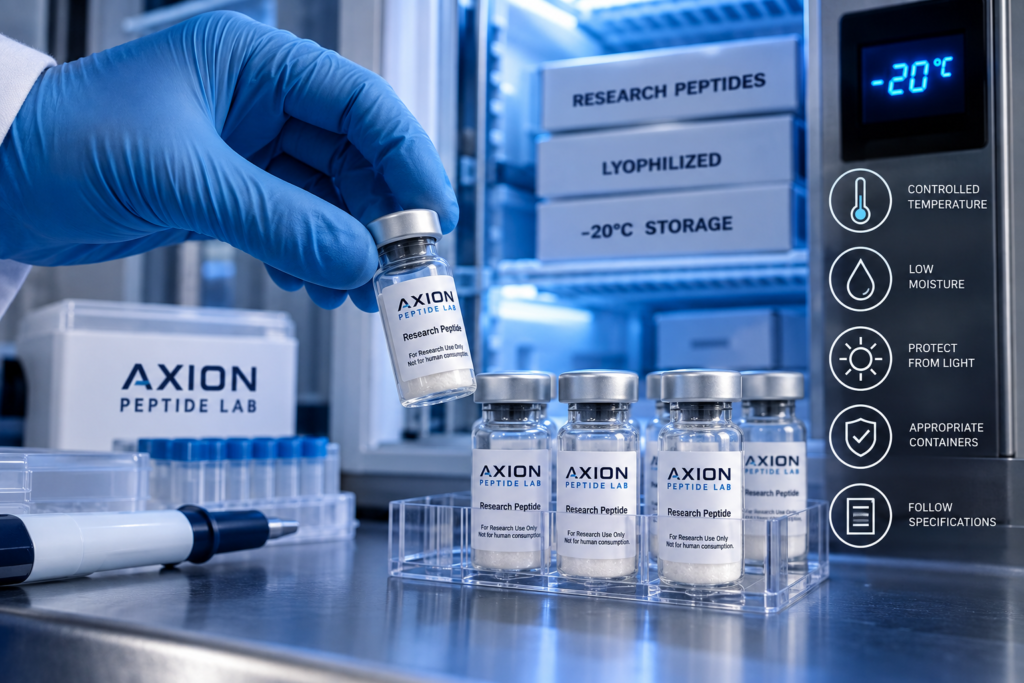
Many research peptides are supplied in lyophilized, or freeze-dried, form.
Lyophilization removes water from a frozen material under controlled conditions, producing a dry solid.
The technique is widely used in biotechnology because reducing water can improve the storage characteristics of certain sensitive materials.
However, lyophilization should not be interpreted as making a peptide permanently stable.
The final stability of a lyophilized material can still depend on factors such as:
- peptide sequence;
- formulation;
- residual moisture;
- storage temperature;
- excipients;
- packaging;
- environmental exposure; and
- manufacturing process.
Scientific research has shown that lyophilization itself can also introduce stresses during freezing and drying.
For this reason, researchers evaluate lyophilized materials using validated stability programs rather than assuming that all freeze-dried peptides behave identically.
Temperature and Research Peptide Storage
Temperature is one of the most frequently discussed variables in research peptide storage.
Higher temperatures can accelerate many chemical processes. However, the exact relationship between temperature and stability depends on the particular molecule and formulation.
The appropriate question is therefore not:
“What temperature should all peptides be stored at?”
Instead, researchers should ask:
“What storage conditions have been established for this particular material?”
Compound-specific information should take priority.
For example, documentation submitted to the FDA concerning certain peptide substances demonstrates that recommended conditions can vary according to the particular peptide, formulation and intended storage duration.
This is why laboratories should avoid creating universal rules for every research material.
Follow documented specifications
When a supplier or manufacturer provides validated storage specifications, laboratories should evaluate and follow those instructions within their own quality system.
Important information may include:
- recommended temperature range;
- protection from moisture;
- protection from light;
- packaging requirements;
- long-term versus short-term conditions; and
- stability or retest information.
Moisture: A Critical Storage Variable
Moisture is another important consideration, particularly for lyophilized materials.
A dry-looking peptide powder does not necessarily mean that environmental moisture is irrelevant.
Residual moisture can affect the physical and chemical characteristics of freeze-dried materials.
Historical peptide stability research has demonstrated that moisture content can influence chemical reactivity in lyophilized peptide formulations.
This makes packaging and environmental control important considerations.
Why laboratory handling matters
Each time a storage container is opened or moved between environments, the material may encounter a different combination of temperature and humidity.
Good laboratory procedures therefore aim to minimize unnecessary environmental exposure.
Researchers should follow the storage and handling specifications associated with the particular material and their institution’s standard operating procedures.
Light Exposure and Peptide Stability
Some biological materials are sensitive to light.
Light can contribute to photochemical reactions in susceptible compounds.
The degree of sensitivity depends on molecular structure and formulation, so not every peptide should be assumed to have identical photosensitivity.
Nevertheless, when product documentation specifies protection from light, laboratories should treat that instruction as part of the material’s quality requirements.
Suitable secondary packaging and controlled laboratory storage can help reduce unnecessary exposure.
Oxygen and Oxidation
Oxidation represents another possible degradation pathway for peptides.
Certain amino-acid residues are more susceptible to oxidative modification than others.
Potential influences include:
- oxygen;
- reactive oxygen species;
- trace contaminants;
- formulation;
- temperature; and
- storage duration.
This again demonstrates why peptide stability cannot be reduced to one variable.
Temperature, moisture, oxygen, light and formulation can interact.
Research peptide storage should therefore be approached systematically.
Laboratory Containers and Peptide Storage
Container selection may seem like a small detail, but it can influence experimental recovery.
Peptides can interact with surfaces.
A study examining stored peptide samples found differences in peptide recovery depending on whether samples were stored in standard plastic, glass or low-adsorption plastic containers.
Hydrophobic peptides were particularly affected in the conditions investigated.
This has an important implication for laboratory research:
The storage environment includes the container itself.
Container considerations may include:
- material compatibility;
- adsorption characteristics;
- closure integrity;
- chemical resistance;
- light protection;
- moisture barrier properties; and
- suitability for the analytical workflow.
Researchers should select laboratory containers according to validated procedures and the characteristics of the peptide being studied.
Environmental Fluctuations and Peptide Quality
Stable storage is not simply about reaching a particular temperature.
Consistency can also matter.
Repeated transitions between environments can expose research materials to changing temperature and humidity conditions.
For sensitive laboratory materials, unnecessary environmental cycling should therefore be minimized where appropriate.
This is another reason laboratories commonly establish procedures covering:
- receiving;
- logging;
- storage;
- sample retrieval;
- aliquoting;
- inventory control; and
- return to controlled storage.
A well-designed process reduces unnecessary handling while improving traceability.
Research Peptide Storage During Transportation
Storage considerations begin before the material reaches the laboratory.
Transportation can expose research products to:
- temperature changes;
- humidity;
- vibration;
- light;
- delays;
- damaged packaging; and
- environmental extremes.
Appropriate packaging should therefore be selected according to the material’s validated shipping requirements.
Interestingly, research involving a specific lyophilized peptide mixture found that those materials remained analytically suitable after defined room-temperature storage and transportation conditions.
That finding should not be generalized to every peptide.
Instead, it demonstrates an important scientific principle:
Stability should be established using data for the particular material and conditions being investigated.
Researchers should avoid assuming that one study proves universal stability across unrelated peptides.
Receiving Research Peptides in the Laboratory
A laboratory quality workflow can begin immediately upon receipt.
Researchers may document:
- product identity;
- catalogue information;
- batch or lot number;
- date received;
- package condition;
- quantity;
- associated analytical documentation;
- specified storage conditions; and
- location within the laboratory inventory system.
This creates traceability.
For laboratories managing multiple research compounds, an inventory system becomes increasingly important.
A research catalogue may contain materials with different:
- sequences;
- molecular weights;
- formulations;
- concentrations;
- storage requirements; and
- analytical specifications.
Organized documentation reduces confusion and improves reproducibility.
Certificate of Analysis and Research Peptide Storage
A Certificate of Analysis (COA) is an important document when evaluating research peptide materials.
Depending on the supplier and analytical program, a COA may contain information such as:
- product identity;
- lot or batch number;
- analytical purity;
- testing methodology;
- molecular information;
- testing date; and
- other quality specifications.
Storage information may be supplied on the COA, product documentation, packaging or separate technical documentation.
Researchers should distinguish between two concepts:
Analytical quality at testing
This represents characteristics measured when the material was analyzed.
Quality during subsequent storage
This depends on what happens to the material after testing.
A high reported purity result does not mean storage conditions can subsequently be ignored.
Manufacturing quality and post-manufacturing handling form parts of the same quality chain.
Common Research Peptide Storage Mistakes
Several mistakes can undermine otherwise careful laboratory workflows.
1. Treating every peptide identically
Different peptide sequences and formulations can have different stability characteristics.
Compound-specific documentation should take priority over generalized internet advice.
2. Ignoring moisture
Temperature receives most of the attention, but moisture can also influence stability.
This is particularly relevant to dry and lyophilized materials.
3. Repeated unnecessary handling
Frequent movement between storage environments may introduce unnecessary variability.
4. Ignoring container compatibility
The container can affect peptide recovery through surface interactions or adsorption.
5. Depending entirely on visual appearance
Chemical degradation is not always visible.
Analytical methods are required when researchers need to establish identity, purity or degradation scientifically.
6. Losing lot information
A vial without reliable lot documentation creates a traceability problem.
7. Separating storage from quality control
Storage should be integrated into the laboratory’s overall quality-management workflow.
Building a Better Research Peptide Storage System
A laboratory managing multiple peptide materials can benefit from a structured system.
Step 1: Record material identity
Maintain accurate product, lot and catalogue information.
Step 2: Review documentation
Examine the supplier’s technical documentation and analytical information.
Step 3: Identify specified storage conditions
Do not assume that every peptide uses identical conditions.
Step 4: Assign an appropriate storage location
The location should correspond with the documented requirements and laboratory SOPs.
Step 5: Maintain inventory records
Record where each research material is stored.
Step 6: Minimize unnecessary exposure
Only retrieve materials when required by the experimental workflow.
Step 7: Maintain traceability
Experimental records should identify the material and lot used.
Step 8: Review stability information
Where storage duration is relevant, researchers should consider available stability or retest information.
This system can improve both organization and experimental reproducibility.
Storage Considerations Across Research Peptide Materials
The growing field of peptide science includes compounds with widely different structural and chemical characteristics. Because of these differences, individual materials may require different approaches to handling, documentation and storage.
Modern laboratory catalogues contain compounds studied across areas such as metabolic pathways, cellular signaling, biochemical analysis, tissue models and other experimental applications.
Examples available through the Axion Peptide Lab catalogue include:
- Retatrutide
- Tirzepatide
- Cagrilintide
- AOD-9604
- GHK-Cu
- BPC-157
- TB-500-related materials
- CJC-1295
- Ipamorelin
- MOTS-c
- SEMAX
- Pinealon
Although these compounds may appear within the same catalogue, they should not automatically be assumed to have identical stability or storage characteristics. Molecular structure, formulation, environmental conditions and other factors can influence how individual materials behave over time.
Laboratories should therefore review the technical documentation provided for the specific product and lot rather than applying the same handling requirements to every compound.
All Axion Peptide Lab products discussed here are supplied strictly for laboratory and scientific purposes. For Research Use Only – Not for human consumption.
Research Peptide Storage and Purity
Storage and purity are related but separate concepts.
A purity measurement generally describes the proportion of the target material relative to detectable impurities under the conditions of a particular analytical method.
Common analytical approaches in peptide research can include techniques such as:
High-Performance Liquid Chromatography
HPLC can be used to separate components within a sample and evaluate chromatographic purity.
Mass Spectrometry
Mass spectrometry can provide information relating to molecular mass and identity.
Additional analytical methods
Depending on the research material, laboratory testing may also investigate:
- water content;
- residual solvents;
- counterions;
- peptide content;
- aggregation;
- related substances; or
- other characteristics.
Storage can become relevant because degradation may alter the analytical profile over time.
Therefore, researchers should view the COA as one component of a broader quality system rather than a substitute for appropriate storage.
Peptide Storage and Experimental Reproducibility
Reproducibility is fundamental to scientific research.
If two experiments use nominally identical materials but those materials have experienced different storage environments, an uncontrolled variable may have been introduced.
Good laboratory documentation can therefore include both:
Material information
and
handling history
when these variables are relevant to the experimental design.
This becomes particularly important in long-running projects where multiple batches or storage periods may be involved.
Research Peptide Storage and Laboratory Quality Control
A strong research workflow can be represented as four connected stages:
1. Supplier evaluation
Researchers evaluate documentation, analytical transparency and material specifications.
2. Receiving inspection
The laboratory confirms identity, lot information and package condition.
3. Controlled storage
Materials are maintained according to their documented requirements.
4. Experimental traceability
The material used in each experiment is recorded.
Each stage supports the next.
High-quality analytical documentation has limited value if the material subsequently experiences uncontrolled conditions.
Similarly, careful storage cannot compensate for inadequate initial characterization.
Quality therefore requires the entire chain.
Why Peptide Sequence Matters
One reason universal peptide-storage recommendations are difficult is that peptides are structurally diverse.
A peptide containing only a few amino acids can behave very differently from a longer sequence.
Individual amino-acid side chains influence properties including:
- hydrophobicity;
- charge;
- solubility;
- oxidation susceptibility;
- interactions with surfaces; and
- aggregation behavior.
Chemical modifications can introduce additional variables.
Examples include:
- terminal modifications;
- conjugated groups;
- salts;
- metal complexes; and
- other structural modifications.
Researchers should therefore evaluate each compound according to its actual chemistry rather than relying exclusively on the general category “peptide.”
Lyophilized vs Solution-State Peptide Stability
Another important consideration is the physical state of the material.
A lyophilized compound and the same material in solution may not have identical stability profiles. The presence of water can influence molecular mobility and create conditions in which certain chemical reactions occur differently.
For this reason, freeze-drying is commonly used when preparing sensitive biological materials for laboratory applications. However, the process itself can introduce physical and chemical stresses, making formulation and process control important considerations.
Scientists may evaluate factors such as:
- freezing rate
- drying conditions
- residual moisture
- excipients
- molecular mobility
- aggregation
- temperature
- container systems
- long-term stability
The goal is not simply to produce a dry powder. Instead, the formulation and storage system should help maintain defined quality characteristics under established conditions.
Laboratory Inventory Management
As a laboratory programme expands, effective inventory management becomes increasingly important. Maintaining organized records allows materials to be identified, located and connected with their associated analytical documentation.
A useful inventory record may include:
| Field | Purpose |
|---|---|
| Product name | Identifies the material |
| Catalogue number | Links the item to its supplier record |
| Lot number | Supports batch-level traceability |
| Date received | Records inventory history |
| Storage location | Supports organized retrieval |
| Storage specification | Records required conditions |
| Quantity | Helps manage available stock |
| COA reference | Links relevant analytical documentation |
| Status | Identifies active, quarantined or archived material |
Digital inventory systems can make these records easier to organize, update and search, particularly when a laboratory manages a growing catalogue of materials.
The appropriate system will depend on the laboratory’s size, workflow, documentation requirements and applicable quality standards.
Research Peptide Storage and Quality Documentation
Documentation is one of the easiest quality improvements a laboratory can make.
For every material, researchers should be able to answer basic questions such as:
What is it?
Where did it come from?
Which lot is it?
What analytical documentation accompanies it?
What storage conditions were specified?
Where is it stored?
When was it received?
When these questions can be answered quickly, laboratory traceability improves significantly.
Research Peptide Storage: 15 Essential Principles
The central lessons can be summarized as follows:
- Treat storage as part of research quality control.
- Follow compound-specific documentation.
- Do not assume every peptide has identical stability.
- Control temperature according to validated specifications.
- Consider moisture and humidity.
- Follow light-protection requirements where specified.
- Consider oxidation and environmental exposure.
- Use suitable laboratory containers.
- Minimize unnecessary environmental cycling.
- Maintain lot-level traceability.
- Keep analytical documentation organized.
- Consider shipping conditions when relevant.
- Distinguish lyophilized materials from solutions.
- Do not rely solely on visual appearance.
- Integrate storage with the laboratory’s overall quality system.
Frequently Asked Questions About Research Peptide Storage
What is research peptide storage?
Research peptide storage refers to the controlled environmental and handling conditions used to preserve peptide materials for laboratory research.
Why are storage conditions important for peptides?
Peptides can be sensitive to variables including temperature, moisture, oxidation, light, formulation and surface interactions. Appropriate storage helps maintain defined material characteristics.
Are all research peptides stored the same way?
No. Peptide sequences, formulations and physical states vary. Researchers should follow the specifications associated with the particular material.
What does lyophilized peptide mean?
A lyophilized peptide has undergone freeze-drying, a process in which water is removed from frozen material under reduced pressure.
Are lyophilized peptides permanently stable?
No. Lyophilization can improve the storage characteristics of some materials, but stability still depends on formulation, temperature, moisture, packaging and other factors.
Can moisture affect lyophilized research peptides?
Yes. Residual moisture and environmental humidity can influence the stability of freeze-dried materials.
Does container type matter?
It can. Research has demonstrated that peptide recovery can differ between container materials because peptides may interact with surfaces.
Can you determine peptide quality by looking at a vial?
No. Visual inspection alone cannot establish molecular identity, purity or chemical stability. Analytical testing is required for these determinations.
What does a peptide COA tell researchers?
A Certificate of Analysis can provide lot-specific analytical information such as identity, purity and testing results, depending on the supplier and testing programme.
Is a COA enough to guarantee future stability?
No. A COA describes analytical findings associated with a particular sample or batch at testing. Subsequent handling and storage remain important.
Why should lot numbers be recorded?
Lot numbers allow researchers to connect experimental materials with their associated analytical and manufacturing documentation.
Can transportation influence peptide quality?
Potentially. Temperature, humidity, package integrity and transit duration may be relevant depending on the material.
What is peptide degradation?
Peptide degradation refers to chemical or physical changes affecting the peptide material. Potential mechanisms vary depending on sequence, formulation and environmental conditions.
Why is peptide stability compound-specific?
Different amino-acid sequences and chemical modifications create different physical and chemical properties.
Where should researchers obtain storage information?
Researchers should consult product-specific technical documentation, manufacturer specifications, validated stability data and their laboratory’s standard operating procedures.
Research Peptide Quality Goes Beyond a Single Number
One of the biggest misconceptions in peptide research is that quality can be summarized entirely by a purity percentage.
Purity matters, but laboratory quality is multidimensional.
Researchers may need to consider:
Identity + purity + documentation + storage + handling + traceability + analytical methodology
Together, these factors provide a much more useful picture of a research material than any single number.
This is why research peptide storage belongs within the same educational framework as understanding peptide COAs, analytical purity and supplier documentation.
Final Thoughts
Proper storage is an important part of laboratory quality management. These materials can have very different chemical and structural properties, meaning their stability may be affected by temperature, moisture, light, oxygen, formulation, packaging, transportation and handling.
For this reason, a single set of storage conditions should not automatically be applied across every compound. A more reliable approach is to consider the characteristics and documented requirements of each material individually.
Laboratories should review available technical documentation, follow established procedures, maintain accurate lot-level records and limit unnecessary environmental exposure. Appropriate analytical testing and careful documentation can further support consistency, traceability and reproducibility throughout the experimental workflow.
Axion Peptide Lab offers a range of materials intended for scientific, laboratory and analytical applications.
For Research Use Only – Not for human consumption.
Authoritative Peptide Research Resources
Researchers studying peptides can benefit from consulting authoritative regulatory resources and peer-reviewed scientific literature covering peptide development, synthesis, characterization, and laboratory research.
For authoritative regulatory information about peptide products and their development, see the FDA’s guidance on Clinical Pharmacology Considerations for Peptide Drug Products. This resource provides regulatory guidance relevant to the development and evaluation of peptide drug products.
For current scientific publications covering peptide biology, chemistry, molecular mechanisms, and research applications, explore Nature’s Peptide Research Collection. Nature provides access to scientific research and developments across numerous areas of peptide science.
Researchers looking for peer-reviewed scientific literature can also explore PubMed’s extensive collection of peptide studies. PubMed is particularly useful for locating published research on peptide chemistry, biological activity, analytical methods, molecular pathways, and emerging areas of peptide investigation.
For a scientific introduction to laboratory peptide synthesis and commonly used research methodologies, see this PubMed resource on peptide synthesis. It provides useful scientific background for researchers interested in understanding how peptide materials can be produced and studied in laboratory environments.
For more detailed information about chemical methods used in peptide production, researchers can consult this peer-reviewed review of peptide synthesis methods. The publication discusses important developments and approaches associated with modern peptide chemistry.
Researchers interested in how peptides are identified, measured, and characterized can also review Nature Reviews Methods Primers on Peptidomics. Peptidomics uses advanced analytical approaches to investigate peptide populations and can provide valuable insights into peptide identification and characterization.
These external scientific resources provide additional background for readers who want to explore peptide research beyond this guide and examine regulatory guidance, peer-reviewed studies, peptide synthesis techniques, and modern analytical methodologies in greater detail.
For Research Use Only – Not for human consumption.