
Retatrutide Research: Clinical Trials, Triple-Agonist Science, Safety and Current Status

Retatrutide research has become one of the most closely watched areas of metabolic and obesity science.
Unlike established GLP-1 medicines that primarily target one receptor, and dual-receptor medicines such as tirzepatide, retatrutide was designed to activate three metabolic receptor systems: GIP, GLP-1 and glucagon.
This triple-receptor approach has generated considerable scientific interest because these signalling systems influence appetite, glucose metabolism, energy balance and other aspects of metabolic physiology.
Early research produced substantial reductions in body weight. Since then, larger Phase 3 trials have reported further results across obesity, type 2 diabetes, osteoarthritis, obstructive sleep apnoea and cardiovascular-risk populations.
However, one distinction is essential from the beginning:
Lilly continues to describe retatrutide as investigational, and the FDA states that retatrutide is not a component of an FDA-approved drug and has not been found safe and effective by FDA for any condition.
That means promising clinical-trial results should not be interpreted as regulatory approval.
This guide examines the current science behind retatrutide, including:
- what retatrutide is
- how triple receptor agonism works
- GIP, GLP-1 and glucagon signalling
- Phase 2 and Phase 3 retatrutide research
- weight-regulation findings
- type 2 diabetes research
- metabolic liver research
- reported adverse effects
- retatrutide compared with semaglutide and tirzepatide
- current US and UK regulatory considerations
- research peptides versus prescription medicines
- future retatrutide clinical trials
What Is Retatrutide?
Retatrutide, also known during development as LY3437943, is an investigational peptide-based compound being developed by Eli Lilly.
It is commonly described as a triple hormone receptor agonist because it activates three different receptor systems:
GIP receptor
GLP-1 receptor
glucagon receptor
This distinguishes retatrutide from several earlier metabolic compounds.
Semaglutide primarily activates the GLP-1 receptor.
Tirzepatide activates both GIP and GLP-1 receptors.
Retatrutide adds glucagon-receptor activity to the GIP/GLP-1 combination.
Research published in Cell Metabolism described LY3437943 as a novel triple agonist designed to combine these three signalling pathways within a single molecule. Preclinical work suggested that glucagon-receptor activity could potentially add an energy-expenditure component to the effects on food intake associated with incretin signalling.
This mechanism is one of the main reasons retatrutide research has attracted such significant scientific attention.
What Are Peptides?
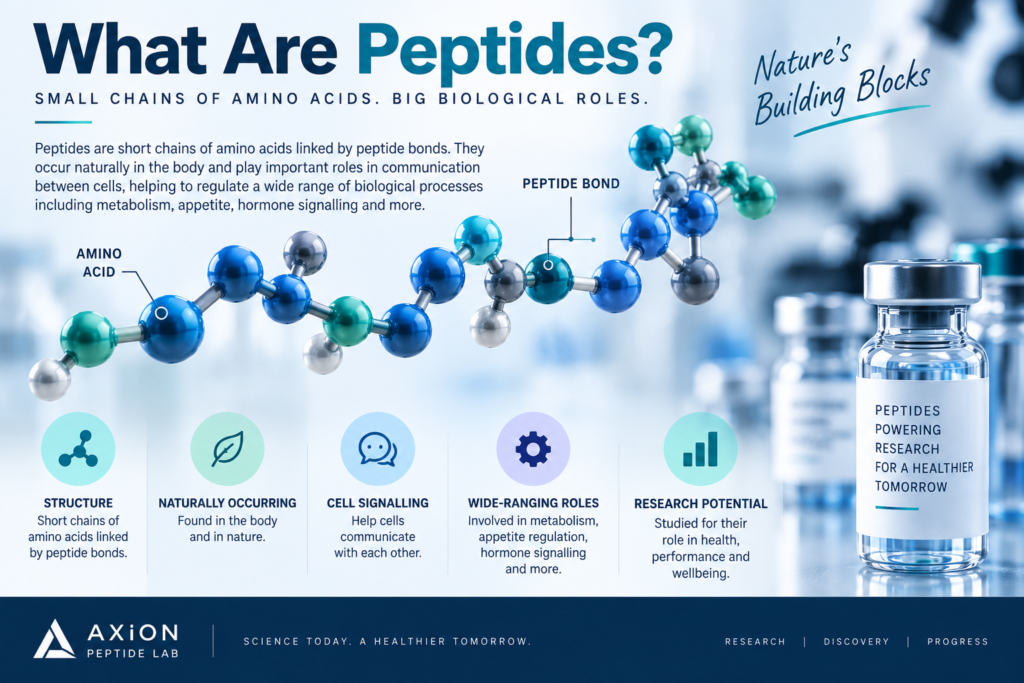
Peptides are chains of amino acids connected by peptide bonds.
Amino acids serve as building blocks for both peptides and proteins.
Many naturally occurring peptides function as biological signalling molecules.
They can participate in processes involving:
metabolism,
appetite,
digestion,
hormonal signalling,
blood-glucose regulation,
immune communication,
growth,
and cell signalling.
Researchers can also design synthetic peptide analogues that mimic or modify natural signalling pathways.
Pharmaceutical researchers frequently modify peptides to change characteristics such as:
receptor activity,
molecular stability,
duration of action,
and resistance to enzymatic breakdown.
Retatrutide is an example of this type of engineered peptide research.
It is not simply naturally occurring GIP, GLP-1 or glucagon.
Instead, it is a single engineered molecule designed to interact with receptors for all three signalling systems.
Why Peptides Are Connected to Weight Regulation
The human body does not regulate body weight through one hormone.
Energy balance involves complex interactions between:
the gastrointestinal system,
brain,
pancreas,
liver,
adipose tissue,
muscle,
and numerous hormonal signals.
Several peptide hormones are released in response to nutrient intake.
These hormones help communicate information about food intake and energy availability throughout the body.
Some influence:
hunger,
satiety,
gastric emptying,
insulin secretion,
glucagon signalling,
glucose regulation,
and energy expenditure.
This biology has become an important target for pharmaceutical research.
Rather than targeting only one pathway, researchers increasingly investigate whether several complementary metabolic pathways can be activated through one molecule.
Retatrutide represents one of the most advanced examples of this approach.
Understanding GIP, GLP-1 and Glucagon
To understand retatrutide research, it helps to understand the three receptor systems it targets.
What Is GLP-1?
GLP-1 stands for glucagon-like peptide-1.
It is a naturally occurring incretin hormone involved in nutrient-responsive signalling.
GLP-1 receptor activation can influence:
glucose-dependent insulin secretion,
appetite,
satiety,
glucagon regulation,
and gastric emptying.
The success of pharmaceutical GLP-1 receptor agonists helped establish this pathway as a major therapeutic target in metabolic medicine.
Semaglutide is one important example.
What Is GIP?
GIP stands for glucose-dependent insulinotropic polypeptide.
It is another incretin hormone released in connection with nutrient intake.
GIP participates in metabolic signalling, including glucose-dependent insulin responses.
Researchers became increasingly interested in combining GIP and GLP-1 receptor activation.
That strategy led to tirzepatide. Retatrutide research
Tirzepatide is therefore classified as a dual GIP/GLP-1 receptor agonist.
What Is Glucagon?
Glucagon is another peptide hormone involved in energy metabolism.
It is traditionally associated with increasing blood glucose by stimulating hepatic glucose production.
That may make glucagon receptor activation seem counterintuitive in a metabolic drug.
However, glucagon biology is more complex than its effect on glucose alone.
Preclinical studies have investigated whether controlled glucagon-receptor activation can influence:
energy expenditure,
lipid metabolism,
hepatic fat,
and broader energy balance.
Retatrutide was designed to combine glucagon receptor activity with GIP and GLP-1 signalling rather than activating glucagon in isolation.
The scientific hypothesis is that these pathways may complement one another.
That hypothesis is still being tested through clinical development.
How Retatrutide’s Triple-Agonist Mechanism Works
Retatrutide is a single molecule rather than a mixture of three separate peptides.
Laboratory pharmacology studies found that it activates human GIP, GLP-1 and glucagon receptors.
Research published in Nature Medicine reported that the compound showed stronger activity at the GIP receptor relative to the native ligand in cell studies while retaining activity at GLP-1 and glucagon receptors. The compound has a pharmacokinetic profile compatible with once-weekly administration within clinical trials.
Researchers believe the three pathways may contribute in different ways.
GLP-1 receptor activity can contribute to appetite reduction and glucose-dependent insulin signalling.
GIP receptor activity may complement incretin and metabolic signalling.
Glucagon receptor activity may influence energy expenditure and lipid metabolism.
The resulting effects cannot simply be calculated by adding three individual hormones together.
Receptor biology is complex, and the balance of activity between the three receptors is an important part of the molecule’s design. Retatrutide research
Why Is Retatrutide Sometimes Called “GLP-3”?
Some websites and social-media accounts have called retatrutide “GLP-3.”
This is not a scientifically accurate name.
There is no newly discovered hormone called GLP-3 involved in retatrutide.
Lilly specifically explains that “GLP-3” is an informal media nickname rather than a scientific classification.
The more accurate description is:
GIP/GLP-1/glucagon triple receptor agonist
or simply:
triple agonist.
Using accurate terminology is particularly important in research content because it prevents oversimplification of the underlying biology.
Early Retatrutide Research
Before large obesity trials began, investigators conducted laboratory, animal and early human studies.
A 2022 Cell Metabolism paper documented the discovery and early development of LY3437943.
In preclinical models, researchers investigated how combining GIP, GLP-1 and glucagon receptor activity could influence glucose regulation and body weight.
Early human pharmacology suggested a duration of activity compatible with weekly investigation and supported progression into larger clinical trials.
The next major step was determining whether these experimental findings would translate into meaningful results in larger groups of humans.
Phase 2 Retatrutide Research in Obesity
One of the most important milestones was a Phase 2 randomized trial published in the New England Journal of Medicine in 2023.
The study enrolled 338 adults with obesity or overweight plus at least one weight-related condition.
Participants were randomized to retatrutide at several study doses or placebo and followed for 48 weeks.
At 48 weeks, mean body-weight changes in the combined study groups reached:
−8.7% with 1 mg
−17.1% with 4 mg
−22.8% with 8 mg
−24.2% with 12 mg
compared with approximately −2.1% with placebo.
The highest-dose group had not clearly reached a weight-loss plateau at week 48, which helped motivate longer Phase 3 studies.
These results established retatrutide as an important candidate for further metabolic research.
But this was still a Phase 2 trial.
Phase 2 studies are intended to investigate efficacy, dose response and safety and are not equivalent to regulatory approval.
What Did Phase 2 Research Show About Larger Weight-Loss Thresholds?
The Phase 2 study also evaluated the proportion of participants reaching different levels of weight reduction.
At 48 weeks, among participants receiving the highest 12 mg study dose:
100% reached at least 5% weight reduction,
93% reached at least 10%,
and
83% reached at least 15%.
The study also reported that 26% of participants in the 12 mg group reached at least 30% weight reduction.
These percentages were findings within a controlled research population.
They should not be interpreted as guaranteed outcomes for individuals or as evidence supporting use of unapproved retatrutide products outside clinical trials.
Phase 3 Retatrutide Research: TRIUMPH-1
Retatrutide subsequently entered the Phase 3 TRIUMPH clinical-development programme.
In May 2026, Lilly announced topline results from TRIUMPH-1, a Phase 3 trial involving adults with obesity or overweight plus a weight-related condition who did not have diabetes.
The study included more than 2,300 participants.
At 80 weeks, Lilly reported average body-weight reductions under its efficacy estimand of:
19.0% with 4 mg
25.9% with 9 mg
28.3% with 12 mg
compared with 2.2% with placebo.
Among participants receiving 12 mg, 45.3% achieved at least 30% body-weight reduction at week 80 in the reported analysis.
These are major Phase 3 findings, but an important evidence distinction remains:
At the time of writing, the main TRIUMPH-1 obesity results are company-reported Phase 3 topline findings rather than a complete peer-reviewed primary publication comparable with the earlier NEJM Phase 2 paper.
That distinction should be preserved when discussing the evidence.
What Happened in the 104-Week TRIUMPH-1 Extension?
A pre-specified extension included participants who began the study with BMI of at least 35 and met the extension requirements.
Lilly reported that participants continuing on the highest study regimen had average weight reduction around 30.3% at 104 weeks under the reported efficacy analysis.
The extension is scientifically interesting because it suggests that some participants continued losing weight beyond the initial 80-week endpoint.
However, extension populations can differ from the original randomized population because eligibility may depend on completing earlier stages of treatment.
Results therefore need to be interpreted in the context of the extension design.
Retatrutide Research in Type 2 Diabetes
Retatrutide is not being investigated only for obesity.
Type 2 diabetes represents another major area of study.
Earlier Phase 2 research published in The Lancet evaluated retatrutide in people with type 2 diabetes and provided evidence supporting continued investigation of its effects on glucose regulation and body weight.
The programme later advanced into Phase 3.
TRANSCEND-T2D-1: Published Phase 3 Retatrutide Research
One particularly important development in 2026 was publication of TRANSCEND-T2D-1 in The Lancet.
Unlike some of the newer Phase 3 obesity results that had been released primarily as topline announcements, TRANSCEND-T2D-1 had undergone peer-reviewed publication.
The 40-week randomized, double-blind Phase 3 study included 537 participants with type 2 diabetes inadequately controlled with diet and exercise alone.
Retatrutide produced average HbA1c reductions of approximately:
1.69 percentage points with 4 mg
1.86 percentage points with 9 mg
1.94 percentage points with 12 mg
compared with about 0.81 percentage points with placebo.
Body-weight changes were approximately:
−11.5%
−13.9%
and
−15.3%
for the respective retatrutide groups, compared with −2.6% with placebo.
This study provides important evidence that the metabolic effects of retatrutide extend beyond obesity populations without diabetes.
Retatrutide nevertheless remains investigational.
Successful Phase 3 results and regulatory approval are different milestones.
TRIUMPH-2 and Retatrutide Research in Obesity With Type 2 Diabetes
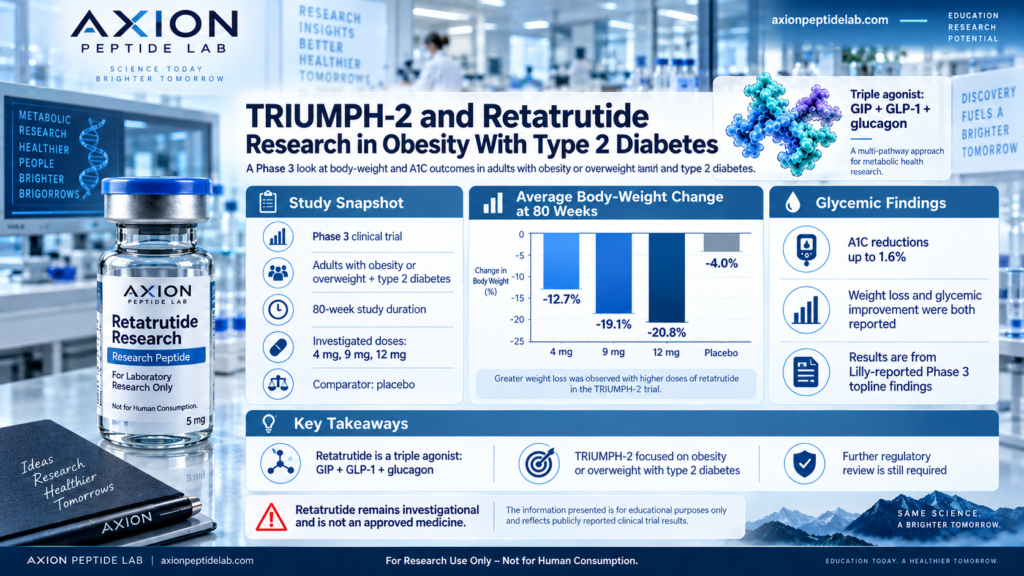
In July 2026, Lilly reported results from TRIUMPH-2, which investigated retatrutide in adults with obesity or overweight and type 2 diabetes.
At 80 weeks, the company reported average body-weight reductions of approximately:
12.7% with 4 mg
19.1% with 9 mg
and
20.8% with 12 mg.
The programme also reported improvements in HbA1c.
These findings are important because people with type 2 diabetes often experience different weight-loss responses in obesity trials compared with populations without diabetes.
Again, detailed publication and independent scientific evaluation remain important as the evidence base matures.
TRIUMPH-3: Cardiovascular-Disease Population
TRIUMPH-3 investigated retatrutide in adults with severe obesity and established cardiovascular disease, with or without type 2 diabetes.
Lilly reported in July 2026 that participants receiving the highest studied doses had average weight reductions exceeding 20% at 80 weeks.
The company reported approximately 21.6% at 9 mg and 22.6% at 12 mg, compared with around 3.2% with placebo under the efficacy analysis.
This population is particularly relevant because cardiovascular disease is one of the major complications associated with obesity.
However, body-weight reduction should not automatically be interpreted as proof of reduced cardiovascular events.
Dedicated cardiovascular-outcomes research is required to answer that question.
Retatrutide and Cardiovascular Outcomes
Lilly’s development programme includes TRIUMPH-OUTCOMES, a large Phase 3 outcomes trial designed to examine cardiovascular and kidney outcomes in adults living with obesity.
The programme has been listed with approximately 10,000 participants and a projected completion around 2029.
Long-term outcomes studies are important because reductions in body weight or laboratory markers do not automatically establish reductions in events such as:
heart attacks,
stroke,
cardiovascular death,
or kidney disease progression.
Those endpoints require direct study.
Retatrutide Research and Knee Osteoarthritis
Obesity places additional mechanical and inflammatory stress on weight-bearing joints.
For this reason, researchers have also investigated whether substantial weight reduction might affect knee osteoarthritis symptoms.
In December 2025, Lilly reported results from TRIUMPH-4, which involved participants with obesity or overweight and knee osteoarthritis.
The company reported substantial reductions in body weight and improvements in WOMAC pain measurements over 68 weeks.
At the highest study dose, Lilly reported average weight reduction of approximately 28.7% and substantial improvement in osteoarthritis pain measures.
Pain improvement could reflect several factors, including weight reduction and broader metabolic effects.
Further publication and analysis are important for understanding those mechanisms.
Retatrutide Research and Obstructive Sleep Apnoea
Obstructive sleep apnoea is strongly associated with obesity in many patients.
The TRIUMPH programme has included study groups examining moderate-to-severe obstructive sleep apnoea.
In June 2026, Lilly reported reductions in sleep-apnoea severity measured through respiratory events in participants studied within the programme.
This is another example of the increasingly broad research programme surrounding retatrutide.
It also demonstrates why retatrutide should not be understood only as a “weight-loss peptide.”
Researchers are studying how substantial metabolic changes affect multiple obesity-associated conditions.
Retatrutide Research and Liver Fat
Another important area involves metabolic dysfunction-associated steatotic liver disease, or MASLD.
A randomized Phase 2a substudy published in Nature Medicine evaluated participants with elevated liver fat.
At week 24, researchers reported mean relative liver-fat reductions of approximately:
42.9% with 1 mg,
57.0% with 4 mg,
81.4% with 8 mg,
and
82.4% with 12 mg,
compared with essentially no reduction in the placebo group.
At higher study doses, a large proportion of participants reached liver-fat levels below 5%.
Researchers also found that reductions in liver fat correlated strongly with reductions in body weight and abdominal fat.
These results support continued investigation of retatrutide in metabolic liver disease.
They do not establish regulatory approval for MASLD or MASH treatment.
Retatrutide Safety and Reported Adverse Effects
No meaningful discussion of retatrutide research is complete without examining adverse events.
Clinical effectiveness and safety must be evaluated together.
Phase 2 Safety Findings
In the 48-week Phase 2 obesity trial, the most commonly reported adverse events were gastrointestinal.
These included effects typical of incretin-related therapies.
The events were generally mild to moderate and were more common at higher study doses.
The study also reported dose-dependent increases in heart rate that peaked around week 24 and subsequently declined.
TRIUMPH-1 Safety Findings
In TRIUMPH-1, Lilly reported nausea, diarrhoea, constipation and vomiting among the most frequent adverse events.
At the highest investigated dose, nausea occurred in approximately 42% of participants in the company-reported dataset, while gastrointestinal adverse events were generally described as consistent with incretin-based therapies.
Lilly also reported dysesthesia, an altered-sensation symptom, more frequently in retatrutide groups than placebo.
Discontinuation because of adverse events increased with higher doses in TRIUMPH-1.
These findings matter because strong efficacy does not eliminate tolerability considerations.
What Researchers Still Do Not Know About Retatrutide
Despite substantial progress, several important questions remain.
Retatrutide does not yet have the same extent of long-term post-marketing safety data available for established prescription medicines.
Researchers continue to investigate:
long-term cardiovascular outcomes,
kidney outcomes,
long-term tolerability,
maintenance of weight reduction,
optimal dosing strategies,
effects after treatment discontinuation,
rare adverse events,
and outcomes in broader populations.
The absence of answers to these questions does not mean retatrutide will necessarily prove unsafe.
It means the evidence is still developing.
That is exactly why Phase 3 programmes and regulatory review exist.
Semaglutide vs Tirzepatide vs Retatrutide
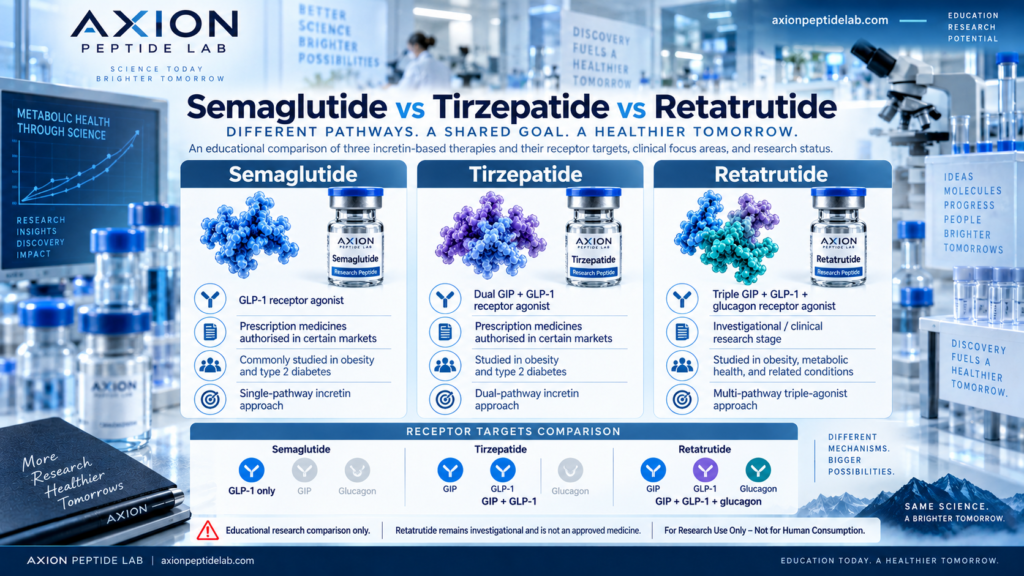
These three compounds are often placed in the same category, but their mechanisms differ.
Semaglutide
Semaglutide primarily acts at the GLP-1 receptor.
Specific semaglutide products such as Wegovy are authorised prescription medicines for defined indications in the United States and UK.
Tirzepatide
Tirzepatide acts at both:
GIP
and
GLP-1 receptors.
Specific products containing tirzepatide, including Zepbound in the United States and Mounjaro in the UK, are authorised for defined medical indications.
Retatrutide
Retatrutide targets:
GIP
GLP-1
and
glucagon receptors.
It remains investigational and unapproved as of September 2026.
Is Retatrutide Better Than Tirzepatide?
The current evidence does not justify declaring a definitive winner.
Retatrutide trials have reported very large average body-weight reductions.
However, comparing percentages from separate clinical trials can be misleading because trials differ in:
participant populations,
study duration,
dose schedules,
statistical methods,
baseline characteristics,
and treatment protocols.
A Phase 3 study called TRIUMPH-5 is directly comparing retatrutide and tirzepatide in adults with obesity.
As of September 2026, that trial had not yet reported final results.
Until direct comparative results are available, claims that retatrutide is definitively “better” than tirzepatide should be treated cautiously.
Is Retatrutide Better Than Semaglutide?
The same evidence limitation applies.
There is no completed obesity trial directly randomizing participants to retatrutide versus semaglutide.
A separate Phase 3 diabetes study programme includes direct comparison with semaglutide, but definitive results had not yet established an overall comparative conclusion as of September 2026.
Cross-trial comparisons can generate hypotheses.
They cannot replace randomized head-to-head evidence.
Is Retatrutide FDA Approved?
No.
As of September 2026, retatrutide is not FDA approved.
The FDA states that retatrutide is not a component of an FDA-approved drug and has not been found safe and effective by the agency for any condition.
FDA also states that retatrutide cannot legally be used in compounding under federal law.
Lilly similarly states that retatrutide remains investigational and is not approved by any regulatory agency.
This remains true even after multiple positive Phase 3 announcements.
When Could Retatrutide Be Submitted for Approval?
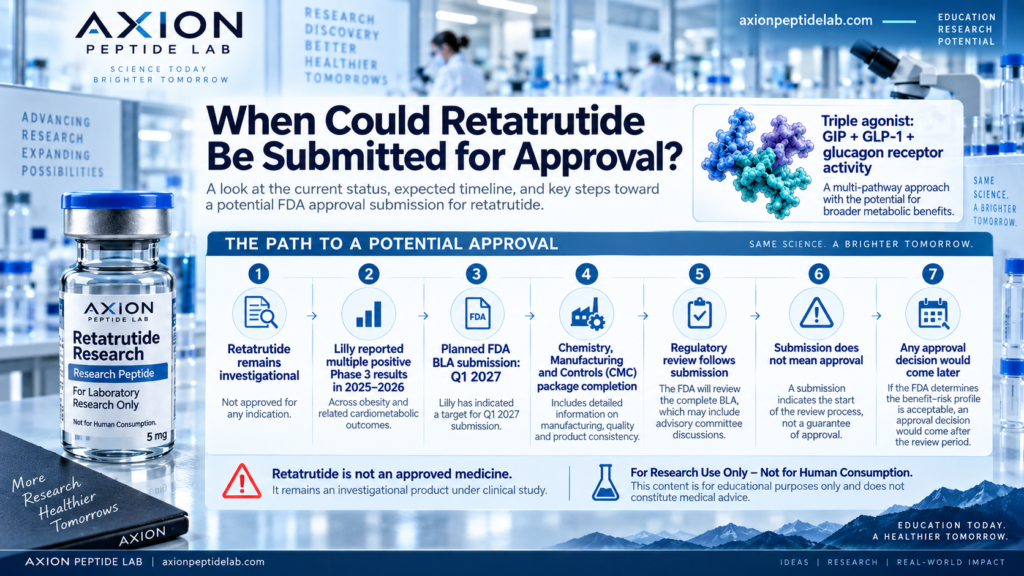
Lilly stated in July 2026 that it planned to submit a regulatory application to FDA in 2027 based on its clinical-data programme.
A planned submission does not guarantee approval.
Regulators independently review factors including:
efficacy,
safety,
manufacturing quality,
clinical-study design,
risk-benefit balance,
and product labelling.
The timeline can therefore change.
Until an agency grants marketing authorisation, retatrutide remains investigational.
UK Regulatory Status of Retatrutide
Retatrutide is also not currently a licensed prescription medicine in the UK.
The MHRA’s 2026 records show regulatory-development activity involving retatrutide, including an agreed paediatric investigation plan for obesity, which is part of the development process rather than marketing authorisation.
By contrast, authorised UK metabolic medicines include defined semaglutide and tirzepatide products.
UK regulators have also warned businesses against promoting unlicensed weight-management medicines or pipeline products to the public before authorisation.
This distinction is especially important for commercial research websites.
Scientific discussion of retatrutide research should not imply that a research product is an approved obesity medicine.
Research Peptides vs Prescription Medicines
A research-use peptide and a prescription pharmaceutical are different categories.
A prescription medicine has undergone formal regulatory review covering areas such as:
clinical efficacy,
safety,
manufacturing quality,
formulation,
stability,
labelling,
and authorised indications.
A research peptide is intended for scientific investigation.
Analytical documentation for a research material may include:
HPLC purity,
mass spectrometry,
batch information,
molecular identity,
and other laboratory characteristics.
Those analytical results do not create pharmaceutical approval.
For example:
A hypothetical research sample showing 99% HPLC purity does not become an approved retatrutide medicine.
Purity and regulatory authorisation answer completely different questions.
Why a COA Matters in Retatrutide Research
For legitimate laboratory research, the identity and analytical characterisation of experimental material matter.
A Certificate of Analysis may provide information such as:
batch number,
HPLC purity,
mass-spectrometric identity,
molecular weight,
analysis date,
and additional laboratory results.
Researchers should verify whether documentation corresponds to the specific material being evaluated.
However, a COA should not be interpreted as:
proof of clinical safety,
proof of therapeutic effectiveness,
FDA approval,
MHRA approval,
or permission for human administration.
Researchers exploring laboratory materials can review AxionPeptideLab.com for research-specific catalogue information where lawful and institutionally appropriate.
Research procurement should remain separate from consumer medical use.
For Research Use Only – Not for human consumption.
Why Unapproved “Retatrutide” Products Are a Concern
The rapid growth of interest in retatrutide has also created a market for products claiming to contain the investigational molecule.
Both FDA and Lilly have issued warnings regarding unapproved retatrutide products marketed for human use.
Lilly states that products claiming to contain retatrutide outside its clinical-trial programme may have unknown ingredients, contaminants, incorrect concentrations or other quality problems.
FDA has similarly warned about unapproved GLP-1-related drugs and retatrutide marketing.
A research-use disclaimer should therefore not be used to disguise intended therapeutic sale or human consumption.
Legitimate laboratory research and consumer treatment are fundamentally different activities.
Current and Future Retatrutide Research

The retatrutide development programme extends well beyond the first obesity trials.
Current or planned research areas include:
obesity,
type 2 diabetes,
cardiovascular outcomes,
kidney outcomes,
knee osteoarthritis,
obstructive sleep apnoea,
chronic low-back pain,
metabolic liver disease,
maintenance of weight reduction,
and direct comparisons with existing metabolic medicines.
Several questions will be particularly important over the next few years.
Will the cardiovascular-outcomes programme show reductions in major clinical events?
How durable will weight reduction be?
What happens after treatment stops?
How does retatrutide compare directly with tirzepatide?
How does it compare with semaglutide in controlled head-to-head research?
Will glucagon receptor activity create additional long-term benefits, risks or both?
These questions cannot be answered by early enthusiasm alone.
They require completed controlled trials and regulatory review.
Frequently Asked Questions About Retatrutide Research
What is retatrutide?
Retatrutide is an investigational peptide-based triple receptor agonist developed by Eli Lilly. It activates GIP, GLP-1 and glucagon receptors.
What is retatrutide being researched for?
Clinical studies have investigated retatrutide in obesity, type 2 diabetes and several obesity-associated conditions including osteoarthritis, obstructive sleep apnoea, cardiovascular disease and metabolic liver disease.
Is retatrutide approved?
No. As of September 2026, retatrutide remains investigational and is not FDA approved or licensed as a prescription medicine.
Is retatrutide a GLP-1 drug?
Retatrutide does activate the GLP-1 receptor, but it is not a GLP-1-only molecule. It simultaneously activates GIP and glucagon receptors.
Is retatrutide “GLP-3”?
No. “GLP-3” is an informal and scientifically inaccurate nickname. Retatrutide is more accurately called a GIP/GLP-1/glucagon triple receptor agonist.
How much weight loss was reported in retatrutide research?
In the published Phase 2 obesity study, the highest study dose produced an average body-weight reduction of approximately 24.2% at 48 weeks. Lilly’s Phase 3 TRIUMPH-1 topline report subsequently reported approximately 28.3% average reduction at 80 weeks for the highest study dose under its efficacy analysis.
Has Phase 3 retatrutide research been published?
Yes, the Phase 3 TRANSCEND-T2D-1 study in adults with type 2 diabetes was published in The Lancet in June 2026. Some major obesity Phase 3 results have so far been announced through sponsor topline releases while detailed peer-reviewed publications continue to emerge.
What are the most common retatrutide side effects reported in research?
Gastrointestinal events including nausea, diarrhoea, constipation and vomiting have been among the most frequently reported. Clinical trials have also observed other events, including altered sensations such as dysesthesia in the TRIUMPH-1 programme.
How is retatrutide different from semaglutide?
Semaglutide primarily activates GLP-1 receptors. Retatrutide activates GIP, GLP-1 and glucagon receptors. Semaglutide has authorised prescription products, while retatrutide remains investigational.
How is retatrutide different from tirzepatide?
Tirzepatide activates GIP and GLP-1 receptors. Retatrutide activates those two receptor systems plus the glucagon receptor.
Is retatrutide better than tirzepatide?
There is not yet enough completed head-to-head evidence to establish an overall conclusion. TRIUMPH-5 is directly comparing retatrutide with tirzepatide, but final results had not been reported as of September 2026.
Does retatrutide research include diabetes?
Yes. Phase 2 and Phase 3 studies have investigated retatrutide in type 2 diabetes. TRANSCEND-T2D-1 was published in The Lancet in 2026.
Does retatrutide affect liver fat?
A Phase 2a substudy published in Nature Medicine reported substantial reductions in liver fat among participants with MASLD, particularly at higher study doses. Further research is continuing.
Can a research-use retatrutide product be treated as a medicine?
No. Laboratory research products should not be considered substitutes for authorised prescription medicines. Clinical-trial evidence concerning an investigational pharmaceutical preparation does not automatically apply to separately manufactured research materials.
What is next for retatrutide?
Future milestones include additional Phase 3 publications, direct comparator studies, long-term cardiovascular and kidney outcomes research and possible regulatory submissions. Lilly has stated plans for regulatory submission following completion of its clinical-data package.
Final Thoughts on Retatrutide Research
Retatrutide research represents an important development in the evolution of metabolic peptide science.
The concept behind the molecule is straightforward but scientifically ambitious:
Instead of targeting one metabolic receptor, retatrutide simultaneously targets three.
GLP-1 signalling contributes established incretin and appetite-related effects.
GIP adds a second incretin pathway.
Glucagon receptor activity introduces another component involving energy and metabolic regulation.
Together, these mechanisms have produced notable findings across early and late-stage trials.
The published Phase 2 obesity study reported substantial average body-weight reduction.
Phase 3 TRIUMPH studies have subsequently reported large weight changes across different obesity populations.
The published TRANSCEND-T2D-1 study demonstrated significant effects on HbA1c and body weight in type 2 diabetes.
Researchers have also reported important signals involving liver fat, knee osteoarthritis and obstructive sleep apnoea.
But scientific enthusiasm should remain proportional to the evidence.
Retatrutide is still investigational.
Long-term outcomes research continues.
Direct comparisons with established medicines are still developing.
Rare safety risks may become clearer only with larger populations and longer observation.
And regulatory agencies have not yet authorised retatrutide as a medicine.
These distinctions matter particularly when clinical research is discussed alongside laboratory peptide products.
A research-use compound should remain clearly separated from human treatment.
Researchers interested in laboratory peptide science can explore relevant research information and catalogue materials through AxionPeptideLab.com, subject to applicable laws and institutional research requirements.
Clinical treatment should remain within authorised medical and pharmaceutical channels.
For Research Use Only – Not for human consumption.
References and Further Reading
Jastreboff AM, Kaplan LM, Frías JP, et al. — Triple-Hormone-Receptor Agonist Retatrutide for Obesity: A Phase 2 Trial. New England Journal of Medicine, 2023. The major peer-reviewed Phase 2 obesity trial involving 338 adults.
Coskun T, Urva S, Roell WC, et al. — LY3437943, a Novel Triple Glucagon, GIP and GLP-1 Receptor Agonist. Cell Metabolism, 2022. Discovery, preclinical pharmacology and early proof-of-concept work.
Bajaj HS, Welch M, Shah P, et al. — TRANSCEND-T2D-1. The Lancet, 2026. Published randomized Phase 3 study of retatrutide in adults with type 2 diabetes inadequately controlled with diet and exercise.
Sanyal AJ, Kaplan LM, Frias JP, et al. — Retatrutide for Metabolic Dysfunction-Associated Steatotic Liver Disease. Nature Medicine, 2024. Phase 2a analysis of liver-fat and metabolic outcomes.
Eli Lilly — TRIUMPH-1 Phase 3 Results, May 2026. Sponsor-reported Phase 3 obesity results and 104-week extension findings.
Eli Lilly — TRIUMPH-2 and TRIUMPH-3 Results, July 2026. Phase 3 topline research involving obesity with type 2 diabetes and severe obesity with cardiovascular disease.
Eli Lilly — Retatrutide Development Information. Current investigational and regulatory-development status.
U.S. Food and Drug Administration — Concerns With Unapproved GLP-1 Drugs Used for Weight Loss. Current FDA information confirming retatrutide is not a component of an FDA-approved drug.
MHRA — GLP-1 Medicines for Weight Loss and Diabetes. UK information distinguishing authorised semaglutide and tirzepatide medicines.
MHRA — Warning on Promotion of Unlicensed Weight-Management Medicines. UK regulatory guidance relevant to pipeline and unlicensed obesity products.