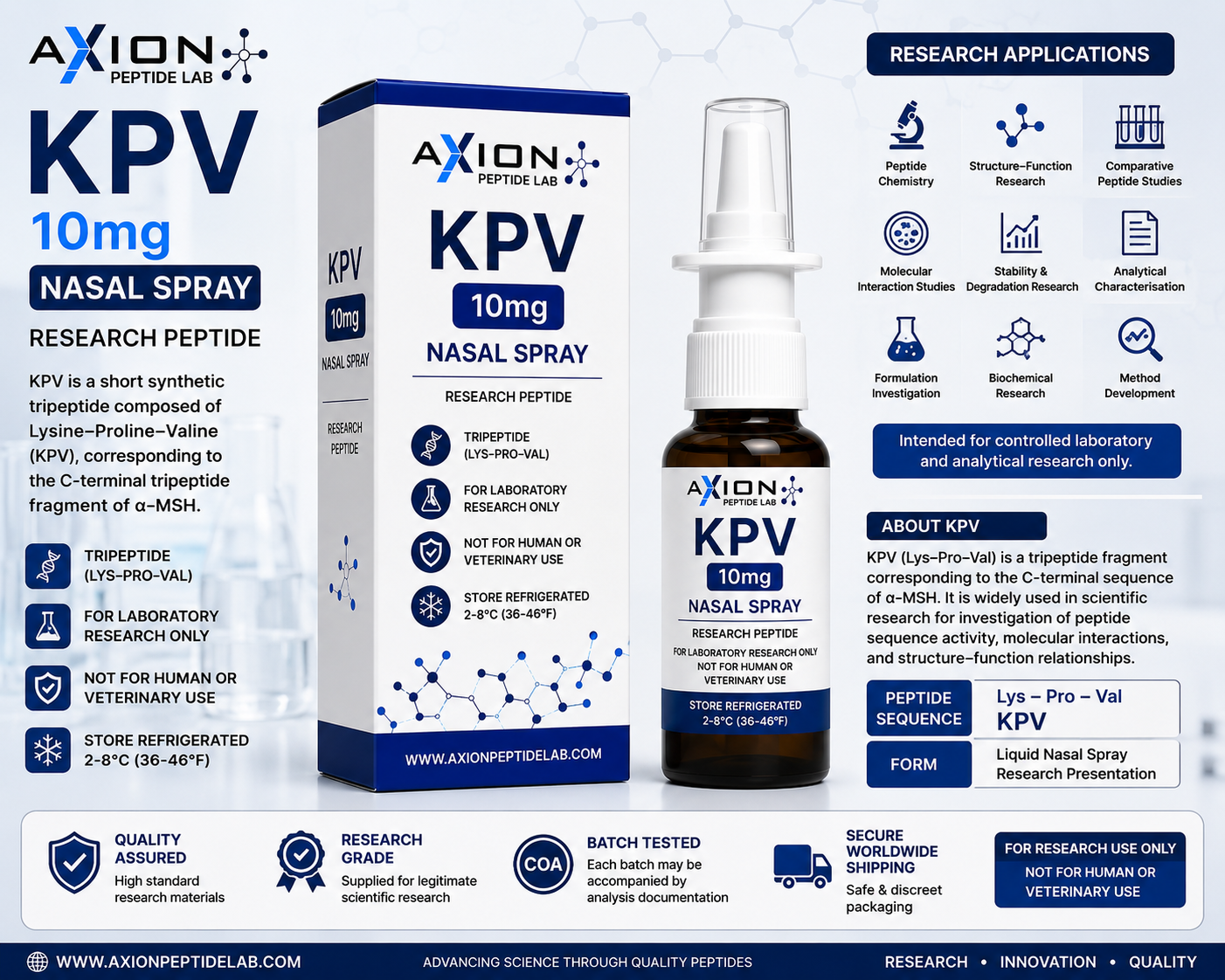
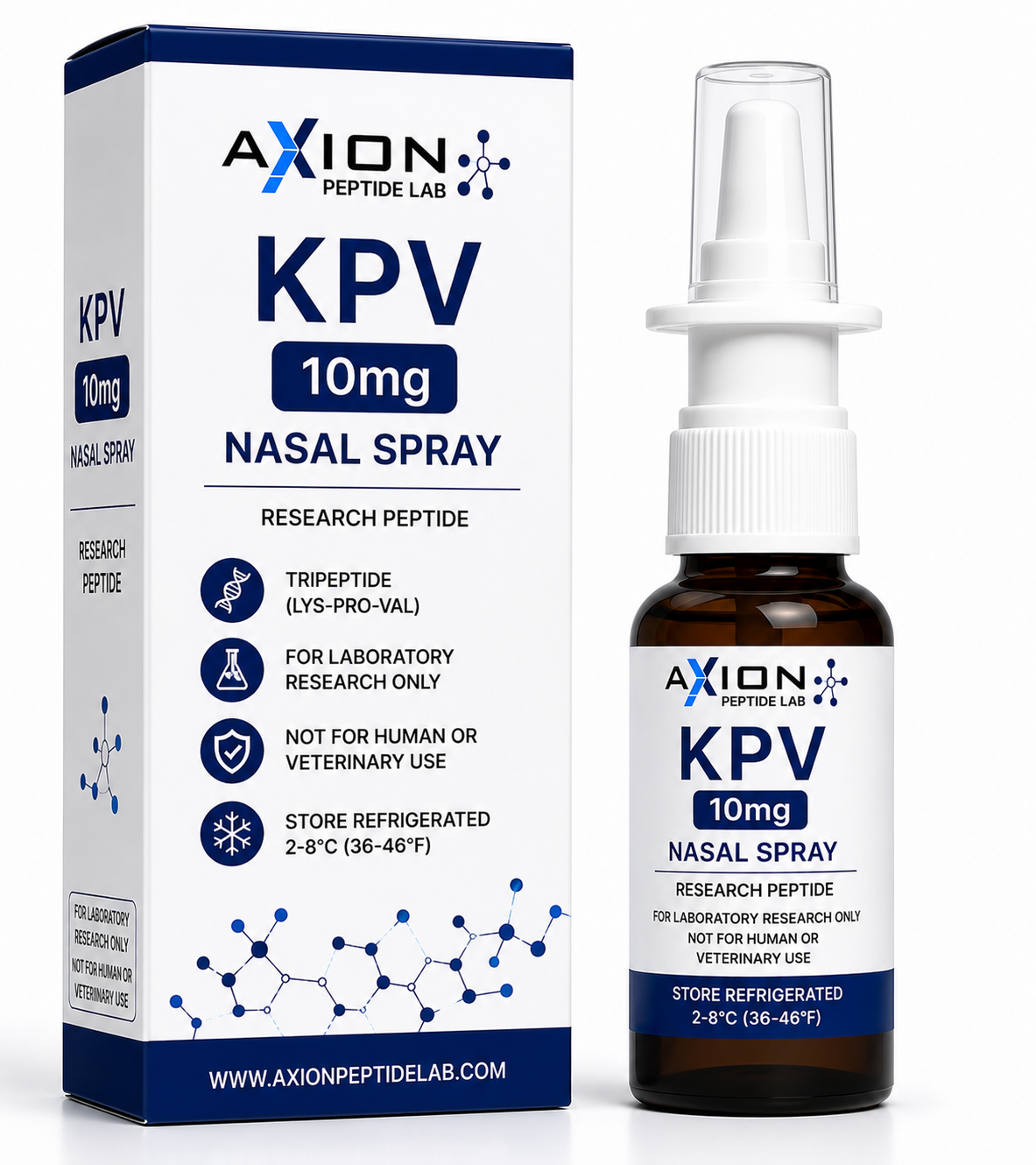
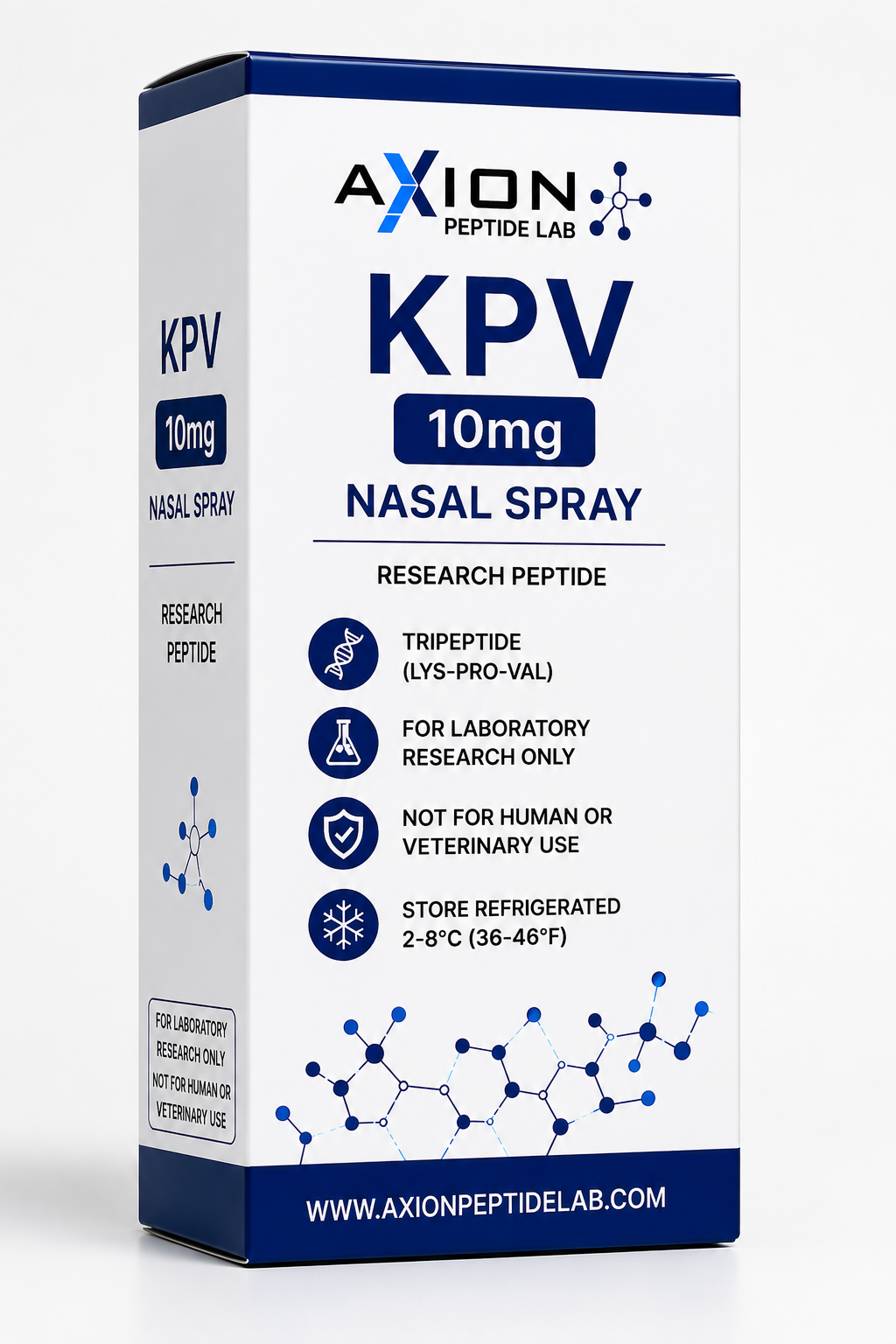
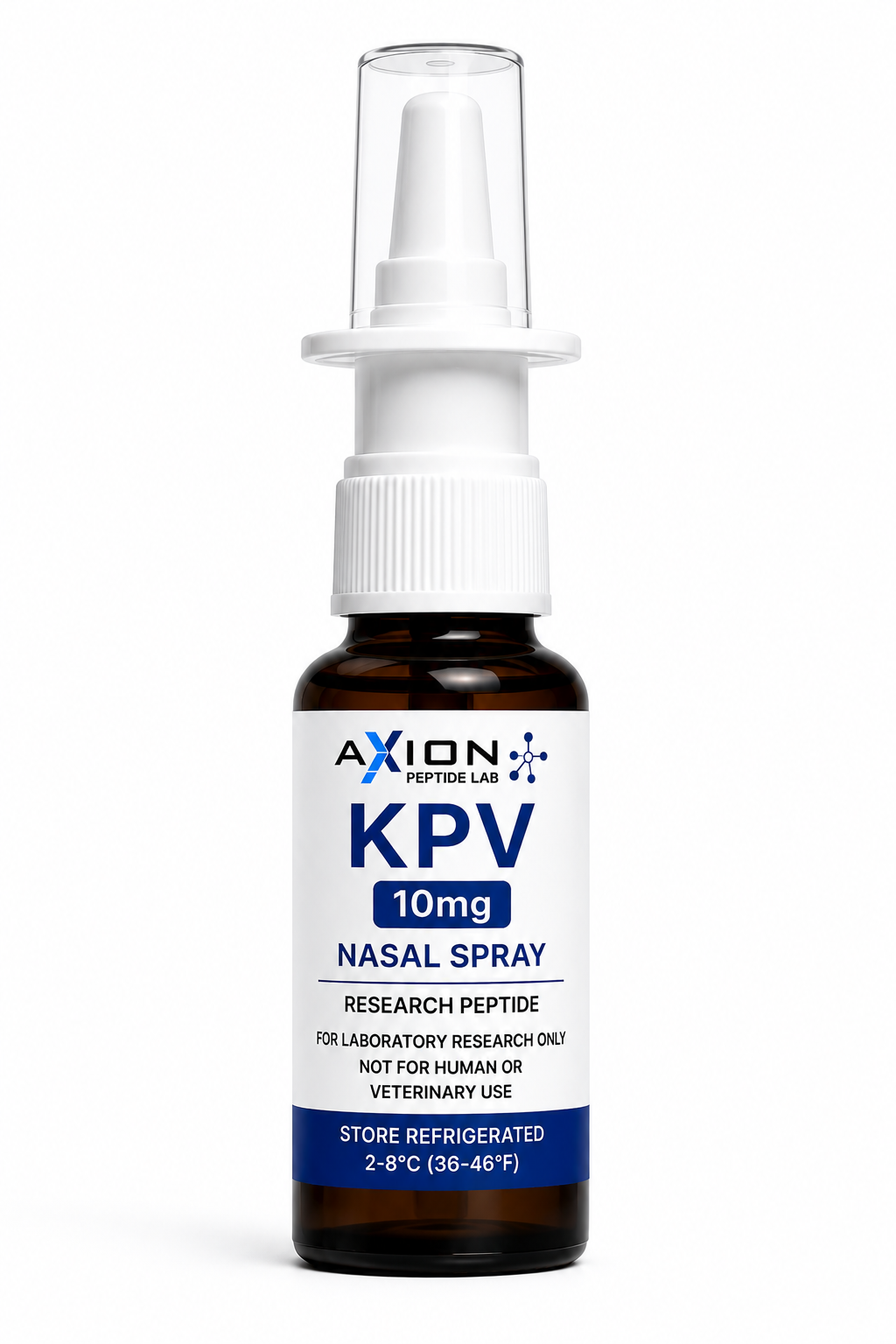
KPV 10mg Nasal Spray is a short synthetic tripeptide research preparation containing the sequence Lys-Pro-Val (KPV). KPV corresponds to a C-terminal tripeptide associated with α-MSH and is supplied in a liquid research format for controlled laboratory investigation.
Potential research areas include peptide chemistry, α-MSH fragment investigation, structure-function relationships, comparative peptide studies, formulation research, stability and analytical characterisation.
The 10mg designation represents the stated research quantity and is not a dosage recommendation. Nasal Spray describes the research presentation only.
For Research Use Only – Not for human or veterinary consumption or administration.
$69.04
KPV 10mg Nasal Spray from Axion Peptide Lab is a short synthetic peptide preparation supplied in a liquid spray format for controlled laboratory, biochemical and analytical investigation. KPV is a three-amino-acid peptide composed of lysine, proline and valine, making it a compact tripeptide of interest for peptide chemistry, molecular interaction, structure-function and analytical research.
KPV is commonly discussed in scientific literature as the C-terminal tripeptide fragment of α-melanocyte-stimulating hormone (α-MSH). Because it represents a small fragment rather than the complete α-MSH peptide, KPV provides researchers with a useful model for investigating how short peptide sequences may retain, lose or alter molecular characteristics associated with larger parent peptides.
The 10mg designation represents the stated research quantity associated with the preparation and is not a dosage recommendation.
“Nasal Spray” describes the liquid research presentation and should not be interpreted as an instruction or recommendation for human intranasal administration.
For Research Use Only – Not for human or veterinary consumption or administration.
KPV is the abbreviated name for the peptide sequence:
Lys-Pro-Val
or:
Lysine-Proline-Valine
The single-letter amino-acid abbreviation is KPV.
With only three amino-acid residues, KPV is classified as a tripeptide.
Its compact structure makes it suitable for controlled experiments involving peptide sequence, structure-function relationships, analytical chemistry and comparative peptide research.
KPV is especially interesting because it corresponds to the C-terminal tripeptide sequence associated with α-MSH.
Researchers can therefore investigate KPV independently or compare it with longer peptide sequences within appropriately designed experimental systems.
Alpha-melanocyte-stimulating hormone, commonly abbreviated α-MSH, is a peptide derived from the proopiomelanocortin system.
KPV represents a small C-terminal fragment associated with the α-MSH sequence.
Studying peptide fragments can help scientists determine which portions of a larger molecule contribute to experimentally observed properties.
Researchers may compare full-length or longer parent-related peptides with shorter fragments such as KPV.
This type of comparison can contribute to structure-function research by helping identify how peptide length and amino-acid composition influence molecular interactions.
KPV should not automatically be assumed to reproduce every property associated with α-MSH.
The smaller peptide has its own structural and experimental characteristics.
Short peptides can provide useful models for studying fundamental principles of peptide chemistry.
Because KPV contains only three residues, researchers can examine the contribution of each amino acid more directly than may be possible with much larger peptides.
Lysine contains a basic side chain, proline has a distinctive cyclic structure, and valine contains a branched hydrophobic side chain.
Together, these residues create a compact molecule with characteristics that can be investigated under controlled laboratory conditions.
Researchers may compare KPV with modified sequences, analogues or related peptide fragments to examine how changes in individual residues affect experimentally measured behaviour.
Structure-function research investigates the relationship between molecular structure and experimentally observed properties.
KPV offers a straightforward sequence for this type of work.
Scientists may compare the original Lys-Pro-Val sequence with substituted, extended or shortened analogues.
Experimental results can then help determine whether particular residues are important for a measured interaction or chemical characteristic.
Researchers may also compare KPV with other fragments derived from larger peptide systems.
These experiments can contribute to broader understanding of peptide sequence-function relationships. KPV 10mg Nasal Spray
KPV has appeared in preclinical scientific literature examining a variety of molecular and cellular processes.
Such research can provide hypotheses for further laboratory investigation, but preclinical observations should not be presented as established therapeutic effects.
Controlled experiments may instead focus on measurable molecular interactions, signalling-associated changes, binding characteristics or other defined biochemical endpoints.
The experimental model, concentration, controls and analytical methodology should be documented carefully.
Results obtained in isolated systems, cultured cells or animal experiments cannot automatically be extrapolated to humans.
Analytical characterisation is an important aspect of peptide research.
KPV can be studied using techniques appropriate for short peptide molecules.
Depending on the laboratory and experimental objective, researchers may employ chromatographic, spectrometric or other validated analytical approaches.
Mass spectrometry may assist with molecular identity investigation, while chromatographic methods can support separation and purity assessment.
Short peptides may present different analytical challenges compared with larger molecules, so methods should be selected and validated appropriately.
Researchers requiring a particular purity specification should consult applicable batch documentation rather than relying on generic product assumptions. KPV 10mg Nasal Spray
Stability can influence the reproducibility of peptide experiments.
Researchers may investigate KPV under different controlled conditions to determine how environmental variables affect the material over time.
Potential experimental variables include temperature, pH, light exposure, solvent environment and formulation composition.
Analytical measurements can be performed at defined intervals to detect changes in peptide integrity or composition.
Results from one formulation should not automatically be assumed to apply to another.
Researchers should use product-specific storage and handling documentation where available.
The KPV 10mg Nasal Spray presentation provides a liquid research format that can be incorporated into appropriately designed formulation experiments.
Researchers may investigate peptide behaviour in solution, formulation compatibility, stability and analytical recovery.
Liquid formulations may contain additional components that influence experimental observations.
Where formulation composition is important to the research design, scientists should consult the applicable product specification to identify relevant ingredients and concentration information.
The presence of a spray dispenser does not establish that the formulation is approved or validated for human intranasal use.
The 10mg designation identifies the stated research quantity associated with the product.
It should not be interpreted as a recommended dose. KPV 10mg Nasal Spray
Researchers should determine experimental quantities according to validated protocols, analytical objectives and institutional laboratory procedures.
Where molar calculations are required, the verified molecular form and concentration information applicable to the supplied material should be used.
Axion Peptide Lab does not provide human dosing or administration protocols for research products. KPV 10mg Nasal Spray
KPV can also be incorporated into comparative peptide experiments.
Researchers may compare KPV with α-MSH-related sequences, other short peptides, modified analogues or sequence variants.
Such experiments can investigate whether changes in amino-acid sequence influence stability, analytical behaviour or defined molecular interactions.
Using appropriate controls is essential.
Experiments should distinguish between effects associated specifically with KPV and those caused by solvents, excipients or other variables in the experimental system.
Published KPV research includes experimental investigations across biochemical, cellular and animal models.
These studies have generated scientific interest in the peptide, but they should be interpreted within their methodological limitations.
Preclinical findings do not establish that a commercially supplied KPV preparation can prevent, diagnose or treat disease in humans.
For an ecommerce research listing, the most scientifically responsible approach is to describe the peptide’s molecular identity, relationship to α-MSH and legitimate laboratory applications without converting experimental observations into medical promises.
KPV research material may be relevant to projects involving:
These are research categories and should not be interpreted as medical indications.
Accurate documentation is essential for reproducible peptide research.
Researchers should record the product identity, batch information, formulation details, experimental conditions and analytical methods relevant to their work.
Where available, product-specific analytical documentation should be reviewed before quantitative experiments.
Certificate of Analysis or independent testing availability may vary according to product and batch.
Claims regarding exact purity, sterility, concentration or other specifications should only be made where supported by documentation applicable to the supplied material.
KPV 10mg Nasal Spray should be handled as laboratory research material.
It should remain clearly identified and separated from medicines, supplements and other products intended for personal use.
Laboratories should follow appropriate procedures for storage, handling and experimental documentation.
Researchers and purchasers are responsible for determining whether acquisition, possession, importation and intended research applications comply with applicable local regulations and institutional requirements.
Researchers looking to buy KPV 10mg Nasal Spray can source this tripeptide research preparation from Axion Peptide Lab for legitimate scientific, biochemical and analytical investigation.
Its compact Lys-Pro-Val structure and relationship to the C-terminal region of α-MSH make KPV an interesting experimental material for peptide chemistry, structure-function, formulation, stability and comparative molecular research.
The liquid spray presentation provides a practical research format while remaining strictly intended for controlled laboratory applications.
For Research Use Only – Not for human or veterinary consumption or administration.
KPV is a short peptide composed of lysine, proline and valine. Its name comes directly from the single-letter abbreviations for these three amino acids.
KPV contains three amino-acid residues and is therefore classified as a tripeptide.
The sequence is Lys-Pro-Val, abbreviated KPV. KPV 10mg Nasal Spray
Yes. KPV is commonly described in scientific literature as the C-terminal tripeptide fragment of α-melanocyte-stimulating hormone.
No. KPV consists of only three amino-acid residues and represents a fragment associated with the larger α-MSH peptide.
Research applications can include tripeptide chemistry, peptide-fragment analysis, structure-function investigation, molecular interaction studies, formulation research, stability and analytical characterisation.
The 10mg designation identifies the stated research quantity associated with the preparation. It is not a human dosage recommendation.
Yes. Appropriate validated analytical techniques can be used to investigate peptide identity, composition, stability and related characteristics.
No. Nasal Spray describes the liquid research presentation. It does not constitute a recommendation or instruction for human intranasal administration. KPV 10mg Nasal Spray
KPV 10mg Nasal Spray is available from Axion Peptide Lab for legitimate laboratory, biochemical and analytical research applications, subject to availability and applicable requirements.