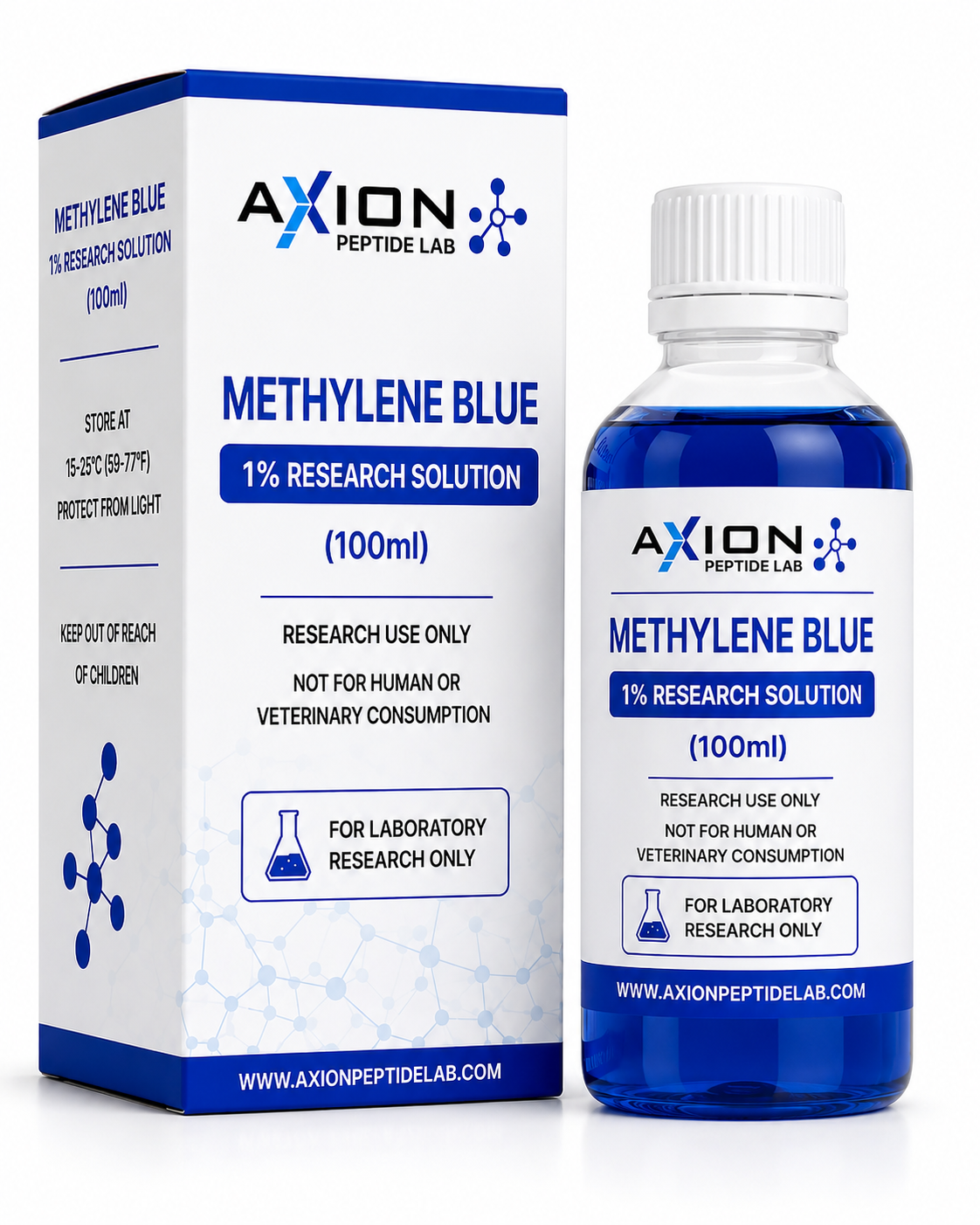
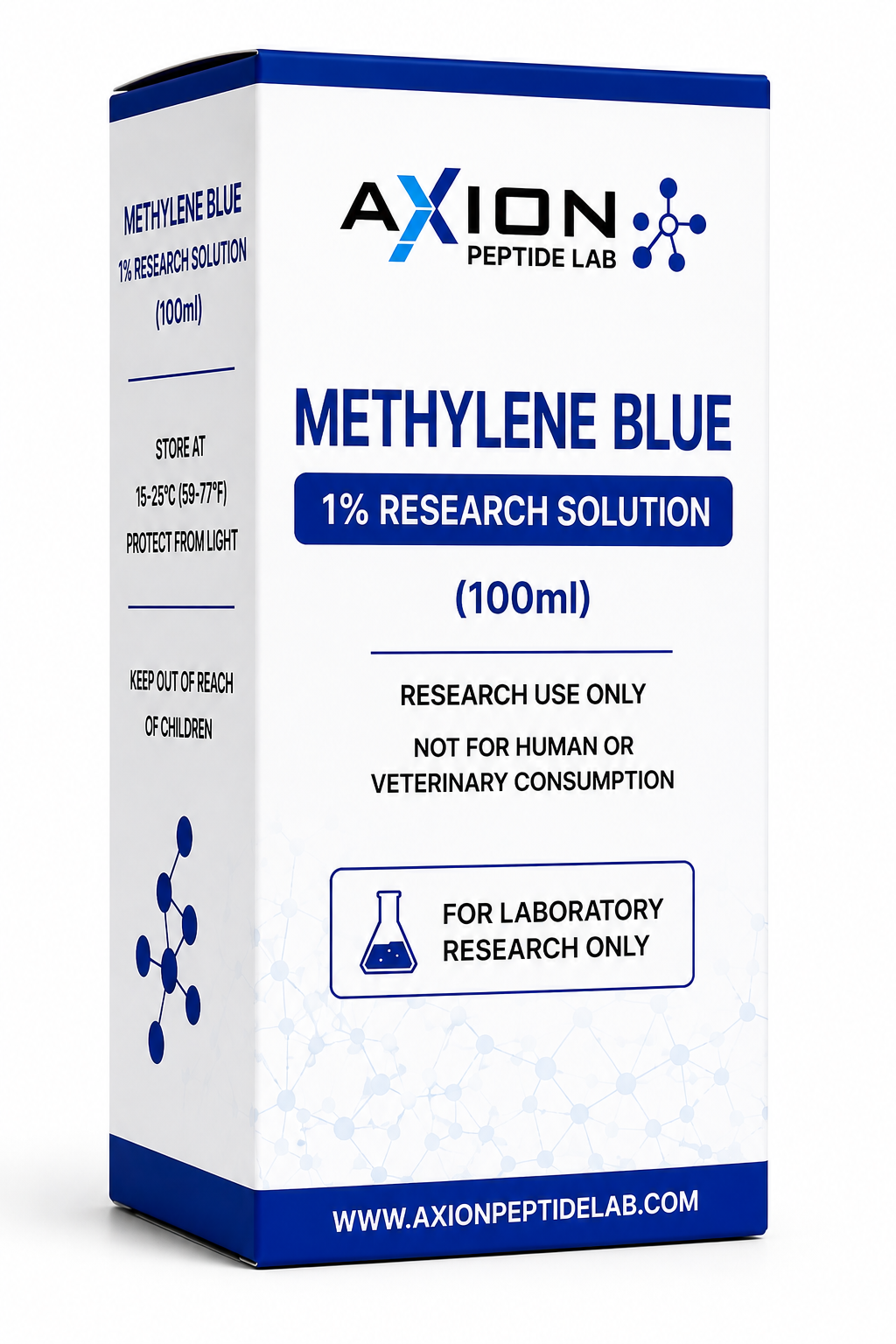
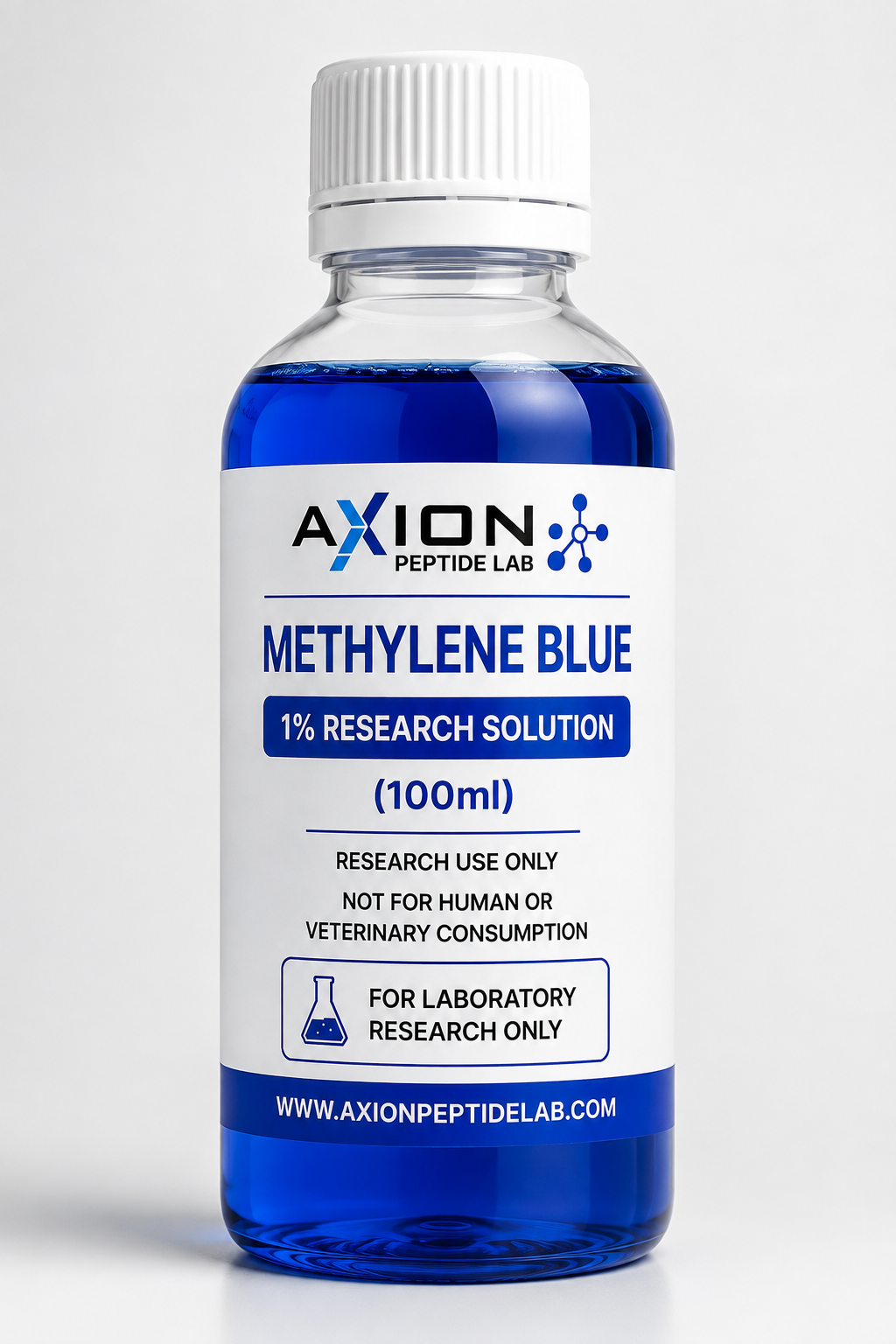
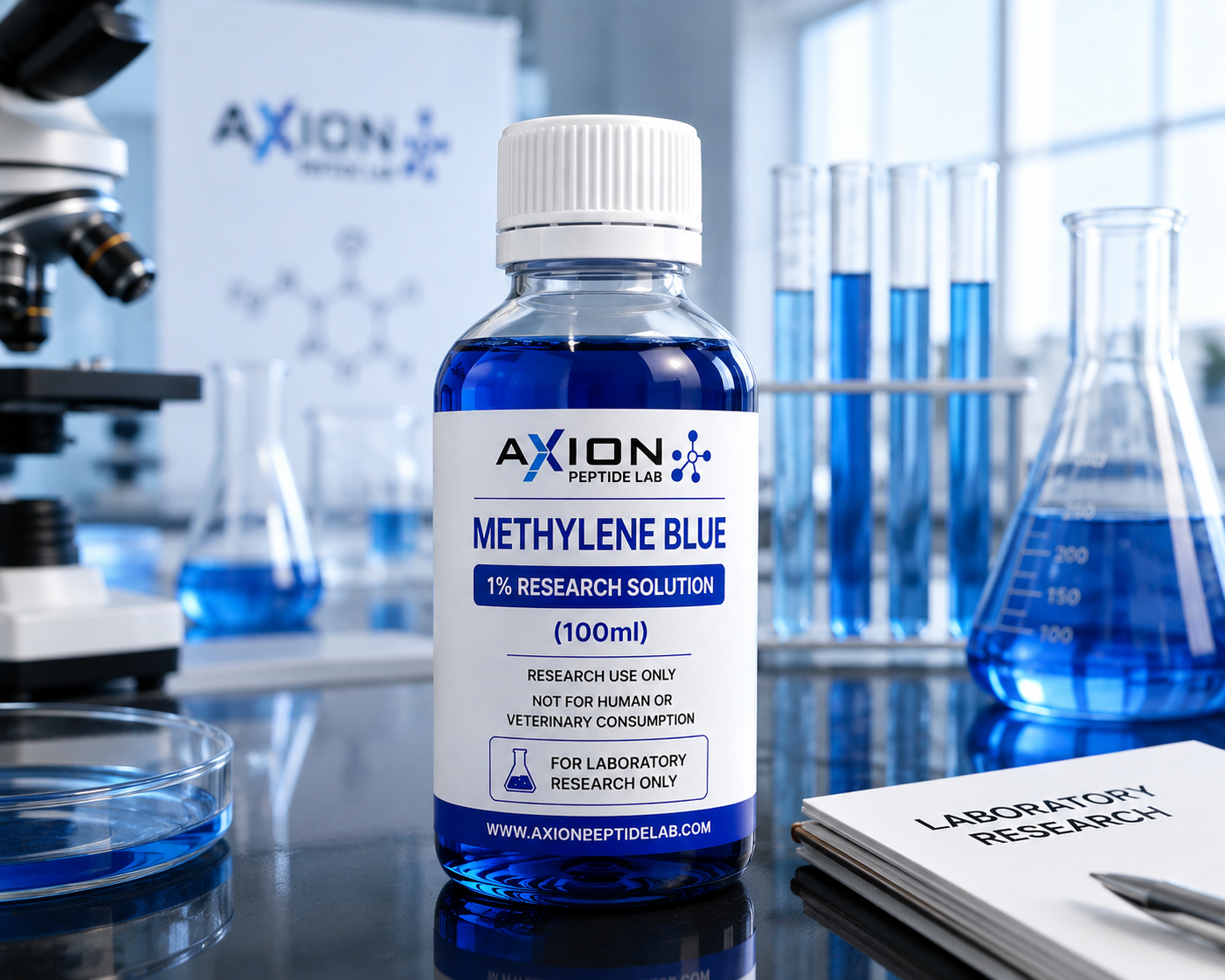
Methylene Blue 1% Research Solution (100ml) is a prepared liquid research material intended for controlled laboratory, chemical and analytical investigation. Methylene blue, also known as methylthioninium chloride or Basic Blue 9, is a phenothiazinium dye widely investigated in redox chemistry, spectroscopy, microscopy, staining, adsorption and analytical research.
The 1% designation represents the stated solution concentration, while 100ml represents the stated container volume.
For Research Use Only – Not for human or veterinary consumption or administration.
$33.82
Methylene Blue 1% Research Solution (100ml) from Axion Peptide Lab is a prepared liquid research material intended for controlled laboratory, chemical, biochemical and analytical investigation.
Methylene blue is a well-established phenothiazinium dye with a long history as a laboratory reagent. Its intense blue colour, redox behaviour and spectroscopic characteristics have made it useful across diverse experimental disciplines, including microscopy, staining, analytical chemistry, redox investigation and chemical-method development.
This product is supplied as a 1% research solution in a 100ml format, providing laboratories with a convenient liquid preparation for appropriately designed experimental workflows.
The 1% designation describes the stated concentration of the research formulation. Researchers requiring the exact concentration basis, solvent system, pH, grade or additional formulation specifications should consult the documentation associated with the specific product and batch.
For Research Use Only – Not for human or veterinary consumption or administration.
Methylene blue is an organic chloride salt and synthetic dye belonging to the phenothiazinium family of compounds.
It is also known by names including methylthioninium chloride and Basic Blue 9.
For the commonly referenced anhydrous chloride form, the molecular formula is:
C₁₆H₁₈ClN₃S
Its molecular weight is approximately:
319.9 g/mol
The commonly referenced CAS Registry Number is:
61-73-4
Researchers should note that methylene blue can exist in different hydrated or chemical forms. Molecular weight and other specifications can therefore differ depending on the precise material.
Batch-specific documentation should always take priority when exact analytical identity is required.
One of the best-known laboratory applications of methylene blue is its use as a dye.
Its strong visible colour allows it to interact with and highlight different materials under suitable experimental conditions.
Methylene blue has consequently been used historically in microscopy, histological investigation and biological staining techniques.
In modern research environments, staining behaviour can be investigated under controlled conditions to study contrast, dye interactions and experimental methodology.
The exact staining protocol depends on the sample, experimental objective and laboratory procedure.
Researchers should establish appropriate protocols rather than treating this commercial research solution as a universal staining preparation.
Methylene blue is particularly interesting from a chemical perspective because of its oxidation-reduction behaviour.
The oxidised form displays the compound’s characteristic blue colour, while reduction can produce a substantially less coloured form commonly associated with leucomethylene blue chemistry.
This reversible behaviour provides a useful model for investigating electron-transfer reactions and redox processes.
Laboratories may examine colour changes under different chemical conditions, monitor redox reactions or investigate how experimental variables influence the oxidation state of the compound.
These characteristics make methylene blue useful for demonstrations and more advanced analytical investigations of redox chemistry.
The strong colour of methylene blue makes it relevant to spectrophotometric research.
Spectrophotometry measures how a substance absorbs electromagnetic radiation at different wavelengths.
Because methylene blue exhibits strong visible absorption, researchers can use appropriately prepared systems to investigate concentration-dependent absorbance, calibration behaviour and changes occurring during chemical reactions.
Such experiments may form part of analytical-method development or instrument validation.
Researchers should establish their own calibration curves and experimental controls rather than assuming that a generic concentration-response relationship applies to every solvent, instrument or sample matrix.
Methylene blue can be incorporated into a variety of analytical chemistry workflows.
Researchers may investigate chemical identity, absorbance characteristics, concentration, stability, degradation or interactions with other experimental materials.
Potential techniques can include UV-visible spectroscopy, chromatographic investigation and other validated analytical approaches.
Its distinct optical characteristics can make methylene blue particularly useful where visible detection is beneficial.
Researchers may also compare different solution conditions to determine how environmental variables influence measured characteristics.
Analytical conclusions should remain specific to the material, method and conditions examined.
Methylene blue has a long association with microscopy.
Its ability to provide visible contrast has contributed to its historical use in staining biological materials.
Modern laboratory research may investigate methylene blue as part of comparative staining studies, microscopy-method development or dye-behaviour experiments.
Variables such as concentration, exposure conditions, sample characteristics and solution chemistry can influence experimental observations.
A 1% research solution provides a defined starting formulation that can be incorporated into appropriately validated workflows.
It should not be assumed that the supplied solution is appropriate for every staining protocol without laboratory evaluation.
Researchers may investigate interactions between methylene blue and different chemical, biological or material surfaces.
Dye adsorption is an important experimental area in environmental chemistry and material science.
Methylene blue is frequently used as a model coloured compound when scientists investigate adsorption behaviour.
Laboratories can examine how experimental materials interact with the dye under controlled conditions.
Variables may include contact time, solution conditions, adsorbent characteristics and starting concentration.
Such research can contribute to understanding adsorption mechanisms and analytical methods for measuring dye removal from experimental systems.
The visible-light absorption characteristics of methylene blue also make it relevant to photochemical investigation.
Researchers may examine how exposure to light influences chemical behaviour under defined experimental conditions.
Experiments can investigate photochemical changes, degradation kinetics or interactions with other compounds.
Because light can potentially affect solution stability, researchers should carefully control illumination conditions where this variable could influence experimental results.
Any product-specific light-protection or storage requirements should be obtained from the relevant documentation rather than assumed.
Methylene blue’s visually observable changes under particular chemical conditions make it useful in experimental systems designed to demonstrate or investigate chemical transformations.
Researchers may use colour measurements as part of controlled reaction monitoring.
Such work can be qualitative or quantitative depending on the experimental design.
Digital imaging, spectrophotometry or other analytical instrumentation may be used to monitor colour changes.
This provides researchers with several possible approaches for examining reaction progress and chemical behaviour. Methylene Blue 1% Research Solution
This product is identified as Methylene Blue 1% Research Solution.
A percentage concentration should always be interpreted according to the concentration convention used in the product specification.
For example, percentage solutions may be expressed according to weight/volume, weight/weight or volume/volume conventions depending on the material and formulation.
Researchers should therefore verify the exact concentration basis from Axion Peptide Lab’s product documentation. Methylene Blue 1% Research Solution
The phrase “1%” should not be converted into a human dose or administration recommendation.
The 100ml designation describes the stated total volume of the product.
A larger liquid format can be convenient for laboratories conducting repeated analytical experiments or research workflows requiring multiple controlled aliquots.
Researchers should use appropriate laboratory measuring equipment when transferring experimental quantities.
Good laboratory practice includes preventing contamination, maintaining clear labelling and recording material usage.
The bottle should remain dedicated to research activities and separated from consumer, food, cosmetic and medicinal products. Methylene Blue 1% Research Solution
Researchers should not infer the complete composition of a research solution from the words “Methylene Blue 1%” alone.
Important formulation variables can include the solvent, concentration basis, pH, chemical form and additional components.
These characteristics can influence experimental results.
Researchers requiring specific parameters should therefore review the product specification and available batch documentation before incorporating the material into sensitive analytical work.
Likewise, claims such as pharmaceutical grade, USP grade, sterile, heavy-metal-free or a specific purity percentage should only be made when supported by appropriate documentation for the product. Methylene Blue 1% Research Solution
Methylene Blue 1% Research Solution may be relevant to controlled investigation involving:
These categories describe laboratory applications rather than medical indications.
Reproducible research depends on accurate experimental documentation.
Researchers should record the product identity, batch information, concentration, experimental conditions, analytical equipment and methodology.
Where available, batch-specific documentation may provide additional information concerning measured specifications.
Certificate of Analysis and independent analytical testing availability may vary according to product and batch.
Laboratories requiring particular analytical characteristics should verify them before beginning experimental work. Methylene Blue 1% Research Solution
Methylene Blue 1% Research Solution should be handled by trained personnel using suitable laboratory procedures.
Appropriate protective equipment and chemical-handling practices should be determined using applicable safety information and institutional requirements.
Because methylene blue is an intense dye, researchers should also take precautions against unintended staining of laboratory surfaces and materials.
The research solution should remain properly labelled and stored according to the product-specific documentation. Methylene Blue 1% Research Solution
Axion Peptide Lab supplies research compounds and laboratory materials intended for controlled scientific and analytical applications.
Methylene Blue 1% Research Solution (100ml) provides researchers with a prepared liquid format suitable for appropriately designed analytical, staining, redox and chemical investigations.
Product specifications and available supporting documentation should be reviewed before purchase to determine whether the material meets the requirements of the intended experiment.
Qualified researchers, laboratories and scientific organisations can buy Methylene Blue 1% Research Solution (100ml) from Axion Peptide Lab for legitimate laboratory and analytical investigation.
Its distinctive colour, established dye chemistry and redox behaviour make methylene blue relevant to numerous experimental disciplines.
This product must not be marketed as a cognitive enhancer, wellness supplement, anti-ageing product or self-treatment preparation. Methylene Blue 1% Research Solution
For Research Use Only – Not for human or veterinary consumption or administration.
It is a prepared methylene blue liquid formulation supplied at a stated 1% concentration for controlled laboratory, chemical and analytical investigation.
Methylene blue is also commonly known as methylthioninium chloride and Basic Blue 9.
The commonly referenced anhydrous chloride form has the molecular formula C₁₆H₁₈ClN₃S.
The anhydrous chloride form has a molecular weight of approximately 319.9 g/mol.
The commonly referenced CAS Registry Number is 61-73-4.
It identifies the stated concentration of the research solution. Researchers should verify whether the specification is expressed as weight/volume or another concentration convention from the product documentation. Methylene Blue 1% Research Solution
It represents the stated total volume of research solution contained in the product.
Research areas can include dye chemistry, microscopy, staining, redox reactions, spectroscopy, adsorption, photochemistry and analytical-method development.
No. It is supplied exclusively for controlled laboratory and analytical research and is not intended for human or veterinary consumption or administration.
Qualified research customers can purchase Methylene Blue 1% Research Solution (100ml) from Axion Peptide Lab for legitimate laboratory and analytical applications, subject to availability and applicable requirements. Methylene Blue 1% Research Solution