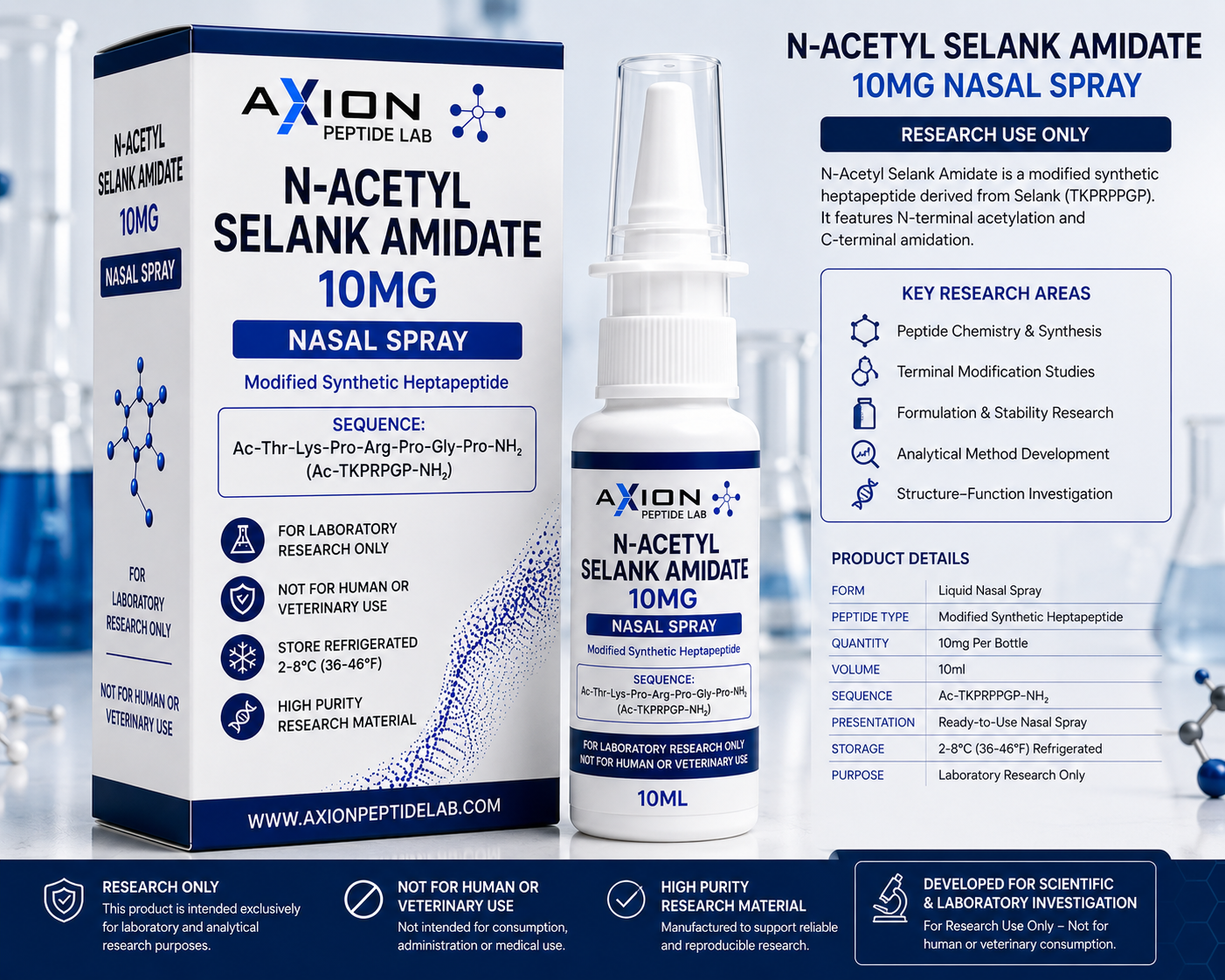
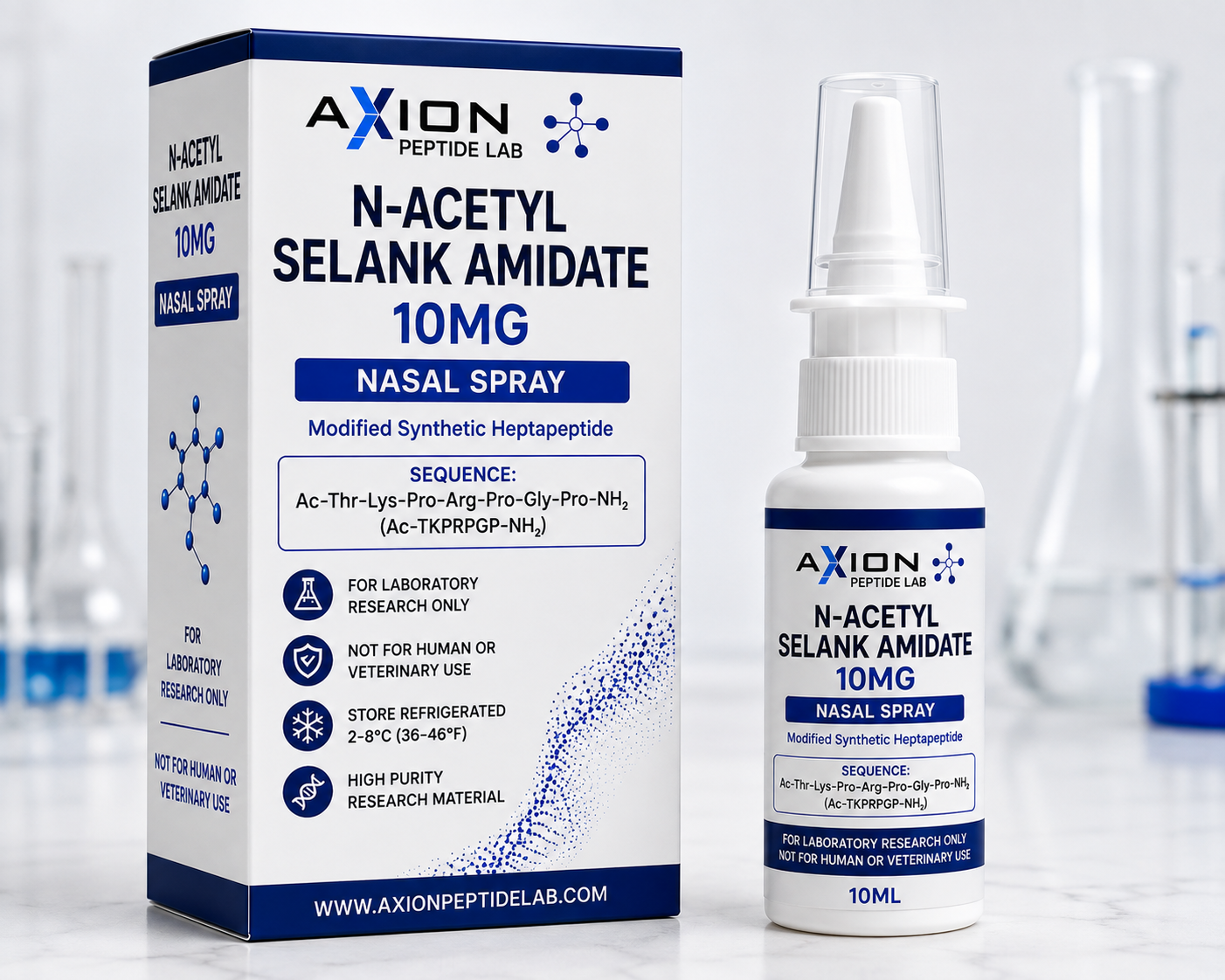
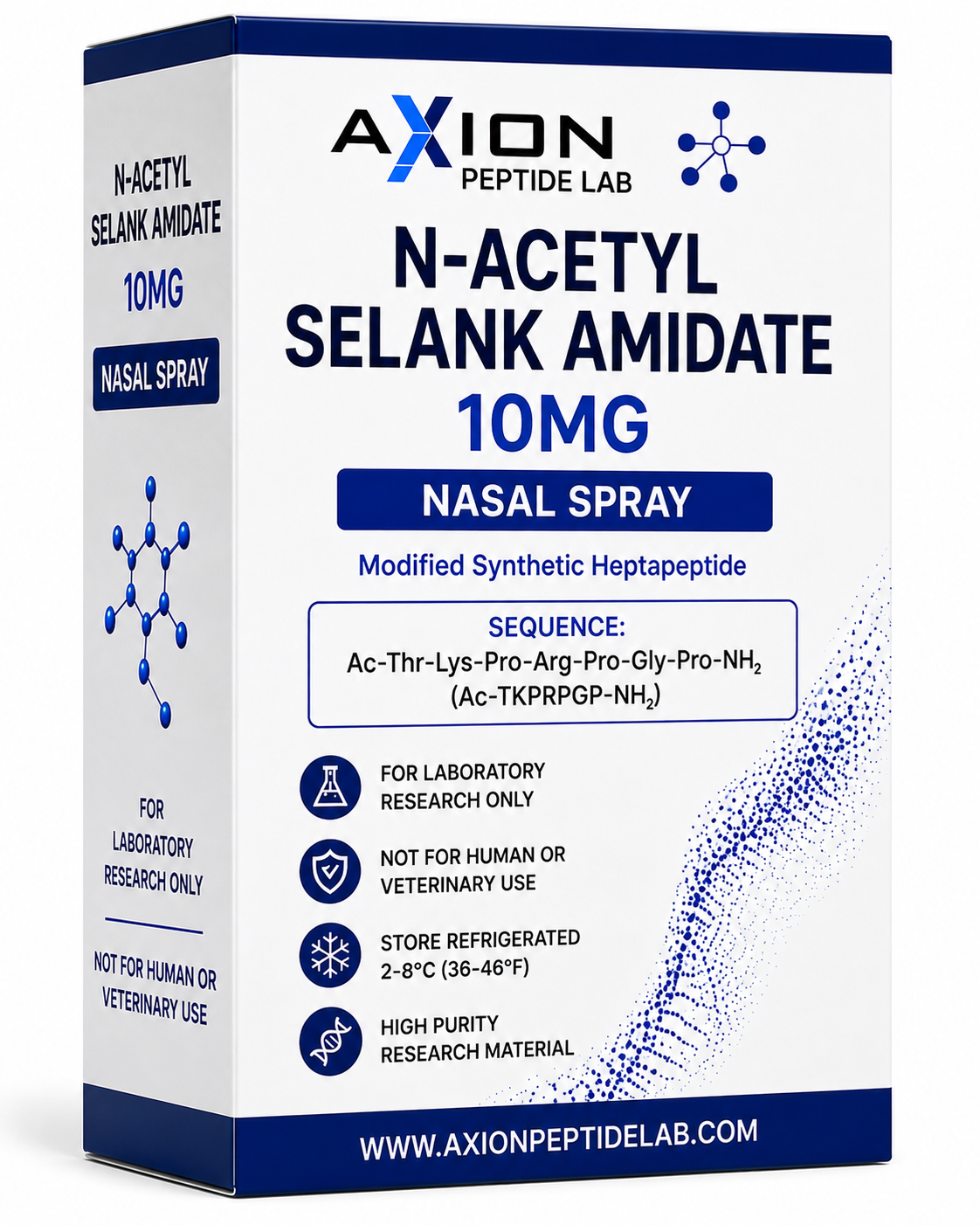
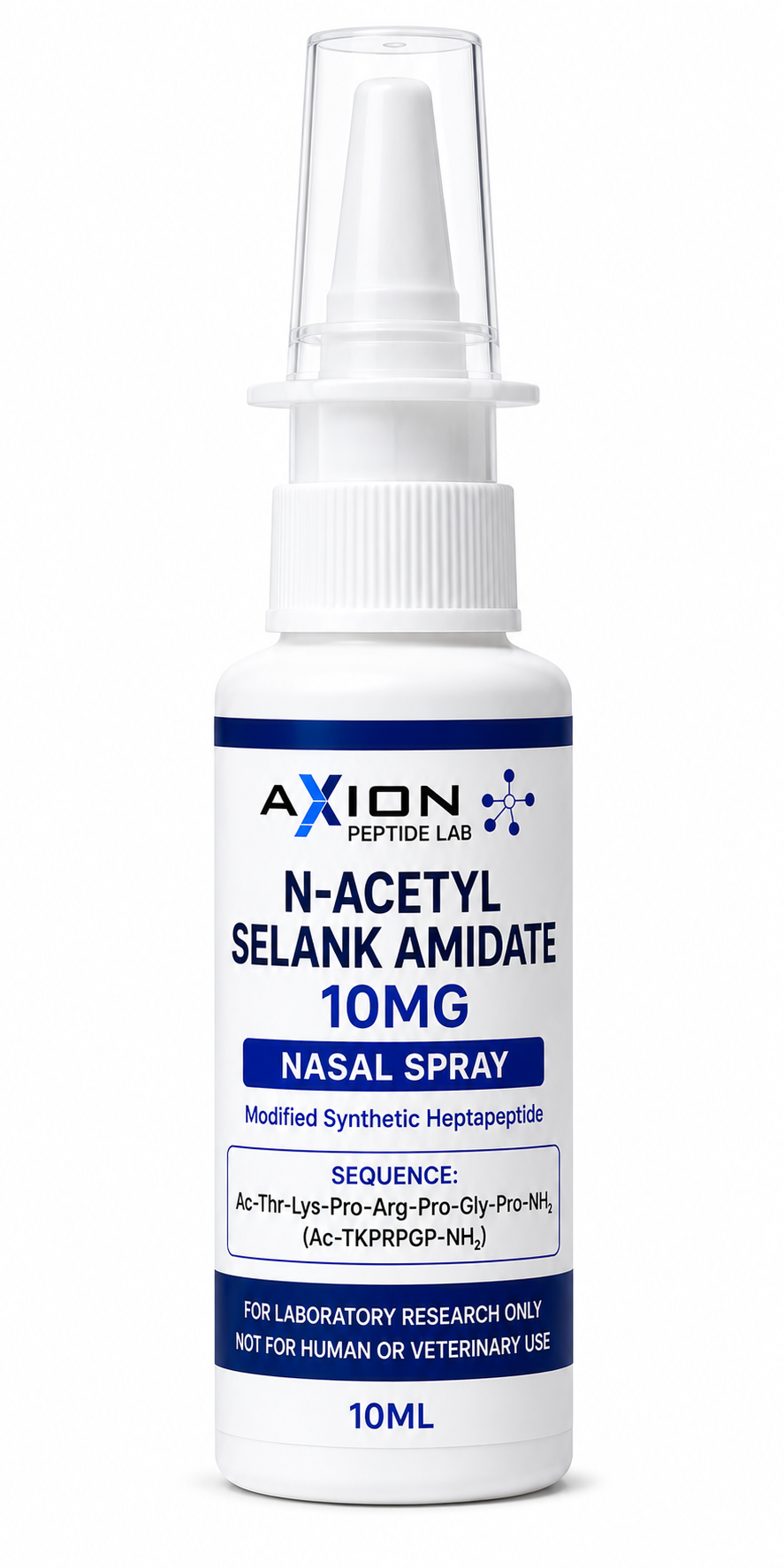
N-Acetyl Selank Amidate 10mg Nasal Spray is a modified synthetic heptapeptide research preparation based on the Selank TKPRPGP backbone.
Commonly represented as Ac-TKPRPGP-NH₂, it incorporates N-terminal acetylation and C-terminal amidation, making it relevant to controlled terminal-modification, comparative peptide, formulation, stability and analytical research.
10mg represents the stated research quantity. Nasal Spray describes the research presentation only.
For Research Use Only – Not for human or veterinary consumption or administration.
$108.29
N-Acetyl Selank Amidate 10mg Nasal Spray from Axion Peptide Lab is a modified synthetic heptapeptide research preparation intended exclusively for controlled peptide chemistry, molecular, formulation, stability and analytical laboratory investigation.
N-Acetyl Selank Amidate is structurally related to Selank, a synthetic tuftsin-related heptapeptide. The parent Selank backbone consists of seven amino-acid residues:
Thr-Lys-Pro-Arg-Pro-Gly-Pro (TKPRPGP)
N-Acetyl Selank Amidate retains this core peptide sequence while incorporating two terminal modifications: N-terminal acetylation and C-terminal amidation.
It is therefore commonly represented as:
Ac-Thr-Lys-Pro-Arg-Pro-Gly-Pro-NH₂
Ac-TKPRPGP-NH₂
These modifications make the compound particularly interesting for comparative peptide-design, terminal-modification, physicochemical, formulation and analytical research.
The 10mg designation identifies the stated quantity of research material and is not a dosage recommendation. “Nasal Spray” describes the physical research presentation and does not constitute administration guidance.
For Research Use Only – Not for human or veterinary consumption or administration.
N-Acetyl Selank Amidate is a chemically modified analogue of Selank.
Selank itself is a synthetic heptapeptide related to tuftsin. Rather than changing the seven-residue Selank backbone, the N-acetyl amidate variant modifies the termini of the molecule.
An acetyl group is incorporated at the N-terminus, while the C-terminal end is amidated.
This creates a useful model for researchers investigating how terminal modifications can influence peptide characteristics without replacing the underlying amino-acid backbone.
Because commercial terminology can sometimes blur the distinction between Selank, N-Acetyl Selank and N-Acetyl Selank Amidate, researchers should confirm the exact molecular identity against applicable product and batch documentation.
The underlying Selank sequence is:
Thr-Lys-Pro-Arg-Pro-Gly-Pro
or:
TKPRPGP
The first four residues—Thr-Lys-Pro-Arg—correspond to the sequence associated with tuftsin, while the additional Pro-Gly-Pro residues form the extended Selank structure.
This seven-residue backbone provides a relatively compact peptide model for laboratory studies involving sequence analysis, terminal chemistry and comparative peptide design.
Researchers can compare the parent sequence with chemically modified derivatives to examine how defined structural changes influence measurable characteristics. N-Acetyl Selank Amidate 10mg
The first major modification in N-Acetyl Selank Amidate is N-terminal acetylation.
In peptide chemistry, N-terminal acetylation involves adding an acetyl group to the amino terminus.
Terminal acetylation can alter properties such as terminal charge and interactions with experimental environments.
This makes N-acetylated peptides useful in controlled studies examining relationships between chemical modification and peptide behaviour. N-Acetyl Selank Amidate 10mg
Researchers may compare unmodified Selank with an N-acetylated analogue under identical analytical conditions to evaluate experimentally observable differences.
The second defining modification is C-terminal amidation.
Instead of retaining a conventional free C-terminal carboxyl group, the modified peptide terminates with an amide.
C-terminal amidation occurs naturally in numerous biologically active peptides and is also widely used in synthetic peptide research.
It can change terminal charge characteristics and other physicochemical properties.
N-Acetyl Selank Amidate therefore provides a useful experimental model in which both ends of the Selank backbone have been chemically modified. N-Acetyl Selank Amidate 10mg
The combination of N-terminal acetylation and C-terminal amidation distinguishes N-Acetyl Selank Amidate from both ordinary Selank and singly modified derivatives.
Researchers may investigate whether dual terminal modification produces measurable differences in chromatographic behaviour, molecular interactions, stability or other physicochemical characteristics.
A well-controlled comparative experiment could evaluate parent Selank and modified analogues under identical conditions. N-Acetyl Selank Amidate 10mg
Such research can help establish relationships between peptide termini and experimentally observed properties without assuming a particular biological outcome.
Selank was developed from a peptide framework related to tuftsin, a naturally occurring tetrapeptide represented by Thr-Lys-Pro-Arg.
The retention of this sequence within the Selank backbone makes N-Acetyl Selank Amidate relevant to comparative tuftsin-related peptide investigation.
Researchers can examine how extending the original four-residue motif and subsequently modifying the termini influences molecular properties.
These studies can contribute to broader research involving short-peptide design and structure-function relationships. N-Acetyl Selank Amidate 10mg
One particularly useful research application is direct comparison among related compounds.
For example, laboratories may compare:
Selank: TKPRPGP
N-Acetyl Selank: Ac-TKPRPGP
N-Acetyl Selank Amidate: Ac-TKPRPGP-NH₂
This approach allows researchers to systematically investigate the consequences of specific terminal modifications.
Analytical methods can then determine whether these structural differences produce measurable changes in chromatographic retention, molecular mass, stability or other experimental parameters.
Peptide structure-function research examines how molecular architecture relates to experimentally measurable behaviour.
N-Acetyl Selank Amidate is useful in this context because the core sequence can remain constant while terminal chemistry changes.
Researchers may investigate relationships involving charge distribution, conformation, molecular interactions and analytical characteristics.
Any observed biological response should remain interpreted within the limitations of the experimental model rather than automatically extrapolated to therapeutic outcomes. N-Acetyl Selank Amidate 10mg
N-Acetyl Selank Amidate may also be incorporated into molecular research models designed to investigate peptide interactions.
Experimental variables might include concentration, temperature, pH, buffer composition and interaction partners.
Researchers should use appropriate positive and negative controls and document experimental conditions carefully.
Because specific published evidence on the fully acetylated-and-amidated analogue remains limited compared with parent Selank, researchers should avoid assuming that findings for ordinary Selank automatically apply to this modified molecule.
The nasal spray presentation makes this product relevant to controlled liquid peptide formulation research.
Researchers may investigate properties such as solution behaviour, formulation compatibility and analytical stability. N-Acetyl Selank Amidate 10mg
The physical spray format can also be considered when investigating packaging and formulation characteristics in a laboratory environment.
“Nasal Spray” in the product name describes the research presentation only.
It does not represent a recommendation or instruction for human intranasal administration.
Terminally modified peptides are particularly interesting for comparative stability studies.
Researchers may compare N-Acetyl Selank Amidate with the parent peptide under predefined laboratory conditions.
Experimental variables may include temperature, pH, light exposure, time and formulation composition.
Samples collected at defined intervals can be examined using appropriate analytical techniques to identify measurable changes.
Storage conditions for the exact commercial preparation should always follow applicable product-specific documentation. N-Acetyl Selank Amidate 10mg
High-performance liquid chromatography (HPLC) is widely used in peptide analytical research.
Appropriately developed chromatographic methods may help laboratories investigate retention characteristics and detect related molecular species.
Researchers comparing Selank variants can use standardised chromatographic conditions to determine whether terminal modification alters analytical behaviour.
Exact purity claims should be based on batch-specific HPLC documentation rather than assumptions derived from other products. N-Acetyl Selank Amidate 10mg
Liquid chromatography-mass spectrometry (LC-MS) provides another valuable approach to peptide characterisation.
Mass spectrometric techniques can provide molecular information useful for distinguishing related peptide variants.
This is especially relevant to N-Acetyl Selank Amidate because laboratories may need to distinguish the fully modified molecule from unmodified Selank or singly modified derivatives.
Appropriate reference materials, instrument calibration and validated analytical procedures should be incorporated when quantitative conclusions are required.
Identity verification is particularly important for modified Selank products.
Public commercial listings sometimes use overlapping names for Selank, N-Acetyl Selank, Selank Amidate and N-Acetyl Selank Amidate. N-Acetyl Selank Amidate 10mg
Researchers should therefore avoid relying solely on a product name.
Where available, documentation should identify the intended sequence and terminal modifications.
For this compound, the commonly represented structure is:
Ac-Thr-Lys-Pro-Arg-Pro-Gly-Pro-NH₂
Batch-specific analytical information should take priority over generic online specifications.
The 10mg designation identifies the stated quantity of peptide associated with the research preparation.
It does not constitute a human or veterinary dose.
Axion Peptide Lab does not provide personal dosing, administration or therapeutic protocols for this research material.
Experimental concentrations and quantities should instead be established according to validated laboratory procedures and study objectives.
N-Acetyl Selank Amidate may be relevant to controlled investigation involving peptide chemistry, terminal modification, N-terminal acetylation, C-terminal amidation, heptapeptide research, tuftsin-related peptide research, comparative peptide analysis, structure-function relationships, formulation studies, molecular investigation, stability experiments, chromatography and mass-spectrometric characterisation.
These are laboratory research categories and not medical indications.
Axion Peptide Lab supplies N-Acetyl Selank Amidate 10mg Nasal Spray as a specialised research preparation for legitimate laboratory and analytical investigation.
The combination of the established TKPRPGP Selank backbone with N-terminal acetylation and C-terminal amidation provides researchers with an interesting model for studying terminal peptide modification, comparative chemistry, formulation, stability and analytical characterisation.
Researchers should review applicable product specifications and batch documentation before conducting quantitative studies. N-Acetyl Selank Amidate 10mg
For Research Use Only – Not for human or veterinary consumption or administration.
N-Acetyl Selank Amidate is a modified Selank analogue containing the Selank heptapeptide backbone with N-terminal acetylation and C-terminal amidation.
It is commonly represented as Ac-Thr-Lys-Pro-Arg-Pro-Gly-Pro-NH₂, abbreviated Ac-TKPRPGP-NH₂.
The underlying peptide backbone contains seven amino-acid residues, making it a heptapeptide.
Ordinary Selank has an unmodified TKPRPGP backbone, while N-Acetyl Selank Amidate incorporates an acetylated N-terminus and amidated C-terminus.
It refers to modification of the peptide’s amino terminus with an acetyl group, changing its terminal chemistry.
C-terminal amidation replaces the conventional terminal carboxyl functionality with an amide, producing a chemically distinct peptide terminus.
10mg represents the stated quantity of research material and is not a human or veterinary dosage recommendation.
Nasal Spray describes the physical research presentation. It does not provide or imply instructions for human intranasal administration.
Yes. Appropriately developed HPLC, LC-MS and mass-spectrometric workflows can support analytical research involving modified peptide materials.
Not necessarily. N-Acetyl Selank describes N-terminal acetylation, while N-Acetyl Selank Amidate additionally specifies C-terminal amidation. Exact identity should be confirmed through applicable product documentation.