Axion Labs Peptides: Best Research Peptide Guide for Quality, Testing and Laboratory Sourcing in 2026
Axion Labs Peptides is a search phrase used by people looking for research peptides, laboratory compounds and scientific information associated with Axion Peptide Lab. Whether you are investigating peptide molecular structures, comparing laboratory materials or reviewing analytical quality standards, understanding how research peptides are identified and evaluated is essential.
At Axion Peptide Lab, our objective is to make scientific product information accessible to researchers, laboratory professionals and organisations interested in peptide chemistry and biochemical investigations.
Research peptides are used in many areas of experimental science, including molecular biology, receptor pharmacology, analytical chemistry, cellular signalling and peptide stability research. Each compound has distinct structural characteristics, making careful product selection and appropriate analytical documentation important.
This comprehensive guide explores Axion Labs Peptides, explains essential research peptide quality principles, introduces selected compounds from our catalogue and provides access to scientific educational resources.
Explore the official Axion Peptide Lab website to review available research materials and product information.
What Are Axion Labs Peptides?
Axion Labs Peptides refers here to research peptide products and related laboratory compounds associated with Axion Peptide Lab.
The official business name used on our website is Axion Peptide Lab. The phrase Axion Labs Peptides is addressed in this guide to help researchers searching for our brand locate the appropriate scientific information.
Peptides are molecular structures composed of amino acids connected through peptide bonds. These amino acid sequences can vary considerably in length, chemical composition and biological characteristics.
Some peptides consist of only a few amino acid residues. Others contain longer sequences or chemical modifications that influence their molecular properties.
In research environments, peptides may be investigated as molecular probes, experimental ligands, analytical reference materials or compounds associated with specific biochemical pathways.
The suitability of any research peptide depends on its identity, experimental purpose, analytical characteristics and applicable laboratory requirements.
Understanding Peptide Molecular Structure
The primary structure of a peptide describes its amino acid sequence.
This sequence influences several molecular properties, including charge distribution, hydrophobicity, conformational behaviour and potential molecular interactions.
Chemical modifications may further affect peptide properties. These can include terminal modifications, incorporation of non-standard amino acids or conjugation with other chemical groups.
Researchers must distinguish between peptides that share similar names but differ in chemical structure.
Even a small structural modification may change chromatographic behaviour, molecular mass or experimental activity.
For further information, explore our article on Peptide Sequence Analysis.
Why Researchers Search for Axion Labs Peptides
Researchers searching for Axion Labs Peptides may be seeking a particular compound, reviewing laboratory quality documentation or comparing scientific suppliers.
A reliable research procurement process begins by identifying the material required for a defined experimental objective.
The compound name alone may not provide sufficient information.
Researchers should consider molecular identity, product formulation, analytical documentation, quantity and storage conditions.
Research-Focused Product Information
The Axion Peptide Lab website provides product listings and educational resources intended to support informed laboratory sourcing.
Individual products should be evaluated according to their listed specifications and research designation.
Analytical Quality Considerations
Peptide quality cannot be established through promotional language alone.
Appropriate analytical information helps researchers understand what has been measured and which characteristics remain unverified.
Scientific Education
Researchers benefit from understanding the principles behind analytical methods rather than relying exclusively on reported numerical results.
Our educational resources explore peptide testing, molecular structure and quality-control considerations.
Product Documentation
Where available, batch-specific records can provide useful information about analytical testing and material traceability.
Documentation should correspond to the actual batch being evaluated.
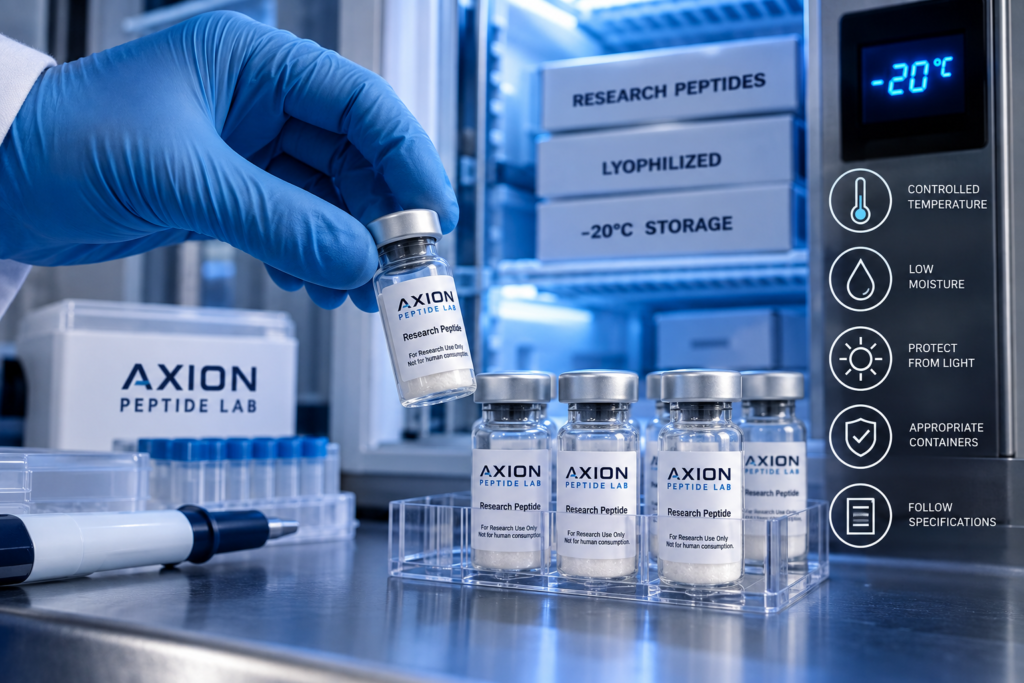
Explore Axion Labs Peptides and Research Products
The Axion Peptide Lab catalogue includes research materials associated with different molecular pathways and analytical investigations.
The following examples introduce selected compounds and their scientific context.
Product inclusion does not imply clinical approval, established therapeutic effectiveness or universal suitability for laboratory use.
Retatrutide Research Peptide
Retatrutide, also identified as LY3437943, is a molecule investigated for its activity at three receptor systems:
- Glucose-dependent insulinotropic polypeptide receptor.
- Glucagon-like peptide-1 receptor.
- Glucagon receptor.
These receptor systems participate in metabolic signalling and related physiological processes.
Retatrutide has been studied in experimental and clinical research programmes investigating receptor pharmacology and metabolic outcomes.
From an analytical perspective, researchers may examine molecular identity, peptide stability, chromatographic characteristics and chemical modifications.
Axion Peptide Lab provides information about several research formats:
Researchers should verify the current product specifications and applicable purchasing restrictions before sourcing any material.
Retatrutide remains an investigational compound. Research product listings do not establish approval for human administration.
CJC-1295 Research Peptide
CJC-1295 is a synthetic peptide associated with investigations involving growth hormone-releasing hormone receptor biology.
Some CJC-1295 formulations incorporate Drug Affinity Complex functionality.
This chemical modification is relevant to research examining peptide-protein interactions and molecular persistence.
Research questions may include peptide structure, receptor interactions, chemical stability and analytical characterisation.
Our CJC-1295 With DAC 5 mg Research Peptide listing provides product-specific information.
Researchers should distinguish CJC-1295 With DAC from other related compounds because chemical modifications can influence molecular properties.
PE-22-28 Research Peptide
PE-22-28 is a short research peptide associated with experimental investigation of TREK-1 potassium channel biology.
TREK-1 belongs to the two-pore-domain potassium channel family.
Research involving this system may examine molecular interactions, ion-channel activity and experimental signalling mechanisms.
Axion Peptide Lab lists PE-22-28 10 mg Nasal Spray as a research material.
The product’s physical presentation does not establish suitability for human administration.
Laboratories should assess the relevant formulation and research restrictions before evaluating such materials.
Axion Labs Peptides and Research Quality
Quality assessment is a central consideration in scientific peptide research.
However, the term quality encompasses several different analytical characteristics.
These may include:
- Molecular identity.
- Chemical purity.
- Quantitative peptide content.
- Impurity profile.
- Stability.
- Batch traceability.
- Suitability for the intended experimental application.
A single analytical result rarely establishes all these properties.
For example, a chromatographic purity result may describe relative peak area under specific analytical conditions without independently confirming complete molecular identity.
Researchers should therefore evaluate the available evidence in relation to the actual scientific question.
What Does Research Peptide Purity Mean?
Purity describes the extent to which a material consists of the intended chemical component rather than other detectable substances.
However, the precise interpretation depends on the analytical method.
Different testing procedures may produce results that are not directly interchangeable.
For example, chromatographic area percentage and mass-based content are different measurements.
A reported purity percentage should always be interpreted alongside the method and supporting documentation.
Why Identity and Purity Are Different
A material can appear relatively pure under one analytical method while still requiring additional confirmation of its molecular identity.
Conversely, a compound may have its expected molecular mass but contain impurities or related substances.
This distinction explains why laboratories frequently use complementary analytical methods.
HPLC Testing for Axion Labs Peptides
High-performance liquid chromatography, commonly called HPLC, is widely used in peptide analysis.
The technique separates components based on their interactions with a stationary phase and a mobile phase.
Different compounds may elute at different times depending on the method conditions.
How HPLC Supports Peptide Research
HPLC can provide information about chromatographic composition and help detect certain impurities.
A typical analytical report may include a chromatogram showing peaks associated with detected components.
The interpretation depends on the method, detector response and integration procedure.
Understanding Chromatographic Purity
A chromatographic area percentage is calculated from detector responses.
It does not automatically represent the absolute mass percentage of the desired peptide.
Different substances may respond differently to the detector.
Consequently, laboratories should avoid interpreting chromatographic purity as proof of every quality characteristic.
Limitations of HPLC
HPLC does not independently establish complete amino acid sequence identity.
Additional analytical methods may be necessary.
Researchers should also consider whether the method has sufficient selectivity to distinguish the target compound from relevant impurities.
Mass Spectrometry and Peptide Identity
Mass spectrometry is another important technique in peptide characterisation.
It measures the mass-to-charge ratios of ions generated from a sample.
Suitable methods can support molecular mass identification and structural investigation.
Why Molecular Mass Matters
A peptide’s molecular mass is related to its chemical composition.
Comparing observed mass data with theoretical values may support identification.
However, different molecular structures can sometimes have identical or similar masses.
Therefore, mass agreement alone may not provide complete structural confirmation.
Tandem Mass Spectrometry
Tandem mass spectrometry can provide additional structural information through fragmentation analysis.
Depending on the method and data quality, fragmentation patterns may help support peptide sequence assignments.
Combining Analytical Methods
HPLC and mass spectrometry answer different analytical questions.
Using complementary methods can strengthen material characterisation.
Researchers should select analytical procedures according to the compound and intended scientific objective.
Understanding Certificates of Analysis
A Certificate of Analysis, or COA, reports selected analytical information associated with a product or batch.
A COA may include product identification, batch information, analytical results and testing dates.
However, certificates differ in scope.
A document reporting chromatographic purity does not necessarily establish sterility, peptide content or complete structural identity.
What Should a Research Peptide COA Include?
Useful information may include:
- Product name and chemical identification.
- Batch or lot number.
- Analytical method.
- Testing date.
- Reported results.
- Relevant acceptance criteria.
- Laboratory identification.
- Supporting analytical information where available.
The documentation should correspond to the material being supplied.
Are All Axion Labs Peptides Independently Tested?
Testing arrangements may vary by product and batch.
Researchers should consult the available documentation rather than assume that every product has identical testing coverage.
Explore our Quality & COA information for additional details.
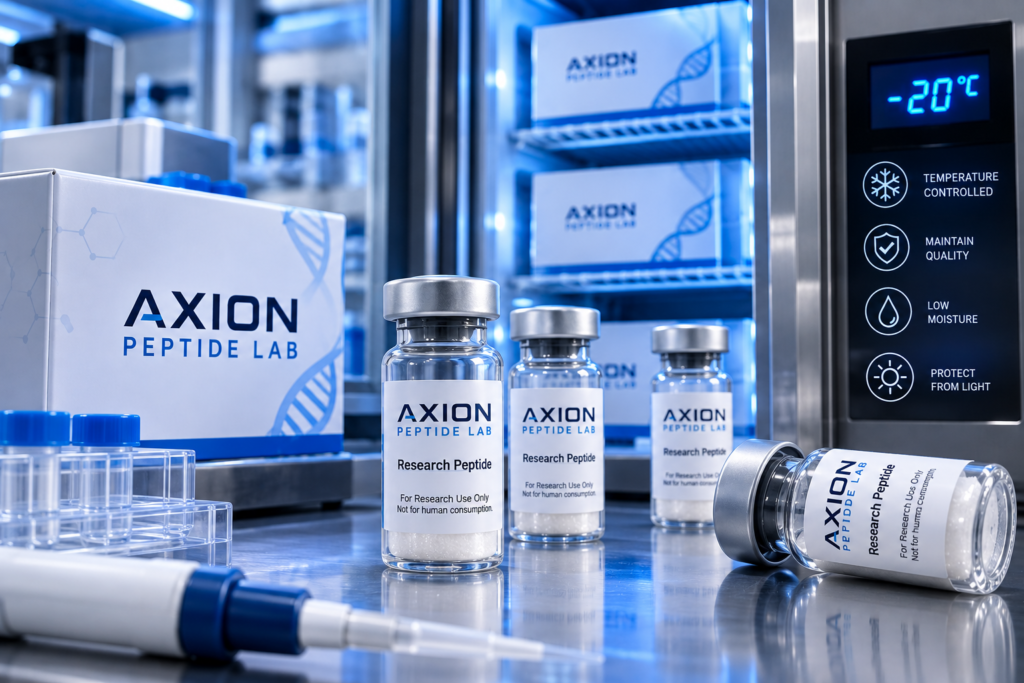
Peptide Batch Testing and Research Reproducibility
Batch testing helps researchers understand the characteristics of a defined material lot.
Two batches of the same named peptide may exhibit differences in measured content, impurity profiles or physical characteristics.
Such differences may affect experimental interpretation.
Batch Identification
Lot identifiers help connect research materials to relevant records.
Laboratories should record these identifiers as part of their inventory and experimental documentation.
Analytical Comparability
Where appropriate, laboratories may compare analytical results between batches.
Meaningful comparisons require suitable methods and consistent interpretation.
Documentation and Traceability
Traceability supports laboratory quality management and reproducibility.
Researchers should maintain records of material identity, receipt date, storage conditions and experimental use.
Read our detailed Peptide Batch Testing Guide.
Peptide Sequence Analysis and Molecular Verification
Peptide sequence analysis investigates the order of amino acid residues.
Sequence verification can be important when closely related compounds share similar molecular properties.
Analytical approaches may include tandem mass spectrometry, peptide mapping or other specialised methods.
The appropriate technique depends on peptide size, chemical modifications and the level of structural information required.
Why Sequence Accuracy Matters
Changes in amino acid order may influence molecular recognition, chemical behaviour and experimental activity.
Even when two compounds share the same molecular formula, differences in sequence can affect their properties.
Challenges in Sequence Verification
Some amino acid residues are difficult to distinguish using particular analytical techniques.
Chemical modifications and incomplete fragmentation information may introduce further uncertainty.
Researchers should interpret sequence assignments according to the strength of the supporting evidence.
Explore Peptide Sequence Analysis for a more detailed discussion.
Peptide Structure–Activity Relationships
Structure–activity relationship research examines how molecular changes influence observed experimental behaviour.
For peptides, these changes may involve amino acid substitutions, stereochemistry, terminal modifications or conformational characteristics.
Amino Acid Substitutions
Replacing one residue with another can alter chemical properties.
The effect depends on the specific position and molecular context.
Chemical Modifications
Peptide modifications may influence stability, solubility or molecular interactions.
These effects require experimental verification.
Molecular Conformation
Peptides may adopt different conformations depending on their structure and environment.
Conformation can influence molecular recognition and receptor interactions.
Experimental Interpretation
Structure–activity findings should be interpreted within the experimental model used.
Results from isolated molecular systems do not automatically predict outcomes in complex biological organisms.
Learn more in our Peptide Structure–Activity Relationship Guide.
Analytical Method Validation in Peptide Research
Reliable scientific results require analytical methods appropriate to their intended purpose.
Method validation evaluates whether a procedure performs adequately under defined conditions.
Important characteristics may include specificity, accuracy, precision, detection capability and robustness.
Specificity
A method should distinguish the target analyte from relevant interfering substances.
Accuracy
Accuracy concerns agreement between measured results and an accepted reference value.
Precision
Precision describes the closeness of repeated measurements.
Robustness
Robustness evaluates how deliberate changes in method conditions affect performance.
Documentation
Appropriate records are necessary to support claims about analytical method suitability.
Researchers should not assume that a method validated for one peptide automatically performs adequately for another.
Read Peptide Analytical Method Validation for additional scientific context.
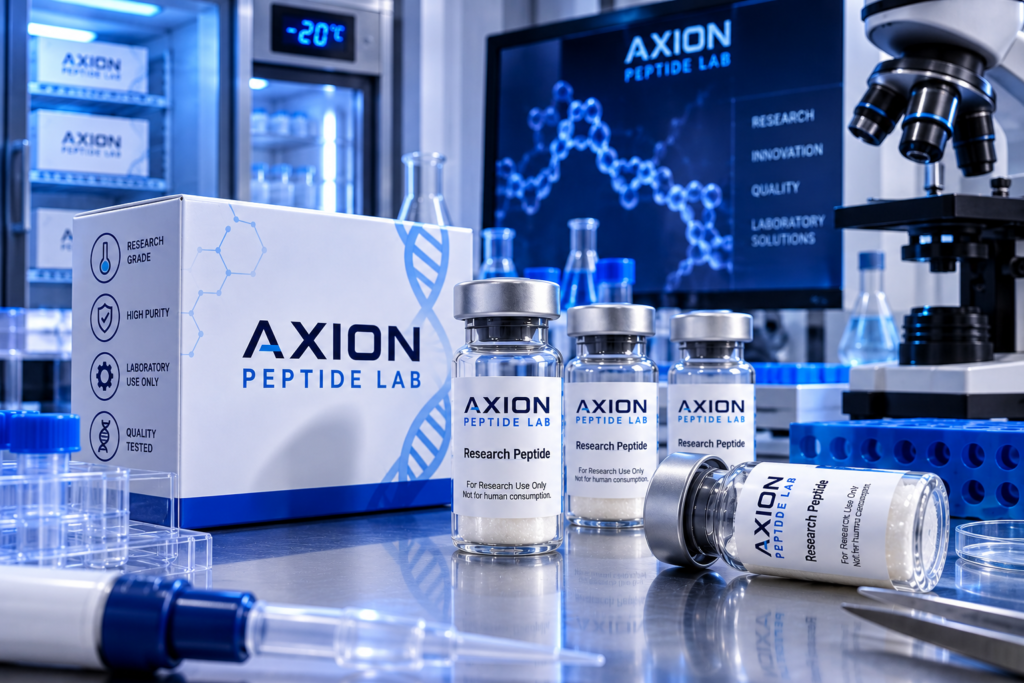
Storage and Stability of Axion Labs Peptides
Peptide stability depends on molecular structure, formulation and environmental conditions.
Different compounds may respond differently to temperature, moisture, light and solution composition.
For this reason, storage requirements should be established using product-specific information.
Temperature Considerations
Temperature can influence chemical degradation processes.
Appropriate storage conditions depend on the material and available stability evidence.
Moisture Exposure
Certain dry peptide formulations may be affected by moisture.
Packaging and handling procedures can influence exposure.
Light Sensitivity
Some peptide compounds may undergo light-associated chemical changes.
Light protection should follow relevant product information.
Solution Stability
Peptides in solution may exhibit different stability characteristics from corresponding dry materials.
Factors such as pH, solvent composition and concentration can influence chemical behaviour.
Laboratory Handling
Researchers should follow established procedures for material identification, storage records and controlled handling.
Universal storage recommendations should not replace compound-specific instructions.
How to Evaluate a Research Peptide Supplier
Researchers comparing Axion Labs Peptides with other laboratory sourcing options should prioritise verifiable information.
A supplier’s website appearance or marketing claims cannot independently establish product quality.
Product Identity
Listings should clearly identify the material and relevant specifications.
Analytical Documentation
Researchers should determine which tests have been performed and whether the results correspond to the supplied batch.
Transparent Information
Product descriptions should distinguish established chemical properties from preliminary scientific findings.
Research Restrictions
Materials should be sourced and used consistently with applicable regulations and institutional requirements.
Customer Support
Researchers may need clarification about product identity, documentation or ordering requirements.
Shipping Eligibility
International sourcing requires attention to destination restrictions, import requirements and material handling conditions.
Visit our Frequently Asked Questions for additional information about Axion Peptide Lab.

Axion Labs Peptides in the USA, UK and Europe
Research laboratories may operate under different national regulatory frameworks.
The legal classification of a peptide depends on factors including the compound, intended use, marketing claims and applicable jurisdiction.
Research-use labelling does not automatically exempt a product from regulatory requirements.
United States
US laboratories should consider applicable federal and state requirements and institutional procurement policies.
United Kingdom
UK researchers should review relevant import requirements, laboratory controls and medicines legislation where applicable.
European Markets
European requirements can differ between countries.
Researchers should verify destination eligibility and applicable restrictions before ordering.
Axion Peptide Lab’s website provides a starting point for reviewing research product information and contacting the supplier.
Scientific Resources for Axion Labs Peptides Research
Scientific research should rely on appropriate primary literature and established technical references.
Several external resources can support laboratory investigations.
PubMed
PubMed provides access to biomedical and life-science literature.
Researchers can use PubMed to identify publications concerning peptide chemistry, receptor pharmacology and analytical testing.
ICH Quality Guidelines
The International Council for Harmonisation publishes guidance covering analytical procedures, stability and pharmaceutical quality.
The relevance of individual guidelines depends on the scientific and regulatory context.
United States Pharmacopeia
The United States Pharmacopeia provides information about analytical standards and quality frameworks.
IUPHAR/BPS Guide to Pharmacology
The IUPHAR/BPS Guide to Pharmacology contains curated information about pharmacological targets and ligands.
IUPAC Gold Book
The IUPAC Gold Book provides standardised terminology for chemistry and related scientific disciplines.
These external resources provide scientific background. They do not certify any specific Axion Peptide Lab product.
Frequently Asked Questions About Axion Labs Peptides
What are Axion Labs Peptides?
Axion Labs Peptides is a search phrase addressed in this guide for research peptide materials associated with Axion Peptide Lab.
Is Axion Labs the official company name?
The official website uses the name Axion Peptide Lab. The phrase Axion Labs Peptides should not be interpreted as proof of a separately registered company.
Where can I find Axion Peptide Lab products?
Visit axionpeptidelab.com to explore product listings and scientific information.
What types of compounds are included?
The catalogue includes research peptide materials associated with different molecular and biochemical investigations. Current availability should be confirmed on individual product pages.
Are Axion Labs Peptides intended for human use?
No. The research materials discussed here are intended strictly for legitimate laboratory and analytical research applications.
What is HPLC peptide testing?
HPLC is an analytical separation technique that can provide information about chromatographic composition and certain impurities.
Does mass spectrometry confirm peptide identity?
Mass spectrometry can support molecular identification, but additional methods may be required for complete structural characterisation.
What does a Certificate of Analysis show?
A COA reports selected analytical results associated with a material or batch. Its scope depends on the tests performed.
Why is batch testing important?
Batch testing helps laboratories assess material characteristics, maintain traceability and interpret potential differences between lots.
How should research peptides be stored?
Storage requirements depend on the compound, formulation and available stability information. Researchers should follow product-specific guidance.
Can research peptides be sourced internationally?
International sourcing depends on the material, destination and applicable regulations.
Where can I learn more about peptide research?
Explore Axion Peptide Lab’s educational articles and established scientific resources such as PubMed, ICH and IUPHAR.
Conclusion: Axion Labs Peptides and Research Quality
Axion Labs Peptides connects researchers searching for Axion Peptide Lab with information about laboratory research materials, analytical testing and peptide quality standards.
Reliable scientific investigations require clearly identified compounds, appropriate analytical methods and careful experimental documentation.
Peptide purity, molecular identity, batch traceability and storage requirements should be evaluated individually rather than inferred from general promotional claims.
Our research catalogue and educational resources provide a starting point for understanding these considerations.
Visit Axion Peptide Lab to explore available research products, review scientific information and enquire about laboratory sourcing requirements.
All products are intended strictly for legitimate laboratory research purposes. Not for human or veterinary consumption, self-administration, diagnosis or treatment.