
Axion Peptides: Best Research Peptide Lab Guide for Quality, Scientific Testing and Laboratory Sourcing in 2026
Axion Peptides represents the research peptide catalogue, laboratory compounds and scientific sourcing services associated with Axion Peptide Lab. For laboratories, analytical researchers and scientific professionals, selecting appropriate peptide materials requires more than identifying a compound by name. Molecular identity, analytical purity, batch documentation, formulation characteristics and storage conditions can all influence research reliability.
The growing scientific interest in peptides has created demand for clearer product information and better understanding of laboratory quality standards. Researchers increasingly encounter products associated with metabolic receptor investigation, peptide signalling, molecular stability, cellular processes and analytical chemistry.
At Axion Peptide Lab, our focus is on providing an accessible research-focused catalogue supported by information about product specifications, quality procedures and laboratory applications.
This guide introduces Axion Peptides, explains how research peptides are evaluated, explores examples from our catalogue and connects researchers with detailed scientific resources.
Whether you are comparing laboratory materials, investigating peptide chemistry or planning research procurement, understanding the evidence behind each compound is an essential starting point.
Explore the Axion Peptide Lab website to review research materials and available product information.
What Are Axion Peptides?
Axion Peptides refers to research peptide materials and associated laboratory products available through Axion Peptide Lab.
Peptides are molecules consisting of amino acids connected through peptide bonds. Their molecular properties depend on several characteristics, including amino acid sequence, side-chain chemistry, terminal modifications and three-dimensional conformation.
Some peptides contain only a few amino acids, while others are considerably larger and exhibit more complex structural characteristics.
In scientific research, peptides may be examined as molecular probes, receptor ligands, signalling molecules, analytical reference materials or experimental compounds.
The term research peptide describes a material’s intended scientific context. It does not establish a universal purity grade, regulatory classification or suitability for a particular experiment.
Researchers evaluating Axion Peptides should therefore distinguish between the general scientific properties of a molecule and the verified characteristics of the specific material being supplied.
Why Peptide Identity Matters
A peptide’s amino acid sequence influences its molecular behaviour.
Even small changes in sequence can affect receptor interactions, chemical stability, molecular recognition or susceptibility to degradation.
Two peptides may have similar molecular masses without having identical structures. Consequently, molecular weight alone cannot always establish complete identity.
Appropriate analytical characterisation may involve mass spectrometry, peptide mapping, sequence analysis or complementary techniques.
For a deeper scientific explanation, read our article on Peptide Sequence Analysis.
Understanding Research-Grade Materials
Research-grade materials are selected for scientific and analytical applications rather than clinical administration.
Important considerations include:
- Defined chemical identity and product specifications.
- Appropriate analytical methods for the intended investigation.
- Available batch-specific quality documentation.
- Relevant storage and handling information.
- Traceability through batch or lot identification.
- Compatibility with institutional laboratory procedures.
These characteristics help researchers assess whether a material is appropriate for their experimental objectives.
Why Researchers Explore Axion Peptides
Scientific research depends on reproducibility. When materials vary unexpectedly, laboratory results may become more difficult to interpret or compare.
Researchers exploring Axion Peptides may be interested in peptide chemistry, molecular pharmacology, analytical testing or the properties of individual research compounds.
Our approach to laboratory sourcing places particular emphasis on accessible product information and research-focused documentation.
1. Research-Focused Catalogue
The Axion Peptide Lab catalogue includes materials associated with different areas of experimental investigation.
Individual listings provide a starting point for examining product identity, research context, quantity and relevant restrictions.
Because compounds can differ substantially in structure and intended analytical application, product selection should follow the laboratory’s defined research requirements.
2. Quality Documentation
A research material should be assessed using evidence appropriate to the characteristic being evaluated.
For example, chromatographic purity, molecular identity and quantitative content are different analytical properties.
Where available, batch-specific documentation can help researchers understand which properties have been tested and which remain unverified.
Explore our Quality and Certificate of Analysis information for an overview of the documentation approach described by Axion Peptide Lab.
3. Laboratory Handling Considerations
Peptides can be sensitive to environmental conditions.
Depending on the molecule and formulation, exposure to moisture, light, oxygen, temperature changes or unsuitable solvents may affect stability.
Appropriate handling therefore depends on the characteristics of the specific material rather than a universal storage rule.
4. Accessible Scientific Education
Understanding research materials requires knowledge of the analytical methods used to characterise them.
Axion Peptide Lab publishes educational content addressing peptide structure, analytical testing, molecular mechanisms and research interpretation.
These resources can help laboratories identify relevant questions before reviewing individual product specifications.
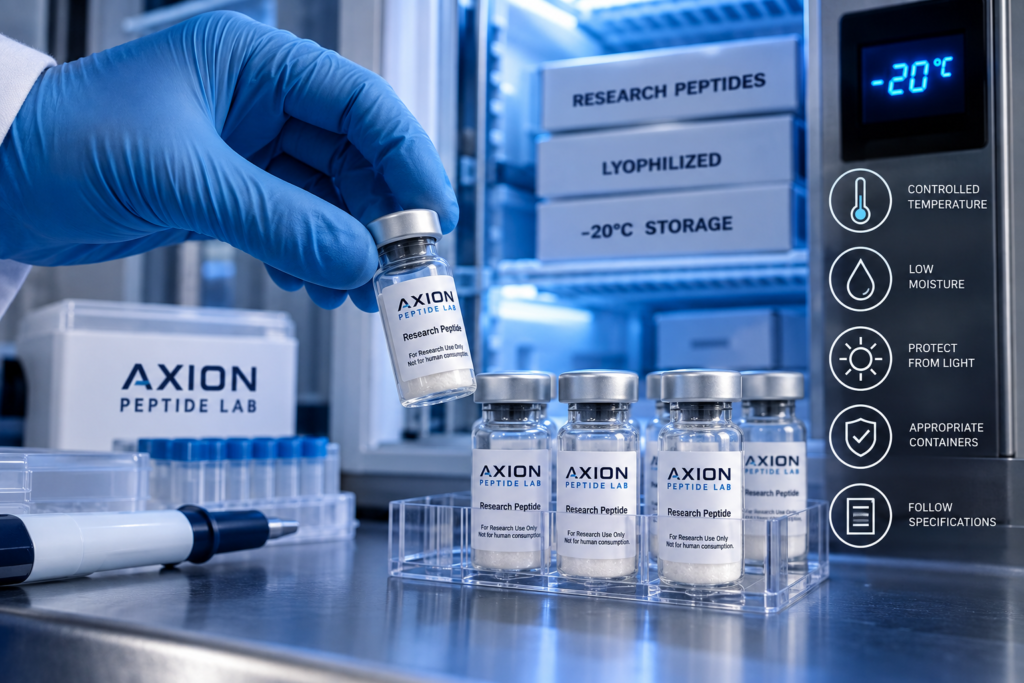
Explore Axion Peptides: Research Products and Scientific Applications
The Axion Peptide Lab catalogue contains several research materials associated with different molecular pathways and analytical investigations.
The examples below link to existing product listings. Inclusion does not imply that a compound is clinically approved, that it has demonstrated therapeutic effectiveness or that every listed batch has identical analytical characteristics.
Retatrutide Research Peptides
Retatrutide, also identified as LY3437943, is a molecule investigated for activity at three receptor systems: the glucose-dependent insulinotropic polypeptide receptor, glucagon-like peptide-1 receptor and glucagon receptor.
This triple-receptor pharmacology distinguishes it from molecules designed primarily around a single receptor pathway.
Scientific investigation of retatrutide has included receptor signalling, metabolic physiology and clinical development research.
For laboratories, research questions may concern molecular identity, peptide stability, analytical characterisation and receptor-related experimental models. axion peptides
Axion Peptide Lab lists several retatrutide research formats:
- Retava Retatrutide 10 mg — research material with a defined listed quantity.
- Retava Retatrutide 30 mg — an additional research-format listing.
- Alluvi Retatrutide 40 mg — designated for research and development applications.
The quantity printed on a research product identifies the listed material amount. It must not be interpreted as a human administration recommendation.
Published findings concerning retatrutide do not establish the safety, efficacy, identity or quality of independently supplied research material.
CJC-1295 Research Peptide
CJC-1295 is a modified peptide associated with scientific investigation of growth hormone-releasing hormone receptor biology.
The compound has attracted research interest involving receptor signalling, peptide modification and molecular interactions.
Certain CJC-1295 formulations incorporate Drug Affinity Complex functionality, which is relevant to studies of peptide-protein interactions and molecular persistence.
Researchers examining such compounds may investigate:
- Molecular structure and peptide modifications.
- Receptor-related signalling mechanisms.
- Peptide-albumin interactions.
- Analytical identity and chromatographic behaviour.
- Chemical stability under defined experimental conditions.
Our CJC-1295 With DAC 5 mg Research Peptide listing provides product-specific information for laboratory evaluation.
Researchers should distinguish modified CJC-1295 formulations from other GHRH-related compounds because chemical differences may affect analytical interpretation.
PE-22-28 Research Peptide
PE-22-28 is a short research peptide associated with experimental investigation of TREK-1 potassium channel biology.
TREK-1 belongs to the two-pore-domain potassium channel family and has been examined in electrophysiological and molecular pharmacology research.
Studies involving PE-22-28 may explore peptide-channel interactions, structure-function relationships and experimental signalling mechanisms.
Analytical investigations can also consider peptide identity, formulation characteristics and chemical stability.
Axion Peptide Lab lists PE-22-28 10 mg Nasal Spray as a laboratory research material.
The spray designation describes its physical presentation. It does not establish suitability for human administration.
Understanding Other Peptide Research Categories
Peptide research extends beyond individual compounds.
Different research programmes may investigate mitochondrial biology, peptide transport, cellular signalling, receptor pharmacology or chemical degradation.
When comparing Axion Peptides, researchers should identify the scientific question first and then determine which molecular characteristics and analytical specifications are relevant.
A compound’s popularity online is not a substitute for scientific suitability, documented identity or appropriate laboratory controls.
Axion Peptides and Research Quality Standards
Quality is one of the most important considerations in research peptide sourcing.
However, the word quality can describe several different characteristics.
A peptide may have the expected molecular mass while containing chemical impurities. Another material may show a dominant chromatographic peak without having its complete amino acid sequence independently verified.
For this reason, comprehensive characterisation may require several complementary analytical methods.
High-Performance Liquid Chromatography
High-performance liquid chromatography, commonly abbreviated HPLC, is used to separate chemical components under defined chromatographic conditions.
In peptide analysis, HPLC may help identify the presence of multiple detectable components and provide information about relative chromatographic composition. axion peptides
The interpretation depends on the separation method, detector response, sample preparation and integration procedure.
A reported chromatographic area percentage is not automatically equivalent to the mass fraction of the desired peptide.
It also does not independently establish molecular identity.
Researchers should therefore review the analytical method and supporting data before interpreting a purity claim.
Mass Spectrometry
Mass spectrometry provides information about the mass-to-charge ratios of detected ions.
In peptide characterisation, suitable mass-spectrometric methods may support molecular mass identification and, with additional fragmentation techniques, sequence-related structural analysis.
Mass spectrometry and HPLC address different analytical questions. axion peptides
Using both methods may provide stronger evidence than relying on either result alone.
Nevertheless, analytical suitability depends on the specific compound, instrument method and research objective.
Peptide Sequence Verification
Peptide sequence analysis investigates the order of amino acid residues.
Methods may include tandem mass spectrometry, Edman degradation, peptide mapping and other specialised techniques.
Complete sequence verification may be challenging when residues are chemically similar, fragmentation coverage is incomplete or structural modifications create ambiguity.
Researchers should avoid interpreting a single molecular mass result as definitive proof of every structural characteristic.
For additional information, see our Peptide Sequence Analysis Guide.
Certificates of Analysis and Axion Peptides
A Certificate of Analysis, or COA, is a document reporting selected analytical information associated with a material or production batch.
For research peptides, a COA may contain product identification, lot information, analytical methods and measured results.
However, the presence of a certificate does not mean every possible quality characteristic has been tested.
What Should Researchers Look for in a COA?
A useful certificate may include:
- The full product or chemical name.
- A batch or lot identifier.
- The date of analysis.
- The analytical methods used.
- Reported results with relevant units.
- Applicable acceptance criteria.
- Laboratory identification.
- Supporting chromatographic or spectral information where available.
The batch identifier should correspond to the material under evaluation. axion peptides
A certificate for a different batch does not independently establish the quality of the current material.
Does 99% Purity Guarantee Research Quality?
No.
A reported purity value should be interpreted within the context of the method used to obtain it.
For example, an HPLC result showing approximately 99% relative peak area does not automatically establish 99% peptide content by mass.
It also does not confirm sterility, endotoxin levels, structural identity or suitability for human use.
The most useful quality assessment combines relevant analytical results with clearly documented limitations.
Axion Peptide Lab provides further information about available documentation through its Quality & COA page.
For a broader explanation of quality control, read our article on Peptide Batch Testing.
Peptide Batch Testing and Reproducible Research
Batch testing helps laboratories assess material associated with a defined production lot.
In scientific research, lot-to-lot differences can complicate experimental interpretation.
Even when two products carry the same compound name, their impurity profiles, physical characteristics or measured content may differ.
Appropriate batch documentation helps laboratories maintain traceability.
Batch Identification
A lot number connects material to relevant production and testing records.
Researchers should record this identifier when receiving and documenting laboratory supplies.
Analytical Consistency
Where appropriate, laboratories may compare chromatographic profiles, mass-spectrometric findings or other measured characteristics between batches.
The comparison should use methods suitable for the intended purpose.
Laboratory Records
Maintaining records of material identity, receipt date, storage conditions and experimental use can improve traceability.
Such records are particularly important when results must be reviewed or reproduced.
Independent Verification
Independent testing can provide additional evidence when conducted using suitable methods.
However, testing claims should be supported by documentation identifying the actual material and batch examined.
Our Peptide Batch Testing Guide discusses important quality-control considerations in greater detail.
Peptide Structure–Activity Relationships
A peptide’s molecular structure influences its behaviour in experimental systems.
Structure–activity relationship research, often abbreviated SAR, investigates how changes in molecular structure affect observed biological activity.
Researchers may examine amino acid substitutions, stereochemistry, terminal modifications or changes in molecular conformation.
These modifications can influence receptor interactions, molecular recognition or chemical stability.
Amino Acid Sequence
The sequence determines the order of amino acid residues.
Changes in sequence can alter molecular properties and experimental behaviour.
Side-Chain Chemistry
Different amino acid side chains possess distinct chemical characteristics.
Charge, hydrophobicity and steric properties may influence molecular interactions.
Peptide Modifications
Chemical modifications can affect stability, solubility or molecular binding characteristics.
Such effects must be established experimentally rather than assumed.
Molecular Conformation
Peptides may adopt different conformations depending on their structure and surrounding environment.
These conformational properties can influence molecular recognition.
Explore our detailed article on Peptide Structure–Activity Relationships to understand how structural differences are investigated.
Analytical Method Validation for Peptide Research
Reliable analytical results require methods appropriate to the questions being investigated.
A method that performs adequately for one peptide may not necessarily be suitable for another compound.
Analytical method validation evaluates characteristics relevant to the intended procedure.
Specificity and Selectivity
The method should distinguish the target analyte from relevant interfering substances to the degree required by its purpose.
Accuracy
Accuracy concerns agreement between measured results and an accepted reference or true value, where such a value can be established.
Precision
Precision evaluates the closeness of repeated measurements under defined conditions.
Detection and Quantitation
Some methods require defined detection or quantitation capabilities.
These characteristics depend on the analytical objective.
Robustness
Robustness examines how deliberate variations in method conditions affect performance.
Documentation
Validated methods require appropriate records supporting their suitability.
A method should not be described as validated simply because an instrument produced a result.
For further reading, visit our Peptide Analytical Method Validation article.
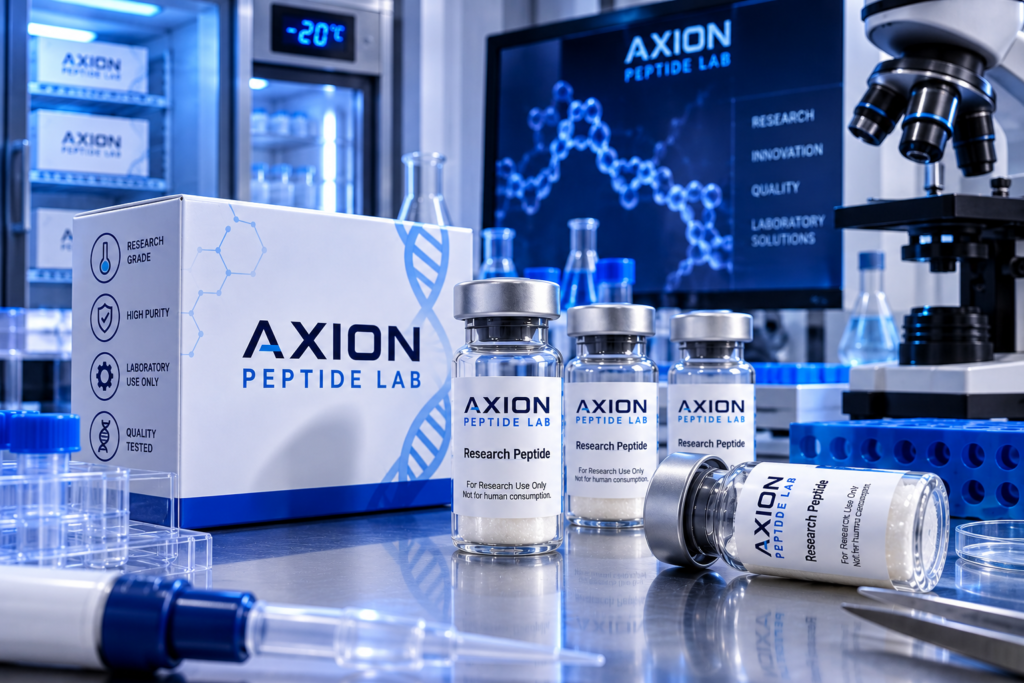
Storage and Handling Considerations for Axion Peptides
Peptide stability depends on molecular structure, formulation and environmental conditions.
Storage requirements should therefore be determined using information relevant to the specific compound.
Temperature
Temperature can influence chemical degradation and other stability-related processes.
Some peptide materials require refrigerated or frozen storage, while others may have different validated conditions.
Researchers should follow the product-specific documentation.
Moisture
Moisture exposure can affect certain dry formulations.
The extent of any effect depends on the material and packaging.
Light Exposure
Some molecules are sensitive to light-induced chemical changes.
Light protection may be relevant when supported by product stability information.
Solution Conditions
Peptides in solution may behave differently from corresponding dry materials.
Relevant factors can include pH, solvent composition, ionic strength and concentration.
Repeated Handling
Repeated opening, transfer or environmental exposure may introduce additional variables.
Laboratories should establish handling procedures appropriate to their analytical objectives.
No universal storage recommendation should replace verified information for an individual research product.
How to Evaluate an Online Research Peptide Supplier
Researchers comparing Axion Peptides with other laboratory sourcing options should use objective evaluation criteria.
A professional-looking website or an attractive price does not independently establish product quality.
Instead, consider the information available about each material and the supplier’s documented processes.
Product Transparency
Review whether listings clearly identify the compound, format and declared quantity.
Ambiguous product descriptions can complicate research procurement.
Analytical Documentation
Determine whether appropriate analytical results are available.
Check whether documentation corresponds to the batch being supplied.
Research Restrictions
Products should be described consistently with their legitimate scientific purpose and applicable regulations.
Customer Support
A supplier should provide a clear way to enquire about product specifications, documentation and ordering requirements.
Delivery Information
Laboratories should review destination eligibility, shipping conditions and handling requirements before placing an order.
Traceability
Batch identifiers and relevant records can help support laboratory inventory management.
For information about Axion Peptide Lab’s approach, visit our About Us and Frequently Asked Questions pages.
Axion Peptides for Research Laboratories in the USA, UK and Europe
International research procurement requires consideration of regulatory requirements, institutional policies and shipping restrictions.
A product’s availability on an international website does not establish that it can legally be imported, purchased or used in every jurisdiction.
Research institutions should review applicable national requirements before sourcing materials.
United States
US laboratories should consider relevant federal and state requirements, institutional purchasing policies and the regulatory status of the material.
Research-use labelling alone does not automatically exempt a product from drug regulations.
United Kingdom
UK research organisations should assess relevant import requirements, laboratory controls and any applicable medicines or chemicals legislation.
European Markets
European requirements may vary according to the country, material and intended use.
Researchers should confirm destination eligibility and applicable restrictions before ordering.
Axion Peptide Lab provides information about its products and research-use requirements through its official website.
Scientific Education and the Axion Peptides Knowledge Base
Research peptide procurement is only one part of scientific work.
Laboratories also require reliable information about molecular mechanisms, analytical methods and the limitations of experimental evidence.
Our educational articles address several complementary topics.
Peptide Sequence Analysis
Learn how analytical methods support the investigation of amino acid order and molecular identity.
Read: Peptide Sequence Analysis.
Peptide Batch Testing
Explore the importance of batch identification, documentation and appropriate quality-control procedures.
Read: Peptide Batch Testing.
Structure–Activity Relationships
Understand how molecular modifications can influence experimentally observed peptide behaviour.
Read: Peptide Structure–Activity Relationships.
Analytical Method Validation
Review essential considerations for evaluating analytical method suitability.
Read: Peptide Analytical Method Validation.
KPV Peptide Research
Explore published experimental research involving KPV, peptide transport and inflammatory signalling pathways.
Read: KPV Peptide Research.
These articles provide scientific background. They should not be interpreted as batch-specific testing reports or evidence of clinical effectiveness for commercial research products.

External Scientific Resources for Peptide Research
Scientific information should be supported by credible reference material.
Researchers investigating Axion Peptides may find the following external resources useful.
PubMed – Scientific Literature
PubMed provides access to biomedical and life-science literature.
Researchers can use it to identify peer-reviewed publications concerning peptide chemistry, molecular biology, receptor pharmacology and analytical methods.
ICH – Analytical and Quality Guidelines
The International Council for Harmonisation quality guidelines include documents addressing analytical procedure validation, analytical development and stability testing.
Their applicability depends on the regulatory and scientific context.
United States Pharmacopeia
The United States Pharmacopeia provides information about analytical standards, quality frameworks and compendial resources.
IUPHAR/BPS Guide to Pharmacology
The IUPHAR/BPS Guide to Pharmacology is a curated scientific resource covering pharmacological targets and ligands.
It can support research into receptor systems and molecular interactions.
IUPAC Gold Book
The IUPAC Gold Book provides authoritative terminology for chemistry and related scientific disciplines.
Consistent terminology improves the clarity of laboratory documentation and scientific communication.
These resources support scientific understanding but do not independently certify any Axion Peptide Lab product.
Frequently Asked Questions About Axion Peptides
1. What are Axion Peptides?
Axion Peptides refers to research peptide materials and laboratory compounds associated with Axion Peptide Lab. Individual products should be assessed according to their molecular identity, specifications and intended laboratory applications.
2. Where can I find Axion Peptide Lab products?
The official website is axionpeptidelab.com, where researchers can review available product listings and supporting information.
3. Are Axion Peptides intended for human consumption?
No. Axion Peptide Lab identifies its research materials as intended for laboratory, analytical and scientific applications, not human or veterinary administration.
4. What is a Certificate of Analysis?
A COA is a document reporting selected analytical information associated with a product or batch. The information may include identity, purity, testing methods and lot details.
5. Are all research peptides independently tested?
Testing arrangements vary by supplier, product and batch. Axion Peptide Lab’s FAQ states that selected products may have independent analytical testing, but not every product necessarily has such documentation.
6. Does HPLC confirm peptide identity?
Not by itself. HPLC primarily provides chromatographic separation information. Molecular identity may require complementary analytical techniques.
7. What does peptide purity mean?
Peptide purity refers to the proportion or relative analytical response associated with the desired material under a specified testing method. The exact meaning depends on how the result was measured and reported.
8. Can different peptide batches produce different analytical results?
Yes. Batch-to-batch differences may occur in measured content, impurity profiles or other characteristics. Appropriate documentation helps researchers evaluate consistency.
9. Why is peptide sequence analysis important?
Sequence analysis provides information about amino acid order, which is important for understanding molecular identity and interpreting experimental results.
10. Can research peptides be shipped internationally?
Shipping eligibility depends on the material, destination and applicable regulations. Laboratories should confirm current requirements before ordering.
11. How should research peptides be stored?
Storage depends on the specific peptide, formulation and available stability information. Follow the relevant product documentation rather than relying on universal recommendations.
12. Where can I learn more about Axion Peptides?
Explore the official website, product listings, quality documentation and educational research articles published by Axion Peptide Lab.
Conclusion: Understanding Axion Peptides and Research Quality
Axion Peptides brings together laboratory research materials, scientific product information and educational resources associated with Axion Peptide Lab.
For researchers, the most important purchasing and analytical decisions begin with clearly defined scientific objectives.
Peptide identity, chromatographic purity, molecular structure, batch traceability and storage requirements should be evaluated according to the intended laboratory application.
No single quality claim can replace comprehensive analytical evidence, and published research about a molecule should not be confused with verified characteristics of an individual commercial batch.
Our website provides a starting point for exploring research peptide materials, reviewing available specifications and learning more about the analytical principles behind peptide research.
Explore Axion Peptides at Axion Peptide Lab. Review the research catalogue, examine product information and contact our team about documentation or laboratory sourcing enquiries.
Research-use notice: All Axion Peptide Lab research products are intended strictly for legitimate laboratory, analytical and scientific applications. They are not intended for human or veterinary consumption, self-administration, diagnosis, prevention or treatment of medical conditions.