
Semaglutide vs Tirzepatide: Powerful Weight-Loss Research Comparison
Introduction
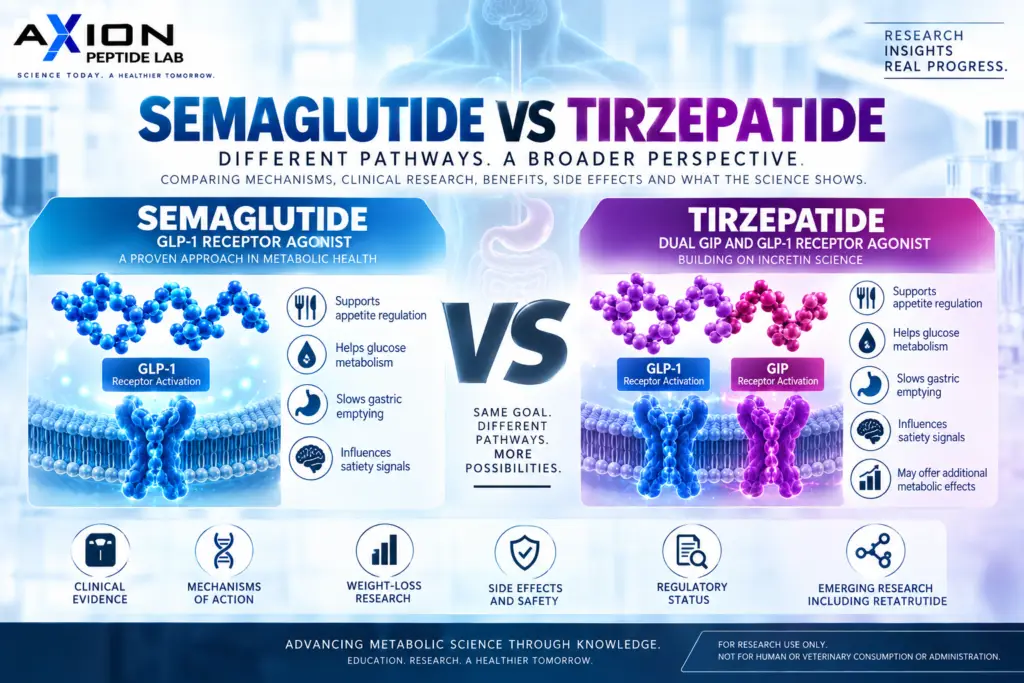
Semaglutide vs tirzepatide has become an important comparison in modern metabolic and weight-management research. Both compounds are associated with incretin signalling and are frequently discussed alongside peptides for weight loss, but they are not identical. Their receptor activity, molecular design, clinical evidence and approved uses differ in important ways.
Semaglutide acts primarily as a GLP-1 receptor agonist, whereas tirzepatide combines activity at both the GIP and GLP-1 receptors. This single-versus-dual receptor distinction is central to understanding why researchers compare the two compounds and how metabolic peptide research has progressed toward increasingly complex signalling approaches.
Clinical research has investigated both molecules extensively in areas including obesity, body-weight management and metabolic disease. Importantly, licensed prescription medicines containing semaglutide or tirzepatide exist for specific indications and jurisdictions. These pharmaceutical medicines must be clearly distinguished from research-use-only peptide materials, which are intended for laboratory and analytical investigation rather than human consumption or administration. Semaglutide vs Tirzepatide
This guide examines the science behind semaglutide and tirzepatide, including their mechanisms, GLP-1 and GIP pathways, clinical research, reported adverse effects and regulatory considerations in the USA and UK. It will also examine how both differ from retatrutide, an investigational triple-receptor compound involving GIP, GLP-1 and glucagon receptor activity.
For researchers exploring metabolic signalling, receptor pharmacology and peptide science, Axion Peptide Lab provides a catalogue of materials intended for legitimate laboratory, analytical and scientific research.
For Research Use Only – Not for human or veterinary consumption or administration.
What Are Peptides and Why Are They Connected to Weight Regulation?
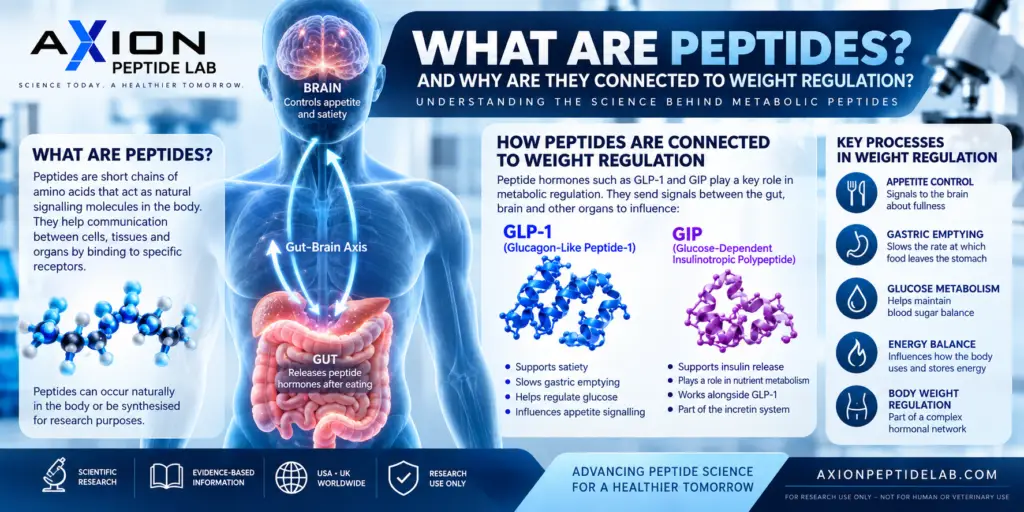
To understand the semaglutide vs tirzepatide comparison, it helps to first understand peptides and the role peptide signalling plays in metabolic research. Peptides are involved in many biological communication systems, including pathways associated with appetite, digestion, glucose regulation and energy balance.
This is one reason the term peptides for weight loss has become increasingly common. However, the phrase can oversimplify a complex field. Peptides and peptide-based compounds do not all work in the same way, and they do not share the same level of clinical evidence or regulatory status. Semaglutide vs Tirzepatide
What Is a Peptide?
A peptide is a molecule made from amino acids joined together by peptide bonds. Amino acids are often described as the building blocks of proteins, but shorter chains can also function as biologically active signalling molecules.
The human body naturally produces many peptide hormones. These molecules can carry signals between tissues by interacting with specific receptors on or within cells.
In metabolic science, researchers are particularly interested in peptide hormones involved in communication between the gastrointestinal system, pancreas, brain and other tissues. Semaglutide vs Tirzepatide
Two important examples are GLP-1 (glucagon-like peptide-1) and GIP (glucose-dependent insulinotropic polypeptide).
These naturally occurring hormones helped provide the scientific foundation for developing longer-acting compounds capable of interacting with the same receptor systems.
Semaglutide and tirzepatide are two prominent examples, although their receptor profiles differ substantially.
Semaglutide primarily targets the GLP-1 receptor, while tirzepatide combines activity at both GIP and GLP-1 receptors. Understanding this distinction is essential when comparing the two molecules. Semaglutide vs Tirzepatide
How Are Peptides Connected to Weight Regulation?
Body-weight regulation involves a complex network of biological signals rather than a single pathway.
The brain, gastrointestinal tract, pancreas, liver, adipose tissue and other organs participate in systems that influence hunger, satiety, nutrient processing, glucose regulation and overall energy balance.
Peptide hormones form part of this communication network.
One particularly important research area is the gut-brain axis. After nutrients enter the gastrointestinal tract, various hormonal signals can communicate information about nutrient availability and metabolic state to other tissues. Semaglutide vs Tirzepatide
GLP-1 is one of the hormones involved in this process.
Research into GLP-1 signalling has examined its relationship with several physiological processes, including:
- appetite and satiety signalling;
- glucose-dependent insulin secretion;
- glucagon regulation;
- gastric emptying; and
- broader metabolic regulation.
These mechanisms helped make the GLP-1 receptor an important target for metabolic research and pharmaceutical development.
GIP represents another incretin-related pathway. Researchers have investigated whether simultaneously targeting GIP and GLP-1 receptors can produce metabolic effects that differ from targeting GLP-1 alone. Semaglutide vs Tirzepatide
This distinction sits at the centre of the semaglutide vs tirzepatide discussion.
From Natural Peptide Hormones to Metabolic Research Compounds
Modern metabolic peptide research has progressed beyond studying naturally occurring hormones alone.
Scientists can modify peptide structures to investigate characteristics such as receptor activity, selectivity, stability and duration of action. This has contributed to the development of several different research strategies.
A simplified progression can be represented as:
GLP-1 receptor research → dual GIP/GLP-1 receptor research → experimental multi-receptor research
Semaglutide represents a major example of GLP-1 receptor agonism.
Tirzepatide expands the approach by targeting both GIP and GLP-1 receptors.
Research has progressed further with compounds such as retatrutide, which is being investigated for activity involving GIP, GLP-1 and glucagon receptors.
These differences demonstrate why compounds commonly grouped together under terms such as “weight loss peptides” should not automatically be treated as interchangeable. Semaglutide vs Tirzepatide
Each molecule has its own structure, receptor profile, clinical evidence, safety data and regulatory status.
Peptides for Weight Loss: An Important Scientific Distinction
When people search for peptides for weight loss, they may encounter approved prescription medicines, investigational drug candidates, laboratory research materials and compounds supported primarily by preclinical evidence.
These categories should remain clearly separated. Semaglutide vs Tirzepatide
The existence of research involving a peptide pathway does not automatically demonstrate that every compound affecting that pathway is an effective or approved weight-management treatment. Likewise, an investigational compound showing promising results in clinical trials should not be described as an approved medicine before the relevant regulatory authorities have completed their review.
For researchers, the scientific value lies in understanding the individual pathways involved and evaluating evidence according to the specific molecule being studied.
This provides the foundation for understanding the next major question in the semaglutide vs tirzepatide comparison: how metabolic peptide pathways such as GLP-1 and GIP actually work. Semaglutide vs Tirzepatide
How Do Metabolic Peptide Pathways Work?
Understanding metabolic peptide pathways is essential when comparing semaglutide vs tirzepatide. These compounds do not simply act on “weight loss” itself. Instead, they interact with receptor systems involved in a much broader network of metabolic processes, including nutrient sensing, glucose regulation, appetite, satiety and gastrointestinal function.
Two of the most important hormones in this area are GLP-1 (glucagon-like peptide-1) and GIP (glucose-dependent insulinotropic polypeptide). Both are incretin hormones released from the gastrointestinal tract in response to nutrients and can enhance glucose-dependent insulin secretion through their respective receptors.
The interaction between the gut, pancreas, brain and other tissues helps explain why these pathways have become major targets in modern metabolic research. Semaglutide vs Tirzepatide
The Gut-Brain Axis
The gut-brain axis describes communication between the gastrointestinal system and the central nervous system.
After food enters the digestive tract, nutrient-related signals trigger the release of several hormones. These signals help communicate information about nutrient availability and metabolic state to the pancreas, brain and other tissues.
GLP-1 is particularly relevant to this process. Research shows that GLP-1 signalling participates in both peripheral and central pathways associated with food intake and gastrointestinal function.
This means the gastrointestinal tract is not simply responsible for digestion. It also functions as an important endocrine signalling system.
The pathway can be simplified as:
Nutrient intake → Gut hormone release → Receptor activation → Brain and pancreatic signalling → Metabolic response
This interconnected system is one reason peptide hormones have become important targets in research involving obesity and metabolic disease.
Appetite and Satiety Signalling
Appetite regulation involves complex interactions among the brain, gastrointestinal tract, hormones and nervous system. Semaglutide vs Tirzepatide
GLP-1 signalling has been extensively investigated for its relationship with satiety and food intake. GLP-1 receptors are found in areas involved in metabolic regulation, and both peripheral and central mechanisms appear to contribute to these effects.
This is an important distinction when discussing peptides for weight loss. Their effects cannot be reduced to a simple idea that a peptide directly “burns fat.” Instead, metabolic compounds can influence biological signalling systems that contribute to energy intake and metabolic regulation.
GIP signalling is also connected to metabolic regulation, although its physiology differs from GLP-1. These differences have become especially important with the development of molecules that simultaneously target both receptors.
Glucose-Dependent Insulin Signalling
GLP-1 and GIP are known as incretin hormones.
After nutrients are consumed, both can interact with receptors on pancreatic beta cells and enhance insulin secretion when glucose levels are elevated. Their respective receptors—GLP-1R and GIPR—belong to the G-protein-coupled receptor family.
This glucose-dependent activity has made incretin biology a major area of metabolic research.
However, GLP-1 and GIP are not identical.
They have different receptor distributions and physiological effects. For example, their effects on glucagon secretion and gastrointestinal function can differ depending on metabolic conditions.
These differences are particularly relevant to the semaglutide vs tirzepatide comparison because semaglutide primarily targets GLP-1R, while tirzepatide combines GIPR and GLP-1R agonism.
Gastric Emptying and Metabolic Regulation
Another important part of GLP-1 physiology involves gastric emptying, which describes how quickly food moves from the stomach into the small intestine.
GLP-1 can slow gastric emptying, influencing how rapidly nutrients enter the intestine and subsequently appear in circulation. Research has also connected this pathway with post-meal glucose regulation and satiety.
GLP-1 and GIP should not be assumed to have identical effects here. Human experimental research has demonstrated meaningful differences between the two incretin hormones in their effects on gastric emptying and appetite.
This illustrates an important principle: two compounds can both participate in metabolic regulation while operating differently across individual pathways.
From Single to Dual and Triple-Receptor Research
One of the most significant developments in metabolic peptide science has been the movement toward multi-receptor agonism.
The progression can be visualised simply:
Semaglutide
GLP-1R
↓
Single-receptor approach
Tirzepatide
GIPR + GLP-1R
↓
Dual-receptor approach
Retatrutide
GIPR + GLP-1R + GCGR
↓
Investigational triple-receptor approach
Semaglutide demonstrates how sustained GLP-1 receptor activation can be used pharmacologically.
Tirzepatide takes a different approach by combining activity at the GIP and GLP-1 receptors. Research into dual GIP/GLP-1 receptor agonism has renewed scientific interest in understanding how the two incretin pathways interact over longer periods.
Retatrutide extends the concept further by adding glucagon receptor activity. It remains an investigational compound, so its clinical-development status must be distinguished from licensed medicines containing semaglutide or tirzepatide.
These single-, dual- and triple-receptor strategies illustrate how metabolic peptide research continues to evolve.
Rather than treating all peptides for weight loss as one category, it is more scientifically useful to examine the receptors they target, how those receptors signal, the quality of clinical evidence and the regulatory status of each individual compound.
The next step in understanding semaglutide vs tirzepatide is therefore to examine the two incretin hormones at the centre of the comparison—GLP-1 and GIP—and understand exactly where their functions overlap and where they differ.
What Are GLP-1 and GIP?
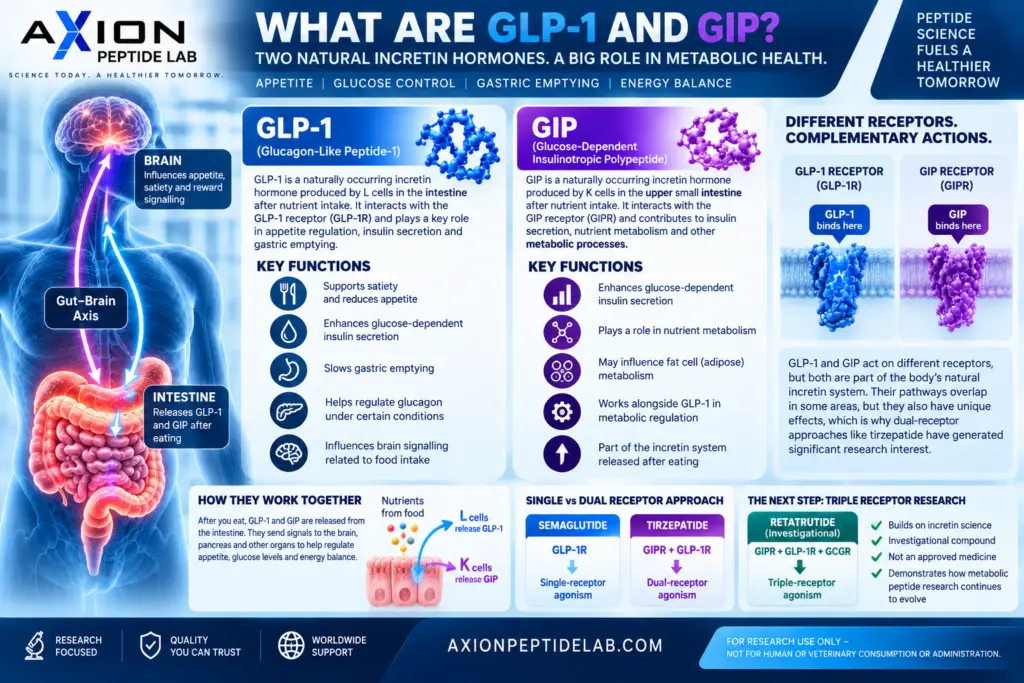
To understand the scientific differences between semaglutide vs tirzepatide, two metabolic hormones are particularly important: GLP-1 and GIP. These naturally occurring peptide hormones belong to a group known as incretins, which are released from the gastrointestinal tract in response to nutrient intake and contribute to the body’s metabolic response after eating.
GLP-1 and GIP share some biological functions, particularly their ability to enhance glucose-dependent insulin secretion. However, they act through separate receptors and also differ in several physiological effects. These similarities and differences provide the scientific foundation for understanding why semaglutide primarily targets one incretin pathway while tirzepatide targets two.
What Is GLP-1?
GLP-1 stands for glucagon-like peptide-1.
It is a naturally occurring incretin hormone produced primarily by intestinal L cells following nutrient intake. GLP-1 interacts with the GLP-1 receptor (GLP-1R), a G-protein-coupled receptor found in several tissues involved in metabolic regulation.
One important function of GLP-1 is its ability to enhance insulin secretion when glucose concentrations are elevated. GLP-1 signalling is also associated with glucagon regulation, gastrointestinal function, appetite and food-intake pathways.
Another important characteristic is its relationship with gastric emptying. GLP-1 signalling can slow the rate at which stomach contents move into the small intestine, although the magnitude and duration of this effect can depend on several factors.
GLP-1 also participates in signalling involving areas of the nervous system associated with appetite and satiety.
These characteristics have made GLP-1R one of the most extensively investigated receptor targets in modern metabolic medicine.
Semaglutide is a prominent example of a compound designed to produce sustained GLP-1 receptor agonism.
This relationship can be simplified as:
Semaglutide → GLP-1 receptor → metabolic signalling
However, semaglutide is not simply naturally occurring GLP-1. It is a modified GLP-1 analogue designed to provide pharmacological activity that lasts substantially longer than endogenous GLP-1.
What Is GIP?
GIP stands for glucose-dependent insulinotropic polypeptide.
Like GLP-1, GIP is an incretin hormone released following nutrient consumption. It is produced predominantly by K cells in the upper small intestine.
GIP interacts with its own receptor:
GIP receptor (GIPR)
GIPR is also a G-protein-coupled receptor.
When glucose concentrations are elevated, GIP can enhance insulin secretion through pancreatic beta-cell signalling. Both GIPR and GLP-1R activation involve intracellular signalling pathways that include increased cyclic AMP, although the two hormones have important physiological differences beyond this shared incretin action.
GIP signalling has been investigated in relation to nutrient metabolism, adipose tissue, pancreatic function, the nervous system and other physiological processes.
For many years, GLP-1 attracted substantially more attention in pharmaceutical weight-management research. The development of dual GIP/GLP-1 receptor agonists, however, renewed scientific interest in how GIP signalling might interact with GLP-1 signalling when both pathways are pharmacologically targeted.
Tirzepatide is the most prominent example of this approach.
The relationship can be represented as:
Tirzepatide → GIP receptor + GLP-1 receptor → dual incretin signalling
The FDA identifies tirzepatide as an agonist of both the GIP and GLP-1 receptors.
GLP-1 vs GIP: What’s the Difference?
Although GLP-1 and GIP are both incretin hormones, they should not be treated as identical.
Their most important similarities include:
- both are naturally occurring peptide hormones;
- both are released in response to nutrient intake;
- both interact with specific G-protein-coupled receptors;
- both can enhance glucose-dependent insulin secretion; and
- both participate in metabolic signalling.
There are also significant differences.
GLP-1 has established physiological effects involving gastric emptying and glucagon suppression under appropriate metabolic conditions. GIP does not reproduce all of these actions and can have different effects on glucagon secretion and nutrient handling.
Their receptors also have different tissue distributions and signalling characteristics.
This is why comparing the two pathways is more complicated than asking which hormone is “stronger.”
The scientific question is instead how activating each receptor—or activating both receptors simultaneously—changes the overall metabolic response.
Why Does Tirzepatide Target Both GIP and GLP-1?
This question is central to understanding semaglutide vs tirzepatide.
Semaglutide primarily uses a single incretin-receptor strategy:
GLP-1R
Tirzepatide uses a dual incretin-receptor strategy:
GIPR + GLP-1R
Tirzepatide is specifically designed to bind to and activate both receptors. Its dual mechanism distinguishes it pharmacologically from selective GLP-1 receptor agonists.
The concept does not simply involve adding two unrelated effects together. Researchers continue to investigate how GIPR and GLP-1R signalling interact and how simultaneous activation contributes to the metabolic effects observed with dual agonism.
This distinction can be visualised as:
SEMAGLUTIDE
↓
GLP-1R
↓
Single-receptor agonism
TIRZEPATIDE
↓
GIPR + GLP-1R
↓
Dual-receptor agonism
This receptor difference is one of the most important scientific distinctions between semaglutide and tirzepatide.
From GLP-1 and GIP to Triple-Receptor Research
The development of dual-receptor compounds has also contributed to a broader area of multi-receptor metabolic research.
A useful progression is:
Semaglutide
GLP-1R
↓
Tirzepatide
GIPR + GLP-1R
↓
Retatrutide
GIPR + GLP-1R + glucagon receptor
Retatrutide therefore extends the multi-receptor concept by incorporating glucagon receptor activity in addition to GIP and GLP-1 receptor agonism.
However, these compounds must not be placed into the same regulatory category simply because they target related pathways. Licensed prescription medicines containing semaglutide and tirzepatide exist for defined indications, whereas retatrutide remains an investigational compound.
Understanding GLP-1 vs GIP therefore provides the foundation for the rest of the comparison. Semaglutide primarily represents sustained GLP-1 receptor agonism, while tirzepatide combines GLP-1 and GIP receptor agonism within one molecule.
The next section examines semaglutide itself—what it is, how its GLP-1 receptor activity works, and what clinical research has actually shown.
What Is Semaglutide?
Semaglutide is a long-acting glucagon-like peptide-1 receptor agonist (GLP-1RA) developed to mimic important aspects of the biological activity of naturally occurring GLP-1. Understanding how semaglutide works is essential to the semaglutide vs tirzepatide comparison because the two compounds share GLP-1 receptor activity but differ significantly in their overall receptor profiles.
Semaglutide primarily targets the GLP-1 receptor (GLP-1R), whereas tirzepatide acts at both GLP-1 and GIP receptors. This makes semaglutide a useful example of a single-incretin-receptor approach compared with tirzepatide’s dual-receptor mechanism.
Semaglutide has been extensively investigated in clinical research involving type 2 diabetes, obesity, cardiovascular outcomes and long-term weight management. Specific pharmaceutical products containing semaglutide have received regulatory approval for defined indications, although approval depends on the particular product, formulation and jurisdiction.
How Does Semaglutide Work?
Naturally occurring GLP-1 is released from intestinal cells following nutrient intake. It interacts with GLP-1 receptors in several tissues and participates in physiological processes involving glucose-dependent insulin secretion, glucagon regulation, gastrointestinal function and appetite-related signalling.
Natural GLP-1, however, has a very short biological half-life because it is rapidly degraded.
Semaglutide was structurally modified to resist rapid enzymatic degradation and remain active substantially longer than endogenous GLP-1. Its design also incorporates fatty-acid modification that promotes albumin binding and contributes to its prolonged pharmacokinetic profile. (pubmed.ncbi.nlm.nih.gov)
Its basic mechanism can therefore be represented as:
Semaglutide → GLP-1 receptor activation → downstream metabolic signalling
This receptor activation is associated with several physiological effects that have been studied clinically.
Semaglutide and GLP-1 Receptor Signalling
GLP-1 receptors belong to the G-protein-coupled receptor family.
When semaglutide activates GLP-1R, intracellular signalling contributes to glucose-dependent insulin secretion. GLP-1 receptor activation can also affect glucagon secretion and gastrointestinal function.
Another important area involves appetite and food-intake signalling.
Research indicates that GLP-1 receptor agonism can influence neural pathways involved in appetite and satiety. This provides an important biological explanation for why GLP-1 receptor agonists became a major focus of obesity and peptides for weight loss research.
Gastric emptying is another component of GLP-1 physiology. GLP-1 receptor activation can slow gastric emptying, although the magnitude of this effect can vary with acute versus sustained exposure and other experimental or clinical conditions.
It is therefore more accurate to describe semaglutide as influencing an interconnected metabolic signalling network rather than claiming it acts through one simple “weight-loss mechanism.”
What Has Semaglutide Been Studied For?
Semaglutide has one of the largest clinical evidence bases among modern GLP-1 receptor agonists.
Research programmes have examined the molecule in several areas, including:
- type 2 diabetes;
- obesity and overweight;
- long-term body-weight management;
- cardiovascular outcomes;
- glucose regulation; and
- broader metabolic health outcomes.
Two major clinical-development programmes are especially relevant.
The SUSTAIN programme investigated injectable semaglutide extensively in type 2 diabetes.
The STEP programme subsequently investigated semaglutide in overweight and obesity.
These programmes provide considerably stronger evidence than isolated laboratory experiments or uncontrolled observational claims.
What Does Clinical Research Show About Semaglutide and Weight Management?
One of the landmark studies was STEP 1, published in the New England Journal of Medicine in 2021.
The trial included 1,961 adults with overweight or obesity without diabetes and compared once-weekly semaglutide 2.4 mg plus lifestyle intervention with placebo plus lifestyle intervention over 68 weeks.
The reported mean change in body weight was approximately −14.9% with semaglutide compared with −2.4% with placebo. (nejm.org)
These findings were important because they demonstrated clinically meaningful average weight change within a large randomized controlled trial.
However, the results require context.
The percentages represent group averages within a defined clinical-trial population. They do not predict an identical response for every individual, and the study involved a specific pharmaceutical formulation, studied dose, eligibility criteria, lifestyle intervention and clinical monitoring.
The results should therefore not be applied automatically to unapproved or research-grade materials.
Why STEP Research Matters for Semaglutide vs Tirzepatide
For several years, comparisons between semaglutide and tirzepatide often relied on results from separate clinical programmes.
Semaglutide had the STEP programme.
Tirzepatide later had the SURMOUNT programme.
Comparing headline percentages from unrelated trials can be misleading because clinical studies may differ in:
- participant characteristics;
- inclusion and exclusion criteria;
- treatment duration;
- studied doses;
- endpoints;
- lifestyle interventions; and
- statistical methodology.
This is why the semaglutide vs tirzepatide evidence became particularly interesting when researchers conducted a direct head-to-head obesity trial rather than relying solely on comparisons across separate studies.
That evidence will be examined later in this article.
Is Semaglutide an Approved Medicine?
This question requires an important distinction.
Semaglutide is an active pharmaceutical ingredient used in approved prescription medicines.
For example, specific semaglutide products have received regulatory authorisation for defined indications in the United States and United Kingdom.
However:
Semaglutide as a molecule ≠ every product claiming to contain semaglutide
Regulatory approval applies to a specific pharmaceutical product, formulation, manufacturing process, indication and labelling.
A laboratory research material containing semaglutide should therefore not be described as an FDA-approved or MHRA-authorised medicine merely because approved medicines containing the same active ingredient exist.
This distinction is particularly important when discussing research peptides versus prescription medicines.
Semaglutide Prescription Medicines vs Research Materials
Licensed semaglutide medicines are manufactured and regulated as pharmaceutical products intended for specified clinical uses.
Research-use materials have a fundamentally different purpose.
They may be used in controlled laboratory work involving areas such as:
- GLP-1 receptor pharmacology;
- peptide chemistry;
- receptor-binding studies;
- analytical characterisation;
- comparative molecular research; and
- metabolic signalling experiments.
Research materials are not substitutes for prescription medicines and should not be promoted for self-administration.
For legitimate laboratory researchers, Axion Peptide Lab provides research materials intended for scientific, analytical and laboratory investigation. Product-specific information and available documentation should be reviewed before selecting a material for an experimental workflow.
For Research Use Only – Not for human or veterinary consumption or administration.
Why Semaglutide Is Important to the Tirzepatide Comparison
Semaglutide provides the GLP-1-only side of the comparison.
The core distinction can be summarised as:
Semaglutide
GLP-1R
Single incretin-receptor agonism
versus
Tirzepatide
GIPR + GLP-1R
Dual incretin-receptor agonism
Both have extensive clinical evidence, but their pharmacology is not identical.
Understanding semaglutide’s GLP-1 receptor mechanism and clinical evidence provides the foundation for examining the other half of the comparison: tirzepatide and its combined GIP/GLP-1 receptor activity.
What Is Tirzepatide?
Tirzepatide is a long-acting peptide-based compound that acts as an agonist at both the glucose-dependent insulinotropic polypeptide receptor (GIPR) and the glucagon-like peptide-1 receptor (GLP-1R). This dual-receptor mechanism is the central scientific distinction in the semaglutide vs tirzepatide comparison.
Semaglutide primarily targets GLP-1R. Tirzepatide combines GIPR and GLP-1R activity within a single molecule.
This can be simplified as:
Semaglutide → GLP-1R
Tirzepatide → GIPR + GLP-1R
Tirzepatide has been studied extensively in clinical programmes involving type 2 diabetes, obesity and long-term weight management. Specific prescription medicines containing tirzepatide are authorised for defined indications in jurisdictions including the USA and UK. This pharmaceutical use must remain clearly separated from laboratory research materials containing the compound.
How Does Tirzepatide Work?
Tirzepatide is designed to activate two incretin-related receptor systems simultaneously.
The first is the GIP receptor.
GIP is a naturally occurring incretin hormone released primarily from intestinal K cells after nutrient intake. GIP receptor signalling contributes to glucose-dependent insulin secretion and other aspects of metabolic physiology.
The second is the GLP-1 receptor.
GLP-1 participates in glucose-dependent insulin signalling, glucagon regulation, gastrointestinal function and pathways associated with appetite and satiety.
Tirzepatide combines activity at both receptors:
Tirzepatide
↓
GIPR + GLP-1R
↓
Dual incretin-receptor signalling
This distinguishes tirzepatide pharmacologically from selective GLP-1 receptor agonists such as semaglutide.
What Does Dual GIP and GLP-1 Receptor Agonism Mean?
The term dual agonist means that one molecule activates two different receptor types.
For tirzepatide, those receptors are:
GIPR — glucose-dependent insulinotropic polypeptide receptor
and
GLP-1R — glucagon-like peptide-1 receptor
Both receptors belong to the G-protein-coupled receptor family and participate in metabolic signalling.
However, dual agonism should not be interpreted simply as “two receptors are automatically better than one.”
Researchers continue to investigate how simultaneous GIPR and GLP-1R activation contributes to tirzepatide’s overall pharmacological effects. Receptor activity, molecular design, pharmacokinetics and downstream signalling all contribute to the response.
This is why the semaglutide vs tirzepatide comparison should be based on clinical evidence as well as receptor count.
What Has Tirzepatide Been Studied For?
Tirzepatide has undergone extensive clinical investigation.
Two major clinical-development programmes are particularly important:
SURPASS — focused primarily on tirzepatide in type 2 diabetes.
SURMOUNT — focused primarily on obesity and weight management.
Research has examined outcomes involving:
- body-weight change;
- glucose regulation;
- cardiometabolic measures;
- long-term weight management;
- type 2 diabetes; and
- obesity-related outcomes.
The SURMOUNT programme is particularly relevant when discussing peptides for weight loss because it provides randomized clinical evidence rather than relying on laboratory findings or anecdotal reports.
What Does Clinical Research Show About Tirzepatide and Weight Management?
A landmark study was SURMOUNT-1, published in the New England Journal of Medicine in 2022.
The phase 3 trial included 2,539 adults with obesity, or overweight with at least one weight-related complication, without diabetes.
Participants were randomly assigned to receive tirzepatide at one of three studied maintenance doses or placebo for 72 weeks alongside lifestyle intervention.
Average percentage changes in body weight reported in the trial were approximately:
5 mg tirzepatide: −15.0%
10 mg tirzepatide: −19.5%
15 mg tirzepatide: −20.9%
Placebo: −3.1%
These results established tirzepatide as an important subject in modern obesity and metabolic research.
However, these numbers require context.
They represent averages from specific randomized clinical-trial groups using a regulated investigational pharmaceutical product under defined study conditions. Individual responses varied, and the results should not be extrapolated to research-grade materials or products outside the clinical trial.
Why SURMOUNT-1 Matters for Semaglutide vs Tirzepatide
SURMOUNT-1 produced substantial scientific interest because of the magnitude of average weight change observed during the trial.
It can be tempting to compare its headline percentages directly with those from semaglutide’s STEP trials.
That approach has limitations.
For example:
STEP 1 investigated semaglutide for 68 weeks.
SURMOUNT-1 investigated tirzepatide for 72 weeks.
The studies also differed in participant populations, treatment protocols and other methodological details.
Comparing results from separate clinical trials therefore cannot establish a true head-to-head difference.
A stronger comparison requires participants to be randomly assigned to semaglutide or tirzepatide within the same clinical trial.
That is why the later SURMOUNT-5 head-to-head trial is particularly important and will be examined in detail later in this article.
Tirzepatide vs Semaglutide: The Key Mechanistic Difference
At the molecular level, the main distinction is straightforward.
SEMAGLUTIDE
GLP-1R
↓
Single incretin-receptor approach
TIRZEPATIDE
GIPR + GLP-1R
↓
Dual incretin-receptor approach
Both compounds therefore interact with GLP-1 receptors.
Tirzepatide additionally activates GIP receptors.
This additional receptor activity is one of the primary reasons researchers have studied whether tirzepatide produces different metabolic outcomes from selective GLP-1 receptor agonism.
However, receptor count alone should never be used to predict clinical superiority. Direct comparative trials provide much stronger evidence.
Is Tirzepatide an Approved Medicine?
Specific pharmaceutical products containing tirzepatide have received regulatory approval or authorisation for defined indications.
In the United States, FDA-approved tirzepatide medicines exist for specified clinical uses. The FDA identifies tirzepatide as a GIP receptor and GLP-1 receptor agonist.
The UK also has authorised tirzepatide medicine for specified indications, subject to applicable prescribing and regulatory requirements.
However, the regulatory distinction remains essential:
Approved tirzepatide medicine ≠ every product containing or claiming to contain tirzepatide
Approval relates to a particular pharmaceutical product, formulation, manufacturing process, quality controls, labelling and indication.
A research-use tirzepatide material is therefore not transformed into an approved medicine merely because its stated research compound is also an active ingredient in a licensed pharmaceutical product.
Tirzepatide Prescription Medicines vs Research Materials
Licensed prescription medicines and laboratory research materials serve fundamentally different purposes.
Prescription tirzepatide products are regulated pharmaceutical medicines intended for authorised clinical use under applicable medical and regulatory requirements.
Research materials may instead support controlled scientific investigation involving areas such as:
- GIP receptor pharmacology;
- GLP-1 receptor pharmacology;
- dual-receptor signalling;
- peptide chemistry;
- receptor-binding experiments;
- metabolic pathway research;
- analytical characterisation; and
- comparative peptide studies.
Research materials should not be promoted or used as substitutes for prescription medicines.
For legitimate laboratory researchers, Axion Peptide Lab provides research materials intended for controlled scientific, analytical and laboratory investigation. Researchers should review product-specific specifications and available documentation to determine suitability for their experimental work.
For Research Use Only – Not for human or veterinary consumption or administration.
Why Tirzepatide Changed Metabolic Peptide Research
Tirzepatide represents an important transition from selective incretin-receptor agonism toward multi-receptor metabolic research.
The progression can be represented as:
Semaglutide
GLP-1R
↓
Single-receptor approach
Tirzepatide
GIPR + GLP-1R
↓
Dual-receptor approach
Retatrutide
GIPR + GLP-1R + GCGR
↓
Investigational triple-receptor approach
This progression does not mean that each newer compound automatically replaces the one before it. Instead, it demonstrates how researchers are investigating increasingly complex combinations of metabolic signalling pathways.
With the individual mechanisms of semaglutide and tirzepatide now established, the next section can directly answer the article’s central question: What are the most important differences between semaglutide and tirzepatide?
Semaglutide vs Tirzepatide: What’s the Difference?
The main difference between semaglutide and tirzepatide is the number and type of incretin receptors they activate. Semaglutide primarily acts as a GLP-1 receptor agonist, while tirzepatide activates both the GIP and GLP-1 receptors.
This distinction is fundamental to understanding why the two compounds are frequently compared in metabolic and weight-management research.
At a glance:
| Comparison | Semaglutide | Tirzepatide |
| GLP-1 receptor activity | Yes | Yes |
| GIP receptor activity | No | Yes |
| Receptor approach | Single incretin | Dual incretin |
| Main targets | GLP-1R | GIPR + GLP-1R |
| Weight-management clinical research | Extensive | Extensive |
| Approved prescription medicines exist | Yes | Yes |
| Same as retatrutide? | No | No |
Although both compounds share GLP-1 receptor activity, tirzepatide’s additional GIP receptor activity gives it a distinct pharmacological profile.
Semaglutide vs Tirzepatide Mechanism of Action
Semaglutide is a modified GLP-1 analogue designed to provide sustained activation of the GLP-1 receptor.
Its mechanism can be simplified as:
Semaglutide → GLP-1R → GLP-1-related metabolic signalling
GLP-1 receptor activation is associated with glucose-dependent insulin secretion, effects on glucagon signalling, appetite regulation and gastrointestinal function.
Tirzepatide takes a different approach.
It is designed to activate two receptors:
Tirzepatide → GIPR + GLP-1R → dual incretin signalling
The FDA describes tirzepatide as an agonist that selectively binds to and activates both GIP and GLP-1 receptors. These are the receptors for the naturally occurring incretin hormones GIP and GLP-1.
The additional GIP component is therefore not simply a marketing distinction—it represents a genuine difference in receptor pharmacology.
GLP-1 vs Dual GIP/GLP-1 Activity
One way to understand the comparison is to think of semaglutide as a single-incretin-receptor strategy and tirzepatide as a dual-incretin-receptor strategy.
SEMAGLUTIDE
GLP-1R
↓
Single-receptor agonism
TIRZEPATIDE
GIPR + GLP-1R
↓
Dual-receptor agonism
Both compounds interact with GLP-1 receptors, meaning they share some overlapping biological pathways.
Tirzepatide additionally activates GIP receptors.
Both GIP and GLP-1 are naturally occurring incretin hormones involved in the body’s response to nutrient intake. However, their physiological roles are not identical.
The significance of tirzepatide’s dual mechanism is therefore more complex than simply saying that it activates “one more receptor.” Researchers continue to investigate how simultaneous GIP and GLP-1 receptor activation contributes to its overall metabolic effects.
Similarities Between Semaglutide and Tirzepatide
Despite their mechanistic differences, semaglutide and tirzepatide have several important similarities.
Both:
- are peptide-based compounds;
- activate the GLP-1 receptor;
- have been extensively investigated in metabolic research;
- have been studied in obesity and weight-management clinical trials;
- influence appetite-related signalling;
- affect glucose-dependent metabolic pathways;
- have long-acting pharmacological designs; and
- are active ingredients in licensed prescription medicines for defined indications.
Both have also become prominent in discussions surrounding peptides for weight loss, although that phrase should not be used to imply that research-grade materials are equivalent to licensed medicines.
Major Differences Between Semaglutide and Tirzepatide
The most obvious difference is receptor activity.
Semaglutide targets:
GLP-1R
Tirzepatide targets:
GIPR + GLP-1R
But this is not the only difference.
Their molecular structures are different, their receptor pharmacology differs, and their major clinical-development programmes were conducted separately.
Semaglutide has been investigated extensively through programmes including SUSTAIN and STEP.
Tirzepatide has been investigated through programmes including SURPASS and SURMOUNT.
Another important distinction is that the molecules should not be considered different versions of the same drug. They are separate active pharmaceutical ingredients with distinct pharmacological characteristics.
Semaglutide vs Tirzepatide for Weight Loss
This is one of the most frequently searched questions surrounding the two compounds.
Earlier comparisons were often made indirectly by placing results from semaglutide’s STEP trials alongside results from tirzepatide’s SURMOUNT trials.
That approach has limitations.
Different clinical trials can involve different:
- participant populations;
- treatment durations;
- doses;
- inclusion criteria;
- lifestyle interventions;
- endpoints; and
- statistical methods.
For that reason, percentages from two unrelated trials should not automatically be interpreted as proof that one treatment is superior.
A much stronger comparison became available with SURMOUNT-5, a randomized head-to-head clinical trial directly comparing tirzepatide with semaglutide in adults with obesity without type 2 diabetes.
The trial included 751 participants and evaluated treatment over 72 weeks. It found a greater mean reduction in body weight with tirzepatide than with semaglutide under the specific conditions studied.
The detailed results, endpoints and limitations of SURMOUNT-5 will be examined in the next section.
Does Tirzepatide Produce Greater Weight Reduction Than Semaglutide?
Current head-to-head evidence provides a more useful answer than comparisons between unrelated trials.
In SURMOUNT-5, tirzepatide produced a greater average percentage reduction in body weight than semaglutide at 72 weeks among the adults with obesity without type 2 diabetes who participated in the trial.
However, this finding requires context.
It does not mean every individual will experience the same result, nor does it establish that tirzepatide is automatically the appropriate medicine for every patient.
Treatment decisions can depend on factors including medical history, contraindications, adverse effects, regulatory indications and individual clinical circumstances.
Clinical evidence should therefore be interpreted at the population level before being applied to individual medical decisions.
Semaglutide vs Tirzepatide: What About Appetite and Gastric Emptying?
Both compounds influence pathways associated with appetite and food intake.
GLP-1 receptor activation is associated with appetite regulation and gastrointestinal effects, including delayed gastric emptying.
Because semaglutide activates GLP-1R, these pathways form part of its pharmacology.
Tirzepatide also activates GLP-1R and therefore shares relevant GLP-1-related mechanisms. Its additional GIP receptor activity creates a broader receptor profile.
The FDA states that tirzepatide decreases calorie intake and that its effects on body weight are likely mediated in part through appetite. Tirzepatide also delays gastric emptying, with the effect being greatest after the first dose and diminishing over time.
These mechanisms illustrate why the compounds have overlapping effects without being pharmacologically identical.
Semaglutide vs Tirzepatide: Are the Side Effects the Same?
There is substantial overlap in the adverse effects reported with the two medicines, particularly gastrointestinal events.
Clinical trials commonly report effects such as:
- nausea;
- diarrhoea;
- vomiting; and
- other gastrointestinal symptoms.
However, frequency and severity can vary according to the medicine, studied dose, treatment stage and individual participant.
The SURMOUNT-5 head-to-head trial reported that gastrointestinal adverse events were the most common events in both groups and were generally mild to moderate, occurring primarily during dose escalation.
Safety should not be reduced to a simple statement that one medicine has “fewer side effects.” The dedicated safety section later in this article will examine reported adverse effects, warnings and contraindications in greater detail.
Which Is Better: Semaglutide or Tirzepatide?
There is no scientifically responsible universal answer to this question.
If “better” refers specifically to average body-weight reduction in the SURMOUNT-5 trial population, tirzepatide produced a greater mean reduction than semaglutide.
But clinical decision-making involves much more than one outcome.
Researchers and healthcare professionals must also consider:
- safety;
- tolerability;
- contraindications;
- approved indications;
- individual response;
- medical history;
- treatment goals; and
- quality of evidence.
Therefore, search terms such as “semaglutide vs tirzepatide which is better?” should be answered using clinical evidence rather than declaring one compound universally superior.
Semaglutide vs Tirzepatide vs Retatrutide
The receptor differences become even clearer when retatrutide is included:
Semaglutide
GLP-1R
→ Single-receptor approach
Tirzepatide
GIPR + GLP-1R
→ Dual-receptor approach
Retatrutide
GIPR + GLP-1R + GCGR
→ Investigational triple-receptor approach
Retatrutide should not be described as simply a “stronger tirzepatide.” It is a different investigational molecule with additional glucagon receptor activity and its own clinical-development programme.
Most importantly, its regulatory status differs: licensed medicines containing semaglutide and tirzepatide exist, while retatrutide remains investigational.
Research Materials vs Licensed Semaglutide and Tirzepatide Medicines
When discussing semaglutide vs tirzepatide, it is essential to separate pharmaceutical medicines from research materials.
FDA-approved semaglutide and tirzepatide products undergo regulatory review for safety, effectiveness and quality for their authorised uses. The FDA specifically warns that unapproved versions do not undergo the same premarket review.
Research-use materials serve a different purpose. They may support controlled laboratory investigation involving receptor pharmacology, peptide chemistry, analytical characterisation and metabolic signalling research.
For legitimate researchers, Axion Peptide Lab provides research materials intended for laboratory, analytical and scientific investigation. These materials should not be represented or used as substitutes for licensed prescription medicines.
For Research Use Only – Not for human or veterinary consumption or administration.
The receptor comparison explains why semaglutide and tirzepatide differ. The next section examines the more difficult question: what does direct clinical research actually show when tirzepatide and semaglutide are compared head-to-head?
Semaglutide vs Tirzepatide for Weight Loss: What Does the Research Actually Show?
The semaglutide vs tirzepatide comparison is most useful when it is based on clinical evidence rather than popularity, anecdotal reports or results taken from unrelated studies. Both compounds have been investigated in large clinical-development programmes, and researchers now also have direct head-to-head evidence comparing them in adults with obesity without type 2 diabetes.
Three areas of evidence are particularly important:
STEP trials → Semaglutide
SURMOUNT trials → Tirzepatide
SURMOUNT-5 → Direct tirzepatide vs semaglutide comparison
Understanding the differences between these forms of evidence is essential when evaluating claims about peptides for weight loss.
What Did the STEP Research Show About Semaglutide?
The STEP clinical-development programme investigated semaglutide 2.4 mg in people with overweight or obesity across several clinical settings.
One of the landmark studies was STEP 1, published in the New England Journal of Medicine in 2021.
The randomized, double-blind trial included 1,961 adults with a body mass index of at least 30, or at least 27 with one or more weight-related conditions. Participants did not have diabetes.
Participants received either once-weekly semaglutide 2.4 mg or placebo alongside lifestyle intervention for 68 weeks.
The reported mean change in body weight was:
Semaglutide: −14.9%
Placebo: −2.4%
The estimated treatment difference was −12.4 percentage points.
The study therefore provided strong randomized clinical evidence that semaglutide produced substantially greater average body-weight reduction than placebo under the conditions investigated.
However, these figures should not be interpreted as guaranteed individual outcomes. They represent averages within a defined clinical-trial population receiving a specific pharmaceutical product under controlled study conditions.
What Did the SURMOUNT Research Show About Tirzepatide?
The SURMOUNT programme investigated tirzepatide in obesity and weight management.
A major early trial was SURMOUNT-1, published in the New England Journal of Medicine in 2022.
It included 2,539 adults with obesity, or overweight with at least one weight-related complication, who did not have diabetes.
Participants were randomly assigned to receive once-weekly tirzepatide at a studied maintenance dose of 5 mg, 10 mg or 15 mg, or placebo, for 72 weeks.
The reported mean percentage changes in body weight were approximately:
| Group | Mean Body-Weight Change |
| Tirzepatide 5 mg | −15.0% |
| Tirzepatide 10 mg | −19.5% |
| Tirzepatide 15 mg | −20.9% |
| Placebo | −3.1% |
These findings established tirzepatide as an important compound in modern obesity research.
But an important SEO and scientific distinction is necessary:
STEP 1 and SURMOUNT-1 were separate trials.
It is therefore inappropriate to simply place −14.9% from STEP 1 next to −20.9% from SURMOUNT-1 and conclude that the difference proves tirzepatide is superior.
A proper comparison requires a head-to-head randomized trial.
SURMOUNT-5: Tirzepatide vs Semaglutide Head-to-Head
The SURMOUNT-5 trial provided that direct comparison.
Published in the New England Journal of Medicine in 2025, SURMOUNT-5 was a phase 3b, open-label, randomized controlled trial directly comparing tirzepatide with semaglutide.
The study included 751 adults with obesity but without type 2 diabetes.
Participants were assigned to receive the maximum tolerated dose of either tirzepatide or semaglutide over 72 weeks.
The primary endpoint was percentage change in body weight from baseline to week 72.
The reported average changes were:
Tirzepatide: −20.2%
Semaglutide: −13.7%
This produced an estimated treatment difference of −6.5 percentage points in favour of tirzepatide.
Under the conditions of this trial, tirzepatide therefore produced a significantly greater average percentage reduction in body weight than semaglutide.
SURMOUNT-5 Results at a Glance
| Comparison | Tirzepatide | Semaglutide |
| Trial | SURMOUNT-5 | SURMOUNT-5 |
| Participants | Same randomized trial | Same randomized trial |
| Duration | 72 weeks | 72 weeks |
| Mean weight change | −20.2% | −13.7% |
| Receptor profile | GIPR + GLP-1R | GLP-1R |
| Mechanism | Dual incretin agonism | GLP-1 agonism |
Because both treatments were evaluated within the same randomized trial, SURMOUNT-5 provides more informative comparative evidence than simply comparing headline results from STEP and SURMOUNT studies conducted separately.
What Did SURMOUNT-5 Show About Waist Circumference?
Body weight was not the only outcome investigated.
SURMOUNT-5 also evaluated change in waist circumference.
At 72 weeks, the reported mean reduction was approximately:
Tirzepatide: −18.4 cm
Semaglutide: −13.0 cm
Again, these are group averages from the trial population rather than guaranteed individual outcomes.
The results nevertheless provide additional comparative evidence concerning the metabolic and anthropometric outcomes investigated in the study.
Did More Participants Reach Major Weight-Loss Thresholds?
SURMOUNT-5 also examined the proportion of participants achieving different levels of body-weight reduction.
The published results showed that participants receiving tirzepatide were more likely than those receiving semaglutide to reach several prespecified weight-reduction thresholds.
One particularly notable secondary endpoint involved a reduction of at least 25% of baseline body weight.
Approximately:
31.6% of tirzepatide participants
versus
16.1% of semaglutide participants
reached that threshold.
These findings strengthen the evidence that tirzepatide produced greater average weight reduction within this particular trial population.
However, they should still be interpreted within the context of the trial rather than presented as predictions of what will happen to an individual patient.
Why Is SURMOUNT-5 More Useful Than Comparing Separate Trials?
Imagine two researchers conduct separate experiments.
One uses a particular participant population for 68 weeks.
Another uses a different population for 72 weeks.
Even if both measure body weight, differences in their results cannot automatically be attributed entirely to the compounds being studied.
Variables can include:
- baseline participant characteristics;
- treatment duration;
- dose escalation;
- maximum tolerated dose;
- inclusion criteria;
- exclusion criteria;
- lifestyle intervention;
- study design;
- participant adherence; and
- statistical methodology.
A randomized head-to-head trial reduces many of these problems because both treatments are evaluated within the same study framework.
This makes SURMOUNT-5 particularly valuable for answering searches such as:
semaglutide vs tirzepatide for weight loss
tirzepatide vs semaglutide results
semaglutide vs tirzepatide clinical trial
and
which produced greater weight loss in clinical research?
Does SURMOUNT-5 Prove Tirzepatide Is Better for Everyone?
No.
The trial demonstrated that tirzepatide produced greater average weight reduction than semaglutide in the population and treatment conditions studied.
That is more precise than saying tirzepatide is universally “better.”
Clinical decisions involve more than average weight change.
Factors can include:
- approved indication;
- medical history;
- contraindications;
- adverse effects;
- tolerability;
- concurrent conditions;
- treatment goals;
- individual response; and
- clinical judgement.
A medicine producing a greater average effect for one endpoint does not automatically make it the most appropriate option for every person.
What Did the Trial Report About Adverse Effects?
Safety is another essential part of the semaglutide vs tirzepatide comparison.
In SURMOUNT-5, the most commonly reported adverse events in both groups were gastrointestinal.
These events were generally described as mild to moderate in severity and occurred primarily during dose escalation.
This is consistent with gastrointestinal effects commonly observed in clinical research involving incretin-based medicines.
However, a complete safety comparison requires more than listing common adverse events. Regulatory prescribing information includes important warnings, contraindications and precautions that need to be considered separately.
These will be examined in the dedicated safety section of this article.
Clinical Research vs Research-Grade Materials
The results from STEP, SURMOUNT and SURMOUNT-5 relate to specific pharmaceutical products used under controlled clinical-trial conditions.
They should not be transferred automatically to laboratory research materials.
A research product stating that it contains semaglutide or tirzepatide is not automatically equivalent to the pharmaceutical formulation investigated in these trials.
Differences may involve manufacturing standards, formulation, quality controls, regulatory oversight and intended use.
For this reason, Axion Peptide Lab research materials are intended exclusively for legitimate laboratory, analytical and scientific investigation and should not be represented as substitutes for licensed prescription medicines.
For Research Use Only – Not for human or veterinary consumption or administration.
What Can We Conclude From the Evidence?
The current evidence allows several careful conclusions.
First, both semaglutide and tirzepatide have substantial clinical evidence supporting their investigation and authorised pharmaceutical use in weight-management settings.
Second, earlier separate STEP and SURMOUNT trials showed substantial average body-weight reductions, but those separate studies should not be treated as direct comparisons.
Third, SURMOUNT-5 provides stronger comparative evidence because semaglutide and tirzepatide were evaluated directly within the same randomized trial.
In that study, tirzepatide produced a greater mean percentage reduction in body weight at 72 weeks than semaglutide.
That does not mean tirzepatide is universally appropriate for every individual, nor does it eliminate the need to consider safety, contraindications and regulatory guidance.
For researchers, the findings are particularly interesting because they provide clinical evidence alongside the mechanistic distinction established earlier:
Semaglutide → GLP-1R
Tirzepatide → GIPR + GLP-1R
The next important question is therefore not simply how much average weight change was observed, but what safety findings and adverse effects have been reported with semaglutide and tirzepatide?
Semaglutide vs Tirzepatide: Safety and Reported Adverse Effects
Safety is an essential part of any evidence-based semaglutide vs tirzepatide comparison. Clinical trials have demonstrated that both medicines can produce significant metabolic effects, but both are also associated with adverse reactions, precautions and contraindications that must be considered alongside efficacy.
The safety profiles overlap substantially because both compounds activate the GLP-1 receptor, although tirzepatide additionally activates the GIP receptor.
Gastrointestinal adverse effects—including nausea, diarrhoea, vomiting and constipation—are among the most frequently reported reactions with these medicines. UK MHRA guidance similarly identifies gastrointestinal effects as some of the most common side effects associated with GLP-1 medicines.
However, common gastrointestinal symptoms are only one part of the safety picture.
Common Side Effects of Semaglutide
Semaglutide has been investigated across extensive clinical programmes, including the STEP and SUSTAIN trials.
For the weight-management formulation of semaglutide, commonly reported adverse reactions include:
- nausea;
- diarrhoea;
- vomiting;
- constipation;
- abdominal pain;
- indigestion;
- abdominal distension;
- fatigue;
- headache;
- dizziness; and
- gastroesophageal reflux symptoms.
Not every participant experiences these effects, and severity can vary considerably.
Gastrointestinal symptoms frequently occur during periods when treatment is being escalated. This is one reason clinical-trial protocols and licensed prescribing information use structured treatment schedules rather than treating semaglutide as an unrestricted substance.
Current prescribing information also contains warnings and precautions covering potentially more serious adverse events and specific clinical circumstances.
Common Side Effects of Tirzepatide
Tirzepatide also has a predominantly gastrointestinal pattern among its frequently reported adverse reactions.
Commonly reported reactions with the FDA-approved weight-management medicine containing tirzepatide include:
- nausea;
- diarrhoea;
- vomiting;
- constipation;
- abdominal pain;
- indigestion;
- injection-site reactions;
- fatigue;
- belching;
- gastroesophageal reflux symptoms; and
- some other treatment-related reactions.
As with semaglutide, the presence of a possible adverse effect does not mean every person will experience it.
The frequency and severity of reactions can vary according to the population studied, exposure, treatment stage, other medicines and individual clinical characteristics.
Gastrointestinal Adverse Effects
The substantial overlap in gastrointestinal adverse effects is not surprising because both compounds interact with GLP-1 receptors.
The most prominent symptoms reported across clinical studies include:
Nausea → Diarrhoea → Vomiting → Constipation → Abdominal discomfort
Most gastrointestinal adverse effects reported with these medicines are mild to moderate or relatively short in duration. However, persistent vomiting or diarrhoea can potentially contribute to dehydration and more serious complications. The MHRA specifically warns that gastrointestinal adverse effects can sometimes result in severe dehydration requiring hospital treatment.
This distinction matters when writing about peptides for weight loss: describing these medicines as simply reducing appetite while ignoring their adverse-effect profiles provides an incomplete picture of the evidence.
What Did SURMOUNT-5 Show About Side Effects?
SURMOUNT-5 is particularly useful because tirzepatide and semaglutide were evaluated within the same randomized head-to-head study.
In the trial, the most common adverse events in both treatment groups were gastrointestinal events.
They were generally mild to moderate in severity and occurred mainly during dose escalation.
This provides evidence that gastrointestinal tolerability is relevant to both sides of the semaglutide vs tirzepatide comparison, rather than being unique to one compound.
However, a clinical trial cannot identify every possible risk. Safety information continues to develop after medicines reach larger populations, which is why pharmacovigilance systems such as the FDA’s adverse-event monitoring and the UK’s Yellow Card scheme remain important.
Acute Pancreatitis and the 2026 MHRA Warning
Pancreatitis deserves particular attention because UK safety guidance was strengthened in January 2026.
The MHRA updated product information for GLP-1 receptor agonists and dual GLP-1/GIP receptor agonists, including semaglutide and tirzepatide, to highlight the potential risk of severe acute pancreatitis.
Acute pancreatitis is considered an infrequent adverse effect, but the MHRA notes that rare reports have included necrotising and fatal pancreatitis.
A major warning symptom is severe, persistent abdominal pain that may radiate to the back and may be accompanied by nausea or vomiting.
The MHRA advises that suspected pancreatitis requires immediate clinical attention and that treatment should not be restarted if pancreatitis is confirmed.
This is an important example of why articles discussing semaglutide and tirzepatide should be periodically updated as regulators receive additional post-marketing safety information.
Gallbladder and Kidney-Related Risks
Regulatory prescribing information for both medicines also contains warnings concerning gallbladder disease.
Problems can include conditions such as gallstones and inflammation of the gallbladder.
Kidney complications are another consideration.
Severe or prolonged gastrointestinal symptoms can contribute to dehydration, which may worsen kidney function in susceptible individuals. Consequently, acute kidney injury appears among relevant warnings and precautions in US prescribing information for these medicines.
These risks illustrate why safety cannot be evaluated by looking only at the most common side effects.
Hypoglycaemia and Other Glucose-Lowering Medicines
Semaglutide and tirzepatide influence glucose-dependent metabolic signalling.
The risk of clinically significant hypoglycaemia can become particularly relevant when these medicines are used alongside certain other glucose-lowering therapies, such as insulin or medicines that stimulate insulin secretion.
This is another reason individual treatment decisions require medical assessment rather than generalised recommendations based on weight-loss results alone.
Thyroid C-Cell Tumour Warning in the United States
US prescribing information for both Wegovy and Zepbound contains a boxed warning concerning thyroid C-cell tumours observed in rodents.
For semaglutide, rodent studies demonstrated thyroid C-cell tumours, but it remains unknown whether semaglutide causes these tumours, including medullary thyroid carcinoma (MTC), in humans.
The same fundamental uncertainty applies to tirzepatide.
The relevant US products are contraindicated in people with a personal or family history of medullary thyroid carcinoma or Multiple Endocrine Neoplasia syndrome type 2 (MEN 2).
It is important to describe this accurately. The animal findings should not be rewritten as proof that semaglutide or tirzepatide causes thyroid cancer in humans.
Allergic and Hypersensitivity Reactions
Serious hypersensitivity reactions have also been reported.
US prescribing information includes warnings concerning reactions such as anaphylaxis and angioedema.
A history of serious hypersensitivity to the relevant active ingredient or product components can therefore affect whether a specific medicine is appropriate.
Again, these are considerations for licensed medicines and clinical decision-making—not instructions for using research materials.
Semaglutide and Eye-Related Safety
Semaglutide also has some safety considerations that deserve separate attention.
Diabetic retinopathy complications are addressed in US prescribing information for relevant semaglutide products, particularly in people with type 2 diabetes.
In addition, UK guidance was updated in February 2026 to reflect very rare reports linking semaglutide treatment with non-arteritic anterior ischaemic optic neuropathy (NAION), a serious condition affecting vision.
This does not mean every person taking semaglutide is expected to develop eye problems. It means that evolving regulatory safety information should be represented accurately when discussing the medicine.
What About Earlier Warnings Concerning Suicidal Thoughts?
This is another area where using current information is important.
Older articles and prescribing information may mention warnings about suicidal behaviour or suicidal ideation for certain GLP-1 weight-management medicines.
However, in January 2026, the FDA announced that its comprehensive evaluation did not identify an increased risk of suicidal ideation or behaviour associated with GLP-1 receptor agonist medicines and requested removal of this warning from the affected US labels, including Wegovy and Zepbound.
This demonstrates why medical SEO articles should not simply reproduce old safety information indefinitely.
Semaglutide vs Tirzepatide Side Effects: Which Is Safer?
It would be misleading to declare one universally “safer” based only on a list of common adverse effects.
Both medicines have substantial clinical safety data, and both have important warnings and precautions.
A more useful comparison is:
| Safety Consideration | Semaglutide | Tirzepatide |
| Gastrointestinal adverse effects | Commonly reported | Commonly reported |
| Nausea | Reported | Reported |
| Diarrhoea | Reported | Reported |
| Vomiting | Reported | Reported |
| Constipation | Reported | Reported |
| Pancreatitis warning | Yes | Yes |
| Gallbladder warnings | Yes | Yes |
| Kidney-related precautions | Yes | Yes |
| Serious hypersensitivity possible | Yes | Yes |
| US thyroid C-cell tumour boxed warning | Yes | Yes |
| GLP-1 receptor activity | Yes | Yes |
| GIP receptor activity | No | Yes |
Individual risk depends on far more than which column contains more warnings.
Medical history, other medicines, underlying conditions, contraindications and individual tolerability can all affect clinical decision-making.
Approved Medicines vs Unapproved and Research Products
Safety evidence from licensed semaglutide and tirzepatide medicines should not automatically be transferred to unapproved products.
The FDA emphasizes that unapproved GLP-1 products do not undergo its premarket review for safety, effectiveness and quality. The agency has also received adverse-event reports associated with compounded semaglutide and tirzepatide products.
This distinction is especially important for research suppliers.
Clinical-trial safety data involving regulated pharmaceutical formulations should not be presented as evidence that a research-grade material is safe for human administration.
Research materials supplied by Axion Peptide Lab are intended for legitimate laboratory, analytical and scientific investigation and are not substitutes for licensed prescription medicines.
For Research Use Only – Not for human or veterinary consumption or administration.
The Bottom Line on Semaglutide vs Tirzepatide Safety
The clinical evidence shows considerable overlap between the adverse-effect profiles of semaglutide and tirzepatide, particularly gastrointestinal effects such as nausea, diarrhoea and vomiting.
Both medicines also carry more serious warnings and precautions that must be considered in appropriate clinical contexts.
Current UK guidance additionally highlights the small but potentially serious risk of acute pancreatitis associated with GLP-1 and dual GLP-1/GIP receptor agonists.
Therefore, the semaglutide vs tirzepatide comparison should never be based on weight-change percentages alone. Efficacy, safety, regulatory status and individual clinical circumstances all form part of the evidence.
With semaglutide and tirzepatide now compared in terms of mechanism, clinical evidence and safety, the next question is where the emerging triple-receptor compound retatrutide fits into metabolic peptide research.
Where Does Retatrutide Fit?
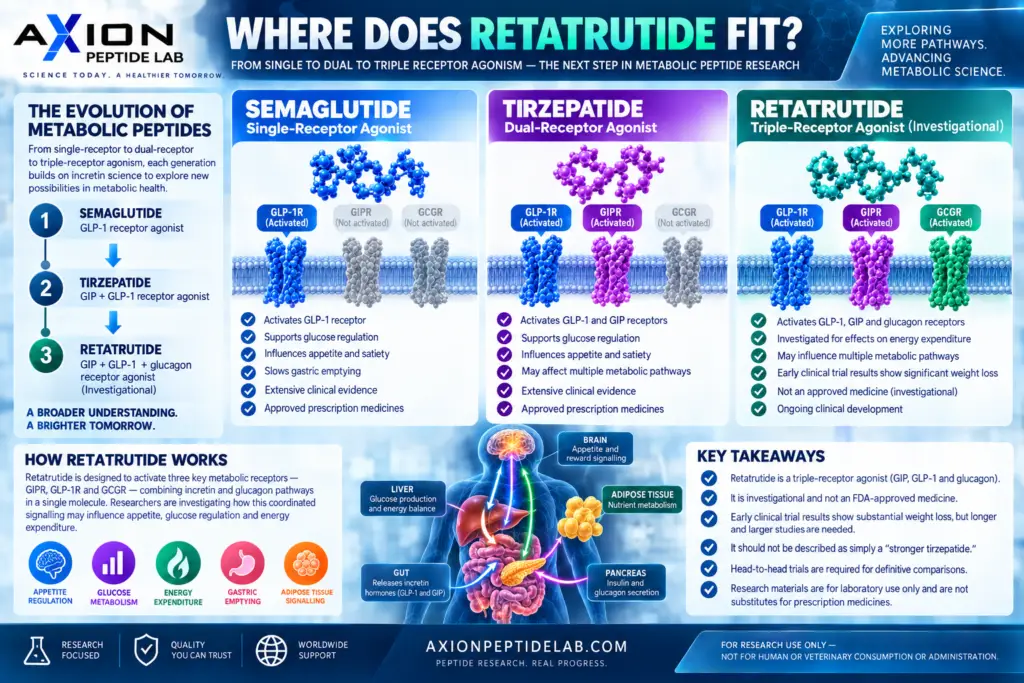
After comparing semaglutide vs tirzepatide, the next major compound in metabolic peptide research is retatrutide. It represents a further development in multi-receptor agonist research because it is designed to activate three metabolic receptor systems rather than one or two.
The progression can be simplified as:
Semaglutide → GLP-1R
Tirzepatide → GIPR + GLP-1R
Retatrutide → GIPR + GLP-1R + GCGR
This makes retatrutide a triple-receptor agonist, with activity at the glucose-dependent insulinotropic polypeptide receptor (GIPR), glucagon-like peptide-1 receptor (GLP-1R) and glucagon receptor (GCGR).
However, there is an essential regulatory distinction: retatrutide remains an investigational drug candidate. It should not be presented as an approved medicine or as simply a newer version of semaglutide or tirzepatide.
What Is Retatrutide?
Retatrutide, also known by the development identifier LY3437943, is an investigational peptide-based compound developed to combine agonist activity at three receptors involved in metabolic regulation.
Those receptors are:
GIPR — glucose-dependent insulinotropic polypeptide receptor
GLP-1R — glucagon-like peptide-1 receptor
GCGR — glucagon receptor
Because it interacts with all three, retatrutide is frequently described in scientific literature as a GIP/GLP-1/glucagon receptor triple agonist.
This distinguishes it from semaglutide and tirzepatide at the receptor level.
The comparison can be visualised as:
| Compound | GLP-1R | GIPR | GCGR | Receptor Strategy |
| Semaglutide | Yes | No | No | Single |
| Tirzepatide | Yes | Yes | No | Dual |
| Retatrutide | Yes | Yes | Yes | Triple |
The presence of three receptor targets does not automatically mean that retatrutide is “three times stronger” or inherently superior. Receptor pharmacology is considerably more complex than simply counting the number of receptors activated.
How Does Retatrutide Work?
Retatrutide combines three signalling pathways within one molecule.
Its proposed pharmacological strategy can be represented as:
GIP receptor activity
+
GLP-1 receptor activity
+
Glucagon receptor activity
↓
Integrated metabolic signalling
The GLP-1 and GIP components connect retatrutide to the incretin pathways discussed earlier in this article.
The additional glucagon receptor component is what particularly distinguishes retatrutide from tirzepatide.
Glucagon is a peptide hormone involved in glucose and energy metabolism. Historically, glucagon receptor activation might appear counterintuitive in a compound being investigated for obesity because glucagon can increase hepatic glucose production.
However, metabolic research has investigated whether carefully balanced glucagon receptor activity combined with incretin receptor agonism may influence energy expenditure, substrate metabolism and other metabolic processes while GLP-1 and GIP signalling contribute complementary effects.
The objective is therefore not simply to maximize activation of every receptor. Researchers are investigating how the balance of activity across GIPR, GLP-1R and GCGR influences the overall pharmacological response.
What Does Clinical Research Show About Retatrutide?
Retatrutide attracted substantial scientific attention following results from a phase 2 obesity trial published in the New England Journal of Medicine in 2023.
The randomized, double-blind, placebo-controlled study included 338 adults with obesity, or overweight with at least one weight-related condition, without diabetes.
Participants were assigned to several retatrutide dose groups or placebo and followed for 48 weeks.
At the highest studied maintenance dose, the trial reported a mean body-weight reduction of approximately 24.2% at 48 weeks.
The study also reported that the weight-loss trajectory had not clearly plateaued by the end of the 48-week treatment period.
These findings generated considerable interest in triple-receptor agonism as a potential direction for future obesity pharmacotherapy.
However, phase 2 results do not establish final clinical effectiveness or regulatory approval.
Larger and longer phase 3 trials are required to characterize benefits, risks and outcomes across broader populations.
Tirzepatide vs Retatrutide: What’s the Difference?
The primary mechanistic difference is the additional glucagon receptor activity of retatrutide.
Tirzepatide
GIPR + GLP-1R
↓
Dual agonist
Retatrutide
GIPR + GLP-1R + GCGR
↓
Triple agonist
Both compounds therefore interact with GIP and GLP-1 receptors.
Retatrutide additionally activates the glucagon receptor.
That extra receptor changes the pharmacological strategy and makes retatrutide scientifically distinct from tirzepatide.
It is inaccurate to describe retatrutide simply as “stronger tirzepatide.” They are separate molecules with different receptor profiles and clinical-development programmes.
Their regulatory status also differs substantially.
Licensed medicines containing tirzepatide are already available for defined indications in multiple jurisdictions, while retatrutide remains under clinical investigation.
Semaglutide vs Retatrutide: What’s the Difference?
The receptor distinction is even greater when comparing semaglutide with retatrutide.
Semaglutide primarily targets:
GLP-1R
Retatrutide targets:
GIPR + GLP-1R + GCGR
Semaglutide therefore represents a selective GLP-1 receptor strategy, while retatrutide investigates simultaneous activity across three metabolic receptors.
The compounds also differ in the maturity of their evidence bases.
Semaglutide has undergone extensive phase 3 development and is an active ingredient in approved prescription medicines.
Retatrutide remains investigational.
For this reason, comparing clinical-trial percentages without acknowledging different development stages would provide an incomplete picture.
Can Retatrutide Be Compared Directly With Semaglutide or Tirzepatide?
Comparisons should be made cautiously.
Results from separate trials are not equivalent to head-to-head evidence.
For example, the approximately 24.2% mean weight reduction reported at 48 weeks in one high-dose group of the retatrutide phase 2 trial should not simply be compared with the STEP, SURMOUNT-1 or SURMOUNT-5 percentages to declare retatrutide superior.
Those studies involved different:
- participants;
- treatment durations;
- study phases;
- protocols;
- doses;
- comparators;
- eligibility criteria; and
- statistical analyses.
The lesson from the earlier semaglutide vs tirzepatide discussion applies here as well:
Cross-trial comparisons generate hypotheses; randomized head-to-head trials provide stronger comparative evidence.
Until suitable direct comparative evidence is available, claims that retatrutide has been clinically proven superior to semaglutide or tirzepatide should be avoided.
What Side Effects Have Been Reported in Retatrutide Research?
In the phase 2 obesity study, the most commonly reported adverse events were gastrointestinal.
These occurred primarily during dose escalation and were generally mild to moderate in severity.
Researchers also observed dose-dependent increases in heart rate that peaked during the study and subsequently declined.
These findings form part of the developing safety profile, but retatrutide’s safety evidence is not yet as mature as that available for established medicines with larger phase 3 and post-marketing datasets.
This is another reason investigational compounds should not be discussed as though their safety profiles are fully established.
Is Retatrutide Approved?
This distinction is critical.
Retatrutide is investigational and is not currently an FDA-approved medicine.
It should therefore not be described as an approved weight-loss medicine, prescribed therapy or established treatment.
The FDA has specifically warned about unapproved GLP-1-related products and states that retatrutide cannot be used in compounding under US federal law. The agency also notes that retatrutide is not an active ingredient in any FDA-approved drug and has not been found safe and effective for any condition.
Its appearance in clinical research does not change that regulatory status.
Why Research Products Must Be Distinguished From Clinical Retatrutide
The term “retatrutide” may appear in several very different contexts:
Clinical-trial investigational drug
versus
Laboratory research material
These are not automatically equivalent products.
Clinical trials use investigational pharmaceutical products manufactured and controlled according to specific clinical-development requirements.
Laboratory materials have a different intended purpose and should not be represented as equivalent to the investigational pharmaceutical formulation used in human trials.
For legitimate researchers, retatrutide-related laboratory work may involve areas such as:
- receptor-binding research;
- GIPR signalling;
- GLP-1R signalling;
- glucagon receptor signalling;
- multi-receptor pharmacology;
- peptide chemistry;
- analytical characterization; and
- comparative metabolic pathway research.
Axion Peptide Lab research materials are intended exclusively for legitimate laboratory, analytical and scientific investigation.
For Research Use Only – Not for human or veterinary consumption or administration.
Why Retatrutide Matters to the Future of Metabolic Peptide Research
Retatrutide illustrates how metabolic research has progressed from targeting individual receptors toward investigating coordinated signalling across several receptor systems.
The evolution can be summarized as:
GLP-1
↓
Single GLP-1 receptor agonism
Semaglutide
↓
Dual GIP/GLP-1 receptor agonism
Tirzepatide
↓
Triple GIP/GLP-1/glucagon receptor agonism
Retatrutide
This progression has expanded scientific interest beyond conventional peptides for weight loss toward a broader question: how can multiple metabolic signalling pathways interact within a single pharmacological strategy?
The answer is still developing.
Semaglutide and tirzepatide have extensive phase 3 clinical evidence and approved pharmaceutical products, whereas retatrutide remains an investigational compound undergoing clinical development.
That regulatory and evidentiary distinction is essential.
With the mechanisms of all three compounds established, the next section can compare semaglutide vs tirzepatide vs retatrutide side by side, including their receptor targets, evidence bases and regulatory status.
Semaglutide vs Tirzepatide vs Retatrutide
The comparison between semaglutide vs tirzepatide vs retatrutide illustrates how metabolic peptide research has progressed from selective GLP-1 receptor agonism toward dual- and triple-receptor strategies.
Although all three compounds interact with the GLP-1 receptor, their overall receptor profiles are different.
Semaglutide primarily activates GLP-1R. Tirzepatide combines GLP-1R and GIPR agonism. Retatrutide extends this concept by combining activity at GLP-1R, GIPR and the glucagon receptor (GCGR).
The progression can be visualised simply:
Semaglutide → GLP-1R
Tirzepatide → GIPR + GLP-1R
Retatrutide → GIPR + GLP-1R + GCGR
These differences have made the three compounds important examples of how peptides for weight loss and metabolic research have evolved. However, receptor count alone cannot determine which compound is more effective, safer or more appropriate.
Semaglutide vs Tirzepatide vs Retatrutide at a Glance
| Comparison | Semaglutide | Tirzepatide | Retatrutide |
| GLP-1 receptor | Yes | Yes | Yes |
| GIP receptor | No | Yes | Yes |
| Glucagon receptor | No | No | Yes |
| Receptor strategy | Single | Dual | Triple |
| Main receptor profile | GLP-1R | GIPR + GLP-1R | GIPR + GLP-1R + GCGR |
| Major obesity research programme | STEP | SURMOUNT | TRIUMPH |
| Phase 3 evidence | Extensive | Extensive | Still developing |
| Approved medicines containing compound | Yes | Yes | No |
| Investigational status | No* | No* | Yes |
| Direct semaglutide vs tirzepatide evidence | Yes | Yes | Not applicable |
| Direct three-way evidence | No | No | No |
*Semaglutide and tirzepatide themselves are active ingredients in approved medicines for specific indications and formulations. This does not mean every product claiming to contain either compound is an approved medicine.
Semaglutide: The Single-Receptor Approach
Semaglutide primarily represents the GLP-1 receptor agonist approach.
Its basic receptor profile is:
GLP-1R ✓
GIPR ✗
GCGR ✗
GLP-1 receptor signalling is associated with glucose-dependent insulin secretion, appetite and satiety pathways, glucagon regulation and gastrointestinal function.
Semaglutide has a mature clinical evidence base. Major programmes such as SUSTAIN and STEP have investigated the compound across type 2 diabetes, obesity and related metabolic outcomes.
Specific pharmaceutical products containing semaglutide have received regulatory approval for defined indications.
This makes semaglutide fundamentally different from experimental compounds that remain in earlier stages of clinical development.
Tirzepatide: The Dual-Receptor Approach
Tirzepatide represents the next major receptor strategy in this comparison.
Its receptor profile is:
GLP-1R ✓
GIPR ✓
GCGR ✗
Instead of targeting GLP-1R alone, tirzepatide combines GIP and GLP-1 receptor agonism within one molecule.
Its SURPASS and SURMOUNT programmes have generated extensive evidence across diabetes, obesity and metabolic research.
Most importantly for the semaglutide vs tirzepatide comparison, the SURMOUNT-5 trial directly compared the two compounds in adults with obesity without type 2 diabetes.
At 72 weeks, mean body-weight change in that trial was:
Tirzepatide: −20.2%
Semaglutide: −13.7%
This is stronger comparative evidence than placing results from unrelated STEP and SURMOUNT studies side by side because both medicines were investigated within the same randomized trial.
However, those results remain averages from a specific study population and do not mean tirzepatide is universally preferable for every individual.
Retatrutide: The Triple-Receptor Approach
Retatrutide represents a further expansion of multi-receptor metabolic research.
Its receptor profile is:
GLP-1R ✓
GIPR ✓
GCGR ✓
The addition of glucagon receptor agonism distinguishes retatrutide from tirzepatide.
Retatrutide is therefore often described scientifically as a GIP/GLP-1/glucagon receptor triple agonist.
The compound has produced notable results in clinical research. In a phase 2 obesity trial published in the New England Journal of Medicine, the highest studied maintenance-dose group had a mean body-weight reduction of approximately 24.2% at 48 weeks.
But that figure must be interpreted carefully.
Retatrutide’s trial was not a head-to-head comparison with either semaglutide or tirzepatide.
It would therefore be scientifically inappropriate to compare:
24.2% retatrutide
directly against
20.2% tirzepatide
or
13.7% semaglutide
and declare a winner.
Those percentages came from different studies conducted under different conditions.
Why Cross-Trial Percentages Can Be Misleading
Clinical-trial results depend on far more than the compound being studied.
Important variables include:
- participant characteristics;
- baseline body weight;
- presence or absence of diabetes;
- treatment duration;
- dose selection;
- dose escalation;
- lifestyle interventions;
- inclusion and exclusion criteria;
- trial phase;
- endpoints;
- adherence; and
- statistical methodology.
For example, retatrutide’s phase 2 obesity study lasted 48 weeks, whereas SURMOUNT-5 evaluated semaglutide and tirzepatide over 72 weeks.
Simply ranking the headline percentages would ignore these methodological differences.
The evidence hierarchy is more useful:
Separate clinical trials
↓
Useful for understanding each compound individually
Randomized head-to-head trials
↓
Stronger evidence for direct comparison
This is why SURMOUNT-5 can directly inform the tirzepatide-versus-semaglutide question, while a definitive three-way comparison involving retatrutide is not currently available.
Does More Receptor Activity Mean Better Results?
Not necessarily.
It can be tempting to construct a simple hierarchy:
One receptor < Two receptors < Three receptors
Biology does not work that simply.
The number of receptors a molecule activates is only one aspect of its pharmacology.
Researchers must also consider factors such as:
- receptor potency;
- receptor selectivity;
- signalling bias;
- exposure;
- pharmacokinetics;
- molecular structure;
- tissue-specific effects;
- interaction among pathways; and
- safety.
Even compounds acting on the same receptor can have different pharmacological characteristics.
For this reason, describing retatrutide as “three times stronger than semaglutide” or simply a “stronger tirzepatide” would be scientifically inaccurate.
The triple-receptor design represents a different pharmacological strategy, not a mathematical measure of potency.
How Their Mechanisms Differ
A simplified comparison shows how metabolic signalling expands across the three compounds.
SEMAGLUTIDE
GLP-1R
↓
Glucose-dependent metabolic signalling
Appetite and satiety pathways
Gastrointestinal effects
TIRZEPATIDE
GIPR + GLP-1R
↓
Dual incretin signalling
Glucose-dependent metabolic effects
Appetite and satiety pathways
RETATRUTIDE
GIPR + GLP-1R + GCGR
↓
Dual incretin + glucagon receptor signalling
Metabolic pathway integration
Investigational effects involving energy metabolism
This framework is useful for understanding receptor pharmacology, but it should not replace clinical evidence.
How Does the Clinical Evidence Compare?
The maturity of the evidence differs considerably.
Semaglutide has extensive phase 3 and post-approval evidence across several clinical indications.
Tirzepatide also has extensive phase 3 evidence, with approved medicines now used for defined clinical indications.
Retatrutide, by comparison, remains in clinical development.
This means researchers know considerably more about the longer-term clinical use and broader safety profiles of approved semaglutide and tirzepatide medicines than they currently know about retatrutide.
Early or mid-stage clinical results can be promising without guaranteeing later regulatory approval.
Regulatory Status Is a Major Difference
The regulatory distinction between these compounds is as important as their receptor differences.
Specific pharmaceutical medicines containing semaglutide have regulatory approval for defined indications.
Specific pharmaceutical medicines containing tirzepatide also have regulatory approval for defined indications.
Retatrutide remains investigational.
It has not been established as an FDA-approved medicine, and clinical investigation should not be confused with regulatory authorisation.
The categories therefore look like this:
SEMAGLUTIDE
→ Active ingredient in approved medicines
TIRZEPATIDE
→ Active ingredient in approved medicines
RETATRUTIDE
→ Investigational compound
This distinction should be clearly maintained throughout educational content discussing weight loss peptides.
Research Materials Are a Separate Category
Another distinction is necessary when these compounds appear in research catalogues.
A laboratory material labelled semaglutide, tirzepatide or retatrutide is not automatically equivalent to the pharmaceutical material used in a clinical trial or an approved medicine.
Approved medicines are manufactured under pharmaceutical regulatory frameworks and reviewed for specific indications, formulations and quality standards.
Research materials serve a different purpose.
Legitimate laboratory research may examine areas including:
- receptor-binding characteristics;
- GLP-1 receptor signalling;
- GIP receptor signalling;
- glucagon receptor signalling;
- peptide structure and chemistry;
- analytical characterisation;
- multi-receptor pharmacology; and
- comparative metabolic pathway research.
For qualified researchers, Axion Peptide Lab provides research materials intended for controlled laboratory, analytical and scientific investigation. Product-specific documentation should be reviewed when assessing suitability for a particular research workflow.
For Research Use Only – Not for human or veterinary consumption or administration.
Semaglutide vs Tirzepatide vs Retatrutide: The Key Takeaway
The clearest distinction between the three compounds is their receptor strategy:
Semaglutide = GLP-1
Tirzepatide = GIP + GLP-1
Retatrutide = GIP + GLP-1 + glucagon
But this does not create a simple ranking from weakest to strongest.
Semaglutide and tirzepatide have extensive clinical evidence and are active ingredients in approved prescription medicines for specific indications. Retatrutide represents an important emerging area of triple-receptor research but remains investigational.
The most scientifically responsible comparison therefore considers mechanism, clinical evidence, safety and regulatory status together, rather than judging compounds solely by receptor count or headline weight-change percentages.
These three molecules represent only part of metabolic peptide research. Other compounds—including cagrilintide, AOD-9604 and emerging amylin-related or multi-receptor candidates—have also attracted research interest and will be examined in the next section.
Other Peptide-Based Compounds Discussed in Weight-Loss Research
Although semaglutide vs tirzepatide dominates many discussions about metabolic medicines, research into body-weight regulation extends far beyond GLP-1 and GIP receptor agonists.
Scientists are investigating several additional hormonal pathways and peptide-based compounds involved in appetite, satiety, energy metabolism and nutrient signalling. These include amylin analogues, cagrilintide, AOD-9604 and emerging multi-receptor compounds.
However, these substances do not all have the same quality or quantity of evidence.
Some are being evaluated in advanced clinical programmes, while others have much more limited human evidence. This distinction is particularly important when discussing peptides for weight loss, because grouping every research compound together can create the false impression that they are equally established treatments.
Cagrilintide
Cagrilintide is a long-acting analogue of amylin, a peptide hormone normally co-secreted with insulin by pancreatic beta cells.
Amylin participates in several physiological processes related to nutrient intake and energy regulation, including satiety signalling and gastric function.
Cagrilintide was designed to provide prolonged activity at amylin-related receptors, making it mechanistically different from semaglutide and tirzepatide.
A simplified comparison is:
Semaglutide → GLP-1 pathway
Tirzepatide → GIP + GLP-1 pathways
Cagrilintide → Amylin-related pathway
This difference has generated interest in whether amylin and GLP-1 pathways can be targeted together rather than relying on incretin signalling alone.
Why Are Researchers Studying Cagrilintide With Semaglutide?
One of the most prominent examples of this research strategy is the combination commonly known as CagriSema, which combines cagrilintide with semaglutide.
The scientific rationale is that the two compounds engage different but potentially complementary pathways:
Cagrilintide → Amylin signalling
Semaglutide → GLP-1 receptor signalling
↓
Combined metabolic pathway research
This approach illustrates an important shift in metabolic science.
Researchers are no longer investigating only whether a single receptor can influence body-weight regulation. Increasing attention is being given to whether complementary hormonal pathways can be combined within a therapeutic strategy.
However, evidence relating to a specific clinical-development combination should not automatically be transferred to separately sourced laboratory materials containing the same named compounds.
Formulation, manufacturing, study design and regulatory controls matter.
What Is AOD-9604?
AOD-9604 is another compound frequently mentioned in online discussions surrounding weight loss peptides, but its evidence base is fundamentally different from those of semaglutide and tirzepatide.
AOD-9604 was developed from a fragment related to the C-terminal region of human growth hormone.
It was investigated with the goal of examining metabolic effects associated with growth-hormone-derived peptide sequences without reproducing the full biological activity of growth hormone.
This makes its research background substantially different from GLP-1, GIP or amylin-based compounds.
AOD-9604 should therefore not be described as a GLP-1 agonist.
It does not belong in the same receptor category as semaglutide or tirzepatide.
What Does the Evidence Show for AOD-9604?
This is an area where careful language is particularly important.
AOD-9604 has been investigated in preclinical and human research, but its evidence for clinically meaningful weight management is considerably less established than the large phase 3 programmes supporting approved semaglutide and tirzepatide medicines.
Earlier research explored whether the compound could influence fat metabolism and body weight. However, the development programme did not establish the kind of robust clinical evidence associated with modern approved obesity medicines.
For this reason, statements such as:
“AOD-9604 is proven to cause weight loss”
or
“AOD-9604 is equivalent to semaglutide”
would overstate the evidence.
A more scientifically responsible description is that AOD-9604 is a research compound historically investigated for metabolic effects, with important limitations in the available clinical evidence.
Amylin-Related Research
Amylin represents a particularly important pathway beyond GLP-1 and GIP.
It is a naturally occurring peptide hormone involved in nutrient-related signalling. Its biological actions include effects associated with satiety and gastric function.
The amylin pathway is not entirely new to medicine. Pramlintide, an amylin analogue, has long provided evidence that amylin receptor pharmacology can be therapeutically relevant in specific clinical settings.
More recent metabolic research has investigated longer-acting amylin analogues and combinations involving other metabolic pathways.
This creates another research progression:
GLP-1 signalling
↓
GIP + GLP-1 signalling
↓
GLP-1 + amylin signalling
↓
Broader multi-pathway metabolic research
Importantly, these strategies are not necessarily replacements for one another. They represent different approaches to understanding and influencing complex metabolic signalling networks.
Why Combine Different Metabolic Pathways?
Body-weight regulation does not depend on a single receptor.
It involves communication among the:
- gastrointestinal tract;
- brain;
- pancreas;
- liver;
- adipose tissue;
- endocrine system; and
- nervous system.
This complexity provides the scientific rationale for investigating combinations of metabolic pathways.
For example:
GLP-1R may contribute to incretin, appetite and gastrointestinal signalling.
GIPR contributes another incretin-related pathway.
GCGR introduces glucagon-related metabolic signalling.
Amylin receptors provide another pathway associated with satiety and nutrient regulation.
Researchers can therefore investigate whether coordinated receptor activity produces effects different from those obtained by targeting a single pathway.
Emerging Multi-Receptor Compounds
Retatrutide is one prominent example of multi-receptor research, but it is not the end of this scientific direction.
Researchers continue to investigate compounds designed around combinations such as:
GLP-1 + GIP
GLP-1 + glucagon
GLP-1 + amylin
GIP + GLP-1 + glucagon
and other emerging metabolic targets.
These approaches are sometimes described using terms such as dual agonists, co-agonists or multi-agonists.
The objective is not simply to activate as many receptors as possible.
Researchers must determine the appropriate balance of receptor activity while evaluating:
- efficacy;
- tolerability;
- pharmacokinetics;
- receptor selectivity;
- metabolic effects;
- cardiovascular outcomes;
- long-term safety; and
- durability of response.
A compound with more receptor targets is not automatically superior.
Established Evidence vs Emerging Research
One useful way to understand the field is by separating compounds according to the maturity of their evidence rather than grouping everything under “weight loss peptides.”
| Compound/Approach | Primary Research Pathway | Evidence Context |
| Semaglutide | GLP-1R | Extensive clinical evidence; approved medicines exist |
| Tirzepatide | GIPR + GLP-1R | Extensive clinical evidence; approved medicines exist |
| Retatrutide | GIPR + GLP-1R + GCGR | Investigational clinical development |
| Cagrilintide | Amylin-related | Clinical development |
| AOD-9604 | GH-fragment-related research | Limited/less established clinical evidence |
| Emerging multi-agonists | Multiple metabolic receptors | Varies from preclinical to clinical research |
This distinction prevents early-stage findings from being presented with the same certainty as evidence from large randomized phase 3 trials and regulatory reviews.
Why Regulatory Status Matters
A compound appearing in a scientific paper or clinical trial does not automatically make it an approved medicine.
The categories must remain distinct:
Approved medicine
→ Regulatory review completed for specific product and indication
Investigational drug
→ Being evaluated in clinical development
Preclinical research compound
→ Primarily investigated in laboratory or animal models
Research-use material
→ Intended for laboratory and analytical investigation rather than clinical use
These categories are particularly important for suppliers and researchers working with metabolic peptides.
Laboratory Research and Axion Peptide Lab
For legitimate laboratory researchers, emerging metabolic compounds can support investigation into areas such as:
- receptor pharmacology;
- peptide structure;
- metabolic signalling;
- analytical characterisation;
- comparative peptide research;
- multi-receptor mechanisms; and
- biochemical pathway analysis.
Where relevant research materials are available, Axion Peptide Lab provides products intended for controlled scientific, analytical and laboratory investigation.
The presence of a compound in the Axion research catalogue should not be interpreted as a claim that it is an approved medicine, clinically effective weight-loss treatment or appropriate for self-administration.
For Research Use Only – Not for human or veterinary consumption or administration.
The Bigger Picture in Weight-Loss Peptide Research
Modern metabolic research has moved beyond asking whether one individual hormone can influence body-weight regulation.
The field increasingly examines networks of interacting hormonal pathways.
Semaglutide demonstrates the importance of GLP-1 receptor signalling.
Tirzepatide adds GIP receptor agonism.
Retatrutide investigates the addition of glucagon receptor activity.
Cagrilintide introduces another strategy through amylin-related signalling.
AOD-9604 represents a substantially different and less clinically established research pathway.
Together, these examples demonstrate why the phrase peptides for weight loss describes a broad research area rather than a single class of interchangeable compounds.
Understanding these differences also leads to one of the most important distinctions in the entire article: a laboratory research peptide and a licensed prescription medicine are not the same thing, even when they share the name of an active compound.
Research Peptides vs Prescription Medicines
One of the most important distinctions in any discussion about semaglutide vs tirzepatide or peptides for weight loss is the difference between a licensed prescription medicine and a research-use-only material.
The same compound name can sometimes appear in pharmaceutical literature, clinical trials and laboratory research catalogues. That does not mean the products are interchangeable.
A prescription medicine has been developed, manufactured, evaluated and regulated for specific clinical uses. A research peptide or research compound is supplied for scientific, analytical or laboratory investigation and should not be represented as an approved medicine simply because it shares the name of an active pharmaceutical ingredient.
This distinction is especially relevant to semaglutide and tirzepatide because approved medicines containing these active ingredients exist, while research materials bearing the same compound names may also be sold for laboratory investigation.
What Is a Licensed Prescription Medicine?
A licensed or authorised prescription medicine is a specific pharmaceutical product that has undergone review by the relevant medicines regulator.
In the United States, this role is performed by the Food and Drug Administration (FDA).
In the United Kingdom, medicines are regulated by the Medicines and Healthcare products Regulatory Agency (MHRA).
Regulatory review considers evidence relating to areas such as:
- pharmaceutical quality;
- manufacturing controls;
- safety;
- effectiveness;
- clinical-trial evidence;
- product labelling;
- formulation; and
- the proposed indication.
Approval therefore applies to a specific pharmaceutical product, not simply to a molecular name.
For example, the fact that semaglutide is the active ingredient in an approved medicine does not mean every vial, powder or solution labelled “semaglutide” is FDA-approved or MHRA-authorised.
The same principle applies to tirzepatide.
What Is a Research-Use-Only Material?
A research-use-only material is supplied for scientific investigation rather than clinical treatment.
Depending on the product and research objective, laboratory applications may include:
- analytical characterisation;
- receptor-binding research;
- peptide chemistry;
- molecular identification;
- assay development;
- biochemical research;
- receptor pharmacology;
- metabolic signalling studies; and
- comparative laboratory experiments.
The intended user and purpose are therefore fundamentally different from those of a prescription medicine.
A research-use label should not be interpreted as a different route for obtaining a medicine for personal use.
Research Use Only means research use only.
It does not mean “unlicensed medicine for self-administration.”
Why Research Peptides and Prescription Medicines Are Not Interchangeable
Two products can state the same compound name while differing substantially in characteristics that matter scientifically and clinically.
These can include:
- manufacturing process;
- formulation;
- excipients;
- concentration;
- analytical specifications;
- purity profile;
- sterility controls;
- packaging;
- stability data;
- storage validation;
- regulatory oversight; and
- intended use.
This is why clinical-trial findings involving an approved or investigational pharmaceutical formulation cannot automatically be transferred to an independently sourced research material.
For example, the results from the STEP programme apply to the pharmaceutical semaglutide formulations evaluated in those studies.
Likewise, SURMOUNT results relate to the tirzepatide pharmaceutical products used under controlled clinical-trial conditions.
Those results should not be used to imply that an unrelated laboratory product will produce the same clinical outcome.
Research Peptides vs Prescription Medicines at a Glance
| Feature | Licensed Prescription Medicine | Research-Use Material |
| Intended purpose | Approved clinical use | Laboratory/scientific research |
| Regulatory review for clinical use | Yes, for defined product and indication | No |
| Human administration | According to authorised medical use | Not intended |
| Clinical efficacy claims | Supported where authorised | Should not be made |
| Clinical dosing instructions | Defined in approved prescribing information | Not appropriate |
| Pharmaceutical formulation | Defined and regulated | Product-specific |
| Manufacturing requirements | Pharmaceutical regulatory framework | Research-material framework |
| Medical prescribing | May require prescription | Not a medicine |
| Clinical-trial results transferable? | Relevant to studied/approved product | Not automatically |
| Research labelling | Not primary purpose | Essential |
| Intended purchaser | Patient via appropriate healthcare system | Qualified researcher/laboratory |
The table demonstrates why a research product should never be promoted simply as a cheaper or easier alternative to a prescription medicine.
Approved Active Ingredient Does Not Mean Approved Research Product
This point is particularly important for SEO content.
Search engines may contain phrases such as:
“buy semaglutide peptide”
“buy tirzepatide peptide”
or
“research peptides for weight loss.”
Commercial search intent does not change regulatory status.
If a laboratory supplier lists semaglutide for research purposes, the product should be presented according to its actual intended use rather than being marketed using claims associated with an approved pharmaceutical medicine.
A responsible description would focus on areas such as:
GLP-1 receptor research
analytical characterisation
peptide chemistry
metabolic pathway research
rather than promising human weight loss or providing administration instructions.
Semaglutide: Medicine vs Research Material
Semaglutide provides a useful example.
A licensed pharmaceutical product containing semaglutide may be authorised for a particular clinical indication.
A separate laboratory product labelled semaglutide may instead be intended for:
- GLP-1 receptor studies;
- analytical testing;
- biochemical assays;
- molecular research; or
- comparative peptide investigation.
These are different product categories.
The laboratory product does not acquire the regulatory status of the prescription medicine merely because both reference semaglutide.
Tirzepatide: Medicine vs Research Material
The same distinction applies to tirzepatide.
Approved pharmaceutical products containing tirzepatide have undergone regulatory review for specified uses.
A laboratory tirzepatide material has a different intended purpose.
Possible research areas can include:
- GIP receptor signalling;
- GLP-1 receptor signalling;
- dual-receptor pharmacology;
- peptide chemistry;
- receptor-binding experiments; and
- analytical characterisation.
Clinical outcomes reported in SURMOUNT or SURPASS should therefore not be presented as promised outcomes from a research material.
What About Retatrutide?
Retatrutide makes the distinction even more important.
Unlike semaglutide and tirzepatide, retatrutide remains investigational.
Clinical trials are evaluating an investigational pharmaceutical product under controlled research conditions.
A laboratory research material carrying the name retatrutide is not automatically the same product used in those clinical trials.
More importantly, the existence of ongoing clinical trials does not make retatrutide an approved medicine.
The FDA has specifically warned consumers about unapproved GLP-1-related products and notes that retatrutide has not been found safe and effective for any condition.
Therefore, terms such as “retatrutide treatment” or “approved retatrutide weight-loss medicine” should not be used to describe research materials.
Why “For Research Use Only” Matters
The phrase For Research Use Only is not merely decorative website text.
It communicates the intended category and purpose of a product.
Research suppliers should ensure that the surrounding content remains consistent with that designation.
For example, a product page should not state:
“For Research Use Only”
and then provide instructions explaining how a consumer should inject the compound for weight loss.
Those messages directly contradict one another.
Research-oriented content should instead focus on scientific characteristics, relevant pathways, available analytical documentation and legitimate laboratory applications.
Research Labelling and Product Transparency
Researchers need accurate information about the material they are evaluating.
Depending on what has actually been verified for a specific product or batch, useful information may include:
- compound identity;
- stated quantity;
- product format;
- batch or lot information;
- analytical documentation;
- handling information;
- research-use designation; and
- supplier contact details.
Claims should correspond to available evidence.
For example, statements such as “99% purity,” “sterile,” “third-party tested” or “pharmaceutical grade” should not be applied automatically across an entire research catalogue unless appropriate product- or batch-specific documentation supports them.
Transparency is more useful to researchers than unsupported quality language.
Why Clinical Research Still Matters to Laboratory Researchers
Separating research materials from medicines does not mean clinical literature is irrelevant to laboratory science.
Clinical studies can help researchers understand:
- receptor targets;
- pharmacological hypotheses;
- observed biological effects;
- safety signals;
- areas requiring further investigation; and
- questions for future experimental work.
The important distinction is how the evidence is used.
A clinical study may provide scientific context for why a receptor pathway is interesting.
It should not be used as proof that an unrelated research product is safe or effective for human administration.
Research Peptides at Axion Peptide Lab
Axion Peptide Lab supplies materials intended for legitimate laboratory, analytical and scientific research.
For metabolic peptide research, this may include materials relevant to investigation of pathways such as:
GLP-1 signalling
GIP signalling
glucagon receptor signalling
amylin-related research
and broader multi-receptor metabolic research.
Researchers should evaluate the specifications and available documentation for the individual product or batch relevant to their experimental requirements.
Axion research products are not represented as substitutes for FDA-approved, MHRA-authorised or otherwise licensed prescription medicines.
For Research Use Only – Not for human or veterinary consumption or administration.
The Key Difference
The simplest way to remember the distinction is:
Prescription medicine
→ Developed and regulated for specific clinical use
Research material
→ Supplied for controlled scientific and laboratory investigation
The name of a compound does not erase that distinction.
Semaglutide and tirzepatide demonstrate this particularly clearly because licensed medicines containing these compounds exist alongside broader scientific research into the molecules and their receptors.
Retatrutide demonstrates the other side of the issue: a compound can be undergoing clinical investigation without yet being an approved medicine.
Keeping these categories separate protects scientific accuracy and makes information about semaglutide vs tirzepatide more useful to both researchers and general readers.
The next sections examine how these distinctions apply specifically in the United States and United Kingdom, where FDA, MHRA, NICE and NHS requirements shape how semaglutide, tirzepatide and research products should be described.
Semaglutide vs Tirzepatide in the USA
For readers in the United States, understanding semaglutide vs tirzepatide requires more than comparing clinical-trial results. The regulatory status of the specific product is equally important.
The U.S. Food and Drug Administration (FDA) regulates prescription medicines and determines whether specific pharmaceutical products can be marketed for particular indications.
Both semaglutide and tirzepatide are active ingredients in FDA-approved medicines. However, this does not mean every product containing or claiming to contain semaglutide or tirzepatide is FDA-approved.
This distinction has become increasingly important as interest in peptides for weight loss has expanded across the United States.
FDA-Approved Semaglutide Products
Semaglutide is the active ingredient in several FDA-approved prescription medicines, but their authorised uses are not identical.
Examples include:
Wegovy — semaglutide
Wegovy has FDA-approved indications involving chronic weight management in defined populations. The FDA has also approved specific cardiovascular-risk-reduction indications for Wegovy.
In March 2026, the FDA additionally approved a higher-dose semaglutide injection, Wegovy HD 7.2 mg, for weight loss and long-term maintenance of weight reduction in certain adults.
Ozempic — semaglutide
Ozempic is also an FDA-approved semaglutide medicine, but its authorised indications should not simply be described as identical to Wegovy’s.
Rybelsus — oral semaglutide
Rybelsus provides another example of why the active ingredient alone does not determine the regulatory status or approved indication of a product.
The important principle is:
Same active ingredient ≠ same pharmaceutical product or indication
Each FDA-approved medicine has its own prescribing information, formulation, indications and regulatory history.
FDA-Approved Tirzepatide Products
Tirzepatide is similarly used in more than one FDA-approved pharmaceutical product.
Mounjaro — tirzepatide
Mounjaro was approved for use in adults with type 2 diabetes within its FDA-authorised indication.
Zepbound — tirzepatide
The FDA approved Zepbound in November 2023 for chronic weight management in qualifying adults with obesity or overweight with at least one weight-related condition, alongside appropriate lifestyle intervention.
The FDA describes tirzepatide as activating both GIP and GLP-1 receptors, distinguishing its mechanism from selective GLP-1 receptor agonists such as semaglutide.
Therefore:
Semaglutide → GLP-1R
Tirzepatide → GIPR + GLP-1R
But the existence of approved medicines containing these compounds does not make independently manufactured products carrying the same compound names FDA-approved.
Active Ingredient vs FDA-Approved Product
This distinction is one of the most important regulatory concepts for readers researching semaglutide vs tirzepatide in the USA.
FDA approval applies to a particular drug product.
It does not operate as a blanket approval of every product containing the same molecular ingredient.
For example:
FDA-approved Wegovy containing semaglutide
is not equivalent to:
an independently sourced vial labelled “semaglutide.”
Likewise:
FDA-approved Zepbound containing tirzepatide
is not equivalent to:
an independently sourced research vial labelled “tirzepatide.”
Differences can involve formulation, manufacturing, quality controls, testing, packaging, stability and regulatory oversight.
What Are Unapproved GLP-1 Products?
The FDA distinguishes approved medicines from unapproved versions of GLP-1-related drugs.
According to current FDA guidance, unapproved semaglutide and tirzepatide products do not undergo the agency’s premarket review for:
- safety;
- effectiveness; and
- quality.
This does not mean every unapproved product is identical or carries exactly the same risks.
It means FDA approval and the associated premarket review cannot be assumed.
This is especially important when consumers encounter online products marketed using the same names as well-known pharmaceutical ingredients.
What About Compounded Semaglutide and Tirzepatide?
Compounded drugs represent another distinct category.
A compounded medicine is not the same as an FDA-approved medicine.
The FDA states that compounded drugs do not undergo FDA premarket review for safety, effectiveness or quality. The agency advises that compounded drugs should generally be used when a patient’s medical needs cannot be met by an FDA-approved drug.
FDA has also raised specific concerns about some compounded semaglutide and tirzepatide products, including adverse-event reports and product-quality issues.
Compounding should therefore not be described as equivalent to ordinary FDA approval.
Semaglutide Salt Forms Are Another Important Distinction
The FDA has also raised concerns about some compounded products using semaglutide sodium or semaglutide acetate.
These salt forms are different active ingredients from the semaglutide used in FDA-approved medicines.
According to the FDA, it does not have information demonstrating that these salt forms have the same chemical and pharmacological properties as the active ingredient used in approved semaglutide products.
This provides another example of why simply seeing the word “semaglutide” on a website is not sufficient to establish pharmaceutical equivalence.
What Is the US Status of Retatrutide?
Retatrutide is in a fundamentally different regulatory category.
Unlike semaglutide and tirzepatide:
Retatrutide is not an active ingredient in an FDA-approved medicine.
It remains an investigational compound.
The FDA currently states that retatrutide has not been found safe and effective for any condition and cannot be used in compounding under federal law.
The same current FDA guidance also identifies cagrilintide as a compound that cannot be used in compounding.
Therefore, clinical research involving retatrutide should not be interpreted as evidence that an FDA-approved retatrutide medicine already exists.
Research Use Only: An Important FDA Distinction
For research suppliers, one of the most important current US regulatory issues concerns products labelled:
“For Research Use Only”
or
“Not for Human Consumption.”
Those statements do not automatically protect a product from being regulated as a drug if the surrounding marketing demonstrates that it is actually intended for human use.
The FDA specifically warns that companies have marketed unapproved products containing substances including semaglutide, tirzepatide and retatrutide while labelling them as being for research purposes or not for human consumption.
According to the agency, problems arise where products are sold directly to consumers for human use or where marketing includes instructions or claims demonstrating an intended therapeutic or physiological use.
This distinction is especially important for peptide research websites.
A supplier cannot responsibly state:
“For Research Use Only”
and then market the same product as a human weight-loss treatment or provide consumers with dosing and administration protocols.
The overall presentation of the product matters.
Why Research Marketing Must Remain Research-Focused
A legitimate laboratory product page should remain consistent with its research designation.
Appropriate scientific topics may include:
- compound identity;
- molecular characteristics;
- receptor pharmacology;
- analytical research;
- biochemical pathways;
- laboratory applications;
- available batch documentation; and
- research-use restrictions.
By contrast, claims directing consumers to use a research product to lose weight, treat diabetes or reproduce clinical-trial outcomes can create a very different regulatory context.
This is particularly important in 2026 because the FDA has continued enforcement against peptide sellers whose websites marketed purported research products in ways the agency determined demonstrated drug-related intended uses.
FDA Enforcement and Online Peptide Sellers
FDA enforcement in this area is not theoretical.
During 2026, the agency has issued warning letters involving online peptide businesses marketing compounds such as semaglutide, tirzepatide and retatrutide.
In these cases, the FDA has examined website claims and other product labelling when determining intended use.
This has an important implication for educational and ecommerce content:
A disclaimer cannot necessarily cancel contradictory marketing claims elsewhere on the same website.
For research suppliers, the safer and more scientifically accurate approach is to keep research products genuinely research-focused throughout product descriptions, blog articles, FAQs and promotional materials.
FDA-Approved Medicines vs Research Materials
A useful distinction for US readers is:
| Category | FDA Status | Intended Context |
| FDA-approved semaglutide medicine | Approved for specified indication(s) | Clinical use according to prescribing information |
| FDA-approved tirzepatide medicine | Approved for specified indication(s) | Clinical use according to prescribing information |
| Compounded semaglutide/tirzepatide | Not FDA-approved | Limited compounding circumstances under applicable law |
| Retatrutide | Investigational; no FDA-approved retatrutide drug | Clinical research |
| Laboratory research material | Not an FDA-approved medicine | Legitimate laboratory/scientific research |
This separation prevents the phrase “FDA approved” from being incorrectly transferred from a regulated pharmaceutical product to a research material.
What Should US Researchers Look For?
For legitimate scientific research, researchers should focus on whether a material is appropriate for the intended laboratory application rather than whether its compound name appears in an approved medicine.
Relevant considerations may include:
- accurate compound identification;
- stated product quantity and format;
- analytical documentation where available;
- batch-specific information;
- supplier transparency;
- research-use labelling; and
- compliance with applicable institutional, federal, state and local requirements.
Researchers should also distinguish documented product characteristics from general marketing language.
Claims such as “pharmaceutical grade,” “sterile,” “99% purity” or “FDA approved” should not be applied to a research material unless the specific claim is accurate, appropriately documented and legally applicable.
Axion Peptide Lab and US Research Customers
For legitimate researchers in the United States, Axion Peptide Lab provides research materials intended for laboratory, analytical and scientific investigation.
Research applications may include areas such as receptor pharmacology, peptide chemistry, analytical characterisation and metabolic signalling studies.
Axion research materials should not be represented as substitutes for Wegovy, Ozempic, Zepbound, Mounjaro or any other FDA-approved prescription medicine.
Likewise, clinical results from STEP, SURMOUNT or other pharmaceutical trials should not be interpreted as promised outcomes from laboratory research products.
For Research Use Only – Not for human or veterinary consumption or administration.
Semaglutide vs Tirzepatide in the USA: Key Takeaway
For US readers, the regulatory distinction can be summarised simply:
Semaglutide
→ Active ingredient in specific FDA-approved medicines
Tirzepatide
→ Active ingredient in specific FDA-approved medicines
Retatrutide
→ Investigational; no FDA-approved retatrutide medicine
Research materials
→ Separate from FDA-approved pharmaceutical products and intended for legitimate scientific investigation
The FDA has made clear that unapproved semaglutide and tirzepatide versions do not undergo the same premarket review for safety, effectiveness and quality as approved medicines.
It has also taken enforcement action where products presented as “research use only” were marketed in ways demonstrating intended human drug use.
For this reason, anyone comparing semaglutide vs tirzepatide in the USA should consider not only the molecule and clinical evidence, but also the specific product, its FDA status and its intended use.
На данном ресурсе можно обнаружить полезную информацию.
https://dvery35.ru/article/2539-redkoe-goluboe-zatmenie-kogda-nebo-nad-vladimirskoy-oblastyu-ozaritsya-dvoynym-lunnym-svetom.html
Тут ресурсе можно найти интересную информацию.
https://relax-spb.ru/read-info/1075-kubanskie-shtormy-pod-vodoy-doma-dorogi-i-gotovnost-k-evakuatsii.html
На данном портале есть шанс почерпнуть ценную информацию.
https://labdiz.ru/full/301-nikolay-drozdov-pochti-90-let-a-zhizn-polna-novykh-tvorcheskikh-marshrutov.htm
На этом сайте вы сможете получить ценную информацию.
https://spirovoraion.ru
На этом ресурсе есть шанс получить важную информацию.
https://kart1na.ru/entry/102-dibrov-opustil-stoimost-svoey-elitnoy-villy-na-75-mln-rubley-velikodushie-bez-otklika/
На этом самом онлайн-ресурсе есть возможность обнаружить достаточно полезной информации.
https://b1.chenews.ru/2ZlIKOXpkFi0/
На этом веб-сайте можно обнаружить полезную информацию.
https://eurasia-log.ru/blog/2026-07-10-ot-ruin-k-skazke-kak-olga-prevratila-zabroshennuyu-dachu-v-volshebnyy-ugolok-kalugi/
На данном веб-сайте есть возможность получить достаточно ценной информации.
https://greencape.ru/travel/2026-06-28-the-psychology-behind-slot-machine-design-and-player-engagement/
На данном ресурсе есть шанс обнаружить нужную информацию.
https://online-festival.ru/detail/3571-chelyabinskaya-zhitelnitsa-obmanula-sotssluzhby-na-million-sudebnyy-prigovor.html