
Peptides for Weight Loss: GLP-1, GIP, Research, Safety & What Science Shows

Peptides for Weight Loss: GLP-1, GIP, Research, Safety & What Science Shows
Interest in peptides for weight loss has grown dramatically as researchers learn more about the hormonal systems that regulate appetite, satiety, glucose metabolism, digestion and energy balance. Much of this attention is connected to peptide hormones such as GLP-1 and GIP and to compounds designed to interact with their receptors.
Peptides themselves are not a single category of weight-loss substances. They are short chains of amino acids with an enormous variety of biological functions. Some participate in metabolic signalling, while many others have little or nothing to do with body-weight regulation.
Modern obesity research has focused particularly on compounds that influence GLP-1, GIP and glucagon receptors. This has led to widespread scientific and public interest in semaglutide, tirzepatide and the investigational compound retatrutide.
These three compounds are often grouped together online, but they are not equivalent. Semaglutide primarily targets the GLP-1 receptor. Tirzepatide acts on both GIP and GLP-1 receptors. Retatrutide is being investigated as a triple agonist targeting GIP, GLP-1 and glucagon receptors.
Their regulatory status also differs significantly. Specific semaglutide and tirzepatide pharmaceutical products are authorised medicines for defined indications, while retatrutide remains investigational and is not currently an approved medicine.
This guide explores what peptides are, how metabolic peptide pathways work, why GLP-1 and GIP matter, what clinical trials involving semaglutide, tirzepatide and retatrutide have shown, and what researchers should understand about safety and regulation.
It is also important to distinguish pharmaceutical medicines from laboratory research materials. Products offered through AxionPeptideLab.com are intended for legitimate laboratory, analytical and scientific research purposes.
For Research Use Only – Not for human consumption.
What Are Peptides?

Peptides are molecules made from amino acids joined together by chemical bonds known as peptide bonds. Amino acids are also the building blocks of proteins, but peptides are generally smaller chains.
Peptides occur naturally throughout biological systems. Some function as hormones, some participate in cellular communication, and others influence immune, neurological or metabolic processes.
A peptide can interact with a specific receptor on a cell and trigger a biological response. This makes peptides particularly useful to scientists studying how signalling pathways function.
One reason peptide science has developed so rapidly is that researchers can produce synthetic peptides that resemble naturally occurring molecules or modify peptide structures to investigate how changes affect receptor binding, stability and biological activity.
Peptides vs Proteins
Peptides and proteins are both composed of amino acids, but proteins are generally larger and structurally more complex.
Proteins may consist of hundreds or thousands of amino acids folded into intricate three-dimensional structures. Peptides are typically shorter and may act more directly as signalling molecules.
There is no single universal number of amino acids that perfectly separates a peptide from a protein, but the distinction remains useful when discussing biochemical research.
Peptide hormones are particularly important because relatively small molecular signals can produce effects across multiple tissues when the appropriate receptors are present.
Natural, Synthetic and Research Peptides
A naturally occurring peptide is produced by a biological organism.
A synthetic peptide is produced using laboratory methods. Scientists may synthesize peptides to reproduce naturally occurring molecules or create modified analogues with different characteristics.
A research peptide generally refers to material supplied for laboratory, analytical or experimental investigation.
Research peptides may be used to study receptor activity, molecular interactions, peptide stability, biochemical pathways or structure–activity relationships.
A laboratory research material should not automatically be considered a medicine simply because the molecule being studied is also associated with pharmaceutical research.
This distinction becomes particularly important when discussing compounds related to peptides for weight loss research.
How Are Peptides Connected to Weight Regulation?
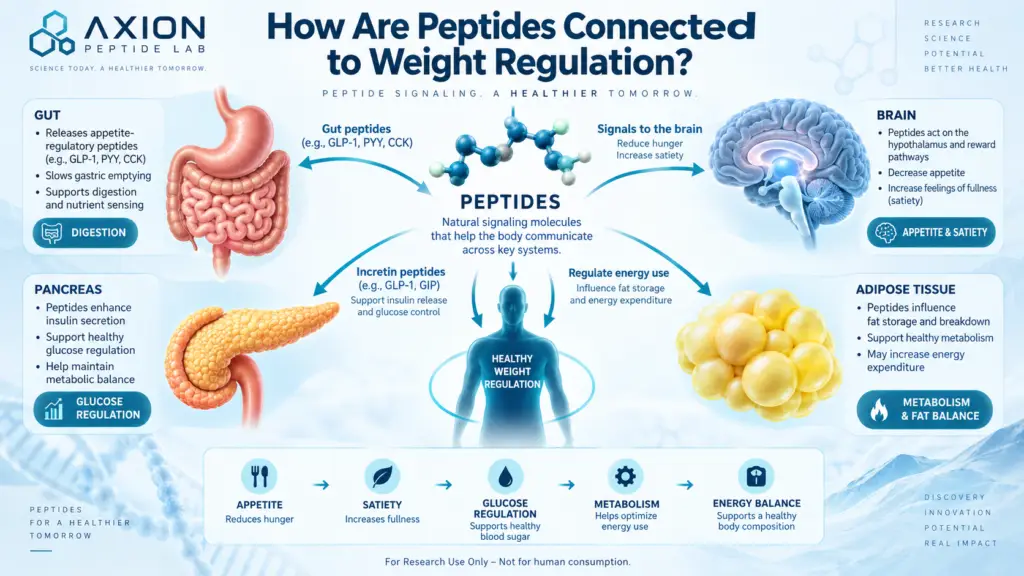
Body weight is regulated by a highly complex network of biological and environmental factors.
Food intake, physical activity and energy expenditure are important, but underlying these processes is an extensive network of hormones, receptors, neural signals and metabolic pathways.
Certain peptide hormones help the body communicate information about nutrient intake and energy availability.
After a person eats, specialised cells in the gastrointestinal tract can release hormonal signals. These signals may communicate with the pancreas, brain and other tissues.
Some of these pathways influence hunger and fullness. Others affect glucose regulation, gastrointestinal function or nutrient storage.
This is why scientists have become increasingly interested in peptide signalling as a potential target for obesity and metabolic research.
However, the phrase “weight loss peptides” can be misleading if it implies that all peptides produce weight reduction. They do not.
The scientifically relevant question is which peptide pathways participate in metabolic regulation and how specific compounds interact with those pathways.
Appetite, Satiety and the Gut-Brain Connection
Hunger is not controlled solely by willpower or the physical amount of food inside the stomach.
The brain constantly receives information about nutrient availability through hormonal and neural signals.
Peptide hormones produced in the gastrointestinal system can participate in this communication.
Signals related to satiety can influence how full someone feels after eating, while other signals can affect food-seeking behaviour, digestion and energy utilisation.
This communication between the gastrointestinal tract and the nervous system is often described broadly as part of the gut-brain axis.
GLP-1 is one of the best-known peptide hormones associated with this area of research.
Its physiological activity includes effects on glucose-dependent insulin secretion, gastrointestinal function and appetite-related signalling.
Understanding these interactions helped create the scientific foundation for modern GLP-1 receptor agonist research.
How Metabolic Peptide Pathways Work
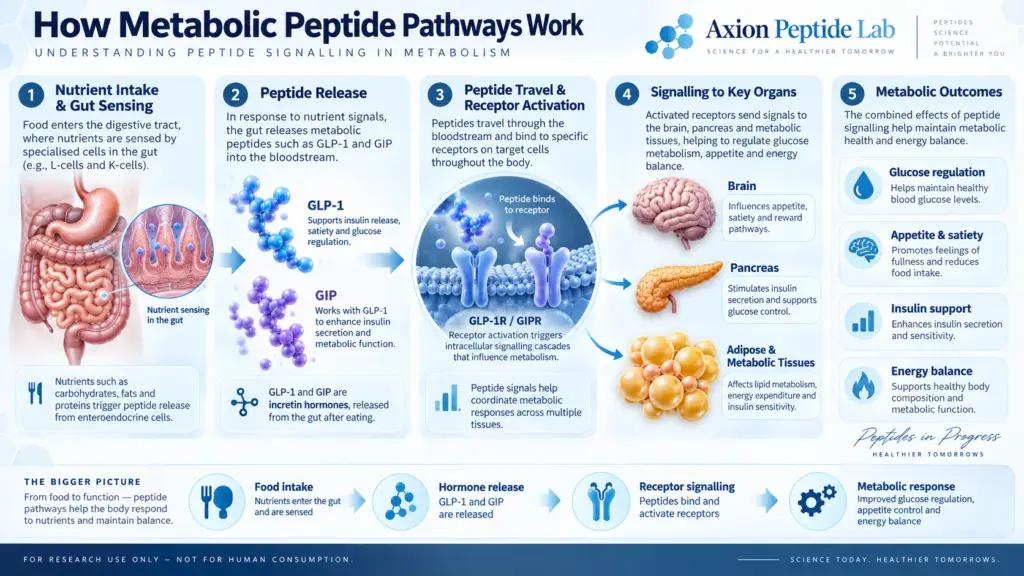
Peptides generally produce biological effects by interacting with receptors.
A simplified sequence looks like this:
Peptide signal → receptor binding → intracellular signalling → cellular response → physiological effect
A receptor can be thought of as a molecular communication point. When the correct signalling molecule interacts with that receptor, biochemical events occur inside the cell.
The result depends on the receptor, the tissue and the signalling pathway.
A receptor found in pancreatic cells may contribute to different physiological outcomes from the same or related receptors located within the nervous system.
For metabolic research, scientists therefore study not only whether a compound activates a receptor but also where that receptor is expressed, how strongly it is activated and how long the signal persists.
The Incretin Effect
GLP-1 and GIP belong to a category of hormones known as incretins.
The incretin system became scientifically important because researchers observed that glucose taken orally could trigger a greater insulin response than an equivalent glucose exposure delivered directly into the bloodstream.
Part of this difference is explained by hormones released by the gastrointestinal tract after nutrient intake.
GLP-1 and GIP are considered the two principal incretin hormones.
Both can influence glucose-dependent insulin secretion, although their overall physiological roles are not identical.
This connection between nutrient intake, intestinal hormone release and pancreatic response forms one of the foundations of modern metabolic peptide research.
GLP-1, GIP and Glucagon Explained
Understanding three hormone pathways—GLP-1, GIP and glucagon—makes it much easier to understand why semaglutide, tirzepatide and retatrutide differ.
What Is GLP-1?
GLP-1 stands for glucagon-like peptide-1.
It is a naturally occurring hormone released primarily from specialised cells in the gastrointestinal tract following food intake.
GLP-1 signalling has been studied in relation to glucose-dependent insulin secretion, glucagon regulation, gastrointestinal activity, appetite and satiety.
The GLP-1 receptor therefore became an important target for researchers investigating diabetes, obesity and cardiometabolic health.
Pharmaceutical GLP-1 receptor agonists are compounds designed to activate this receptor for longer periods than naturally occurring GLP-1, which is normally broken down relatively quickly.
Semaglutide is an important example.
What Is GIP?
GIP stands for glucose-dependent insulinotropic polypeptide.
Like GLP-1, it is an incretin hormone released after nutrient intake.
GIP interacts with its own receptor and participates in glucose-dependent insulin signalling and broader metabolic pathways.
For many years, GLP-1 received more attention in pharmaceutical development. More recently, scientists have investigated whether simultaneously targeting GLP-1 and GIP receptors can create a different metabolic response.
This research contributed directly to the development of tirzepatide.
What Is Glucagon?
Glucagon is another peptide hormone involved in metabolic regulation.
It is widely known for its role in maintaining glucose availability, but glucagon signalling also interacts with broader aspects of energy metabolism.
Researchers have become interested in whether carefully combining glucagon receptor activity with GLP-1 and GIP receptor activity could influence energy expenditure and nutrient metabolism.
That concept forms part of the scientific rationale behind retatrutide.
Peptide-Based Compounds Commonly Discussed in Weight-Loss Research
Several peptide-based compounds appear frequently in discussions about metabolic research.
Three of the most prominent are semaglutide, tirzepatide and retatrutide.
They represent three different approaches:
Semaglutide: GLP-1
Tirzepatide: GIP + GLP-1
Retatrutide: GIP + GLP-1 + glucagon
The progression from single to dual to triple receptor agonism is scientifically interesting, but more receptor targets do not automatically mean a compound is superior.
Safety, effectiveness and long-term clinical value must still be demonstrated through controlled research.
Semaglutide: GLP-1 Receptor Agonism
Semaglutide is a synthetic GLP-1 receptor agonist.
By activating the GLP-1 receptor, pharmaceutical semaglutide can influence pathways involved in appetite, gastrointestinal function, glucose-dependent insulin secretion and metabolic regulation.
Semaglutide has been studied extensively in obesity and type 2 diabetes.
One of the landmark studies was the STEP 1 trial.
Researchers enrolled 1,961 adults with overweight or obesity who did not have diabetes. Participants received either semaglutide 2.4 mg or placebo alongside lifestyle intervention for 68 weeks.
The mean change in body weight was −14.9% in the semaglutide group compared with −2.4% in the placebo group.
The study was important because it demonstrated that prolonged GLP-1 receptor agonism could produce substantial average body-weight changes within a controlled clinical setting.
Those results should not be interpreted as a prediction for every individual.
Clinical trial averages describe the study population rather than guaranteeing a particular outcome for any specific person.
Semaglutide research has also expanded beyond body weight.
In 2024, the FDA approved Wegovy for reducing the risk of cardiovascular death, heart attack and stroke in adults with established cardiovascular disease and overweight or obesity.
In March 2026, the FDA approved a higher-dose semaglutide formulation, Wegovy HD, for reducing excess body weight and maintaining weight reduction in specified adults.
These approvals relate to specific regulated pharmaceutical products.
They do not mean a laboratory research material labelled semaglutide is automatically equivalent to Wegovy.
Tirzepatide: Dual GIP and GLP-1 Agonism
Tirzepatide represents a different strategy.
Rather than targeting the GLP-1 receptor alone, tirzepatide activates both the GIP and GLP-1 receptors.
Researchers describe this as dual agonism.
The combination allows scientists to investigate whether simultaneous activation of two incretin pathways changes metabolic outcomes compared with GLP-1 receptor agonism alone.
One of the most important tirzepatide obesity trials was SURMOUNT-1.
The Phase 3 trial included 2,539 adults with obesity or overweight plus at least one weight-related complication who did not have diabetes.
Participants received one of several tirzepatide dose levels or placebo for 72 weeks.
The study reported substantial average body-weight reductions, with the highest studied dose producing approximately a 20.9% mean reduction at 72 weeks, compared with roughly 3.1% with placebo.
These findings established dual GIP/GLP-1 agonism as a major area of metabolic research.
In November 2023, the FDA approved Zepbound, containing tirzepatide, for chronic weight management in specified adults with obesity or overweight plus at least one weight-related condition.
Tirzepatide is also the active ingredient in Mounjaro, which has separate medical indications.
Again, approval applies to the regulated pharmaceutical product—not every laboratory material carrying the tirzepatide name.
Retatrutide: Triple Receptor Agonism
Retatrutide extends the multi-receptor concept further.
It is designed to activate:
GIP + GLP-1 + glucagon receptors
This makes retatrutide a triple agonist.
Scientists are investigating whether combining these three pathways may produce metabolic effects that differ from GLP-1 agonism or dual GIP/GLP-1 agonism.
A Phase 2 trial published in the New England Journal of Medicine enrolled 338 adults with obesity or overweight plus at least one weight-related condition.
At 48 weeks, the study reported mean body-weight changes of approximately −8.7% in the 1 mg group, −17.1% in the combined 4 mg groups, −22.8% in the combined 8 mg groups and −24.2% in the 12 mg group, compared with −2.1% for placebo.
These results generated significant scientific interest and supported progression into larger Phase 3 trials.
However, regulatory status is critical.
Retatrutide remains investigational and is not currently approved by the FDA or any other regulatory agency. Lilly states that its safety and efficacy continue to be evaluated in Phase 3 clinical trials.
Promising clinical results are not the same as regulatory approval.
Semaglutide vs Tirzepatide vs Retatrutide
The three compounds can be compared at a high level:
| Feature | Semaglutide | Tirzepatide | Retatrutide |
|---|---|---|---|
| Main receptor targets | GLP-1 | GIP + GLP-1 | GIP + GLP-1 + glucagon |
| Research strategy | Single agonist | Dual agonist | Triple agonist |
| Major research areas | Appetite, glucose, obesity, cardiovascular outcomes | Appetite, glucose, obesity, multi-incretin signalling | Appetite, glucose, energy metabolism, multi-receptor signalling |
| Specific approved medicines | Yes | Yes | No |
| Current retatrutide status | — | — | Investigational |
This progression illustrates how metabolic research has evolved.
Semaglutide established the importance of sustained GLP-1 receptor activity.
Tirzepatide expanded the concept by adding GIP receptor activity.
Retatrutide is exploring whether adding glucagon receptor activity provides additional metabolic effects.
But receptor count alone cannot determine which compound is “best.”
A triple agonist could theoretically produce beneficial effects through additional pathways, but it could also produce additional or different adverse effects.
Only properly controlled clinical trials can answer those questions.
What Does Clinical Research Actually Show?
The rapid popularity of metabolic peptides online has created a major problem: results from different clinical studies are often placed side by side as though the trials were identical.
They are not.
Different studies may involve different patient populations, treatment durations, dose schedules, lifestyle interventions and statistical methods.
Comparing headline percentages from separate trials is therefore useful for context but cannot prove superiority.
STEP 1: Semaglutide
STEP 1 followed 1,961 adults for 68 weeks.
The semaglutide group experienced a mean weight change of −14.9%, compared with −2.4% for placebo.
The study demonstrated clinically significant weight reduction in the trial population and became one of the foundational studies supporting semaglutide’s role in obesity treatment.
SURMOUNT-1: Tirzepatide
SURMOUNT-1 followed 2,539 adults with obesity or overweight and weight-related complications for 72 weeks.
The trial reported dose-dependent body-weight reductions, with the highest studied dose producing an average reduction of approximately −20.9%.
However, STEP 1 and SURMOUNT-1 were separate studies.
Their percentages should not be treated as a controlled semaglutide-versus-tirzepatide comparison.
SURMOUNT-5: Direct Tirzepatide vs Semaglutide Evidence
A stronger comparison became available with SURMOUNT-5, published in 2025.
This trial directly randomised 751 adults with obesity but without type 2 diabetes to tirzepatide or semaglutide for 72 weeks.
Mean body-weight change was approximately:
−20.2% with tirzepatide
versus
−13.7% with semaglutide
within the specific conditions of that trial.
Waist circumference also decreased more in the tirzepatide group.
Because both treatments were studied under the same trial framework, this provides stronger comparative evidence than comparing unrelated studies.
Nevertheless, even a direct trial does not mean every individual will experience the same result.
Retatrutide Evidence
Retatrutide’s published Phase 2 results were highly notable, with the 12 mg group experiencing a mean body-weight reduction of 24.2% at 48 weeks.
But retatrutide remains at a different stage of development from approved semaglutide and tirzepatide products.
Its evidence base is continuing to grow, and regulatory authorities have not yet determined whether its overall benefit-risk profile supports approval.
This illustrates an important principle:
Strong results do not automatically equal regulatory approval.
Why Clinical Trial Percentages Need Context
When headlines say that a compound produced a certain percentage of weight loss, that number is typically an average.
Within every clinical trial, individual responses vary.
Some participants lose substantially more than the average. Some lose less. Some discontinue treatment. Some experience side effects.
Clinical trial interpretation also depends on whether researchers analyse all randomised participants, only participants who remained on treatment, or a statistical estimand designed to account for discontinuations and missing data.
This is why high-quality scientific reporting should avoid statements such as “this peptide will make you lose 20% of your body weight.”
A more accurate description is that participants receiving a specific pharmaceutical or investigational compound experienced a particular average change under controlled trial conditions.
Safety and Reported Adverse Effects
Effectiveness is only one half of the scientific equation.
Researchers and regulators must also evaluate safety.
Across major GLP-1 and dual GIP/GLP-1 studies, gastrointestinal adverse effects are commonly reported.
These can include nausea, vomiting, diarrhoea, constipation and abdominal discomfort.
In SURMOUNT-5, gastrointestinal events were the most common adverse effects in both the tirzepatide and semaglutide groups, and most were mild to moderate and occurred primarily during dose escalation.
Retatrutide’s Phase 2 trial also reported gastrointestinal events as the most common adverse effects. They were dose-related and mostly mild to moderate. Dose-dependent increases in heart rate were also observed, peaking around week 24 before declining.
Pancreatitis and Current UK Safety Guidance
Safety information can continue to evolve even after a medicine has been approved.
In January 2026, the UK’s MHRA strengthened warnings relating to acute pancreatitis for GLP-1 receptor agonists and dual GLP-1/GIP receptor agonists.
The regulator described acute pancreatitis as a known but infrequent adverse effect and highlighted rare reports of severe, necrotising and fatal cases.
This does not mean that most people using these medicines will develop pancreatitis.
It demonstrates why regulatory safety monitoring continues after approval.
Large clinical trials can identify common adverse effects, but very rare events may become clearer only when medicines are used across much larger populations.
Research Peptides vs Prescription Medicines
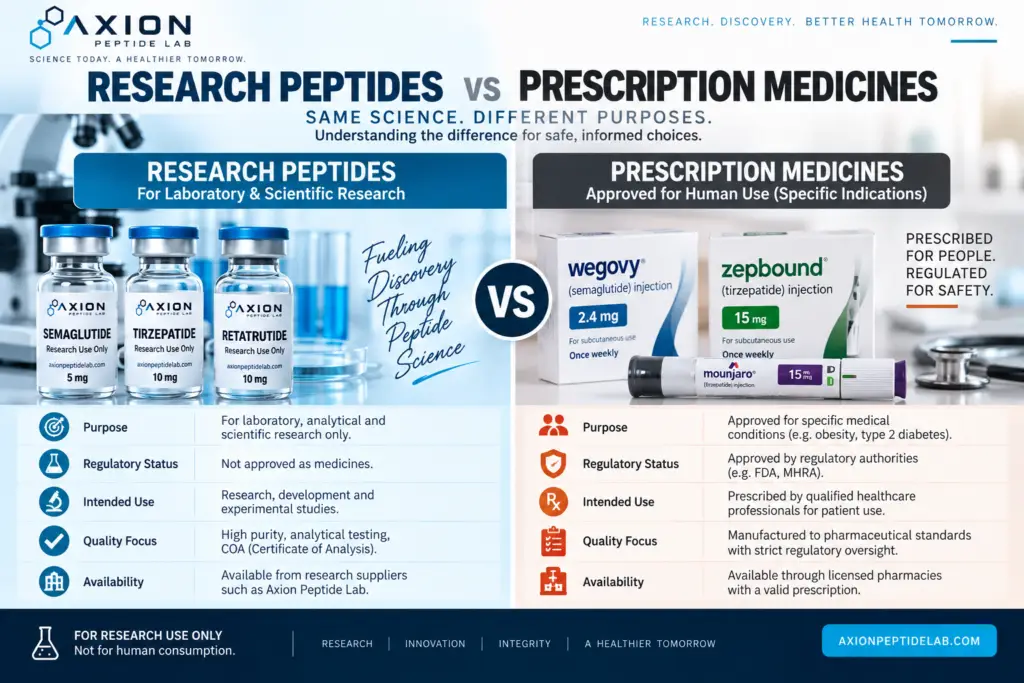
This distinction is essential for anyone reading about peptides for weight loss.
Three different categories can easily become confused.
A licensed prescription medicine is a specific product that has undergone regulatory assessment for manufacturing quality, safety, effectiveness, labelling and defined medical indications.
An investigational medicine is still undergoing clinical research and has not yet received regulatory approval.
A research-use peptide is supplied for laboratory, analytical or scientific investigation.
These are not interchangeable categories.
A laboratory product labelled semaglutide does not automatically become Wegovy.
Research tirzepatide is not automatically Mounjaro or Zepbound.
Research-use retatrutide is not Lilly’s regulated clinical-trial investigational medicine.
Clinical trial findings obtained using pharmaceutical-grade or investigational products cannot automatically be transferred to independently supplied laboratory materials.
Products available from AxionPeptideLab.com are intended for legitimate research purposes.
For Research Use Only – Not for human consumption.
USA Regulatory Considerations
In the United States, the FDA evaluates medicines for specific indications.
Approval belongs to the particular pharmaceutical product, formulation and use described in the product’s regulatory documentation.
For example, the FDA approved Zepbound for chronic weight management in specified adults in 2023.
The FDA has also continued updating its regulatory approach to semaglutide, tirzepatide and related products.
In April 2026, the agency proposed excluding semaglutide, tirzepatide and liraglutide from the 503B bulks list after finding insufficient evidence of a clinical need for outsourcing facilities to compound these drugs from bulk substances under that pathway.
These developments show why anyone discussing peptide-based medicines must use current regulatory information rather than relying on outdated online claims.
UK Regulatory Considerations
In the United Kingdom, the Medicines and Healthcare products Regulatory Agency (MHRA) regulates medicines and monitors their safety.
NICE performs a different role, evaluating clinical and cost effectiveness and making recommendations concerning NHS use in England.
Current NICE guidance includes tirzepatide and semaglutide among recommended medicine options for weight management under defined eligibility criteria. NICE states that weight-management medicines should be used alongside a reduced-calorie diet and increased physical activity.
UK guidance also makes clear that not every GLP-1 medicine is authorised for weight loss.
The same active ingredient may appear in different brands with different authorised uses.
This is another reason accurate product names and indications matter.
Research-use materials should never be marketed as though they have automatically acquired the approvals belonging to licensed medicines.
Why Peptides Have Become Such an Important Research Area
Peptide science has several characteristics that make it attractive to researchers.
Peptides can interact selectively with receptors, allowing researchers to target specific signalling systems.
Scientists can also modify peptide structures to alter characteristics such as receptor selectivity, stability or duration of activity.
The success of GLP-1 receptor agonism encouraged researchers to ask whether combining pathways could produce different metabolic outcomes.
That progression can be seen clearly:
GLP-1 agonism → GIP/GLP-1 dual agonism → GIP/GLP-1/glucagon triple agonism
Future research may extend this concept even further.
Scientists are investigating not just body weight but cardiovascular outcomes, liver disease, kidney disease, sleep apnea, body composition and long-term metabolic health.
Current and Future Peptide Research
The next phase of metabolic peptide research will likely focus increasingly on outcomes beyond a number on the scale.
Body-weight reduction is important, but obesity affects multiple organ systems.
Researchers therefore want to know whether newer treatments can improve cardiovascular health, liver disease, kidney outcomes, sleep-related disorders and overall metabolic risk.
Longer-term research is also essential.
Questions that remain important include whether weight changes are maintained, what happens after treatment stops, whether long-term safety signals emerge and which populations benefit most.
Direct head-to-head research will become increasingly valuable.
SURMOUNT-5 demonstrated why these studies matter: rather than comparing two unrelated trials, researchers tested tirzepatide and semaglutide under the same clinical framework.
Similar comparative research will be important when evaluating future multi-receptor compounds.
Retatrutide is a prominent example.
Its Phase 2 evidence is promising, but Lilly continues to describe the compound as investigational and under Phase 3 evaluation.
Until regulators review the complete evidence package, retatrutide should continue to be described as an experimental or investigational compound.
Sourcing Peptides for Legitimate Laboratory Research
For researchers, sourcing laboratory materials involves very different considerations from obtaining prescription medicines.
Research laboratories may evaluate factors such as compound identity, stated purity, analytical testing, batch traceability and appropriate storage information.
Documentation can be especially important when experiments need to be reproduced across different batches.
Legitimate researchers exploring peptide signalling, receptor activity and metabolic pathways can review the research catalogue available through AxionPeptideLab.com.
Research products should be selected according to the requirements of the scientific project, relevant institutional standards and applicable laws.
They should not be selected or promoted as substitutes for prescription weight-management medicines.
For Research Use Only – Not for human consumption.
Frequently Asked Questions About Peptides for Weight Loss
Peptides are short chains of amino acids that can function as biological signalling molecules. Different peptides have different functions, ranging from hormonal signalling to cellular communication.
What does “peptides for weight loss” mean?
The phrase usually refers to peptide-based hormones or compounds associated with pathways that influence appetite, satiety, glucose regulation or energy balance. It does not mean that every peptide causes weight loss.
What is GLP-1?
GLP-1 is a naturally occurring incretin hormone involved in post-meal metabolic signalling, including glucose-dependent insulin secretion and appetite-related pathways.
What is GIP?
GIP is another incretin hormone involved in nutrient-dependent metabolic signalling and glucose-dependent insulin secretion.
What is the difference between GLP-1 and GIP?
Both are incretin hormones, but they act through different receptors and have different physiological roles across multiple tissues.
What is semaglutide?
Semaglutide is a GLP-1 receptor agonist. Specific pharmaceutical semaglutide products are authorised medicines for defined medical indications.
What is tirzepatide?
Tirzepatide is a dual GIP and GLP-1 receptor agonist. Specific pharmaceutical tirzepatide products have received regulatory approval for defined indications.
What is retatrutide?
Retatrutide is an investigational compound designed to activate GIP, GLP-1 and glucagon receptors.
Is retatrutide FDA approved?
No. Retatrutide remains investigational and has not currently been approved by the FDA.
Is retatrutide the same as tirzepatide?
No. Tirzepatide targets GIP and GLP-1 receptors, while retatrutide targets GIP, GLP-1 and glucagon receptors.
Which is better: semaglutide or tirzepatide?
The SURMOUNT-5 trial found greater average body-weight reduction with tirzepatide than semaglutide in adults with obesity without type 2 diabetes under that trial’s specific conditions. Individual treatment decisions, however, depend on medical history, regulatory indications, risks and professional medical assessment.
Does retatrutide work better than tirzepatide?
That cannot be concluded simply by comparing percentages from separate studies. Retatrutide remains investigational, and direct comparisons are needed to establish relative effectiveness and safety.
What is a triple receptor agonist?
A triple receptor agonist is designed to activate three receptor systems. Retatrutide is being studied for activity at GIP, GLP-1 and glucagon receptors.
Are research peptides medicines?
No. Laboratory research products should not be treated as licensed prescription medicines.
Can research peptides be used for human consumption?
Products specifically designated for laboratory research are not intended for human consumption or self-administration.
Conclusion
Research into peptides for weight loss and metabolic regulation has reshaped scientific understanding of how the gut, pancreas, brain and other tissues communicate.
GLP-1 receptor research established that targeting peptide signalling could produce significant metabolic effects.
Semaglutide became one of the most important examples of this single-receptor approach.
Tirzepatide expanded the concept by combining GIP and GLP-1 receptor activity, and direct clinical research has demonstrated important differences between tirzepatide and semaglutide within specific study populations.
Retatrutide represents the next experimental step by combining GIP, GLP-1 and glucagon receptor agonism. Its published Phase 2 results have generated considerable scientific interest, but it remains an investigational compound and should not be described as an approved medicine.
The broader lesson is that peptide research should be evaluated using evidence rather than hype.
Mechanism, clinical trial quality, adverse effects, long-term safety and regulatory status all matter.
For legitimate laboratory researchers investigating peptide signalling, metabolic pathways and related areas of molecular science, AxionPeptideLab.com provides access to research-focused peptide materials and scientific information.
For Research Use Only – Not for human consumption.
References and Further Reading
Clinical and regulatory information in this article should be reviewed alongside current primary sources, including the U.S. Food and Drug Administration, the UK Medicines and Healthcare products Regulatory Agency, NICE, PubMed, ClinicalTrials.gov and peer-reviewed medical journals.
Key evidence includes the STEP 1 semaglutide trial published in the New England Journal of Medicine.
The SURMOUNT-1 tirzepatide obesity trial provides major Phase 3 evidence for dual GIP/GLP-1 agonism.
The SURMOUNT-5 trial provides direct comparative evidence involving tirzepatide and semaglutide.
The Phase 2 retatrutide study provides peer-reviewed evidence regarding GIP, GLP-1 and glucagon triple agonism.
For current UK weight-management recommendations, consult NICE guidance.
For current safety information regarding GLP-1 and GLP-1/GIP medicines, consult MHRA guidance.
For the current development status of retatrutide, consult official clinical-trial records and Lilly’s investigational-product information.