Order Laboratory Peptides Online: 15 Essential Steps for Research Procurement
Researchers looking to order laboratory peptides online should treat purchasing as part of the scientific workflow rather than as an ordinary e-commerce transaction. Selecting a research material requires consideration of compound identity, experimental requirements, stated purity, analytical documentation, batch traceability, physical format, storage information, supplier transparency, shipping conditions, and laboratory record keeping.
Online research catalogues have made it easier for laboratories to discover and compare peptide materials. Researchers can review compounds, examine available specifications, compare product quantities, and organize procurement without relying entirely on traditional printed catalogues.
Convenience, however, should not replace careful evaluation.
Peptides represent an extremely diverse group of molecules. Different compounds may be investigated in areas including molecular biology, analytical chemistry, receptor science, biochemical signaling, metabolic pathways, mitochondrial research, peptide chemistry, cellular models, and structural investigation.
The correct product therefore depends on the scientific question being investigated.
This guide explains 15 essential steps researchers can follow when ordering laboratory peptide materials online, from defining the experimental objective through receiving and documenting the product.
It also introduces selected research materials available through Axion Peptide Lab and explains why each product should be evaluated according to its own scientific context.
For Research Use Only – Not for human consumption.
What Are Laboratory Research Peptides?
Peptides are molecules composed of amino acids connected through peptide bonds.
They vary enormously in sequence, size, structure, and biological characteristics.
Naturally occurring peptides participate in many biological systems. Synthetic peptides can also be produced for controlled laboratory investigation.
Laboratory research peptides may be studied in connection with:
- Molecular structure
- Receptor interactions
- Biochemical pathways
- Cellular signaling
- Peptide stability
- Analytical characterization
- Molecular binding
- Peptide chemistry
- Metabolic signaling
- Mitochondrial biology
- Comparative molecular research
- Experimental biological models
The phrase “laboratory peptide” does not mean that every peptide is appropriate for every laboratory application.
Researchers should determine the suitability of an individual material based on the requirements of their experimental protocol.
Why Researchers Order Laboratory Peptides Online
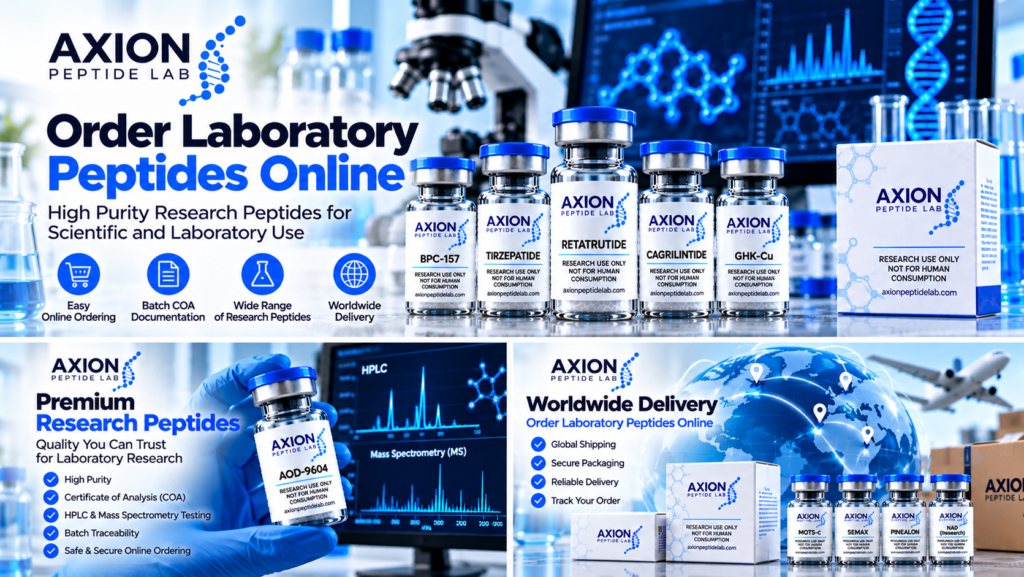
Digital research catalogues provide laboratories with convenient access to information about different research materials.
Researchers can compare products according to characteristics such as:
- Compound
- Quantity
- Product format
- Stated purity
- Available documentation
- Batch information
- Storage requirements
- Supplier information
- Shipping availability
Online procurement can also make it easier to organize multiple research materials within one project.
However, researchers should avoid approaching research materials as ordinary consumer products.
Scientific procurement requires documentation and traceability.
A laboratory should know what was purchased, which batch was received, how it was stored, and which experiments involved the material.
1. Define the Research Objective Before Ordering
Before researchers order laboratory peptides online, they should define the scientific objective.
Start with the research question.
For example, a laboratory may be investigating:
- Receptor signaling
- Molecular binding
- Peptide stability
- Chromatographic characteristics
- Molecular mass
- Cellular pathways
- Mitochondrial signaling
- Metabolic mechanisms
- Peptide degradation
- Comparative molecular properties
The research objective helps determine which compound is required.
Researchers should avoid choosing a peptide first and attempting to design an experiment around it afterward.
A stronger workflow is:
Research question → experimental design → required compound → required specifications → supplier evaluation → procurement.
This keeps scientific reasoning at the center of the purchasing process.
2. Confirm the Exact Compound
After identifying the research objective, confirm the exact compound required.
This may sound straightforward, but research catalogues can contain compounds with similar names or multiple versions of related materials.
Researchers should review:
- Full compound name
- Abbreviation
- Stated quantity
- Product format
- Molecular information where relevant
- Product identifier
- Research-use designation
Accurate identification becomes particularly important when several materials are being purchased simultaneously.
Internal laboratory records should use consistent names.
This can reduce confusion during experimental work.
3. Determine the Appropriate Quantity
Researchers should determine the quantity required by the experimental protocol before ordering.
Purchasing too little material may interrupt a research project.
Purchasing substantially more than necessary may create unnecessary storage and inventory considerations.
Quantity planning can include:
- Number of experiments
- Number of experimental replicates
- Duration of the research project
- Expected analytical requirements
- Storage limitations
- Potential future experiments
Researchers conducting long-term studies should also consider whether multiple orders or batches may be involved.
This should be documented.
4. Review the Product Description Carefully
A research product page should provide enough information to identify what is being supplied.
Before researchers order laboratory peptides online, they should read the complete product description.
Do not rely only on the product title.
Useful information can include:
- Compound identity
- Stated quantity
- Physical format
- Research designation
- Storage information
- Analytical information
- Batch information
- Product-specific notes
If important information is unclear, researchers should seek clarification before ordering.
5. Understand Stated Peptide Purity
Purity is frequently discussed when comparing research peptide materials.
However, researchers should understand what a purity result means.
A peptide purity percentage generally describes the relative amount of the target peptide compared with detectable peptide-related impurities under a particular analytical method.
It does not necessarily answer every question about the material.
Researchers should consider:
What method produced the result?
Which batch was tested?
Is the compound clearly identified?
When was testing performed?
Does the documentation correspond to the supplied product?
Does the stated specification meet the requirements of the experiment?
This provides more useful information than simply comparing headline purity percentages.
6. Examine the Certificate of Analysis
A Certificate of Analysis, commonly abbreviated as COA, may provide important analytical information about a research material.
Depending on the product and testing performed, a COA may contain:
- Compound name
- Product identification
- Batch or lot number
- Testing date
- Stated purity
- Analytical method
- Molecular information
- Test results
- Additional specifications
Researchers should examine the actual document where available.
Simply seeing the words “COA available” does not explain what information the document contains.
Why Batch Matching Matters
If a COA identifies a specific batch, researchers should determine whether that batch corresponds to the product they receive.
This strengthens traceability between the physical material and associated analytical information.
7. Understand HPLC Analysis
High-Performance Liquid Chromatography, or HPLC, is commonly encountered in peptide research.
HPLC separates components within a sample based on their interactions with a chromatographic system.
In peptide analysis, researchers may use HPLC to examine sample composition and estimate relative purity.
A chromatogram can contain multiple peaks.
The interpretation of these peaks depends on the analytical conditions.
Factors can include:
- Column
- Mobile phase
- Detection method
- Sample preparation
- Flow conditions
- Integration parameters
Researchers do not need to become chromatography specialists before purchasing research materials.
However, understanding the basic role of HPLC helps researchers interpret purity claims more carefully.
8. Understand Mass Spectrometry
Mass spectrometry is another analytical technique frequently used in molecular research.
It provides information relating to molecular mass and can assist with compound characterization.
Researchers may encounter documentation referring to:
- MS
- LC-MS
- ESI-MS
- Molecular mass
- Mass spectrum
Chromatography and mass spectrometry provide different types of information.
Researchers should avoid assuming that one analytical result automatically confirms every characteristic of a research material.
The required analytical evidence depends on the scientific objective.
9. Check Batch and Lot Information
Batch traceability is an important component of research procurement.
Imagine that a laboratory conducts experiments for eight months.
The first four months use one batch of a peptide.
The remaining experiments use another batch.
If researchers record this information, they can later determine exactly which batch was associated with each experiment.
A laboratory inventory record might contain:
Compound: Exact research material
Supplier: Product source
Product Code: Catalogue reference
Batch/Lot: Relevant identifier
Quantity: Stated amount
Order Date: Procurement date
Receipt Date: Arrival date
COA: Associated analytical information
Storage: Laboratory storage location
Project: Research project
Experiment: Internal experiment reference
This provides considerably better traceability than simply recording the compound name.
10. Understand the Product Format
Many research peptide products are supplied in lyophilized form.
What Does Lyophilized Mean?
Lyophilization is a controlled freeze-drying process.
Water is removed from frozen material under reduced pressure.
The resulting material may appear as:
- Powder
- Cake-like material
- Compact material
- Thin residue
The physical appearance can vary.
Researchers should not attempt to determine identity or purity based solely on appearance.
Analytical information and product documentation provide more meaningful evidence.
11. Review Storage Requirements
Research materials should be stored according to appropriate product-specific conditions.
Factors that can influence peptide stability include:
- Temperature
- Moisture
- Light
- Oxidation
- Time
- Container integrity
- Environmental changes
Researchers should review the available storage information for each compound.
A single storage assumption should not automatically be applied to every research peptide.
Different molecular structures may behave differently.
The laboratory should also maintain appropriate storage records.
12. Evaluate the Supplier
Before researchers order laboratory peptides online, they should evaluate the supplier as well as the product.
Important areas include:
Product Transparency
Is the compound clearly identified?
Documentation
Is relevant analytical information available?
Batch Traceability
Can the product be associated with a batch or lot?
Research Positioning
Is the material genuinely presented for laboratory investigation?
Contact Information
Can researchers request clarification?
Shipping Information
Are destination conditions and restrictions explained?
Catalogue Organization
Can researchers easily locate relevant research materials?
No single characteristic establishes supplier reliability.
Researchers should consider the complete procurement experience.
13. Check Shipping Availability
Research procurement frequently crosses geographic boundaries.
Before ordering, researchers should determine whether the material can appropriately be shipped to their destination.
Relevant considerations may include:
- Destination
- Carrier
- Customs procedures
- Import requirements
- Institutional rules
- Product-specific restrictions
- Applicable regulations
Worldwide delivery should not be interpreted as a guarantee that every compound can be shipped to every destination.
Researchers remain responsible for understanding requirements applicable to their research environment.
14. Create a Procurement Record Before Checkout
A useful laboratory practice is to create the procurement record before the order is completed.
Record:
- Compound
- Quantity
- Supplier
- Product page
- Product code
- Expected documentation
- Intended project
- Order date
Once the material arrives, additional information can be added.
This helps ensure that procurement information is not lost.
15. Inspect and Document the Material When It Arrives
The procurement process does not end at checkout.
When research materials arrive, laboratories should follow their normal receiving and inventory procedures.
Researchers may document:
- Arrival date
- Product identity
- Quantity
- Packaging condition
- Batch or lot
- Associated documentation
- Storage location
This information can then be connected to the appropriate research project.
The product should be stored according to applicable product information and laboratory procedures.
Research Products Available From Axion Peptide Lab
Researchers looking to order laboratory peptides online can explore several categories of research materials through Axion Peptide Lab.
Each compound represents a different area of scientific investigation.
Researchers should select products according to their experimental protocols rather than treating different peptide materials as interchangeable.
Retatrutide Research Peptide
Retatrutide has become an important subject within metabolic and receptor-signaling research.
Scientific investigation has examined its interaction with multiple receptor pathways, including glucagon, GIP, and GLP-1 receptor systems.
This multi-receptor research profile makes Retatrutide distinct from compounds targeting fewer pathways.
Researchers may investigate aspects such as:
- Receptor signaling
- Molecular characteristics
- Comparative pathway activity
- Analytical behavior
- Stability
Axion Peptide Lab provides Retatrutide research materials in multiple stated quantities, subject to availability.
These products are intended strictly for appropriate laboratory investigation.
For Research Use Only – Not for human consumption.
Tirzepatide Research Peptide
Tirzepatide is associated with research involving GIP and GLP-1 receptor pathways.
Scientific investigation of these pathways has contributed significantly to the broader understanding of incretin biology.
Laboratories may investigate Tirzepatide in experimental contexts involving:
- Receptor interactions
- Molecular signaling
- Analytical characterization
- Comparative peptide research
- Stability
Researchers should distinguish research-use Tirzepatide materials from regulated prescription products containing the same active molecule.
Cagrilintide 5mg Research Peptide
Cagrilintide is associated with research involving amylin-related pathways.
Amylin is a peptide hormone involved in biological signaling.
Researchers studying this area may investigate molecular mechanisms and pathway interactions in appropriate experimental models.
Axion Peptide Lab includes Cagrilintide 5mg among its research catalogue.
GHK-Cu 50mg Research Peptide
GHK-Cu is a copper-binding peptide complex.
It differs substantially from incretin-related compounds in both structure and research context.
GHK-Cu has been investigated in various molecular and cellular research settings.
Researchers should consult compound-specific scientific literature when determining whether GHK-Cu is appropriate for their experiment.
AOD-9604 5mg Research Peptide
AOD-9604 is a peptide-related research compound associated with experimental investigation involving a fragment related to growth-hormone research.
Researchers should evaluate the available scientific literature, product specifications, and analytical documentation before selecting AOD-9604 for a project.
BPC-157 Research Peptide
BPC-157 appears frequently in experimental peptide research.
Much of the scientific evidence surrounding this compound comes from preclinical or experimental contexts.
Researchers should distinguish such findings from established clinical evidence.
Axion Peptide Lab’s BPC-157 research materials are intended strictly for laboratory investigation.
TB-500 Research Material
TB-500 is another material encountered in peptide research catalogues.
Researchers investigating TB-500 should establish the experimental objective and review relevant scientific literature before procurement.
Axion Peptide Lab also offers selected research blends containing BPC-157 and TB-500.
Glow 70mg Research Blend
The Axion Peptide Lab catalogue includes the Glow 70mg research blend containing GHK-Cu, BPC-157, and TB-500 research materials.
Blends create different experimental considerations from single-compound materials.
Researchers should document:
- Individual components
- Stated quantities
- Batch
- Product identity
- Experimental objective
Where experimental design requires researchers to isolate individual variables, a single-compound product may be more appropriate than a blend.
MOTS-c 10mg Research Peptide
MOTS-c is associated with scientific research involving mitochondrial biology.
Mitochondria play central roles in cellular energy processes.
Research into mitochondria-associated signaling continues to contribute to broader understanding of cellular metabolism.
Researchers interested in MOTS-c should evaluate the relevant literature and experimental requirements before ordering.
SEMAX Research Peptide
SEMAX has been investigated in experimental molecular and neurological research contexts.
Researchers should evaluate the quality and type of scientific evidence associated with any compound.
Experimental findings should not automatically be interpreted as established clinical conclusions.
Pinealon Research Products
Pinealon is another research material available within the Axion Peptide Lab catalogue.
Researchers should first define the experimental objective and then determine whether the compound’s characteristics fit the planned study.
NAD Research Compounds
Axion Peptide Lab also provides NAD-related research compounds.
Nicotinamide adenine dinucleotide is a biologically important molecule involved in cellular redox chemistry and metabolic processes.
NAD is not structurally classified as a peptide.
This distinction illustrates why accurate product categorization is important when browsing research catalogues.
How to Compare Laboratory Peptides Online
Researchers comparing products can use a standardized framework.
Create a comparison table containing:
Compound
Record the exact research material.
Quantity
Compare the stated amount.
Product Format
Determine whether the material is supplied in the required physical form.
Purity Information
Record the stated purity where available.
Analytical Method
Identify the method associated with the result.
COA
Determine whether relevant documentation is available.
Batch
Check whether batch information can be recorded.
Storage
Review available storage information.
Supplier
Evaluate transparency and communication.
Shipping
Confirm destination availability.
Price
Compare cost after evaluating the scientific requirements.
This creates a more meaningful comparison than simply sorting products by price.
Why Price Should Not Be the Only Factor
Laboratories operate within budgets.
Cost matters.
However, research procurement should consider the complete value of a material.
Suppose one product is less expensive but provides limited documentation.
Another product costs slightly more but offers clearer identification, batch information, and relevant analytical documentation.
The lower price does not automatically represent better research value.
Researchers should balance:
- Cost
- Specifications
- Documentation
- Traceability
- Shipping
- Storage
- Experimental requirements
The objective is not necessarily to find the cheapest material.
The objective is to find material appropriate for the research project.
How to Organize Research Peptide Inventory
Laboratories working with multiple peptide materials should maintain an organized inventory system.
A basic inventory can include:
| Field | Information |
|---|---|
| Compound | Exact research material |
| Supplier | Product source |
| Product Code | Catalogue identifier |
| Quantity | Stated amount |
| Batch/Lot | Product batch |
| Date Received | Arrival date |
| Storage | Laboratory location |
| COA | Documentation reference |
| Project | Associated research |
| Status | Available/allocated/completed |
Consistent inventory records can reduce confusion when several materials are stored simultaneously.
Why Research Documentation Should Be Archived
Researchers should consider preserving documentation associated with individual orders.
Web pages can change.
New product batches can replace older ones.
Analytical documents may be updated.
Researchers may therefore preserve:
- Product description
- COA
- Batch information
- Purchase record
- Receipt information
- Storage record
- Experimental allocation
These records can later help researchers reconstruct which materials were used in a particular study.
Research Peptide Procurement and Reproducibility
Reproducibility depends partly on knowing exactly what materials were used.
Consider two laboratory records.
The first says:
“Research peptide used.”
The second says:
Compound: GHK-Cu
Supplier: Recorded
Batch: Recorded
Quantity: Recorded
Analytical Documentation: Archived
Storage: Recorded
Experiment: Internal reference
The second record provides considerably more information.
Researchers attempting to understand or repeat the experiment can identify the material more precisely.
Procurement documentation therefore contributes to overall research organization.
Ordering Peptides for Long-Term Research Projects
Long-term projects require additional planning.
Researchers may need to consider:
- Project duration
- Expected material requirements
- Multiple batches
- Storage capacity
- Product stability
- Supplier availability
- Shipping times
- Procurement budget
- Documentation retention
If multiple batches are required, researchers should document when the transition occurs.
For example:
Experiments 001–025: Batch A
Experiments 026–050: Batch B
This creates useful traceability.
Ordering Peptides for Comparative Laboratory Research
Some research projects compare several compounds.
Researchers might investigate differences in:
- Molecular structure
- Analytical behavior
- Receptor interactions
- Stability
- Biochemical pathways
Comparative studies require careful control of experimental variables.
Procurement records should therefore identify each material accurately.
Researchers should avoid assuming that two related compounds are directly interchangeable.
Research Peptides vs Prescription Medicines
Research materials and prescription medicines belong to different categories.
A compound can appear in both scientific research and regulated pharmaceutical development.
That does not make all products containing that molecule equivalent.
Prescription medicines may operate under regulated manufacturing, labeling, distribution, prescribing, and quality frameworks.
Research-use-only materials are intended for scientific investigation.
Researchers should maintain this distinction clearly.
For Axion Peptide Lab products discussed in this article:
For Research Use Only – Not for human consumption.
Why Scientific Evidence Should Guide Product Selection
Supplier information can help researchers understand what material is being offered.
However, product pages should not replace scientific literature.
Researchers should consult appropriate scientific publications when designing experiments.
Scientific literature may provide information regarding:
- Molecular structure
- Experimental history
- Research models
- Analytical methods
- Biological pathways
- Limitations
- Areas requiring further research
Product procurement should follow scientific reasoning rather than online popularity.
Understanding Levels of Scientific Evidence
Not all scientific evidence has the same meaning.
Researchers may encounter:
- Chemical characterization
- In-vitro laboratory research
- Cell-based experiments
- Animal studies
- Early human research
- Controlled clinical studies
- Regulatory evaluation
Findings should be interpreted according to the level of evidence.
An observation from an experimental model should not automatically be translated into a clinical claim.
This distinction is particularly important when discussing research peptide compounds online.
Ordering Laboratory Peptides in the USA
Researchers in the United States should consider applicable institutional, federal, state, and product-specific requirements.
Different research environments may have different procurement systems.
Examples include:
- Universities
- Commercial laboratories
- Private research facilities
- Analytical laboratories
- Biotechnology organizations
Researchers should follow the policies applicable to their organization.
Research-use labeling does not remove the need to understand the legal and regulatory context surrounding an individual compound.
Ordering Laboratory Peptides Internationally
International procurement can introduce additional considerations.
Researchers should review:
- Destination-country requirements
- Import regulations
- Customs procedures
- Carrier policies
- Institutional rules
- Product restrictions
Axion Peptide Lab provides worldwide shipping options subject to applicable regulations, product availability, customs requirements, destination restrictions, and carrier policies.
Researchers should verify requirements before ordering.
Common Mistakes When Ordering Laboratory Peptides Online
Researchers can improve procurement by avoiding common mistakes.
Ordering Before Defining the Experiment
The research objective should determine the compound.
Choosing Based Only on Price
Cost should be evaluated alongside specifications and documentation.
Ignoring Analytical Methods
A purity percentage is more meaningful when researchers understand how it was measured.
Failing to Record Batch Information
Batch records support traceability.
Ignoring Storage Requirements
Research materials should be stored according to appropriate product-specific information.
Treating All Peptides as Similar
Peptide compounds can differ dramatically.
Confusing Research Materials With Medicines
Research-use materials should remain clearly separated from approved pharmaceutical products.
Ignoring Import Requirements
International delivery can involve additional rules.
Failing to Archive Documentation
Researchers may need product and batch information later.
20-Point Checklist Before You Order Laboratory Peptides Online
Before placing an order, researchers can review this checklist:
- Define the research objective.
- Confirm the exact compound.
- Determine the required quantity.
- Review the complete product description.
- Confirm the physical format.
- Review stated purity.
- Identify the analytical method.
- Examine the COA where available.
- Confirm batch or lot information.
- Review molecular information where relevant.
- Check storage requirements.
- Evaluate supplier transparency.
- Confirm research-use designation.
- Review supplier communication options.
- Check shipping availability.
- Review destination restrictions.
- Check institutional procurement requirements.
- Create an internal procurement record.
- Document the material when received.
- Archive relevant documentation.
This checklist can help make online peptide procurement more systematic and traceable.
Frequently Asked Questions About Ordering Laboratory Peptides Online
What are laboratory research peptides?
Laboratory research peptides are peptide materials intended for appropriate scientific, analytical, or experimental investigation.
Where can researchers order laboratory peptides online?
Researchers can obtain materials from specialized research suppliers. Product identity, documentation, batch traceability, storage information, supplier transparency, and applicable procurement requirements should be evaluated before ordering.
What should I check before ordering a research peptide?
Check the exact compound, quantity, physical format, stated purity, analytical documentation, batch information, storage requirements, supplier information, and shipping availability.
What does peptide purity mean?
Peptide purity generally describes the relative proportion of the target peptide compared with detectable peptide-related impurities under a specific analytical method.
What is a Certificate of Analysis?
A COA may provide information such as product identity, batch, testing date, stated purity, analytical methods, and other specifications.
What is HPLC?
High-Performance Liquid Chromatography is an analytical technique used to separate components within a sample and is frequently used in peptide analysis.
What is mass spectrometry?
Mass spectrometry provides information related to molecular mass and can assist researchers with molecular characterization.
Why does the peptide batch matter?
Batch information allows laboratories to connect a physical material with documentation and specific experiments.
What does lyophilized mean?
Lyophilization is a controlled freeze-drying process used to remove water from a material.
Does Axion Peptide Lab offer Retatrutide research materials?
Axion Peptide Lab includes Retatrutide research materials in its catalogue in multiple stated quantities, subject to availability.
Does Axion Peptide Lab offer Tirzepatide research materials?
Yes. Tirzepatide research materials are included within the catalogue for appropriate scientific and laboratory investigation.
Can researchers order GHK-Cu?
GHK-Cu 50mg is among the research products available from Axion Peptide Lab, subject to availability and applicable requirements.
Is Cagrilintide available?
Cagrilintide 5mg is included in the research catalogue for appropriate laboratory applications.
Does Axion Peptide Lab provide AOD-9604?
AOD-9604 5mg is among the research materials offered within the catalogue.
Are BPC-157 and TB-500 available?
Axion Peptide Lab includes research materials involving BPC-157 and TB-500, including selected research blends.
Is MOTS-c available?
MOTS-c 10mg is part of the research catalogue for appropriate scientific investigation.
Are NAD research compounds available?
The catalogue includes NAD-related research compounds. NAD itself is not structurally classified as a peptide.
Can laboratory peptides be shipped worldwide?
International availability depends on the product, destination, applicable regulations, customs requirements, and carrier policies.
Are research peptides prescription medicines?
No. Research-use-only materials should not be treated as approved prescription medicines.
Why should laboratories save peptide documentation?
Archived documentation can help researchers associate product specifications, batch information, storage records, and procurement information with individual experiments. order laboratory peptides online
Final Thoughts: How to Order Laboratory Peptides Online
Researchers preparing to order laboratory peptides online should approach procurement systematically.
Begin with the scientific question.
Identify the required compound.
Determine the appropriate quantity.
Review the complete product description.
Understand the stated purity.
Examine available analytical documentation.
Record batch information.
Review the physical format.
Confirm storage requirements.
Evaluate the supplier.
Check shipping and destination requirements.
Create a procurement record.
Finally, document and store the material according to appropriate laboratory procedures when it arrives.
Axion Peptide Lab provides a research catalogue containing Retatrutide, Tirzepatide, Cagrilintide, GHK-Cu, AOD-9604, BPC-157, TB-500, MOTS-c, SEMAX, Pinealon, selected research blends, NAD research compounds, and additional materials intended for appropriate laboratory investigation.
Each compound should be evaluated independently.
The best purchasing decision is not necessarily the product with the lowest price or the most prominent marketing.
Scientific procurement should prioritize experimental suitability, product identification, useful documentation, batch traceability, appropriate storage information, and accurate laboratory records.
Following these principles can help researchers create a more organized procurement workflow from initial product selection through final experimental documentation.
For Research Use Only – Not for human consumption.
For authoritative regulatory information about peptide products and their development, see the FDA’s guidance on peptide drug products: https://www.fda.gov/regulatory-information/search-fda-guidance-documents/clinical-pharmacology-considerations-peptide-drug-products
For current scientific publications covering peptide biology, chemistry, and research applications, explore Nature’s peptide research collection: https://www.nature.com/subjects/peptide
Researchers looking for peer-reviewed scientific literature can explore PubMed’s extensive collection of peptide studies: https://pubmed.ncbi.nlm.nih.gov/?term=peptides
For a scientific introduction to laboratory peptide synthesis and commonly used research methods, see this PubMed resource: https://pubmed.ncbi.nlm.nih.gov/22851497/
For detailed information about chemical methods used in peptide production, this peer-reviewed scientific review provides useful background: https://pmc.ncbi.nlm.nih.gov/articles/PMC6270108/
For information about modern methods used to identify and characterize peptides, see Nature Reviews Methods Primers on peptidomics: https://www.nature.com/articles/s43586-023-00205-2
For Research Use Only – Not for human consumption.